NCLT
School of Computing, DCU, Dublin, Ireland [email protected]
NCLT,
School of Computing, DCU, Dublin, Ireland [email protected]
Abstract
This paper presents a thorough examina-tion of the validity of three evaluaexamina-tion mea-sures on parser output. We assess parser performance of an unlexicalised probabilis-tic parser trained on two German tree-banks with different annotation schemes and evaluate parsing results using the PARSE-VAL metric, the Leaf-Ancestor metric and a dependency-based evaluation. We reject the claim that the T¨uBa-D/Z annotation scheme is more adequate then the TIGER scheme for PCFG parsing and show that PARSE-VAL should not be used to compare parser performance for parsers trained on treebanks with different annotation schemes. An anal-ysis of specific error types indicates that the dependency-based evaluation is most appro-priate to reflect parse quality.
1 Introduction
The evaluation of parsing results is a crucial topic in NLP. Despite severe criticism for PCFG parsing the PARSEVAL metric is still the standard evalua-tion measure. PARSEVAL has been criticised for not representing ’real’ parser quality (Carroll et al., 1998; Brisco et al., 2002; Sampson et al., 2003).
Recent studies investigating the impact of differ-ent treebank annotation schemes on unlexicalised probabilistic parsing of German (K¨ubler, 2005; K¨ubler et al., 2006; Maier, 2006) have been using the PARSEVAL metric for evaluation. Results (la-belled bracketing f-score) are about 16% higher for a
parser trained on the T¨uBa-D/Z treebank (Telljohann et al., 2004) than for a parser trained on the NEGRA treebank (Skut et al., 1997). Maier (2006) takes that as evidence that the NEGRA annotation scheme is less adequate for PCFG parsing, while a parser trained on the T¨uBa-D/Z yields PARSEVAL results in the same range as a parser trained on the English Penn-II treebank (K¨ubler et al., 2006). These re-sults are based on the assumption that PARSEVAL is an appropriate measure for comparing parser perfor-mance of a PCFG parser trained on treebanks with different annotation schemes.
This paper presents parsing experiments with the PCFG parser BitPar (Schmid, 2004) trained on two German treebanks. The treebanks contain text from the same domain, namely two German daily news-papers, but differ considerably with regard to their annotation schemes. We score parsing results using three different evaluation measures and show that the PARSEVAL results do not correlate with the re-sults of the other metrics. An analysis of specific error types shows the differences between the three measures. Our results indicate that dependency-based evaluation is most appropriate to compare parser output for parsers trained on different tree-bank annotation schemes.
“The professors express their concerns about the state of the economy.” Figure 1: TIGER Treebank tree
“What connections does he still have with those in power or with the people of Kosovo.” Figure 2: T¨uBa-D/Z Treebank tree
2 TIGER and T¨uBa-D/Z
The two German treebanks used in our experiments are the TIGER Treebank (Release 2) and the T¨uba-D/Z (Release 2). The T¨uBa-T¨uba-D/Z consists of approx-imately 22 000 sentences, while the TIGER Tree-bank is much larger with more than 50 000 sen-tences. TIGER is based on and extends the NEGRA data and annotation scheme. Both treebanks con-tain German newspaper text (Frankfurter Rundschau for TIGER and ’die tageszeitung’ (taz) for T¨uBa-D/Z) and are annotated with phrase structure and de-pendency (functional) information. Both treebanks use the Stuttgart T¨ubingen POS Tag Set (Schiller et al., 1995). TIGER uses 49 different grammati-cal function labels, while the T¨uBa-D/Z utilises only 36 function labels. For the encoding of phrasal node categories the T¨uBa-D/Z uses 30 different
cat-egories, the TIGER Treebank uses a set of 27 cate-gory labels.
[image:2.595.138.469.298.457.2]phrasal phrasal words nodes/sent nodes/word /sent
TIGER 8.29 0.47 17.60
[image:3.595.62.283.110.164.2]T¨uBa-D/Z 20.69 1.20 17.27
Table 1: Average number of phrasal nodes/words in TIGER and T¨uBa-D/Z
Figures 1 and 2 also illustrate the different anno-tation of PPs in both annoanno-tation schemes. In the TIGER Treebank the internal structure of the PP is flat and the adjective and noun inside the PP are directly attached to the PP, while the T¨uBa-D/Z is more hierarchical and inserts an additional NP node. Crossing branches show the long distance depen-dency between the PP and the noun Sorgen (wor-ries) in the TIGER tree, while in the T¨uBa-D/Z the node label OA-MOD encodes the information that the PP modifies the accusative objectVerbindungen (connections).
Another major difference is the annotation of topological fields in the style of Drach (1937) in the T¨uBa-D/Z. The model captures German word order, which accepts three possible sentence configurations (verb first, verb second and verb last), by provid-ing fields like the initial field (VF), the middle field (MF) and the final field (NF). The fields are posi-tioned relative to the verb, which can fill in the left (LK) or the right sentence bracket (VC). The order-ing of topological fields is determined by syntactic constraints.
2.1 Differences between TIGER and NEGRA To date, most PCFG parsing for German has been done using the NEGRA corpus as a train-ing resource. The annotation scheme of the TIGER Treebank is based on the NEGRA anno-tation scheme, but it also employs some impor-tant extensions, which include the annotation of verb-subcategorisation, appositions and parenthe-ses, coordinations and the encoding of proper nouns (Brants and Hansen, 2002).
3 The Evaluation Measures
The three evaluation metrics used in our experiments are:
- the PARSEVAL metric (PV) - the Leaf-Ancestor metric (LA) - a dependency-based evaluation (DB) Below we demonstrate the differences between the three evaluation measures, using Sentence 4 from the TIGER test set as an example:
(1) Die
the Regierunggovernmentriefcalledzumto theweltweitenworldwide Kampffight gegen
againstTerrorterror auf.up
“The government called for a worldwide war against terror.”
3.1 PARSEVAL
[image:3.595.323.461.481.647.2]PARSEVAL checks label and wordspan identity in parser output compared to the original treebank trees, but neither weights results, differentiating be-tween linguistically more or less severe errors, nor does it give credit to constituents where the syntac-tic categories have been recognised correctly but the phrase boundary is slightly wrong.
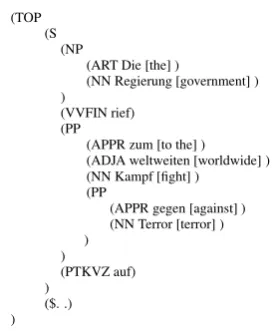
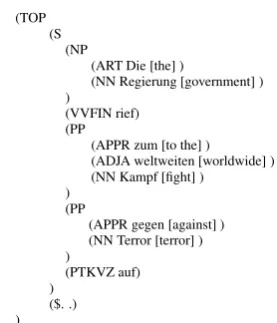
Figure 3 shows the gold tree for our example sen-tence (1). In the parser output the second PP was incorrectly attached to the sentence level (Figure 4) instead of being attached to the noun inside the PP.
(TOP (S
(NP
(ART Die [the] )
(NN Regierung [government] ) )
(VVFIN rief) (PP
(APPR zum [to the] ) (ADJA weltweiten [worldwide] ) (NN Kampf [fight] )
(PP
(APPR gegen [against] ) (NN Terror [terror] ) )
)
(PTKVZ auf) )
($. .) )
Die Regierung rief zum weltweiten Kampf gegen terror auf.
“The government called for a worldwide war against terror.”
Figure 3: Gold tree for example (1)
(TOP (S
(NP
(ART Die [the] )
(NN Regierung [government] ) )
(VVFIN rief) (PP
(APPR zum [to the] ) (ADJA weltweiten [worldwide] ) (NN Kampf [fight] )
) (PP
(APPR gegen [against] ) (NN Terror [terror] ) )
(PTKVZ auf) )
($. .) )
Die Regierung rief zum weltweiten Kampf gegen terror auf.
[image:4.595.94.233.103.265.2]“The government called for a worldwide war against terror.”
Figure 4: Parser output tree for example (1)
3.2 Leaf-Ancestor
LA (Sampson et al., 2003) measures the similarity between the path from each terminal node in the parser output tree to the root node and the corre-sponding path in the gold tree. The path consists of the sequence of node labels between the termi-nal node and the root node, and the similarity of two paths is calculated by using the Levenshtein distance (Levenshtein, 1966).
For each terminal node in the parser output the sequence of node labels between the terminal node and the root node is compared to the same path in the gold tree. This results in an evaluation result for string similarity for each terminal node. The score for the whole tree is the average of the values for all terminals in the tree. Figure 5 shows LA evalua-tion results for example (1). The numbers in the left column give the LA scores for each terminal node, which results in an average score of 0.963 for the whole sentence.
Phrase boundaries are taken into consideration, in order to distinguish between paths like the one for
zum([PP S TOP) and the one forweltweiten (PP S TOP) in Figure 5. The LA metric does this as fol-lows: for each terminal at the beginning of a phrase LA looks for the highest non-terminal node govern-ing the phrase which also starts with the terminal, and inserts a left boundary marker before the cate-gorial label of the non-terminal node, if the phrase starts with the terminal node. ForDie[the] the
high-1.000 Die NP S [ TOP : NP S [ TOP
1.000 Regierung NP ] S TOP : NP ] S TOP
1.000 rief S TOP : S TOP
1.000 zum [ PP S TOP : [ PP S TOP
1.000 weltweiten PP S TOP : PP S TOP
0.857 Kampf PP S TOP : PP ] S TOP
0.889 gegen [ PP PP S TOP : [ PP S TOP
0.889 Terror PP PP ] S TOP : PP ] S TOP
1.000 auf S ] TOP : S ] TOP
1.000 . TOP ] : TOP ]
[image:4.595.311.532.107.209.2]Sentence 1: avg. 0.963
Figure 5: LA result for example (1)
est non-terminal governing node is TOP. As the sentence starts withDie, a left boundary marker is inserted before the TOP node. For zum the high-est governing non-terminal node which starts with the wordzumis the PP, therefore the left boundary marker is inserted before the PP node.
Additionally, LA looks at each terminal node at the end of a phrase and inserts a right boundary marker after the label of the highest non-terminal node of the phrase ending with the terminal node. In the gold tree of our example the terminal node
Kampf[fight] is not the final node of the PP. Due to the PP attachment error in the parser output tree, on the other hand,Kampf[fight] is in a phrase-final po-sition, with the PP as the highest non-terminal node governing the terminal. Therefore a right boundary marker is inserted after the PP node in the path of the parser output, which results in a score of 0.889 for path similarity between gold tree and parser output.
The average result for the whole sentence is 0.963, while a perfect sentence would get a score of 1. If LA encounters a mismatch between the words in the gold tree and the parser output, it simply stops without returning a result for the whole sentence.
3.3 Dependency-Based Evaluation
The dependency-based evaluation used in the exper-iments follows the method of Lin (1998) and K¨ubler et al. (2002), converting the original treebank trees and the parser output into dependency relationships of the form WORD POS HEAD. Functional labels have been omitted for parsing, therefore the depen-dencies do not comprise functional information.
Die Regierung rief zum weltweiten Kampf gegen Terror auf
-
[image:5.595.84.479.127.187.2]
-“The government called for a worldwide war against terror.”
Figure 6: Dependency relations for example (1)
WORD POS HEAD triple format the dependency tree looks as follows (Table 2).
WORD POS HEAD
Die [the] ART Regierung
Regierung [government] NN rief
rief [called] VVFIN -zum [to the] APPRART rief
weltweiten [worldwide] ADJA Kampf
Kampf [fight] NN zum
gegen [against] APPR zum
Terror [terror] NN gegen
[image:5.595.62.280.280.382.2]auf [up] PTKVZ rief
Table 2: Gold dependency triples for example (1)
The PP attachment error in the parser output leads to an error in the dependency triples, incorrectly as-signing rief [called] as the head ofgegen [against] (Table 3), while in the gold triples the PPgegen Ter-ror[against terror] is a dependent of the preposition
zum[to the].
WORD POS HEAD
gegen [against] APPR rief
Table 3: Error in parser output dependency triples
For our example we get a precision and recall of 88.89 respectively. Following Lin (1998), our algo-rithm computes precision and recall:
• Precision: the percentage of dependency re-lationships in the parser output that are also found in the gold triples
• Recall: the percentage of dependency relation-ships in the gold triples that are also found in the parser output triples.
We assessed the quality of the automatic depen-dency conversion methodology by converting the 1024 original trees from each of our test sets into dependency relations, using the functional labels in
the original trees to determine the dependencies. We then removed all functional information from the trees and converted the stripped trees into depen-dencies, using heuristics to find the head. We eval-uated the dependencies for the stripped gold trees against the dependencies for the original gold trees including functional labels and obtained an f-score of 99.65% for TIGER and 99.13% for the T¨uBa-D/Z dependencies. This shows that the conversion is re-liable and not unduly biased to either the TIGER or T¨uBa-D/Z annotation schemes.
4 Experimental Setup
For the experiments we trained the PCFG parser BitPar (Schmid, 2004) on the TIGER treebank and the T¨uBa-D/Z. The training sets for each treebank contain 21067 sentences, while the test sets in-clude 1024 sentences each. To allow a meaningful comparison of parsing results we selected sentences comparable with regard to sentence length, syntac-tic structure and complexity from both treebanks for our test sets. This resulted in an average sentence length of 14.5 for the TIGER test set and of 14.7 for the T¨uBa-D/Z. Before extracting the grammars we inserted a virtual root node and resolved the cross-ing branches in the TIGER treebank by attachcross-ing the non-head child nodes higher up in the tree. After this preprocessing step we extracted an unlexicalised PCFG from each of our training sets. We parsed our test sets with the extracted grammars, using raw text as parser input.
5 Results
Table 4 shows the evaluation results for the differ-ent metrics.1 PARSEVAL shows higher results for
precision and recall for the T¨uBa-D/Z. For DB eval-uation the parser trained on the TIGER training set achieves about 7% higher results for precision and recall than the parser trained on the T¨uBa-D/Z. The LA results are much closer to each other, but also show better results for the TIGER parse trees.
[image:6.595.330.511.164.350.2]PARSEVAL Dependencies LA Prec Rec Prec Rec Avg. TIGER 81.21 81.04 85.78 85.79 0.9388 T¨uBa 87.24 83.77 78.63 78.61 0.9258
Table 4: Parsing results for three evaluation metrics
Comparing the f-score learning curves in the three metrics shows that for PARSEVAL the gap between TIGER and T¨uBa-D/Z is consistent throughout the whole training process. But while during the first stages of training the difference in results adds up to around 12%, the gap becomes smaller with more training data. When trained on 90-100% of the training data, the difference in f-scores decreases to around 5% (Figure 7).
0 20 40 60 80 100
60
65
70
75
80
85
90
PARSEVAL
percent training data
f−score
[image:6.595.72.305.201.259.2]TIGER TüBa−D/Z
Figure 7: F-score learning curves for TIGER and T¨uBa-D/Z (PARSEVAL)
The LA learning curve shows an advantage for T¨uBa-D/Z during the first stages of training. When training the parser on less than 20% of the training data, the T¨uBa-D/Z-trained grammar yields better results. Training the parser on more than 50% of the sentences in the training set reverses the picture:
while the f-score for T¨uBa-D-Z does not seem to im-prove further, the TIGER results clearly show an on-going learning effect (Figure 8).
0 20 40 60 80 100
86
88
90
92
94
Leaf−Ancestor
percent training data
f−score
TIGER TüBa−D/Z
Figure 8: F-score learning curves for TIGER and T¨uBa-D/Z (Leaf-Ancestor)
The learning curve for the dependency-based evaluation (Figure 9) shows a similar tendency. While the T¨uBa-D/Z yields better results when trained on a small amount of training data only, and from more than 20% of the training set onwards only shows a moderate increase, the f-score for TIGER improves faster and shows an advantage of more than 6% over the T¨uBa-D/Z f-score when trained on the whole training set.
The wide difference between the results raises the question, which of the metrics is the most adequate for judging parser quality. The next section ap-proaches this question by looking at the behaviour of the different metrics with regard to specific error types.
5.1 Part-of-Speech Errors
[image:6.595.92.270.434.620.2]0 20 40 60 80 100
0
20
40
60
80
Dependency−Based Evaluation
percent training data
f−score
[image:7.595.78.258.110.297.2]TIGER TüBa−D/Z
Figure 9: F-score learning curves for TIGER and T¨uBa-D/Z (Dependencies)
5.2 Missing Nodes / Additional Nodes
Parse trees achieving 100% precision and recall for DB evaluation, but not for the PARSEVAL and LA metric mostly lack a non-terminal node such as a proper name node enclosing an NP, a multi-token number for the TIGER treebank or theNachfeld (fi-nal field) for the T¨uBa-D/Z. This applies to 23 sen-tences in the TIGER test set and to 29 sensen-tences in the T¨uBa-D/Z test set. In the parser output of the parser trained on the TIGER treebank there are also sentences which show additional categorial nodes not present in the gold trees, such as prepositional phrases enclosing a pronominal adverb, adverbial phrases or adjectival phrases. Both the missing and the additional nodes do not translate into depen-dency errors as the dependencies for the trees can be extracted correctly. Nonetheless they lead to a significant decrease in precision and recall for the PARSEVAL scores and, to a lesser extent, also for the LA scores.
5.3 PP Attachment Errors
Parse trees with attachment errors often get rea-sonable results for the PARSEVAL metric but only show mediocre scores for DB evaluation. We demonstrate this for two sentences with PP attach-ment errors from the TIGER test set (Figure 1) and the T¨uBa-D/Z (Figure 2).
Figure 10: TIGER (dotted line: parser output)
Figure 11: T¨uBa-D/Z (dotted line: parser output)
In the gold trees one of the PPs is a child re-spectively grandchild of the other PP, while in the parser outputs both PPs are mis-attached to the same mother node (dotted lines). Table 5 shows the eval-uation results for the two sentences.
PARSEVAL Dependencies LA
Prec Rec Prec Rec Avg.
[image:7.595.310.517.111.221.2]TIGER 80.00 80.00 88.89 88.89 0.963 T¨uBa 92.31 85.71 88.89 88.89 0.935
Table 5: Parsing results for PP attachment error
[image:7.595.309.518.276.432.2]be-tween the PARSEVAL results for two comparable trees is caused by the higher ratio of nodes per words in the T¨uBa-D/Z annotation scheme. For the TIGER tree the parser is able to match 4 out of 5 brack-ets which yields a recall of 4/5 = 80%. For the T¨uBa-D/Z the parser correctly identifies 12 out of 14 brackets in the gold tree and therefore achieves a recall value of 12/14 = 92.31%. The dependency-based evaluation gives identical results for the two sentences, which is what linguistic intuition would ask for.
6 Conclusions
In this paper we rejected the claim that the German T¨uBa-D/Z is more appropriate for PCFG parsing than the TIGER treebank. We showed that the PAR-SEVAL metric cannot be used to compare parser output from parsers trained on different treebanks, because it favours annotation schemes with a high ratio of nodes per word. We have also shown that PARSEVAL results do not correlate with other eval-uation measures like the Leaf-Ancestor metric or a dependency-based evaluation, and that the results of a dependency-based evaluation best reflect the lin-guistic notion of a good parse.
References
Dipper, S., T. Brants, W. Lezius, O. Plaehn, and G. Smith. 2001. The TIGER Treebank.In Third Workshop on
Linguistically Interpreted Corpora LINC-2001,
Leu-ven, Belgium.
Brants, Sabine, and Silvia Hansen 2002. Developments in the TIGER Annotation Scheme and their Realiza-tion in the Corpus.In Proceedings of the Third Confer-ence on Language Resources and Evaluation (LREC 2002), pp. 1643-1649. Las Palmas, Canary Islands. Briscoe, E. J., J. A. Carroll, and A. Copestake. 2002.
Relational evaluation schemes. In Proceedings Work-shop ’Beyond Parseval - towards improved evaluation measures for parsing systems’, 3rd International
Con-ference on Language Resources and Evaluation, pp.
4-38. Las Palmas, Canary Islands.
Carroll, J., E. Briscoe and A. Sanfilippo. 1998. Parser evaluation: a survey and a new proposal. In Proceed-ings of the 1st International Conference on Language
Resources and Evaluation, Granada, Spain. 447-454.
Dipper, S., T. Brants, W. Lezius, O. Plaehn, and G. Smith. 2001. The TIGER Treebank.In Third Workshop on
Linguistically Interpreted Corpora LINC-2001,
Leu-ven, Belgium.
Drach, Erich. 1937. Grundgedanken der Deutschen Sat-zlehre.Frankfurt/M.
K¨ubler, Sandra, and Heike Telljohann. 2002. Towards a Dependency-Oriented Evaluation for Partial
Pars-ing. In Proceedings of Beyond PARSEVAL – Towards
Improved Evaluation Measures for Parsing Systems
(LREC 2002 Workshop), Las Palmas, Gran Canaria.
K¨ubler, Sandra. 2005. How Do Treebank Annotation Schemes Influence Parsing Results? Or How Not to Compare Apples And Oranges. In Proceedings of
RANLP 2005, Borovets, Bulgaria.
K¨ubler, Sandra, Erhard Hinrichs, and Wolfgang Maier. 2006. Is it Really that Difficult to Parse German?
In Proceedings of the 2006 Conference on Empirical
Methods in Natural Language Processing, EMNLP,
Sydney, Australia.
Levenshtein, V. I. 1966. Binary codes capable of correct-ing deletions, insertions, and reversals. Soviet Physics - Doklady, 10.707-10 (translation of Russian original published in 1965).
Lin, Dekang. 1998. Dependency-based Evaluation of MINIPAR. Workshop on the Evaluation of Parsing Systems, Granada, Spain.
Maier, Wolfgang. 2006. Annotation Schemes and their Influence on Parsing Results. In Proceedings of
the COLING/ACL 2006 Student Research Workshop),
Sydney, Australia.
Sampson, Geoffrey, and Anna Babarczy. 2003. A test of the leaf-ancestor metric for parse accuracy. Natural
Language Engineering, 9 (4):365-380.
Schmid, Helmut. 2004. Efficient Parsing of Highly Am-biguous Context-Free Grammars with Bit Vectors. In Proceedings of the 20th International Conference on
Computational Linguistics (COLING 2004), Geneva,
Switzerland.
Skut, Wojciech, Brigitte Krann, Thorsten Brants, and Hans Uszkoreit. 1997. An annotation scheme for free word order languages. In Proceedings of ANLP 1997, Washington, D.C.
Telljohann, Heike, Erhard W. Hinrichs, Sandra K¨ubler, and Heike Zinsmeister. 2005. Stylebook for the T¨ubingen Treebank of Written German
(T¨uBa-D/Z). Seminar f¨ur Sprachwissenschaft, Universit¨at
T¨ubingen, Germany.
Schiller, Anne, Simone Teufel, and Christine Thielen. 1995. Guidelines fr das Tagging deutscher
Textcor-pora mit STTS. Technical Report, IMS-CL, University