DOI:
BE
Sch
Abstra reason Despit where used t Such effecti respon concis PROT framew Keywo Niger with n soluti these game found know largel of thi way this demo anoth know appro social and s and displa econo from specia : http://dx.doEXTEND
EYOND T
ODUComputer S
Computin
IlishanCompu
hool of Com
Ilishan
act: In recent ye ns ranging from
te these, impact e there is no form to solve significa is common in A ively help overc nsible for this ov se feature and fu TÉGÉ II, SPEDE work that addres
ords: Expert Sys
I. ria and many native and indi ions to many special forms e hunters, warr d in rural an wledge is dom
ly, individuals, is specialized k
of documentin knowledge onstrations pa her. A few o wledge and pro
oach. However l unrest, mod earch for west economies, an aced people omies. As thes
their progen alized knowle oi.org/10.264
Internati
DING THE
THE FRO
ULAJA, GodwScience Depa
ng and Engin
Babcock Univ n Remo, Ogun
IDOWU Sun
uter Science
mputing and E
Babcock Univ n Remo, Ogun
ears, there had b m shortening KE
t of KE product malized way of k ant problems. W Africa, especial come this challe versight and fac unction based cl E, RLM, CRLM sses the isolated stems, Non-form . INTRO other nations igenous life-en ailments and of knowledge riors, farmers d remote are miciled. The p
, families and o knowledge and ng, storing, pr other than assed down f others at best
ocedures usin r, factors such ern civilizatio tern education nd the likes
(IDP), death e factors separ nitors who ar edge, this inev
483/ijarcs.v1
Volume
ional Journ
Avail
E REACH
ONTIERS
FUNCTIO
win Oluseyiartment, Sch
neering Scien
versity, State Nigeria nday A.Department
Engineering
versity, State Nigeriabeen many fram E product develo ts (Expert Syste keeping and exch When custodians
ly among native enge. This howe tor solution to th lassification and M, and PGM/CPG
problem. mal Sectors, Kno
ODUCTION around the w nriching skills, social ills. C include traditi and certain fa eas in whose problem howe organizations i d skills often la reserving, and
the oral an from one ge strife to pre ng manual pap h as economic n drive, natur in the more civ
often lead t or migration rate up-coming re the custod vitably results
1i1.6504
e 11, No. 1, Ja
al of Advan
RESEAR
lable Onlin
H OF KNO
OF FORM
ON BASE
hool of
nces
t,
Sciences
meworks on imp opment time, pe ems (ES) and K hanging their spe
of such speciali e farmers, hunte ever requires a his problem into d review of eight GM) in common
owledge Enginee
world are rife cultures and ustodians of ional healers, amilies often
lineage the ever is that in possession
ack a formal d exchanging nd practical
eneration to eserve these per and pen c instability, ral disasters, vilized cities to internally
n to better g generations dians of the
s in loss of
anuary-Feb
nced Resea
RCH PAPER
ne at www.i
OWLEDG
MAL SEC
ED CLASS
C
roving Knowled erformance impr Knowledge Based ecialized knowle zed knowledge ers and healers.better understan o subsequent des t prominent KE n use in recent y
ering, Specialize
some o especia Howev of Art develop System to abat special human human Applic (autono agricul These p many c and the good [3 cited a problem buildin KE h organiz
bruary 2020
rch in Com
R
ijarcs.info
GE ENGIN
CTORS US
SIFICATI
AWComputer Sc
Computing
B Ilishan R Co Natio Ilis dge Engineering rovement, to addd Systems (KBS edge. Here, heur die, their untapp . Extending the nding of existin sign of a KE fra frameworks and years and conse
d Knowledge, D
or all of this kn ally when such
ver, Knowledge tificial Intelli pment of Expe ms (KBS) as a te this trend. K lly designed an
expert, as a s expert in e ation sector omous cars) [ ltural, social m
products have critical and lif eir reach can 3]. Poor adopt as one major ms in Africa ng KE product has not been zations and thi
0
puter Scien
NEERING
SING A FE
ION
WODELE, O
ience Depar
g and Engine
Babcock Unive Remo, Ogun S
NWAOCHA omputer Scien onal Open Uni han Remo, Og
g (KE). These fr dressing knowle S)) has not been ristics and implic ped problem solv reach of KE p ng KE framewor
amework. To thi d models (Comm equently recomm
Domain Knowled
knowledge with h knowledge cu
e Engineering igence that f ert Systems (ES
technological KE products a nd developed t substitute or in executing his rs include [2], security, media, aerospac
benefitted man fe crucial spec
be extended t tion of technolo r cause of f a [4]. Althou
s are many an n duly felt is calls for urg
nce
ISSN No. 09
G PRACTI
EATURE
Oludelertment, Scho
eering Scienc
ersity, State NigeriaA, Vivian O. ce Department iversity of Nige gun State Niger
rameworks had edge acquisition n felt in non-for cit tacit knowled ving skills perish ractice to these rks in a bid to is end, this pape monKADS, MIK mends developm
dge Custodian
h appalling con ustodians die.
(KE) which is focuses on d S) and Knowle intervention c are software a to carry out th n the least, to s cognitive pro health, tran commerce and e and the Intern
n in the forma cialist fields fo to non-formal
ogy for instanc food (cocoa)
ugh methodo nd proliferated in several n gent attention [
976-5697
ICE
AND
ool of
ces
t, eria ria emerged for n challenges. rmal sectors dge are often h with them. sectors can isolate gaps er provides a KE, MOKA, ment of a KEnsequences
s a subfield design and
edge Based can be used applications he role of a support the owess [1]. nsportation d industry, rnet.
al sectors in or decades, sectors for ce had been production ologies for
trend perpetuates, important domain and specialized knowledge continue to escape being captured and harnessed for the benefit of mankind escape with. This is especially true when the custodians of such knowledge die. In a bid to appropriately remedy this problem, this study is poised at first establishing factors responsible for this problem and then recommend appropriate solution.
II. REVIEW OF LITERATURE
In literature, many problems had been cited as challenges facing KE. These include poorly managed knowledge base, products with integrity issues [6], inconsistent query processing techniques and lack of consistent data organization and exchange processes [7]; products that failed to meet changing user requirements specifications as new technologies (such as mobile and ubiquitous computing) emerge. Smith [8] emphasized the need to address knowledge elicitation problems in order to avoid deadlock. Paucity of and lack of cooperation from domain knowledge experts and providers [9]; [10]. These people admittedly are few and on high demand. This led to challenges with populating and effectively managing the knowledge base of KE products.
Ubiquitous Computing - In recent years, demands for KE products that satisfactorily meet users’ needs at their comfort zoneand time are on increase. This can be below expectation given the power and ubiquity of internet technology and level of proliferation of models, frameworks and products of KE circulating around the world Failure to factor emerging technologies into design and implementation of KE products (intelligent systems) is directly responsible for this.
Sector Oversight - Individual and private sectors without a formalized way of keeping and exchanging knowledge suffer. Many such ones use heuristics and tacit knowledge to solve important problems, sometimes without following any sequential procedure [4]. When such solution providers as these die, their untapped problem solving skill perishes with them and remains inaccessible to the world. Such is common in Africa, especially among native farmers, hunters and traditional healers.
In-appropriate Tools and Technology - Prolonged attachment to outdated development tools and techniques [7] has resulted in interface usability challenges [4] and other design issues which in turn had resulted in low intake of technological innovations, imprecise and poor knowledge transfer processes, inadequate extension and advisory services and other negative, diverse and sector-dependent implications. Hence the need for improved method of developing KE applications that captures the needs of formal and non-formal sectors alike [6].
III. RELATED WORKS
Atanasov and Krupka [12] in an ES design called Modern Expert System Architecture, added new functional features such as interactive module, coordination module, rule editor and knowledge editor intended to improve ES design and performance further. They also tried to separate
knowledge acquisition (gaining knowledge) from the core ES shell.
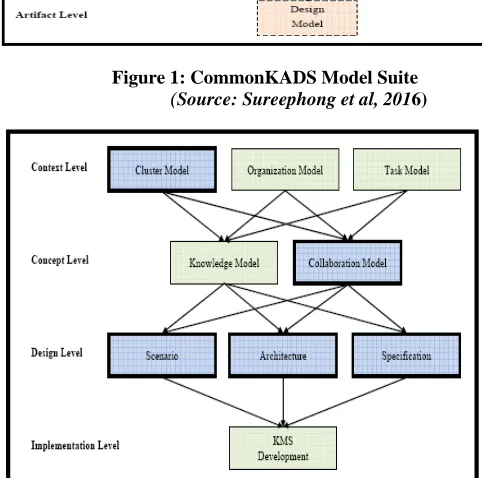
As a reference point, in the industry cluster, the unresolved issues of CommonKADS had, in some cases in practice called for replacement of these models (with cluster model, collaboration models and combined scenario,
[image:2.612.321.571.189.282.2]architecture and specification models, respectively, (compare fig. 1 and 2) because of lack of concrete definition in its design model. This lack could cause the knowledge engineer to misinform the system developer [5].
Figure 1: CommonKADS Model Suite
(Source: Sureephong et al, 2016)
Figure 2: Proposed Methodology for Developing KMS for the Industry Cluster
(Source: Sureephong et al, 2016)
[image:2.612.322.563.261.500.2]Atanasova and Krupka [12 in their Modern Expert System Architecture reflected the presence of new elements such as interactive module, coordination module, rule editor and knowledge editor in design of modern ES.
Saket, Akankasha and Vikas in [14] explored the structure and role of expert system in agriculture and gave an overview of feasibilities of designing, developing and implementation of expert systems for agriculture. Their objective is to motivate scientists and extension workers to peer into possibilities of developing applications for the benefit of entire global agricultural community. The work however lacks specific implementation framework that factors emerging technologies into ES design.
Diana-Aderina in [15] specified that expert system components have gone beyond consisting of just the traditional three components: inference engine, user interface and knowledge base and there is the need to acknowledge this design of modern ES. This opinion supports the work of Turban, Sharda and Delen, (2011) who added the workspace, the application module and the knowledge refinement module to the structure of expert system (Turban, Sharda and Delen, 2011) as distinct and prominent features of the knowledge acquisition subsystem.
Wiliyanto, [16] in a study conducted by Dian Atnantomi Wiliyanto to determine the effectiveness of web based expert systems application in identifying and intervening the lives of children with special needs, he found that use of expert system is effective in identifying and intervening to help children with special needs in inclusive schools. She recorded 52% result accuracy.
Santosa, Romla and Herawati, in[17]used Fuzzy Mamdani, Santosa, Romla and Herawati to develop an expert system to detect and care for cataract eye disease based on the symptoms identified. From a sample of 50 cases, the software had 78% prediction accuracy compared with that of human experts.
Shodhganga [6] compared several ES development models applicable in Agric and came up with a web based model. He pointed out that ES is an expertise driven research area where researchers have many times used multi methodologies approach to develop ES.
Significantly, these studies neither address the need to extend KE to non-formal sectors, nor establish why the oversight had been sustained. Hence, the need for a feature and function based classification and analysis of prominent KE methodologies in recent years.
IV. A FEATURES AND FUNCTION BASED CLASSIFICATION OF KNOWLEDGE ENGINEERING FRAMEWORKS AND PROBLEM SOLVING METHODS (PMS) Table 1 gives a feature and function based characterization and classification of some prominent selected knowledge engineering methods developed in the past few decades. This was carried out to determine what existing gaps need to be filled in order to address this peculiar application oversight challenge. Factors considered are: the basic underlying assumption(s), principles or
strength of the methodology; its application domain or scope; object orientation capability; implementation complexity; integration of knowledge elicitation and acquisition facilities and; identified gaps or weak points in literature if there is any.
A. CommonKADS / KADS – II
This is the European de facto standard for knowledge analysis and development of knowledge intensive systems. It is strongly model based, equipped with powerful modeling reusable templates for knowledge management, analysis and application development. Its six models –
organizational model, task model, agent model, knowledge (or expertise) model, communication model and design model capture specifics of the KBS to be built as well as its proposed organizational operating environments. While the
expertise and design models focus on describing functional and non-functional aspects of the KBS under construction, the other four models focus on modeling the organization where the KBS will be used and the tasks carried out within the organization.
Although, this model has been acknowledged as the industry standard, it can however be argued that CommonKADS was developed for well defined formalized “hard” domains whereas the industry is a “semi-soft” domain. This implies that necessary modifications to match organizational context and environment are required. In CommonKADS for instance, the Agent model specifies what task is carried by particular agent, what other agents are involved in executing a task, qualification of each agent, list of tasks for each agent and knowledge items possessed by each agent. This is not well defined in industry context though because this concept is based on the assumption that communication in the industry context is intra and horizontal such that tasks assignments to agents are internal and stereotyped. Reality however dictates otherwise. There is industrial interdependence of knowledge and resources and knowledge communication must be both intra and inter, vertical and horizontal (a shoe and leather bag factory for example depends on and must communicate with hide and skin processing industry) to achieve production objectives. This weakness of the agent model by extension directly and adversely affects the communication model whose role it is to model knowledge exchange between agents for the industry. By the same token, the design model is adversely affected. Therefore, this model require modification so as to make expected output clear and unambiguous (Sureephong, 2016; Sandberg, 96).
B. MIKE
Model-based and Incremental Knowledge Engineering, MIKE is a model based problem solving method (PSM) that strongly relies on KARL (a formal operational knowledge specification language) for post analysis knowledge acquisition and test-running and on DesignKARL language for design implementation. Its five cyclic phases are:
expertise model and involvement of the expert in the validation process via prototyping possible.
MIKE uses structured interviews to acquire expert knowledge and stores these in natural language in the informal so called knowledge protocols. Structuring and formalization phases transform this to the KARL model with all functional requirements. Non-functional requirements are added at the iterative design phase to generate the design model. The language DesignKARL enhances KARL features with ability to describe data types and algorithms as well as possession of features needed to structure KARL model further. It also made description of design process and associated decision making operations possible. This culminates in the implementation phase which is done on target hardware and operating system.
However, MIKE as shown is limited in application scope to modeling KBS under development as it does not scale well to capture all that it takes to embed KBS into big business environment. It requires extended models that can capture different views of the business environment.
C. Other Models
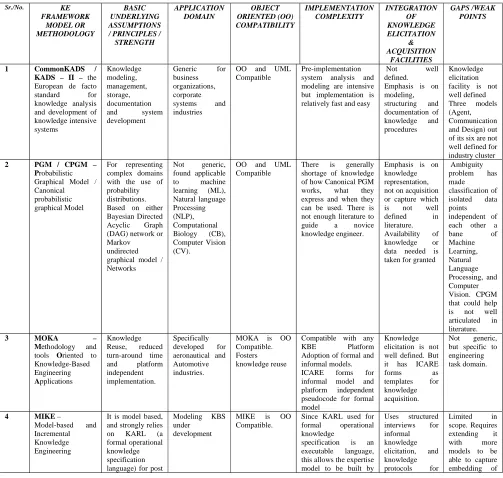
PROTÉGÉ II, MOKA, PGM/CPGM, SPEDE, Role Limiting Methods (RLM) and Constrained Role Limiting Methods (CRLM) are some other PSMs developed for KBS development over the past few decades other than CommonKADS and MIKE. Table 1 gives a feature and function based classification of eight prominent knowledge engineering methodologies developed in the past few decades.
Table 1: Features and Function Based Classification of Some Prominent Knowledge Engineering Approaches
Sr./No. KE
FRAMEWORK MODEL OR METHODOLOGY
BASIC UNDERLYING ASSUMPTIONS / PRINCIPLES / STRENGTH
APPLICATION DOMAIN
OBJECT ORIENTED (OO) COMPATIBILITY
IMPLEMENTATION COMPLEXITY
INTEGRATION OF KNOWLEDGE ELICITATION
& ACQUISITION
FACILITIES
GAPS /WEAK POINTS
1 CommonKADS / KADS – II – the European de facto standard for knowledge analysis and development of knowledge intensive systems
Knowledge modeling, management, storage, documentation
and system development
Generic for business
organizations, corporate
systems and industries
OO and UML Compatible
Pre-implementation system analysis and modeling are intensive but implementation is relatively fast and easy
Not well
defined.
Emphasis is on modeling, structuring and documentation of knowledge and procedures
Knowledge elicitation facility is not well defined Three models (Agent, Communication and Design) out of its six are not well defined for industry cluster 2 PGM / CPGM –
Probabilistic Graphical Model / Canonical
probabilistic graphical Model
For representing complex domains with the use of probability distributions. Based on either Bayesian Directed Acyclic Graph (DAG) network or Markov undirected graphical model / Networks
Not generic, found applicable to machine learning (ML), Natural language Processing (NLP), Computational Biology (CB), Computer Vision (CV).
OO and UML Compatible
There is generally shortage of knowledge of how Canonical PGM works, what they express and when they can be used. There is not enough literature to guide a novice knowledge engineer.
Emphasis is on knowledge representation, not on acquisition or capture which is not well defined in literature.
Availability of knowledge or data needed is taken for granted
Ambiguity problem has made
classification of isolated data points
independent of each other a bane of Machine
Learning, Natural Language Processing, and Computer Vision. CPGM that could help is not well articulated in literature.
3 MOKA –
Methodology and
tools Oriented to
Knowledge-Based Engineering Applications
Knowledge Reuse, reduced turn-around time and platform independent
implementation.
Specifically developed for aeronautical and Automotive industries.
MOKA is OO Compatible. Fosters knowledge reuse
Compatible with any KBE Platform Adoption of formal and informal models. ICARE forms for informal model and platform independent pseudocode for formal model
Knowledge elicitation is not well defined. But it has ICARE forms as templates for knowledge
acquisition.
Not generic, but specific to engineering task domain.
4 MIKE –
Model-based and Incremental
Knowledge Engineering
It is model based, and strongly relies on KARL (a formal operational knowledge specification language) for post
Modeling KBS under
development
MIKE is OO Compatible.
Since KARL used for formal operational knowledge
specification is an executable language, this allows the expertise model to be built by
Uses structured interviews for informal
knowledge elicitation, and knowledge
protocols for
[image:4.612.55.558.262.740.2]analysis phase and DesignKARL language for design
implementation phase.
Tried to leverage on
CommonKADS by supporting prototyping and incremental reversible system development.
explorative
prototyping. Ditto to Design Model which is iteratively refined and run using DesignKARL until satisfactory.
storing knowledge
expressed in natural language
KBS into business
environment to capture different enterprise views. Since KARL (an interpreted language ) cannot be used to specify real time problems, this limits scope of MIKE too.
5 PROTÉGÉ-II – A suite of tools (MAITR & DASH) that automate building knowledge acquisition tool given abstract models (domain ontologies) of the proposed system
Rapid
Development of KBS using special tools. MAITRE tools helps builders create and build domain specific
ontologies of target application. DASH tools automatically
build a knowledge acquisition
shell/tool into which domain specific
knowledge is entered by the knowledge engineer.
Building Intelligent systems, Knowledge Based Systems, Knowledge Engineering applications
PROTÉGÉ II is OO Compatible and promotes reuse of components and procedures
Given that the domain ontologies (content knowledge) are available, the suite of tools (MAITRE, DASH etc) automate building required application
Elicitation of domain
knowledge is not captured in its design.
The domain dependent knowledge (ontologies) has to be sourced and keyed into the knowledge acquisition tool built by PROTÉGÉ II by the knowledge
engineer. Still undergoing design improvements & requires large projects to fulfill its goal.
6 SPEDE -Developed by Rolce-Royce with consultation support from Epistemics
Developed for use in knowledge management to help businesses capture validate and communicate vital information.
Medium to Large
Commercial Business Domain
SPEDE is OO compatible.
Implementation made easy with the 10 tools embedded in PCPACK5.
The series of review meeting of knowledge engineers and management (tagged gates) aids in a spiral implementation.
Knowledge elicitation from domain experts remains a major challenge. There are series of knowledge
modeling and classification templates however.
Not generic. Difficult to implement in non formal / non-business knowledge domains where knowledge elicitation and validation from the domain experts must precede
electronic data capture.
Process not being
autonomous, knowledge engineer(s) spend much time to key domain knowledge. 7 Role Limiting
Methods (RLM) e.g. SALT (a Propose-and-Revise PSM) – a shell approach Problem Solving Method (PSM) that fosters reusable problem solving methods.
Uses role limiting shells and predefined
structured
graphical user interfaces to guide and ease knowledge
engineers’ task of populating knowledge base during knowledge acquisition phase.
Applicable to specific types of problem for which the shell is appropriate.
RLM is OO compatible
For efficiency, there is need for mapping tasks types to corresponding RLM – a difficult-to-meet requirement.
Its fixed structure (shell) does not sit well with problems requiring application of several problem solving methods
Knowledge elicitation is not well defined, has inflexible shell-based knowledge entry graphical user interfaces given that the knowledge is available.
8 CRLM – Configurable RLM. An approach to add flexibility to RLM by allowing for several PSMs (such as Heuristic Classification and Set-Covering Classification) to run within the same
shell via reconfiguration of the shell.
Decomposition of Shell’s complex PSM into several subtasks each of which several solution methods are allowed and applied
Applicable to wider range of problems for which the shell is appropriate with overheads.
CRLM is OO compatible
Configuring and re-configuring the CRLM burdens the system developer each time.
Knowledge elicitation is not well defined, it has inflexible shell-based
knowledge entry graphical user interfaces given that the knowledge is available.
Every CRLM has a fixed scheme of knowledge
types and predefined
communication paths. Configuring the CRLM burdens the system developer each time.
V. RESULTS AND DISCUSSIONS Findings show that despite the presence of knowledge modeling, management, storage, documentation and refinement features present in almost all these analyzed KE approaches, 87.5% of them did not have well defined features for knowledge elicitation. Building knowledge modeling, management, storage, documentation and refinement templates should be preceded with knowledge elicitation since only available knowledge can be managed, modeled or refined. Thus Knowledge acquisition problem, which is not just about modeling, management, storage, documentation and refinement of knowledge but importantly includes knowledge elicitation which had largely been overlooked in literature, had predominantly been responsible for poor impact and performance of KE products in informal sectors. It is imperative to devise an effective means of eliciting knowledge from all in the knowledge domain, be it formal sectors (whose domain knowledge might be already well structured, in electronic and easily convertible form) or non formal sectors (whose knowledge exists in unstructured, non electronic, hand-written, and sometimes oral form). This might require tact, patience, motivation and strong persuasiveness (convincing skill) on the part of the Knowledge Engineer in order to convince them and gain their cooperation. It is therefore recommended that KE frameworks that factor knowledge elicitation, (not just knowledge acquisition models and refinements) into design of KE product and development be developed and adopted for KE product development and practice.
VI. CONCLUSION
This study identified knowledge acquisition (knowledge elicitation to be precise) bottlenecks as the major factor responsible for lack of significant impact of KE practice in informal sectors around the world but especially in Africa. It also discovered that while there had been numerous knowledge acquisition features in almost all existing KE frameworks and methodologies, emphasis had been on knowledge refinements and modeling, and structuring knowledge capture templates while knowledge elicitation receives little attention. Other problems emanating from this include poor KE product design and performance validation. Since knowledge elicitation must precede knowledge capture, acquisition onto electronic templates and refinements, this should receive adequate and immediate attention. Extending the reach of KE to non formal sectors therefore require factoring knowledge elicitation into the design of KE products. This study therefore recommends design and development of a framework in KE that factors knowledge elicitation from all necessary sectors, formal or
non formal into its design. This will enable Knowledge Engineers to salvage and prevent important but inherently tacit and heuristic knowledge domiciled with individuals such as farmers, hunters and traditional healers found in non formal sectors in African and some other remote places in the world from perishing with custodians of this specialized knowledge when they die. It will also help solve the associated problems of KE product design and performance validation.
VII. REFERENCES
[1]M. Rouse, and M. Haughn, (2017) Definition of Knowledge
Engineering. Retrieved from https://searchenterpriseai.techtarget.com/definition/knowledge
-engineering
[2]Gibbs, S.,l (2016). Autonomous Cars – Who is building them
and How. Retrieved from
https://www.theguardian.com/technology/2016/may/26/self-driving-cars-whos-building-them-and-how-do-they-work [3]S. Rudi, V.R. Benjamins, and F. Dieter (2017). Knowledge
Engineering: Principles and Methods. Retrieved from https://www.researchgate.net/profile
[4]J. Anga, (2014) Production of cocoa beans, Quarterly Bulletin of Cocoa Statistics, London, 2006, XXXI, XXXIX (2013), XL (2014).
[5]P. Sureephong, N. Chakpitak, Y. Ouzroute, G. Neubert and A. Bouras (2016) Knowledge Engineering Techniques for Cluster Development. Retrieved from https://www.researchgate.net publication › 301872111_Knowledge_Engin...
[6]M. Shodhganga (2018). Agricultural Expert System. Retrieved from
http://shodhganga.inflibnet.ac.in/bitstream/10603/71534/10/1 0_chapter%203.pdf
[7]M. Kantureeva, A. Zakirova, T. Mannapova, M. Mussaif, and K. Nigmetov (2014). The Methodology of Expert Systems. 14(2).
[8]S. Smith, Expert System Architecture Block Diagram (2016) Retrieved from
https://www.google.com/search?q=expert+system+architecture+bl ock+diagram
[9]S. Osindero, Y.W. Teh, (2006). A fast Learning Algorithm for Fast Learning Nets (PDF). Neural Computations 18(7), 1527–1554.
[10]S.I. Ele, E.E. Umoh, and W.A. Adesola, (2014). An Overview of the Development, Principles, Stages and Building Blocks of Expert System. West African Journal of Industrial & Academic Research 2(1)
[12]I. Atanasova, & J. Krupka (2013). Architecture and Design of Expert System for Quality of Life Evaluation. Informatica Economicã , 17(3), 28-35.
[13]F. Shervan, T. Hadi and J. Shahram (2013) Design and Development of an Expert System to Help Head of University Departments in International Journal of Science and Modern Engineering (IJISME) 1(2), 45 – 48.
[14]M.A. Saket, and D. Vikas (2014). Expert Systems In Agriculture: An Overview; International Journal of Science Technology & Engineering. 1(5).
[15]M. Diana-Aderina, & A. Mihai-Constantin. (2015) Architectural Model of Expert Systems. International
Symposium Engineering and Competitiveness (EMC 2015).
Retrieved from https://www.researchgate.net/publication/281268197_ARCHI
TECTURAL_MODEL_OF_EXPERT_SYSTEMS
[16]D.A. Wiliyanto (2017). The use of Web based expert system application for identification and intervention of children with special needs in inclusive schools. journal.uad.ac.id › Home › 11(4)
[17]Santosa, Romla and Herawati, (2018) Expert System Diagnosis of Cataract Eyes Using Fuzzy Mamdani Method. Journal of Physics: Conference Series, 953(1).