Original Research Article
A study on maternal and perinatal outcome in premature rupture of
membranes at term
Sailaja Surayapalem, Vijayalakshmi Cooly*, Bhuvaneswari Salicheemala
INTRODUCTION
Rupture of foetal membranes occurs during active phase of normal labour. Early rupture of membranes may jeopardize the pregnancy contributing to significant maternal and perinatal morbidity. However, the risk is associated with multiple factors like duration of
pregnancy and time of rupture of membranes.1 Most of
the studies indicate the incidence of premature rupture of membranes is around 5-10%.2 Management of cases of
PROM still remains as one of the most difficult and controversial problems in obstetrics. Premature rupture of membranes is defined as rupture of foetal membranes before the onset of labour.
ABSTRACT
Background: Premature rupture of membranes is defined as rupture of foetal membranes before the onset of labour. Management of cases of PROM still remains as one of the most difficult and controversial problems in obstetrics. PROM can cause maternal complications like chorioamnionitis, increased operative procedures, puerperal sepsis and neonatal morbidity and mortality. The present study is undertaken to study the labour outcome, maternal morbidity and perinatal morbidity and mortality in term PROM.
Methods: 200 Cases of spontaneous rupture of membranes with gestational age >37 weeks with confirmed PROM by a speculum examination were selected. A detailed history was taken, and gestational age confirmed, general, systemic and obstetric examinations were done. Parameters of maternal and foetal well being were recorded. All study groups received prophylactic antibiotics. Single pelvic examination done, and maternal vitals recorded fourth hourly. All the data was analyzed and statistical significance was calculated using Chi-square test.
Results: PROM was common in age group of 20-24 years (35%) with mean age of 22.6 years and SD of 2.8 years, and common in primigravida. Majority of women were admitted within six hours of PROM (41.5%) and Mean duration of induction to delivery interval was 12.9 hours. The mean duration between PROM to delivery was 20.2 hours which was statistically significant. Cesarean sections were more among primigravidas. Failure to progress was the common indication. Maternal morbidity was significant (17.5%). No maternal mortality in the study. Perinatal mortality was 1.5%. Birth asphyxia was the commonest cause. Perinatal morbidity was seen in 26%. Escherichia coli was common organism found in cervical swab culture.
Conclusions: In present study, majority was primigravidas and the most common age group was 20-24 years belonging to low socioeconomic status. Maternal morbidity and neonatal morbidity was associated with increased duration of PROM to delivery and infection of the female genital tract with pathogens. Hence an appropriate and accurate diagnosis of PROM is essential for favorable outcome in pregnancy.
Keywords: Birth asphyxia, Maternal mortality, Perinatal mortality, PROM
Department of Obstetrics and Gynecology, Narayana Medical College, Nellore, Andhra Pradesh, India
Received: 16 September 2017
Accepted: 16 October 2017
*Correspondence:
Dr.Vijayalakshmi Cooly, E-mail: [email protected]
Copyright: © the author(s), publisher and licensee Medip Academy. This is an open-access article distributed under the terms of the Creative Commons Attribution Non-Commercial License, which permits unrestricted non-commercial use, distribution, and reproduction in any medium, provided the original work is properly cited.
Preterm premature rupture of membranes is defined when rupture of membranes occurs before 37 weeks of gestation. Some of the studies conducted earlier describes that PPROM near term with expeditious delivery of on infected and on asphyxiated infants is associated with a low risk of severe foetal and maternal morbidity.3
In some of the Indian studies, the incidence of PROM is reported as 7-12% in all labours.4,5 Cases of PROM are
prone to cord compression/ cord prolapse and are associated with high risk of ascending infection. Lengthier the time interval between rupture of membranes and onset of labour more the risk of ascending infection and acquiring chorioamnionitis.6
PROM is associated with increased risk of
chorioamnionitis, unfavorable cervix and dysfunctional labour, increased cesarean rates, postpartum hemorrhage and endometritis in the mother.
Most of the studies mentioned possible neonatal outcomes in cases of PROM may include respiratory distress syndrome, hypothermia, hypoglycemia, intraventricular hemorrhage, broncho pulmonary dysplasia etc. PROM is associated with 20% of neonatal deaths. Hence PROM is an obstetric condition which is poorly defined with an obscure etiology and associated with significant maternal morbidity and mortality.7 Hence
the present study was conducted to analyze the maternal and perinatal outcomes in premature rupture of membranes at term.
METHODS
A prospective cross sectional study was conducted at Narayana General Hospital for a period of two years by Department of Obstetrics and Gynecology from November 2014 to October 2016.All the patients attending the outpatient department and emergency were enrolled as cases in the study. Cases were selected by random sampling technique. All the data collected was entered in a Microsoft excel spread sheet and checked for corrections. Statistical analysis was done by using SPSS software version 10.
Inclusion criteria
• Gestational age of >37 weeks confirmed by clinical examination, dates and ultrasound examination.
• Confirmation of PROM by Direct visualization or Fern test.
• Cervical dilatation of <3 cms.
• Single live pregnancy with vertex presentation.
• Lack of uterine contractions for at least 1 hour from PROM.
Exclusion criteria
• Cases with >37 weeks of gestation, previous history of LSCA, complications like contracted pelvis, cephalopelvic disproportion, multiple pregnancy.
A detailed menstrual and obstetric history of the case was noted in a separate questionnaire sheet by interviewing. Detailed clinical obstetric examination was done and history of the signs and symptoms were noted which include time of onset of draining, amount of fluid lost, its color, odor, association with pain or bleeding per vagina and perception of fetal movements. General examination and systemic examination was done as per the protocol.
A sterile speculum examination was done and condition of the vagina and cervix was noted. Liquor was collected and subjected for litmus paper test and fern test. Cervical swab was taken and sent for gram stain and culture and sensitivity. Bishop’s score was noted by pelvic examination and based on the score labour was induced with prostaglandins and time of induction was noted. Induction to delivery interval and PROM to delivery interval was noted.
Immediately after delivery, APGAR score of the newborn was noted at 1 and 5 minutes interval any other associated complications and findings were noted. Neonatal morbidity and mortality was noted. Maternal complications any were watched during the puerperal period and followed until discharge from the hospital.
RESULTS
[image:2.595.313.544.489.692.2]The present study was conducted on 200 cases of PROM who attended the Department of Gynecology and emergency of Narayana General Hospital, a tertiary care hospital in south India. All the cases which included in the study were fulfilling the inclusion criteria.
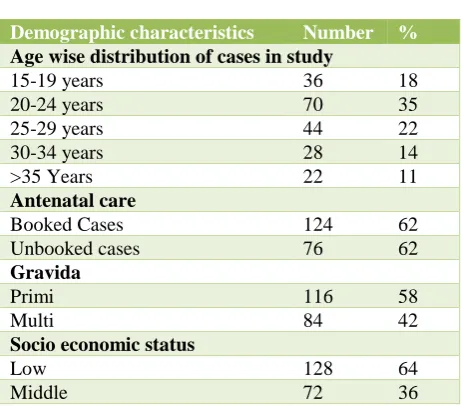
Table 1: Demographic characters of cases in the study.
Demographic characteristics Number %
Age wise distribution of cases in study
15-19 years 36 18
20-24 years 70 35
25-29 years 44 22
30-34 years 28 14
>35 Years 22 11
Antenatal care
Booked Cases 124 62
Unbooked cases 76 62
Gravida
Primi 116 58
Multi 84 42
Socio economic status
Low 128 64
Middle 72 36
minimum were 18 years. The mean age was 22.6 years with standard deviation of 2.8 years. 124 (62%) were booked cases, 116 (58%) were of primigravidas and 128 (64%) of cases were of low socio economic status in the study and were statistically significant (p value <0.001) (Table 1).
Table 2: Bishop's score at time of admission.
Bishop's score Primi Multi
No. % No. %
0-2 12 10.34 0 0
3-4 74 63.8 38 45.24
5-6 30 25.86 46 54.76
Total 116 84
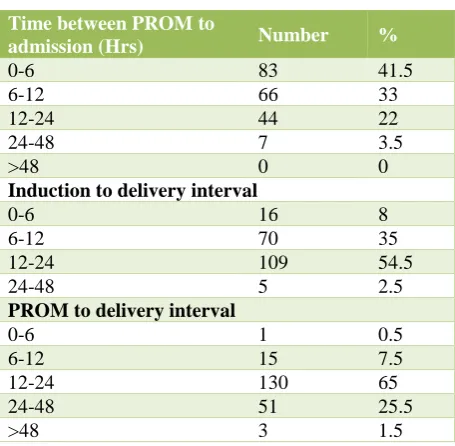
63.8% of cases in primigravidas had bishop’s score in range of 3-4, whereas 54.76% of cases in multigravidas had range of 5-6 (Table 2). 41.5% of cases were admitted within 6 hours of PROM and 33% within 6-12 hours, 22% within 12-24 hours and 3.5% within 24-48 hours. None of the cases were admitted after 48 hours. The earliest admission was within 30 minutes and maximum time was 36 hours. Maximum number of cases delivered within 24-48 hours (54.5%) in both primi and multigravidas and 35% of cases within 6-12 hours. Highest duration of delivery interval was 28 hours and least was 2 hours. Mean duration of induction to delivery interval was 12.9 hours which was statistically significant (p value< 0.001). Maximum number of cases delivered within 12-24 hours (65%) in both primi and multigravidas followed by 25.5% within 24-48 hours and only 1.5% of cases after 48 hours. The mean duration between PROM to delivery was 20.2 hours which was statistically significant (Table 3).
Table 3: Time related changes in cases of the study.
Time between PROM to
admission (Hrs) Number %
0-6 83 41.5
6-12 66 33
12-24 44 22
24-48 7 3.5
>48 0 0
Induction to delivery interval
0-6 16 8
6-12 70 35
12-24 109 54.5
24-48 5 2.5
PROM to delivery interval
0-6 1 0.5
6-12 15 7.5
12-24 130 65
24-48 51 25.5
>48 3 1.5
In present study, it is observed that 70% of cases had normal vaginal delivery, 2.5% of cases had instrumental
[image:3.595.312.547.316.447.2]delivery and 27.5% of cases had LSCS. Vaginal delivery was more in multigravidas (71.43%) when compared to primigravidas (68.97%) and LSCS was more in primigravidas (28.45%) when compared to multigravidas (26.19%) (Table 4).
Table 4: Outcome of labour in primi and multigravida.
Gravida
Vaginal delivery
Forceps delivery
LSCS
No % No % No %
Primi 80 68.97 3 2.59 33 28.45
Multi 60 71.43 2 2.38 22 26.19
Failure to progress was the most common indication for LSCS observed in both primi and multigravidas (45.45%) followed by foetal distress (32.73%) and intrapartum sepsis was the least common indication (1.82%) (Figure 1).
Figure 1: Indication for LSCS.
The rate of maternal morbidity was 17.5%, febrile morbidity accounting to maximum with 8% followed by wound infection 2.5% and others were LRTI (2%) UTI, PPH, MRP and puerperal sepsis (each 1%).
Table 5: Maternal and perinatal morbidity.
Maternal morbidity Number %
Febrile morbidity 16 8
Wound infection 5 2.5
LRTI 4 2
UTI 2 1
PPH 2 1
MRP 2 1
Puerperal sepsis 2 1
Perinatal morbidity
Birth asphyxia 28 14
Septicemia 8 4
Umbilical cord sepsis 4 2
Conjunctivitis 1 0.5
LRTI 2 1
Convulsions 6 3
Meconium aspiration syndrome 1 0.5
Malformations 2 1
25
18
11
1 45.45%
32.73%
20%
1.82%
Failure to progress
Fetal distress DTA Intrapartum
[image:3.595.54.282.506.729.2] [image:3.595.314.543.562.769.2]No maternal mortality was recorded in present study. The rate of perinatal morbidity was 26% with birth asphyxia contributing the maximum cause with 14% and other less common were septicemia (4%), convulsions (3%), umbilical cord sepsis (2%), LRTI (1%), malformations (1%) and MAS (0.5%) (Table 5). Perinatal mortality was 3% with birth asphyxia being the major cause in 5 cases and 1 with septicemia.
Table 6: Relationship between PROM to delivery interval-maternal and fetal morbidity.
Duration (Hrs) Maternal Foetal
No. % No. %
0-6 2 6.06 6 11.53
6-12 8 24.24 15 28.85
12-24 20 60.6 28 53.85
24-48 3 9.1 3 5.77
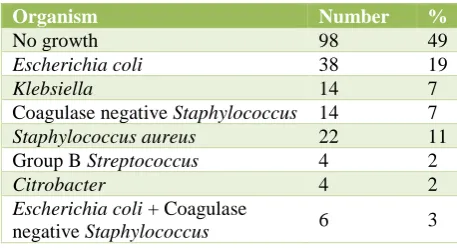
In present study it was observed that longer the PROM to delivery interval, higher risk of maternal and foetal morbidity. 60.6% of cases who had maternal morbidity had PROM to delivery interval between 12-24 hours and perinatal morbidity in 53.85% of cases (Table 6). 51% of women has positive cervical swab culture. No bacterial growth was observed in 49% of cases in the study and the predominant isolate from the cervical swab was
Escherichia coli (19%) followed in order by
Staphylococcus aureus (11%), Klebsiella pneumoniae, Coagulase negative staphylococcus (each 7%) and Citrobacter group B streptococcus (each 2%) in the study (Table 7).
Table 7: Results of cervical swab culture.
Organism Number %
No growth 98 49
Escherichia coli 38 19
Klebsiella 14 7
Coagulase negative Staphylococcus 14 7
Staphylococcus aureus 22 11
Group B Streptococcus 4 2
Citrobacter 4 2
Escherichia coli + Coagulase
negative Staphylococcus 6 3
DISCUSSION
Premature rupture of membranes is a common complication of pregnancy which leads to increased maternal complications, operative procedures, maternal mortality and morbidity. The present study was conducted at Narayana General Hospital among 200 cases attending the emergency and Department of Obstetrics and Gynecology. In present study the commonest age group was 20-24 years (35%) which correlates with the findings in the study of Kodkany BS et al and Devi A et al.8,9 Most of the studies demonstrate
that risk of PROM increases with age. In the present
study 11% of cases were above 35 years of age. The occurrence of PROM is more in unbooked cases than booked cases and the risk was statistically significant which is similar to findings in many studies all over the world.10 The incidence of PROM was high in cases of
low socioeconomic status in present study (64%) which can be explained that poor nutritional status leads to decreased antibacterial activity and increased defects in the foetal membrane. Other associated factors which could increase the risk include malnutrition, anemia, and increased genitourinary infections due to poor personal hygiene. Similar findings were reported by many studies in India and abroad.11 In the present study increased cases
of PROM were observed in cases of primigravidas than multigravidas which is contrary to many of the studies, multiparity is a risk factor for PROM due to long standing infection, trauma to cervix and patulous os. The mean duration between PROM to delivery interval in the present study was 20.2 hours, it was observed in our study that as the duration of PROM to delivery increases there is an increased risk of development of maternal and neonatal morbidity which is similar to the findings of Thakor U et al in their study.12 The percentage of cases
with Bishops score in range of 5-6 was higher in multigravidas than primigravidas and in range of 3-4 was higher in primigravidas than multigravidas in our study which is similar to findings of Zaghloul et al.13 Most of
the studies indicate higher the Bishops score there is an increase in the chances of normal delivery in both primi and multigravidas. In the present study, the rate of LSCS was 27.5% which is similar to findings of Swathi pandey et al and contrary to findings of Ray P et al and Jayaram VK et al who reported an incidence of 31.5% of LSCS in their studies.14-16 In the present study, maternal morbidity
was observed in 33 cases (16.5%) which is similar to findings in the study of Al-Qa et al and Antolic ZN et al.17 Febrile morbidity was the commonest morbidity in
our study and no cases of maternal mortality was observed in our study. However, in study of Tahir S et al
the most common morbidity observed was
chorioamnionitis which lead to the development of septicemia.18 There is always an association of perinatal
morbidity and mortality with PROM, in our study the incidence of perinatal morbidity was 26% and mortality was 3% which is similar to findings of Noor S et al and contrary to findings of Kifah Al et al who reported higher rates of morbidity and mortality in his study.19,20 The
[image:4.595.52.281.475.599.2]predominant isolate and associated with neonatal morbidity in both primi and multigravidas.
CONCLUSION
To conclude in present study, majority was primigravidas and the most common age group was 20-24 years belonging to low socioeconomic status. There was a significant association between socioeconomic status, PROM to induction delivery interval in our study. Maternal morbidity and neonatal morbidity was associated with increased duration of PROM to delivery and infection of the female genital tract with pathogens. Hence an appropriate and accurate diagnosis of PROM is essential for favorable outcome in pregnancy. Hence it is always advisable to develop new scoring strategies involving demographic variables with previous history to identify high risk cases to treat them prior to rupture.
Funding: No funding sources Conflict of interest: None declared
Ethical approval: The study was approved by the Institutional Ethics Committee
REFERENCES
1. Jairam VK, Sudha S. A study of premature rupture of membranes management and outcome. J Obstet Gynecol India. 2001; 51(2): 58-60.
2. Aktar MS, Degan JS, Aktar UA, D Sharam. PROM: Study of 300 cases and review of literature. J Obstet Gynecol India.1980;30:81.
3. Kodkany, Telang. Premature rupture of membranes, a study of 100 cases. J Obstet Gynecol India 1991;41:492.
4. Raghavan SS. Endocervical prostaglandin E2 (PGE2) gel in premature rupture of membranes. J Obstet Gynecol India. 2001;51:122.
5. Uma S, Nisha S, Shikha S. A prospective analysis of etiology and outcome of preterm labor. J Obstet Gynecol India. 2007;57(1):48-52.
6. Noor S, Nazar AF, Bashir R, Sultana R. Prevalance of PPROM and its outcome. J Ayub Med Coll Abbottabad. 2008;19(4):14-17.
7. Naeye R, Peters E. Causes and consequences of premature rupture of fetal membranes. Lancet. 1980;1:192-4.
8. Devi A, Rani R. Premature rupture of membranes – A clinical study. J Obstet Gynecol India. 1996;46:63.
9. Kodkany, Telang. Premature rupture of membranes, a study of 100 cases. J Obstet Gynecol India 1991;41:492.
10. El-Messidi A, Cameron A. Diagnosis of premature rupture of membranes: inspiration from the past and insights for the future. J Obstet Gynecol Can. 2010;32:561-9.
11. Vogel JP, Lee AC, Souza JP. Maternal morbidity and preterm birth in 22 low- and middle-income countries: a secondary analysis of the WHO Global Survey dataset. BMC Pregnancy Childbirth. 2014;14:56.
12. Umed T, Aitra N, Baxi S, Hazra M. Labor characteristics in pre-labor rupture of membranes. J Obstet Gynecol India. 1994;44:527.
13. Zaghloul SA. Effect of premature rupture of membranes on maternal, fetal and neonatal outcomes among mothers attending delivery in Kasr El Aini Maternity hospital. Master thesis. 1996.
14. Swati Pandey, Dave A, Bandi S. Maternal and foetal outcome in cases of PROM. J Obstet Gynecol India. 2000;50:63.
15. Jayaram VK, Sudha S. A study of PROM – Management and outcome. J Obstet Gynecol India. 2001;51:58-60.
16. Piya R, Sikdar K, Das A, Ghosh T. Study of cases of chorioamniotics followed premature rupture of membranes. J Obstet Gynecol India. 1997;47:136. 17. Al-Qa K, Al-Awaysheh F. Neonatal outcome and
prenatalantibiotic treatment in premature rupture of membranes. Pak J Med Sci. 2005;21(4):441-4. 18. Tahir S, Aleem M, Aziz K. Incidence of outcome of
PROM. Pak T Med Sci. 2002;18(1):26-32.
19. Noor S, Fawwad A, Shahzad H, Sultana R, Bashir R. Foeto maternal outcome in patients with or without premature rupture of membranes. J Ayub Med Coll Abbottabad. 2010;22(1):164-7.
20. Kifah AL Qa Qa, Awaysheh FA. Neonatal outcome and prenatal antibiotics treatment in premature rupture of membranes. Pak J Med Sci. 2005;21:441-4.
Cite this article as: Surayapalem S, Cooly V, Salicheemala B.A study on maternal and perinatal outcome in premature rupture of membranes at term. Int J Reprod Contracept Obstet Gynecol