Volume 6, No. 6, June - July 2015
International Journal of Advanced Research in Computer Science
RESEARCH PAPER
Available Online at www.ijarcs.info
Cloud Computing and Physical Health
Brijesh K. Upadhayay
Research Scholar, Department of Computer Science, O.P.J.S. University, Churu, Rajasthan, India
Abstract: The cloud computing has changed the definition of data sharing in IT. Cloud computing provides the easy access of data without investing in infrastructure by company. Thus, research and development in cloud computing are scaling in a positive direction, due to the growing demand for cloud computing but no one is bothered about its impact on physical health. This paper provides the results after thorough analysis and data collection how cloud based services are acting like slow poison for physical health of youths.Youths expressed concern about the long use of cloud services and its impact on physical health. The result shows that female youth have feeling of fatigued faster due to the long use of cloud based services as compared to male youth.Male and female both youth were accepted that weight has increased due to the long use of cloud based services and finally male youth were accepted that sexual appetite has been decreases due to long use of cloud based services as compare to female youth.
Keywords: Cloud computing; social networking websites; physical health; fatigue; weight rise; sexual appetite; sick; sleeping disorder.
I. INTRODUCTION
Cloud computing and define it as a virtual pool of computing resources. They elaborate on the actual workings of cloud computing and asserts the presence of mandatory application environments, that enables the users to access and store data in a dynamic manner. Moreover, [1], identify the different cloud computing styles. They introduce SaaS, utility computing, network service, PaaS, Management service provider, commercial service platform and integrating internet. They define SaaS as a type of cloud computing that transfer programs to its end users through a browser. Utility computing is defined as a service offered by cloud computing through its characteristic features such as virtualization, memory and data center pool. Network service is defined as a service closely linked with SaaS, which provides the developers the necessary platform to develop applications for the cloud [1].
PaaS is a developing platform, that gives the end-users’ an opportunity to develop their own applications and transfer it to the other users across the cloud platform. MSP is an application designed especially for the IT organizations to scan mail viruses and monitor programs. Commercial service platform provides the necessary interface for the end-users and service provider to interact with one another. Finally, ‘integrating internet’ is a type of cloud deployment that integrates all the similar service providers, that provides open choices for the end users’ to select and opt the required service [1].
[image:1.595.325.552.326.529.2]Armbrust et al (2009) outline the different modes such as public cloud and private cloud as cloud deployment services. The major difference between the two modes is the availability of services to end users. When a cloud is available as pay-as-you-go to the public it is referred to as private cloud. It is sols as utility computing in the market. Contrastingly, private clouds are specifically assigned to business organizations and are not made to go public [2].
Figure 1.1: Typical structure cloud computing system [3]
IT corporations today need to ensure the accessibility and availability of relevant hardware and software devices and applications to accomplish their goals and objectives. Apart from purchasing computing machines, they need to buy appropriate software licenses and tools for each and every employee in the organization [3]. Moreover, additional hiring of staff requires instant increase in infrastructure. Not only stressful and cumbersome, the entire process increases the purchase and maintenance costs of the organization.
Cloud technology also offers other benefits to developing countries since they no longer have the burden of investing in costly infrastructures and easy availability of data storage without worry but another aspect of cloud technology is negative impacts on youth mental and physical health.
high use of cloud based social media is wiring our brains accordingly which may lead to negative results, such as lack of in cognitive skills.[4]
Use of social media and cloud computing also creates an opportunity for emotional distress from receiving threatening, harassing, or humiliating communication from another teen, called cyberbullying.
a. In California, approximately 23% of teens report being threatened by a peer [5]. Cyberbullying appears similar in prevalence to offline bullying [6].
b. Cyberbullying has been shown to cause higher levels of depression and anxiety for victims than traditional bullying and has also been connected to cases of youth suicide with teens known to engage in reading hurtful comments days before their suicide attempts [7]. c. Those most at risk for cyberbullying include lesbian,
gay, bisexual, transgender (LGBT) and allied youth. “Allied youth” refers to young people who are openly supportive of LGBT youth. A 2010 study found that 54% of these youths report being cyberbullied within the last 30 days [8].
d. Females are the next most likely group to be cyberbullied, with 21% of female teens reporting cyberbullying [8].
e. Those who are victims of online harassment are also more likely to be perpetrators [9]. Teens most at risk for cyberbullying are also those at risk of offline harms, such as teens who have experienced sexual or physical abuse or those living in poor home environments [10].
II. MATERIAL AND METHOD
A. Tool for Data Collection:
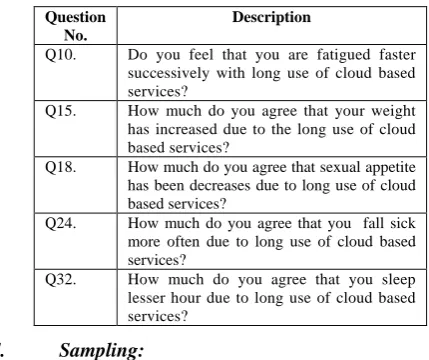
The self created test was used for collecting data from the universe and F-test for data analysis. Test have 05 questions out of 32 questions for knowing the impact of cloud based services on physical health.
B. Scoring and Interpretation:
Scores for Cloud Based Services Inventory (CBSI) are derived from the responses on each item obtained on five point response format "Extremely", "Moderately", "Slightly" and "Not at all". Items of the inventory are given scores of 4, 3, 2 and 1 for "Extremely", "Moderately", "Slightly" and "Not at all" responses.
Table: 1 Responses Score Extremely 4 Moderately 3 Slightly 2 Not at all 1
[image:2.595.322.537.257.437.2]The maximum possible score for CBSI is 100 and minimum being 25. High score on CBSI is indicative of poor physical health. The maximum score of physical health scale is 20 and minimum 5. Physical health scale measures the extent to which the individual is concerned about his fatigue, body weight disorder, sleeping disorder, sexual appetite and sick. People scoring high on this scale would have not good physical health.
Table 2.1 Question
No.
Description
Q10. Do you feel that you are fatigued faster successively with long use of cloud based services?
Q15. How much do you agree that your weight has increased due to the long use of cloud based services?
Q18. How much do you agree that sexual appetite has been decreases due to long use of cloud based services?
Q24. How much do you agree that you fall sick more often due to long use of cloud based services?
Q32. How much do you agree that you sleep lesser hour due to long use of cloud based services?
C. Sampling:
The sample for the study was selected by Multi-stage random sampling method. Since the elements of the sample are of a scattered nature and are only a variable in ‘clusters’ (i.e. colleges, online), a list of youths is prepared from the different colleges of Uttarakhand state and google online form link
http://goo.gl/forms/pCxdw33xoY
The questionnaires for physical health were administered over these 400 youths and 320 of these have been selected as for requirement of the following research paradigm.
Table: 3 Gender Internet Speed Less than or equal to 512 kbps
(A1)
Internet Speed Greater than 512 kbps (A2)
∑
Internet Use Less than or equal to 2hrs Per day
(B1)
Internet Use More than 2hrs Per day
(B2)
Internet Use Less than or equal to 2hrs Per day
(B1)
Internet Use More than 2hrs Per day
(B2)
Male 40 40 40 40 160
Female 40 40 40 40 160
∑ 80 80 80 80 320
D. Variables:
a. Independent Measure:
a) Internet User Per Hours - Internet use per day for cloud based services is taken for study as independent measure with two different status of less than equal to 2 hours per day and greater than 2 hours per day.
b) Internet Speed - Internet speed for cloud based services is taken for the study as independent measure with two
different status of less than equal to 512 kbps and another greater than 512 kbps.
c) Gender - Gender of youth as male and female are taken another independent measure of the present investigation.
b. Dependent Measure:
III. RESULTS
The impact of cloud based services on youth physical health will be studied. Longer use of cloud based services would effect on physical health of youth and face so much problems like fatigued, weight loss, sexual appetite and sleeping disorder.
Graph 3.1
Graph 4.18 represented that female youth were accepted that are feeling of fatigued faster successively with long use of cloud based services as compared to male youth. Male and female both youth were accepted that weight has increased due to the long use of cloud based services. Male youth were accepted that sexual appetite has been decreases due to long use of cloud based services as compare to female youth. Female youth were accepted that they fall sick more often due to long use of cloud based services than male youth. Most of female youth were accepted that they sleep lesser hour due to long use of cloud based services as compared to male youth.
Graph 3.2
Graph 3.3
Graph 3.2 shows that most of female youth were accepted that there was no relationship with fatigued and cloud based services. Most of female youth were accepted that no effect on their weight due to the long use of cloud based services. Most of female youth were accepted that there was no effect on sexual appetite due to the long use of cloud based services. Female youth were accepted that there was no effect on their sickness due to the long use of cloud computing. Most of female youth were "Slightly Agree" that they get sleeping disorder ever since they were using of cloud based websites.
Graph 3.3 shows that most of male youth were accepted that there was no relationship with fatigued and cloud based services. Most of male youth were accepted that there was no effect on their weight due to the long use of cloud based services. Most of male youth were accepted that there was no effect on sexual appetite due to the long use of cloud based services. male youth were accepted that there was no effect on their sickness due to the long use of cloud computing. Most of male youth were agree that there was no effect on their sleeping pattern ever since they were using of cloud based websites.
Table-3.1 THE ANOVA SUMMARY (P < .05)
SOURCE OF VARIANCE S.S. df M.S. F P
Treatment 484 5 96.8
Gender 121.28 1 121.28 18.63 <.01
Internet Speed 100.14 1 100.14 15.38 <.01 Internet Use in Hrs. 126.26 1 126.26 19.39 <.01 Gender × Internet Speed × Internet Use in Hrs. 136.32 2 68.16 10.47 <.01 Within Error 2045.05 314 6.51
Total 2529.05 319
F.05 (1, 314)–3.87; F.05 (2, 314)–3.03
F.01 (1, 314)–6.72; F.01 (2, 314)–4.68
Table-3.1 shows that female youth were sleep lesser hour due to long use of cloud based services than male youth. Those youth were using upto 512 kbps internet speed would fatigued faster successively with long use of cloud based services than youth having internet speed above 512 kbps. Those youth who were using internet use
more than 2 hrs per day, thought that fall sick more often due to long use of cloud based services than youths were using internet less than or equal to 2 hrs per day.
0 20 40
Q.10 Q.15 Q.18 Q.24 Q.32
Pop
ul
at
ion
%a
ge
Questions
Physical Health of Male
and Female Youth
Male Female
0 100
Q.
10
Q.
15
Q.
18
Q.
24
Q.
32
opul
at
io
n %
ag
e
Questions
Physical Health of
Male Youth
Not at all Slightly Moderately Extremely
0 50 100
Q.
10
Q.
15
Q.
18
Q.
24
Q.
32
Pop
ul
at
ion
%a
ge
Questions
Physical Health of
Female Youth
Table-3.2 Research Paradigm
Gender Internet Speed Less than or equal to 512 kbps (A1)
Internet Speed Greater than 512 kbps (A2)
∑
Internet Use Less than or equal to 2hrs
Per day (B1)
Internet Use More than 2hrs
Per day (B2)
Internet Use Less than or equal to 2hrs Per day (B1)
Internet Use More than 2hrs Per day
(B2)
Male 333 339 295 362 1329
Female 372 473 327 354 1526
∑ 705 812 622 716 2855
Although further breakup of Interaction between different groups shows in Table-3.3. Table-3.3 't' Test
S.No. Gender Interaction M SD t P 1 Male A1 ×B1 8.33 2.17 0.26
A1 ×B2 8.48 2.92
2 Male A2 ×B1 7.38 2.49 2.93 <.01 A2 ×B2 9.05 2.62
3 Male A1 ×B1 8.33 2.17 1.82 A2 ×B1 7.38 2.49
4 Male A1 ×B1 8.33 2.17 1.35 A2 ×B2 9.05 2.62
5 Male A1 × B2 8.48 2.92 1.82 A2 × B1 7.38 2.49
6 Male A1 × B2 8.48 2.92 0.93 A2 × B2 9.05 2.62
7 Female A1 ×B1 9.3 2.35 4.99 <.01 A1 ×B2 11.83 2.17
8 Female A2 ×B1 8.18 2.68 1.12 A2 ×B2 8.85 2.73
9 Female A1 ×B1 9.3 2.35 1.99 <.05 A2 ×B1 8.18 2.68
10 Female A1 ×B1 9.3 2.35 0.79 A2 ×B2 8.85 2.73
11 Female A1 × B2 11.83 2.17 6.69 <.01 A2 × B1 8.18 2.68
12 Female A1 × B2 11.83 2.17 5.40 <.01 A2 × B2 8.85 2.73
13 A1 ×B1 Male 8.33 2.17 1.92 Female 9.3 2.35
14 A1 ×B2 Male 8.48 2.92 5.82 <.01 Female 11.83 2.17
15 A2×B1 Male 7.38 2.49 1.38 Female 8.18 2.68
16 A2 ×B2 Male 9.05 2.62 0.33 Female 8.85 2.73
t.05 (df=78)= 1.99; t.01 (df=78)= 2.64
A. Internet Speed Variability Based Results:
a. The female youth fall sick more often who were using internet speed up to 512 kbps for less than or equal to 2 hrs per day than female youth using internet speed greater than 512 kbps for less than or equal to 2 hrs per day.
B. Internet Used Per Day Variability Based Results: a. The male youth using internet speed more than 512
kbps for more than 2 hrs per day would fatigued faster successively than male youth using internet speed more than 512 kbps for less than or equal to 2 hrs per day. b. The female youth using internet speed upto 512 kbps
for more than 2 hrs per day would sleep lesser hour than female youth using internet speed upto 512 kbps for less than or equal to 2 hrs per day.
C. Internet Speed and Internet Used Per Day both Variability Based Results:
a. The female youth were fall sick more often who were using internet speed up to 512 kbps for more than 2 hrs per day that female youth using internet speed more than 512 kbps for less than or equal to 2 hrs per day.
D. Gender Variability Based Results:
a. The female youth were fatigued faster successively who were using internet speed up to 512 kbps for more than 2 hrs per day that male.
IV. CONCLUSION
Results shows that female youth have feeling of fatigued faster successively with long use of cloud based services as compared to male youth. Male and female both youth were accepted that weight has increased due to the long use of cloud based services. Male youth were sexual appetite decreases due to long use of cloud based services as compare to female youth. Female youth were fall sick more often due to long use of cloud based services than male youth. Most of female youth were sleep lesser hour due to long use of cloud based services as compared to male youth. The female youth were fall sick more often who were using internet speed up to 512 kbps for more than 2 hrs per day that female youth using internet speed more than 512 kbps for less than or equal to 2 hrs per day. Our research survey shows that female are more effective from cloud based services in compare to male so we suggest that we should find some solutions to reduce the negative effective on youth physical health. We should build new technology but we do not forget the side effect of that.
V. REFERENCES
[1] Zhang, Shuai, Zhang, Shufen, Shufen, Xuebin and Huo, Xiuzhen; (2010) Cloud Computing Research and Development Trend. IEEE Computer Society, 93-97. Doi 10.1109/ICFN.2010.58
13 57 9 11 13 15 17 19
Ph
ys
ic
al
H
ea
lth
Female Youth Physcial
Health
Physical Health 1357
9 11 13 15 17 19
Ph
ys
ic
al
H
ea
lth
Female Youth Physcial
Health
[2] Armbrust, Michael, Fox, Armando, Griffith, Rean, Joseph, Anthony D, Katz,Randy, Konwinski, Andy, Lee, Gunho, Patterson, David, Rabkin, Ariel, Stoica, Ion and Zaharia, Matei; (2009) Above the Clouds: A Berkeley View of Cloud Computing. Technical Report. University of California database. Technical Report No. UCB/EECS-2009-28 Available:
http://www.eecs.berkeley.edu/Pubs/TechRpts/2009/EECS-2009-28.html (Acc. 2011-9-15)
[3] Strickland, Jonathan; (2011). How Cloud Computing Works.
howstuffworks.
Available:http://computer.howstuffworks.com/cloudcomputi ng/cloudcomputing.htm(Acc. 2011-9-15)
[4] Upadhayay K. Brijesh, Aggarwal Mayank (2015) Impact of cloud based services on mental health, International Journal of Engineering and Computer Science, Vol 4 Issue 8 Aug 2015, Page No. 13653-13663.
[5] California Health Interview Survey (CHIS). (2001). Retrieved on May 30, 2011.Available: website: http://www.chis.ucla.edu
[6] Lenhart A. (2007). Cyberbullying. Retrieved on June 3, 2011 from Pew Internet and American Life Project. Available: http://www.pewinternet.org/Reports/2007/Cyberbullying.asp x.
[7] Kowalski, R.N. (2010). Alexis Pilkington Facebook Horror: Cyber bullies harass even after suicide. Retrieved on June 3, 2011.Available:
http://www.huffingtonpost.com/2010/03/24/alexis-pilkington-faceboo_n_512482.html
[8] Blumenfeld, W.J. and Cooper, R.M. (2010). LGBT and Allied Youth Responses to Cyberbullying: Policy Implications. The International Journal of Critical Pedagogy, 3(1), 114-133. Available: http://freireproject.org/images/2321/IJCPv3_7.pdf (Acc. June 3, 2011)
[9] Ybarra, M.L, Espelage, D.L, & Mitchell, K.J. (2007). The co-occurrence of Internet harassment and unwanted sexual solicitation victimization and perpetration: Associations with psychosocial indicators. JAdolesc Health. 41(S6), 31–41. [10] Berkman Center for Internet and Society, Harvard Law
School, Internet Safety Technical Task Force. (2008).
Enhancing Safety and Online Technologies: Final Report of the Internet Safety Task Force to the Multi-State Working Group on Social Networking for the State Attorneys General
of the United States.
![Figure 1.1: Typical structure cloud computing system [3]](https://thumb-us.123doks.com/thumbv2/123dok_us/693907.1076991/1.595.325.552.326.529/figure-typical-structure-cloud-computing.webp)