Authenticated Network Time Synchronization
Benjamin Dowling
Queensland University of Technology
[email protected]
Douglas Stebila
Queensland University of Technology
McMaster University
[email protected]
Greg Zaverucha
Microsoft Research
[email protected]
Abstract
The Network Time Protocol (NTP) is used by many network-connected devices to synchronize device time with remote servers. Many security features depend on the device knowing the current time, for example in deciding whether a certificate is still valid. Currently, most services implement NTP without authentication, and the authen-tication mechanisms available in the standard have not been formally analyzed, require a pre-shared key, or are known to have cryptographic weaknesses. In this paper we present an authenticated version of NTP, calledANTP, to protect against desynchronization attacks. To make ANTP suitable for large-scale deployments, it is designed to minimize server-side public-key operations by infre-quently performing a key exchange using public key cryp-tography, then relying solely on symmetric cryptography for subsequent time synchronization requests; moreover, it does so without requiring server-side per-connection state. Additionally, ANTP ensures that authentication does not degrade accuracy of time synchronization. We measured the performance of ANTP by implementing it in OpenNTPD using OpenSSL. Compared to plain NTP, ANTP’s symmetric crypto reduces the server throughput (connections/second) for time synchronization requests by a factor of only 1.6. We analyzed the security of ANTP using a novel provable security framework that involves adversary control of time, and show that ANTP achieves secure time synchronization under standard cryptographic assumptions; our framework may also be used to analyze other candidates for securing NTP.
Keywords:time synchronization, Network Time Pro-tocol (NTP), provable security, network security
1
Introduction
TheNetwork Time Protocol (NTP)is one of the Internet’s oldest protocols, dating back to RFC 958 [14] published in 1985. In the simplest NTP deployment, a client device
sends a single UDP packet to a server (therequest), who responds with a single packet containing the time (the
response). The response contains the time the request was received by the server, as well as the time the response was sent, allowing the client to estimate the network delay and set their clock. If the network delay issymmetric, i.e., the travel time of the request and response are equal, then the protocol is perfectly accurate.Accuracymeans that the client correctly synchronizes its clock with the server (regardless of whether the server clock is accurate in the traditional sense, e.g., synchronized with UTC).
The importance of accurate time for security. There are many examples of security mechanisms which (often implicitly) rely on having an accurate clock:
• Certificate validation in TLS and other protocols.
Validating a public key certificate requires confirm-ing that the current time is within the certificate’s validity period. Performing validation with a slow or inaccurate clock may cause expired certificates to be accepted as valid. A revoked certificate may also validate if the clock is slow, since the relying party will not check for updated revocation information. • Ticket verification in Kerberos.In Kerberos,
authen-tication tickets have a validity period, and proper verification requires an accurate clock to prevent authentication with an expired ticket.
network-level attacker who can intercept and modify NTP traffic, such as a malicious wireless access point or an insider at an ISP. In practice, most NTP servers do not authenticate themselves to clients, so a network attacker can intercept responses and set the timestamps arbitrarily. Even if the client sends requests to multiple servers, these may all be intercepted by an upstream network device and modified to present a consistently incorrect time to a victim. Such an attack on HSTS was demonstrated by Selvi [30], who provided a tool to advance the clock of victims in order to expire HSTS policies. Malhotra et al. [10] presents a variety of attacks that rely on NTP being unauthenticated, further emphasizing the need for authen-ticated time synchronization. (Confidentiality, however, is not a requirement for time synchronization, since all time synchronization is public. Similarly, client-to-server authentication is not a goal.)
NTP security today. Early versions of NTP (NTP, NTPv1 and NTPv2) had no standardized authentication method. NTPv3 added an authentication method using pre-shared key symmetric cryptography. An extension field in the NTP packet added a cryptographic checksum, computed over the packet. NTPv3 negotiation of keys and algorithms must be done out-of-band. For example, NIST offers a secure time server, and (symmetric) keys are transported from server to client by postal mail [21]. Establishing pre-shared symmetric keys with billions of client PCs and other NTP-synchronizing devices seems impractical. NTPv4 introduced a public-key authenti-cation mechanism called Autokey which has not seen widespread adoption; and unfortunately, Autokey uses small 32-bit seeds that can be easily brute forced to then forge packets. A more recent proposal is the Network Time Security (NTS) protocol [32], which we discuss in §??.
Most NTP servers do not support NTP authentica-tion, and NTP clients in desktop and laptop operating systems will set their clocks based on unauthenticated NTP responses. On Linux and OS X, by default the client either polls a server periodically, or creates an NTP request when the network interface is established. In both cases the system clock will be set to any time spec-ified by the NTP response. On Windows, by default clients will synchronize their clock every nine hours (us-ingtime.microsoft.com), and ignore responses that would change the clock by more than 15 hours. These two defaults reduce the opportunity for a man-in-the-middle (MITM) attacker to change a victim clock and the amount by which it may be changed, but cumulative small-scale time changes can build in the long-term to large-scale time inaccuracies. Such a technique is demonstrated by Teichel
et al.when attacking time-synchronization as secured by TESLA-like protocols [34]. In Windows domains (a net-work of computers, often in an enterprise), the domain
controller provides the time with an authenticated variant of NTPv3 [13].
1.1
Contributions
We present the ANTP protocol for authenticated network time synchronization, along with results on its perfor-mance and security. ANTP protocol messages are trans-ported in the extension fields of NTP messages. ANTP allows a server to authenticate itself to a client using pub-lic key certificates and pubpub-lic key exchange, and provides cryptographic assurance using symmetric cryptography that no modification of the packets has occurred in transit. Like other authenticated time synchronization protocols using public keys [32] we assume an out-of-band method for certificate validation exists, as certificate validation requires an accurate clock. We follow the direction set by the IETF Informational document “Security Require-ments of Time Protocols in Packet-Switched Networks” (RFC 7384) [19] to determine what cryptographic, com-putational, and storage properties ANTP should achieve. ANTP has three phases. In thenegotiation phase, the client and server agree on which cryptographic algorithms to use; this phase would be carried out quite infrequently, on the order of monthly or less. In thekey exchange phase, the client and server use public key cryptography to es-tablish a symmetric key that the server will use to authen-ticate later time synchronization responses; this phases would also be carried out infrequently, say monthly. In thetime synchronization phase, the client sends a time synchronization request, and the server replies with an NTP response that is symmetrically authenticated using the key established in the key exchange phase; this may be done frequently, perhaps daily or more often. No-tably, the server need not keep per-client state: the server offloads any such state to the client by encrypting and authenticating it under a long-term symmetric key, and the client sends that ciphertext back to the server with each subsequent request.
Phase Throughput Latency at 50% load Latency at 90% load
ANTP – Negotiation – RSA 58 240 186±26 202±43
ANTP – Negotiation – ECDH 146 808 172±35 233±133
ANTP – Key Exchange – RSA 1 754 891±121 997±346
ANTP – Key Exchange – ECDH 13 210 197±56 344±142
ANTP – Time Synchronization 175 644 168±35 230±158
ANTP – All 3 phases – RSA – 2 255±587 2 646±345
ANTP – All 3 phases – ECDH – 1 325±499 2 252±1 172
NTP 291 926 147±34 181±136
Table 1: Performance results for each phase of ANTP (top), a complete 3-phase execution of ANTP (middle), and NTP (bottom).Throughput: mean completed phases per second.Latency: mean and standard deviation of the latency in microseconds of server responses at either 50% or 90% server load. All are computed over 5 trials, top and bottom over 100 seconds each; see Section 4.2 for details.
since it may be sufficiently accurate for general use.
ANTP performance. Performance constraints on time synchronization protocols are driven by the fact that time servers are heavily loaded, and must provide responses promptly. ANTP’s design allows it to achieve high per-formance while maintaining high security. The frequently performed time synchronization phase uses only symmet-ric cryptography, making it only slightly more expensive than simple NTP time synchronization. Since the ses-sion key established in the key exchange phases is reused across many time synchronization phases, expensive pub-lic key operations are amortized, and can be separately load-balanced. And, as noted above, ANTP offloads state to clients, leaving the server stateless.
We implemented ANTP in OpenNTPD’s [36] imple-mentation of NTP, using OpenSSL [37] for cryptographic computations. Table 1 reports the performance of our implementation, compared with unauthenticated simple NTP. ANTP does decrease throughput and increase la-tency, but the impact is quite reasonable. On a single core of a server, ANTP can support 175k authenticated time synchronization phase connections per second, a factor of 1.6 fewer than the 291k unauthenticated simple NTP connections per second. Latency for time synchroniza-tion (over a 1 gigabit per second local area network) at 50% load increases from 147 microseconds for unauthen-ticated simple NTP to 168 microseconds for ANTP’s time synchronization phase. The other two phases, negotiation and key exchange, will be performed far less frequently on average by clients. Throughput of negotiation phases is bandwidth-, not CPU-, limited. For exchange, we im-plemented methods: 2048-bit RSA key transport and static-ephemeral elliptic curve Diffie–Hellman key ex-change using the NIST P-256 curve; as expected, both of these are substantially more expensive than time synchro-nization phases, but are also performed far less frequently. Details of our implementation and testing methodology,
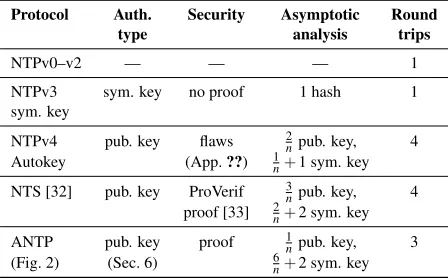
Protocol Auth. Security Asymptotic Round type analysis trips
NTPv0–v2 — — — 1
NTPv3 sym. key no proof 1 hash 1 sym. key
NTPv4 pub. key flaws 2npub. key, 4 Autokey (App.??) 1
n+1 sym. key
NTS [32] pub. key ProVerif 3npub. key, 4 proof [33] 2n+2 sym. key ANTP pub. key proof 1
npub. key, 3
(Fig. 2) (Sec. 6) 6n+2 sym. key
Table 2: Comparison of time synchronization protocols. a
n+bdenotesaoperations that can be amortized overn time synchronizations plusboperations per time sync.
as well as more results, appear in Section 4.
ANTP compares well with other authentication meth-ods for NTP, as seen in Table 2. ANTP uses fewer amor-tized public key operations compared to NTPv4 Autokey and NTS and has fewer rounds. NTPv3 using symmet-ric key operations is more lightweight, but is highly re-stricted in that it only supports symmetric authentication via pre-established symmetric keys, making it unsuitable for deployment with billions of devices.
RSA key transport, Apache/OpenSSL could serve 633 connections/second/core, just over one-third of the ANTP RSA key exchange phases; and for ECDHE/ECDSA key exchange, Apache/OpenSSL could serve only 1156 con-nections/second/core, less than a tenth of ANTP ECDH key exchange phases.
ANTP security. ANTP’s design is supported by a thor-ough analysis of its cryptographic security using the prov-able security paradigm. To do so, we extend existing frameworks for key exchange and secure channels [2, 8] to develop a novel framework that handles protocols where
timeplays a central role. The adversary in our security analysis is a network attacker capable of deleting, reorder-ing, editreorder-ing, and creating messages between parties. Since our model is about time synchronization, parties in our model have local clocks, and the adversary is given com-plete control over the initialization of all clocks, as well as the ability to increment the time of parties not involved in a protocol run. This allows us to model the ability of an adversary to delay packet transmission: this is particu-larly important in the case of NTP, where delaying packets asymmetrically can cause the client to synchronize to an inaccurate time.
We then show that ANTP achieves secure time syn-chronization as defined by our model, under standard as-sumptions on the security of the cryptographic primitives (key encapsulation mechanism, hash function, authenti-cated encryption, message authentication code, and key derivation function) used to construct the protocol.
2
Network Time Protocols
Here we review the two most commonly deployed time synchronization protocols, NTP and SNTP, as well as a recent proposal called Network Time Security [32].
2.1
The Network Time Protocol
TheNetwork Time Protocol (NTP) was developed by Mills in 1985 [14], and revised in 1988, 1989, 1992 and 2010 (NTPv1 [6], NTPv2 [15], NTPv3 [16] and NTPv4 [17] respectively). NTP is designed to synchronize the clocks of machines directly connected to hardware clocks (known asprimary servers) to machines without hard-ware clocks (known as secondary servers). NTP protects against Byzantine traitors by querying multiple servers, selecting a majority clique and updating the local clock with the majority offset. This assumes the attacker can only influence some minority of the queried servers.
2.2
The Simple Network Time Protocol
The Simple Network time Protocol (SNTP) is a vari-ant of NTP that uses an identical message format but
Client Server
t1←Now()
req←t1
req
−→ t2←Now()
.. .
t3←Now()
t4←Now() resp←− resp←t2kt3
RTT←(t4−t1)−(t3−t2)
˜
θ3←RTT/2
offset← 12(t2+t3−t1−t4)
time←Now() +offset
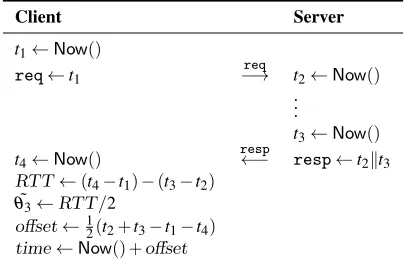
Figure 1: Simple Network Time Protocol (SNTP).Now()
denotes the procedure that outputs the local machine’s current time.RTT denotes the total round-trip delay the client observes and ˜θ3denotes the approximation of the
propagation time from server to client. The time of the server receivingreqis denotedt2and sendingrespist3.
Note thatoffset=t3+θ˜3−t4, which we will use in our
correctness analysis of ANTP.
only queries a single server when requesting time syn-chronization. Windows and OS X by default synchro-nize using a single time source (time.windows.comand time.apple.comrespectively). Our construction lends itself well to SNTP, as it authenticates time samples from a single server. Security analysis is also easier as we can avoid the more complex sorting and filtering algorithms of NTP, and client and server behaviours are simpler. Note that SNTP and NTP client request messages are the same. SNTP has three distinct stages: (1) the creation and transmission ofreqby the client; (2) the processing of reqby the server, and transmission ofresp; and (3) the processing ofrespand clock update by the client. An abstraction of the protocol behaviour can be found in Figure 1, including the client’s clock update procedure. Though the format for NTP packets are identical for both client and server NTP messages, we usereqto indicate a NTP packet in client mode, andrespto indicate a NTP packet in server mode, omitting packet content details.
1. The client creates an SNTPreqpacket, sets transmit timestamp(t1) toNow()and sends the
message.
2. The server creates an SNTP resp packet with all fields identical to the received req, but signalling Server mode. The server sets originate timestamp to the value transmit timestamp from req. The server also sets receive timestamp (t2) to Now()
immediately after receipt of req, and sets transmit timestamp (t3) toNow()immediately
before sending the message to the client.
the current time (and saves it as t4). If
resp.originate timestamp is not equal to req.transmit timestamp, the client aborts the protocol run. The client calculates the total round-trip time RTT and the local clock offset offsetas in Figure 1.
(The rest of the fields in the NTP packets are irrele-vant for calculating the local clock offset and correcting the local clock for a single-source time synchronization protocol. These extra fields in the NTP packet are used primarily for ranking multiple distinct time sources.)
From this, we can compute a bound of the amount of error that is introduced to the clock update procedure via asymmetric packet delay when the packets are unmod-ified. Asymmetric packet delay is the scenario where the propagation time from client to server is not equal to the propagation time from server to client. Letθ1be the
propagation time from client to server,θ2the server
pro-cessing time andθ3the propagation time from server to
client.θ3is approximated in SNTP by ˜θ3=RTT2 , where
RTT= (t4−t1)−(t3−t2) =θ1+θ3.
The actual offset isoffsetactual=t3+θ3−t4. The
ap-proximated offset is computed asoffset= 12(t2+t3−
t1−t4). Whenθ1=θ3, thenoffset=t3+θ˜3−t4and
offset=offsetactual. In the worst possible case, packet delivery is instantaneous, and the entire roundtrip time is asymmetric delay. The client approximates the off-set as above, and thus the error introduced this way is
1
2|(θ1−θ3)| ≤RTT.
The error that a passive adversary with the ability to delay packets can introduce does not exceed theRTT: clients can abort the protocol run whenRTTgrows too large, giving them some control over the worst-case error.
2.3
NTP Security and Other Related Work
In terms of security, early versions of NTP (NTP to NTPv2) had no standardized authentication method.
NTPv3 symmetric-key authentication. NTPv3 pre-sented a method for authenticating time synchronization – using pre-shared key symmetric cryptography. NTPv3’s added additional extension fields to the NTP packet, con-sisting of a 32-bit key identifier, and a 64-bit crypto-graphic checksum. The specification of NTPv3 describes the checksum as the encryption of the NTP packet with DES, but notes that other algorithms could be negotiated. The distribution of keys and negotiation of algorithms was considered outside the scope of NTP.
NTPv4 Autokey public key authentication. NTPv4 in-troduced a method for using public-key cryptography for authentication, known as the Autokey protocol. Autokey is designed to prevent inaccurate time synchronization by authenticating the server to the client, and verifying no
modification of the packet has occurred in transit. Au-tokey is designed to work over the top of authenticated NTPv3. Autokey uses MD5 and a variety of Schnorr-like [28] identification schemes to prevent malicious at-tacks, but as an analysis of Autokey by R¨ottger shows [25], there are multiple weaknesses inherent in the Au-tokey protocol, including use of small seed values (32 bits) and allowing insecure identification schemes to be negotiated. The size of the seed allows a MITM adver-sary with sufficient computational power to generate all possible seed values and use the cookie to authenticate adversarial-chosen NTP packets. This weakness alone allows an attacker in control of the network to break au-thentication of time synchronization, thus NTP with the Autokey protocol is not a secure time synchronization pro-tocol. Mills describes his experiments on demonstrating reliability and accuracy of network time synchronization using NTPv2 implementations [18], but does not offer a formal security analysis of NTP. Mills does show that honest deployment of NTP in networks can offer time syn-chronization accuracy to within a few tens of milliseconds after only a few synchronizations. ANTP was originally intended as a means to addressing the vulnerabilities in the Autokey protocol, but with many changes to mini-mize public-key and symmetric-key operations, message bandwidth. While inspiration for ANTP is the Autokey protocol, the design diverged significantly enough to con-sider it a separate protocol design.
Network Time Security. The Network Time Security protocol (NTS) [32] is an IETF Internet-Draft that uses public-key infrastructure in order to secure time synchro-nization protocols such as NTP and the Precision Time Protocol (PTP) [1]. However, NTS is costly in terms of server-side public-key operations, is a four round-trip pro-tocol, requires clients to manage public/private key pairs and digital certificates, and does not have an equivalent to ANTP’s no-cryptographic-latency feature.
NTS has inherited many design choices from the Au-tokey protocol, in particular protocol flow, and key deriva-tion strategy using secret server seeds. Similarly to the Autokey protocol, NTS servers reuse the random-nessserver seed used to generate a shared secret key (referred to as a cookie) for each client by cookie=
HMAC(server seed,Hash(client public-key certificate)), encrypting this value and a client-chosen nonce with the client public-key, authenticating the server by digitally signing thecookiewith the server private key. Note that the client public-key certificate in NTS serves to protect the confidentiality and ensures uniqueness of thecookie
for each client using a different public-key certificate. It does not serve to authenticate the client to the server. In ANTP clients do not need a certificate, only the server.
message, which includes the client’s selection of hash and key encapsulation algorithms as well as a client nonce. The server must compute costly public-key operations over these values for each association phase. As a result, a NTS server requires three public-key operations per client to establish a shared secretcookie.
NTS is a work-in-progress and a future revision may be updated to address some of these issues. We previ-ously discovered a flaw in the association phase which would allow MITM adversaries to perform negotiation downgrade attacks (draft version-06) and communicated our findings to the authors. This has since been fixed and we reviewed draft version-12for this paper.
3
Authenticated NTP
In this section we present theAuthenticated Network Time Protocol (ANTP): a new variant of NTP designed to allow an SNTP client to authenticate a single NTP server and output a time counter within some accuracy margin of the server time counter. Our new protocol ANTP allows an ANTP server to authenticate itself to an ANTP client, as well as provide cryptographic assurances that no mod-ification of the packets has occurred in transit. ANTP messages, much like Autokey and NTS, are included in the extension fields of NTP messages. We summarize the novel features of ANTP below:
• The client is capable of authenticating the server, and all messages from the server. Replay attacks are explicitly prevented for the client.
• The server does not need to keep state for each client. • The server does only one public-key operation per
client in order to generate a shared secret key. • The shared secret key can be used for multiple time
synchronization attempts by the same client.
• The client has a “no-cryptographic-latency” option to avoid additional error in the approximation of ˜θ3
due to cryptographic operations.
3.1
Protocol Description
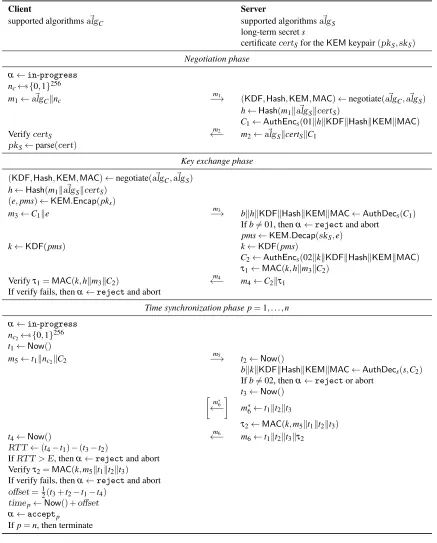
ANTP is divided into four separate phases. A detailed protocol flow can be found in Figure 2.
• Setup: The server chooses a long term key sfor the authenticated encryption algorithm. This is used to encrypt and authenticate offloaded server state between phases.
• Negotiation Phase: The client and server communi-cate supported algorithms; the server sends its certifi-cate and stateC1, an authenticated encryption (using
s) of the hash of the message flow. The valueC1will
be later used to authenticate negotiation.
• Key Exchange Phase: The client uses a key encap-sulation mechanism (KEM) based on the server’s public key from its certificate to establish a shared key with the server. The client sends the KEM ci-phertext and encrypted stateC1to the server. The
server derives the shared keyk, then encrypts it (us-ings) to computeC2. The server replies with a MAC
(for key confirmation) and offloaded stateC2(for use
in the next phase).
• Time Synchronization Phase: The client sends a time synchronization request and includes offloaded server stateC2. The server recoverskfromC2and
uses it to derive a fresh key to authenticate the re-sponse, which the client verifies. The client can also request “no-cryptographic-latency” time syn-chronization, where the server will immediately re-ply without authentication, and then send a second message with authentication.
3.2
Design Rationale and Discussion
Of the security properties discussed in RFC 7384 [19], ANTP achieves the following:protection against manipu-lation, spoofing, replay and delay attacks; authentication of the server(if ANTP is applied in a chain, implicit authentication of primary server);key freshness; avoids degradation time synchronization; minimizes computa-tional load; minimizes per-client storage requirements of the server. The following properties from [19] are only partly addressed by ANTP, which we explain in fur-ther detail below: resistance against therogue master,
cryptographic DoSandtime-protocol DoSattacks. Stateless server. While storage costs are gener-ally not an issue, synchronizing state between multiple servers implementing a high-volume network endpoint liketime.windows.comis still expensive and compli-cated to deploy. For reliability and performance these servers are often in multiple data centers, spread across multiple geographic regions. In ANTP the server regen-erates per-client state as needed. Our construction uses
authenticated encryption (AE)in a similar manner to TLS Session Tickets [26] for session resumption, where the server authenticates and encrypts its per-client state using a long-term symmetric key, then sends the ciphertext to the client for storage. The client responds with the cipher-text in order for the server to decrypt and recover state. The server periodically refreshes the long-term secret key for the AE scheme (the intervals are dependent on the security requirements of the AE scheme).
au-Client Server
supported algorithmsalg~ C supported algorithmsalg~ S
long-term secrets
certificatecertSfor theKEMkeypair(pkS,skS)
Negotiation phase
α←in-progress nc←${0,1}256 m1←alg~ Cknc
m1
−→ (KDF,Hash,KEM,MAC)←negotiate(alg~ C, ~algS)
h←Hash(m1kalg~
SkcertS)
C1←AuthEncs(01khkKDFkHashkKEMkMAC)
VerifycertS
m2
←− m2←alg~ SkcertSkC1
pkS←parse(cert)
Key exchange phase
(KDF,Hash,KEM,MAC)←negotiate(alg~ C, ~algS)
h←Hash(m1kalg~
SkcertS) (e,pms)←KEM.Encap(pks)
m3←C1ke −→m3 bkhkKDFkHashkKEMkMAC←AuthDecs(C1)
Ifb6=01, thenα←rejectand abort pms←KEM.Decap(skS,e)
k←KDF(pms) k←KDF(pms)
C2←AuthEncs(02kkkKDFkHashkKEMkMAC)
τ1←MAC(k,hkm3kC2) Verifyτ1=MAC(k,hkm3kC2)
m4
←− m4←C2kτ1
If verify fails, thenα←rejectand abort
Time synchronization phase p=1, . . . ,n
α←in-progress nc2←${0,1}
256
t1←Now()
m5←t1knc2kC2
m5
−→ t2←Now()
bkkkKDFkHashkKEMkMAC←AuthDecs(s,C2)
Ifb6=02, thenα←rejector abort t3←Now()
m∗6
←−
m∗6←t1kt2kt3
τ2←MAC(k,m5kt1kt2kt3)
t4←Now() ←−m6
m6←t1kt2kt3kτ2
RTT←(t4−t1)−(t3−t2)
IfRTT>E, thenα←rejectand abort Verifyτ2=MAC(k,m5kt1kt2kt3) If verify fails, thenα←rejectand abort
offset=12(t3+t2−t1−t4)
timep←Now() +offset
α←acceptp Ifp=n, then terminate
Figure 2: Authenticated NTP (ANTPE), whereEis a fixed upper bound on the desired accuracy. The pre-determined
negotiation function negotiate takes as input two ordered lists of algorithms and returns a single algorithm.ndenotes the maximum number of synchronization phases, andpdenotes the current synchronization phase.[m∗6]indicates an optional message sent based on a “no-cryptographic-latency” flag present inm5, omitted in this figure. Note that if
thenticated protocol is also bound by the total round-trip time of the time synchronization phase.
Since cryptographic computations over the synchro-nization messages adds asymmetrically to propagation time, it introduces error in the approximation of propa-gation time ˜θ3, so authentication operations degrade the
accuracy of thetransmit timestampin theresp. As noted above, ANTP includes a “no-cryptographic-latency” mode to reduce error due to authentication: during the Time Synchronization Phase, at the client’s option, the server will immediately process arespas in Figure 1 and sends it to the client, without authentication. The server subsequently creates an ANTPServerResp mes-sage, and sends therespwithServerRespin the NTP extension fields of the savedresp. A client can then use the time when receiving the initialrespto set its clock, but only after verifying authentication with the ANTP ServerResp, aborting if authentication fails, if either message wasn’t received, or if messages were received in incorrect order. Here, cryptographic processing time does not introduce asymmetric propagation time. (The TESLA broadcast authentication protocol of Perrig et al. [23] de-lays authentication as well, to improve efficiency rather than accuracy as in ANTP.)
Efficient cryptography. Public-key operations are com-putationally expensive, especially in the case of a server servicing a large pool of NTP clients. ANTP only re-quires a single public-key operation per-client to ensure authentication and confidentiality of the premaster secret key material. The client can reuse the shared secret key on multiple subsequent time synchronization requests with that server. ANTP uses akey encapsulation mech-anismfor establishing the shared secret key. We allow either static-ephemeral elliptic curve Diffie-Hellman key exchange or key transport using RSA public key encryp-tion. While one might ordinarily avoid use of RSA or static-ephemeral DH for key exchange since they do not provide forward secrecy, this is not a concern for ANTP since we do not need confidentiality as the contents of the messages (time synchronization data) are public.
Key freshness and reuse. ANTP allows multiple time synchronization phases for each session using the same shared secret keykbut with a new nonce in each Time Synchronization Phase to prevent replay attacks and en-sure uniqueness of the protocol flow. This reuse can continue until either the client restarts the negotiation phase or the server rotates public keys or authenticated encryption keys.
Denial of service attacks. Against a man-in-the-middle, some types of denial-of-service (DoS) attacks are unavoid-able, as the adversary may always drop messages.
Amplification attacks can be of concern. Unauthenti-cated SNTP has a roughly 1:1 ratio of attacker work to
server work, in that one attack packet causes one packet in response, and a small computational effort is required by the server. In ANTP, the cryptographic operations do allow some amplification of work. Based on the ex-perimental results in Table 1, the negotiation and time synchronization phases have less than a 1:2 ration of at-tacker work to server work. As for the key exchange phase, the server performs a public key operation while a malicious client may not. However, a server under attack can temporarily stop responding to key exchange requests while still responding to time synchronization requests, and since most honest clients will perform key exchange infrequently, their service will not be denied.
Another amplification can be caused by the no-cryptographic-latency feature, since two response packets are sent for each request. This mode can be turned off during attack, the server indicating with a flag that it does not (currently) support this feature.
Finally, in the negotiation phase the server’s response is also considerably larger than the client request (be-cause it includes a certificate), but, like the key exchange phase, the negotiation phase may be temporarily disabled without denying service to clients who already have estab-lished a premaster secret. Another option is to replace the server certificate chain with a URL where the client can download it. Depending on the size of the certificate(s) this could reduce the bandwidth amplification consider-ably. This last mitigation requires detailed analysis, which we leave to future work.
on a valid ANTP response, and ignore NTP responses. For similar reasons, clients are not recommended to im-plement a fall back from ANTP to NTP.
4
Implementation and Performance
Here we describe our instantiation of ANTP in terms of cryptographic primitives used as well as its implementa-tion and performance testing.
4.1
Instantiation and Implementation
We instantiate ANTP using the following cryptographic algorithms. We use AES128-GCM as the symmetric encryption algorithm for the server to encrypt and de-crypt state, SHA-256 as the hash algorithm, and HMAC-SHA256 and HKDF-HMAC-SHA256 as the MAC and key deriva-tion funcderiva-tions respectively. We support two key encapsula-tion mechanisms, RSA key transport and static-ephemeral elliptic curve Diffie-Hellman:
• RSA key transport: InKeyGen, the public key and secret key are a 2048-bit RSA key pair.Encapis de-fined by selecting a keyk←${0,1}128and
encrypt-ingkusing the RSA public key with RSA-PKCS#1.5 encryption;Decapperforms decryption with the cor-responding RSA secret key.
• Static-ephemeral elliptic curve Diffie–Hellman: Let
Pbe the generator (base point) of the NIST-P256 elliptic curve group of prime orderq. InKeyGen, the secret key is sk←$Zq and the public key is pk=sk·P, where·denotes scalar-point multiplica-tion. InEncap, selectr←$Zqand computec←r·P
and k←KDF(ckX(r·pk)). In Decap, compute
KDF(ckX(sk·c)). KDF is HMAC-SHA256 and
X(Q)gives the x-coordinate of elliptic curve point
Q. This is the ECIES-KEM [31] which is IND-CCA secure under the elliptic curve discrete logarithm assumption in the random oracle model [4]. We implemented ANTP by extending OpenNTPD ver-sion 1.92 [36]. Our implementation relies on OpenSSL version 1.0.2f [37] for its cryptographic components; no-tably, this version included a recent high-speed assembly implementation of the NIST P-256 curve.
4.2
Performance
Methodology. We collected performance measurements for each of the negotiation, key exchange, and time syn-chronization phases. We wanted to know the maximum number of connections per second that could be supported in each phase, as well as the latency a client would ex-perience for a typical server. For comparison we also
collected performance measurements for unauthenticated NTP time synchronization phases.
Our experiments were carried out between two ma-chines acting as clients, and a single server machine run-ning ANTP. The server had an Intel Core i7-4770 CPU running at 3.40GHz with 15.6 GiB of RAM; we used two similar client machines, which in our experiments were always sufficient to saturate the server. The clients and server were connected over an isolated 1 gigabit local area network. The server was running Linux Mint 17.2 with no other software installed.
It is important to note that OpenNTPD is not multi-threaded, so the OpenNTPD server process runs on a single core, regardless of the number of cores on the machine. As the key exchange phase is CPU bound, in a threaded server implementation we expect key exchange phase throughput to increase linearly with the number of CPU cores until bandwidth is saturated.
For testing throughput (connections/second), we used our own multi-threaded UDP flooding benchmarking tool that sends static packets and collects the number of re-sponses, the average latency of those rere-sponses, and the number of dropped packets. We tuned the number of queries per second to ensure that the server’s (single) core had around 95% utilization, and that more client packets were sent than being processed, but not so many more that performance became degraded (i.e., the server dropped less than 1% of packets being received per second).
For testing individual phase latency, we again used our UDP benchmarking tool, this time measuring latency of a subset of connections while maintaining a particular background ANTP load at the server (either 50% or 90% of supported throughput), to measure the latency a client would experience at an unloaded or loaded server.
For testing total protocol runtime, we instrumented the OpenNTPD client to report the runtime of a single complete (all three phases) ANTP synchronization, again with background ANTP load as above.
Results – individual phases.
Table 1 shows the results of each phase. Results re-ported are the average of 5 trials. For throughput and individual phase latency, each trial was run for 100 sec-onds. For throughput, Table 1 reports the number of response packets received at the client machine.
Key exchange phases. As expected, server key ex-change throughput is higher when ECC is used for pub-lic key operations compared to RSA. This difference is explained by the relative costs of the underlying crypto-graphic operations: using OpenSSL’sspeedcommand for benchmarking individual crypto operations, the run-time of ECC NIST P-256 point multiplication is 8.62× faster than RSA 2048 private key operations, whereas we observe a 7.54×improvement in throughput for ANTP’s ECDH key exchange over ANTP’s RSA key exchange. Latency for RSA key exchange is approximately 2.9 times that of ECDH key exchange at 90% load.
Time synchronization phases.While ANTP time syn-chronization phases are more computationally intensive than unauthenticated NTP, throughput is reduced by only a factor of approximately 1.6. Since this phase is CPU bound, we expect a multi-threaded server implementa-tion to increase ANTP throughput. Latency increase for ANTP at 50% load is only about 14% and at 90% load is about 27%.
Results and extrapolation – all 3 phases. Since each client makes a full 3-phase time synchronization (negoti-ation, followed by key exchange, followed by time syn-chronization) relatively infrequently, it does not make sense to measure server throughput for complete 3-phase time synchronizations. We did measure latency of a 3-phase time synchronization to note the performance that a client would perceive on its initial synchronization. As expected, the total runtime of a client exceeds the sum of the latencies from each individual phase due to the client performing its own cryptographic operations.
It is interesting to note that latency slows as the server approaches load capacity. Future work on OpenNTPD and other NTP servers could include optimizations to re-duce latency and improve time synchronization accuracy under increasing load.
We can extrapolate from the individual phase results the client pool that ANTP could feasibly support running on the same hardware. For example, Windows by de-fault polls time servers every 9 hours [12]. Assuming this is true for all clients (and that the clients synchronize uniformly across the period) 175,644 time synchroniza-tion requests per second would correspond to a pool of 5,755,502,592 clients.
ANTP clients would choose how often to restart the ne-gotiation phase and we recommend doing so periodically to ensure the attack window from exposure of the symmet-ric key is limited. If keys are re-exchanged monthly, this is a ratio of 1:1:1440 for expected negotiation, key exchange, and time synchronization messages, which increases to 1:1:8640 if clients re-exchanged every 6 months. From these or other expected ratios, one could extrapolate the expected performance impact of using ANTP over NTP.
5
Security Framework
In this section we introduce our new time synchronization provable security framework for analyzing time synchro-nization protocols such as ANTP, NTP and the Precision Time Protocol. It builds on both the Bellare–Rogaway model [2] forauthenticated key exchangeand the Jager et al. framework forauthenticated and confidential chan-nel establishment[8]. Neither of those models however includes time. Schwenk [29] recently proposed a frame-work for modelling time in provable security analysis of protocols such as Kerberos: time is a global parameter and each party may query atime oracleto receive the time from the global time counter.
Our framework however models time as a counter that each party separately maintains, as the goal of the protocol is to synchronize these disparate counters. Additionally, the adversary in our execution environment has the ability to initialize each protocol run with a new time counter in-dependent of the party’s own counter, and controls when protocol runs can increment their counter, effectively giv-ing the adversary complete control of both the latency of the network and the computation time of the parties.
5.1
Execution Environment
There arenppartiesP1, . . . ,Pnp, each of whom is a proto-col participant. Each party generates a long-term key-pair
(ski,pki), and can run up tonsinstances of the protocol which are referred to as sessions. We denote thesth ses-sion of a partyPi asπis. Note that each sessionπis has access to the long-term key pair of the partyPi. In ad-dition, we denote withT andTcthe full transcript and
server-session maintained client transcriptTc.
Per-Session Variables. The following variables main-tained by each session:
• ρ∈ {client,server}: the role of the party. • id∈ {1, ...,np}: the identity of the party.
• pid∈ {1, . . . ,np}: the believed identity of the part-ner.
• α ∈ {accept,reject,in-progress}: the session status.
• k∈ {0,1}128: the session key.
• Tc∈ {{0,1}∗,/0}: ifρ=server, the transcript of
client messages, otherwiseTc=/0.
• T ∈ {0,1}∗: the transcript of messages sent and re-ceived.
• time∈N: a counter maintained by the session.
at will. The adversary can compromise long-term and session keys. Additionally, the adversary is able to set the clock of a party to an arbitrary time when beginning a session and control the rate at which time progresses during the execution of a session. The following queries model normal execution with adversary control of time:
• Create(i,r,t): The adversary actives a new ses-sion with partyPi, initializing it withπis.ρ=rand πis.time=t. Note that ifπis.ρ=client, thenπis responds with the first message of the protocol run. • Send(i,s,m,~∆): The adversary sends a messagem
to a sessionπis. PartyPiprocesses the messagem and responds according to the protocol specifica-tion, updating per-session variables and outputting some messagem∗if necessary. During message pro-cessing, the party may execute multiple calls to a distinguishedNow()procedure, modelling the party reading its current time from memory; immediately before the`th such call to theNow()procedure, the session’sπis.timevariable is incremented by∆`. The next queries model compromise of secret data: • Reveal(i,s): The adversary receives the session key
kof the sessionπis.
• Corrupt(i): The adversary receives the long-term secret-keyskiof the partyPi.
The following query allows additional adversary con-trol of the clock:
• Tick(i,s,∆): The adversary increments the counter
πis.timeby∆.
The vector~∆ inSend is necessary due to subtleties in the security framework: An adversary cannot issue
Tickqueries to a session during the processing of aSend
query, but a party may read its clock multiple times while processing a message and thus expect to receive differ-ent clock times. The vector~∆in theSendquery allows adversary control of this clock rate.
Note that our model assumes that during execution of a session, the clocks between two parties advance at the same rate, otherwise it does not make sense for two parties to try to synchronize their clocks at all. This im-plicitly assumes that the parties are in the same reference frame. Additionally, while computer clocks may progress at different rates, we are assuming that, over a relatively short period of time, like the few seconds for an execu-tion of the protocol, the difference in clock rate will be negligible. This will be formalized in Definitions 3 and 4 with the condition that the adversary advances thetime of matching sessions symmetrically: aTick(j,t,∑`i=1∆l) must be issued if session πtj matching πis exists when
Send(i,s,m,~∆)is issued.
Security Experiment. Thetime synchronization se-curity gameis played between a challengerC who im-plements allnpparties according to the execution
envi-ronment and protocol specification, and an adversaryA. After the challenger generates the long-term key pairs, the adversary receives the list of public keys and interacts with the challenger using the queries described above. Eventually the adversary terminates.
5.2
Security Definitions
The goal of the adversary, formalized in this section, is to break time synchronization security by causing any client session to complete a session with a time counter such that |πs
i.time−πtj.time|>δ, (whereπtjis the partner of the sessionπissuch thatπtj.id=πis.pid, andδ is an accuracy margin) or cause a sessionπis to accept a protocol run without having a matching session πtj. The adversary controls the initialization of the party’s clock in each session, and the rate at which the clock advances during each session, with the restriction that during execution of a session the adversary must advance the party and its peer at the same rate.
5.2.1 Matching Conversations and Authentication
Authentication is defined similarly to the approach of Bel-lare and Rogaway [2], by use of matching conversations. We use the variant of matching conversations employed by Jageret al. [8], and modify the definition to reflect client authentication of stateless servers.
Definition 1(Matching Conversations). We say a session
πismatchesa sessionπtjifπis.ρ6=πtj.ρandπis.T prefix-matchesπtj.T . For two transcripts T and T0, we say that
T is aprefixof T0if|T| 6=0and T0is identical to T for the first|T|messages in T0. Two transcripts T and T0
prefix-matchif T is a prefix of T0, or T0is a prefix of T .
Prefix-matching prevents an adversary from trivially winning the game by dropping the last protocol message after a session has accepted. Note that since our focus is clients authenticating stateless servers,
Definition 2(Stateless Server Authentication). We say that a sessionπisaccepts maliciouslyif:
• πis.α=accept;
• πis.ρ=client;
• no Reveal(i,s)orReveal(j,t)queries were issued before πis.α ←accept and πtj.T prefix-matches πis.T ;
• noReveal(i,s0)queries were issued beforeπis.α← acceptandπs
0
i .Tc=πis.Tc
• noCorrupt(j)query was ever issued beforeπis.α← accept, where j=πis.pid;
The firstRevealcondition preventsAfrom trivially winning the game by accessing the session key of the Test session. Similarly theCorruptcondition preventsA from trivially winning by decrypting the premaster secret with the session peer’s public-key. the possibility exists for an adversary to trivially win the game by replaying client messages to a second session and querying the second session withReveal. DisallowingRevealqueries in general is clearly too restrictive, so we prevent this in the second Revealcondition by disallowing Reveal
queries to server sessions sharing client contributions.
5.2.2 Correct and Secure Time Synchronization
The goal of a time synchronization protocol is to ensure that the difference between the two parties’ clocks is within a specified bound. A protocol isδ-correct if that difference can be bounded in honest executions of the protocol, andδ-accurate secure if that difference can be bounded even in the presence of an adversary.
Definition 3(δ-Correctness). A protocolT satisfiesδ -correctnessif, in the presence of a passive adversary that faithfully delivers all messages and increments in each partner session symmetrically, then the client and server’s clocks are withinδ of each other. More precisely, in the
presence of a passive adversary, for all sessionsπiswhere • πis.α=accept;
• πis.ρ=client;
• whenever A queries Send(i,s,m,~∆) or
Send(j,t,m0, ~∆0),Aalso queriesTick(j,t,∑`i=1∆`)
orTick(i,s,∑`i=1∆0`), respectively; and
• whenever Aqueries Tick(i,s,∆), orTick(j,t,∆0),
Aalso queriesTick(j,t,∆)orTick(j,t,∆0),
respec-tively;
we must also have that|πs
i.time−πtj.time| ≤δ. Definition 4(δ-Accurate Secure Time Synchronization).
We say that an adversaryAbreaks theδ-accuracyof a
time synchronization protocol if whenAterminates, there exists a sessionπiswith partner idπis.pid=j such that:
• πis.α=accept;
• πis.ρ=client
• A made no Corrupt(j) query before πis.α ← accept;
• Amade noReveal(i,s)orReveal(j,t)query before
πis.α←acceptandπtjmatchesπis;
• while πis.α = in-progress and A queried
Send(i,s,m,~∆) or Send(j,t,m0, ~∆0), then A also queriedTick(j,t,∑`i=1∆`)orTick(i,s,∑∆i=1∆0`),
re-spectively;
• while πis.α = in-progress and A queried
Tick(i,s,∆), orTick(j,t,∆0), thenAalso queried
Tick(j,t,∆)orTick(j,t,∆0), respectively; and
• |πs
i.time−πtj.time|>δ.
The probability an adversary A has in breaking δ
-accuracy of a time synchronization protocolT is denoted
AdvtimeT,δ(A).
5.3
Multi-Phase Protocols
Our construction in Section 3 has a single run of the ne-gotiation and key exchange phases, followed by multiple time synchronization executions reusing the negotiated cryptographic algorithms and shared secret key. To model the security of suchmulti-phasetime synchronization pro-tocols, we further extend our framework so that a single session can include multiple time synchronization phases. The differences from the model described in the previous section are detailed below.
Per-Session Variables. The following variables are added or changed:
• n∈N: the number of time synchronization phases allowed in this session.
• timep, for p∈ {1, . . . ,n}: the time recorded at the conclusion of phasep.
• α ∈ {acceptp,reject,in-progress}, for p ∈ {1, . . . ,n}: the status of the session. Note that, when phasepconcludes andα←acceptpis set, the party also setstimep←time.
Adversary Interaction. The adversary can direct the client to run an additional time synchronization phase with a new Resync query, and the client will respond according the protocol specification. TheCreatequery in this setting is also changed:
• Create(i,r,t,n): Proceeds as forCreate(i,r,t), and also setsπis.n←n.
• Resync(i,s,~∆) - The adversary indicates to a
ses-sionπisto begin the next time synchronization phase. PartyPiresponds according to protocol specification, updating per-session variables and outputting some messagem∗if necessary. During message process-ing, immediately before the`th call to theNow()
procedure, the session’sπis.timevariable is incre-mented by∆`.
The goal of the adversary is also slightly different to ac-count for the possibility of breaking time synchronization of any given time synchronization phase: the adversary’s goal is to cause a client session to haveanyphase where its time is desynchronized from the server’s. In particular, for there to be some client instanceπisand some phase
psuch that|πs
Definition 5(δ-Accurate Secure Multi-Phase Time Syn-chronization). We say that an adversaryAbreaks the δ-accuracyof a multi-phase time synchronization proto-col if whenAterminates, there exists a phase p session
πiswith partner idπis.pid=j such that:
• πis.ρ=client
• πis.α=acceptqfor some q≥p;
• Adid not make aCorrupt(j)query beforeπis.α← acceptpwas set;
• Adid not make aReveal(i,s)orReveal(j,t)query beforeπis.α←acceptpwas set andπtjmatchesπis;
• while πis.α = in-progress and A queried
Send(i,s,m,~∆) or Send(j,t,m0, ~∆0), then A also queriedTick(j,t,∑`i=1∆`)orTick(i,s,∑`i=1∆0`),
re-spectively;
• while πis.α = in-progress and A queried
Tick(i,s,∆), orTick(j,t,∆0), thenAalso queried
Tick(j,t,∆)orTick(j,t,∆0), respectively; and
• |πs
i.timep−πtj.timep|>δ.
The probability an adversary A has in breaking δ -accuracy of multi-phase time synchronization protocol
T is denotedAdvmulti-timeT, δ (A).
6
Security of ANTP
In this section we present our correctness and security theorems on ANTP.
6.1
Correctness
Theorem 1(Correctness of ANTP). FixE∈N.ANTPE
is anE-correct time synchronization protocol as defined in Definition 3.
Proof. When analyzing ANTP in terms of correctness, we can restrict analysis to data that enters the clock-update procedure as input, as the rest of the protocol is designed to ensure authentication and does not influence the ses-sion’stimecounter. This allows us to narrow our focus to SNTP, which is the time synchronization core of ANTP.
We first focus on a single time synchronization phase. At the beginning of the time synchronization phase of ANTP, the client will send an NTP request (req) which containst1, the time the client sentreq. Note that the
adversary is restricted to delivering the messages faith-fully as a passive adversary, and also must increment the time of each protocol participant symmetrically. The ad-versary otherwise has complete control over the passage of time. Thusθ1, θ2,θ3are non-negative but otherwise
arbitrary values selected by the adversary (whereθ1is
the propagation time from client to server,θ2is server
processing time andθ3is propagation time from server
to client). Thus the client computes the round-trip time
of the protocol as:RTT= (t4−t1)−(t3−t2) =θ1+θ3
and approximates the server-to-client propagation time as ˜
θ3=12(θ1+θ3).
When the client-to-server and server-to-client propaga-tion times are equal (θ1=θ3) then ˜θ3=θ3, and the values
t3andt2allow the client to exactly account forθ2. The
timecounter is updated bytime+offset=t3+θ˜3−t4,
and upon completion the client’s clock is exactly synchro-nized with the server’s clock.
When θ16=θ3, we have that θ3−θ˜3= 12(θ3−θ1),
so the statisticst1, ...,t4 do not allow the client to
ex-actly account for client-to-server propagation timeθ3;
the client’s updated time may be off by up to12(θ3−θ1).
Fortunately, we can bound this value byE: we know that12(θ3−θ1)≤12(θ1+θ3), and furthermore we know
thatANTPEwill only accept time synchronization when
1
2(θ1+θ3)≤E, so in sessions that accept (assuming a
passive adversary) we have that the client’s clock is at most12(θ3−θ1)≤Edifferent from the server’s clock.
Now moving to the multi-phase setting, we note that this analysis of the correctness of ANTP applies to each separate time synchronization phase: since the client’s
(t1,t4)values are only used to calculate the total
round-trip time of the time synchronization phase, thus if the rate-of-time for both client and server during the phase is the same, each phase is alsoE-accurate in the presence of a passive adversary, even if the adversary dramatically changes the rate-of-time for partners between time syn-chronization phases.
6.2
Security
Security of a single 3-phase execution of ANTP in the sense of Definition 4 is given by Theorem 2 below. Se-curity of multiple phases in the sense of Definition 5 follows with a straightforward adaptation; details appear in Appendix B.
Intuitively, the bound on the possible error that anA can introduce without altering packets is as in Section 3. It follows then that if all messages are securely authenti-cated, and the only inputs to the clock-update procedure are either:
• authenticated via messages, or • the round trip delayRTT,
then any attacker can only introduce at mostEerror into the clock-update procedure (whereE≥RTT).
Theorem 2(Security of ANTP). FixE∈Nand letλ
be the length of the nonces in m1 and m5 (λ =256).
AEare secure, thenANTPEis aE-accurate secure time synchronization protocol as in Definition 4. In particular, there exist algorithmsB3, . . . ,B8, described in the proof
of the theorem, such that, for all adversariesA, we have
AdvtimeANTP
E,E(A)≤
n2pn2s
2λ−2+n 2
pn2s
AdvcollHash(B3A) +AdvAEAuthEnc(B4A) +Advind-ccaKEM (B5A)
+AdvkdfKDF(B6A) +AdvAEAuthEnc(BA7) +Adveuf-cmaMAC (B8A)
where npand nsare the number of parties and sessions
created byAduring the experiment.
The standard definitions for security of the un-derlying primitives and the corresponding advantages AdvAuthEncAE (A), Advind-ccaKEM (A), AdvcollHash(A), Adveuf-cmaMAC
(A), and AdvkdfKDF(A)are given in Appendix A.
Proof. From Theorem 1, ANTPE is anE-correct time
synchronization protocol in the sense of Definition 3. Thus all passive adversaries have probability 0 of break-ingE-accuracy ofANTPE. If we show that the advantage
AdvauthANTP
E(A)of any adversaryAof breaking
authentica-tion security (i.e., to accept without session matching) of
ANTPEis small, then it follows that the advantage of any active adversaryAin breakingE-accuracy ofANTPEis similarly small. In other words, it immediately is the case that AdvtimeANTP
E,E(A)≤Adv
auth
ANTPE(A).
We now focus on bounding AdvauthANTP
E(A). In order to
show that an active adversary has negligible probability in breakingANTPEauthentication, we use a proof struc-tured as a sequence of games. We let Pr(breaki)denote the probability that the adversary causes some session to accept maliciously in gamei. We iteratively change the security experiment, and demonstrate that the changes are either failure events with negligible probability of occurring or that if the changes are distinguishable we can construct an adversary capable of breaking an un-derlying cryptographic assumption. Since the client will only accept synchronization if all three phases are prop-erly authenticated, the advantage of an active adversary is negligible given our cryptographic assumptions.
Game 0. This is the original time synchronization game described in§4: AdvauthANTP
E(A) =Pr(break0).
Game 1. In this game, we abort the simulation if any nonce is used in two different sessions by client instances. There are at most 2nsnp nonces used by client instances, each λ bits. The probability that a collision occurs among these values is(2nsnp)2/2λ, so: Pr(break0)≤Pr(break1) +
n2sn2p
2λ−2.
Game 2. Here, we guess the first client session to accept maliciously, aborting if incorrect. We select randomly
from two indices(i,s)←${1, . . . ,np} × {1, . . . ,ns} and
abort ifπis is not the first session to accept maliciously. Now the challenger responds toReveal(i,s)queries (if πis.α=accept) by aborting the game, as it follows that the guessed session cannot accept maliciously. There are at mostnpnsclient sessions, and we guess the first session to accept maliciously with probability at least 1/npns, so Pr(break1)≤npnsPr(break2).
Game 3. Here we guess the partner session to πis, by selecting from two indices(j,t)←${1, . . . ,np} ×
{1, . . . ,ns} and abort if πtj is not the partner session to πis.Now, the challenger answers Corrupt(j) and
Reveal(j,t)queries beforeπis.α←acceptby aborting the game, as it follows that the guessed session cannot accept maliciously. There are at mostnpns server ses-sions, and we guess the partner of the first session to accept maliciously with probability at least 1/npns, so Pr(break2)≤npnsPr(break3).
Game 4. Here we abort if a hash collision occurs, by computing all hash values honestly and aborting if there exists two evaluations(in,Hash(in)),(inˆ,Hash(in))ˆ
such thatin6=inˆ butHash(in) =Hash(in)ˆ . The simula-tor interacts with a Hash-collision challenger, outputting the collision if found. Thus: Pr(break3)≤Pr(break4) +
AdvcollHash(B3A).
Game 5. In this game, we abort if in server sessionπtj the ciphertext received inm3is not equal to the ciphertext
sent inm1but the output ofAuthDecsis not⊥.
We construct an algorithmB4Athat simulates Game 4 identically, except to interact with an AEchallenger in the following way: WhenPj needs to runAuthEnc orAuthDec,BA
4 uses its oracles to compute the required
value. In server sessionπtj, whenB4Areceives a ciphertext inm3that was not equal to the ciphertext sent inm1but the
output of theAuthDecoracle is not⊥, this corresponds to a ciphertext forgery, and thus: Pr(break4)≤Pr(break5) +
AdvAEAuthEnc(BA
4).
Game 6. In this game, sessions πis andπtj compute the session keykby applyingKDFto a random secret
pms0←$KEM.K, rather than the pmsthat was
encapsu-lated usingKEM.Encapand transmitted in ciphertexte. Any algorithm used to distinguish Game 5 from Game 6 can be used to construct an algorithm capable of distin-guishingKEMencrypted values via plaintext, thus break-ing IND-CCA security of the key encapsulation mecha-nism.
We construct a simulatorBA
5 that interacts with aKEM
challenger.B5Aactivates partyPjwith the public keypk received from the challenger.BA
5 responds identically to
queries fromAas in Game 5, except as follows: • BA
5 computes the KEM ciphertextefor the session
• BA
5 computesπis.k←KDF(pms)
• In anyPjsession wherem3contains the challenge
ciphertext above,BA
5 computes the session key as
k←KDF(pms).
• In any otherPj session wherem3does not contain
the challenge ciphertext above,BA
5 queries the
ci-phertext to itsDecaporacle to obtain the premaster secret and uses that as its input toKDFto compute the session keyk.
• BA
5 never needs to answer aCorrupt(j)query
be-cause of Game 3.
When the random bitbsampled by the KEM ind-cca chal-lenger is 0,pmsis truly the decapsulation of the ciphertext
e, in which caseBA
5 perfectly simulates of Game 5. When
b=1,pmsis random and independent ofe, in which case BA
5 perfectly simulates Game 6. Observe thatBA5 never
asks the challenge ciphertexteto its decapsulation oracle. An adversary capable of distinguishing Game 5 from Game 6 can therefore be used to break IND-CCA security ofKEM, so Pr(break5)≤Pr(break6) +Advind-ccaKEM (BA5).
Game 7. In this game, we replace the secret keykin sessionsπisandπtjwith a uniformly random valuek0from {0,1}lKDF wherel
KDF is the length of theKDFoutput,
instead of being computed honestly viak←KDF(pms). In Game 6, we replaced the premaster secret value
pmswith a uniformly random value fromKEM.K. Thus, any algorithm that can distinguish Game 6 from Game 7 can distinguish the output ofKDFfrom random. We explicitly construct such a simulatorBA
6 that interacts
with aKDFchallenger, and proceeds identically to Game 6, except: when computing k for πis, B6A queries the
KDFchallenger withpms; and when computingkforπtj, BA
6 setsπtj.k=πis.k. When the random bitb sampled by the KDFchallenger is 0, k=KDF(pms), and BA
6
provides a perfect simulation of Game 6. Whenb=1,
k←${0,1}lKDFandBA
6 provides a perfect simulation of
Game 7.
An adversary capable of distinguishing Game 6 from Game 7 can therefore distinguish the output ofKDFfrom random, so Pr(break6)≤Pr(break7) +AdvkdfKDF(B6A).
Game 8. In this game, in sessionπtjwe replace the con-tents of the ciphertextC2sent inm3with a random string
of the same length, and abort if the ciphertext received in
m5is not equal to the ciphertext sent inm3but the output
of theAuthDecsalgorithm is not⊥. We construct an algorithm BA
7 that interacts with
an AE challenger in the following way: BA7 acts ex-actly as in game 7 except for sessions run by partyPj. In sessionπtj, for the computation ofC2, B7A picks a
uniformly random binary string z0 of length equal to
z=kkKDFkHashkKEMkMACand submits(z,z0)to its
AuthEncoracle. For all other computations thatPj
in-volvingAuthEncsorAuthDecs,BA7 submits the query its
respectiveAuthEncorAuthDecoracle.
When the random bitbsampled by theAEchallenger is 0,C2contains the encryption ofz, soBA7 provides a
perfect simulation of Game 7. Whenb=1,C2contains
the encryption ofz0, soBA
7 provides a perfect
simula-tion of Game 8. An adversary capable of distinguish-ing Game 7 from Game 8 can therefore break the con-fidentiality ofAEand guessb. Additionally, ifBA
7
re-ceives a ciphertext inm5 that was not equal to the
ci-phertext sent in m3 but the output of theAuthDec
or-acle is not⊥, this corresponds to a ciphertext forgery, and thus BA
7 has broken the integrity of AE. Thus,
Pr(break7)≤Pr(break8) +AdvAEAuthEnc(BA7).
The effect of Game 8 is that, in the target session and its partner, the key used in the MAC computations is independent of the values transmitted.
Game 9. In this game, we abort when the sessionπis accepts maliciously. We do this by constructing a sim-ulatorBA
8 that interacts with the MACchallenger, but
computes τ1 and τ2 for πtj by querying hkm3kC2 and
m5kt1kt2kt3to theMACchallenger. B8Averifies MAC
tags forπs
∗
i∗ by again queryinghkm3kC2andm5kt1kt2kt3 to the MAC challenger and ensuring the MAC chal-lenger’s output is equal to the tag to be verified. Note that now that the keykis substituted for the key main-tained by theMACchallenger:kwas already uniformly random and independent of the protocol run, and by Game 2 and Game 3, the simulator already responds toReveal
queries toπisandπtjby aborting the security experiment. Thus these changes to the game are indistinguishable. When πis.α ←accept, BA
8 checks Pj to see if there is a matching session. Since by Game 1 all protocol flows are unique (by unique nonces), ifPjhas no match-ing session the adversary must have produced a valid MAC tag ˆτ1or ˆτ2such thatMAC.Tag(k,hkm3kC2) =τˆ1
orMAC.Tag(k,m5kt1kt2kt3) =τˆ2and (by Game 8) the
key k is uniformly random. BA
8 submits the
appro-priate pair(hkm3kC2,τˆ1),(m5kt1kt2kt3,τˆ2)to theMAC
challenger and aborts. Thus, Pr(break8)≤Pr(break9) +
Adveuf-cmaMAC (BA
8).
Analysis of Game 9. We now show that an active adver-sary has a probability negligibly close to 0 of forcing a client sessionπis∗∗ to accept maliciously in Game 9. We
briefly summarize the changes in games.
1. Nonces no longer collide for honest parties. Each transcriptπis.T will have unique honest matching sessionπtj.
2. Guess target session;Caborts ifReveal(i,s)query asked.
3. Guess partner session; C aborts if Corrupt(j) or
Reveal(j,t)query asked.