Abstract— Password-based authentication schemes are convenient, but vulnerable to simple dictionary attacks. Cryptographic secret keys are safe, but difficult to memorize. More recently, biometric information has been used for authentication schemes. Das proposed a biometric-based authentication scheme, but it has various vulnerabilities. Jiping et al. improved Das’s scheme, but some vulnerabilities remain. In this paper, we analyze the cryptanalysis of Jiping et al.’s authentication scheme and propose the security enhanced biometric-based user authentication scheme for the C/S System.
I. INTRODUCTION
Remote identity-based authentication schemes are based on using only passwords. The password-based authentication schemes are the simple and convenient method to have a user authenticated in order to provide services of a computing or communication system [1-7]. However, only passwords are easy to break by using simple dictionary attacks. To overcome this problem, cryptographic secret keys and passwords are used in the remote user authentication schemes [8-10]. But the long and random cryptographic keys are difficult to memorize. So they must be stored somewhere, it is very weak point. To solve problem, various biometric-based authentication schemes are proposed. Das proposed new authentication scheme but has various vulnerability [11], so Jiping et al proposed the security improved biometric-based user authentication scheme for C/S system than Das’s scheme [12]. But Jiping et al’s scheme still has security problems. In section 2, we study related works. In section 3, we briefly review the Jiping et al’s biometric-based remote user authentication scheme using smart cards. In section 4, we analyze the security vulnerability of Jiping et al’s authentication scheme and suggest solution. Finally, we conclude the paper in section 5.
II. RELATED WORKS
A. Smart card Attack
Various researchers have observed that confidential information stored in all smart cards could be extracted by physically monitoring power consumption like SPA and DPA. When a user loses a smart card, an attacker can analyze it. So various schemes leave it vulnerable to off-line password attacks. And attacker can be authenticate to server without user’s ID and password.
Younsung Choi is with the School of Information and Communication Engineering, Sungkyunkwan University, korea (e-mail: [email protected]). Dongho Won is with the School of Information and Communication Engineering, Sungkyunkwan University, korea (e-mail: [email protected]).
B. Biometric-based Authentication
Biometrics refers to the quantifiable data related to human characteristics and traits. Example include to fingerprint, face recognition, DNA, palm print, hand geometry, iris, retina, odour/scent, typing rhythm, gait, and voice. Biometrics-based authentication is used in identification and access control. Biometric information cannot be lost or forgotten and is very difficult to copy or share and forge or distribute. And also, biometric information cannot be guessed easily and is not easier to break than others.
C. Das’s Biometric-based User Authentication Scheme
Das proposed biometric-based remote user authentication which is inherently more reliable and secure than usual traditional password-based remote authentication schemes. But this scheme has security vulnerability to replay attack, denial-of-service attack, user impersonation attack, and password change problem. Moreover, this scheme does not provide mutual authentication between the user and server.
III. REVIEW OF JIPING ET AL.’S SCHEME
Das proposes biometric-based authentication scheme but this scheme is various security problems. To solve these problems, Jiping et al proposed improved biometric-based authentication scheme [12]. For convenience, we use notations shown in Table 1.
TABLEI: NOTATION
Notation Description
Ci Client
Si Server
Ri Registration center
PWi Password shared between 𝐶𝑖 and 𝑆𝑖
IDi Identity of the user 𝐶𝑖
Bi Biometric template of the user 𝐶𝑖
d(·) Symmetric parametric function
𝜏 Predetermined threshold
h(·) A secure one-way hash function
Xs A secret information maintained by the server
Rc A random number chosen by 𝐶𝑖
Rs A random number chosen by 𝑆𝑖
A || B Data 𝐴 concatenates with data 𝐵
A ⊕𝐵 XOR operation of 𝐴 and 𝐵
A. Registration Phase
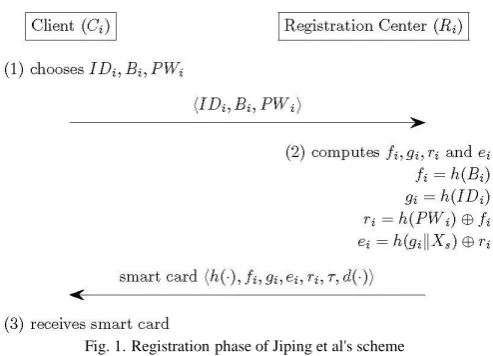
In the registration phase, remote user 𝐶𝑖 has to perform the following registration steps. Figure 1 shows the registration phase of Das scheme.
Cryptanalysis of and Improvement on Biometric-based
User Authentication Scheme for C/S System
Fig. 1.Registrationphase of Jiping et al's scheme
(1) The user 𝐶𝑖 inputs personal biometric 𝐵𝑖 on a device and sends the identity ID𝑖 and password PW𝑖 to the registration center 𝑅𝑖 in person.
(2) The registration center 𝑅𝑖 computes 𝑓𝑖 = h(𝐵𝑖), 𝑔𝑖 = ℎ(ID𝑖), 𝑟𝑖 = ℎ(PW𝑖)⊕𝑓𝑖, and 𝑒𝑖 = ℎ(𝑔𝑖 ‖ 𝑋𝑠)⊕𝑟𝑖. 𝑋𝑠 is secret information shared by Ri and Si. 𝑋𝑠 and passwords of the corresponding users are not disclosed to any others for all secure future communications.
(3) Registration center 𝑅𝑖 loads (h(·), 𝑓𝑖, 𝑔𝑖, 𝑒𝑖, 𝑟𝑖, 𝜏, 𝑑(·)) on the user’s smart card and sends this information to the user 𝐶𝑖
using a secure channel.
B. Login Phase
In the login phase, remote user 𝐶𝑖 has to perform the following login steps. Figure 2 show the login phase.
Fig. 2. Loginphase of Jiping et al's scheme
(1) 𝐶𝑖 first inserts user’s smart card into the card reader of a terminal and inputs user’s biometric template, 𝐵’𝑖, on the device. If 𝑑(𝐵𝑖, 𝐵’𝑖) > 𝜏, login phase is terminated. Otherwise, 𝐶𝑖 passes the biometric verification and then inputs user’s password PW𝑖.
(2) Smart card computes 𝑟’𝑖 = h(PW𝑖)⊕𝑓𝑖. If 𝑑(𝑟’𝑖, 𝑟𝑖) > 𝜏, then password is not correct, so the system terminates the session; otherwise, the smart card computes 𝑀1 = 𝑒𝑖⊕ 𝑟’𝑖,
which is equal to h(𝑔𝑖 || 𝑋𝑠), 𝑀2 = h(𝑅𝑐‖ 𝑇), where 𝑅𝑐 is a
random number generated by the user 𝐶𝑖 and 𝑇 is the current timestamp of 𝐶𝑖’s system, and 𝑀3 = 𝑀1⊕𝑀2.
(3) Finally, the user 𝐶𝑖 sends the message <𝑔𝑖, 𝑀2, 𝑀3, 𝑇>
to the remote server 𝑆𝑖.
C. Authentication Phase
In the authentication phase, remote user 𝐶𝑖 and server Si have to perform the following authentication phase. When the remote server 𝑆𝑖 receives the login message <𝑔𝑖, 𝑀2, 𝑀3, 𝑇>
at time 𝑇*, it will perform the following steps as shown in figure 3 to authenticate whether the user 𝐶𝑖 is legitimate or not. Figure 3 show the authentication phase.
(1) Check T. If (𝑇*− 𝑇) > Δ𝑇, the authentication phase is terminated, where Δ𝑇 is the expected time interval for the transmission delay of the system. Otherwise, if (𝑇*− 𝑇) ≤ Δ𝑇, the authentication steps will be performed.
(2). 𝑆𝑖 checks the accuracy of 𝐶𝑖’s ID𝑖. It computes 𝑀4 = h(𝑔𝑖‖ 𝑋𝑠) using the secret value 𝑋𝑠 maintained by the server 𝑆𝑖
and then computes 𝑀5 = 𝑀4⊕𝑀3 and verifies whether 𝑀5 =
𝑀2 or not. If it does not accurate, then 𝑆𝑖 rejects 𝐶𝑖’s login
request. The verification is successful, the next step will be performed.
(3) 𝑆𝑖 computes 𝑀6 = h(𝑅𝑠‖ 𝑇𝑠) and 𝑀7 = 𝑀4⊕𝑀6, where
𝑇𝑠 is the timestamp of the server 𝑆𝑖, and then 𝑆𝑖 sends message ⟨𝑀4, 𝑀6, 𝑀7, 𝑇𝑠⟩ to the user 𝐶𝑖.
(4) After receiving the message ⟨𝑀4, 𝑀6, 𝑀7, 𝑇𝑠⟩ at time
𝑇**, 𝐶𝑖 checks the freshness of 𝑇𝑠 by verifying (𝑇** − 𝑇𝑠) > Δ𝑇. If it holds, the following session is terminated; otherwise 𝐶𝑖
computes 𝑀8 = 𝑀4⊕𝑀7 and then verifies whether 𝑀8 = 𝑀6.
If it does not hold, 𝐶𝑖 terminates the session. Otherwise, it goes to the next step.
(5) 𝐶𝑖 computes 𝑀9 = 𝑀4⊕ 𝑀6 and then verifies whether
𝑀9 = 𝑀7. If it does not hold, 𝑆𝑖 is rejected by 𝐶𝑖; otherwise, if
it holds, 𝐶𝑖 computes 𝑀10 = h(𝑅𝑐|| 𝑇’), where 𝑇’ is the current
timestamp of the user 𝐶𝑖, and then computes 𝑀11 = 𝑀7⊕ 𝑀10
and sends the message ⟨𝑀11, 𝑅𝑐, 𝑇’⟩ to the remote server 𝑆𝑖.
Step 6. When 𝑆𝑖 receives the message ⟨𝑀11, 𝑅𝑐, 𝑇’⟩ at time
𝑇***, it checks (𝑇***− 𝑇’) > Δ𝑇. If it holds, the authentication phase is terminated. Otherwise, if it does not hold, 𝑆𝑖 computes 𝑀12 = h(𝑅𝑐||𝑇’) and then computes 𝑀13 = 𝑀4
⊕𝑀6⊕𝑀12. After computing 𝑀13, then 𝑆𝑖 verifies whether
𝑀13 = 𝑀11. If it holds, 𝑆𝑖 accepts 𝐶𝑖’s login request; otherwise,
𝑆𝑖 rejects the login request.
Fig 3. Authentication phase of Jiping et al's scheme
D. Password Change Phase.
In Jiping et al.’s scheme, user 𝐶𝑖 can freely change the password PWold𝑖 to a new one PWnew𝑖. The password change
procedure is performed as follows.
ℎ(𝐵’𝑖 ) and verifies it by checking 𝑑(𝑓’𝑖, f𝑖) ≤ 𝜏. Where 𝑓𝑖 = ℎ(𝐵
𝑖) is the information stored in the smart card.
(2) If it holds, 𝐶𝑖 inserts old password PWold𝑖 and new
password PWnew𝑖. Otherwise the password change procedure
is terminated.
(3) Smart card performs 𝑟’𝑖 = h(PWold𝑖 ) ⊕𝑓’𝑖 and checks
𝑑(𝑟’𝑖 , 𝑟𝑖) ≤ 𝜏. 𝑟𝑖 is the information stored in the smart card. (4) If it holds, the smart card computes 𝑟’𝑖 = h(PWnew𝑖) ⊕𝑓𝑖,
𝑒’𝑖 = 𝑒𝑖⊕𝑟𝑖(= h(ID𝑖 || 𝑋𝑠)), and 𝑒’’𝑖 = 𝑒’𝑖⊕𝑟𝑖.
(5) Finally, replace 𝑒𝑖 with e’’i and 𝑟𝑖 with 𝑟’’𝑖 on the smart card.
IV. CRYPTANALYSIS OF JIPING ET AL.’S SCHEME
Jiping et al enhanced the security of Das’s authentication scheme and proposed the new authentication scheme. But Jiping et al’s authentication scheme still has security problem. These problems are server masquerading attack, stolen smart card attack and authentication without login phase.
A. Server Masquerading Attack
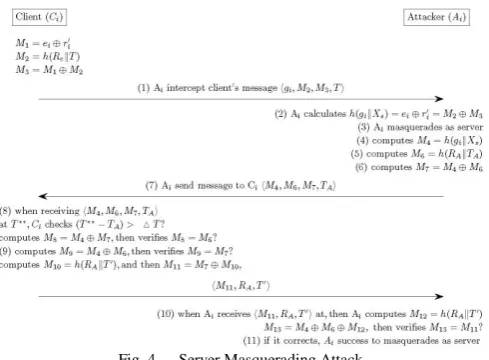
Attacker can masquerade as legitimate server if attacker knows h(gi || Xs). It is reason that server authenticates user using only h(gi || Xs). Figure 4 shows the phase of server masquerading attack. Firstly, attacker intercepts client’s message <gi, M2, M3, T>. Then, attacker calculates h(gi || Xs) using M2⊕ M3. Because h(gi || Xs) = 𝑒𝑖⊕𝑟𝑖 = M2⊕M3. The
attacker computes M4, M6, M7 and TA using h(gi || Xs) and sends them to client. The client check and authenticate messages. And the attacker receives M11, Rc and T’, then attacker checks the success to masquerades as server. The client is authenticated with the attacker. In Jiping et al’s scheme, the attacker can execute server masquerading attack. To solve this problem, it is necessary to add another security information to authenticate with server and client. The Attacker has to not compute the security information using communicate message between server and client.
Fig. 4. Server Masquerading Attack
B. Stolen Smartcard Attack
Kocher et al. and Messerges et al. pointed out that the confidential information stored in all existing smart cards could be extracted by physically monitoring its power consumption. Therefore, if the user loses his smart card, all secrets in the smart card may be revealed by attacker [13,14]. In Jiping et al.’s scheme, a smart card stores various secrets
for the login and authentication of user. The smart card for user IDi includes (h(·), 𝑓𝑖, 𝑔𝑖, 𝑒𝑖, 𝑟𝑖, 𝜏, 𝑑(·)). So if attacker gets
or steals user’s smart card, attacker can obtain and know fi, gi,
ri of useri. The attacker can calculate h(PWi) and h(IDi), then attacker executes off-line password attack using rainbow table, dictionary attack and brute attack. So the attacker can obtain
IDiand PWi. It is reason that IDi and PWi are protected using
h(·). To solve this problem, it is necessary to add random number with high-entropy. Figure 5 shows the phase of stolen smart card attack.
Fig. 5. Stolen smart card attack
C. Authentication without Login Phase.
In Jiping et al.’s scheme, attacker can be authenticate with server without login phase. To skip the login phase, the attacker need to still or get the user’s smart card. In other words, if the attacker obtain user’s smart card, the attacker can be authenticate to server without user’s IDi, PWi and user’s biometric information Bi. Figure 6 shows the phase of authentication without login phase.
Firstly, attacker gets or steals the user’s smart card and obtains information from smart card using SPA and DPA. So the attacker can generate and compute the Rc, M1, M2and M3 using this information. And the attacker sends ⟨gi, M2, M3, T ⟩ to the server. Then, the attacker receives ⟨𝑀4, 𝑀6, 𝑀7, 𝑇𝑠⟩ and
then, the attacker can computes ⟨M11, Rc, T’ ⟩ and send these messages to server. So attacker can be authenticated to the server without user’s IDi, PWi and the user’s biometric information Bi. To solve this problem, it is necessary to add information of user’s PWi or Bi to authentication messages.
V. PROPOSED SCHEME
In this section, to solve Jiping et al’s security problem, we propose security enhanced biometric-based user authent -ication Scheme for the C/S System.
A. Proposed registration phase
The registration procedure of proposed scheme is described in Fig. 7
Fig. 7 Proposed Registration Phase
B. Proposed login phase
And now, the login procedure of proposed scheme is described in Fig. 8
Fig. 8 Proposed Login Phase
C. Proposed authentication phase
The authentication procedure of proposed scheme is described in Fig. 9
Fig. 9 Proposed Authentication Phase
VI. CONCLUSION
In this paper, we analyze the cryptanalysis of Jiping et al.’s biometric-based user authentication scheme for the client/server system. Jiping et al. proposed an improved authentication scheme to solve the problem of vulnerabilities in Das’s scheme. However, Jiping et al.’s scheme has some remaining security problems: the server-masquerading attack, stolen smart-card attack and authentication without login phase. To solve this problem, it is necessary to add secret information to the registration, login and authentication phases. And we proposed security enhanced biometric-based user authentication Scheme for the C/S System.
REFERENCES
[1] C. T. Li, “An enhanced remote user authentication scheme providing
mutual authentication and key agreement with Smart Cards,” in
Proceedings of the 5th International IEEE Computer Society Conference on Information Assurance and Security, pp. 517–520, Xi’an, China, 2009.
[2] K. H. M. Wong, Z. Yuan, C. Jiannong, and W. Shengwei, “A
dynamic user authentication scheme for wireless sensor networks,” in
Proceedings of the IEEE International Conference on Sensor Networks, Ubiquitous, and Trustworthy Computing (SUTC ’06), pp. 244–251, Taichung, Taiwan, June 2006.
[3] T. H. Lee, “Simple dynamic user authentication protocols for wireless
sensor networks,” in Proceedings of the 2nd International Conference
on Sensor Technologies and Application pp.657–660,CapEsterel, France, August 2008.
[4] B. Vaidya, J. J. Rodrigues, and J. H. Park, “User authentication schemes with pseudonymity for ubiquitous sensor network in NGN,”
[5] N.-Y. Lee and Y.-C. Chiu, “Improved remote authentication scheme with smart card,” Computer Standards and Interfaces, vol. 27, no. 2, pp. 177–180, 2005.
[6] M. KimandC. K. Koc, “Asimple attackon a recently introduced
hash-based strong-password authentication scheme,” International
Journal of Network Security, vol. 1, no. 2, pp. 77–80, 2005..
[7] L.-C. Ko, “A novel dynamic user authentication scheme for wireless
sensor networks,” in Proceedings of the IEEE International
Symposium on Wireless Communication Systems, pp. 608–612, Reykjavik, Iceland, October 2008.
[8] J.Nam, K.K.R. Choo, M. Kim, J. Paik and D. Won, ”Dictionary
Attacks against Password-Based Authenticated Three- Party Key
Exchange Protocols”, KSII TRANSACTIONS ON INTERNET AND
INFORMATION SYSTEMS, Volume 7, NO. 12, December 2013, pp.3244-3260.
[9] J.Nam, K. K. R. Choo, J. Kim, Kang, H. K. Kim, J. Paik, and D. Won
(2014). Password-Only Authenticated Three-Party Key Exchange with Provable Security in the Standard Model. The Scientific World Journal, 2014.
[10] H. Jeong, D. Won and S. Kim, "Weaknesses and Improvement of Secure Hash-Based Strong-Password Authentication Protocol",
Journal of Information Science and Engineering, Volume 26, Number 5, September 2010, pp.1845-1858.
[11] A. K. Das, "Analysis and improvement on an efficient biometric-based remote user authentication scheme using smart cards." Information Security, IET 5.3 (2011): 145-151.
[12] L. Jiping, D. Yaoming, X. Zenggang, and L, Shouyin, “An Improved
Biometric-Based User Authentication Scheme for C/S System”,
International Journal of Distributed Sensor Networks, 2014. [13] P. Kocher, J. Jaffe, B. Jun, “Differential power analysis”, the 19th
Annual International Cryptology Conference on Advances in Cryptology, 1999, 388-397.
[14] T. S. Messerges,; E. A. Dabbish, R. H. Sloan, “Examining smart-card
security under the threat of power analysis attacks”, Computers. IEEE Transactions on Computers, 2002, 51(5), 541-552
[15] T. S. Messerges, E. A. Dabbish, and R. H. Sloan, “Examining