Available Online atwww.ijcsmc.com
International Journal of Computer Science and Mobile Computing
A Monthly Journal of Computer Science and Information Technology
ISSN 2320–088X
IMPACT FACTOR: 6.017
IJCSMC, Vol. 7, Issue. 12, December 2018, pg.59 – 78
State of ICT Enabled e-Governance
Landscape of India for Achieving
Sustainable Development Goals
Giribabu Dandabathula
1, Anjali Sharma
2, Pooja Karma
2, Chandrika Mohapatra
3,
Ch Sudhakar Reddy
4, S Srinivasa Rao
1, Peddineni V.V Prasada Rao
51
Regional Remote Sensing Centre – West, NRSC/ISRO, Jodhpur, India
2
Devi Ahilya Vishwavidyalaya, Indore, India
2
Devi Ahilya Vishwavidyalaya, Indore, India
3
Symbiosis International University, Pune, India
4
National Remote Sensing Centre, NRSC/ISRO, Hyderabad, India
1
Regional Remote Sensing Centre – West, NRSC/ISRO, Jodhpur, India
5
Andhra University, Vishakhapatnam, India
1 [email protected] 2 [email protected] 2 [email protected] 3 [email protected] 4 [email protected] 1 [email protected] 5 [email protected]
Abstract— Information and Communication Technologies (ICTs) enables electronic Governance (Governance). e-Governance is all about providing reliable and efficient online services to the citizens in a secure manner. e -e-Governance is currently being utilized by many developing countries to achieve Sustainable Development Goals (SDGs). The 17 SDGs are mirrored substantially in India's development plans and priorities through National Institution for Transforming India (NITI Aayog). NITI Aayog has mapped the goals and targets to various nodal ministries through flagship programmes. Government of India has launched several ambitious missions to accomplish all the targets of SDGs. During the course of launching these missions and schemes, numerous ICT tools have been development and deployed, which has helped to significantly enhance the efficiency of Government programmes. This paper presents the results of survey data which illustrates the state of ICT enabled landscape belonging to fifty three ministries via 431 web sites, 106 mobile applications, and 57 Geo-portals. Major schemes/mission projects implemented by various ministries were also depicted along with their responsibilities for achieving the targets of SDGs in India.
I. INTRODUCTION
Information and Communication Technologies (ICTs) has a significant role in achieving sustainable human development and poverty eradication [1]. As an accelerator, driver, multiplier and innovator, ICTs are powerful if not indispensable tools in the massive scaling up and interlinking of development interventions and outcomes [2]. ICT refers to the technologies such as the Internet, Intranets, Extranets, Enterprise resource planning (ERP) and other such technologies that cover the spectrum from basic infrastructure implementation to technologies that improve services and operations in an organization [3].
Most of the Governments of the developing countries are aiming to deliver reliable, efficient and quicker citizen centric services by reducing manual methods through the use of ICTs [4]. Electronic Governance or e-Governance is all about doing the business online and in a secure manner. The extent of coverage, usability, and enormous volumes of request processing with ease of delivery of services are some of the key success factors for any e-Governance initiatives and agencies are increasingly levering the massive advancements in ICT to drive these initiatives and reduce the digital divide [5]. e-Government in a broader perspective encompasses all the key factors of governance – better delivery of government services to citizens, improved interaction with business and industry, employee and citizen empowerment through access to information, and more efficient management, i.e., the use of ICT to transform the delivery of government services. ICT is an integral part of successful e-Government implementation [3].
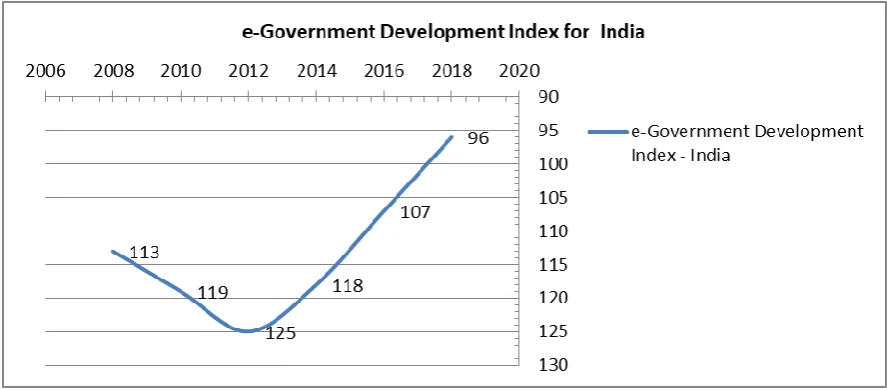
The United Nation‟s e-Government Development Index, which assesses e-Government development at the national level, is a composite index based on the weighted average of three normalized indices [6]. One-third is derived from a Telecommunications Infrastructure Index (TII) which is based on data provided by the International Telecommunications Union (ITU), one-third from a Human Capital Index (HCI) which is based on data provided by the United Nations Educational, Scientific and Cultural Organization (UNESCO), and one-third from the Online Service Index (OSI) which is based on data collected from an independent survey questionnaire, conducted by UNDESA, which assesses the national online presence of all 193 United Nations Member States [7, 8, 9, 10]. According to [11, 12, 13] it is reported that for the year 2018 “India‟s rank has improved by 22 places” and occupies the 96th position in the ranking. This is a quantum leap in achievement in the area of e-Governance. Figure 1 shows the chart that depicts the e-Government development index for India from the year 2008 till 2018. The motivation of this study is to investigate the triggering factors for the improvement of e-Government Development Index for India.
Fig. 1 United Nation‟s e-Government Development Index for India
The 17 SDGs are mirrored substantially in India's flagship programmes, priorities and is a part of development agenda of India [15]. The responsibility for overseeing SDG implementation has been assigned to the National Institution for Transforming India (NITI Aayog which is synonymous to commission on policy implementation), which is the premier policy think tank of the Indian Government and is chaired by the Prime Minister of India. NITI Aayog has mapped the goals and targets to various nodal ministries as well as flagship programmes [16, 17].
For implementing the SDG agenda, the Government of India has launched several ambitious programmes/schemes to accomplish all the 169 targets. During the course of launching these programmes, numerous ICT tools have been development and deployed, which has helped to significantly enhance the efficiency of Government functions. This article discusses the latest state of ICT enabled e-Governance landscape to achieve the sustainable development goals. The article takes aid of results obtained from a survey on the e-Governance activities that are planned and implemented by 53 ministries that are part of Indian Government. Results obtained from this survey were articulated as state of ICT enabled e-Governance landscape which has been correlated with the objectives of SDGs.
II. GENESIS OF E-GOVERNANCE, M-GOVERNANCE AND G-GOVERNANCE IN INDIA
The formulation of the National e-Governance Plan (NeGP) in 2006 has boosted the e-Governance process in India [18]. Ray [19] mentioned that “in the recent times majority of government initiatives are in the realm of e-Governance”. Projects like Direct Cash Transfer (DCT), Aadhar (which is a 12-digit unique identity number allotted to residents of India, based on their biometric and demographic data) Enabled Payment System (AEPS), Digital India program, MyGov Portal and „Digital Cloud for Everyone‟ program have gained much importance [20]. e-Governance laid the „foundation for better governance – efficient, economical and effective‟ in India [21]. Meity mentioned “The NeGP was conceptualized to focus on e-Governance initiatives at the national level with an aim to make all Government services accessible to the common man in his locality, through common service delivery outlets, and ensure efficiency, transparency, and reliability of such services at affordable costs to realize the basic needs of the common man" [22].
As an extension of the NeGP and in cognizance of the vast mobile phone subscriber base (about 935 million in the country as of 2017), the Government of India is providing public services through mobile devices [22]. Ministry of Electronics and Information Technology has laid a framework for mobile governance or m-Governance and is responsible for delivery of public information and services to citizens and stakeholders by leveraging wireless and new media technology platforms, mobile phones devices and mobile applications. Augmentation of m-Governance started from 23rd December 2013 under the guidance of Department of Electronics and Information Technology (DeitY). The m-Governance portal and the m-App Store can be accessed at http://mgov.gov.in/ and the service oriented statistics from this portal confirms that India Government is successful in implementing effective m-Governance and shows lot of improvement to the delivery of government services to the citizens with mobile technology. PIB mentions that „m-Governance has put Indian Governance within citizens reach‟ [21].
Geospatial Governance or g-Governance can be treated as a geospatial plug-in to e-Governance and 'can be' defined as an extended module of e-Governance with the additional functionality of geospatial technology. Bishop et al. [23] elaborated that the rapid proliferation of geospatial technologies includes advances in geodesy, photogrammetry, geophysics, computer science, statistics, remote sensing (RS) and geographic information systems (GIS) and webGIS. Geospatial tools and technologies provide information about locations, distances, directions, routes, travel time and cost, and the characteristics of places [24] in his submission specified that “the advantages of geospatial data will enable an unprecedented way to understand geographic relations among people, places and natural resources within and helps in decision making”.
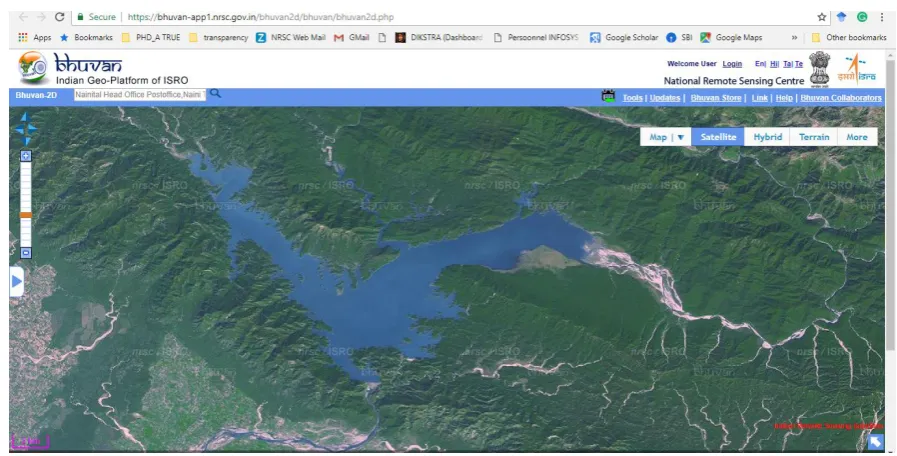
Zhao and Coleman [27] mentioned that “in recent times there is increased trend of using Web applications of e-governance and Web-based mapping due to the Internet revolution”. PIB [28] reported that “Bhuvan platform provides nation-wide seamless ortho-corrected image base, thematic datasets for natural resources, transport network, Digital Surface Model (DSM), hydrologic base (from basin to watershed) and millions of Points of Interest (POI) data. Bhuvan services include visualization of remote sensing data (India-centric), free satellite data download, geophysical products, host of thematic services and customized application tools for Government data collaboration and enabling g-Governance”. Bhuvan platform renders near real-time data and information support towards management of natural disasters (like floods, landslides, forest fires and cyclones) in the country [29]. Figure 2 depicts the screenshot of Bhuvan web portal (in citizen view mode) and its caliber for displaying highest possible resolution of data.
Fig. 2 Bhuvan web portal with its capability of satellite data dissemination
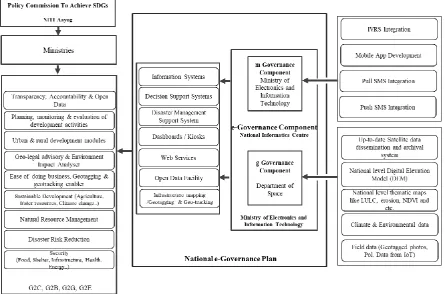
Services from e-Governance, m-Governance and g-Governance lead to the successful implementation of Government-to-Citizen (G2C), Government-to-Business (G2B), Government-to-Employee (G2E), and Government-to-Government (G2G) applications that would integrate all levels of government functions. The thrust given by mobile apps and the location based services of geospatial technology has enabled Indian government to achieve the feat of ICT based delivery of services. Figure 3 depicts the components of Indian e-Governance implementation.
Fig. 3 Components of Indian e-Governance system with National e-Governance Plan (NeGP) as a core and NITI Aayog as a program management role.
III.METHODOLOGY
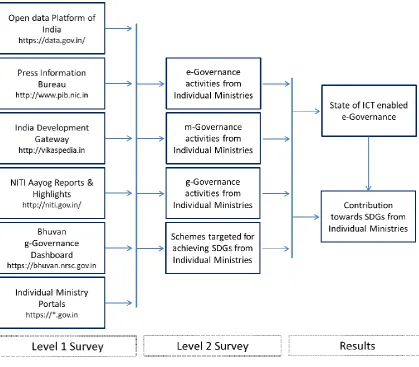
The methodology uses two levels of surveys. Level 1 of survey is intended to extract the information about e-Governance, m-e-Governance, g-Governance and schemes from various authentic dashboards, platforms and news reports from Indian Governments‟ websites. The second level of survey is used to compile the final state of ICT enabled e-Governance landscape and its mapping to achieve SDGs. Figure 4 depicts the methodology implemented for conducting the survey.
Fig. 4 Methodology flow for surveying the state of ICT enable e-Governance landscape
IV.RESULTS
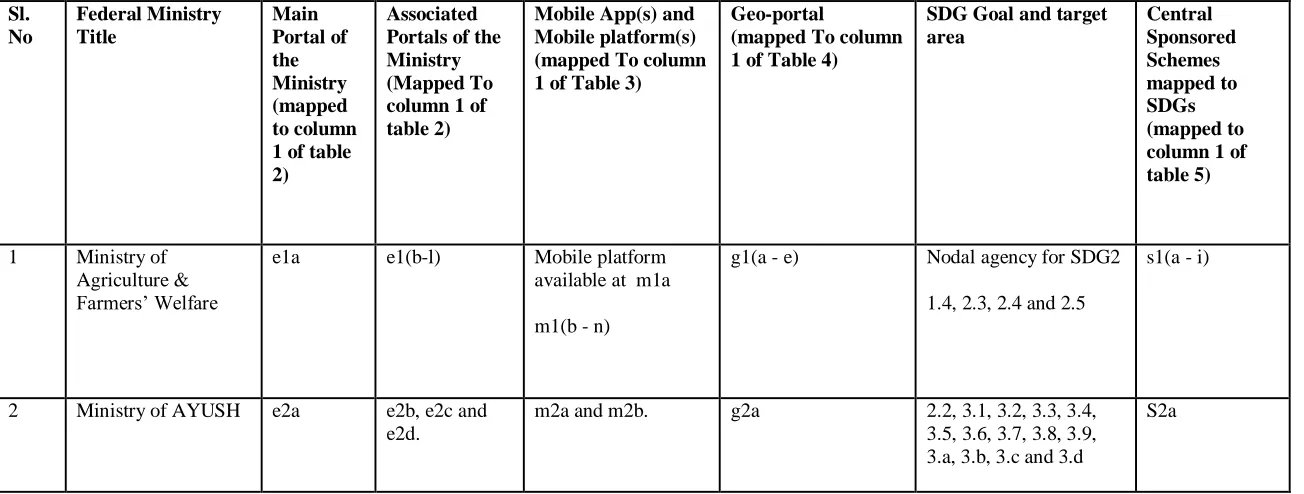
TABLE1
SUMMARY TABLE REPRESENTING THE ICT ENABLED E-GOVERNANCE LANDSCAPE FOR MINISTRY OF AGRICULTURE &FARMERS‟WELFARE AND MINISTRY OF AYUSH.(SOURCE:COMPLETE DATASET FOR 53
MINISTRIES CAN BE FOUND AS TABLE_1 FROM [37]).
Sl. No Federal Ministry Title Main Portal of the Ministry (mapped to column 1 of table 2)
Associated Portals of the Ministry (Mapped To column 1 of table 2)
Mobile App(s) and Mobile platform(s) (mapped To column 1 of Table 3)
Geo-portal
(mapped To column 1 of Table 4)
SDG Goal and target area Central Sponsored Schemes mapped to SDGs (mapped to column 1 of table 5)
1 Ministry of Agriculture & Farmers‟ Welfare
e1a e1(b-l) Mobile platform available at m1a
m1(b - n)
g1(a - e) Nodal agency for SDG2
1.4, 2.3, 2.4 and 2.5
s1(a - i)
2 Ministry of AYUSH e2a e2b, e2c and e2d.
m2a and m2b. g2a 2.2, 3.1, 3.2, 3.3, 3.4, 3.5, 3.6, 3.7, 3.8, 3.9, 3.a, 3.b, 3.c and 3.d
TABLE 2
E-GOVERNANCE PORTALS FOR MINISTRY OF AGRICULTURE &FARMERS‟WELFARE AND MINISTRY OF AYUSH.(SOURCE:COMPLETE DATASET FOR 53 MINISTRIES CAN BE FOUND AS TABLE_2 FROM [37]) Portal Code
(mapped to column 3 and column 4 of table 1)
Universal Resource Locator (URL) of the Portal Remark
e1a http://agriculture.gov.in/ Main Portal for Ministry of Agriculture and Farmers‟ Welfare
e1b https://pmfby.gov.in/ Portal for Pradhan Mantri Fasal Bima Yojana
e1c https://soilhealth.dac.gov.in/# Soil Health Card
e1d http://pmksy.gov.in/ Pradhan Mantri Krishi Sinchayee Yojana
e1e http://agmarknet.gov.in/# Agriculture Market – Connecting Farmers to Market
e1f http://enam.gov.in National Agriculture Market to Connect Farmer to the Trader
e1g http://rkvy.nic.in/
(Rashtriya Krishshi Vikas Yojana – State government‟s agriculture development plans)
e1h http://seednet.gov.in/ National initiative for information on quality seeds
e1i http://farmech.dac.gov.in Portal for mechanization and technology
e1j http://nfdb.gov.in/ Portal for national fisheries development
e1k http://cfqcti.dacnet.nic.in/ Portal for fertilizer quality control
e1l https://pgsindia-ncof.gov.in/
Portal to promote domestic organic market growth and also to enable small and marginal farmer to have easy access to organic certification.
e2a http://ayush.gov.in/ Ministry Portal (Ministry of AYUSH)
e2b http://ayushportal.nic.in/
AYUSH Research Portal - Evidence based research data of AYUSH systems at global level
e2d https://www.nmpb.nic.in/
Portal for National Medicinal Plants Board which is to help in developing appropriate mechanisms for coordination between various ministries/ departments/organizations in India and implements support
policies/programs for overall (conservation, cultivation, trade and export) growth of medicinal plants sector both at the Central /State and International level.
TABLE 3
LIST OF MOBILE APPS DEVELOPED BY MINISTRY OF AGRICULTURE &FARMERS‟WELFARE AND MINISTRY OF AYUSH.(SOURCE:COMPLETE DATASET FOR THE 53 MINISTRIES CAN BE FOUND AS TABLE_3 FROM [37]).
Portal Code (mapped to column 5 of table 1)
Mobile App title Universal Resouce Locator (URL) of the Portal Remark
m1a Mobile platform for Agriculture and Farmer‟s welfare
https://mkisan.gov.in/default.aspx Mobile platform for Agriculture and Farmer‟s welfare
m1b Kisan Suvidha app https://mkisan.gov.in/mApp/Kisan_Suvidha.apk It provides information on current weather and also the forecast for the next five days, market prices of commodities/crops in the nearest town, knowledge on fertilizers, seeds, machinery etc.
m1d Mkisan Application
https://mkisan.gov.in/mApp/mKisan.apk This app has been designed and developed by in-house IT team of DAC with the help of C-DAC Pune. It enables farmers and all other stakeholders to obtain advisories and information being sent by experts and government officials at different levels through mkisan portal without registering on the portal.
m1e Crop Insurance mobile app
http://farmer.gov.in/insurance/document/CropInsu rance.apk
Crop Insurance mobile app can be used to calculate the Insurance Premium for notified crops based on area, coverage amount and loan amount in case of loanee farmer. It can also be used to get details of normal sum insured, extended sum insured, premium details and subsidy information of any notified crop in any notified area.
m1f AgriMarket http://mkisan.gov.in/mApp/MarketRates.apk AgriMarket mobile app can be used to get the market price of crops in the markets within 50 km of the device‟s location. This app automatically captures the location of person using mobile GPS and fetches the market price of crops in those markets which falls within the range of 50 km. There is another option to get price of any market and any crop in case person does not want to use GPS location.
m1g Pashu Poshan https://play.google.com/store/apps/details?id=coo p.nddb.pashu_poshan
NDDB has developed android based software that can be used on phones as well as tablets. With the help of this software balanced ration is formulated while optimizing the cost considering animal profile, i.e. cattle or buffalo, age, milk production, milk fat, and feeding regime etc. and milk producers are advised to adjust the quantity of locally available feed ingredients offered to their animals along with mineral mixture.
m1h Digital Mandi India
https://play.google.com/store/apps/details?id=com .appkiddo.smartfarmer
This App helps in checking the latest Indian agricultural commodities Mandi prices from different states and districts.
m1j IFFCO Kisan Agriculture
https://play.google.com/store/apps/details?id=com .IFFCOKisan
App developed and managed by Indian Farmers‟ Fertilizer Cooperative Ltd (IFFCO Kisan). Its aim is to help Indian farmers make informed decisions through customized information related to their needs.
m1k Krishi Mitr https://play.google.com/store/apps/details?id=com .rml.Activities
RML Farmer is a one of its kind agricultural app where farmers can keep up with the latest commodity and mandi prices, precise usage of pesticides and fertilizers, farm and farmer related news, weather forecast and advisory.
m1l Kheti-badi app https://play.google.com/store/apps/details?id=com .bizaid.kheti_badi&hl=en
Kheti-badi is a social initiative App. It aims to promote and support „Organic Farming‟ and provide important information/issues related to farmers in India.
m1m AgriApp https://play.google.com/store/apps/details?id=com .criyagen&hl=en
It provides complete information on Crop Production, Crop Protection and all relevant agriculture allied services.
m1n Krishi Gyan https://play.google.com/store/apps/details?id=com .mixorg.krishidarshan.activities&hl=en
Apart from providing general information on farming, this application enables Indian farmers to connect with Krishi Gyan experts and ask them questions related to farming, and get answers within the application through notifications.
m2a Celebrating Yoga App
Google Play Store Acts as a platform to share information and insights about people‟s participation in Yoga activities
TABLE 4
LIST OF GEO-PORTALS DEVELOPED FOR/BY MINISTRY OF AGRICULTURE &FARMERS‟WELFARE AND MINISTRY OF AYUSH.(SOURCE:COMPLETE DATASET FOR 53 MINISTRIES CAN BE FOUND AS TABLE_4 FROM [37]).
Portal Code (mapped to column 6 of table 1)
Universal Resource Locator (URL) of the Portal Remark
g1a https://farmer.gov.in/ Geo-Portal to help Farmers and allied segment
g1b
https://bhuvan-app1.nrsc.gov.in/chaman/ Geo-portal for Coordinated programme on Horticulture Assessment and Management using Geoinformatics (CHAMAN)
g1c http://bhuvan.nrsc.gov.in/governance/shc/ Geo-portal for Soil Health Card scheme
g1d https://krishi.icar.gov.in/Geo_Portal.jsp KRISHI (ICAR) Geo-portal acts like a repository and visualization of Indian Agricultural Research Information.
g1e
https://bhuvan.nrsc.gov.in Bhuvan platform provides Land use land cover (LULC) data on yearly basis and every five year at 1:250000 scale and 1:50000 respectively. Programmatic outputs like SIS-DP yielded LULC data at 1:10000 scales were available in this platform. This platform act as data accumulation platform from field collection apps
TABLE 5
LIST OF SCHEMES THAT ARE IMPLEMENTED BY MINISTRY OF AGRICULTURE &FARMERS‟WELFARE AND MINISTRY OF AYUSH.(SOURCE:COMPLETE DATASET FOR 53 MINISTRIES CAN BE FOUND AS TABLE_5 FROM
[37]).
Scheme Code (mapped To column
8 of table 1)
Scheme title Universal Resource Locator (URL) of the Scheme
s1a National Food Security Mission https://www.nfsm.gov.in/
s1b Mission for integrated Development of Horticulture https://midh.gov.in/
s1c National Mission on Sustainable Agriculture https://nmsa.dac.gov.in/
s1d National Oilseed and Oil Palm Mission https://nmoop.gov.in/
s1e National Mission on Agriculture Extension and Technology Information provided in http://agricoop.nic.in
s1f Rashtriya Krishi Vikas Yojana (RKVY) (ACA & RAFTAAR) https://rkvy.nic.in/
s1g National Livestock Mission Information available at dahd.nic.in
s1h Livestock Health and Disease Control Information available at dahd.nic.in
s1i National Programme for Bovine Breeding and Dairy Development Information available at dahd.nic.in
Fig. 5 Part of website for National Food Security Mission (NFSM), a scheme implemented by Ministry of Agriculture and Farmer‟s Welfare towards achieving the target 2.3 of SDG 2.
e-Kranti [32] mentions that “the aim of Indian e-Governance efforts is to make all public services accessible to the common man in his locality, through common service delivery outlets and ensure efficiency, transparency and reliability of such services at affordable costs to realize the basic needs of the common man”. The result from this study conforms to this ambition. Figure 6 shows typical website for Ministry of Agriculture and Farmers‟ Welfare with all new web deployment technologies. The observation from the results also suggests that all the websites are using the latest technologies for website development/deployment which are highly responsive in nature and with high level of security. National Cyber Security Policy is a policy framework by Department of Electronics and Information Technology (DeitY); it aims at protecting the public and private infrastructure from cyber-attacks in India [33].
Fig. 6 Website for Ministry of Agriculture and Farmers‟ Welfare with rich content of accessible information and acts as a gateway for the delivery of services.
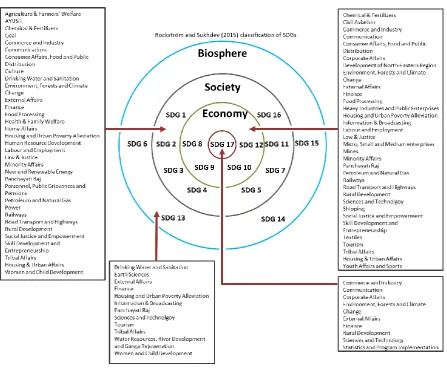
Fig. 7 Mapping of respective ministries to the SDG on Rockström and Sukhdev (2015) Classification of SDG.
At the economy level which includes SDGs like 8, 9, 10 and 12 deals primarily in the areas of economic growth, employment issues, infrastructure, industrialization, inequality issues, consumption and production. To achieve the goals in this level, ministries like 'Commerce and Industry', 'Corporate Affairs‟, „Environment, Forests and Climate Change', Finance, 'Housing and Urban Poverty Alleviation', 'Labour and Employment', Information & Broadcasting, 'Law & Justice', 'Social Justice and Empowerment', 'Skill Development and Entrepreneurship', Tourism, Tribal Affairs, 'Housing & Urban Affairs' and 'Youth Affairs and Sports' have incorporated effective e-Governance strategies.
For achieving SDG17 which embeds the goal of „Partnerships to achieve the Goal‟ is being supported by „Commerce and Industry‟, Communication, „Corporate Affairs‟, „Environment, Forests and Climate Change‟, „External Affairs‟, Finance, „Rural Development‟, „Sciences and Technology‟ and „Statistics and Program Implementation‟.
Fig. 8 Figure showing the campaign by Ministry of Agriculture & Farmer‟s Welfare to encourage the use of mobile apps like Kisan Suvidha and Pusa Krishi.
V. CONCLUSION
As reported by Shankar et al. [35] „e-Governance empowers the vision of minimum Government, maximum Governance and institutionalizes the digital data towards the fulfilment of the larger vision of Digital India efforts‟, the results from this study also shows that the push for e-Governance and Digital India has increased due to various booming sectors dealing with ICT, proliferating mobile devices and revolution in geographical information systems. Most of the ministries and departments at federal level and state level are able to leverage the power of ICT, mobile technology and Geospatial data along with their functions by accessing and consuming the services hosted on electronic platforms.
ESRI [36] expressed that the „concepts of e-Governance has emerged as one of the driving forces for the Governments by enabling the administration to re-design and improve its existing processes, connect with citizens and facilitate interactions with and within the society‟. Fact is, the combinational use of readily available Internet access, mobile platforms and geo-spatial information has enabled the Indian Government authorities to provide a new level of services to both private and the public. The following points describe the salient features of the results from the study.
G2B applications for natural resource management, sustainable land development, economic development and providing new avenues for corporate world
G2C applications for making online information on government services and to streamline interaction for transparency, accounting as well as citizen participation.
G2G applications have improved the amount, quality, and speed of information exchange within and among various levels of government.
G2E applications have provided better communication to enable employees use the resources more wisely.
WebGIS as a platform have provided facility to view the spatial data through internet and enabled possibility of monitoring and planning the developmental programs, disaster applications, infrastructure mapping and other possible sectors of applications.
Increased deployment of mobile apps by various ministries has enabled the potential for the use of mobile channel as a supplement to increase the accessibility and usage of the Government services in all possible sectors.
UNPAN report predicted that e-government has the potential to help support the implementation of the 2030 Agenda and its 17 sustainable development goals [10]. This survey finds that Indian e-government landscape has unleashed itself as an effective tool for facilitating integrated policies and public service by promoting accountable and transparency through open data and e-participation and participatory decision-making as well as by advancing online services to bridge the digital divides. Indian e-Governance has fostered the development through e-government with participation of 53 ministries and congregated the best practises, information and intelligent processes. The landscape shows that numerous public services were brought online in the recent years and this led to the development of digital government whereby back office procedures, as well as front office features were increasingly driven by technology. With the objective of ensuring the overarching objective of poverty eradication and 'Leaving No One Behind' as a key principal towards achieving the SDGs, Indian ICT based e-Governance strategy is making to realize the 2030 agenda demands.
R
EFERENCES
[1] Unwin T., ICT4D: Information and communication technology for development, Cambridge University Press, Cambridge, UK, 2009.
[2] United Nations, Global E-government Readines Report: Towards Access for Opportunity, The Department of Economic and Social Affairs, United Nations, New York. Retrieved on 2 November 2018 from https://publicadministration.un.org/egovkb/portals/egovkb/Documents/un/2004-Survey/Complete-Survey.pdf , 2004.
[3] Gupta, B., Dasgupta, S., Gupta, A., Adoption of ICT in a government organization in a developing country: An empirical study, The Journal of Strategic Information Systems 17(2), pp. 140-154, 2008.
[4] Ndou, V., E–Government for developing countries: opportunities and challenges, The Electronic Journal of Information System in Developing Countries 18(1), pp. 1-24, 2004.
[5] Vijaykumar, N., Role of ICT in E-Governance: Impact of Cloud Computing in Driving New Initiatives. SETLabs Briefings 9(2), pp. 43-55, Retrieved on 2 November 2018 from http://workspace.unpan.org/sites/Internet/Documents/UNPAN93452.pdf , 2001.
[6] UN e-Government Knowledge Base, Retrieved on 2 November 2018 from https://publicadministration.un.org/egovkb/en-us/ , 2018.
[7] UNPAN, UN e-Government Survey 2010, Leveraging E-government at a Time of Financial and Economic Crisis, New York: UNPAN, Retrieved on 2 November 2018 from http://unpan1.un.org/intradoc/groups/public/documents/un-dpadm/unpan038851.pdf ,2010.
[8] UNPAN, UN e-Government Survey 2012, E-Government for the People, New York: UNPAN. Retrieved on 2 November 2018 from http://unpan1.un.org/intradoc/groups/public/documents/un/unpan048065.pdf , 2012.
[9] UNPAN, UN e-Government Survey 2014. E-Government for the Future We Want, New York: UNPAN. Retrieved on 2 November 2018 from http://unpan3.un.org/egovkb/Portals/egovkb/Documents/un/2014-Survey/E-Gov_Complete_Survey-2014.pdf, 2014.
[10] UNPAN, UN e-Government Survey 2016. E-Government in Support of Sustainable Development, New
[11] UNPAN, UN e-Government Survey 2016 Gearing E-Government To Support Transformation Towards Sustainable And Resilient Societies, New York: UNPAN. Retrieved on 2 November 2018 from http://workspace.unpan.org/sites/Internet/Documents/UNPAN98558.pdf, 2018.
[12] Country Data, Retrieved on 2 November 2018 from https://publicadministration.un.org/egovkb/data-center, 2018.
[13] EGDI, Retrieved on 2 November 2018 from https://thelogicalindian.com/awareness/un-e-government-development/, 2018.
[14]. Stafford-Smith, M., Griggs, D., Gaffney, O., Ullah, F., Reyers, B., Kanie, N., Stigson, B., Shrivastava, P., Leach, M., O‟Connell, D., Integration: the key to implementing the Sustainable Development Goals. Sustainability Science 12(6), pp. 911-919, 2017.
[15] Panagariya, A., On the implementation of Sustainable Development Goals: Voluntary National Review Report. UN High Level Political Forum. Retrieved on 2 November 2018 from https://sustainabledevelopment.un.org/content/documents/15836India.pdf , 2018.
[16. Voluntary National Review, Retrieved on 2 November 2018 from https://sustainabledevelopment.un.org/memberstates/india, 2017.
[17] NITI, Mapping of the Ministries for Goals and Targets, Retrieved on 2 November 2018 from http://niti.gov.in/writereaddata/files/SDGsV20-Mapping080616-DG_0.pdf , 2018.
[18] Zoughbi, S., Major Issues Affecting Government Data and Information in Developing Countries. In Securing Government Information and Data in Developing Countries. IGI Global, pp. 115-126, 2017.
[19]. Ray, S.S, Critical analysis of e-Governance in India, Retrieved on 2 November 2018 from https://medium.com/@shilpisinharay/critical-analysis-of-e-governance-in-india-3343ed8fa357, 2017.
[20] PwC, Digital India - Targeting inclusive growth. PwC. India, Retrieved on 2 November 2018 from https://www.pwc.in/assets/pdfs/publications/2017/digital-india-targeting-inclusive-growth.pdf , 2017.
[21] PIB, Text of Speech by Prime Minister at the Digital India Dinner 26 September 2015, San Jose, California, Retrieved on 2 November 2018 http://pib.nic.in/newsite/PrintRelease.aspx?relid=128215 , 2015.
[22] Meity, Ministry of Electronics & Information Technology, Retrieved on 2 November 2018 http://meity.gov.in/ Accessed 02 October 2017.
[23]. Bishop, M.P., James, L.A., Shroder, Jr. J.F., Walsh, S.J., Geospatial technologies and digital geomorphological mapping: Concepts, issues and research, Geomorphology 137(1), pp.5-26, 2012.
[24] Downs, R.M., Coming of age in the geospatial revolution: The geographic self re-defined, Human Development 57(1), pp. 35-57, 2014.
[25] Anderson, K., Ryan, B., Sonntag, W.., Kavvada, A., Friedl, L., Earth observation in service of the 2030 Agenda for Sustainable Development. Geo-spatial Information Science 20(2), pp. 77-96. 2017.
[26] Paganini, M., Petiteville, I., Ward, S., Dyke, G., Steventon, M., Harry, J., Kerblat, F., Satellite Earth Observations in Support of the Sustainable Development Goals. European Space Agency. Retrieved on 2 November 2018 from http://eohandbook.com/sdg/files/CEOS_EOHB_2018_SDG.pdf , 2018.
[27] Zhao, J., Coleman, D.J., 2006, GeoDF: Towards a SDI-based PPGIS application for E-Governance. In Proceedings of the GSDI 9 Conference, Santiago, Chile. Retrieved on 2 November 2018 http://citeseerx.ist.psu.edu/viewdoc/download?doi=10.1.1.455.117&rep=rep1&type=pdf ,2006.
[29] Evangelidis, K., Ntouros, K., Makridis, S., Papatheodorou, C., Geospatial services in the Cloud. Computers & Geosciences 63, pp.116-122, 2014.
[30] Ono, T., Iida, K., Yamazaki, S., Achieving Sustainable Development Goals (SDGs) through ICT Services. FUJITSU Scientific & Technical Journal 53(6), pp.17-22., 2017.
[31] Sachs, J.D., Modi, V., Figueroa, H., Fantacchiotti, M.M., Sanyal, K., Khatun, F., Shah, A., ICT & SDGs. The Earth Institute, Columbia University, 2016.
[32] e-Kranti, Retrieved on 2 November 2018 http://meity.gov.in/content/e-kranti , 2018.
[33] National Cyber Security Policy, National Cyber Security Policy. Retrieved on 2 November 2018 http://meity.gov.in/content/national-cyber-security-policy-2013-0 , 2013.
[34] Rockström, J., Sukhdev, P., How food connects all the SDGs. Stockholm Resilience Centre , 2016.
[35] Shankar, R., Prajapati, J., Patel, A.N., Patel, K., Kalubarme, M.H., Innovative use of Geo-informatics Technology in e-Governance for District Urban Development Agency (DUDA), Narmada District, Gujarat State. International Journal of Advanced Remote Sensing and GIS 6 (1), pp. 2156-2170, 2017.
[36] ESRI, eGovernance, Retrieved on 2 November 2018 http://www.esri.in/industries/government/egovernance , 2018.