Article
1
Incorporating Sustainability into Engineering
2
Education Using e-Learning
3
Edmond Sanganyado 1,2
4
1 University of California, Riverside, 900 University Ave., Riverside, CA
5
2 Shantou University,
6
Abstract: The purpose of this study was to develop e-learning activities that integrated
7
sustainability concepts and practices in process engineering education. Two blended courses were
8
developed with two activities evaluated quantitatively and qualitatively to measure student
9
engagement, quality of responses, and incorporation of sustainability in their arguments. Social
10
network analysis and lexical analysis were used to assess students’ participation in discussions and
11
peer reviews. In the online discussion, 97 comments were made averaging 120 words per comment.
12
The participants averaged 3.88 comments, with the majority of comments exhibiting simple and
13
complex argumentation, a deep reflection, and widespread use of terms associated with
14
sustainability such as recycling, pollution, waste, and environment. Furthermore, evaluation of peer
15
reviews revealed that the participants demonstrated they could identify errors and positives in an
16
argument. Therefore, this study demonstrated that e-learning, particularly peer review and online
17
discussion could help chemistry and engineering students understand sustainability.
18
Keywords: sustainability; Green Engineering; curriculum development; chemical education;
19
engineering education
20
21
22
1. Introduction
23
Demonstration of an understanding of sustainability and societal and environmental is
24
considered a key engineering competency by several engineering societies.1 Hence, engineering
25
education could play a critical role in ensuring the SDGs are met by 2030. Industrialization and
26
urbanization are often credited for improving the standard of living and the life expectancy of people
27
worldwide. However, in the past century, industrialization and urbanization contributed to
28
significant deterioration of various environmental compartments, such as soil, water and the
29
atmosphere.2–5 For that reason, in 2016, the UNDP set seventeen sustainable development goals
30
(SDGs) focusing on eradication of poverty without compromising the environment or the future. The
31
National Research Council defined sustainability as “a path forward that allows humanity to meet
32
current environmental and human health, economic, and societal needs without compromising the
33
progress and success of future generations.”6 Many African nations have agriculture- and
mining-34
based economies that rely heavily on fossil fuels. Hence, a lack of sustainability directly affects their
35
national economies.
36
Applied chemistry graduates from local universities in developing nations are often employed
37
in the process industry. Hence, such curriculum often includes several process engineering courses
38
to improve their employability. The curriculum are often designed to ensure that upon completion
39
of studies, the students would demonstrate personal effectiveness, academic, workplace, and
40
industry-wide technical competencies (Figure 1).1 Process engineering courses focus on
industry-41
wide technical competencies, that is foundations of engineering, design, manufacturing and
42
construction, engineering economics, operations and maintenance, and safety. Although
43
sustainability and environmental impact is a core engineering competency, applied chemistry
44
curriculum does not often include classes on sustainable development. Sustainability could be
45
incorporated through creation of new elective courses. In the past 25 years, Green Engineering classes
46
were successfully developed in many universities in North America.6,7 Since curriculum development
47
is often expensive and time consuming, introduction of new Green Engineering courses has been
48
lacking in many African nations. However, professors often have autonomy over course content,
49
hence they can incorporate sustainability as term papers, assignments, quizzes or class discussions.
50
51
52
Figure 1. Engineering competencies addressed in the undergraduate applied chemistry
53
curriculum at a public university in Zimbabwe.
54
55
Blended learning can offer a unique opportunity of incorporating key sustainability concepts
56
and practices within the applied chemistry and engineering curricula.7 The recent developments in
57
technology, such as e-learning offer an opportunity for substantial growth in engineering education.
58
However, they are several challenges with implementing e-learning in Africa, and these include poor
59
internet access or connectivity, lack of locally developed learning material and lack of technical
know-60
how.8,9 Furthermore, online learning can be hindered by technological difficulties and lack of
61
community resulting in decrease of learner motivation.8 However, by combining face-to-face and
62
online learning, blended learning has been shown to be an effective alternative.10–12
63
It was hypothesized that student engagement and appreciation of sustainability in developing
64
nations could be improved through e-learning. Incorporating sustainability requires development of
65
content that address local issues.13 Hence, the goal of this project was to develop e-learning course
66
materials that emphasize the role of sustainability in process engineering. Furthermore, lexical
67
analysis was used to assess students’ participation in discussions and peer reviews.
68
2. Methodology
69
2.1. Participants
70
The participants in the study were 25 students from a public university in Zimbabwe. All the
71
students were in their final year at college. The students had varying experiences in online learning.
72
However, none of the students had previously enrolled in a blended learning class as part of their
73
curriculum. Course materials for the two courses were prepared on Canvas, a learning management
74
system. The participants accessed Canvas on their phones or using a computer.
75
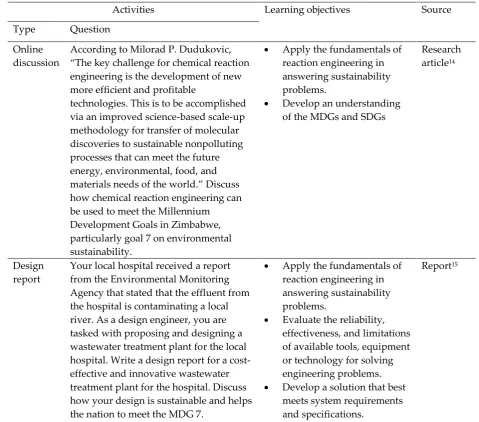
The types of activities, assessed questions, and the corresponding learning objectives are listed
77
in Table 1.
78
79
Table 1. Activities used in the incorporation of sustainability in process engineering.
80
Activities Learning objectives Source
Type Question
Online discussion
According to Milorad P. Dudukovic, “The key challenge for chemical reaction engineering is the development of new more efficient and profitable
technologies. This is to be accomplished via an improved science-based scale-up methodology for transfer of molecular discoveries to sustainable nonpolluting processes that can meet the future energy, environmental, food, and materials needs of the world.” Discuss how chemical reaction engineering can be used to meet the Millennium Development Goals in Zimbabwe, particularly goal 7 on environmental sustainability.
• Apply the fundamentals of reaction engineering in answering sustainability problems.
• Develop an understanding of the MDGs and SDGs
Research article14
Design report
Your local hospital received a report from the Environmental Monitoring Agency that stated that the effluent from the hospital is contaminating a local river. As a design engineer, you are tasked with proposing and designing a wastewater treatment plant for the local hospital. Write a design report for a cost-effective and innovative wastewater treatment plant for the hospital. Discuss how your design is sustainable and helps the nation to meet the MDG 7.
• Apply the fundamentals of reaction engineering in answering sustainability problems.
• Evaluate the reliability, effectiveness, and limitations of available tools, equipment or technology for solving engineering problems.
• Develop a solution that best meets system requirements and specifications.
Report15
MDG 7 was used in the activities as it offers a concise reference to the SDGs relevant to process engineering;
81
namely, SDG 6, 7, 9, 13, 14, and 15.
82
83
Participant engagement during the online discussion and peer review was measured using the
84
quality of comments submitted. The first activity, online discussion was open for about 6 weeks
85
during the semester. The second activity involved preparing a design report for a rural wastewater
86
treatment plant. After submitting the design report, anonymously evaluated and scored other
87
participants’ reports. Each submission was peer reviewed by three participants. Lexical analytics
88
were used to establish the impact of social engagement in the online discussion and peer reviews.
89
Participant posts from the online discussion (N = 97) were collected from the two courses and
90
subsequently weighted for their quality in five key aspects; namely, Argumentation, Responsiveness,
91
Elicitation, Reflection on Individual Process, and Reflection on Group Process (Table 2).16,17 The peer
92
reviews were analyzed for their quality as well.
93
94
Table 2. Weighting scheme for quality of participant contribution.
95
Dimensions Key aspects Weight
Content Argumentation None Unsupported Simple Complex Discursiveness Responsiveness None Acknowledge Respond to
single idea
Respond to multiple ideas Elicitation None Unclear
question
Question one person
Question whole group Reflectivity Reflection in
the question or submission
None Shallow: reflection on own posts with no explanation
Deep: explain how the learning process shape one's idea Reflection on
group discussion
None Shallow: reflection on group posts with no explanation
Deep: explain how the learning process was shaped by group's idea Adapted from Chen et al., 2018.
96
3. Results
97
3.1. Online Discussion
98
The online discussion was available between January 21, 2017 and February 28, 2017. All the
99
participants took part in the activity generating. The participants averaged 120 words per comment.
100
Furthermore, the participants averaged 3.88 posts in the online discussion (Figure 2). Of the 25
101
participants, 5 where highly active as they contributed at least 6 comments each. Ten participants
102
contributed 2 or less comments, and the remainder made 3 or 4 comments. The participants shared
103
11 high quality web pages from universities, government departments, international organizations
104
and research papers (data not shown).
105
106
To determine if the participants incorporated sustainability concepts and practices in the online
108
discussion, a word cloud was generated from the forum posts (Figure 3). The participants used words
109
associated with sustainability such recycling, waste, environment, catalysts, carbon, and pollution.
110
111
112
Figure 3. The visualized the most frequent words used in the online discussion.
113
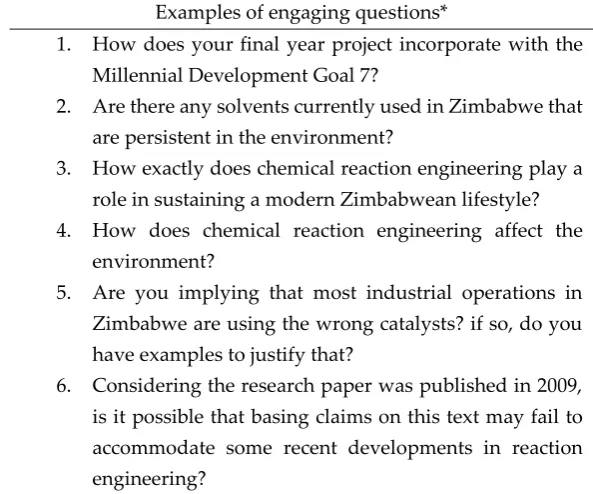
The participants contributed 15 questions that demonstrated the participants reflected on
114
sustainability. Examples of the engaging questions posted on the forum are shown in Table 3.
115
However, it should be noted that two of the questions contributed were for technical assistance.
116
Table 3. Elicitations in online discussions.
117
Examples of engaging questions*
1. How does your final year project incorporate with the Millennial Development Goal 7?
2. Are there any solvents currently used in Zimbabwe that are persistent in the environment?
3. How exactly does chemical reaction engineering play a role in sustaining a modern Zimbabwean lifestyle? 4. How does chemical reaction engineering affect the
environment?
5. Are you implying that most industrial operations in Zimbabwe are using the wrong catalysts? if so, do you have examples to justify that?
6. Considering the research paper was published in 2009, is it possible that basing claims on this text may fail to accommodate some recent developments in reaction engineering?
*Questions have been edited for clarity.
118
119
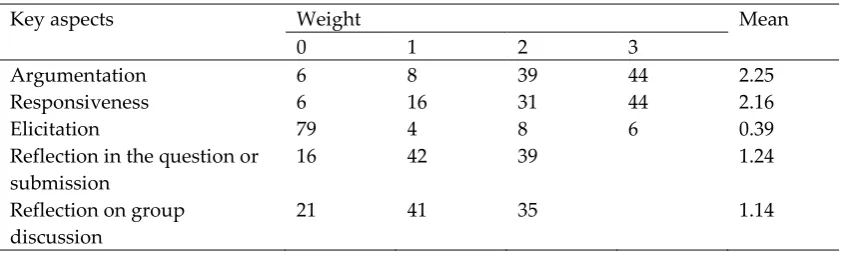
The argumentation and responsiveness in the comments where slightly above moderate at 2.25
120
and 2.16, respectively (Table 4). However, the level of elicitation was low at 0.39. They were only 15
121
questions out of the 97 comments. The reflection in the post and group ideas was slightly above
122
average at 1.24 and 1.14, respectively.
123
Table 4. The total count and means of weighted conceptual engagement in online discussion.
125
Key aspects Weight Mean
0 1 2 3
Argumentation 6 8 39 44 2.25
Responsiveness 6 16 31 44 2.16
Elicitation 79 4 8 6 0.39
Reflection in the question or submission
16 42 39 1.24
Reflection on group discussion
21 41 35 1.14
3.2. Design Report
126
Out of 25 participants, 22 submitted their design report and were double-blind reviewed by
127
three peers. About 51.5 % of the comments were poor with participants failing to identify the positive
128
or negative aspects of the paper they reviewed. However, 24.2 % peer reviews identified at least one
129
positive attribute of a submission. Furthermore, another 24.2 % peer reviews identified at least one
130
error in the submission reviewed. The participants, identified the errors using expressions such as,
131
“lacked,” “did not,” “neglected,” “more research,” and “did not include.”
132
4. Discussion and Conclusions
133
The study sought to establish e-learning could be used as a tool for incorporating sustainability
134
in chemical and engineering education in developing nations. The results suggested that e-learning
135
activities such as online discussion and peer review of assignments encouraged student engagement.
136
Similar results were obtained in a study on blended learning among health students at Makerere
137
University. Although, the study focused on international collaborations among participants from
138
low-income and high-income countries, the results similarly demonstrated blended learning offered
139
an engaging platform and a ‘personalized learning experiences.’8
140
The quality of the comments in online discussion and peer review were high suggesting the
141
students offered well-argued responses that offered at least a single supported idea and deep
142
reflection. Social interaction among participants probably encouraged students to participate more.
143
The learning management system used in the study had tools for ‘liking’ a comment and this
144
probably incentivized posting more thoughtful and well-argued comments.16 The quality of the
145
responses in this study were probably due to the fact that the question the participant addressed was
146
local and relevant. A previous study found student engagement was mainly influenced by course
147
design and student perception.11 Furthermore, the study found when a student considered the online
148
activity to be highly important they became cognitive and emotional engaged to the task.11 Therefore,
149
to enhance student engagement, the instructor should probably demonstrate the importance of the
150
activity.
151
The participants managed to incorporate sustainability concepts and practices in their
152
arguments. As illustrated by the word cloud (Figure 3), the responses in online discussion
153
demonstrated Tier 4 engineering competencies. For example, the following words were widely used
154
reaction, process, raw materials, inputs, conditions, pollution, which are associated with engineering
155
competencies of foundations of engineering, design, manufacturing and construction, engineering
156
economics, operations and maintenance, and safety, respectively.1 Thus, online learning offered a
157
platform for students to actively learn about sustainability. This study provides instructors with
158
techniques on how to incorporate sustainability in chemical and engineering education. Furthermore,
159
in this study we used and demonstrated techniques for assessing the quality of student responses.
160
References
162
(1) United States Department of Labor. Engineering Competency Model; 2015.
163
(2) Teta, C.; Ncube, M.; Naik, Y. S. Heavy metal contamination of water and fish in peri-urban dams around
164
Bulawayo, Zimbabwe. African J. Aquat. Sci. 2017, 42 (4), 351–358.
165
(3) Sanganyado, E.; Lu, Z.; Fu, Q.; Schlenk, D.; Gan, J. Chiral pharmaceuticals: A review on their
166
environmental occurrence and fate processes. Water Res. 2017, 124, 527–542.
167
(4) Teta, C.; Hikwa, T. Heavy Metal Contamination of Ground Water from an Unlined Landfill in Bulawayo,
168
Zimbabwe. J. Heal. Pollut. 2017, 7 (15), 18–27.
169
(5) Gwenzi, W.; Chaukura, N. Organic contaminants in African aquatic systems: Current knowledge, health
170
risks, and future research directions. Sci. Total Environ. 2018, 619–620, 1493–1514.
171
(6) Allen, D. T.; Shonnard, D. R.; Huang, Y.; Schuster, D. Green Engineering Education in Chemical
172
Engineering Curricula: A Quarter Century of Progress and Prospects for Future Transformations. ACS
173
Sustain. Chem. Eng. 2016, 4 (11), 5850–5854.
174
(7) Hawkins, N. C.; Patterson, R. W.; Mogge, J.; Yosie, T. F. Building a sustainability road map for
175
engineering education. ACS Sustain. Chem. Eng. 2014, 2 (3), 340–343.
176
(8) Protsiv, M.; Rosales-Klintz, S.; Bwanga, F.; Zwarenstein, M.; Atkins, S. Blended learning across
177
universities in a South-North-South collaboration: A case study. Heal. Res. Policy Syst. 2016, 14 (1), 1–12.
178
(9) Boateng, R.; Mbrokoh, A. S.; Boateng, L.; Senyo, P. K.; Ansong, E. Determinants of e-learning adoption
179
among students of developing countries. Int. J. Inf. Learn. Technol. 2016, 33 (4), 248–262.
180
(10) Moskal, P.; Dziuban, C.; Hartman, J. Blended learning: A dangerous idea? Internet High. Educ. 2013, 18,
181
15–23.
182
(11) Manwaring, K. C.; Larsen, R.; Graham, C. R.; Henrie, C. R.; Halverson, L. R. Investigating student
183
engagement in blended learning settings using experience sampling and structural equation modeling.
184
Internet High. Educ. 2017, 35 (December 2016), 21–33.
185
(12) Bohle Carbonell, K.; Dailey-Hebert, A.; Gijselaers, W. Unleashing the creative potential of faculty to
186
create blended learning. Internet High. Educ. 2012, 18, 29–37.
187
(13) Glasson, G. E.; Mhango, N.; Phiri, A.; Lanier, M. Sustainability science education in Africa: negotiating
188
indigenous ways of living with nature in the third space. Int. J. Sci. Educ. 2010, 32 (1), 125–141.
189
(14) Dudukovic, M. P. Reaction engineering: Status and future challenges. Chem. Eng. Sci. 2010, 65 (1), 3–11.
190
(15) United Nations Economic and Social Council. Progress towards the Sustainable Development Goals: Report
191
of the Secretary-General; 2016.
192
(16) Chen, B.; Chang, Y.-H.; Ouyang, F.; Zhou, W. Fostering student engagement in online discussion
193
through social learning analytics. Internet High. Educ. 2018, 37 (May 2017), 21–30.
194
(17) Wise, A.; Zhao, Y.; Hausknecht, S. Learning Analytics for Online Discussions: Embedded and Extracted
195
Approaches. J. Learn. Anal. 2014, 1 (2), 48–71.