Cross Processor Cache Attacks
Gorka Irazoqui
Worcester Polytechnic Institute[email protected]
Thomas Eisenbarth
Worcester Polytechnic Institute[email protected]
Berk Sunar
Worcester Polytechnic Institute
[email protected]
ABSTRACT
Multi-processor systems are becoming the de-facto standard across different computing domains, ranging from high-end multi-tenant cloud servers to low-power mobile platforms. The denser integration of CPUs creates an opportunity for great economic savings achieved by packing processes of multiple tenants or by bundling all kinds of tasks at vari-ous privilege levels to share the same platform. This level of sharing carries with it a serious risk of leaking sensitive information through the shared microarchitectural compo-nents. Microarchitectural attacks initially only exploited coprivate resources, but were quickly generalized to re-sources shared within the CPU.
We present the first fine grain side channel attack that works across processors. The attack does not require CPU co-location of the attacker and the victim. The novelty of the proposed work is that, for the first time the directory protocol of high efficiency CPU interconnects is targeted. The directory protocol is common to all modern multi-CPU systems. Examples include AMD’sHyperTransport, Intel’s
Quickpath, and ARM’sAMBA Coherent Interconnect. The proposed attack does not rely on any specific characteristic of the cache hierarchy, e.g. inclusiveness. Note that in-clusiveness was assumed in all earlier works. Furthermore, the viability of the proposed covert channel is demonstrated with two new attacks: by recovering a full AES key in OpenSSL, and a full ElGamal key in libgcrypt within the range of seconds on a shared AMD Opteron server.
Keywords
Invalidate+Transfer, Cross-CPU attack, HyperTransport, cache attacks
1.
MOTIVATION
Remote servers and cloud computing servers are now more popular than ever due to scalability and low costs. High end users now prefer to remotely access a Virtual Machine
or a server that they share with other users rather than buy-ing and maintainbuy-ing their private hardware. Security plays a crucial role in this scenario since users do not want any-one interfering with their applications. Modern Operating Systems (OSs) now implement permissions and even more advanced sandboxing techniques such as running tasks in virtual machines that ensure isolation and avoid userspace interference.
While sandboxing has been proven effective at the software level, information dependent on a potential victim’s activity can still be leaked at the lower layers of the implementation stack, i.e. via shared hardware resources. If the leakage is strong enough, an attacker observing the leakage might be able to steal sensitive fine grain information such as crypto-graphic keys. To elaborate,microarchitectural side channel attackstake advantage of the existing hardware leakage in modern hardware architectures. By following a fundamen-tal computer architecture design and optimization principle,
“make the common case fast”, computer architects have cre-ated machines where access and execution times vary de-pending on the processed data. Microarchitectural attacks exploit this data dependent behavior as a covert channel from which they infer sensitive information. One of the most popular covert channels exploited in modern proces-sors is the cache, due to its granularity and the lack of any access restrictions1. Although their applicability was ques-tioned for a long time, they found an ideal scenario with modern cloud computing and remote server technologies. In fact, these services are designed to host more than one user concurrently in the same server.
Microarchitectural attacks are impervious to access bound-aries established at the software level. First starting in the native execution case (a spy process running alongside the victim in the same user space), researchers have shown the effectiveness of such attacks under gradually more restric-tive execution environments. For example, the attacks were carried out first inside a single VM and later across VMs [40] with tighter constrains on the attackers privileges. Not in vain, researches have shown to even recover cryptographic keys across VMs, demonstrating the big threat that they can imply.
The first practical implementations of microarchitectural covert channels were studied in 2005, taking advantage of L1 cache
leakages [13, 30]. Later, more covert channels like the Branch Prediction Unit (BPU) proved to be as dangerous as caches [11]. These earlier works focused on the native (non-virtualized) setting. Such attacks were largely dismissed as being unre-alistic, especially by the industry. As the logic goes, if an at-tacker was able to smuggle a spy process into the victim’s ex-ecution space, he had already gained access to significant re-sources so there was no point in further carrying out a more complicated low-level microarchitectural attack. Therefore, the spy process was not considered to carry any significant meaning in the real world. With the emergence of the com-pute cloud where unknown and independent parties—the victim and the attacker—run alongside in VMs on the same physical machine, concerns were renewed. However, citing the co-location problem again such concerns were dismissed by cloud service providers. It was not until 2009 when Ris-tenpart et al. [32] showed the possibility of co-locating two VMs and further extracting keystrokes across VM bound-aries in the Amazon EC2 commercial cloud. This study not only demonstrated the grave risks posed by microarchitec-tural side channel attacks on user’s privacy but also reignited research in this direction.
Recent studies uncovered a variety of stronger covert chan-nels along with attacks exploiting them. The most pop-ular leakage is caused by the Last Level Cache (LLC), a resource that is shared across cores and thus works across different cores on the same processor. Attacks exploiting the LLC have proven to recover various types of sensitive information [37, 25, 39] ranging from cryptographic keys to the number of items in a victim’s shopping cart. Industry reacted by disabling features that were enabled prior to the discovery of the LLC cache covert channel [7] and by hard-ening cryptographic libraries [2].
More recently, researchers have also shown that there exists hardware leakage in the memory bus channel [35]. Although this leakage was used to achieve targeted co-location in com-mercial clouds [34, 36], its ability to recover fine grain infor-mation is still an open question. However, the memory bus channel is unique in that it works across processors: it can be used to detect co-location even on multi-CPU systems. This is very relevant, as modern computer systems not only have an increasing number of cores per processor, but also come with an increasing number of processors per system. This trend is not restricted to servers, in fact even mobile platforms now frequently come with at least two separate processors [16].
In this work we present the first cache based cross-processor attack by introducing a new microarchitectural covert chan-nel.
Our Contribution
We present the exploitation of a new covert channel based on the cache coherency protocols implemented in modern pro-cessors and multiprocessor systems. In order to retrieve fine grain information from this covert channel we introduce the
Invalidate and Transfertechnique, which relies on shared
data between different cores in a system, irrespective of their placement within or across processors. While previously pre-sented cache attacks relied on the inclusiveness of the LLC, our new spy process does not require any special
charac-teristic of the cache hierarchy. Thus it succeeds in those processors where prior cache attacks have not been shown to work, e.g., AMD servers with exclusive caches. Further-more, we present the first attack that is able to retrieve fine grain information across CPUs in multiple socket servers, thereby we do not rely on CPU co-location to execute the attack. We present the viability of the attack by attacking a softwareOpenSSLimplementation of the AES symmetric ci-pher and a square and multiplylibgcryptimplementation of the ElGamal public key scheme.
In summary, this work
• introduces the first cross-CPU fine grain side channel attack, i.e., we do not need CPU co-location between attacker and victim to obtain the leakage information
• shows for the first time a directory protocol based at-tack that does not rely in any specific characteristic of the cache hierarchy. Therefore our attack applies on servers that have not been shown to be vulnerable to microarchitectural side channel attacks such as AMDs Opteron series processors or ARM processors.
• the attack exploits data dependent timing variations in AMD’sHyperTransport, Intel’sQuickpathand could be applied to ARM’sAMBA Coherent Interconnect as well.
• demonstrates the power of the new side channel by re-covering a full AES key and a full ElGamal key within a few of seconds.
The rest of the study is divided as follows. We first review the related work in Section 2, we discuss the background knowledge Section 3 and Section 4. The new attack is pre-sented in Section 5 and in 6. The Results are prepre-sented in Section 7, before discussing the viability in other scenarios 8. We conclude in Section 9.
2.
RELATED WORK
Microarchitectural attacks have been studied for more than 20 years Originally, covert channels like the cache were stud-ied theoretically, as in [23, 23, 31]. Tsunoo et al. [33] were the first ones to practically obtain leakage from a cache side channel attack against DES in 2003. In 2004, with the pop-ularity of the AES cipher, two new cache-based attacks were presented. The first one was implemented by Bernstein [13] by exploiting microarchitectural timing differences observed for different look up table positions. At the same time, Os-vik et al. [30] proposed two new spy processes namedEvict
+ TimeandPrime and Probe. While the first one modifies
the state of the cache between identical encryptions, the lat-ter one fills the entire cache with attackers data before the encryption and checks which parts of the cache have been used after the encryption. All the attacks, with different number of encryptions required, achieved the full recovery of the AES encryption key.
channel attack on AES [14]. Shortly later Acıi¸cmez et al. ex-ploited similar collision attacks in the first and second round of the AES cipher [9]. Again Acıi¸cmez et al. implemented the first attack against RSA, by monitoring instruction cache accesses instead of data cache accesses [10].
Although the cache became the main targeted microarchi-tectural side channel studied by researchers, Acıi¸cmez et al. [11] also considered the Branch Prediction Unit (BPU) as an exploitable source of leakage for non-constant execution flow software. In particular, they recovered a full RSA key by analyzing the outcome of vulnerable internal branches.
However, due to the raising popularity of multi-core proces-sors and cloud computing systems, microarchitectural side channel attacks were dismissed for a long time due to their limited applicability. Indeed most of the previously pro-posed attacks targeted core private resources within the same Operating System.
It was in 2009 when Ristenpart et al. [32] proposed mech-anisms to achieve co-location in the Amazon EC2 cloud, bringing a whole new scenario where microarchitectural at-tacks could realistically be applied. In the following years, researchers started exploiting the scenario opened by [32]. Zhang et al. [38] proposed in 2011 a mechanism to detect whether a user is co-residing with any potential attacker in the same core, while in 2012 again Zhang et al. [40] pro-posed the first successful fine grain side channel attack in the cloud by recovering an ElGamal encryption key. At the same time, Gullasch et al. [21] proposed a new attack on AES that would later acquire the name ofFlush and Reload.
However, it was in 2013 when the first cross-core side channel attack was studied. Utilizing the same technique as in [21] Yarom et al. [37] studied how theFlush and Reloadattack applied in the LLC can recover a full RSA key even with VMs that are not co-located in the same core. Shortly later Irazoqui et al. [26] presented a new attack on the AES cipher across VMs, again using theFlush and Reloadspy process.
TheFlush and Reloadattack was later expanded by a wide
range of attacks [12, 27, 39, 20, 19, 22], going from PaaS cloud attacks to cache template attacks. However, this at-tack is only applicable in the cloud if deduplication is en-abled, restricting thereby the applicability of it. In order to overcome this issue, Liu et al. and Irazoqui et al. [18, 25] proposed a new attack in the LLC based on thePrime and
Probeattack that did not require deduplication, recovering
RSA and AES keys respectively. Recently, this attack has been expanded by Inci et al. [24] by showing its applicability in the public Amazon EC2 cloud and by Oren et al. [29] by implementing it in javascript and showing its applicability in web browser scenarios.
3.
BACKGROUND
In this section we discuss the strengths and weaknesses of current microarchitectural attacks and discuss why the most powerful one, based on LLC leakage, has not yet been ex-ploited on AMD CPUs.
3.1
Microarchitectural Covert Channels
In the last 10 years many studies have identified and ex-ploited different microarchitectural attacks under very dif-ferent scenarios. Since the chronological order of these stud-ies has already been discussed in section 2, this section aims at describing the different covert channels already exploited and their applicability.
• L1 Cache: The L1 cache was one of the first microar-chitectural covert channels that was exploited. It is usually divided into a separate data cache and an in-struction cache, each usually several kB (often 32 or 64kB) in size. One of the advantages of the L1 cache is that the attacker can isolate his data-related attacks from the instructions and vice versa. Furthermore, an attacker can monitor the entire L1 cache with a reason-able timing resolution due to its small size. However, distinguishing accesses from the L1 and L2 became a difficult task in modern processors, since they only dif-fer in a few cycles. Furthermore, the L1 (and usually L2) caches are a core-private resource, and therefore are only exploitable when victim and attacker are co-located in the same core. As modern processors in-corporate more and more cores in their systems, the applicability of L1 cache attacks reduces drastically.
• BPU: The BPU is another microarchitectural com-ponent that has been proved to leak information. In order to gather this information, the attacker needs to know whether the executed branch has been mis-predicted or not. Thus, having knowledge about how the BPU predicts the branches and about the size of the BTB is crucial to run this kind of attacks. Unfor-tunately, this information is not released anymore in modern processors. Furthermore, the time difference between a well predicted and a mispredicted branch is not bigger than a few cycles in modern processors. Moreover, the BPU is a core-private resource like the L1 cache, and therefore can only be exploitable in the case of core co-residency.
• LLC:The LLC is a recently discovered covert channel that provides many advantages over the previous ones. First, it is a shared resource between cores, and there-fore core co-residency is not needed anymore. Second, LLC side channel attacks distinguish between accesses from the LLC and accesses from the memory. In con-trast to the previous side channel attacks, distinguish-ing LLC from memory accesses can be done with a low error rate, since usually they differ in a few tens of cy-cles. However, these attacks have thus far only been applied to processors where the LLC is inclusive, i.e., for caches where data in the L1 cache is also present in the LLC.
covert channel is strong enough to detect co-location, it does not give fine grain information as the previous channels described.
3.2
Why Nobody Attacks AMD Processors
Over the last few years, many cross-core side channel attacks have been introduced to target Intel processors. But none have considered attacking other kinds of servers. Indeed, the utilized covert channels make use of specific characteristics that Intel processors feature. For example, the proposed LLC attacks take advantage of the inclusive cache design in Intel processors. Furthermore, they also rely on the fact that the LLC is shared across cores. Therefore these attacks succeed only when the victim and the attacker are co-located on the same CPU.These characteristics are not observed in other CPUs, e.g. AMD or ARM. This work focuses on AMD, but the same technique should also succeed in ARM processors, as dis-cussed in Section 8.2. In this sense, AMD servers present two main complications that prevents application of existing side channel attacks:
• AMD tends to have more cores per CPU in high end servers compared to Intel. Indeed, high end AMD servers commonly incorporate 48-cores. The large num-ber of cores reduces the chance of being co-located, i.e. sharing the core with a potential victim. This fact re-duces the applicability of core-private covert channels such as L1-Cache and BPU based attacks.
• LLCs in AMD are usually exclusive ornon-inclusive. The former does not allocate a memory block in dif-ferent level caches at the same time. That is, data is present in only one level of the cache hierarchy. Non-inclusive caches show neither inclusive or exclu-sive behavior. This means that any memory access will fetch the memory block to the upper level caches first. However, the data can be evicted in the outer or inner caches independently. Hence, accesses to L1 cache cannot be detected by monitoring the LLC, as it is possible on Intel machines.
Hence, to perform a side channel attack on AMD proces-sors, both of these challenges need to be overcome. Here we present a covert channel that is immune to both complica-tions. The proposed attack is the first side channel attack that works across CPUs that feature non-inclusive or exclu-sive caches.
4.
CACHE COHERENCE PROTOCOLS
In order to ensure coherence between different copies of the same data, systems implement cache coherence protocols. In the multiprocessor setting, the coherency between shared blocks that are cached in different processors (and therefore in different caches) also needs to be maintained. The system has to ensure that each processor accesses the most recent value of a shared block, regardless of where that memory block is cached. The two main categories of cache coher-ence protocols are snooping based protocols and directory based protocols. While snooping based protocols follow a
decentralized approach, they usually require a centralized data bus that connects all caches. This results in exces-sive bandwidth need for systems with an increasing number of cores. Directory-based protocols, however, enable point-to-point connections between cores and directories, hence follow an approach that scales much better with an increas-ing number of cores in the system. We put our focus in the latter one, since it is the prevailing choice in current multi-processor systems. The directory keeps track of the state of each of the cached memory blocks. Thus, upon a memory block access request, the directory will decide the state that the memory block has to be turned into, both in the request-ing node and thesharing nodes that have a cached copy of the requested memory block. We analyze the simplest cache coherence protocol, with only 3 states, since the attack that is implemented in this study relies on read-only data. Thus, the additional states applied in more complicated coherency protocols do not affect the flow of our attack.
We introduce the termshome node for the node where the memory block resides, local node for the node requesting access to the memory block, and owner node referring a node that has a valid copy of the memory block cached. This leads to various communication messages that are summa-rized as follows:
• The memory block cached in one or more nodes can be in either uncached state, exclusive/modified or
shared.
• Upon a read hit, thelocal node’scache services the data. In this case, the memory block maintains its state.
• Upon a read miss, thelocal nodecontacts the home node to retrieve the memory block. The directory knows the state of the memory block in other nodes, so its state will be changed accordingly. If the block is inexclusivestate, it goes toshared. If the block is in sharedstate, it maintains it. In both cases the
local nodethen becomes an owner and holds a copy
of the shared memory block.
• Upon a write hit, the local node sets the memory block to exclusive. Thelocal nodecommunicates the nodes that have a cached copy of the memory block to invalidate or to update it.
• Upon a write miss, again the thehome nodewill service the memory block. The directory knows the nodes that have a cached copy of the memory block, and therefore sends them either an update or an invalidate message. Thelocal node then becomes an owner of
theexclusivememory block.
since it is not consistent with the value stored in the mem-ory. A write back operation would set the memory block back to theexclusivestate.
The protocols implemented in modern processors are vari-ants of the MESI protocol, mainly adding additional states. For instance, the Intel i7 processor uses a MESIF protocol, which adds the additionalforwardstate. This state will des-ignate the sharing processor that should reply to a request of a shared memory block, without involving a memory access operation. The AMD Opteron utilizes the MOESI protocol with the additionalowned state. This state indicates that the memory block is owned by the corresponding cache and is out-of-date with the memory value. However, contrary to the MESI protocol where a transition frommodifiedto
shared involves a write back operation, the node holding
theownedstate memory block can service it to the sharing
nodes without writing it back to memory. Note that both the MESIF and MOESI protocol involve a cache memory block forwarding operation. Both theowned and the for-wardstate suggest that a cache rather than a DRAM will satisfy the reading request. If the access time from cache differs from regular DRAM access times, this behavior be-comes an exploitable covert channel.
4.1
AMD HyperTransport Technology
Cache coherency plays a key role in multi-core servers where a memory block might reside in many core-private caches in the same state or in a modified state. In multiple socket servers, this coherency does not only have to be maintained within a processor, but also across CPUs. Thus, complex technologies are implemented to ensure the coherency in the system. These technologies center around the cache di-rectory protocols explained in section 3. The HyperTrans-port technology implemented by AMD processors serves as a good example. To save space here we only focus on the features relevant to the new proposed covert channel. A detailed explanation can be found in [15, 3].
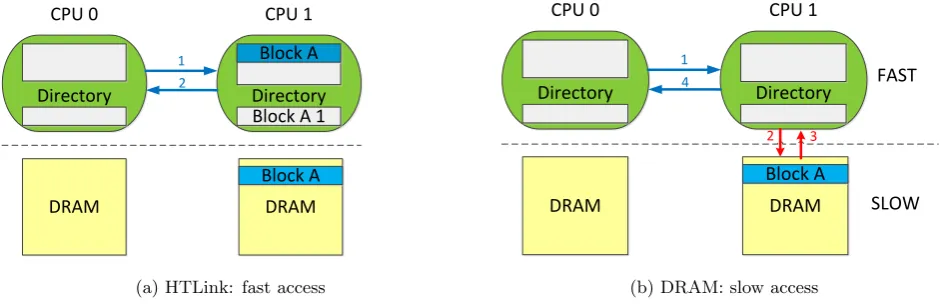
The HyperTransport technology reserves a portion of the LLC to act as directory cache in the directory based proto-col. This directory cache keeps track of the cached memory blocks present in the system. Once the directory is full, one of the previous entries will be replaced to make room for a new cached memory block. The directoryalwaysknows the state of any cached memory block, i.e., if a cache line exists in any of the caches, it must also have an entry in the di-rectory. Any memory request will go first through the home node’s directory. The directory knows the processors that have the requested memory block cached, if any. The home node initiates in parallel both a DRAM access and aprobe filter. The probe filter is the action of checking in the di-rectory which processor has a copy of the requested memory block. If any node holds a cached copy of the memory block, a directed probe against it is initiated, i.e., the memory block will directly be fast forwarded from the cached data to the requesting processor. Adirected probemessage does not trigger a DRAM access. Instead, communications between nodes are facilitated via HyperTransport links, which can run as fast as 3 GHz. Figure 1 shows a diagram of how the HyperTransport links directly connect the different CPUs to each other avoiding memory node accesses. Although many execution patterns can arise from this protocol, we will only
Figure 1: DRAM accesses vs Directed probes thanks to the HyperTransport Links
explain those relevant to the attack, i.e. events triggered over over read-only blocks which we will elaborate on later. We assume that we have processors A and B, refereed to as
PaandPb, that share a memory block:
• IfPaandPbhave the same memory block cached, upon a modification made byPa,HyperTransportwill notify
PbthatPahas the latest version of the memory block. Thus,Pawill have to update its version of the block to convert thesharedblock into aownedblock. Upon a new request made byPb,HyperTransport will transfer the updated memory block cached inPa.
• Similarly, upon a cache miss in Pa, the home node will send a probe message to the processors that have a copy of the same shared memory block, if any. If, for instance, Pb has it, adirected probe message is initiated so that the node can service the cached data through the hypertransport links. Therefore, Hyper-Transport reduces the latency of retrieving a memory block from the DRAM by also checking whether some-one else maintains a cached copy of the same memory block. Note that this process does not involve a write-back operation.
• When a new entry has to be placed in the directory ofPa, and the directory is full, one of the previously allocated entries has to be evicted to make room for the new entry. This is referred as adowngrade probe. In this case, if the cache line is dirty a writeback is forced, and an invalidate message is sent to all the processors (Pb) that maintain a cached copy of the same memory block.
DRAM DRAM Block A 1
Block A
CPU 0 CPU 1
Directory Directory
Block A
1 2
(a) HTLink: fast access
DRAM
DRAM
CPU 0
CPU 1
Directory
Directory
Block A
FAST
SLOW
1 4
2 3
(b) DRAM: slow access
Figure 2: Comparison of a directed probe access across processors: probe satisfied from CPU 1’s cache directly via HTLink (a) vs. probe satisfied by CPU 1 via a slow DRAM access (b).
4.2
Intel QuickPath Interconnect Technology
In order to maintain cache coherency across multiple CPUs Intel implements a similar technique to AMD’s HyperTrans-port calledIntel QuickPath Interconnect (QPI) [1, 5]. In-deed, the later one was designed five years latter than the first one to compete with the existing technology in AMD processors. Similar to HyperTransport, QPI connects one or more processors through high speed point-to-point links as fast as 3.2GHz. Each processor has a memory controller on the same die to make to improve the performance. As we have already seen with AMD, among other advantages, this interface efficiently manages the cache coherence in the system in multiple processor servers by transferring shared memory blocks through the QPI high speed links. In con-sequence, the proposed mechanisms that we later explain in this paper are also applicable in servers featuring multi-CPU Intel processors.5.
A NEW CROSS-CPU COVERT CHANNEL
In this section we present a new covert channel based on cache coherency technologies implemented in modern pro-cessors. In particular, we focus on AMD processors, which have exclusive caches that in principle are invulnerable to cache side channel attacks although the results can be read-ily applied to multi-CPU Intel processors as well. In sum-mary,• We present the first cross-CPU side channel attack, i.e., we show that core co-location is not needed in multi-CPU servers to obtain fine grain information.
• We present a new covert channel that utilizes directory based cache coherency protocols to extract sensitive information.
• We show that the new covert channel succeeds in those processors where cache attacks have not been shown to be possible before, e.g. AMDs exclusive caches.
• We demonstrate the feasibility of our new side channel technique by mounting an attack on a T-table based AES and a square and multiply implementation of El-Gamal schemes.
5.1
Invalidate + Transfer attack
We propose a new spy process that takes advantage of leak-ages observed in the cache coherency protocol with memory blocks shared between many processors/cores. The spy pro-cess does not rely on specific characteristics of the cache hierarchy, like inclusiveness. In fact, the spy process works even across co-resident CPUs that do not share the same cache hierarchy. From now on, we assume that the victim and attacker share the same memory block and that they are located in different CPUs or in different cache hierarchies in the same server.
The spy process is executed in three main steps, which are:
• Invalidate step:In this step, the attacker invalidates a memory block that is in his own cache hierarchy. If the invalidation is performed in a shared memory block cached in another cache processors cache hierar-chy, theHyperTransport will send an invalidate mes-sage to them. Therefore, after the invalidation step, the memory block will be invalidated in all the caches that have the same memory block, and this will be un-cached from them. This invalidation can be achieved by specialized instructions likeclflushif they are sup-ported by the targeted processors, or by priming the set where the memory block resides in the cache direc-tory.
• Wait step: In this step, the attacker waits for a cer-tain period of time to let the victim do some compu-tation. The victim might or might not use the invali-dated memory block in this step.
• Transfer step:In the last step, the attacker requests access to the shared memory block that was invali-dated. If any processor in the system has cached this memory block, the entry in the directory would have been updated and therefore a direct proberequest will be sent to the processor. If the memory block was not been used, the home directory will request a DRAM access to the memory block.
100 150 200 250 300 350 0
0.1 0.2 0.3 0.4 0.5 0.6
Hardware cycles
Probability
DRAM access Direct transfer access
Figure 3: Timing distribution of a memory block request to the DRAM (red) vs a block request to a co-resident processor(blue) in a AMD opteron 6168. The measurements are taken from different CPUs. Outliers above 400 cycles have been removed
is issued, mainly because the memory block is issued from another processors cache hierarchy. This is graphically ob-served in Figure 2. Figure 2(a) shows a request serviced by theHyperTransport link from a CPU that has the same memory block cached. In contrast, Figure 2(b) represents a request serviced by a DRAM access. This introduces a new leakage if the attacker is able to measure and distinguish the time that both actions take. This is the covert chan-nel that will be exploited in this work. We use theRDTSC
function which accesses the time stamp counter to measure the request time. In case the RDTSC function is not avail-able from user mode, one can also create a parallel thread incrementing a shared variable that acts as a counter. We also utilize themfenceinstruction to ensure that all memory load/store operations have finished before reading the time stamp counter.
The timing distributions of both the DRAM access and the directed transfer access are shown in Figure 3, where 10,000 points of each distribution were taken in a 48-core 4 CPU AMD Opteron 6168. The x-axis represents the hardware cycles, while they-axis represents the density function. The measurements are taken across processors. The blue dis-tribution represents a directed probe access, i.e., a co-resident CPU has the memory block cached, whereas the red distribution represents a DRAM access, i.e., the memory block is not cached anywhere. It can be observed that the distributions differ in about 50 cycles, fine grain enough to be able to distinguish them. However, the variance in both distributions is very similar, in contrast to LLC covert chan-nels. Nevertheless, we obtain a covert channel that works across CPUs and that does not rely on the inclusiveness property of the cache.
Hardware cycles
250 300 350 400 450 500 550 600 650
Probability
0 0.1 0.2 0.3 0.4 0.5 0.6 0.7
DRAM access Direct transfer access
Figure 4: Timing distribution of a memory block request to the DRAM (red) vs a block request to a co-resident core(blue) in a dual core Intel E5-2609. The measurements are taken from the same CPU. Outliers above 700 cycles have been removed
We also tested the viability of the covert channel in a dual socket Intel Xeon E5-2609. Intel utilizes a similar technique to theHyperTransporttechnology calledIntel Quick Path
Interconnect. The results for the Intel processor are shown
in Figure 4, again with processes running in different CPUs. It can be observed that the distributions are even more dis-tinguishable in this case.
6.
EXPLOITING THE NEW COVERT
CHAN-NEL
In the previous section, we presented the viability of the covert channel. Here we demonstrate how one might exploit the covert channel to extract fine grain information. More concretely, we present two attacks:
• a symmetric cryptography algorithm, i.e. table based
OpenSSLimplementation of AES, and
• a public key algorithm, i.e. a square-and-multiply based
libgcryptimplementation of the ElGamal scheme.
6.1
Attacking Table based AES
We test the granularity of the new covert channel by mount-ing an attack in a software implementation of AES, as in [26]. We use the C OpenSSL reference implementation, which uses 4 different T-tables along 10 rounds for AES-128. The first 9 rounds is composed of 4 main operations:
AddRound-Key,Subbbytes,ShiftRows,Mixcolumns. The last round
exe-cutes the same operations except theMixcolumnsoperation. Thus, as in [26], we mount a last round attack, i.e., we as-sume that the ciphertext is known to the attacker.
one of the T-tables. Each memory block contains 16 T-Table positions and it has a certain probability, 8% in our particular case, of not being used in any of the 10 rounds of an encryption. Thus, applying ourInvalidate + Transfer
attack and recording the ciphertext output, we can know when the monitored memory blockhas not been used. For this purpose we invalidate the memory block before the encryption and try to probe it after the encryption. In a noise free scenario, the monitored memory block will not be used for 240 ciphertext outputs with 8% probability, and it will not be used for the remaining 16 ciphertext with 0% probability (because they directly map through the key to the monitored T-table memory block). Although microar-chitectural attacks suffer from different microarmicroar-chitectural sources of noise, we expect that theInvalidate + Trans-fercan still distinguish both distributions.
Once we know the ciphertext values belonging to both dis-tributions, we can apply the equation:
Ki=T[Sj]⊕Ci
to recover the key. Since the last round of AES involves only a Table look up and a XOR operation, knowing the ciphertext and the T-table block position used is enough to obtain the key byte candidate that was used during the last AES round. Since a cache line holds 16 T-table values, we XOR each of the obtained ciphertext values with all the 16 possible T-table values that they could map to. Clearly, the key candidate will be a common factor in the computations with the exception of the observed noise which is eliminated via averaging. As the AES key schedule is revertible, know-ing one of the round keys is equivalent to knowknow-ing the full encryption key.
6.2
Attacking Square and Multiply ElGamal
Decryption
We test the viability of the new side channel technique with an attack on a square and multiplylibgcrypt implemen-tation of the public key ElGamal algorithm, as in [40]. An ElGamal encryption involves a cyclic group of orderpand a generator g of that cyclic group. Then Alice chooses a numbera∈Z∗pand computes her public key as the 3-tuple
(p, g, ga) and keepsaas her secret key.
To encrypt a messagem, Bob first chooses a numberb∈Z∗p
and calculatesy1=gbandy2= ((ga)b)∗mand sends both to Alice. In order to decrypt the message, Alice utilizes her secret key a to compute ((y1)−a)∗y2. Note that, if a malicious user recovers the secret keyahe can decrypt any message sent to Alice.
Our target will be they−1athat uses the square and multiply technique as the modular exponentiation method. It bases its procedure in two operations: a square operation followed by a modulo reduction and a multiplication operation fol-lowed by a modulo reduction. The algorithm starts with the intermediate stateS =bbeingb the base that is going to be powered, and then examines the secret exponentafrom the most significant to the least significant bit. If the bit is a 0, the intermediate state is squared and reduced with the modulus. If in the contrary the exponent bit is a 1, the intermediate state is first squared, then it is multiplied with
the base band then reduced with the modulus. Algorithm 1 shows the entire procedure.
Algorithm 1Square and Multiply modular exponentiation
Input: Ciphertextc∈ZN, Exponenta
Output: cd modN
ab=bitwise(a) .Convert exponentato bit string
S=cj=len(a) .Exponentiation Step
whilej >0do
S=S2 modN
if ej== 1then
S =S∗c modN
end if
j=j−1
end while returnS
As it can be observed the algorithm does not implement a constant execution flow, i.e., the functions that will be used directly depend on the bit exponent. If the square and multiply pattern is known, the complete key can be eas-ily computed by converting them into ones and zeros. In-deed, our Invalidate + Transferspy process can recover this information, since functions are stored as shared mem-ory blocks in cryptographic libraries. Thus, we mount an attack with the Invalidate + Transfer to monitor when the square and multiplication functions are utilized.
7.
EXPERIMENT SETUP AND RESULTS
In this section we present the test setup in which we imple-mented and executed theInvalidate+Transferspy process together with the results obtained for the AES and ElGamal attacks.7.1
Experiment Setup
In order to prove the viability of our attack, we performed our experiments on a 48-core machine featuring four 12-core AMD Opteron 6168 CPUs. This is an university server which has not been isolated for our experiments, i.e., other users are utilizing it at the same time. Thus, the environ-ment is a realistic scenario in which non desired applications are running concurrently with our attack.
The machine runs at 1.9GHz, featuring 3.2GHz HyperTrans-port links. The server has 4 AMD Opteron 6168 CPUs, with 12 cores each. Each core features a private 64KB 2-way L1 data cache, a private 64KB L1 instruction cache and a 16-way 512KB L2 cache. Two 6MB 96-way associative L3 caches—each one shared across 6 cores—complete the cache hierarchy. The L1 and L2 caches are core-private resources, whereas the L3 cache is shared between 6 cores. Both the L2 and L3 caches are exclusive, i.e., data can be allocated in exactly one cache level at a time. This is different to the inclusive LLC where most of the cache spy processes in literature have been executed.
Ciphertext value
0 50 100 150 200 250
Miss counter value normalized with maximum
0 0.1 0.2 0.3 0.4 0.5 0.6 0.7 0.8 0.9 1
Figure 5: Miss counter values for each ciphertext value, normalized to the average
do not reside in the same CPU and do not share any LLC. To ensure this, we utilized thetasksetcommand to assign the CPU affinity to our processes.
Our targets were the AES C reference implementation of OpenSSL and the ElGamal square and multiply implemen-tation of libgcrypt 1.5.2. The libraries are compiled as shared, i.e., all users in the OS will use the same shared symbols. In the case of AES we assume we are synchronized with the AES server, i.e., the attacker sends plaintext and re-ceives the corresponding ciphertexts. As for the ElGamal case, we assume we are not synchronized with the server. Instead, the attacker process simply monitors the function until valid patterns are observed, which are then used for key extraction.
7.2
AES Results
As explained in Section 6, in order to recover the full key we need to target a single memory block from the four T-tables. However, in the case that a T-table memory block starts in the middle of a cache line, monitoring only 2 memory blocks is enough to recover the full key. In fact, there exists a memory block that contains both the last 8 values of T0 and the first 8 values of T1. Similarly there exists a memory block that contains the last 8 values of T2 and the first 8 values of T3. Since this is the case for our target library, we only monitor those two memory blocks to recover the entire AES key.
We store both the transfer timing and the ciphertext ob-tained by our encryption server. In order to analyze the results, we implement a miss counter approach: we count the number of times that each ciphertext value sees a miss, i.e. that the monitored cache line was not loaded for that ciphertext value. An example of one of the runs for cipher-text number 0 is shown in Figure 5. The 8 ciphercipher-text values that obtain the lowest scores are the ones are the ones corre-sponding to the cache line, thereby revealing the key value.
In order to obtain the key, we iterate over all possible key
Key Guess
0 50 100 150 200 250 300
Miss Counter Ratio
0 0.01 0.02 0.03 0.04 0.05 0.06
X: 180 Y: 0.05315
Figure 6: Correct key byte finding step, iterating over all possible keys. The maximum distance is observed for the correct key
103 104 105
0 0.02 0.04 0.06 0.08 0.1 0.12
Number of encryptions
Difference of Ratios
Figure 7: Difference of Ratios over the number of encryptions needed to recover the full AES key. The correct key (bold red line) is clearly distinguishable from 20,000 encryptions.
byte values and compute the last round of AES only for the monitored T-table values, and then group the miss counter values of the resulting ciphertexts in one set. We group in another set the miss counter of the remaining 248 ciphertext values. Clearly, for the correct key, the distance between the two sets will be maximum. An example of the output of this step is shown in Figure 6, where the y-axis represents the miss counter ratio (i.e., ratio of the miss counter value in both sets) and the x-axis represents the key byte guess value. It can be observed that the ratio of the correct key byte (180) is much higher than the ratio of the other guesses.
Timeslot ×104
0 0.2 0.4 0.6 0.8 1 1.2 1.4 1.6 1.8 2
Square funcion usage
0 0.2 0.4 0.6 0.8 1 1.2 1.4 1.6 1.8 2
Idle Decrypt Idle Decrypt Idle Decrypt Idle Decrypt
Figure 8: Trace observed by theInvalidate+Transfer, where 3 4 decryption operations are cached. The decryption stages are clearly visible when the square function usage gets the 0 value
recover the full AES key. This is shown in Figure 7, where they-axis again represents the ratios and thex-axis repre-sents the number of encryptions. As it can be observed, the correct key is not distinguishable before 10,000 traces, but from 20,000 observations, the correct key is clearly distin-guishable from the rest. We conclude that the new method succeeds in recovering the correct key from 20,000 encryp-tions.
7.3
ElGamal Results
Next we present the results obtained when the attack aims at recovering an ElGamal decryption key. We target a 2048 bit ElGamal key. Remember that, unlike in the case of AES, this attack does not need synchronization with the server, i.e., the server runs continuous decryptions while the at-tacker continuously monitors the vulnerable function. Since the modular exponentiation creates a very specific pattern with respect to both the square and multiply functions, we can easily know when the exponentiation occurred in the time. We only monitor a single function, i.e., the square function. In order to avoid speculative execution, we do not monitor the main function address but the following one. This is sufficient to correctly recover a very high percentage of the ElGamal decryption key bits. For our experiments, we take the time that the invalidate operation takes into account, and a minimum waiting period of 500 cycles be-tween theinvalidateand thetransferoperation is suffi-cient to recover the key patterns. Figure 8 presents a trace where 4 different decryptions are caught. A 0 in they-axis means that the square function is being utilized, while a 1 the square function is not utilized, while thex-axis rep-resents the time slot number. The decryption stages are clearly observable when the square function gets a 0 value.
Please recall that the execution flow caused by a 0 bit in the exponent issquare+reduction, while the pattern caused
Table 1: Summary of error results in the RSA key recovery attack.
Traces analysed 20
Maximum error observed 3.47% Minimum error observed 1.9%
Average error 2.58%
Traces needed to recover full key 5
by a 1 bit in the exponent issquare+reduction+multiply+
reduction. Since we only monitor the square operation, we
reconstruct the patterns by checking the distance between two square operations. Clearly, the distance between the two square operations in a 00 trace will be smaller than the dis-tance between the two square operations in a 10 trace, since the latter one takes an additional multiplication function. With our waiting period threshold, we observe that the dis-tance between two square operations without the multiplica-tion funcmultiplica-tion varies from 2 to 4Invalidate+Transfersteps, while the distance between two square operations varies from 6 to 8Invalidate+Transfersteps. If the distance between two square operations is lower than 2, we consider it part of the same square operation. An example of such a trace is shown in Figure 9. In the figure, S refers to a square operation,Rrefers to a modulo reduction operation andM
refers to a multiply operation. The x-axis represents the time slot, while the y axis represents whether the square function was utilized. The 0 value means that the square function was utilized, whereas the 1 value means that the square function was not utilized. The pattern obtained is
SRM RSRSRM RSRSRM RSRSRM RSRM RSRSRM RS
RM RSRSRM RSRS, which can be translated into the key
bit string 101010110101010.
However, due to microarchitectural sources of noise (context switches, interrupts, etc) the recovered key has still some er-rors. In order to evaluate the error percentage obtained, we compare the obtained bit string with the real key. Any in-sertion, removal or wrong guessed bit is considered a single error. Table 1 summarizes the results. We evaluate 20 dif-ferent key traces obtained with the Invalidate+Transfer
spy process. On average, they key patterns have an error percentage of 2.58%. The minimum observed error percent-age was 1.9% and the maximum was 3.47%. Thus, since the errors are very likely to occur at different points in order to decide the correct pattern we analyse more than one trace. On average, 5 traces are needed to recover the key correctly.
8.
VIABILITY OF THE COVERT CHANNEL
IN OTHER SCENARIOS
We demonstrated the covert channel in a shared server set-ting. However, there are other scenarios where the proposed covert channel exists and can be exploited as shown earlier.
8.1
Cloud Computing Scenario
sac-Time slot
0 10 20 30 40 50 60 70 80 90 100
Square function utilized
-0.2 0 0.2 0.4 0.6 0.8 1
S S S S S S S S S S S S S S
S R M R R R M R R R M R RS R M R R M R R R M R R R M R R R M R R
Figure 9: Trace observed by the Invalidate+Transfer, converted into square and multiply functions. The
y-axis shows a0when the square function is used and a 1when the square function is not used
rifices profitability for improved security and allocates in-dependent VMs per customer application / container (e.g. Amazon Beanstalk notably follows this higher security model), then the applications that belong to different users of the PaaS may be executed within the same OS. Thus, both at-tacker and victim share parts of the memory space as demon-strated in [38]. This scenario is essentially the same sce-nario used in the attack proposed in this paper. Therefore, the proposedInvalidate + Transfermay also be applica-ble in PaaS clouds that do not allocate independent VMs per customer application. IaaS clouds provide each user with a dedicated OS where applications can be executed. In this particular case, theInvalidate + Transfer would work when the hypervisor implements deduplication tech-niques, i.e., if memory pages are shared across VMs. Note, our previous research [26] learned that for security reasons, AWS is not susceptible to this, as they do not implement memory deduplication in their custom Xen deployments.
8.2
Mobile Devices
ARM devices implement a technique called AMBA Cache Coherent Interconnectthat facilitates fast interprocessor con-nections very similar to the HyperTransport protocol ex-ploited in this paper. This technology helps to maintain cache coherency across ARM CPUs using asnoop filter
protocol supported by a cache directory architecture [8, 4, 6]. Thus, upon a shared memory read miss, thesnoop fil-terchecks whether the same memory block is cached in an adjacent processor. If successful, a direct cache-to-cache link will be established, thereby eliminating the need for a slow DRAM access. This fact seems to be exploited in [28].
9.
CONCLUSION
We presented a new covert channel exploiting cache coher-ence protocols which recovers information leakage caused by the data access time difference. The new attack exploits the fact that data cached anywhere in the multiprocessor system has lower access times than memory accesses facilitated by fast interconnects such as AMDHyperTransport and Intel
QuickPath. The attack thus can retrieve fine-grain informa-tion even when victim and attacker are located in different processors on the same system. Even further, the new covert channel does not rely on specific properties of cache
hier-archies like inclusiveness. This was a common assumption in previous attacks. The coherence protocol ensures that the data is found independently of where in the cache it is stored. Thus, the new attack can be applied in processors where cache attacks have not been demonstrated before such as in AMD processors. We proved the viability of the new attack by recovering a full AES key and a full ElGamal key across co-located AMD CPUs.
Acknowledgements
This work is supported by the National Science Foun- da-tion, under grant CNS-1318919. We would like to thank Edward Burnham for his support on the server configura-tion.
10.
REFERENCES
[1] An introduction to the QuickPath Interconnect.http: //www.intel.com/content/dam/doc/white-paper/ quick-path-interconnect-introduction-paper.
pdf.
[2] Fix Flush and Reload in RSA.
https://lists.gnupg.org/pipermail/
gnupg-announce/2013q3/000329.html.
[3] HyperTransport Technology white paper.
http://www.hypertransport.org/docs/wp/ht_
system_design.pdf.
[4] Increasing Performance and Introducing CoreLink CCI-500.https://community.arm.com/groups/ processors/blog/2015/02/03/
extended-system-coherency--part-3--corelink-cci-500.
[5] Intel QuickPath Architecture.
http://www.intel.com/pressroom/archive/
reference/whitepaper_QuickPath.pdf.
[6] Introduction to AMBA 4 ACE.
https://www.arm.com/files/pdf/
CacheCoherencyWhitepaper_6June2011.pdf.
[7] Transparent Page Sharing: new default setting.
http://blogs.vmware.com/security/2014/10.
[8] Verifying ARM AMBA˝o 5 CHI Interconnect-Based SoCs Using Next-Generation VIP.http://www. synopsys.com/Company/Publications/DWTB/Pages/
[9] Acii¸cmez, O., Schindler, W., and ¸Cetin K. Ko¸c. Cache Based Remote Timing Attack on the AES. In
Topics in Cryptology CT-RSA 2007, The
Cryptographers Track at the RSA Conference 2007, pp. 271–286.
[10] Acıi¸cmez, O.Yet Another MicroArchitectural Attack: Exploiting I-Cache. InProceedings of the 2007 ACM Workshop on Computer Security Architecture. [11] Acıi¸cmez, O., K. Ko¸c, c., and Seifert, J.-P.
Predicting secret keys via branch prediction. InTopics in Cryptology CT-RSA 2007, vol. 4377. pp. 225–242. [12] Benger, N., van de Pol, J., Smart, N. P., and
Yarom, Y.”ooh aah... just a little bit” : A small
amount of side channel can go a long way. In
Cryptographic Hardware and Embedded Systems -CHES 2014 - 16th International Workshop, Busan, South Korea, September 23-26, 2014. Proceedings
(2014), pp. 75–92.
[13] Bernstein, D. J.Cache-timing attacks on AES, 2004.
URL:http://cr.yp.to/papers.html#cachetiming.
[14] Bonneau, J., and Mironov, I.Cache-Collision Timing Attacks against AES. InCHES 2006, vol. 4249 ofSpringer LNCS, pp. 201–215.
[15] Conway, P., Kalyanasundharam, N., Donley, G.,
Lepak, K., and Hughes, B.Cache hierarchy and memory subsystem of the amd opteron processor.
IEEE Micro 30, 2 (Mar. 2010), 16–29.
[16] Cornero, M., and Anyuru, A.Multiprocessing in mobile platforms: the marketing and the reality.
http://etn.se/images/expert/
FD-SOI-eQuad-white-paper.pdf.
[17] Crane, S., Homescu, A., Brunthaler, S., Larsen, P., and Franz, M.Thwarting cache side-channel
attacks through dynamic software diversity. In
Network And Distributed System Security Symposium, NDSS (2015), vol. 15.
[18] Fangfei Liu and Yuval Yarom and Qian Ge and Gernot Heiser and Ruby B. Lee. Last level cache
side channel attacks are practical. InS&P 2015. [19] Gruss, D., Bidner, D., and Mangard, S.Practical
Memory Deduplication Attacks in Sandboxed Javascript. InESORICS 2015 (2015).
[20] Gruss, D., Spreitzer, R., and Mangard, S.Cache template attacks: Automating attacks on inclusive last-level caches. In24th USENIX Security Symposium (USENIX Security 15)(Washington, D.C., Aug. 2015), USENIX Association, pp. 897–912. [21] Gullasch, D., Bangerter, E., and Krenn, S.
Cache Games – Bringing Access-Based Cache Attacks on AES to Practice. SP ’11, pp. 490–505.
[22] G¨ulmezoglu, B., Inci, M. S., Apecechea, G. I.,
Eisenbarth, T., and Sunar, B.A faster and more realistic flush+reload attack on AES. InConstructive Side-Channel Analysis and Secure Design - 6th International Workshop, COSADE 2015 (2015), pp. 111–126.
[23] Hu, W.-M.Lattice Scheduling and Covert Channels. InProceedings of the 1992 IEEE Symposium on Security and Privacy.
[24] Inci, M. S., Gulmezoglu, B., Irazoqui, G., Eisenbarth, T., and Sunar, B.Seriously, get off my
cloud! cross-vm rsa key recovery in a public cloud.
Cryptology ePrint Archive, Report 2015/898, 2015.
http://eprint.iacr.org/.
[25] Irazoqui, G., Eisenbarth, T., and Sunar, B.S$A: A Shared Cache Attack that Works Across Cores and Defies VM Sandboxing and its Application to AES. In
36th IEEE Symposium on Security and Privacy (S&P 2015).
[26] Irazoqui, G., Inci, M. S., Eisenbarth, T., and
Sunar, B.Wait a Minute! A fast, Cross-VM Attack on AES. InRAID (2014), pp. 299–319.
[27] Irazoqui, G., Inci, M. S., Eisenbarth, T., and Sunar, B.Lucky 13 strikes back. InProceedings of
the 10th ACM Symposium on Information, Computer and Communications Security (New York, NY, USA, 2015), ASIA CCS ’15, ACM, pp. 85–96.
[28] Lipp, M., Gruss, D., Spreitzer, R., and Mangard, S.ARMageddon: Last-Level Cache
Attacks on Mobile Devices.ArXiv e-prints(Nov. 2015).
[29] Oren, Y., Kemerlis, V. P., Sethumadhavan, S., and Keromytis, A. D.The spy in the sandbox: Practical cache attacks in javascript and their implications. InProceedings of the 22Nd ACM SIGSAC Conference on Computer and
Communications Security (New York, NY, USA, 2015), CCS ’15, ACM, pp. 1406–1418.
[30] Osvik, D. A., Shamir, A., and Tromer, E.Cache Attacks and Countermeasures: The Case of AES. In
Proceedings of the 2006 The Cryptographers’ Track at the RSA Conference on Topics in Cryptology, CT-RSA’06.
[31] Page, D.Theoretical Use of Cache Memory as a Cryptanalytic Side-Channel, 2002.
[32] Ristenpart, T., Tromer, E., Shacham, H., and Savage, S.Hey, you, get off of my cloud: Exploring information leakage in third-party compute clouds. In
Proceedings of the 16th ACM Conference on Computer and Communications Security, CCS ’09, pp. 199–212. [33] Tsunoo, Y., Saito, T., Suzaki, T., and Shigeri,
M.Cryptanalysis of DES implemented on computers with cache. InProc. of CHES 2003, Springer LNCS
(2003), pp. 62–76.
[34] Varadarajan, V., Zhang, Y., Ristenpart, T.,
and Swift, M.A placement vulnerability study in multi-tenant public clouds. In24th USENIX Security Symposium (USENIX Security 15)(2015),
pp. 913–928.
[35] Wu, Z., Xu, Z., and Wang, H.Whispers in the hyper-space: High-speed covert channel attacks in the cloud. InUSENIX Security symposium (2012), pp. 159–173.
[36] Xu, Z., Wang, H., and Wu, Z.A measurement study on co-residence threat inside the cloud. In24th USENIX Security Symposium (USENIX Security 15)
(2015).
[37] Yarom, Y., and Falkner, K.FLUSH+RELOAD: A High Resolution, Low Noise, L3 Cache Side-Channel Attack. In23rd USENIX Security Symposium (USENIX Security 14), pp. 719–732.
2011 IEEE Symposium on Security and Privacy. [39] Zhang, Y., Juels, A., Reiter, M. K., and
Ristenpart, T.Cross-tenant side-channel attacks in
paas clouds. InProceedings of the 2014 ACM SIGSAC Conference on Computer and Communications Security.
[40] Zhang, Y., Juels, A., Reiter, M. K., and
Ristenpart, T.Cross-VM Side Channels and Their
Use to Extract Private Keys. InProceedings of the 2012 ACM Conference on Computer and