Available Online atwww.ijcsmc.com
International Journal of Computer Science and Mobile Computing
A Monthly Journal of Computer Science and Information Technology
ISSN 2320–088X
IJCSMC, Vol. 4, Issue. 5, May 2015, pg.871 – 876
RESEARCH ARTICLE
Study of Cloud Simulation Tools
based on Cloud Sim
Shilpa Kumari
1, Tanuj Wala
21Research Scholar, Department of Computer Science, Career Point University Hamirpur, India 2
Assistant Professor, Department of Computer Science, Career Point University Hamirpur, India
1 [email protected], 2 [email protected]
Abstract— As the concept of cloud computing evolving day by day and everyone from individuals to different organizations want to connect with cloud through datacenter which may generates many problems for cloud service providers. The cloud simulation tool provides a platform to implement solutions for it which is very similar to the real datacenter. In this paper, we will study three simulation tools. These tools are variants of cloud Sim and one of them is the successor of NS2. Also, we will analyze their behavior individually and identify which one is best suited for power consumption as main feature.
Keywords— Cloud computing, datacenter, cloud sim, cloud analyst, cloud report, and green cloud.
I. INTRODUCTION
customers to datacenter. The rest of the paper organized as follows, the section II presents the introduction about the cloud simulation tools. Section III covers the detail working of cloud simulation tools (i.e. cloud analyst, cloud report, and green cloud). And in the end, Section IV provides the conclusion of complete discussion.
II. CLOUD SIMULATION TOOL
Cloud is a model to enable a convenient and on-demand network access. Now, most of the organizations focus on adopting cloud computing model so that they can cut capital expenditure, efforts and control operating costs. But the problem occurs when we want to test the performance of scheduling and allocation policies in a real Cloud environment for different application models. The use of real infrastructures for benchmarking the application performance under variable conditions is often constrained by the rigidity of the infrastructure. Thus, it is not possible to perform benchmarking experiments in repeatable, dependable, and scalable environments using real world Cloud environments. So a viable alternative is the use of cloud simulation tools [2]. These tools are available to design and develop customized cloud computing models. Simulation tools are mostly used by developers, students and researchers [3]. These tools open up the possibility of evaluating the hypothesis in a controlled environment where one can easily reproduce results [2]. Various tasks performed by the cloud simulators are:
Modeling and simulation of large scale cloud computing datacenters
Modeling and simulation of virtualized server hosts, with customizable policies for provisioning host resources to VMs.
Modeling and simulation of energy aware computational resources.
Modeling and simulation of datacenter network topologies and message passing applications. Modeling and simulation of federated clouds.
Dynamic insertion of simulation elements, stopping and resuming simulation.
User defined policies for allocation of hosts to VMs, and policies for allotting host resources to VMs.
III.CLOUDSIMSIMULATOR
CloudSim is a widely used simulator for cloud parameters developed in the CLOUDS Laboratory, at the Computer Science and Software Engineering Department of the University of Melbourne. The CloudSim library is used for the following operations [4]:
Large scale cloud computing at datacenters. Virtualized server hosts with customizable policies.
Support for modelling and simulation of large scale cloud computing datacenters.
Support for modelling and simulation of virtualized server hosts, with customizable policies for provisioning host resources to VMs.
Support for modelling and simulation of energy aware computational resources.
Support for modelling and simulation of datacenter network topologies and message passing applications.
Support for modelling and simulation of federated clouds.
Support for dynamic insertion of simulation elements, as well as stopping and resuming simulation. Support for user defined policies to allot hosts to VMs, and policies for allotting host resources to VMs. User defined policies for allocation of hosts to virtual machines.
As the CloudSim has major limitation of lack of Graphical User Interface, so several variants has been developed such as CloudAnalyst, CloudReport, Green Cloud, etc. In rest of the chapter we will discuss all these three variants of CloudSim, and also describe why we choose the Green Cloud Simulator tool for our simulation work.
A. CloudAnalyst
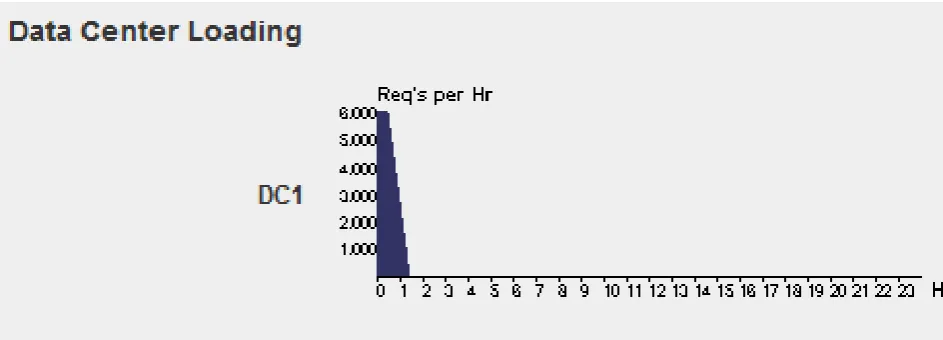
Figure 1.1: Datacenter load.
The result of CloudAnalyst in the form of graph is shown in Figure 1.1. Here this graph shows that the number of requests which can be handled by datacenter is 6,000 in an hour. We can run number of simulations by taking different parameters to examine the datacenter load and accordingly can change some parameters to balance it. But our main motive was to examine the power consumption of datacenter, and this tool was unable to provide this information.
B. CloudReport
CloudReport is a graphic tool that simulates distributed computing environments based on the Cloud Computing paradigm. It uses CloudSim as its simulation engine and provides an easy to use user interface, report generation features and creation of extensions in a plugin fashion. The application simulates an Infrastructure as a Service (IaaS) provider with an arbitrary number of datacenters. Each datacenter is entirely customizable. The user can easily set the amount of computational nodes (hosts) and their resource configuration, which includes processing capacity, amount of RAM, available bandwidth, power consumption and scheduling algorithms. The customers of the IaaS provider are also simulated and entirely customizable. The user can set the number of virtual machines each customer owns, a broker responsible for allocating these virtual machines and resource consumption algorithms. Each virtual machine has its own configuration that consists of its hypervisor, image size, scheduling algorithms for tasks (here known as cloudlets) and required processing capacity, RAM and bandwidth. It generates the simulation result in the form of HTML files [5]. The number of supported extensions by this tool is:
• Virtual machines allocation policies. • Broker policies.
• Processing elements provisioners. • RAM provisioners.
• Bandwidth provisioners. • Cloudlets schedulers. • Power consumption models. • Resource utilization models. • Virtual machines schedulers.
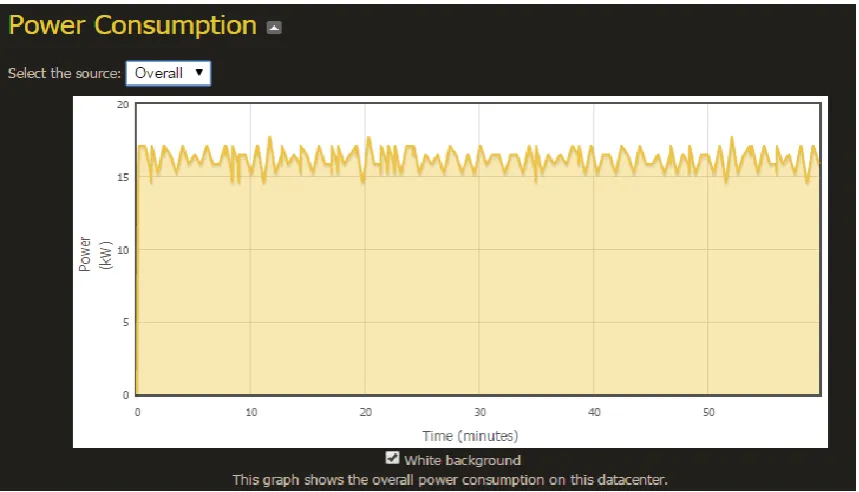
Figure 1.2: Overall power consumption by host.
As it is shown in Figure 1.2, this tool provides enough information related to the power utilization by all hosts, but it is also important to know power consumption of complete datacenter. And this tool was not able to provide this information as well as power consumption by switches.
C. GreenCloud
The figure 1.3 presents the result of three-tier debug architecture, the average Load/Server is 0.3 i.e. lightly loaded, and Datacenter Load is 26.6%. It presents all information regarding the Total Tasks, Average Tasks/Server, Rejected task, failed task by server and so on. The Pie chart shows the energy consumption of each component in percentage such as Server, Core switch, aggregation switch, and Access switch.
The main features provided by GreenCloud simulation tool are: • Completely focused on cloud networking and energy awareness. • Simulation of CPU, memory, storage and networking resources. • Independent energy models for each type of resource.
• Provide support of virtualization and VM migration. • Network-aware resource allocation.
• Completely based upon TCP/IP implementation. • Open Source software.
• The script used is C++/OTcl.
With these useful features this tool has also some drawbacks which cannot be neglected. • High Simulation time, generally Tens of minutes.
• Limited graphical support. • High memory requirements.
IV.CONCLUSIONS
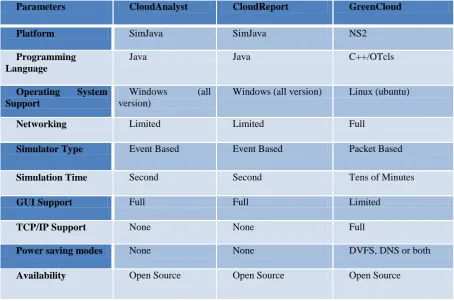
After running the multiple simulations, it is clear that each tool is efficient at particular circumstances. This paper provides the analysis of these tools w.r.t the power utilization. The observations of this study are (i.)The first simulation tool (i.e. cloud analyst) just provides the detail regarding load over datacenter by varying the User Base (UB) and Datacenter (DC) parameters. But this tool was unable to provide the information regarding power consumption of datacenter. (ii.) The 2nd tool (i.e. cloud report) provides the information regarding the power utilization of datacenter, but the power consumption by individual component was missing. (iii.) The last tool (i.e. Green cloud) provides all the information that is missing in both the previous tools with some its own limitation. So, according to our study the green cloud tool provides the best result regarding power utilization of datacenter. The Table 1 presents the overview of these tools in terms of different parameters.
Parameters CloudAnalyst CloudReport GreenCloud
Platform SimJava SimJava NS2
Programming Language
Java Java C++/OTcls
Operating System Support
Windows (all version)
Windows (all version) Linux (ubuntu)
Networking Limited Limited Full
Simulator Type Event Based Event Based Packet Based
Simulation Time Second Second Tens of Minutes
GUI Support Full Full Limited
TCP/IP Support None None Full
Power saving modes None None DVFS, DNS or both
REFERENCES
[1] VangieBeal, “cloud computing (the cloud)” http://www.webopedia.com/TERM/C/cloud_computing.html ,
Retrieved on 20th August, 2013.
[2] Dr. Rahul Malhotra & Prince Jain, “Study and Comparison of CloudSim Simulators in the Cloud Computing”, In Standard International Journals, October 2013.
[3] Harleen Kaur and Er. Vinay Gautam, “A Survey of Various Cloud Simulators”, In ICSE, September 2014. [4] http://cloudsimsetup.blogspot.in/, “Cloud simulation tools and softwares”, Retrieved on 5th December,
2015.
[5] https://github.com/thiagotts/CloudReports, “thiagotts / CloudReports: A simulation tool for Cloud Computing environments”, Retrieved on 31st May, 2013.
[6] Theophilus Benson, Aditya Akella, and David A. Maltz, “Network Traffic Characteristics of Data Centers in the Wild”, In IMC, November 2010.
[7] Shekhar Srikantaiah, Aman Kansal, and Feng Zhao, “Energy Aware Consolidation for Cloud Computing”, In usenix, December 2008.
[8] Rajkumar Buyya , Rajiv Ranjan, and Rodrigo N. Calheiros, “InterCloud: Utility-Oriented Federation of Cloud Computing Environments for Scaling of Application Services”, In Springer , May 2010.
[9] Qing Yi and Suresh Singh, “Minimizing Energy Consumption of FatTree Data Center Networks”, In sigmetrics, December 2014.
[10] Mladen A. Vouk, “Cloud Computing – Issues, Research and Implementations”, In Journal of Computing and Information Technology, April 2008.
[11] Min Chen and Hai Jin, Yonggang Wen, and Victor C. M. Leung, “Enabling Technologies for Future Data Center Networking: A Primer”, In IEEE Network, August 2013.