Available Online atwww.ijcsmc.com
International Journal of Computer Science and Mobile Computing
A Monthly Journal of Computer Science and Information Technology
ISSN 2320–088X
IJCSMC, Vol. 4, Issue. 4, April 2015, pg.429 – 436
RESEARCH ARTICLE
Energy Efficient Data Collection from Clusters in
Wireless Sensor Network with Help of Mobile Bots
S.B. Borge
1, M.U.Kinikar
2¹Computer Engineering Dept & S.P University of Pune, India
²Computer Engineering Dept & S.P University of Pune, India 1[email protected]; 2[email protected]
Abstract— In a wireless sensor networks, there are large numbers of sensor that are used to collect data from the network whenever any event occurs. These sensor nodes are placed at large distance from the base station. The data transmission range of sensor node is limited, so the clusters of sensor nodes are formed with the help of any optimizing algorithm. Genetic algorithm (GA), artificial bee Colony (ABC) algorithm or Particle Swarm Optimization (PSO) algorithm can be used to form clusters. The multiple mobile nodes are going to collect the data from those cluster heads. The ABC-MMN algorithm is used to minimize the energy consumed by the cluster heads. Also, instead of single mobile node, multiple mobile nodes would be used to reduce the travelling cost. The pre-computed path is being used for data collection on the basis of the clusters formed by optimizing algorithm. The communication of mobile nodes is done with each other for a change in the path during the collection of data from cluster heads.
Keywords — Multiple Mobile nodes, Clustering, Data Collection, ABC-MMN algorithm, Wireless sensor Network
I. INTRODUCTION
In a Wireless sensor network, recent research works have proved that dynamic mobile nodes are playing a vital role instead of static sensor nodes for data collection. In static network, it is considered that the sensor nodes are highly populated. The communication between those nodes is possible through multiple hops because of highly populated network [1]. The data is transferred from one node to another till it reaches the sink node.
nodes move around the wireless sensor network to collect the data from the heads of the cluster. In this paper, the survey is done on clustering of nodes on a regional basis and multiple mobile nodes collecting the data from cluster heads.
The rest of the paper is organized as follows. Section II provides a brief overview of the literature. Section III gives the architecture of multiple mobile nodes. Section IV introduces the Artificial Bee Colony Multiple Mobile Nodes Algorithm. Section V shows the performance and the result of our proposed algorithm. Section VI gives the applications of multiple mobile nodes in wireless sensor networks. Finally, Section VII concludes our work.
II. LITERATURESURVEY
Traditionally, the nodes in wireless sensor networks were considered as denser networks. Due to denser networks the nodes were able to communicate with each other [1]. Thus, in many research the wireless sensor nodes are assumed to be static. If any event occurs in sensor node, the data is transmitted from one sensor node to another till it reaches to sink node. Thus to transmit data of a single node, many of the nodes have to transmit the data. Unfortunately the energy is consumed of many nodes. The problem with static sensor nodes is that they have a limited energy in the form of battery supply.
To improve the network lifetime, it is necessary to store the energy of sensor nodes. This could be achieved by clustering the static nodes with the help of optimizing algorithms. A very popular clustering algorithm which proposes a two-phase operation based on single-tier network using clusters is called LEACH [09]. The cluster heads are created randomly and also it performs the data aggregation process in the clusters.
Ant colony optimization (ACO) algorithm follows Ants behavior of finding food sources [10]. In event based applications, it is a candidate method for multi-path routing using a swarm based algorithm to maximize network lifetime.
ACO is not suitable for monitoring applications where we require continuous data transfer. PSO algorithm [11] could be used for clustering purpose and to define the cluster heads. It gives us the desired results. But then we also require the best clustering algorithm which maximizes the network lifetime. This artificial bee colony (ABC) algorithm proposed by Dervis Karaboga [12] which is a new optimizing technique could be used for clustering of wireless sensor nodes.
III.ARCHITECTUREOFMULTIPLEMOBILENODES
The assumptions of traditional wireless sensor nodes, the sensor nodes were densely populated. Due to denser nodes, they were able to communicate with each other. If any event occurs in sensor node, the data was travelled through node by node to sink node. Thus, it consumes the energy of many nodes. In this paper, we assume that the nodes are associated at larger distances. Due to the large distances between two nodes, the communication is not possible between those nodes. It implies that for communication, the nodes are not in range of each other. In such scenario, we propose a method of data collection from such nodes when any event occurs. Clusters are formed by grouping those nodes. Each cluster is having its cluster head, which is going to deliver the data to the mobile node. Instead of single mobile node we have used multiple mobile nodes to collect the data from clusters.
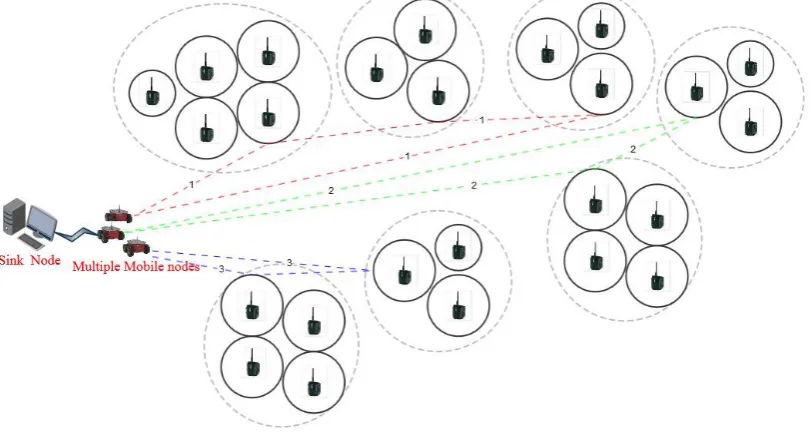
Fig. 1. Multiple Mobile node Architecture for 25 sensor nodes
The architecture of 25 sensor nodes is shown in figure 1. Here 25 sensor nodes are divided into 7 different clusters with the help of efficient clustering algorithm i.e. ABC algorithm [3]. The cluster heads Ch are calculated on the basis of energy backup of sensor nodes in each cluster. After each journey of mobile nodes, the cluster heads are changed to increase the network lifetime. Mobile nodes Mn are calculated depending upon the number of clusters. The equation (1) gives the total number of mobile nodes to be imposed depending on total number of cluster heads.
Mn=(Ch-1)/2 (1)
In figure 1, three mobile nodes collect the data from 7 different clusters. The paths of the mobile nodes are decided by ABC-MMN algorithm proposed in this paper. After collecting the data from cluster heads, all mobile nodes transfers the data to sink node. The use of multiple mobile nodes improves the time consumed by single mobile node to collect the data from sensor nodes. Thus, it improves the network lifetime.
IV.ARCHITECTUREOFMULTIPLEMOBILENODES
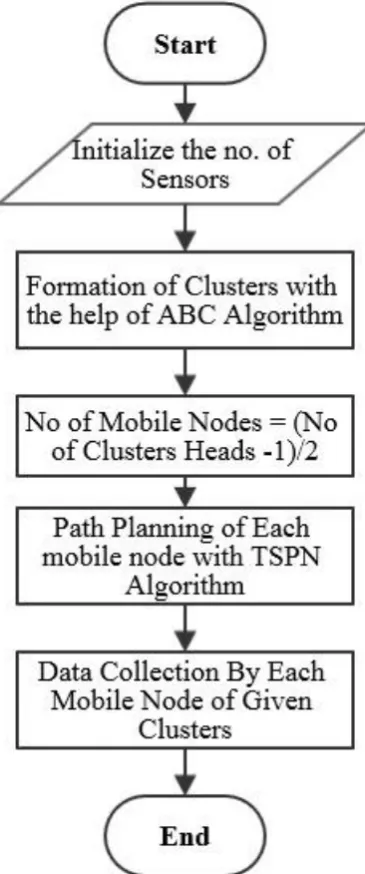
In this paper, Artificial Bee colony multiple mobile nodes (ABC-MMN) is proposed to collect the data from clusters more efficiently. Artificial Bee colony algorithm has proved the most efficient data collection in wireless sensor networks by single mobile node [2]. In this section we impose the ABC algorithm on multiple mobile nodes to collect the data from cluster heads. Algorithm 1 gives our ABC-MMN algorithm.
Algorithm 1:
1. N Initialize the number of nodes.
2. Evaluate the nodes in three groups, i.e. Employed, Onlooker, Scout Nodes. 3. Loop 0, MLCMax Loop Count
4. Do
a. For all employed nodes
i. Calculate the distance of neighbor nodes Dij= dik - dkj
ii. Follow the greedy selection process to form the clusters depending on Dij b. For all onlooker nodes
i. Calculate the fitness of all nodes in clusters (Fi).
ii. Follow the greedy selection process to choose cluster heads (Ch) depending upon the fitness value in each cluster (Fbest).
c. Memorize the best solution for cluster heads. d. Loop Loop +1
5. While Loop <= MLC
6. No of Mobile nodes (Mn)=(Cluster Heads (Ch)-1)/2
7. Calculate the distance between cluster heads Dch = Dic-Djc. 8. Divide the clusters equals to number of mobile nodes.
9. For Each mobile node Mi
a. Array of Cluster heads An{Ch1,Ch2,…Chn} b. For i 1 to Cn do
i. If Ai != visited ii. Ai visited iii. di data of Chi iv. End For c. End For
TABLE I:NOTATIONS
Sr. No. Notation Description
1 N Total Number of Nodes 2 MLC Maximum Loop Count 3 Dij Distance between two nodes
4 Fi Fitness of node i
5 Ch Total no of cluster heads
6 Fbest Best Fitness Value
7 Mn Total number of mobile nodes
8 Dch Distance between the clusters
Fig. 2. Flowchart of Artificial Bee Colony Multiple Mobile Node (ABC-MMN) algorithm.
V. RESULTS
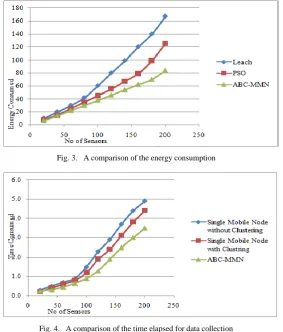
We vary the number of sensors from {25, 50, 100, 150, 200…500} and for each instance the energy conserved is recorded for three algorithms i.e. for Leach, PSO and ABC-MMN. Figure 3 shows the energy conserved by all of three algorithms. The results have proven that the ABC-MMN algorithm could be used to preserve the energy of sensor nodes.
Fig. 3. A comparison of the energy consumption
Fig. 4. A comparison of the time elapsed for data collection
Fig. 7. Fitness(i) of the mobile node.
VI.APPLICATIONS
The advantages of allowing multiple mobile nodes to collect the data increase the number of applications in static WSN fields. The sensors could be attached to peoples for health monitoring i.e. heartbeats, blood pressure, and temperature. Military fields could also use this for detecting the positions and movements of military. Depending on which commander can give signals and could make decisions for attacking on enemies.
VII. CONCLUSION AND FUTURE WORK
In this paper, we presented that data could be collected efficiently in wireless sensor networks with the help of an Artificial Bee colony multiple mobile node algorithm. The clustering of nodes and data collection was done successfully with the help of ABC-MMN algorithm. Through high extensive simulations done on this system, we got validated with the high efficiency of our proposal. In the future, we will replace the static sensor nodes by dynamic sensor nodes. So that sensor nodes could be planted to the heart patients and data could be collected by multiple mobile nodes for providing them necessary remedies in time.
ACKNOWLEDGEMENT
I would like to thank the anonymous referees for their helpful guidance that has improved the quality of this paper. Also, I am thankful to my Project Guide Prof. M. U. Kinikar, for her valuable guidance.
REFERENCES
[1] G. Anastasi , S. K. Das & M. D. Francesco, “Data Collection in Wireless Sensor Networks with Mobile Elements: A Survey,” ACM Transactions on Sensor Networks (TOSN) New York, NY, USA, Volume 8 Issue 1, August 2011.
[2] Wei-Lun Chang, Deze Zeng,Rung-Ching Chen & Song Guo,”An artificial bee colony algorithm for data collection path planning in sparse wireless sensor networks”, Springer-Verlag Berlin Heidelberg 2013, August 2013.
[3] C. Ozturk , D. Karaboga & S. Okdem, “Cluster based wireless sensor network routing using artificial bee colony algorithm,” Springer, Wireless sensor Network 2012, pp. 847–860, 24 April 2012.
41-[5] Ko-Ming Chiu, Jing-Sin Liu & Shih-Rong Yang, “Robot Routing Using Clustering-Based Parallel Genetic Algorithm with Migration,” Journal of Communications Engineering and Networks, Vol. 2 Iss. 2, pp. 71-83, Apr. 2014.
[6] S.Wankhade & N. Chavhan, “A Review On Data Collection Method With Sink Node In Wireless Sensor Network,” International Journal of Distributed and Parallel Systems , Vol.4, No.1, pp. 67-74,Jan 2013. [7] O Chen & R Luo ,“Mobile Sensor Node Deployment and Asynchronous Power Management for Wireless
Sensor Networks,” IEEE Transactions On Industrial Electronics, Volume 59, No. 5, pp. 2377-2385, May 2012.
[8] O. Tekdas, V. Isler, J. Lim, & A. Terzis, “Using mobile robots to harvest data from sensor fields,” Wireless Communications, IEEE, Volume:16, Issue: 1, pp. 22-28, Feb 2009.
[9] H. Balakrishnan, W. Heinzelman & A. Chandrakasan, ” Energy-efficient communication protocols for wireless microsensor networks”, In Proc. hawaaian International conference. on systems science, pp. 1–10, 2000.
[10] Dorigo, M., & Caro, D. G.,”Ant colony optimization: A new meta-heuristic”,In Proceedings of CEC99 Congress on Evolutionary Computation, pp. 1470–1477,1999.
[11] Kennedy, J., & Eberhart, R. C, “Particle swarm optimization”, IEEE Int. Conf. on neural networks ,Vol. 4, pp. 1942–1948, Piscataway,1995