Available Online atwww.ijcsmc.com
International Journal of Computer Science and Mobile Computing
A Monthly Journal of Computer Science and Information Technology
ISSN 2320–088X
IJCSMC, Vol. 3, Issue. 6, June 2014, pg.266 – 274
RESEARCH ARTICLE
Adaptive Image De-Noising Model
Based on Multi-Wavelet with
Emphasis on Pre-Processing
Shubhra Soni
1M.Tech. Scholar, Department of Computer Science and Engineering
Rungta College of Engineering & Technology, Kohka, Bhilai (C.G.), India
1
[email protected]
Ahsan Hussain
2Assistant Professor, Department of Computer Science and Engineering
Rungta College of Engineering & Technology, Kohka, Bhilai (C.G.), India
2
[email protected]
Abstract— The field of signal or image processing naturally deals with the image de-noising. The image may be corrupted by a noise and/or poor illumination and/or high temperature, and/or transmission. The ability of capturing the energy of signal provides us the better solution towards de-noising of a natural images corrupted by Gaussian noise using multi-wavelet techniques. Multi-wavelet can gratify with symmetry and asymmetry which are very imperative characteristics in signal processing. The image will be highly de-noised if and only if the degree of the noise is lesser. Normally, its energy is dispersed over low frequency band while both its noise and details are dispersed over high frequency band. Corresponding hard threshold used in various scale high frequency sub-bands. In this paper proposed to indicate the aptness of various wavelets and multi-wavelet based and a size of different neighborhood on the performance of image de-noising algorithm in terms of PSNR value. Finally it compares wavelet and multi-wavelet techniques and produces best de-noised image using multi-wavelet technique based on the performance of image de-noising algorithm in terms of PSNR Values.
© 2014, IJCSMC All Rights Reserved 267
I. INTRODUCTION
This paper investigates the suitability of different wavelet bases and the size of different neighborhood [1][4][5]on the performance of image de-noising algorithms in terms of PSNR. Over the past decade, wavelet transforms have received a lot of attention from researchers in many different areas. Both discrete and continuous wavelet transforms have shown great promise in such diverse fields as image compression, image de-noising, signal processing, computer graphics, and pattern recognition to name only a few. In de-noising, single orthogonal wavelets with a single-mother wavelet function have played an important role. De-noising of natural images corrupted by Gaussian noise using wavelet techniques is very effective because of its ability to capture the energy of a signal in few energy transform values. Crudely, it states that the wavelet transform yields a large number of small coefficients and a small number of large coefficients.
The problem of Image de-noising can be summarized as follows. Let A (i,j) be the noise-free image and B(i, j) the image corrupted with independent Gaussian noise [10] Z (i, j)
B(i, j) = A(i, j) +σ Z(i, j) (1)
Where Z (i, j) has normal distribution N(O, 1). The problem is to estimate the desired signal as accurately as possible according to some criteria. In the wavelet domain, if an orthogonal wavelet transform is used, the problem can be formulated as
Y(i, j) = W(i, j) +N(i, j) (2)
where Y(i,j) is noisy wavelet coefficient; W(i,j) is true coefficient and N(i,j) noise, which is independent Gaussian. In multi-wavelet [2] aspects, the symmetry and dissymmetry of the wavelet is rather important in signal processing. But single-wavelets with orthogonal intersection and compact-supporting are not symmetric except Harr. Recently, research on multi-wavelet is an active orientation. As multi-wavelet can satisfy both symmetry and asymmetry which are very important characters in signal processing. Multi-wavelet is commonly used in image compression, image de-noising, digital watermark and other signal processing field, so it is especially appropriate to processing complex images.
There are r compact-supporting scaling functions Ø= (Ø1, Ø2…Ør) and they are inter-orthogonal with the
wavelet functions Ψ= (Ψ1, Ψ2…Ψr) T
Ør(t) (l=1, 2,….r).The orthogonal basis of L 2
(R) space is 2j/2Ψr(2 j
t-k) (j, kЄZ, l=1, 2…, r). Hb, Gkis the N*N matrix finite response filters with orthogonal basis, and then the following specific equations can be obtained:
∑ (3)
∑ (4)
II. MULTI-WAVELET TRANSFORM
The Multi-Wavelet[3][6][12] Transform of image signals produces a non-redundant image representation, which provides better spatial and spectral localization of image formation, compared with other multi scale representations such as Gaussian and Laplacian pyramid. Recently, Multi-Wavelet Transform has attracted more and more interest in image de-noising.
The Gaussian noise will nearby be averaged out in low frequency Wavelet coefficients. Therefore only the Multi-Wavelet coefficients in the high frequency level need to hard be threshold [7].
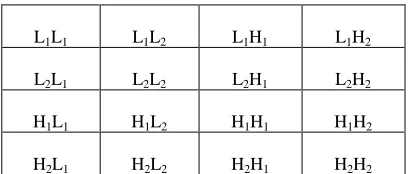
Fig. 2 The hierarchical relationship between every sub-band
III. THRESHOLD FOR WAVELET
The following are the methods of threshold [7][8] selection for image denoising band in Wavelet transform.
Method A Vishushrink
Threshold T can be calculated using the formulae,
T= σ
This method performs well under a number of applications because wavelet transform has the compaction property of having only a small number of large coefficients. All the rest wavelet coefficients are very small. This algorithm offers the advantages of smoothness and adaptation. However, it exhibits visual artifacts.
Method B Neighshrink
Let d(i,j) denote the wavelet[14] coefficients of interest and B(i,j) is a neighborhood window around d(i,j). Also let S2=∑ 2(i, j) over the window B (i, j). Then the wavelet coefficient to be threshold is shrinked according to the formulae,
d (i,j)= d(i,j)* B(i,j) where the shrinkage[3] factor can be defined as
B(i,j) = ||( 1- T2/S2(i,j))|| ,and this formulae yields positive result.
Method C Modineighshrink
During experimentation, it was seen that when the noise content was high, the reconstructed image using Neigh shrink contained mat like aberrations. These aberrations could be removed by wiener filtering the reconstructed image at the last stage of IDWT [13]. The cost of additional filtering was slight reduction in sharpness of the reconstructed image. However, there was a slight improvement in the PSNR of the reconstructed image using wiener filtering. The de-noised image using Neigh shrink sometimes unacceptably blurred and lost some details. The reason
L1L1 L1L2 L1H1 L1H2
L2L1 L2L2 L2H1 L2H2
H1L1 H1L2 H1H1 H1H2
H2L1 H2L2 H2H1 H2H2
© 2014, IJCSMC All Rights Reserved 269
could be the suppression of too many detail wavelet coefficients. This problem will be avoided by reducing the value of threshold itself: So, the shrinkage [3] factor is given by
B(i,j) = ||( 1- (3/4)*T2/S2 (i,j))||
IV. HARD THRESHOLD FOR MULTIWAVELET
The key of wavelet threshold in image de-noising is how to evaluate the coefficients. Although the methods of hard and soft threshold [1] are used widely in practice, there are many faults in their nature. Hard threshold is to keep datum greater than the threshold, and all data less than the threshold are put to zero, the formula is as following:
A’j,k=
Where σ is threshold and Aj,k the wavelet coefficients.
In hard threshold, Aj,k which are discontinuous at σ will bring some concussions and large mean-square deviation to
the reconstructed signal
V. DE-NOISING PROCESS FOR MULTI-WAVELET
If the noised image is
I (i,j)=X (i,j)+n (i,j) i,j=1,2,….,N (3)
Where n (i,j) is white Gaussian noise whose mean value is zero, σ is its variance, and X(i,j) the original signal. The problem of de-noising can be thought as how to recover X (i, j) from I (i, j). Transform the formula (3) with multiwavelet, formula (4) is obtained
W1 (i,j)= Wx (i,j)+ Wn (i,j) (4)
It is known from multi-wavelet transformation that, the multi-wavelet transformation of Gaussian noise is also Gaussian distributed, there are components at different scales, but energy distributes evenly in high frequency area, and the specific signal of the image has projecting section in every high frequency components. So image de-noising can be performed in high frequency area of multi-wavelet transformation. The above said methods are evaluated using the quality measure Peak Signal to Noise ratio which is calculated using the formulae,
PSNR= 10log 10 (255) 2/MSE (db)
Where MSE is the mean squared error between the original image and the reconstructed de-noised image. It is used to evaluate the different de-noising scheme like Wiener filter, Visushrink, Neigh shrink [11], ModifiedNeighshrink and multi-wavelet.
VI. PROPOSED ARCHITECTURE
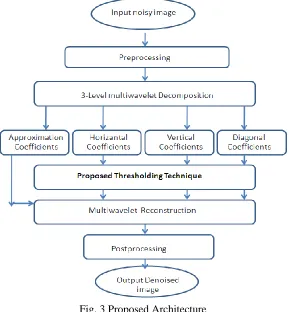
In this proposed approach of denoising the first step will cover preprocessing for the input image, we are using Row preprocessing method. After preprocessing we will transform the image into the multiwavelet as domain using an orthogonal periodic multiwavelet transform. Now the thresholds will be calculated by using the proposed method.
Aj,k….|Aj,k|≥σ
Perform the inverse multiwavelet transform to obtain the reconstruction information then perform post-processing the reconstruction information to get the denoised image.
Fig. 3 Proposed Architecture
PSNR value: The image mean square error and peak value signal-to-noise ratio were applied to estimate the de-noising effect of the image. Peak Signal to Noise ratio(PSNR) which is calculated using the formula,
PSNR= 10log 10 (255) 2/MSE (db)
where MSE is the mean squared error between the original image and the reconstructed de-noised image. It is used to evaluate the different denoising scheme like Wiener filter, Neighshrink etc.
Algorithm for Peak Signal to Noise ratio (PSNR)
Step1: Difference of noisy image and noiseless image is
calculated using imsubstract Command.
Step2: Size of the matrix obtains in step 1 is calculated.
Step3: Each of the pixels in the matrix obtained in step
is squared.
Step4: Sum of all the pixels in the matrix obtained in
Step3 is calculated.
© 2014, IJCSMC All Rights Reserved 271
VII. EXPERIMENTAL RESULTS WITH SCREENSHOTS
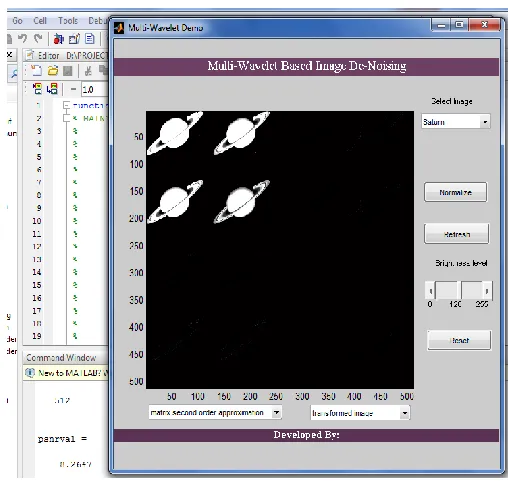
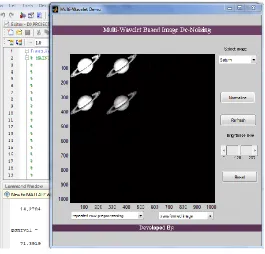
We did experiment on various noisy images and got that repeated row processing gives best PSNR value.
Fig. 4 Matrix first order Approximation
Fig. 6 Repeated row processing
© 2014, IJCSMC All Rights Reserved 273
We have done experiment on images using Matlab 7.9 and following table provide results.
Sr.
No. Method Image PSNR Value
1 GHM with Matrix 1st Order 14.39
2 GHM with Matrix 2nd Order 52.22
3 GHM with Repeated Row Inf
4 GHM with Matrix 1st Order 11.35
5 GHM with Matrix 2nd Order 14.69
6 GHM with Repeated Row Inf
7 GHM with Matrix 1st Order 13.22
8 GHM with Matrix 2nd Order 28.58
VIII. CONCLUSION
In this paper, the image de-noising using Discrete Wavelet Transform and Multi-Wavelet transform is analyzed the experiments were conducted to study the suitability of different wavelet and multi-wavelet bases and also different window sizes. Experimental Results also show that multi-wavelet with hard threshold gives better result than Modified Neigh shrink, Neigh shrink, Weiner filter and Visushrink.
Multiwavelets are a new addition to the body of wavelet theory. Realizable as matrix-valued filter banks leading to wavelet bases, multiwavelets offer simultaneous orthogonality, symmetry, and short support, this is not possible with scalar 2-channel wavelet systems. After reviewing this recently developed theory, we examine the use of multiwavelets in a filter bank setting for discrete-time signal and image processing. Multiwavelets differ from scalar wavelet systems in requiring two or more input streams to the multiwavelet filter bank .After reviewing the recent notion of multiwavelets (matrix-valued wavelet systems), we have examined the use of multiwavelets in a filter bank setting for discrete-time signal processing.
REFERENCES
[1] D. L. Donoho, "Denoising By Soft-Thresholding," IEEE Transactions On Information Theory, VOL. 41, PP.613-627, 1995.
[2] Bui, G. Y. Chen, "Translation Invariant De-Noising Using Multiwavelets," IEEE Transactions On Signal Processing, VOL.46, NO. 12, PP.3414-3420, 1998.
[3] L. Sendur and I. W. Selesnick, "Bi-variate Shrinkage with Local Variance Estimation," IEEE Signal Processing Letters, Vol. 9, No. 12, pp. 438-441,2002.
[4] G. Y. Chen and T. D. Bui, "Multi-wavelet De-noising using Neighboring Coefficients," IEEE Signal Processing Letters, vol. 10, no.7, pp.211-214, 2003.
[5] Sendur Land Selesnick I W 2002 Bivariate Shrinkage Functions FOR Wavelet-Based Denoising Exploiting Interscale Dependency IEEE Trans Signal Processing
[6] Lin K Z, Li D P and Hua K Q 2000 Operator Description of Image Wavelet Denoising Journal of Harbin University of Science And Technology 5 8 -12.
[7] S QZhang, X H Xu, J T Lv, X Y Xang and N He of an Improved Approach To Image Denoising Based On Multi- Wavelet and Threshold, International Symposium on Instrumentation Science and Technology, Journal of Physics. [8] R. J. Vidmar. (1992, August). On the use of atmospheric plasmas as electromagnetic reflectors. IEEE Trans.
Plasma Sci. [Online]. 21(3). pp. 876—880.
[9] RathaJeyalakshmi and Ramar, "A Modified Method for Speckle Noise Removal inUltrasound Medical Images", International Journal of Computerand Electrical Engineering, Vol. 2, No. 1, pp. 54-58, February, 2010
[10]Ahmed Badawi, Michael Johnson and Mohamed Mahfouz, "Scattered Density in Edge and Coherence Enhancing Nonlinear Anisotropic Diffusion for Medical Ultrasound Speckle Reduction", International Journal of Biological and Life Sciences, Vol. 3, No. 1, pp. 1-24, 2007
[11]Ratnaparkhe, Manthalkar and Joshi, “Texture Characterization of CT Images Based on Ridge let Transform”, ICGST-GVIP Journal, Vol. 8, No. 5, pp. 43-50, January 2009
[12]Sudha, Suresh and Sukanesh, "Speckle Noise Reduction in Ultrasound Images by Wavelet Thresholding based on Weighted Variance", International Journal of Computer Theory and Engineering, Vol. 1, No. 1, pp. 7-12, April 2009
[13]Pierrick Coupe, Pierre Hellier, Charles Kervrann and Christian Barillot, "NonlocalMeans-Based Speckle Filtering for Ultrasound Images", IEEE Transactions on Image Processing, Vol. 18, No. 10, pp. 2221-2229, October 2009.
[14]YangWang and Haomin Zhou, "Total Variation Wavelet-Based Medical Image Denoising", International Journal of Biomedical Imaging, Vol. 2006, pp.1-6, January 2006
[15]Fernanda Palhano Xavier de Fontes, Guillermo Andrade Barroso and Pierre Hellier, "Real time ultrasound image denoising", Journal of Real-Time Image Processing, Vol. 1, pp.1-14, April 2010