Journal of
RANGE
MANAGEMENT
Conservation of Soil and Soul
REV. ALANSON BROWN Box 1013: Sonora, Texm
Conservation and proper man- agement of our natural resources are basically a religious problem and this fact determines our tech- nical, social, economic and political approach to a solution. This is my conviction and contention. The god or gods a man worships determines what he does with his natural re- sources and how he approaches life in its totality. This is the key to our problem as a nation and as in- dividuals interested in and dedi- cated to the conservation and prop- er management of what God in His goodness has given us; whether it be farm land, range land, forested land or the minerals in and under the land. The worship of false, greedy gods results in the destruc- tion of this resource while the wor- ship of the one, true God of all Creation results in the conserva- tion of His precious gift to us.
Lowdermilk (1953) asked Pro- fessor Gautier, an expert on North Africa, if the climate there had changed since Roman times in order to justify the desolation of the area. He answered, “We have no evidence to indicate that the climate has changed in an impor- tant degree since Roman times, but the people have changed.” Lowder- milk concludes “that the decline of North Africa is due to a change in a people and more especially to a change in culture and methods of use of land that replaced a highly developed and intensive agriculture and that allowed ero- sion to waste away the land and to change the regime of waters.” A c*bange in culture means a
change in religion ; therefore here is secular evidence that my convic- tion and contention is valid.
I will spell out my contention and conviction that conservation of natural resources is basically a religious problem with two points. The first is that the only worthy motive for conservation and prop- er management of our land re- source is to glorify God. The second is that man’s conservation of self (salvation), both individual- ly and as a group, is dependent upon and tied in with conservation and proper management of land resource.
To substantiate my first point that the only worthy motive for conservation is the glorification of God I want to tell you about the early Christian Monastics and what they did for agriculture; for what we consider the great accomplish- ments of today in agriculture are merely the “fruits of the spirit” of humble men who served and glori- fied God with all their hearts, minds, souls, and bodies.
St. Benedict believed and taught that idleness is the enemy of the soul and prescribed manual labor as a part of the discipline of all monastic communities. To provide this need of the soul and to pro- vide for their physical needs as well, the monks set to work on the land about them. They approached all Creation as the gift of God and treated it as such. It was ap- proached in reverence, without fear, and with temperance and self- restraint in its use.
159
Just what did result from their efforts in the field of agriculture ! In Northumberland (Great Brit- ain) two thousand square miles of shady plains and barreu sheaths were turned over to the church. All was developed into fat pastur- age and abundant harvest. The un- productive Fen district (swamps) of Southhampton was described in these words, “It is a counterfeit of Paradise, where the gentleness and purity of heaven appear to be re- flected. * * * Not an inch of land as far as the eye can reach lies uncultivated. Here the soil is hid- den by fruit trees, there by vines stretched upon the ground or trailed on trellises.”
They taught that land should be fallowed after continuous crop- ping. They practiced crop rota- tion with clover as a soil building crop. They taught and practiced the value of drainage and irriga- tion. They pioneered in forest and water conservation.
?“’ ,’
160 ALANSON BROWN
of Europe and Britain. Their ac- complishments in the field of agri- culture were by-products of their primary desire to praise and serve their Lord !
Now to explain my conviction that man’s conservation of self (sal-
vation), both individually and as a group, is dependent upon and tied in with conservation of land re-
sources. Range experts have found that it is fruitless to study the grasses of an area without consid- ering all other biological and geo- graphical factors at play. Grass then is only a segment of a total relation of plant, animal and phys- ical environment. This analogy carries over into all Creation. Man dare not study the total Creation without considering himself a part of it. We are related directly to Creation, but in the Creation we were given t.he command to have dominion over it and subdue it. This lordship of Creation in no way divorces us from the natural world. We were made out of the stuff of the earth but the Almighty breathed the life of his likeness into us. Thus we are created in His image out of the stuff of na- ture. Man is the crown of all Cre- ation and has been given a life- long lease on the rest of the created order. Therefore as lease-holders for God we have the responsibility for the care of this earth. What happens to the natural world af- fects man and what happens to man affects the natural world.
Thus in our religious striving for conservation of self or for what is commonly called “salvation” we dare not think that we are able to leave behind the natural world. Listen to the promise of God in the Book of Deuteronomy, “And if you will obey my commandments which I command you this day, to love the Lord your God, and to serve him with all your heart and with all your soul, he will give the rain
for your land in its season, the early rain and the later rain, that you may gather in your grain and your wine and your oil. And he will give grass in your fields for your cattle, and you shall eat and be full. Take heed lest your heart be deceived, and you turn aside and serve other gods and worship them, and the anger of the Lord be kindled against you, and he shut up the heavens, so that there be no rain, and the land yield no fruit, and you perish quickly off the good land which the Lord gives you.” (Deut. 11:13-17) The kind of lease-holders we are and have been will be taken into account when we appear before our Maker. For in truth the land around us be- comes and is the reflection of man’s soul. Overgrazed pastures and gutted fields reflect greedy, grasping spirits who have for- gotten whence they came and who breathed the fullness of life into them. They have abdicated their God-given lordship of nature and gone chasing after false gods. As God’s men and God’s people we are responsible to Him for what we do with the glorious creation He has given us.
St. Paul put it in better words when he writes to the Christians at Rome, “For the creation waits with eager longing for the reveal- ing of the sons of God ; for the creation was subjected to futility, not of its own will but by the will of him who subjected it in hope ; because the creation itself will be set free from its bondage to decay and obtain the glorious liberty of the children of God.” (Romans 8 :19-X) St. Paul is saying that the Creation is waiting for men to enter fully into and’accept the salvation God has given us and that when man does this all Crea- tion will be freed from death and decay. He even suggests that God made man lord of Creation so that
it might serve as a reflection of the sickness of man’s soul. m
You and I know what has been done by our government and cer- tain inspired individuals in the field of agriculture, yet none of the plans offered have solved our basic problem-the loss of our land re- sources. The USDA has printed thousands of bulletins, the Exten- sion Service has demonstrated, the Experiment Stations have experi- _ mented, and the Soil Conservation Service has “put it on the ground” but still we have not solved the problem.
The root of the problem is the sickness of man’s soul and until that sickness is cured we can only treat the symptoms of his disease. The cure is for man and all men to acknowledge God as their Crea- tor-the Source of all our Bounty. We are dependent on Him for all that we have and at the same time we are stewards of all that He has given us. Once we recognize the root of our problem and get on with the job- of conservation of souls then we can get on with the L job of saving our land resources.
BIBLIOGRAPHY
Bum=, Do&! CUTHBERT. 1919. Benedic- tine Monachism. Longmans, Green & Co., London.
GOODELL, HENRY H. 1901. The influence of the Monks in agriculture. In 49th Annual Report, Massachusetts State Board of Agriculture.
HANNAH, IAN C. 1925. Christian Mon- asticism. Macmillan Co., N. Y. HOLY BIBLE. 1946. Thomas Nelson &
Sons. Revised standard version. LOVT’DERMILK, W. C. 1953. Conquest of
land through 7,000 years. U. S. Dept. Agr., Agr. Inform. Bull. 99.
O’CONNOR, JOHN G. 1921. Monasticism and civilization. P. J. Kenedy & Sons, N. Y.
SIMKHOVITCH, VALDIMIR, G. 1921. Toward the understanding of Jesus and other historical studies. Macmillan Co., N. Y. THOIMPSON, JAMES W. 1928. Economic
and social history of the Middle Ages. D. Appleton-Century Co., N. Y. -- and EDGAR N. JOHNSON. 1937. An
’ How Livestock Grazing Habits and Growth
Requirements of Range Plants Determine
Sound Grazing Management
AUGUST L. HORMAY
Ra,nge Go~servatiomist, California Fore& an(d Range Ex- perimewt Station, Forest Service, U. S. Dept. of Agriculture, Berkeley, Calif or&al
_*
To a stockman the main objec- tive of a range livestock enterprise is sustained maximum livestock production and sustained maxi- mum dollar income. These can be realized only when forage produc- tion on the range is maintained at a maximum level. Unfortunately many livestock ranges in the West have deteriorated and are produc- ing only part of their capacity of forage and livestock. Restoration of forage production on these ranges is a major problem that has not yet been satisfactorily solved.
Management
of Grazing
All-Impolrtant
The basic requirement for range
inefficient depending on how these factors are applied.
improvement is proper manage- ment of grazing. It is true that ranges can be improved by arti- ficial reseeding, weed and brush control, water spreading, and simi- lar cultural measures, but usually the total area that can be treated economically in these ways is rela- tively small. Furthermore, once the range is improved by these methods, maintenance of range production still depends on proper grazing management.
Almost every range presents a different g r a z i n g management problem, so there is no set formula for manipulating these factors. Good grazing management rests mainly on an understanding of certain facts concerning range and livestock behavior, supplemented by management experience and good judgment. Knowledge of live- stock grazing habits and plant growth habits can be used to de- termine good grazing practices- particularly for those phases of management that affect the im- provement and maintenance of the range. This generalization is based chiefly on research and observa- tions of cattle grazing on mountain summer ranges in northeastern California where the grazing sea- son is about four months, June to October.
Selective Grazing Main Cause of Deterioration
What constitutes grazing man- agement “? For a given kind of live- stock it consists of the manipula- tion of only four factors: (1) Stocking rate, (2) season of graz- ing, (3) livestock distribution, and (4) frequency of range grazing. A
Most western ranges are covered by, or have the capacity to grow, bunchgrass type vegetation. This type of vegetation reproduces from seed. Improvement of the type for grazing depends mainly on getting reproduction of desirable forage species in the right places.
A close look at how bunchgrass ranges react under grazing use re- veals the fundamental answer to the problem of range improve- range deteriorates or improves and+
ment. The grazing habits of live- livestock production is efficient or
I * ll’he Californiu Forest and Range Bx-
periment Station is mahtained at Berke- ley in cooperation with the University of California.
stock play a dominant role in range deterioration. Cattle, for ex- ample, graze the range selectively, eating certain plants on certain areas more closely and more con-
sistently than on others. Preferred forage species on readily accessible, preferred sites are utilized closely even under light or moderate stock- ing of the range as a whole. Len d-L - ing emphasis to this point are sev- eral recent utilization studies-by the California Forest and Range Experiment Station at the Burgess Spring Experimental Range in Northeastern California, by John- son (1953) on pine-timber cattle ranges in Colorado, and by Wool- folk ( 1949) on sheep ranges in Montana.
At the Burgess Spring Experi- mental Range, for example, utiliza- tion of Idaho fescue in open areas in a pine timber stand averaged 43 per cent at the end of a particular g r a z i n g season. The average height of the remaining plant growth was 4 inches. However, 40 per cent of the plants in this stand were grazed to a l-inch stubble, 29 per cent to a 2-inch stubble, 13 per cent to a 3-inch stubble, 3 per cent to a 4-inch or taller stubble, and 15 per cent were ungrazed. Other studies have indicated that clipping Idaho fescue to a 1.5-inch stubble for only one season was harmful to the plant; it reduced both basal area and flower stalk production the next year. So in this case, although the average utiliza- tion of the stand was only 43 per cent, more than 40 per cent of the stand was harmfully grazed. _ I
Now the unfortunate part about ’ selective grazing is that plants and areas that are grazed heavily one season tend to be grazed heavily I the next season, and those grazed lightly once tend to be grazed lightly again. Even during the I -- season, livestock tend to regraze , the same plants rather than eat ungrazed ones. This consistent pat- tern of use is the result of the \ grazing habits of the livestock. ‘c
162 Al:GUST L. HORMAY
FIGURE, stock is the
Cont*inuous grazing of particular forage prime cause of range deterioration.
At the Burgess Spring Experiment Range about 29 per cent of the Idaho fescue stand in the pine- timber type was destroyed by 8 years of moderate seasonal graz- ?-
I lng. As closely grazed sites become bare and exposed to soil erosion or become covered with less desirable forage species, depending on local circumstances, livestock are forced to graze the less desirable species )r 0 This process leads to, ever-enlarg- move to less accessible areas. ing areas of deterioration. Range breakdown is spotty because of se- lective grazing. Also some sites deteriorate more rapidly than oth- ers under the same grazing pres- sure because of differences in soil,
livestock tend to graze the palat- able species and leave the unpalat- able ones.
Nor can close cropping of plants on the preferred areas be pre- vented by regulating stocking rate. The general effect of reducing stocking is to reduce the total area grazed and the number of plants that are closely cropped. But close use-as close as under heavy stock- ing-still prevails on the preferred areas. There is no practical point on the stocking scale where close . grazing of a part of the vegetation ‘, /‘does not occur. Stocking rate sim-
il
ply determines closely cropped area and the rate the size of the \ of vegetation change due to graz- slope, vegetation and related fac- I ing.tors. Evidence that ranges deterio- rate in this manner is stamped on practically every mountain range in northeastern California.
plants and range areas by live-
1
Rest Essential
for Range
Improvement
The crux of the problem of rang;: improvement, therefore, is to main- tain the relatively small part of the total plant cover that is closely cropped each year. The question is: How can grazing be regulated so as to prevent close use of these plants? The answer is: It can’t.
Clearly no livestock distribution measure can prevent selective graz- ing. Even on the smallest area,
Varying the season of grazing provides little opportunity for pre- venting injury to the vegetation. In the first place, close cropping is damaging to the vegetation prac- tically throughout the grazing sea- son-even when the vegetation is mature. It is particularly harmful just before flowering time when the vegetation is green and grow- ing most rapidly. Shifting live- stock about to relieve grazing pres- sure on the vegetation at critical stages of plant growth is impracti- cal. Time is too short. Further- more, frequent moving of livestock reduces their total weight gains during the season. Nor is it de-
sirable for livestock production to forego use of the vegetation when it is most susceptible to grazing injury; that is the very time of maximum grazing values.
Persistent close cropping of a portion of the vegetation, there- fore, cannot be entirely prevented so long as the range is grazed. But the harmful effects of grazing can be overcome by controlling the fre- quency of grazing, that is, by with- holding grazing at intervals long enough to give all plants a chance to recover normal vigor, produce seed (Fig. 2), and establish re- production (Fig. 3). The funda- mental answer to range improve- ment and maintenance, therefore, is periodic resting of the range \f rom grazing. Now this does not mean that stocking rate, season of grazing, and livestock distribution do not have some bearing on range improvement a n d maintenance. They do. But these factors bear more importantly on the efficiency of range use and livestock produc- tion.
The idea of resting ranges to ef- fect improvement is not new. A. W. Sampson reached this conclu- sion from studies started in the Wallowa Mountains of Oregon in 1907 and designed what is known as the deferred and rotation sys- tem of grazing. Many other range investigators, including Frandsen (1950), Hull and Johnson (1955), Hutchings and Stewart (1949)) Jones and Love (1945), McCarty (1938)) McCarty and Price (1942))
Table 1. Schedule of grazing treat- ments to encourage reproduction of
Idaho fescue.
Pew Treatment
1st Graze closely first half of season for full herbage use. Rest dur- ing second half of season. 2nd Rest entire season to restore
vigor of grazed plants.
3rd Rest during first half of season to protect developing seed crop from being gra.zed. Graze closely during second half of season for full herbage use and to get seed
I trampled in the soil.
LIYESTOCB GRAZING HABITS AND GRAZING MANAGEMENT 163
have concluded that some form of rest and rotation grazing is needed for range improvement and main- tenance. Grazing studies conducted at the Burgess Spring Experimen- tal Range from 1935 to 1951, have led to the same conclusion. How- ever, these studies have indicated the need for longer rest periods than have been generally recog- nized before.
How to Provide the Needed Rest
,-
The amount of rest needed in a particular case is determined by the growth requirements of the vegetation-in fact by the key for- age species on the range. A key species is one that is most desired for grazing value and soil cover. Idaho fescue, the key species at Burgess Spring, was found to need one full season of rest to restore normal plant vigor after one sea- son of grazing. A half season of rest was needed to protect the de- veloping seed crop from grazing, and a minimum of one season of rest was needed to insure seedling establishment.
A grazing schedule based on these growth requirements and de- signed to enourage establishment of reproduction would be as shown in Table 1. Grazing and resting in this schedule are timed so that the benefits of resting are not nullified by grazing.
Operation of the plan would re- quire subdivision of the range into four units. Each unit would re- ceive the four treatments in order during a 4-pear period (Table 2). The different range units would be grazed and rested over a 4-year pe- riod in rotation. Thus two units would be rested and two grazed each year. At the beginning of the season all of the livestock to be grazed on the range would be placed in unit 1 (see first year in Table 2). Then about midseason after seed ripens the livestock would all be moved to unit 3. At the end of each 4-year period the , - grazing schedule would be started
over again.
The specific grazing schedule out- lined here serves to illustrate the
FIGIJRE 2. Vigorous plants and heavy seed crops are needed for adequate establish- ment of reproduction of desirable forage species. The necessary seed can be obtained in the proper places only by resting the sange from grazing at intervals.
principles in a rest-rotation graz- ing system. The important meas- ure is to provide sufficient rest at the right time to permit establish- ment of reproduction. Some key species may require less rest than that found necessary for Idaho fescue ; then fuller use would be made of all the forage on the range and fewer treatments and there- fore fewer subdivisions of the range would be needed. Other key species may need more rest and, therefore, more treatments and more units. Once the range is built up to a maximum or near maximum herbage production ca- pacity, units that are normally rested in the building-up process can be opened to grazing from time to time to permit fuller use of the forage on the entire range.
A rest-rotation grazing plan provides positively for continu- ous establishment of reproduction, weather atid site conditions per-
mitting. Each year a different range unit is given an opportunity to produce seedlings. Because the rest periods are long, encompassing entire grazing seasons, they satisfy the growth requirements of most of the other plant species associ- ated with the key species on any given site. These broad require- ments also satisfy the needs of vegetation over a uniform climatic region. A grazing system based on Idaho fescue, for example, is suited to mountain ranges throughout most of the east slope Sierra-Cas- cade region of California and Ore- gon.
The merits of rest-rotation graz- ing systems for restoring the pro- ductivity of bunchgrass type ranges have not been fully explored. They should be tried and tested more adequately. A practical-scale test of such a system based on Idaho fescue is now under way on the Harvey Valley Cattle Allotment on
Table 2. Operation of grazing schedule on a four-unit range area.
Year . 1
Unit
2 3 4
1st
2nd
3rd
4th
1% Graze
$$ Rest Rest
11~ Rest l/z Graze Rest
Rest
1/L Rest 1% Graze Rest
_ lb2 Graze I$ Rest
l/z Rest 1,~ Graze Rest
l/z Graze l,l Rest Rest
Rest
$4 Graze 1h Rest Rest
164 AUGUST IL. HORMAY
FIGURE 3. Improvement and maintenance of the range and maximum sustained live-
stock production depend on the continuous establishment of reproduction of desirable forage species.
the Lassen National Forest in northeastern California. This al- lotment encompasses more than 32,000 acres and has a grazing ca- pacity of 500 animal-units at pres- ent. The grazing plan requires use of five range units. The first over- all appraisal of the effectiveness of the plan in increasing grazing ca- pacity on the allotment will be made in 1960 when each of the units will have had one opportu- nity to produce a seedling crop. The results obtained to date are
encouraging.
Summarizing, t h e n, selective grazing of the vegetation is the prime cause of range deterioration. Selective grazing cannot be pre- vented, but its harmful effects can be overcome by resting the range from grazing at intervals. Resting must be timed so as to provide the key forage species on the range the opportunity to reproduce on a continuous basis. There is little doubt that periodic resting from grazing is essential for the im-
Game Habitat and the Multiple Use
of
Southern Forest Ranges”
HUBERT D. BURKE
Southern Forest Experiment Station, Forest Service, U. S. Dept. of Agriculture, New Orlealns, Louisiana *
Most southern ranges are forest ranges in the complete sense of the word. They exist chiefly on lands that were once and likely to be again covered with forests of hardwood and pine. Savannah for- mations can be found, but most openings are temporary and are
IPaper presented at the 9th Annual Neet- ing of the American Society of Range Management, Denuer, Colorado, January 24-27, 1956.
maintained by fires. Records cite the use of fire by Indians to keep hunting areas open. When pas- tures are not mowed, when fields are abandoned, or when openings in the woods are kept free of fire, the inevitable return to forest be- gins. It is on these transitory ranges that the management of livestock and game is practiced in the South.
The kind and quantity of forage
provement and maintenance of bunchgrass type ranges and for h maximum sustained livestock pro- duction.
LITERATURE CITED
FRANDSEN, WALDO R. 1950. Manage- ment of reseeded ranges. Jour. Rallge Mangt. 3 (2) : 125129.
HULL, A. C. JR. AND W. M. JOHNSON.
1955. Range seeding in the Ponder- osa pine zone in Colorado. U. S. Dept. Agr. Cir. 953. 44 pp.
HUTC’HINGS, SELAR S. AND GEORGE STXW-
ART. 1949. Increasing forage yields and sheep production on intermountain winter ranges. U. S. Dept,. Agr. Cir. 925. 63 pp.
JONES, BURL,E J. _&ND R. M. LOVE. 1945. Improving California ranges. Calif. Agr. Ext. Svc. Cir. 129. 48 pp. JOHNSON, W. M. 1953. Effect of graz-
ing intensity upon vegetation and cat- tle gains on Ponderosa pine-bunch- grass ranges of the front range of Colorado. U. S. Dept. Agr. Cir. 929. 36 PP.
MCCARTY, EDWARD C. 1938. The rela- tion of growth to the varying carbo- hydrate content in mountain brome. U. S. Dept. Agr. Tech. Bull. 598. 24 PP.
MCCARTY, EDWARD C. AND RAYMOND PRICE. 1942. Growth and carbohy- dra,te content of important mountain , forage plants in central Utah as af- fected by clipping and grazing. U. S. h Dept. Agr. Tech. Bull. 818. 51 pp. WOOL~OL~K, E. J. 1949. Stocking north-
ern Great Plains sheep range for sus- tained high production. U. S. Dept. Agr. Cir. 804. 39 pp.
164 AUGUST IL. HORMAY
FIGURE 3. Improvement and maintenance of the range and maximum sustained live-
stock production depend on the continuous establishment of reproduction of desirable forage species.
the Lassen National Forest in northeastern California. This al- lotment encompasses more than 32,000 acres and has a grazing ca- pacity of 500 animal-units at pres- ent. The grazing plan requires use of five range units. The first over- all appraisal of the effectiveness of the plan in increasing grazing ca- pacity on the allotment will be made in 1960 when each of the units will have had one opportu- nity to produce a seedling crop. The results obtained to date are
encouraging.
Summarizing, t h e n, selective grazing of the vegetation is the prime cause of range deterioration. Selective grazing cannot be pre- vented, but its harmful effects can be overcome by resting the range from grazing at intervals. Resting must be timed so as to provide the key forage species on the range the opportunity to reproduce on a continuous basis. There is little doubt that periodic resting from grazing is essential for the im-
Game Habitat and the Multiple Use
of
Southern Forest Ranges”
HUBERT D. BURKE
Southern Forest Experiment Station, Forest Service, U. S. Dept. of Agriculture, New Orlealns, Louisiana *
Most southern ranges are forest ranges in the complete sense of the word. They exist chiefly on lands that were once and likely to be again covered with forests of hardwood and pine. Savannah for- mations can be found, but most openings are temporary and are
IPaper presented at the 9th Annual Neet- ing of the American Society of Range Management, Denuer, Colorado, January 24-27, 1956.
maintained by fires. Records cite the use of fire by Indians to keep hunting areas open. When pas- tures are not mowed, when fields are abandoned, or when openings in the woods are kept free of fire, the inevitable return to forest be- gins. It is on these transitory ranges that the management of livestock and game is practiced in the South.
The kind and quantity of forage
provement and maintenance of bunchgrass type ranges and for h maximum sustained livestock pro- duction.
LITERATURE CITED
FRANDSEN, WALDO R. 1950. Manage- ment of reseeded ranges. Jour. Rallge Mangt. 3 (2) : 125129.
HULL, A. C. JR. AND W. M. JOHNSON.
1955. Range seeding in the Ponder- osa pine zone in Colorado. U. S. Dept. Agr. Cir. 953. 44 pp.
HUTC’HINGS, SELAR S. AND GEORGE STXW-
ART. 1949. Increasing forage yields and sheep production on intermountain winter ranges. U. S. Dept,. Agr. Cir. 925. 63 pp.
JONES, BURL,E J. _&ND R. M. LOVE. 1945. Improving California ranges. Calif. Agr. Ext. Svc. Cir. 129. 48 pp. JOHNSON, W. M. 1953. Effect of graz-
ing intensity upon vegetation and cat- tle gains on Ponderosa pine-bunch- grass ranges of the front range of Colorado. U. S. Dept. Agr. Cir. 929. 36 PP.
MCCARTY, EDWARD C. 1938. The rela- tion of growth to the varying carbo- hydrate content in mountain brome. U. S. Dept. Agr. Tech. Bull. 598. 24 PP.
MCCARTY, EDWARD C. AND RAYMOND PRICE. 1942. Growth and carbohy- dra,te content of important mountain , forage plants in central Utah as af- fected by clipping and grazing. U. S. h Dept. Agr. Tech. Bull. 818. 51 pp. WOOL~OL~K, E. J. 1949. Stocking north-
ern Great Plains sheep range for sus- tained high production. U. S. Dept. Agr. Cir. 804. 39 pp.
GAME HABITAT ASD MULTIPLE USE OF SOUTHERX RSSGES 165
.- square feet per acre. Above 110 square feet of basal area, forage again began to increase, because mature longleaf stands open u@ and allow more light to reach the forest floor. At basal areas of 150 square feet, forage averaged a little over 500 pounds.
In Louisiana, Campbell and Cas- sady (1951) found that herbage production was higher under hard- wood than under pine stands, be- cause pine litter accumulated much greater weight than did hardwood litter.
Decline and Restoration of Forests and Wildlife
,-
The variation of forage with tim- ber density requires that plans for managing livestock and wildlife be closely correlated with plans for timber management. The need for close correlation did not always exist and is by no means universal today. It is developing with the rapid spread of scientific timber management.
In the past, clear-cutting left millions of acres devoid of trees and thus established temporary grassland. Free range was the rule then and, in many places, still is. Cutover timberlands, largely com- pany-owned, were used as public domain, chiefly for cattle. Deer had not been seen in some areas for almost a century.
In southwest Louisiana, for ex- ample, the 1939 Forest Survey found 1.5 million acres of cutover land that had not reforested since the virgin timber was cut thirty to fifty years previously; another 3 million acres were relatively open cutover stands. These lands sup- ported large herds of cattle and sheep, some goats and many hogs. Each year fire was used to reduce accumulated material from the pre- vious year and “green up” the range, much as had been done in earlier times by the Indians.
, -
During the past 20 years condi-
aBasal area of a tree is the moss-sectional area of its stem as measured 4.5 feet from the ground.
tions have been changing. Fire protection has received increased support from the people, and nat- ural forest regeneration is re-cov- ering many areas that had lapsed into grass. The large temporary prairies on the cutover longleaf pinelands are as a rule fairly level and have a high timber-producing potential; these are being planted or seeded to pines. As a result, former free-range lands are rapidly becoming covered with even-aged forests. The U. S. Forest Service reported that by 1954 more than 2% million acres had been planted or seeded in the South.
Within established forests, den- sity of stocking is increasing, tim- ber management plans are being applied on larger ,holdings, and cutting is scheduled.
At the same time that the forests have been rebuilding, deer have been re-introduced and protected. Now they are increasing rapidly, and a large and active segment of the public has such an intense in- terest in deer that public land ad- ministrators, livestock operators, and owners of private timberlands could not ignore the problem even if desired. The management of deer forage adds another element to range management. That suffi- ciently large breeding herds exist to provide rapid expansion of the deer population up to or beyond the capacity of the range is evident from a comparison of estimated carrying capacity for the Southern states and their present popula- tion :
Potential Present
deer deer
State Pop.” pop.**
Alabama 450,000 46,118 Arkansas 500,000 75,000 Florida 400,000 42,000 Georgia (no est.) 33,000 Louisiana 165,000 78,000 Mississippi 240,000 50,000 North Carolina 155,000 160,000 South Carolina (no est.) 50,000 Tennessee 250,000 20,000 _--
“Barick, F. B. 1951. Deer restoration in the Southeastern United States,
Today the range manager in the South is faced with two new and rapidly developing situations. One is the re-establishment of the for- ests due to the practice of timber management. The other is the rapid increase of deer over the entire region.
Effect of All-Aged Timber lMa,nagement Upon Range Timber management practices, upon which range management must be based, fall into the two broad categories of all-aged and even-aged. In the management of all-aged stands, individual trees or small groups of trees are harvested as they mature. The general struc- ture of the stand, and hence the amount of forage, remains some- what constant.
Under these conditions, it is necessary for the range manager to determine the effect of the various methods of selective timber har- vest, with their variations in open- ings, upon the forage for livestock and deer. He must determine the type of selective cutting that pro- vides openings in the forest most beneficial to forage production. With this accomplished, the timber management plan can be adjusted to provide the greatest amount of forage commensurate with the ob- jectives of timber production.
Moreover, the necessity for pre- venting undue damage to tree re- production may make it necessary to reduce stocking below the level of forage availability.
Effect of Even-Aged Timber Management Upon Range In management of even-aged tim- ber stands, all, or practically all, of the timber in a given stand is cut at the same time. Much of the existing browse remains, and a heavy growth of grass and forbs
Paper presented at the 5th annual meet- ing of the Southeastern Assoc. of Game and Fish Commissioners. The potential is based on the estimated carrying ca- pacity of the deer ranges.
166
comes in during the first growing season after the cut. The heavy growth covers the area until the young trees, which have come from seed of the previous stand or which may have been planted following the cutting, grow sufficiently to begin to shade out the grasses. As the grasses are shaded out, a heavy growth of shrubs often dominates the understory, but it too becomes thinner as the trees develop. As has been noted, these effects vary widely under the various timber types.
Under even-aged timber manage- ment, then, forage fluctuates wide- ly both in amount and composition. In stands managed for pulpwood, the cycle may be as short as 15 years. Here again total available forage does not always indicate the stocking level. During the first seasons after cutting, when forage is most abundant, tree reproduc- tion is becoming established and the range manager must adjust stocking rates and seasons of graz- ing to prevent da,mage. Cassady, et al., in Louisiana (1955) found that, while cattle rarely graze pines when other green forage is avail- able, losses will be excessive where cattle concentrate and over-graze. Little damage occurred when graz- ing was deferred until there was plenty of green forage.
The utilization of forage under even-aged stands of timber thus depends upon the recognition of the timber-growing cycle as well as the correct evaluation of the sep- arate browse and forage cycles that accompany timber growth.
Neled for Combined Livestock- Game Forage Analysis Today stocking must be based not only upon grazing capacity for cattle but also the capacity of the forage to support deer. Formerly,
HUBERT D. BURKE
browse and forbs in the forest were either considered as a part of the cattle forage or used as a forage safety factor.
Many studies have conside<ed livestock and timber or deer and timber but few if any southern studies have been made to deter- mine the proper correlation of live- stock and deer with timber. This must now be done under both all- aged and even-aged timber condi- tions. A start has been made by both game managers and land ad- ministrators.
Harlow (1955), using the forage weight method developed for southern ranges by Campbell and Cassady (1955), made a forage analysis of four forest types in Florida. Forage species for both deer and cattle were recorded as a basis for estimating combined deer and cattle pressure.
During July 1955, in a field meeting on the Ouachita National Forest in Arkansas, ranges and staff of the Forest, personnel of the State Game and Fish Commission, and range research men from the Southern Forest Experiment Sta- tion calculated combined cattle and deer carrying capacity on a 7,000- acre area containing pine, pine- hardwoods, and old fields.
In addition to grass and browse, the range manager, who now must consider game in his calculations, needs to know the deer food avail- able in the form of acorns (for oaks are present in almost all southern forest stands). The mast crop pro- vides an important supplement to the deer diet and may play an im- portant role in the conditioning of deer for breeding.
Fire
Fire and its relation to timber and range management is of great importance, particularly in the
-VP
longleaf-slash pine forests of the Gulf Coast, where prescribed burns _ are used extensively in timber man- agement. The range manager needs to know the effects of fire in stands producing both deer and livestock forage, as well as timber.
Summary
Most southern ranges are forest ranges. Now that forest cover is returning to large areas of cutover land, the close correlation of live- stock and wildlife management with timber management plans be- comes necessary. Deer, which were absent or scarce in most areas twen- ty years ago, are now numbered by thousands and are increasing rap- idly. Range management must be based on methods of forage anal- ysis that consider both wildlife and livestock forage. Information must be secured on the response of forage to various timber-harvesting methods, the establishment of re- production, and the use of con- trolled burning.
LITERATURE CITED M
CAIIPBELL, R. S. AND J. T. CASSADY.
1951. Grazing values for cattle on pine forest ranges in Louisiana. La. Agr. Expt. Sta. Bull. 452. 31 pp.
-and -. 1955. Forage weight inventories on southern forest ranges. Southern Forest Expt. Sta. Occas. Paper 139. 18 pp.
CASSADY, J. T., WALT HOPKINS AND
L. B. WHITAKER. 1955. Cattle grazing
damage to pine seedlings. Southern Forest Expt. Sta. Occas. Paper 141. 14 PP.
GAINES, E. M., R. S. CAMPBELL AND J. J. BRdSINGTON. 1954. Forage pmduction
on longleaf pine lands of southeastern Alaba.ma. Ecology 35: 59-62.
HARLOW, RICHARD F. 1955. Preliminary report on a deer browse census based on 100 per cent clipping method. Paper presented at 9th annual meeting, Southeastern Assoc. of Game & Fish Commissioners. 47 pp.
R,E~D, R. A. 1951. Woodland forage in the Arkansas Ozarks. Jour. Range Man@. 4: 391-396.
Plan now to attend the 10th Annual Meeting of the American Society
Elementary Morphology of
How It Affects Utilization1
C. A. RECHENTHIN
Soil Conservation
In grass, God in His wisdom gave the world a plant that is admirably adapted to withstand the grazing of animals and be an efficient for- age producer.
Early in its life, the grass seed- ling has growth habits that enable it to survive in spite of grazing animals. J. E. Weaver (1930), in extensive studies of the develop- ment of grass roots, found that roots are sent deeply into the soil before much surface is exposed above the ground. He found that little bluestem, for example, sends roots 2 to 2.5 inches into the ground before the shoot appears above the ground. The root is much ,- branched at the end of 3 days, and at the end of 2 weeks, has reached a depth of 6 inches, with a lateral spread of 2 to 3 inches. Thus, the seedling. becomes firmly attached to the soil soon after germination, and is able to resist being pulled from the soil by a grazing animal.
Grasses as EfEcient Forage Plants
There seem to be two primary reasons why grasses are such effi- cient forage producers : (1) the location of the meristematic tissue and growth habits of the plant, and (2) the ability of the plant to pro- duce new shoots from buds at the nodes, the process known as “till- ering.”
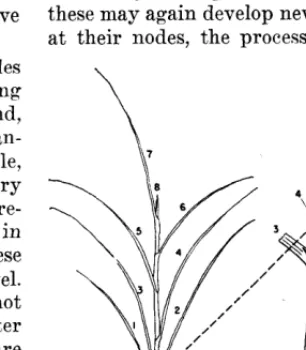
Growth Habits of Grass Let’s examine the structure of a grass plant to see how the loca- tion of the meristematic tissue af- fects its utilization. The stem of a grass plant is made up of a series of nodes and internodes (Fig. 1).
IPaper presented at the Ninth Annual Meeting, American Society of Range Management, Denz;er, Colorado, January 25. 2956.
Service,
Grass Growth and
Sam Angelo, Texas
A sheath is attached at each node, with the leaf blade at the upper end of the sheath. The meristemat- ic, or growth, tissue is located at the nodes in the stems, and at the base of the sheath and the blade.
Roll of ’
nmature leaves I
Node
Seedstalk three weeks old
Seedsta Ik three moni hs old
Growth is by the division, or mul- tiplication, of the growth cells in the meristematic tissue. Thus, the internodes, sheaths and blades issue out of the meristematic region much as a pencil lead issues out of a mechanical pencil.
The grass stem has all its nodes and leaves in embryonic or rudi- mentary form when it emerges from the seed. Growth starts first in the basal node and leaf,’ pushing the rudimentary stalk upward. As that node and leaf approach full size, growth starts in the next node, then the next, and so on until the stem
Seedstalk was cut
Off so new seed- sta I
bud tlon
ks grew from scales at ~unc- of leaf sheath
and joint
ew shoot
elongate
/
ii C
FIGURE 1. Defoliated seedstalks of giantreed (Arundo donax) show how a grass grows from the active tissue at the swollen node. A. Telescoping of joints of a young plant; B. Elongated step of an older plant that is still growing as noted by the telescoping of joints toward the tip; C. Top of growing grass was cut off and new stems grew from the dormant buds at the joints.
168
BIG BLUESTEM SEEOSTALK
ON JUNE 23 AND AGAIN ON AUGUST 21
FIGURE 2. Development of big- bluestem seedstalk on June 23 and on August 21. Four lower joints remained about the same length during the observation but the plant more than doubled in size from the fourth joint upward.
reaches its full length (Fig. 2). The basal nodes of perennial grasses are very short. The sheaths and blades of these nodes are thrust upward, well ahead of the embry- onic stem, or growing point. The sheaths and blades of the basal nodes overlap each other, forming a bundle or tube, the older more mature leaves on the outside, pro- viding a protective cover for the immature leaves and the growing stem on the inside (Fig. 3). In some grasses, there may be 8 to 10 very short basal nodes, and the growing stem is not thrust above the ground and exposed to grazing until considerable growth has oc- curred.
An animal may graze off the leaves that are above the ground, without removing the meristematic tissue at the base of the leaves, or the growing point. Thus, a plant can continue its growth, except for a temporary slowing down of the growth due to the reduction of food-manufacturing leaves.
C. A. RECHENTHIN
Herein lies one fundamental dif- ference between grasses and the broad-leaved plants which makes grasses the more efficient forage producer. Unlike the grasses, the growing cells of the broad-leaved plants are found in the growing, or terminal bud. Upon germina- tion, the terminal bud is immedi- ately thrust upward, and within reach of a grazing animal. If re- moved before a leaf-joint is formed, there will be no further growth. If the terminal bud is removed above a leaf joint, many plants have the ability to start growth from a new bud formed at the leaf joint.
There are differences in grass species, themselves, in how they re- spond to grazing. J. E. Weaver and W. W. Hansen (1941) have made extensive studies of the or- igin, composition and degeneration of pastures in the Midwest. Pal- atability, nutritive value and other factors cause livestock to select some grasses more readily than others, and if too heavily used, even to graze some out of pastures.
Farrel A. Branson (1953) found, however, that differences in the physical structure of grasses may also be important in how grasses respond to grazing. Species of grasses vary in the number of short basal nodes, and also in the number of fruiting stems to vegetative stems.
The number of short basal nodes influences how soon the growing stem is thrust above the ground, and within reach of a grazing an- imal. Little bluestem, for example, was found to have 13 to 15 very short basal nodes, the whole aggre- gating no more than one inch in length (Fig. 4). Most of these short nodes are below ground level. Thus, the growing point is not pushed above ground until after the first 12 to 15 short nodes are mature, which may be mid-growing season. There are about 7 elongated nodes above ground.
Sideoats grama has 10 to 12 very short iydes, totalling little more than one-half inch in length. On the other hand, there are only 2 or
3 nodes above ground. Thus, the growing, or rudimentary, stem, is not pushed to within reach of a grazing animal until shortly before the seed head is produced.
r
The seed heads of little bluestem and sideoats grama are thus ex- posed to a grazing animal only for a short time. Sideoats grama, hav- ing only a few nodes above ground, produces seed heads quickly after the point emerges above the ground, and the chances of the head being removed by grazing are small. It can effectively resist heavy I.&r azing.
On the other hand, some grasses as Indiangrass and switchgrass have only 2 to 4 short basal nodes (Fig. 5). The growing stem is elevated above ground soon after growth starts, and is within reach of a grazing animal. This fact, combined with the high palatability of these grasses in early growth stages, makes it highly probable that the growing stem will be re- moved, particularly under heavy use.
Production of New Grass Shoots
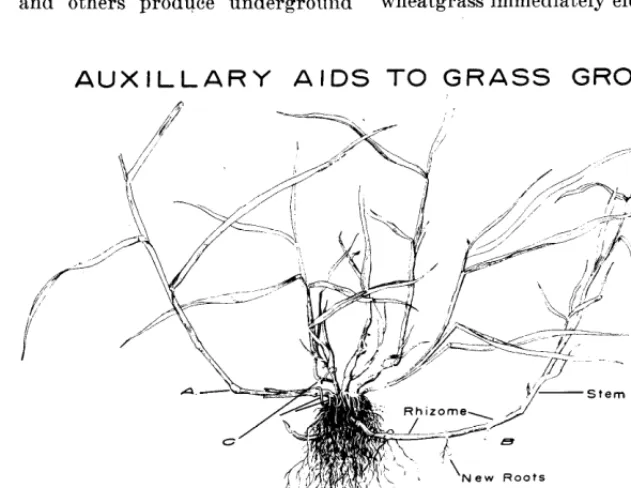
The second important character- istic of grasses that makes them efficient forage producers is their ability to produce new shoots at the nodes, as illustrated in Figure 1, (C.). Buds at the short basal nodes may develop new shoots, and these may again develop new shoots at their nodes, the process known
MORPHOLOGY OF GRASS GROWTH 169
LITTLE BLUESTEM SlOEOATS GRAMA blue grama, both tolerant of heavy
FIGURE 4. Seedsta,lks of little bluestem and sideoats grama with leaves and sheaths removed showing short basal nodes. Detail enlarged 5 times that of habit sketch.
as “tillering.” Generally, growth hormones are produced in the new or growing buds, and the buds at the nodes do not develop. How- ever, under the stimulation of re-
grazing, have ratios of about 6 vegetative stems to each stem pro- ducing a seed head. Switchgrass, a grass less tolerant to grazing, has a ratio of more than 2 fruit- ing stems to each vegetative stem. Branson concluded that those grasses producing a predominance of fruiting stems are less tolerant of grazing than those producing an abundance of vegetative stems.
Stolon and Rhizome Development Certain grasses have the ability to produce stolons and rhizomes, another characteristic probably closely associated with the ability to tiller, making them tolerant to grazing. Buffalograss and curly- mesquite produce surface runners, or stolons, from the axillary buds on the nodes. The growing points of these grasses remain at or near the ground level, and they have a high ratio of vegetative stems to fruiting stems. They are very tol- erant of grazing, even though quite palatable when growing.
Johnsongrass (Fig. 6)) western wheatgrass, Kentucky bluegrass, and others produce underground
INOIANGRASS SWITCHGRASS
FIGURE 5. Seedstalks of Indiangrass and switchgrass with leaves and sheaths removed showing position of basal nodes.
stems, or rhizomes, by means of which they spread. These rhizomes are below the ground and, there- fore, cannot be grazed. However, both Johnsongrass and western wheatgrass immedia tely elevate the moval of the growing stem, growth
hormones are then produced in the
bud scales at the nodes, which will
AUXILLARY
AIDS
TO GRASS
GROWTH
begin growth.Grasses having many short basal nodes, as sideoats grama and little bluestem, have many buds from which to “tiller.” Adventitious roots are developed at the nodes to supply the needs of the newly- developed lateral branches into
which the axillary buds develop. ,,/ Indiangrass and switchgrass, k with fewer short basal needs, have only a few nodes from which buds I can develop i.nto new shoots. They are less able to spread or even maintain growth under intense grazing.
Branson (1953) found that the New Roots
ratio of fruiting stems to vegetative stems in grasses has an influence on response to grazing. Sideoats
-- grama, a grass tolerant of close- t.
grazing, has a ratio of slightly FIGURE 6. Axillary aids to grass growth.
more than 2 vegetative stems to geotropic reaction of growth tissue on lower side of node in forcing stem upward; A. Lodged or bent-over stem showing
170 C. A. RECHENTHIN
growing point of the stem above ground upon emerging, and have a low ratio of vegetative stems to fruiting stems, making them less tolerant of grazing than the blue- grass, which has a high ratio and remains close to the ground.
Still other grasses, like Bermuda- grass, have both stolons and rhi- zomes. Bermudagrass remains close to the ground and can tolerate in- tense grazing.
Another feature adding some- what to the value of grasses for grazing is their ability to withstand trampling. The plant is able to tiller if the shoot is removed by grazing or trampling. The meriste- matic tissue at the nodes also re- tains its ability to resume limited growth. If the shoot is knocked
down accidentally, the tissue on the lower side of the stem resumes growth. The cells on the lower side of the stem are the collection point in such cases of growth hor- mones, stimulating the cells to elon- gate, thus elevating the stem again to a vertical position, where normal production of the seed head can proceed.
Thus we can see in grasses a type of plant that is adapted to withstand grazing and to be an efficient producer of forage for grazing animals. Perhaps ages of grazing have left only those plants in the plains and prairie regions that were able to withstand grazing -an application, to a degree at least, of the law of the survival of the fittest.
BIBLIOGRAPHY
ALLR~D, B. W. 1947. How to know m grass. Soil Conservation Service, Re- gion 4. unnumbered publ.
---. 1950. Practical grassland man- agement. Sheep and Goat Raiser Magazine, San Angelo, Tex. 307 pp. ARBER, AGNES. 1934. The Gramineae, a
study of cereal, bamboo and grass. Cambridge Univ. Press. 480 pp. BRANSDN, FAELRZL A. 1953. Two new
factors affecting resistance of grasses to grazing. Jour. Range Mangt. 6( 3) :
165171.
EVANS, M. W. 1946. The grasses, their growth and development. Ohio Agr. Expt. Sta. Agron. mimeo. 105. 246 pp.
WEAVER, J E. 1930. Underground plant development in its relation to grazing. Ecology 11: 543-557.
WEAVE&, J. E. AND W. W. HANSEN. 1941. Native midwestern pastures, their origin, composition and degen- eration. Nebraska Cons. and Survey Div. Bull. 22.
EFFECTS OF SEED TREATMENTS UPON THE GERMINATION OF CERTAIN BROWSE SPECIES OF COLORADO
Abstract of thesis submitted in partial fulfillment of the requirements for the Degree of Master of Science in Range Manugement, Colorado A. and M. College, 1954.
Attempts to restore browse cover on depleted big game winter ranges by artificial reseeding have gen-
erally failed. Successful reseeding of brows,e pla.nts has been handicapped by a lack of information con- cerning methods of treating browse seeds which will induce satisfactory germination.
A study was undertaken to compare the relative effectiveness of two seed treatments, stratification and a#cid scarification, in inducing germination of three shrubs : antelope bitterblrush (Purshicc tride”nt&a), mountain mahogany (Cercocarpus mowtalvms) and fourwing saltbush (AtripZex calnescem). Potential germination of these seeds was also determined for comparative purposes by staining embryos with tetra- zolium chloride by the topographic method.
Stratification was accomplished by placing seed in moist acid peat at temperatures of 31” F. to 41” F. Samples were removed at weekly intervals to deter- mine the optimum period of stratification.
Acid scarification w&s accomplished by placing seed in a copper-screen basket and suspending in concen- trated sulfuric acid for ten minute int,ervala up to 90 minutes. The seed were then washed a.nd planted in flats of vermiculite in four replications of 50 seeds each for germination at temperatures of 62” to 77” F. The best’ period of stratification for bitterbrush was 49 t,o 70 days. After 49 days in stratification a few of the seeds began to sprout. The germination of seed stratified for 70 days was 82.5 percent, while non-treated seed germinated 1 percent. Acid treat- ment of bitterbrush for a period of 50 minutes re- sulted in a germination of 83.5 percent.
The best period of stratification for mountain ma- hogany was four weeks or longer. At the end of nine weeks stratification, however, a large portion of the seed began to sprout,. The germination of seed
stratified for 70 days was 71 percent, while non- treated seed germina,ted 1 percent’.
Mountain mahogany seed soaked in acid for 60 minutes ha.d the highest germination, 51.5 percent. This figure is significant’ly higher than the control, but is also significantly lowler t.han t.he germination resulting from stratification. Nevertheless, acid scari- fication removes the hairy styles from the seed which would permit, the seed to pass, readily through a seed drill for more rapid and effective planting.
Fourwing saltbush seed does not require stratifica- tion so only acid treatment was used on these seeds. The germination of seed soaked for 60 minutes was 15.5 percent, while the control lot germinated 10.5 percent.
Staining of the embryos by use of 2,3,5-triphenyl- tetlazolium chloride proved inconclusive in indicating germination capacity for bitterbrush and mountain mahogany. Fourwing saltb,ush, however, reacted fa- vorably to the stain. The1 average potential germi- nation of fourwing saltbush as indicated by staining was 41 percent,, while the a.verage germination of acid treated seed was 14.75 percent.
These studies show that acid scarification of bitter- brush is as effective as stratification in inducing bet- ter germina,tion. Acid scarification may be accom- plished in less time than stratification, and the treat- ment. is advantageous in instances where1 seed must be treat,ed and planted in a minimum of time.
While stratification induces better germination of mountain mahogany than acid scasification, the latter treatment, relmoved the hairy styles so that seed may be planted with drills. In view of the known advan- tages of drilling in planting seed more uniformly in the soil, acid scarification of mountain mahogany seed is to be preferred wherever drilling of seed may be effect,ive.
Acid scarification removes the wings of fourwing saltbnsh seed s#o that it may be drilled.--Rcalyymoad
Some Soil-Plant Relationships in
Eastern Oregon
E. WILLIAM ANDERSON
Range Conaervationnist, Soil CoJnservation Serviced, Pendle-
to%, Oregon
Soil and plant technicians, ranch- ers and farmers have long recog- nized the fact that soil differences are often accompanied by certain plant differences. Scientists have studied and written about precise soil-plant relationships. H. L. Shantz (1911, 1938) and A. W. Sampson (1939) contributed much to the understanding of plants and the soils on which they grow over a wide area, and to the application of these facts to western agricul- ture.
In studying soil-plant relation- ships, a phase of a soil type is the unit of soil mapping about which the greater number of precise state- ments and predictions can be made concerning soil use, management and productivity. Locally, and on arable lands, these specific soil- plant relationships are well known and recognized. On non-arable lands, the concepts of soil-plant relationships are often general in nature; as, for example, that salt- grass occurs on saline soils and conifers on acid soils. This is due to the longer and more detailed background of research and obser- vation on cultivated lands than on range and forest lands.
The Study Area
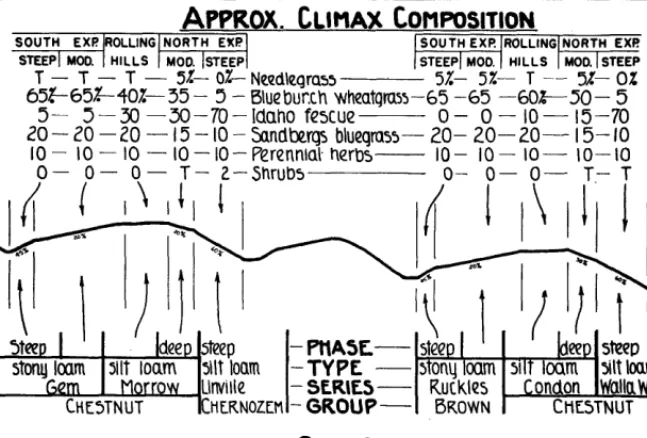
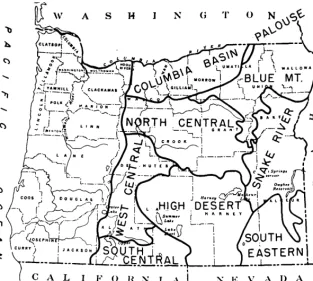
A study of range sites, their soils, original vegetation, and response to grazing use in eastern Oregon, has revealed some significant soil- plant relationships that have not been commonly known. To illus- trate, the Columbia Basin Area of northeastern Oregon has been se- lected as an example. This area is bounded on the east and south by the Blue Mountains, on the west by ._ the Cascades, and on the nbrth by the Columbia River. Figure 1 is a north-south profile section of this Area.
From the north at the Columbia River at an elevation of about 300 feet and extending south for about 10 miles is a low rolling terraced area sloping toward the river. Far- ther south for about 15 miles is an area of low undulating hills some- what higher in elevation. From here on south for another 25 miles, the drainage pattern becomes more pronounced with elevations rising to about 4,000 feet where the Blue Mountain timbered area begins.
Average annual precipitation along this profile ranges from about 7 to 8 inches at Irrigon on the river to about 16 inches near the timber.
soils
The general soils pattern is shown in Figure 1. The area near- est the Columbia River is charac- terized by Rupert sand, a soil de-
veloped in alluvium that has been reworked by wind. The undulat- ing hills a’re represented by the Ritzville silt loam, a soil developed from eolian deposits. The foothill area to the south is characterized by areas of Condon silt loam and Morrow silt loam, which are pri- marily derived from loess with minor residual characteristics from basalt.
Typical of zonal soils, the soils representing this land profile re- flect the influence of the active factors of soil genesis-climate and living organisms, chiefly vegeta- tion. Three great soil groups,1 Sierozem, Brown, and Chestnut,2 are represented by these soils. They reflect improving climatic factors for plant growth.
Vegetation
The concurrent development of soil profile and vegetation, each
IPersons unfa,miliar with the concepts of great soil groups will find them defined and disavsed in the 1958 Yearbook of Agriculture SOILS AND MEN.
ZImprovements in the soil classification system being currently developed may somewhat cha%ge the present clastifica- tion of certain soil series mentioned in this paper.
COLUMBIA BASIN OF WIERN OREGON APPROXIMATE CLIMAX COMPOSITION
40 % -_____ 60 % __ Duo bunch wheatqrass ---65% ---20 % 5 30 IO __ Idaho fescue 0 ---0 f
20 - - - - - 20 -- Sandbergs bluegrass- - ----225 ----20
T
: ____~-~ - T -~ Needleqrasses ~ 5 ---30 0 ____-~- 0 --Indian rIcegrass--- 0 ---IO
: IO ___----~~ IO --~~ Perennial herbs---- -_ 5 ---IO ._J ;
I 7oort ____- ~ 700*-p-- FORAGE. YICLO Lbs/acre __- 500*---
+ I I
ZOO’ 5
4.000' Llovailon 1 2
1b"t ppt 2
NOIZTH- U 300, LkvPt\on
7-8’ ppt m
c---Z5 mnles ___- _____--_- __ -- -y- 15 m\k?s - - IO m,hc _
Morrow Condon Ritzville &pert
silt loam silt loam silt loam sand
CHE3TNUT BROWN 5IEKOZE.M
Residual - v/II-Id Wind Water
SO\&
FIGURE 1. General north-south profile section of the Columbia Basin Area of East-
ern Oregon showing general soil-plant relationships as influenced by changing soils, elevation, precipitation, geographic position and other climatic and physiographic factors.