Study of various spectroscopic properties of the
D
smeson
Virendrasinh H. Kher1,a, Nayneshkumar Devlani1,b, and Ajay Kumar Rai2,c
1Applied Physics Department, Polytechnic, The M.S. University of Baroda, Vadodara 390002, INDIA 2Department of Applied Physics , S.V. National Institute of Technology, Surat 395007, INDIA
Abstract. Spectroscopic parameters of theDs(cs) meson are obtained using phenomeno-¯
logical quark antiquark potential(coulomb plus power) model consisting ofO(1/m) cor-rection to the potential. Within Variational scheme Gaussian wave function is employed with a hamiltonian incorporating kinematic relativistic corrections to obtain various prop-erties such as the mass spectra, decay constants, electromagnetic transitions. The results are compared with various experimental measurement as well as other theoretical predic-tions.
1 Introduction
The Ds meson is a light-heavy quark structure composed of the charm and the strange quark[1]. The ground state masses as well as the 1P state masses of theDsmeson have been measured quite accurately[1]. Mass spectrum as well as many other spectroscopic properties of theDsmeson have been extensively studied in various theoretical schemes[2]. There exists mutual variation in the masses of 1P states predicted by these models as well as with the experimental measurements. Recently some of the higher excited states such as theDs1(2710),DsJ(2860) andDsJ(2040) have been experimentally measured. Being a light-heavy quark meson system theDsmeson requires a relativistic treatment. In this paper we employ a potential model scheme that incorporates kinematic relativistic corrections to the kinetic energy term as well asO(1/m) corrections to the potential energy term of the hamiltonian. This allows for an opportunity to test the applicability and validity of such a model to a light-heavy quark bound system.
The paper is organized as followingly. Section 2 provides the theoretical background and the calculation of the mass spectrum of theDsmeson. In section 3 we obtain the decay constants. In section 4 electromagnetic transition rates are estimated while in section 5 we conclude the present work.
2 Theoretical formulation
For the study of theDsmeson we consider the relativistic Hamiltonian in which motion of the quarks inside the meson is relativistic[3–5]
H=
p2+m2 c+
p2+m2 ¯
s+V(r) (1)
ae-mail: [email protected] be-mail: [email protected] ce-mail: [email protected]
C
wherepis the relative momentum of the quark-antiquark andmcis thecquark mass andms¯is thes quark mass. The Hamiltonian in Eq(1) represents the energy of the meson in the meson rest frame. We expand the kinetic energy(K.E.) part of the Hamiltonian, as
K.E.=p 2 2 1 mc + 1 ms¯
−p4
8 1 m3 c + 1 m3 ¯ s
+O(p6) (2)
andV(r) is the quark-antiquark potential[6, 7],
V(r)=V(0)(r)+
1 mc+
1 ms¯
V(1)(r)+O 1 m2 ; (3) where[8–10],
V(0)(r)=−αc
r +Ar+V0 (4)
Ais the potential parameter and V0 is a constant. αc = (4/3)αS
M2,α S
M2 is the strong run-ning coupling constant. The non-perturbative form ofV(1)(r) is not yet known, but leading order perturbation theory yields
V(1)(r)=−CFCAα2s/4r2; (5)
whereCF =4/3 andCA =3 are the Casimir charges of the fundamental and adjoint representation, respectively[6]. The value of the QCD coupling constantαs(M2) is determined through the simplest model with freezing[11, 12], namely
αs(M2)=
4π
11−2 3nf
lnM2+MB2
Λ2
(6)
whereM=2mcms¯/(mc+ms¯),MB=0.95 GeV[11, 12], andΛ =0.413 GeV[13].
We have used the gaussian wave function in the present study. The gaussian wave function in position space has the form
Rnl(μ,r)=μ3/2
2 (n−1)! Γ(n+l+1/2)
1/2
(μr)le−μ2r2/2
Ll+n−11/2(μ2r2) (7)
and in momentum space has the form
Rnl(μ,p)=(−1) n
μ3/2
2 (n−1)! Γ(n+l+1/2)
1/2 p
μ
l e−p2/2μ2
Ll+n−11/2
p2
μ2
(8)
Here,μis the variational parameter andLis Laguerre polynomial.
For the present study, we employ the Ritz variational scheme. We obtain the expectation values of the Hamiltonian as
Hψ=Eψ (9)
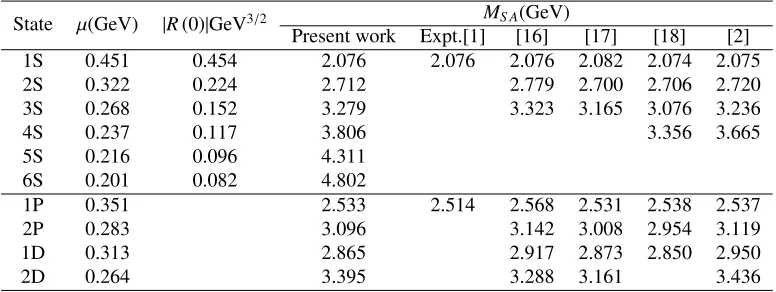
Table 1.Spin averaged masses ofDsmeson.
State μ(GeV) |R(0)|GeV3/2 MS A(GeV)
Present work Expt.[1] [16] [17] [18] [2]
1S 0.451 0.454 2.076 2.076 2.076 2.082 2.074 2.075
2S 0.322 0.224 2.712 2.779 2.700 2.706 2.720
3S 0.268 0.152 3.279 3.323 3.165 3.076 3.236
4S 0.237 0.117 3.806 3.356 3.665
5S 0.216 0.096 4.311
6S 0.201 0.082 4.802
1P 0.351 2.533 2.514 2.568 2.531 2.538 2.537
2P 0.283 3.096 3.142 3.008 2.954 3.119
1D 0.313 2.865 2.917 2.873 2.850 2.950
2D 0.264 3.395 3.288 3.161 3.436
As the interaction potential assumed here does not contain the spin dependent part, Eq(9) gives the spin averaged masses of the system. The calculated spin averaged mass os the ground state is matched with the experimental spin-averaged mass using the equation [10]
MS A=MP+3
4(MV−MP) (10)
;whereMV andMP are the vector and pseudoscalar meson ground state masses taken from ref [1]. This fixes the parameterV0. Using this value ofV0 we calculateS, P, andDwave spin-averaged masses ofDsmesons which are listed in Table 1. For the comparison for thenJstate, we compute the spin-averaged or the center of weight mass from the respective theoretical values as [10]
MCW,n=ΣJ
2(2J+1)MnJ ΣJ2(2J+1)
(11)
where,MCW,ndenotes the spin-averaged mass of thenstate andMnJrepresents the mass of the meson in thenJstate.
The value of the radial wave function R(0) for 0−+ and 1−− states would be different due to their spin dependent hyperfine interaction. The spin hyperfine interaction of the heavy-light flavored mesons is small and this can cause a small shift in the value of the wave function at the origin[10, 15]. The parameters used to calculate the low lying masses of theDs meson are A = 0.135GeV−1, ms¯ =0.55GeV,mc =1.35 GeVand the value of the constantV0 =−0.123 GeV.The spin averaged masses for S, P and D states are tabulated in Table 1. It can be observed that the spin-averaged masses obtained are in good agreement with experimental and other theoretical predictions.
2.1 Excited states
We add separately (in Eq.(9)) the spin-dependent part of the usual one gluon exchange potential (OGEP) between the quark anti quark for computing the hyperfine and spin-orbit shifting of the low-lyingS, Pand D-states. Thus to take into account the spin dependent and spin-orbit interaction, causing the splitting of thenLlevels one introduces additional term in the Hamiltonian[19–21]
VS D(r) =
L·Sc 2m2
c
+L·S¯s 2m2
¯ s
−dV(0)(r) rdr +
8 3
αS r3
+4 3
αS mcm¯s
L·S
r3 + 8αS 9mcms¯
Sc·S¯s4πδ(r)
+4 3αS
1 mcms¯
3(Sc·n)(S¯s·n)−(Sc·S¯s)
1
r3, n= r
whereV(0)(r) is the phenomenological potential, the first terms takes into account the relativistic corrections to the potentialV(r), the second term accounts spin orbital interaction, third term is usual spin-spin interaction part which is responsible for pseudoscalar and vector meson splitting(Eq. (15) & (16)) and fourth term stands for tensor interaction.
In the case of quark and antiquark of unequal mass charge-conjugation parity is no longer a good quantum number and so the states withJ=L, are mixtures of spin-triplet 3LLand spin-singlet 1LL states:J=L=1, 2, 3, . . .
|ψJ = 1
LLcosφ+ 3LLsinφ (13)
ψ J
= − 1
LLsinφ+ 3LLcosφ (14)
whereφis the mixing angle and the primed state has the heavier mass. Such mixing occurs due to the nondiagonal spin-orbit and tensor terms in Eq (9). The masses of the physical states were obtained by diagonalizing the mixing matrix. The calculated values of the mass spectra ofDsmeson are listed in Table 2. We are following spectroscopic notationn2S+1LJin Table 2. Overall the mass spectrum is in satisfactory agreement with others.
Table 2.Masses of theDsmesons(in GeV).
State Present Expt.[1] [2] [18] [17] [16] [24]
11S0 1.962 1.968 1.969 1.975 1.940 1.965 1.969
13S1 2.108 2.112 2.111 2.108 2.130 2.113 2.107
13P
0 2.436 2.318 2.509 2.455 2.380 2.487 2.344
1P1 2.536 2.535 2.574 2.522 2.520 2.605 2.510
1P1 2.518 2.460 2.536 2.502 2.510 2.535 2.488
13P
2 2.558 2.573 2.571 2.586 2.580 2.581 2.559
21S
0 2.684 2.688 2.659 2.610 2.700 2.640
23S
1 2.722 2.710+−127 2.731 2.722 2.730 2.806 2.714 13D
1 2.881 2.913 2.838 2.820 2.900 2.804
1D2 2.867 2.931 2.845 2.860 2.913 2.849
1D2 2.846 2.961 2.856 2.880 2.953 2.788
13D
3 2.851 2.862+−63 2.971 2.857 2.900 2.925 2.811 23P
0 3.033 3.054 2.901 2.900 3.067 2.830
2P1 3.086 3.044+−309 3.067 2.928 3.000 3.114 2.958
2P1 3.100 3.154 2.942 3.010 3.165 2.995
23P2 3.112 3.142 2.980 3.060 3.157 3.040
31S0 3.265 3.219 3.044 3.090 3.259
33S
1 3.283 3.242 3.087 3.190 3.345
23D
1 3.411 3.383 3.144 3.250 3.217
2D2 3.396 3.403 3.172 3.280 3.260
2D2 3.380 3.456 3.167 3.290 3.217
23D
3 3.382 3.469 3.157 3.310 3.240
41S
0 3.798 3.652 3.331
43S
3 Decay constants
The decay constants of mesons are important parameters in the study of leptonic or non-leptonic weak decay processes. In the non-relativistic limit, we compute the decay constants using the Van-Royen-Weisskopf formula[25],
fP2/V =
12 ψP/V(0) 2
MP/V ¯ C2(α
S); (15)
where ¯C(αS) is the QCD correction factor given by[26]
¯ C2(α
S)=1−απS
2−mQ−mq¯ mQ+mq¯
lnmQ mq¯
. (16)
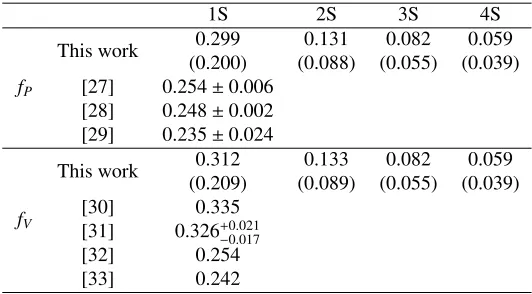
The computed fPand fV forDsmeson using equation (15) are tabulated in Table 3. The value in parenthesis is the decay constant with QCD correction. The Eq. (15) also gives the inequality[14]
√
mvfv≥ √mpfp (17)
Our results are in accordance with Eq. (17).
Table 3.Decay constants of theDsmeson(in GeV).
1S 2S 3S 4S
fP
This work 0.299 0.131 0.082 0.059
(0.200) (0.088) (0.055) (0.039) [27] 0.254±0.006
[28] 0.248±0.002 [29] 0.235±0.024
fV
This work 0.312 0.133 0.082 0.059
(0.209) (0.089) (0.055) (0.039)
[30] 0.335
[31] 0.326+−00..021017
[32] 0.254
[33] 0.242
4 Electromagnetic transition widths
4.1 Electric Dipole Transition
The radiative widths are calculated in the dipole approximation. The E1 matrix elements are deter-mined by using the variational radial wave functions of the initial and the final state and explicitly performing the angular integration given by[34]
Γf i= 4α
9
eQmq¯−eqmQ¯ mq¯+mQ
2
k3|f|r|i|2 Ef Mi×
⎧⎪⎪⎪ ⎪⎪⎪⎪⎪ ⎨ ⎪⎪⎪⎪⎪ ⎪⎪⎪⎩
1 for3PJ→3S
1 1 for1P1→1S0 (2J+1)/3 for3S1→3PJ
3 for1S
0→1P1
Here,αis the fine structure constant,kis the photon energy,eq¯ andeQare the quark charges in units of the proton charge,Ef is the energy of the final meson state, Miis the mass of the initial meson state, andmq¯andmQare the quark masses employed within the present work.
The E1 radiative transition widths are listed in tables (4).
Table 4.E1 transition widths in theDsmeson.
Transition k(GeV) Γ(keV) [35] [34] [36] [24] 13P
2→13S1γ 0.411 2.74 8.8 44.1 19
1P1→13S1γ 0.392 0.05 4.76 8.90 5.6 1P1→11S0γ 0.509 5.11 3.49 54.5 15 1P1→11S0γ 0.495 0.09 4.9 12.8 6.2 1P1→13S1γ 0.377 2.07 0.13 15.5 5.5 13P
0→13S1γ 0.306 1.13 1.0 4.92 1.9
23S
1→13P2γ 0.158 0.14 0.1
23S1→13P0γ 0.271 0.73 6.9
21S0→1P1γ 0.144 0.006 21S0→1P1γ 0.161 0.44 23S1→1P1γ 0.180 0.004 23S
1→1P1γ 0.196 0.27
4.2 Magnetic Dipole Transitions
The M1 rate for transitions betweenS-wave levels is given by[24, 37] is
ΓM1(i→ f+γ)= 16α
3 μ 2
k3(2Jf+1)|f|j0(kr/2)|i|2, (19)
where the magnetic dipole moment is
μ=mqeQ¯ −mQeq¯ 4mqmQ¯
(20)
andkis the photon energy. Rates for the allowed transitions between the triplet and the spin-singlet states are given in Table (5).
Table 5.M1 transition widths in theDsmeson.
Transition k(GeV) Γ(keV) [34] [38] 13S1→11S0γ 0.141 0.085 1.91 0.2 23S1→21S0γ 0.038 0.002
33S
1→31S0γ 0.018 0.000 23S
1→11S0γ 0.654 1.28 21S
0→13S1γ 0.514 1.82
5 Conclusion
as well asO(1/m) correction to potential energy term. Looking at table 1 it can be seen that the spin averaged masses for the various s, p and d wave states are in good agreement with the exper-imental measurements as well as other theoretical estimates. From table 2 it can be observed that the entire mass spectrum is also in fair agreement with various models and experimental results. The pseudoscalar and vector decay constants without QCD correction are in satisfactory agreement with other theoretical predictions as can be seen from table 3. The e1 transition rates listed in table 4 as well as M1 transition rates listed in table 5 obtained with the present framework show significant dis-agreement with other theoretical estimates. In conclusion we find that the present model is adequately predicts the mass spectrum however the decay properties are in disagreement.
References
[1] J. Beringer, P.D. Group, Phys. Rev.D86, 010001 (2012) [2] D. Ebert, R. Faustov, V. Galkin, Eur. Phys. J.C66, 197 (2010) [3] N. Devlani, A.K. Rai, Phys. Rev. D84, 074030 (2011) [4] N. Devlani, A. Rai, Eur. Phys. J.A48, 104 (2012) [5] N. Devlani, A. Rai, Int. J. Theor. Phys.52, 2196 (2013)
[6] Y. Koma, M. Koma, H. Wittig, Phys. Rev. Lett97, 122003 (2006) [7] N. Devlani, A. Rai, Eur. Phys. J.A50, 154 (2014)
[8] A.K. Rai, R.H. Parmar, P.C. Vinodkumar, J. Phys. G: Nucl. Part. Phys.28, 2275 (2002) [9] A.K. Rai, J.N. Pandya, P.C. Vinodkumar, J. Phys. G: Nucl. Part. Phys.31, 1453 (2005) [10] A.K. Rai, B. Patel, P.C. Vinodkumar, Phys. Rev. C78, 055202 (2008)
[11] A.M. Badalian, A.I. Veselov, B.L.G. Bakker, Phys. Rev. D70, 016007 (2004) [12] Y.A. Simonov, Physics of Atomic Nuclei58, 107 (1995)
[13] D. Ebert, R.N. Faustov, V.O. Galkin, Phys. Rev. D79, 114029 (2009) [14] D.S. Hwang, G.H. Kim, Phys. Rev. D55, 6944 (1997)
[15] B. Patel, P.C. Vinodkumar, J. Phys. G.36, 035003 (2009) [16] M. Di Pierro, E. Eichten, Phys. Rev. D64, 114004 (2001)
[17] J. Zeng, J.W. Van Orden, W. Roberts, Phys. Rev. D52, 5229 (1995)
[18] T. Lahde, C. Nyfalt, D. Riska, Nucl. Phys.A674, 141 (2000),hep-ph/9908485 [19] E.J. Eichten, C. Quigg, Phys. Rev. D49, 5845 (1994)
[20] D. Gromes, Z. Phys.C26, 401 (1984)
[21] S. Gershtein, V. Kiselev, A. Likhoded, A. Tkabladze, Phys. Usp.38, 1 (1995) [22] S. Godfrey, Phys. Rev.D70, 054017 (2004)
[23] G. Aad et al. (The ATLAS Collaboration) (2014),1407.1032v1 [24] D.M. Li, P.F. Ji, B. Ma, Eur. Phys. J.C71, 1 (2011)
[25] R. Van Royen, V. Weisskopf, Nuovo Cim.A50, 617 (1967) [26] E. Braaten, S. Fleming, Phys. Rev. D52, 181 (1995)
[27] D. Asner et al. (Heavy Flavor Averaging Group) (2010),arXiv:hep-ex/1010.1589
[28] C.T.H. Davies, C. McNeile, E. Follana, G.P. Lepage, H. Na, J. Shigemitsu (HPQCD Collabora-tion), Phys. Rev. D82, 114504 (2010)
[29] S. Narison, Phys. Lett.B520, 115 (2001),hep-ph/0108242 [30] D. Ebert, V.O. Galkin, R.N. Faustov, Phys. Rev. D57, 5663 (1998)
[33] A. Abd El-Hady, A. Datta, J.P. Vary, Phys. Rev. D58, 014007 (1998) [34] S.F. Radford, W.W. Repko, M.J. Saelim, Phys. Rev. D80, 034012 (2009) [35] F.E. Close, E.S. Swanson, Phys. Rev. D72, 094004 (2005)
[36] S. Godfrey, Phys. Rev.D72, 054029 (2005)