IJEDR1402002
International Journal of Engineering Development and Research (www.ijedr.org)1327
Super Scope All-in-One Electronics Lab Assistant
Device with USB Connectivity
S. Kasi Viswanth Reddy1, P. Ponnammal2
Department of ECE, SRM University, Chennai, Tamilnadu, India
1[email protected], 2[email protected]
___________________________________________________________________________________________________________________
Abstract— Test and measurement instruments such as oscilloscopes and multimeters are the traditional hardware tools, an electronics engineer would have on his bench. Students in engineering curriculum, when exposed to these instruments, often come across a multitude of equipment’s such as voltmeters, ammeters, oscilloscopes and even simple things like calculator. Even after the touchscreen based smartphone revolution, most of the engineering colleges in India continue the tradition of introducing the students to a decade old instruments. The main objective is to design and develop a portable device called Super-Scope which is ALL-IN-ONE electronics lab equipment that has multiple functionalities needed by a modern day engineering student for his practical experiments in electronics and computer labs that would replace the existing plethora of instruments. The device is a fully operated from touchscreen using menus and touch buttons. The device has a USB-UART bridge circuit that gives USB connectivity for Desktop/Laptop communication for data logging the measured quantities such as current, voltage, speed, voice frequency, frequency, intensity of light and temperature. This process can be fully controlled by the user from the device UI. It also helps to easily upgrade the firmware of the device from a desktop/Laptop. The device is controlled by LPC1313, a powerful 32-bit ARM Cortex-M3 microcontroller from NxP Semiconductors.
Index Terms—ARM, Measurement instrument, All-IN-ONE electronics lab, UART, LPC1313.
I.INTRODUCTION
Test and measurement instruments such as oscilloscopes and multimeters are the traditional hardware tools, an electronics engineer would have on his bench. Students in engineering curriculum, when exposed to these instruments [1], often come across a multitude of equipment’s such as voltmeters, ammeters, oscilloscopes and even simple things like calculator. Even after the touchscreen based smartphone revolution, most of the engineering colleges in India continue the tradition of introducing the students to a decade old instruments [3].
Proposed System
This project is to design and develop a portable device called Super-Scope which is ALL-IN-ONE [5] electronics lab equipment that has multiple functionalities needed by a modern day engineering student for his practical experiments in electronics and computer labs that would replace the existing plethora of instruments [4]. The device is a fully operated from touchscreen using touch buttons and menus. The following features are been implemented in this project:
Logic Analyzer Voltmeter Ammeter Ohmmeter Tachometer Audiometer
3-axis Motion Monitor Light Meter
Temperature Probe Calculator.
II.SYSTEMDESCRIPTION
Block Diagram
The below figure 3.1 shows the block diagram for the proposed system for the All-in-one Electronics Lab assistant device with USB connectivity.
ARM CORTEX – M3
IJEDR1402002
International Journal of Engineering Development and Research (www.ijedr.org)1328
implementations from those requiring memory protection and powerful trace technology through to extremely cost sensitive devices requiring minimal area.LPC1313
The LPC1313 are ARM Cortex-M3 based microcontrollers for embedded applications featuring a high level of integration and low power consumption. The ARM Cortex-M3 is a next generation core that offers system enhancements such as enhanced debug features and a higher level of support block integration [7].
Temperature Sensor
The LM35 [9] is an integrated circuit sensor shown below in figure 3.4 can be used to measure temperature with an electrical output proportional to the temperature (in oC). The LM35 series are precision integrated-circuit temperature sensors, whose output voltage is linearly proportional to the Celsius (Centigrade) temperature. The LM35 is rated to operate over a −55° to +150°C temperature range, while the LM35C is rated for a −40° to +110°C range (−10° with improved accuracy).
Light-Dependent Resistor
An LDR alternatively called, photoresist or, photoconductor, or photocell, is a variable resistor whose value decreases with increasing incident light intensity. An LDR is made of a high-resistance semiconductor. The LDR is shown in the below figure 3.5. If light falling on the device is of high enough frequency, photons absorbed by the semiconductor give bound electrons enough energy to jump into the conduction band. The resulting free electron (and its hole partner) conduct electricity, thereby lowering resistance.
MEMS ACCELEROMETER
An accelerometer is a device for measuring acceleration and gravity induced reaction forces. Single- and multi-axis models are available to detect magnitude and direction of the acceleration as a vector quantity. The LIS302DL is an ultra-compact low-power three axes linear accelerometer.
BUZZER
An electronic device for signalling with sound is called as a buzzer or beeper. The major use of the buzzers is in automobiles, household appliances such as a microwave oven, or game shows. It most commonly consists of a number of switches or sensors connected to a control unit that determines if and which button was pushed or a preset time has lapsed, and usually illuminates a light on the appropriate button or control panel, and sounds a warning in the form of a continuous or intermittent buzzing or beeping sound. Initially this device was based on an electromechanical system which was identical to an electric bell without the
IJEDR1402002
International Journal of Engineering Development and Research (www.ijedr.org)1329
metal gong (which makes the ringing noise). Often these units were anchored to a wall or ceiling and used the ceiling or wall as a sounding board. Another implementation with some AC-connected devices was to implement a circuit to make the AC current into a noise loud enough to drive a loudspeaker and hook this circuit up to a cheap 8-ohm speaker. Nowadays, it is more popular to use a ceramic-based piezoelectric sounder like a Sonalert which makes a high-pitched tone. Usually these were hooked up to "driver" circuits which varied the pitch of the sound or pulsed the sound on and off.Voltage and current sensor
These sensors are used to find the simple current and voltages in a circuit. These sensors are useful when the student or the researcher is working in laboratory. Instead of using a standard ammeter and voltmeter that can be replaced with this equipment.
Rotary Encoder
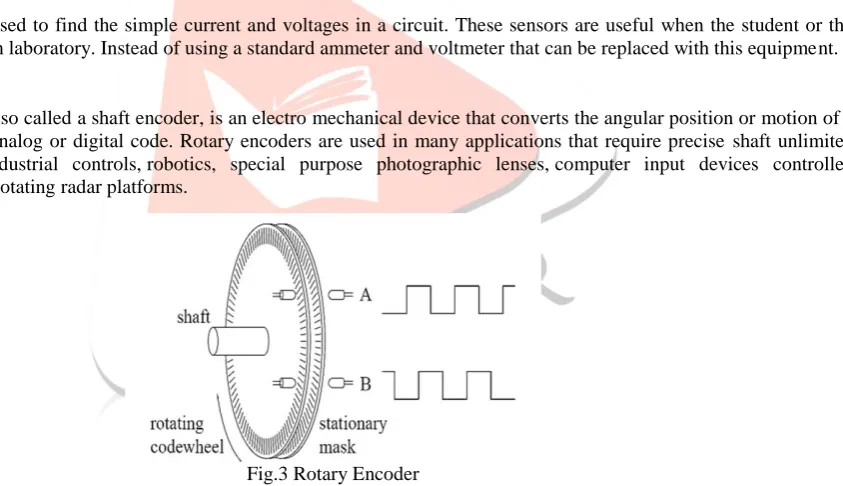
A rotary encoder, also called a shaft encoder, is an electro mechanical device that converts the angular position or motion of a shaft or axle in to an analog or digital code. Rotary encoders are used in many applications that require precise shaft unlimited rotation—including industrial controls, robotics, special purpose photographic lenses, computer input devices controlled stress rheometers, and rotating radar platforms.
The working principle of rotary encoder is discussed below. They employ two outputs called A & B, which are called quadrature outputs, as they are 90 degrees out of phase.00->01->11->10->00 clockwise one rotation completed.00->10->11->01->00-> anti clockwise one rotation completed.
III.SOFTWARE
LPCXpresso is a new, low-cost development platform available from NXP. The software consists of an enhanced, Eclipse-based IDE, a GNU C compiler, linker, libraries, and an enhanced GDB debugger. The hardware consists of the LPCXpresso development board which has an LPC-Link debug interface and an NXP LPC ARM-based microcontroller target. LPCXpresso is an end-to-end solution enabling embedded engineers to develop their applications from initial evaluation to final production.
The LPCXpresso IDE, powered by Code Red Technologies, is based on the popular Eclipse development platform and includes several LPC-specific enhancements. It is an industry-standard GNU tool chain with an optimized C library that gives engineers all the tools necessary to develop high-quality software solutions quickly and cost-effectively. The C programming environment includes professional-level features. There is syntax coloring, source formatting, function folding, on- and offline help, and extensive project management automation.
Fig 2. MEMS Accelerometer
IJEDR1402002
International Journal of Engineering Development and Research (www.ijedr.org)1330
IV.SIMULATION RESULTSThe device has the following features built in: Digital Signal Oscilloscope – used to monitor signals acquisitioned through the inbuilt 10-bit A to D converter. This device is single channel, 100 KHz bandwidth. The signal s will be shown in color waveforms in a nice 65K Color QVGA Touch screen TFT Graphical LCD Display.
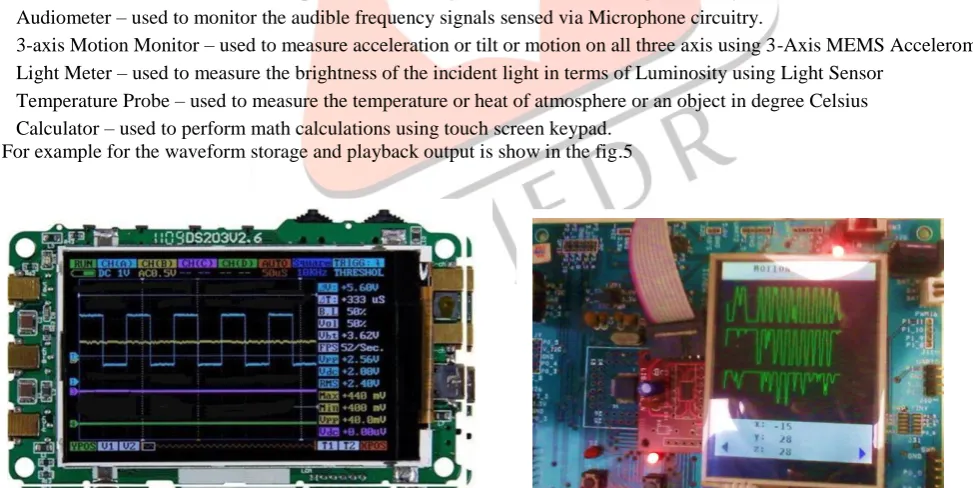
Waveform Storage and Playback – used to save the acquired signals for analyzing and viewing. The storage medium is a 2GB Micro SD memory card.
Frequency Generator – used to generate pulses at variable frequencies with added pulse width control Logic Analyzer – used to analyze serial protocols such as UART
Voltmeter – used to measure the input DC voltage
Ammeter – used to measure the input DC current using current shunt resistor drop Ohmmeter – used to find the resistor values, short circuits and components such as diodes
Tachometer – used to measure the speed of the rotating shaft of the motor using the Rotary Encoder Audiometer – used to monitor the audible frequency signals sensed via Microphone circuitry.
3-axis Motion Monitor – used to measure acceleration or tilt or motion on all three axis using 3-Axis MEMS Accelerometer Light Meter – used to measure the brightness of the incident light in terms of Luminosity using Light Sensor
Temperature Probe – used to measure the temperature or heat of atmosphere or an object in degree Celsius Calculator – used to perform math calculations using touch screen keypad.
For example for the waveform storage and playback output is show in the fig.5
For example for the waveform 3-axis motion monitor output is show in the fig.6. V. CONCLUSION
The paper is to design and develop a portable device called Super-Scope which is ALL-IN-ONE electronics lab equipment that has multiple functionalities needed by a modern day engineering student for his practical experiments in electronics and computer labs that would replace the existing plethora of instruments. The device is a fully operated from touchscreen using touch
Fig. 4 LPC Xpresso IDE
Fig.5 Waveform storage and playback output
IJEDR1402002
International Journal of Engineering Development and Research (www.ijedr.org)1331
buttons and menus. The device has a USB-UART bridge circuit that gives USB connectivity for Desktop/Laptop communication for data logging the measured quantities such as current, voltage, speed, voice frequency, frequency, intensity of light and temperature. This process can be fully controlled by the user from the device.REFERENCES
[1] Yair linn, ―An ultra low cost wireless communications laboratory for education and research‖.IEEE Trans. Vol., 55,no.2,may 2012.
[2] ABET (2012).criteria for accrediting engineering programs 2012-2013. [online] available. http://www.abet.org/engineering criteria-2012-2013/.
[3] E.G.Guimaraes, E.Cardozo, D.H.Moraes and P.R.Coelho, ―design and implementation issues for modern remote laboratories‖, IEEE Trans, learn.Technol., vol. 4,no.2,pp. 149-161,2011.
[4] Mohamed Tawfik, Elio Sancristobal, Sergio Martin, Gabriel Diaz, Manuel Castro, ―State-of-the-Art Remote Laboratories for Industrial Electronics Applications‖, 2012 TAEE,567-572.
[5] Luís Gomes, ―Current Trends in Remote Laboratories‖ IEEE Transactions On Industrial Electronics, Vol. 56, No. 12, December 2009.
[6] J. d. J. Rangel-Magdaleno, J. R. Rivera-Guillen, R. d. J. Romero-Troncoso, and R. A. Osornio- Rios. (2011). FPGA-Matlab-based open core for three-time controllers in automatic control applications. Comput. Appl. Eng. Educ. [Online]. Available: http://dx.doi.org/10.1002/ cae.20526.
[7] E. Monmasson, L. Idkhajine, and M. W. Naouar, ―FPGA-based controllers,‖ IEEE Ind. Electron. Mag., vol. 5, no. 1, pp. 14–26, 2011.
[8] D. V. Pop, M. E. Auer, and D. G. Zutin, ―New solution for remote design and test of digital systems with the Altera MAX CPLD Laboratory within the iLab Shared Architecture,‖ in Proc.Remote Eng. Virtual Instrum. (REV) 2011, Brasov, Romania.
[9] P. Zenzerovic and V. Sucic, ―Remote laboratory for microcontroller systems design,‖ in Proc. Int. Conv. Inf. Commun. Technol., Electron. Microelectron. (MIPRO), 2011, pp. 1685–1688.
[10] M. Tawfik, E. Sancristobal, S. Martin, C. Gil, P. Losada, G. Diaz, and M. Castro, ―Remote laboratories for electrical & electronic subjects in new engineering grades,‖ in Proc. IEEE Fomento e Innovación con Nuevas Tecnologías en la Docencia de la Ingeniería (FINTDI), 2011, pp. 1–6.
[11] N. Sousa, G. R. Alves, and M. G. Gericota, ―An integrated reusable remote laboratory to complement electronics teaching,‖