A PRELIMINARY STUDY OUTCOME AND ANALYSIS OF TEACHING AND
LEARNING PROBLEMS IN ENGINEERING AT UNITEN
Chen Kang Lee
Universiti Tenaga Nasional,Jalan IKRAM-UNITEN, Kajang Selangor, Malaysia
Manjit Singh Sidhu
Universiti Tenaga Nasional,Jalan IKRAM-UNITEN, Kajang Selangor, Malaysia
ABSTRACT
This paper presents a preliminary study on the teaching and learning problems in engineering in
mechanics dynamics domain. The motivation for conducting this pilot study is to suggest the
improvements in learning mechanics dynamics through smart interactive computer aided learning
approach. A questionnaire was distributed to the mechanical engineering students in UNITEN with
a sample size of n=127. The data collected was analyzed and the preliminary results revealed that
students faced difficulties to comprehend the mechanics dynamics concepts. As such newer
technological software may be useful as an additional supplementary tool to aid them in learning.
Keywords:
Education, Engineering, Technology, Learning problems.1.
INTRODUCTION
In the era of knowledge driven society, education in general and tertiary education in specific
plays a critical and major role in developing the human capitals (knowledge workers) for the
nations.In fact, the shift to a new paradigm of education that expects to foster the development of
emerging knowledge economy is a great challenge faced by the education practitioners globally,
including engineering education. Recently, the paradigm shift in engineering education raised the
attention of the engineering communities and is actively discussed in numerous reports
(Auguestine, 2005; Froyd et al., 2012; National Science Board, 2007; Prados, 1998; Wince-Smith,
2005). Dobson (2012) reports that the number of enrolments in undergraduate programmes in
engineering has grown at more than the national average this century in Australia. As discussed by
Duderstadt (2008), one of the characteristics for new paradigms of engineering education is the
change of pedagogical style that shift from classroom based pedagogy to active learning
approaches that engage problem-solving skills and team building, by which it is more focused on
discovery oriented , interactive and collaborative learning experiences. In order to response to the
changes in the global environments, the current problems in engineering education need to be
International Journal of Asian Social Science
Special Issue: International Conference on Teaching and Learning in Education, 2013
1839
2.
OVERVIEW OF ENGINEERING EDUCATION IN UNITEN
University TenagaNasional (UNITEN) is one of the established private higher-learning
institutions in Malaysia (Manjit, 2006). For engineering education, UNITEN offered courses in
electrical engineering, electrical power engineering, mechanical engineering, computer and
communication engineering, and civil engineering. This research focused the study on mechanical
engineering specifically on the problems faced by students in mechanics dynamics domain.
Mechanics dynamics is a core subject for the degree students in mechanical engineering with the
pre-requisite of mechanics statics. At present this subject is conducted through the lecture and
tutorial sessions. The assessments include quizzes, assignments, mid-term test and final exam. This
subject is important and serves three purposes, by which it enables the students to (i) understand
the importance of dynamics in Engineering systems, (ii) the acquisition of sufficient knowledge of
the theory of dynamics and to apply them in the analysis of dynamic systems and (iii) apply the
knowledge of dynamics in the design of engineering systems.
Till date, the major teaching and learning approach of mechanic dynamics in UNITEN still
emphasizes more on instructor-centered, one-way delivery mode and passive students’
participations. The teaching tools involved are the used of power-point slides presentation for the
theory of mechanics dynamics, and the used of white board to further illustrate on the application
of formula in a series of proper working steps to reach the solution of a problem. This is the traditional “chalk and talk” approach that has been used since few decades ago (Mills &Treagust, 2003).According to the previous research studies,the traditional learning (passive classroom
teaching) may lead to passive learning, ignore individual differences and needs of the learners, and
do not emphasize more on critical thinking, or other higher order thinking skills (Hannum &
Briggs, 1982). Furthermore, it could not engage the learners in visualization tasks
(Cairncross&Mannion, 1999; Kabouridis, 2010).For those weak learners (in term of learning
engineering subjects), they may not actually benefit from the traditional teaching and learning
approach, thus require alternative instructional methods to aid in their learning (Manjit et al., 2004).
3.
METHODOLOGY
The main objective of this preliminary study was to find out the students’ difficulties in
learning mechanics dynamics both from the perspective of students and instructors. In this study the survey questionnaire was employed to collect the students’ feedback. The data collection took approximately one month from 30th July 2012 to 27th August 2012. Five sections of the students
who have taken the mechanics dynamics subject were invited to participate in this study. The
questionnaire was prepared and administrated to the students in the hard copy form with the help
from two mechanical engineering academic staffs by distributing the questionnaires to the students
15 minutes before the class ended. Short briefing was provided for the students on how to fill in the
survey questionnaire. Each of the students took approximately 10 -12 minutes to complete
4.
FINDINGS AND ANALYSIS
A total of 150 set of questionnaires were distributed to the students and in return, 127
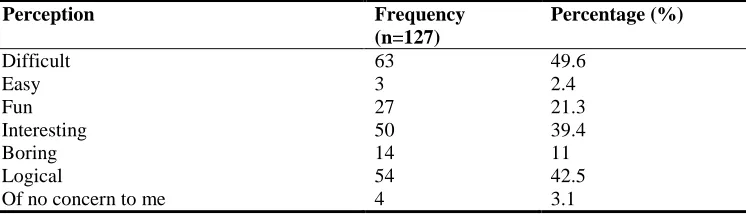
respondents completed the questionnaires which showed the response rate of 84.67%. Basic statistical method (descriptive technique) was used to assess the students’ responses. Through Table 1, it can be identified that 49.6% of the students expressed their perception that this is a
difficult subject. Meanwhile, 42.5% of the students think that this subject is logical. However,
39.4% of the students would think that this is an interesting subject.
Table- 1. General perception about this subject
Perception Frequency
(n=127)
Percentage (%)
Difficult 63 49.6
Easy 3 2.4
Fun 27 21.3
Interesting 50 39.4
Boring 14 11
Logical 54 42.5
Of no concern to me 4 3.1
A detailed summary of students’ response generally in learning mechanics dynamics is compiled and listed as shown in Table 2. Based on the 127 respondents, it can be clearly identified
that more than 60% of the students agreed that the new concepts (e.g. the equation of motion,
curvilinear motion, relative motion analysis, kinetic energy and etc) are the most difficult part for
this course. Besides that, it was found out that approximately 40% of the students fall in the category of ‘often’ and ‘always’ when dealing with the understanding of the material in the textbook. It can also be identified that 47.3% of the students often and always try to do some
exercises from the text to reinforce their problem solving techniques. Regarding the problems in
understanding the contents due to the static figures shown, 26.8% of the students often faced this
problem while 39.4% of the students sometime faced this problem. In general, more than 60% of
the students did more or less face the problems on this issue. For the visualization problems, more
than 70% of the students at least will face this issue sometimes throughout their study. In contrast,
it is a good sign to find out that more than 50% of the students would find the step-by-step
approach shown in the sample solutions is useful to aid their understanding. For the level of
1841 Table- 2. Summary of students’ response generally in learning mechanics dynamics
General Question Strongly
Disagree Disagree Unsure Agree
Strongly Agree New concepts are the most
difficult part of the course. (e.g. the equation of motion, curvilinear motion, relative motion analysis, kinetic energy and etc.) 1 (0.8%) 16 (12.6%) 27 (21.3%) 66 (52%) 17 (13.4%)
Working with the textbook Always Often Sometimes Seldom Never I understand the material in the
textbook. 6 (4.7%) 45 (35.4%) 50 (39.4%) 22 (17.3%) 4 (3.1%) I try to do some of the exercises
from the text to reinforce my problem-solving techniques. 11 (8.7%) 49 (38.6%) 50 (39.4%) 14 (11%) 3 (2.4%)
I have problems in understanding the contents because the figure(s) shown is/are static (no animations). 10 (7.9%) 34 (26.8%) 50 (39.4%) 24 (18.9%) 9 (7.1%)
I have problems in visualize /visualizing the scenario as described in the text.
14 (11%) 24 (18.9%) 58 (45.7%) 27 (21.3%) 4 (3.1%)
The step-by-step approach shown in the sample solutions was
sufficient to aid my
understanding. 28 (22%) 37 (29.1%) 51 (40.2%) 8 (6.3%) 3 (2.4%)
Knowledge level Very
Good Good Moderate Bad
Very Bad Overall, I think my level of
knowledge for this subject is
4 (3.1%) 44 (34.6%) 70 (55.1%) 8 (6.3%) 1 (0.8%)
Problem solving ability is important in the learning process of mechanics dynamics. Table 3 provides a summary regarding the responses of students’ problem solving ability in mechanics dynamics. As referred to Table 3, only 35.4% of the students fall in the category of ‘always’ or ‘often’ in clearly understand the problem. More than 50% of the students did not always clearly understand the problem that need to be solved. Regarding the ability to clearly identify the given
and unknown in problem solving process, approximately 45.6% of the students can often perform
while others still facing the problems on this issue. It can be identified that more than 60% of the students’ response to have the ability to draw and label the diagram. However, it can also be identified that only 45.6% of the students provide responses that they can often / always think of a
plan for the solution. It is interesting to further identify that only approximately 31.5% of the
students often /always have the ability to provide alternative ways of solving the problem. Less
than 50% of the students can often /always describe the steps that they perform while solving the
problem. This is consistent with the finding that less than 50% of the students can often explain the
obtained results after the problem solved. Through Table 3, it is interesting to identify that more
than 75% of the students often /always preferred to use examples solved in the class as a model for
Table- 3. Summary of students’ problem solving ability in mechanics dynamics Problem Solving Ability Always Often Sometimes Seldom Never I clearly understand the problem. 5
(3.9%) 40 (31.5%) 69 (54.3%) 11 (8.7%) 2 (1.6%) I can clearly identify the given and
the unknown. 13 (10.2%) 45 (35.4%) 52 (41%) 17 (13.4%) 0 (0%) I can draw and label diagram. 20
(15.7%) 62 (48.8%) 30 (23.6%) 15 (11.8%) 0 (0%) I can think of a plan for the solution. 6
(4.7%) 52 (40.9%) 54 (42.5%) 15 (11.8%) 0 (0%) I can see alternative ways of solving
the problem. 5 (3.9%) 35 (27.6%) 58 (45.7%) 22 (17.3%) 7 (5.5%) I can describe step by step what I
did. 13 (10.2%) 45 (35.4%) 48 (37.8%) 18 (14.2%) 3 (2.4%) I can explain the obtained results. 7
(5.5%) 50 (39.4%) 51 (40.2%) 17 (13.4%) 2 (1.6%) I used examples solved in the class
as a model for solving problems.
54 (42.5%) 43 (33.9%) 22 (17.3%) 7 (5.5%) 1 (0.8%)
Besides that, feedbacks were collected from three of the mechanical engineering instructors
regarding the problems faced by students in mechanics dynamics through the short interviews
performed between June to August 2012. The summary of the instructors’ feedbacks on problems
faced by students was compiled as shown in Table 4. It can be clearly identified that three of the
instructors shared the same opinions by which they realized that the students did face the
difficulties in visualization especially on the dynamic movement that involved the z-axis.
Furthermore, two of the instructors also shared the same views that some of the students did not
build up a strong foundation in physics and mathematics. This would lead to the difficulties in
understanding of certain concepts in mechanics dynamics. One of the instructors mentioned that
some of the students are too focus on how to solve the problems using formula in order to reach the
final outcome without having the ability to justify the steps involved or lack the understanding
about the logical flow of the solution steps. In addition, one of the instructors further identified that
some of the students did not acquire a strong understanding about the importance of engineering
mechanics dynamics especially the fundamental principle and knowledge, thus lead to the
difficulties faced while moving into the mechanical design subjects.
Table- 4. Instructors’ feedbacks on problems faced by students Instructors Problems faced by students
1
Difficulties in visualization (need dynamic representation)
Foundation in physics and mathematics not strong
Lack the understanding on the purpose of study (overall picture for engineering profession)
Low learning interest
2 Visualization problems – due to static images and bored of discussing using the textbook.
No interaction involved in the understanding of the application (engineering problems) –static representation of the image
1843 steps that lead to the final answer / logical flow of the solution steps) (iii) tend
to memorise steps (refer to the example & do it similarly).
Not aware / do not understand about the importance of engineering mechanics dynamics– and how to link all these fundamental principles & knowledge for the later application (mechanical design)
3 Foundation of students especially in physics is weak
Visualization problems (dynamic movement that involved x-axis, y-axis and z-axis.)
Meanwhile, the students’ response on learning using the courseware was summarized as stated in Table 5. It can be identified that only 58.3% of the students aware or expose to the use of
learning courseware in engineering whereas the remaining 41.7% of the students are not aware
about the technologies used in learning. There are 44.1% of the students who believe that some
contents can be learned faster when using a computer whereas 42.5% of the students are unsure
about this. It can be identified that 44% of the students agreed and believed that they will engage in
the learning by employing computer simulations while 48% of the students are unsure about this.
There are only 49.6% of the students believe that the user interaction performed with the computer
simulation on engineering models may enhance the learning process. Furthermore, it is interesting
to find out that more than 50% of the students believed that the 2D and 3D animation on
engineering model may help to support the visualization process.
Table- 5. Summary of students’ response on learning using courseware Learning courseware
Aware of / expose to the use of
learning courseware Yes: 74 (58.3%) No: 53 (41.7%)
Strongly
Disagree Disagree Unsure Agree
Strongly Agree I believe that some contents can be
learned faster when using a computer. 2 (1.6%) 15 (11.8%) 54 (42.5%) 39 (30.7%) 17 (13.4%)
I believe I will engage in the learning with the use of /by employing computer simulations.
3 (2.4%) 7 (5.5%) 61 (48%) 44 (34.6%) 12 (9.4%)
I believe that the user interaction performed with the computer simulation on engineering models may enhance the learning process.
2 (1.6%) 7 (5.5%) 55 (43.3%) 52 (40.9%) 11 (8.7%)
I believe that the 2D animation on engineering model may support the visualization process. 3 (2.4%) 8 (6.3%) 50 (39.4%) 52 (40.9%) 14 (11%)
I believe that the 3D animation on engineering model may enhance the visualization process.
2 (1.6%) 3 (2.4%) 49 (38.6%) 50 (39.4%) 23 (18.1%)
5.
DISCUSSION
The results of this preliminary study revealed that the difficulties in learning mechanics
dynamics are the problems that need to be solved. This is especially referring to the visualization
visualization problems faced by students are consistent both from the students’ response and the instructors’ feedback. The visualization problems may arise due to few potential factors such as the use of text descriptions and the static representation of the figures in order to illustrate the dynamic
movement of the mechanism that limit the visualization ability of the students. The use of smart
information and communication technologies (ICT) such as the multimedia technologies may aid to enhance the students’ visualization ability by using the interactive and animated contents representation in 2-D and 3-D. The detailed descriptions of the various smart ICT software that
were developed and on-going research to support engineering education can be found in the
literature (Aziz, 2011; Gao et al., 2011; Hsieh et al., 2005;). The futuristic multimedia technologies
such as the virtual reality and augmented reality applications in the classroom are still at the initial
stage of research and more experiments are to be explored in the current stage to see its feasibility.
Besides that, the research results also indicated that the students do face the difficulties in
problem solving especially focus on the ability to justify the steps involved or the lack of
understanding about the logical flow of the solution steps as shown in Table 3. The details
guidance through the step-by-step approach can be provided in order to aid in the students
understanding. This can be achieved through the help from the use of the smart ICT software
embedded with the artificial intelligent components to guide the students following the step-by-step
approach to the solution of the problem. Interaction with each of the step provided with useful hints
and tips to guide the students may aid to enhance the students understanding. In addition, the smart
ICT software constructed using multimedia technologies supports the characteristics by which the
delivery of information (through multiple media / format), the organisation in which it is delivered
and the timing of that delivery can be controlled by the user (Cairnscross&Mannion, 1999). This
will give greater learning flexibility for the students especially those slow learners (in engineering
learning).
Furthermore, the results of this preliminary study also indicated that there is a huge potential in
utilizing the smart ICT to aid in the engineering learning for mechanics dynamics subject. As
referred to Table 5, it can be identified that there are still large number of students who are unsure
about the potential benefits of smart ICT in learning. Thus, further empirical research is urged to
validate the potential of smart ICT in realizing the educational benefits especially in the context of
engineering education for a better or revolutionized engineering learning environment.
6.
CONCLUSION
Higher education institutions should be aware that it needs to achieve considerable progress as
the teaching market grows.This paper presents the preliminary research study on the teaching and
learning problems for the engineering in mechanics dynamics domain. The research results
indicated that students faced the difficulties in learning mechanics dynamics. The utilization of
smart ICT tools to facilitate the teaching and learning of mechanics dynamics are proposed. Further
empirical research studies are required in order to explore the potential of smart ICT and its
1845