ROSSLER NONLINEAR DYNAMICAL MACHINE FOR CRYPTOGRAPHY APPLICATIONS Sunil Pandey*
M.Tech. (Info Sec) Computer Sc. & Engg. MANIT Bhopal 462 051
Praveen Kaushik Lecturer Computer Sc. & Engg. MANIT Bhopal 462 051
Dr. S.C. Shrivastava Professor & Head Elec & Comm Engg. MANIT Bhopal 462 051
*Corresponding Author
e-mail: [email protected]
ABSTRACT
In many of the cryptography applications like password or IP address encryption schemes, symmetric cryptography is useful. In these relatively simpler applications of cryptography, asymmetric cryptography is difficult to justify on account of the computational and implementation complexities associated with asymmetric cryptography. Symmetric schemes make use of a single shared key known only between the two communicating hosts. This shared key is used both for the encryption as well as the decryption of data. This key has to be small in size besides being a subset of a potentially large keyspace making it convenient for the communicating hosts while at the same time making cryptanalysis difficult for the potential attackers. In the present work, an abstract Rossler nonlinear dynamical machine has been described first. The Rossler system exhibits chaotic dynamics for certain values of system parameters and initial conditions. The chaotic dynamics of the Rossler system with its apparently erratic and irregular characteristics and extreme sensitivity to the initial conditions has been used for the design of the cryptographic key in an attempt to increase the confusion and the challenge for the potential attackers.
Summary of Results
In this paper symmetric cryptography schemes for ensuring data confidentiality and integrity in simple cryptography applications based on the concept of a Rossler nonlinear dynamical machine has been described.
INTRODUCTION
Simple systems like for example password encryption or IP address encryption generally use symmetric cryptography. For such systems standard asymmetric cryptography techniques like RSA or Elliptic Curve Cryptography or symmetric cryptography techniques like DES or AES are overkill.
Data Confidentiality
Data that is to be kept confidential includes passwords and IP addresses. The data is encrypted with a secret key that only intended receivers possess thereby achieving confidentiality. The Rossler system is conceptually simple and is not based on the concept of rounds, which are computation intensive as well as complex and could therefore find application here.
Data Integrity
Chaotic Systems
Chaos theory investigates the dynamics of nonlinear systems with relatively few sub-units or degrees of freedom that exhibit random-like, yet perfectly deterministic dynamical behavior and a high sensitivity to initial conditions. According to the Poincare-Bendixson theorem, continuous time nonlinear dynamical systems with at least three degrees of freedom can exhibit chaotic dynamics. Properties of continuous time chaotic systems useful in the design of cryptographic algorithms include the apparently erratic but perfectly deterministic dynamics of such systems, the high-sensitivity of such systems to infinitesimal changes in initial conditions, computational irreducibility of system trajectories, real phase space, and real system parameters. Digital realization of chaotic dynamics is through non integer arithmetic which is an approximation to continuous-value systems.
Rossler System
The Rossler system has been studied by Otto Rossler and arose from his work in the field of chemical kinetics. The Rossler system is described by a system of 3 coupled nonlinear ordinary differential equations:
dx / dt = - y – z dy / dt = x + a y dz / dt = b + z ( x - c )
where a = 0.2, b = 0.2, c = 5.7
This series also does not form limit cycles or reach a steady state. Like other chaotic systems the Rossler system is sensitive to the initial conditions, and two close initial states will diverge, with increasing number of iterations.
Fig 1: 3-D phase portrait of the Rossler attractor
Integration Solver
The Runge-Kutta method for a system of ordinary differential equations is explained here. Suppose there are m variables x1, x2, ... xm each of which vary over time. Suppose further there
are m differential equations for these m variables given by:
x1' = f1(x1, x2, ..., xm)
x2' = f2(x1, x2, ..., xm)
...
There are no derivatives on the right hand side of any of those equations, and there are only first derivatives on the left hand side. These equations can be summarized in vector notation as x' = f (x) where x = (x1, x2, ..., xm) and we use the "vector of functions" concept where f = (f1, f2,
..., fm). Next we label our time states xn, xn+1 which are separated by time interval of length h.
That is, xn is the value of the m variables at time tn. And x1,n is the value of the first variable x1 at
time tn.
xn=(x1,n, x2,n, ..., xm,n)
xn+1 = (x1,n+1, x2,n+1, ..., xm,n+1)
Suppose we have the state of the simulation at time tn as xn. To compute the state a short time
h later and put the results into xn+1, the Runge-Kutta method does the following:
an = f(xn)
bn = f(xn + h
⁄2 an)
cn = f(xn + h
⁄2 bn)
dn = f(xn + h cn)
xn+1 = xn + h⁄6 (an + 2 bn + 2 cn + dn)
The new vector xn+1 gives you the state of the simulation after the small time h has elapsed.
Rossler Machine
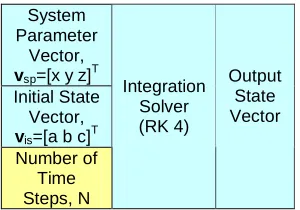
Fig 3: Rossler Machine
The Rossler machine shown in Fig 3 computes the dynamics of the Rossler system. This machine takes as inputs the system parameter vector whose components are the three system parameters, the initial state vector whose components are the initial states of the three variables and the scalar number of iterations or time steps of the integration solver. The three components of the system parameter vector and the initial state vector are floating point numbers while the number of time steps is a positive integer. The output of the Rossler machine is the state vector, i.e., the values of the state variables at the end of the pre-specified number of time steps.
The Rossler machine can be realized in hardware.
Related Work
References mentioned in [1], [2], and [4] through [8] specifically deal with encryption and decryption schemes based on chaos theory.
System Parameter
Vector,
vsp=[x y z]T Initial State
Vector,
vis=[a b c]T Number of
Time Steps, N
Integration Solver (RK 4)
Results Simulation
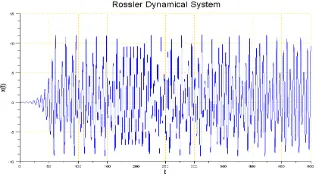
Simulation has been performed in Scilab environment. Figure 2 shows the plot of the dynamics of the first dependent variable of the Rossler nonlinear dynamical system. Simulation has been performed for vsp = [0.2 0.2 5.7]
T
, vis = [0.0001 0.0001 0.0001] T
, N=500 and step size parameter in the Runge Kutta solver is 0.1
Fig. 2: Dynamics of 1st Rossler Variable Data Confidentiality Scheme
Individual characters of the plaintext message are first mapped to real numbers. These values are the initial states of any one variable, say x. The Rossler machine is run with given state parameter and initial state vectors and number of time steps. Values at the end of iterations are taken as the ciphertext corresponding to the individual character. Ciphertext is transmitted to the receiver via the potentially insecure channel. Receiver runs the Rossler machine at his end and determines which final value corresponds to what initial value of the variable x, and is therefore able to decipher the ciphertext.
Data Integrity Scheme
Individual characters of the plaintext message are first mapped to real numbers. In addition, the characters in the message are assigned positional weights. The weighted sum is computed. This weighted sum is used as the initial condition for the first component of the initial state vector in the Rossler machine. The Rossler machine is run with given state parameter and initial state vectors and number of time steps. The value at the end of the run is taken as the “message digest” corresponding to the message. This “message digest” is transmitted to the receiver via the potentially insecure channel. The receiver decrypts the ciphertext (if the message is encrypted) and subsequently runs the Rossler dynamics at his end and determines if the computed “message digest” matches the value given to him by the sender. If there is a match, then the message integrity is ensured, otherwise the message has been tampered with.
Conclusions
References
[1] Pandey, S. “Algorithms for Cryptography and Message Integrity Check using Chaotic Dynamics of the Rossler Nonlinear Dynamical System”, M.Tech. Thesis, July 2009, MANIT, Bhopal 462 051
[2] Kotulski, Z., Szczepański, J., “Discrete chaotic cryptography (DCC)”, Proceedings of 11th Workshop on Nonlinear Evolution Equations and Dynamical Systems, OAK, Kolymbari near Chania, Crete, Greece; 18-28 June, 1997 (NEEDS’97)
[3] May, Robert, M., “Simple Mathematical Models with Very Complicated Dynamics”, Nature, Vol. 261, p.459, June 10 1976
[4] M. S. Baptista, “Cryptography with chaos”, Physics Letters A, Volume 240, Issue 1-2, p. 50-54
[5] Sarkar, A., “Encryption with Chaos”, Proceedings of National Conference on Nonlinear Systems & Dynamics, pp. 357-358
[6] Bose, R. and Banerjee, A., “Implementing Symmetric Cryptography Using Chaos Functions”, Advanced Computing & Communication Conference, 1999
[7] Cristea, B., Cehan, C., Serbanescu, A., Grecu, D., “Applications of Chaos Theory in Cryptography”, http://cristeab.googlepages.com/cristea02applications.pdf
[8] Lawande, Q.V., Ivan, B.R., Dhodapkar, S.D., “Chaos Based Cryptography : A New Approach to Secure Communications”, BARC Newsletter No. 258, July 2005
[9] Strogatz, Steven, “Nonlinear Dynamics and Chaos”, Perseus Publishing. ISBN 0-7382-0453-6, 2000