TABLE OF CONTENTS:
Vol. 41, No. 2, March 1988
ARTICLES98 Presidents’s Address: Furthering the Range Management Profession by Jack R. Miller Animal Ecology
100 Arthropod predation of black grass bugs (Hemiptera: Miridae) in Utah ranges by Jaime E. Araya and B. Austin Haws
104 Longevity of harvester ant colonies in southern Idaho by Sanford D. Porter and Clive D. Jorgensen
Plant-Animal Interactions
108 Some vegetation responses to selected livestock grazing strategies, Edwards Plateau, Texas by Thomas L. Thurow, Wilbert H. Blackburn, and Charles A. Taylor, Jr.
114
118
Mule deer-induced mortality of mountain big sagebrush by E. Durant McArthur, A. Clyde Blauer, and Stewart C. Sanderson
Cattle grazing tall larkspur on Utah mountain rangeland by James A. Pfister, Michael H. Ralphs, and Gary D. Manners
Plant Ecology
122 Successional patterns in bitterbrush habitat types in northcentral Washington by Berta A. Youtie, Brad Griffith, and James M. Peek
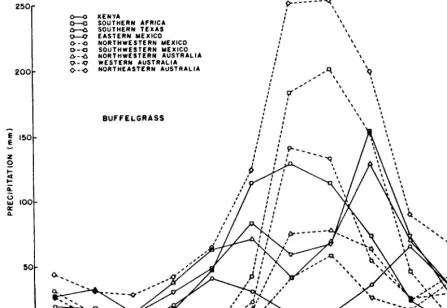
127 The influence of climate and soils on the distribution of four African grasses by Jerry R. Cox, M.H. Martin-R., F.A. Ibarra-F., J.H. Fourie, N.F.G. Rethman, and D.G. Wilcox
139 Plant distribution surrounding Rocky Mountain pinyon pine and oneseed juniper in south- central New Mexico by Susan M. Armentrout and Rex D. Pieper
144 Influence of forest site on total nonstructural carbohydrate levels of pinegrass, elk sedge, and snowberry by Janice K. Krueger and Donald J. Bedunah
150 Germination responses of desert saltgrass to temperature and osmotic potential by Greg J. Cluff and Bruce A. Roundy
Plant Physiology
153 Use of leader lengths and diameters to estimate production and utilization of Cercocarpus brev#Iorus by El Fatih Mahgoub, Rex D. Pieper, and Melchor Ortiz
155 Analysis of Russian thistle (Solso& species) selections for factors affecting forage nutritional value by James H. Hageman, James L. Fowler, Margaret Suzukida, Virginia Salas, and Roxanne Lecaptain
Soils
159 Using the Green and Ampt infiltration equation on native and plowed rangeland soils by Neil C. Hutten and Gerald F. Gifford
162 Traccelement intake via soil ingestion in pronghorns and in black-tailed jackrabbits by W. John Arthur, 111, and Robert J. Gates
Measurements 167
168
Simple pivot balance for measuring phytomass in quadrats by D.E. Johnson, M.M. Borman, and Mohamed Ben Ali
Published bimonthly-January, March, May, July, September, November
Economics
172 Economic optimum big sagebrush control for increasing crested wheatgrass production by John A. Tanaka and John P. Workman
Copyright 1988 by the Society for Range
Management 178 An economic assessment of risk and returns from prescribed horning on tellgrees prairie by lNDlVlDUALSUBSCRlPTlONisbymembershipin D.J. Bemardo, D.M. Engle, and E.T. McCollum
the Society for Range Management. BOOK REVIEWS
LIBRARY or other INSTlTUTlONAL SUBSCRIP- 184 TIONS on a calendar year basis are $58.00 for the United States postpaid and 888.CNJ for other coun- tries, postpaid. Payment from outside the United States should be remitted in US dollars by interna- tional money order or draft on a New York bank. BUSlNESSCOl?RESPONDENCE,concerningsub- scriptions, advertising, reprints, back issues, and related matters, should be addressed to the Manag- ing Editor, 1839 York Street, Denver, Colorado 80208.
EDITORIALCORRESPONDENCE,concemingmanu- scripts or other editorial matters, should be addressed to the Editor, 1839 York Street, Denver, Colorado 80206.
INSTRUCTIONS FOR AUTHORS appear on the inside back cover of most issues. A Style Manual is also available from the Society for Range Manage- ment at the above address @$2.00for single copies; $1.25 each for 2 or more.
THE JOURNAL OF RANGE MANAGEMENT (ISSN 0022-409X) is published six times yearly for $58.00 per year by the Society for Range Management, 1839 York Street, Denver, Colorado 80208. SECOND CLASS POSTAGE paid at Denver, Colorado. POSTMASTER: Return ontln /oumrl wlth address change-RETURN POSTAGE GUARANTEED-to Society for Range Management, 1839 York Street, Denver, Colorado 80206.
The Journal of Range Yanagemont serves as a forum for the presentation and discussion of facts, ideas, and philosophies pertaining to the study, management, and use of rangelands and their several resources. Accordingly, all material published herein is signed and reflects the individ- ual views of the authors and is not necessarily an official position of the Society. Manuscripts from any source-nonmembersas well as members-are welcome and will be given every consideration by the editors. Submissions need not be of a technical nature, but should be germane to the broad field of range management. Editorial comment by an indi- vidual is also welcome and, subject to acceptance by the editor, will be published as a “Viewpoint.”
Managing Edltor PETER V. JACKSON Ill
1839 York Street Denver, Colorado 88206 Edltor
PATRICIA G. SMITH
Society for Range Management 1839 York Street
Denver, Colorado 80206 (303) 3557070
Book Revhw Edltor GRANT A. HARRIS
Forestry and Range Management Washington State University Pullman, Washington 99164-fHlO
Biochemistry of Storage Carbohydrates in Green Plants by P.M. Dey and R.A. Dixon cd.; Environmental Economy edited by Richard Brooker and Matthew Corder; and The Role of Legmnea in Conservation Tillage Systems edited by J.F. Power.
ASSOCIATE EDITORS WILL BLACKBURN
N.W. Watershed Res. Center 270 South Orchard Boise, Idaho 83705 CARLTON BRITTON
Range 8 Wildlife Mgmt Texas Tech University Lubbock, Texas 79409 THOMAS A. HANLEY
Forestry Sciences Lab. Box 20909
Juneau, Alaska 99802 RICHARD H. HART
USDA-AR!
RODNEY HEITSCHMIDT Box 1858
Vernon, Texas 78384 N. THOMPSON HOBBS
Colorado Div. of Wildlife 317 W. Prospect
Fort Collins, Colorado 80528 PETE W. JACOBY, JR.
P.O. Box 1858 Vernon, Texas 78384 HOWARD MORTON
2ooO E. Allen Road Tucson, Arizona 85719
BRUCE ROUNDY 325 Biological Sciences East Building, Univ. Arizona Tucson, Arizona 85721 PAUL TUELLER
Range Wildlife 8 Forestry UNR 1999 Valley Road Rena, Nevada 89512 RICHARD S. WHITE
KSU Extension Center Colby, Kansas 87701 STEVE WHISENANT
401 Widtsoe Building Brigham Young Univ,
Btil Uildreth
Rd. Provo, Utah 84602President’s Address
Furthering the Range Management
Profession
P
I
JACK R. MILLER
As I come down to my last offtcial act as President of SRM, it is difticult to decide what to say, or, to find the right words to say it with.
I talked to my wife Jan about what I might use as a theme for this President’s Address. Jan has been my loyal supporter, con- fidant, and secretary through this past year-well, through these past many years. Anyway, we thought it might be good to focus in on things your Society does to further the range management profession. I have heard members, as well as others, ask ques- tions such as, “What does the SRM really do? We know you have good meetings twice a year and the membership really enjoys the close personal relationships and camaraderie. But what does the Society do for the profession?” I will try to address some of the issues that seem important to me.
The SRM has developed a strategic Plan of Work that clearly lays out the mission, goals, and objectives of the Society. An Annual Plan of Work is developed each year that assigns spe- cific objectives for each of the 30 committees, councils, panels, and task groups, as well as the Sections. This planning structure has helped us to place our emphasis where it is most needed and provides better continuity from year to year.
In the next few minutes I will briefly touch on some of the activities that the SRM is engaged in to achieve our mission.
Under the heading ofprofessional deve/opmenf I will address several programs that the Society has designed to further devel- opment of individual members, as well as the range management profession as a whole.
Continuing Education
As can be seen by the program for this meeting in Corpus Christi, more symposia, work-shops, and training sessions are being held in conjunction with the Annual and Summer meet- ings. In addition, many Sections are holding such sessions, as well as working with agencies and organizations to offer contin- uing education opportunities. The responsibility for seeking and taking advantage of these opportunities rests with the individual. Career
Opportunities
The
Professional Affairs Committee is working with the Range Science Education Council to analyze trends in resource management to see where future opportunities lie for mnge- trained professionals. On the other side of the coin is our educa- tional system, continuing to turn out graduates who have the needed skills and are recognized and sought after by potential employers. As we answer these questions we will be in a better position to see improved career opportunities for range managers.Accreditation
The range
Curricula Accreditation Program continues to strive for quality, range management educational programs. There are now 9 colleges with accredited range programs and a10th is in the mill.
Consultant Certification
This activity of the SRM has great potential for bringing recognition to the importance of range management expertise and improving the quality and reliability of range management services available. There are currently 44 certified range consul- tants. the Certification Panel is now working with the I&E Committee to develop an excellent informational brochure.
Monitoring
GuidelineThe Excellence in Range Management Committee, formerly the Producer Affairs Committee, has, as one of its objectives, to develop a statement regarding the importance of range resource monitoring and some basic guides to assist users in resouxe monitoring.
Range Cover Type
At the request of several Federal agencies, SRM is moving ahead with an effort to identify and describe major range cover types in the U.S. This undertaking is being coordinated by Tom Shiflet and will involve many of our members. The product will be a document similar to Forest Cover Types that has been in use for several years. This may be expanded to include Canada and Mexico.
Publications
The Joumal of Range Managemenf and Rangelands are qual- ity, professional publications. The Society also produces a number of other publications pertaining to management of range resources. One example is the Glossary of Terms, which has recently been updated and will soon be available. A new item is the long-awaited, 35 Yeor Index of JRM articles which is now available. If you don’t have yours, be sure to get hold of Pete, or one of the Denver staff, and purchase a copy.
History
SRM is 40 years old this year. It was built and has survived on the hard work and dedication of manv people. Manv of vou in this room are charter members. These-46 y&s are &h with the happenings that make a society like ours grow. Some happy, some not, but all part of our growth. The History and Archives Committee works to preserve this heritage. A small group of dedicated members recently spent many hours pulling together and writing a summary of the development of the SRM. This, too, is now available.
Student Activities
Certainly young people are the future of our profession and our organization. The SRM carries out a number of student activities that help to attract young people into the profession and start them off on a career. You have seen examples of that today. We are proud of these young people and the members of the Student Activities Committee that work with them.
Awards
It is important that recognition be given for a job well done. Our awards program is designed to do that. The hard part is selecting the most deserving people from among the many quali-
fied. Everyone has a part to play in nominating award candi- dates. The Awards Committee can screen and process nomina- tions, but they can’t make them. We have had a number of new awards in recent years with the Chapline Awards, and proposals for others are being considered.
Another main heading of activities that SRM is involved in is the area of public outreach. The general public, and even many natural resources and environmental groups, do not understand or appreciate the importance of range resources. Information that others get regarding range resources is often incomplete or misleading and tends to create false impressions.
SRM is doing a number of things to establish a leadership role in range management and provide the public with factual, understandable information.
Washington, D.C. Lhison
Clare Hendee filled this role for many years, using his own resources for the most part. Two years ago the Board made a commitment to provide additional funding to strengthen our presence in the United States’ Capitol. Ray Housley, with assist- ance from George Lea, is now doing that job and doing it well. We are being informed of pertinent activities at the national level and becoming increasingly recognized as a professional society. I hope you are reading the Capital Corral section in Rangelands. It gives the best, quick insight into the happenings concerning natural resources, particularly range resources, that IVe seen.
Public
OutreachPosition
At the time the board made the decisions to provide addi- tional funding to the Washington, D.C., Liaison, there was a second proposal from the I&E Committee for a Public Relations position on the Denver staff. We couldn’t afford both, and it was a tough decision. We decided to forego the public relations position for the time being. However, effort continued and, I am happy to announce, we established a position half-time in the Denver office last month. The person filling this position is Jerry Schwien, a public affairs specialist with the SCS in Denver. Jerry will be working half-time in the Denver office under the supervision of Pete Jackson. His salary is funded by SCS with some other agencies helping in other areas.
Denver Office
This year, after several years of looking, SRM purchased and moved into a new office. The building is not new, but it is a clas- sic that was originally built as a residence for Lieutenant Gover- nors of Colorado. It is a beautiful building and is a tine head- quarters for our professional society. An open house, last month, was sponsored by the Colorado Section. It attracted a large number of people from the Denver area and acquainted them with our new location. The Colorado Section is also work- ing to establish a plantation at the office with representative State Grasses from all the states that have them. In the mean- time, the old office building is completely rented and will go up for sale when the commercial real estate market in Denver looks right.
National Range Confaence
Do you remember the National Range Conference that was held in Oklahoma City? It was the first conference of that type concerning range resources and resulted in an extensive plan of action to further objectives of good range management. SRM was given the lead role in a number of action items and these have been disseminated to various committees for action. There will probably be another national range conference in the not- toodistant future and SRM will be right in the middle of it.
Conservation Reserve Program
The
CRP has potential to have major effect on management of range resources and range-related industry. Recognizing this, the Colorado Section jumped to the forefront in sponsoring aConservation Reserve Program Symposium in Denver. The symposium was an outstanding success and attracted a large turn-out, including the Secretary of Agriculture and heads of two resources agencies as speakers. During a panel discussion, Wilson Scaling, Chief of the SCS, outlined some challenges to SRM on how we might be more effective in promoting range management, particularly in relation to the CRP. In response to that, we have appointed a CRP Task Group under the direction of Harold Goetz, head of the Range Department at CSU, to consider these challenges and propose a plan of action. Success in Range
Management
In recent years we have seen an emergence of public interest in management of range resources. Unfortunately, this is often manifested in a negative light giving the impression that a poor job has been done of managing our range resources. Prompted
by initiative from Stan Tixier, Regional Forester with the USFS, effort is being made to make visible more of the many success stories in improving range resources. One of the concurrent ses- sions for this meeting is dedicated to that. I believe this is a bandwagon more of us should jump on.
Range Condition Assessment
As
I just mentioned, we have seen a number of articles critical of what is happening to our range resources. Quite often these articles make references to range condition reports prepared by agencies to support an argument that the range is going to hell in a hand basket. As professionals, we recognize there are cer- tainly examples of current mismanagement of range that are in need of correction, but by and large, condition of rangeland in the U.S. has improved over the past SO-60 years.If that is the case, available range condition reports must be misleading, or at least, subject to misinterpretation. I believe SRM, the leading professional organization concerning range management, has a role to play in coordination with the agen- cies to interpret range assessment data and provide accurate and understandable information to the public on what has happened to our range resources over the years and what is happening now.
We have a sub-committee of the Public Affairs Committee working on that.
Much of what I have said so far has been in reference to the United States or at least the North American Continent. Let’s not forget, we are an international organization. We have members in 48 countries, but, that in itself, does not make us an effective international organization. What are we doing to pro- mote proper management of range resources on an international scale? The International Affairs Committee puts out an Intema- tional Range Newsletter which is intended to effect a networking between countries and encourage activity in range management.
SRM supports the International Rangeland Congress Contin- uing Committee which plays the lead in scheduling and organiz- ing the International Rangeland Congress. So far, the IRC has been held in United States and Australia-one is scheduled for later this year in India. This is a fascinating part of the world and I hope there will be a good representation of SRM
members. Future IRC’s? I have heard mention of locations such as Mexico, Africa, and China.
We support formation of additional Sections of SRM in other countries or additional range organizations. Pete Jackson recently attended a meeting of the Third Rangeland Congress of Mexico in Durango, Mexico. There, the first steps were taken to form a Mexican Society for Range Management. We feel each country should consider their own situation to determine what is best. If the economic and political climate is such that a country can be more effective with their own society, we support that. If Mexico goes that way, we would like to continue a strong part- nership, retain their activity in our Society and, hopefully, main- tain a Mexico Section.
Arthropod predation of black grass bugs (Hemiptera: Mir-
idae) in Utah ranges
JAIME E. ARAYA AND B. AUSTIN HAWS
AbstnCt
The predation by selected 8rthropod pred8ton on immature 8nd
8dult bl8ck gr8ss bugs (BCB), Labops hesperius and Irbisia bra-
chycera, on Utah ranges was inveatiyted. Adult Nab& altematus
was found to be the most hnport8nt prcdrtor of BGB; this species is
p8rtieuirriy abundant in wly spring 8nd ~8s observed preying on BGB both in the field and in laboratory feeding tests. Imm8turc nrbids consumed the bug8 but preyed mostly on leafhoppers, smaller plant bug nymphs, and other immature nahids. Nubis vanduzeei showed potentiai es 8 predator of adult BGB in the
laboratory feeding tests. Spiders were important predators of BGB. Based on predation of BGB in field and laboratory studies, the spiders observed were ranked as follows from greatest to least importance 8s predators: Xyst&us cunctator, iU&anenops kpi- dus, Tibellus sp. (Thomisidre), Cadancira sp. (Clubionidre), and Tetragnatha sp. (Armeidae). Spiders attacked any prey of a size
similar to themselves, but they 8Iso preyed on beneiIciai 8rthro- pods, including nabids and other spiders.
Key Words: whcrtgrss, Lycosidae, M&p&a foxi, Para&cda fordcina, wolfspiders
Large areas of rangelands in Utah and other western states have been seeded to introduced wheatgrasses (Agropyron sp.) which are infested with the univoltine black grass bugs (BGB) Labops hespe- rim Uhler and Irbisiu bruchyceru Uhler (Hemiptera: Miridae) (Hewitt et al. 1974, Rogler & Lorenz 1983). The BGB hatchas soon as the winter snow melts and begin to feed on and damage grasses during the critical early spring stage of plant growth (Brewer et al. 1979). The damaged grasses develop a yellow to whitish mottling marked with small, black fecal spots. Heavily affected grasses may eventually become completely dry. Severely damaged plants seem to be unattractive to livestock (Haws et al. 1973, Higgins et al.
1977, Maiechek et al. 1977).
The major BGB species in Utah appears to be L. hesperius, but L.. hirtus Knight and L. utahensis Knowlton are also important in certain areas (Knowlton 1945, Haws et al. 1973, Hewitt et al. 1974). Details on the biology of L. hesperius can be found in the review by Araya (1982). Another important BGB, I. brachyceru, has appar- ently been responsible for much of the damage formerly attributed to Labops (Hewitt et al. 1974). BGB are not usually present in large numbers on native grasses (Higgins et al. 1977) or in areas inter- mixed with native plants (Haws et al. 1973), probably in part because these ranges provide a good habitat for insecteating arthropods.
The management of crop pests through biological and inte- grated control methods requires an understanding of the complex interactions between the pests and beneficial insects (Smith et al.
1976). While beneficial arthropods are essential elements in inte- grated pest control, very little is known concerning their relative efficiency in controlling pest species (Wilson and Gutierrez 1980).
Authors arc associate professor of entomology, Dcpartamento de Sanidad Vegetal, Facultad de Ciencias Agrarias y For&ales, Univcrsidad de Chile. Casilla 1004 - Santiago, Chile, currently at Dept. of Entomology, Purdue Univ., W. Lafayette, Ind. 47907; and professor of entomology, Dept. of Biology, UMC 53, Utah State Univ., Logan 64322.
The contributions of our colleague entomologists Eric Coombs and Roy Meadows during these studies, the identification of spider species by Dr. Eric Zurchcr, Utah State Univ., and Dr. W.J. Gcrsh, Univ. of Arizona, and of ants by Dr. George. C. Wheeler, San Antonio, Texas, arc greatly appreciated.
Manuscript accepted 29 October 1987.
100
Information about predators of insects in rangeland grasses is particularly scarce.
Most predators are polyphagous, thus a direct predator-prey relationship is difficult to ascertain. Knowledge of the seasonal abundance of predaceous arthropods is helpful in defining their roles in regulating insect pests. This information is essential for developing effective insect pest management programs (Shepard et al. 1974). Many predators can be observed in rangelands, but the effectiveness of each species is difficult to evaluate in field studies. Cage tests in the greenhouse might be a preliminary step in estab- lishing an index of predator efficiency against each prey species. Such an index can be used for planning integrated control pro- grams (Tamaki and Weeks 1972).
The objectives of this study were: (1) To identify major potential invertebrate predators of BGB in selected Utah ranges, and (2) To compare predation by adult and immature invertebrate predators on selected range insects under laboratory conditions.
Materials and Methods
These studies were conducted in BGB-infested rangelands near Porterville, Morgan Co., Utah; Logan, Cache Co., Utah; Hodge Creek, Logan Canyon, Cache Co., Utah; and the wheatgrass ranges around the Alpine Cabin of the Intermountain Research Station, Ephraim Canyon, Sanpete Co., Utah. A brief description of the study sites appears in Table 1. Laboratory studies were conducted in the Range Entomology Laboratory, Department of Biology, Utah State University, Logan.
Procedures for Objective 1
A 38.i~m diameter sweep net was used to collect insects and spiders periodically during the growing seasons of 1981 and 1982 from selected grasslands with BGB (Table 1). Litter sampling on the same dates and fields was helpful particularly in providing immature BGB specimens. Pitfall traps helped in identifying the species of arthropods present, but were considered unreliable because of the different behavior responses they induced on differ- ent species of arthropods, as evident in preliminary studies, and because they provided mostly dead or damaged specimens. Quan- titative data on arthropod abundance is described by Araya (1982).
Procedures for Objective 2
Live BGB and insect predators were separated from the material collected with the sweep net and from the litter sampled (particu- larly for immature BGB) by using an aspirator, a small hair brush, or grass leaves or stems that some insects readily grasp. Spiders were separated with forceps. Three studies were designed. Studies of Predation with One Species of Prey Per Predator, Growing Season of 1981
Ten adults of either L. hesperius or I. bruchyceru were caged with one adult predator of each of the selected predator species (the most abundant in the field), in transparent plastic cylinders 25 cm high and 9 cm diameter. Each cylinder was covered with a screen lid and had a vial holding a small clump of live wheatgrass (Agro- pyron sp.) on the bottom on which the BGB could feed (Araya 1982). BGB mortality was recorded every 2 days, and the dead insects were replaced with live ones. There were at least 5 replica-
Table 1. Some invertebrate predatom of black grau bags collected lrom selected Utah rangelands during tbe 19111 and 1911t growing semom.
Predators Localities’ 1981 1982
Insects:
-Nobis oltemotus P
Mav 3. 17.28
Apr. 14,22,28
Mav 4. 6, 10. 14.21. 27. Ju& 3; 10. J&e 2; 14,2i, 28 H June 20, July 2
A July 30
-Nobis vonduzeei P May 12, 17,28, May 27,
June 3,10 June 21,28
L June 17
A July 30
-Nobid nymphs P May 21,27,
June 2, 14,21,28
- Porodecerlo fonnicino P May 28
A July 29, Aug. 6 Spiders:
-Xysricus cunctator P May 12, 17,28, May 21,27,
June 5.12, 18 June 2, 14,2 1,28 H June 20, July 12
L June 2 1, July 2 A June 25
-Xysricus benefactor’ P June 18
-Misumenops lepidus P May 8,18, June 18 May 27, June 2,28
L July 1
A June 25
-Tibellus sp. (either i? P June 18
oblongus or T. chomberlini) L June 14,21
-l%onorhus sp. P May 2, 10, 14, 21,27
-Tetrognorho sp. P June $12, 18 May 27
H June 20
L June 14
A June 27
-Merepeiro foxi P June 18 Apr. 14,27, May 4,27, June 2
-Casrioneiro sp. P May 26, June 9 Apr. 14, May 4, lo,27
H July 16
L July 5
A June 25
‘P = Porterville, Morgan Co., UT (wheatgrass monoculture on about 1,600 m elevation hillside fields. L = Logan (semi urban field with diverse grasses and forbs! about I.400 m elevation), Cache Co, UT. El = Hodge Creek, Logan Canyon, Cache Co., UT (a field patch surrounded by shrub and tree species, on a cteck about 2,000 m elevation). A = Fields around the the Alpine Cabin of the Intermountain Res. Ex
*One male specimen, identified by Dr. W.J. Gersh, Univ. o P
. St&, Ephraim Canyon, Sanpetc Co., UT. Anzona.
tions of IOday long tests for each individual predator tested, although more replications were used for some species. BGB natu- ral mortality was evaluated from control cylinders containing no predators. Ten-day long tests were repeated at different times of the growing season to test for consistency of the results, which was verified since these replications were not significantly different.
Studies of Predation with One Species of Prey Per Predator,
Growing Season of 1982
Table 2. Mrmn aumbem 01 dud adult Lobops hesperius and Irbida bra- chycera after erpmure to selected predators, in numbem of pw dead eecb 4g h from l total of ten lndlviduela per cyclinder and predator in 1981 (meear of ten-day long leeding trhls).
Five-day experiments similar to those of 198 1 were conducted in 1982, but the plastic cylinders were replaced with 5 cm diameter Petri dishes lined with moistened filter paper. The Petri dishes facilitated handling of the predators and mortality data were more rapidly collected, compared to the IO-cm cylinders used the pre- vious year. Each Petri dish contained a grass clump (Pea sp., a suitable host plant for BGB, as seen in preliminary observations), that was tied with filter paper around the base to keep the grass fresh. Filter paper liners and food were replaced every 48 h to reduce mortality due to waste accumulations. The number of adult or immature BGB per predator and replication was increased from 10 to 20. Mortality of BGB was recorded every 24 h and the dead prey were replaced with live insects. At least 5 replications of 5day tests per predator were used in tests with immature BGB. Five replications were always used in tests with adult BGB.
Treatments Numbers of dead prey
(predators) Lobops Irbisio -
-Xysricus cunclolor 6.03a 6.14 b
- Tibellus sp. 5.92a . . . .
-Tetragnatha sp. 4.24 b 6.10 b
-Misumenops lepidus 3.80 hc 5.96 b
-Nobis vonduzeei 3.25 cd 7.15a
-Costioneiro sp. 3.00 cd 5.64 b
-Nobis olternorus 2.67 d 5.72 b
-Control 0.94 e 4.10 c
Results in the same column followed by different letters arc signiticantly different (KO.05). according to tests of significance utilizing the “t” distribution between means of non-paired samples with different numbem of observations (LeClerg et al. 1962, Ataya 1%2).
Because of the varying number of replications, the differences in BGB mortality detected through ANOVA in 1981 (Table 2), and in 1982 with immature prey (Table 3), were compared using the “t”
distribution method between means of non-paired samples (Le- Clerg et al. 1962, Araya 1982). Significant differences in mortality of adult BGB in 1982 detected in an ANOVA were separated using the Duncan multiple range test (Duncan 1955).
Studies of Predator Preference
Table 3. Mean nlrmbcn of dud immature and adult Lubops hapek and Irbirirr lwuchyceru dter crposure to selected predators, in am&en of prey dud each 24 b from a total of 20 indiv&hmL per Petri dbb and predator ia l!M2 (meun of fh-day loq feeding triala).
Numbers of dead prey
3rd-4th instar nymphs’ Adults2
Treatments (predators) Stage of development Lubops Irblsia Lubops Irbisia
-Nabis altematus Adults 5.26a 4.09a 3.56a 4.28a
-Xysticus cunctator Adults . . . . . . . . . 3.12 b
-Misumenops lepidus 3rd instar . . . . . . 3.44a 2.28 cd
-Nabid nymphs 3rd instar 1.76 b . . . 3.04ab 2.56 bc
-Wolf spiders (Lycosidae) Adults 1.36 bc 0.92 c . . . . . .
-Castianeira sp. 4st instar 1.20 bc 2.08 b . . . . . .
-Tetragnatha sp. 3rd instar 1.12 bc . . . . . . 2.44 cd
-Formica spp. Adults 1.07 bc 1.09 c . . . . . .
-Tunathus sp. Adults 0.76 c 2.12 b 2.44 bc 1.96 cd
-Control . . . 0.90 c 0.90 c 1.92 c 1.88 d
‘Results in the same column followed by different letters are significantly difterent (P(O.05). according to tests of &nificancc utilizing the ‘Ydistribution between mcam of non-paired samples with different numbers of observations (Leclerg et al. 1%2, Araya 1982).
*Results in the same column follow4 by diiemnt letters an significantly different (KO.OS), according to Duncan multiple range tests (Duncan 1955).
sweep net from the selected Utah ranges infested with BGB (Table 1) were put into transparent acrylic cages 59 X 30 X 30 cm lined with moistened filter paper to avoid dehydration and containing fresh grasses and forbs. All the arthropod specimens in the cages that were observed to be involved in a predatory activity (e.g., specimens in the act of preying or being preyed upon) were col- lected and identified (Araya 1982).
Results and Discussion
Nabids and spiders were present throughout the study areas during 1981-1982 (Table 1). Adult Nubis olternutns Parshley overwinter and appear early in the season (Taylor 1949). In early spring, adult N. altemutus which have successfully overwintered are practically the only enemies of the early stages of BGB, and help reduce Lubops populations at the time of the year when they damage the host plants most (Hawset al. 1973, Higgins et al. 1977, Brewer et al. 1979). Nubis vunduzeei Kirk was also collected and was particularly common near Porterville in June of 1982. The predatory mirid Purudecerluformicinu (Parshley) was abundant in 1981 on the elevated ranges in Ephraim Canyon. Thomisids were the most important spiders preying on BGB, Xysticus cunctutor Thorell in particular, because of its abundance and active preda- tion on adult BGB (Araya 1982). Xysticus spp. are very quiet spiders and do not walk when disturbed (Kaston 1972). Second in abundance in 1981 appeared to be Misumenops lepidus Mceler (Hentz). Tibellus sp., another ‘crab spider’ fairly common in bushes and tall grass (Kaston 1972), was extremely mobile and difficult to handle, but it was observed preying on adult BGB in the field study sites. Misumenops showed an intermediate level of mobility between those of Xysticus and Tibellus. lhunutus sp., another thomisid common on grasses (Kaston 1972), was collected during May of 1982 near Porterville.
Tetrugnuthu sp. spiders (Araneidae) were commonly collected from grasses in 1981, but were less abundant in 1982. They charac- teristically waited for their prey hanging from their webs with their long anterior 2 pairs of legs extended in front of their slender and elongated bodies. Custianeiru sp. (Clubionidae) was fairly com- mon in all fields examined, but its populations were composed mostly of immature stages. MetepeirufoxiGertsch & Ivie (Aranei- dae) was collected in small numbers since it prefers areas with shrubs rather than open grasslands. The majority of spiders in Utah ranges overwinter as immatures. They become active and develop in the spring, maturing into adults during the summer (Dr. Eric Zurcher, Utah State Univ., personal communications, 1982). Most spiders collected in this study during early spring were 3rd instar spiderlings. The specimens collected thereafter were larger and more developed. The exception were ‘wolf spiders’ (Lycosi-
102
dae). Many mature wolf spiders were observed near Portervihe early in both years, but they were difficult to handle. Lycosids were not seen preying on BGB in the field, but because of their abun- dance they were included in the predation tests of 1982. However, they did not kill BGB in the laboratory feeding tests. Further studies are required to determine their prey during early spring. Some other spiders collected were not included in the feeding studies because of their scarcity in the field.
Besides the predation on BGB, M. lepidus. Tetrugnuthu, and Custiuneiru were observed occasionally preying on leafhoppers in the field. Leafhoppers were very common insects on the rangelands studies. Xysticus cunctator was also observed preying on nabids, grasshopper nymphs, and on its own species. Remains of leaf- hoppers and small flies were found occasionally in the field hang- ing from the silky traps of Tetrugnuthu. Custiuneiru, and Zhunutus.
Tables 2 and 3 summarize the mean mortalities of BGB by selected predators in the 1981-1982 laboratory tests. Spiders, X. cunctutor and Tibellus in particular, were effective predators of L. hesperius. They preyed significantly more on BGB than did the other predators in the 1981 laboratory tests. Following in preda- tory activity were Tetrugnuthu and M. lepidus. The third most effective group of predators were the two nabid species and Castla- neiru. This spider is relatively slow compared to BGB, and proba- bly prefers smaller prey, as it was observed preying on leafhoppers and small plant bugs in the field. As opportunistic predators, spiders will attack any prey easy to catch and handle (Lincoln et al.
1967, Howell and Pienkowski 1970), feeding on pests but also on beneficial insects (Whitcomb and Bell 1964).
Zrbisiu had a higher natural mortality than Lubops. This might be attributed in part to the grass (Pou sp.) fed to the BGB. ZrbtSu may prefer other grasses (Haws et al. 1973). The relatively greater predation on Lubops perhaps reflected the greater mobility of Zrbisiu and their ability to escape from predators in the field. Unlike Lubops, the greatest mortality of Zrbisiu resulted from their exposure to N. vunduzeei (Table 2). All other predators tested consumed significantly fewer BGB than this nabid, but they had similar predation levels among themselves. Even though a given predator may be very efficient individually, it may have little impact on a pest ifits own field population is small or reduced or if it prefers smaller prey (Wilson and Gutierrez 1980), and also ifit is attracted to prey other than the pest species, as reported for Nubis spp. and Geocoris spp. (Knowlton 1943, 1944, 1949, Whitcomb and Bell 1964, van den Bosch and Hagen 1966, Eveleens et al.
1973).
The list of predators tested in 1982 (Table 3) was different from that of 198 1. The 1982 growing season was delayed because of the severe winter, and spiders collected in May were mostly immatures (except Thunutus and wolf spiders). Nubt3 ulternutus, especially
adults, were the most significant predators of immature and adult BGB both in the laboratory and from field observations, confirm- ing their value during early spring, the most critical time for infested grasslands (Brewer et al. 1979). Second in predation on Irbisia was X. cunctator, followed by immature nabids. Other arthropods tested failed to increase the mortality of immature Labops compared to the controls. With the exception of Castia- neira on immature Irbisia, immature spiders tested appeared not to be effective predators of immature BGB, probably because of their smaller size. Size is a determinant factor in predation (Howell and Pienkowski 1970, Wilson and Gutierrez 1980). In the 1982 labora- tory feeding tests, Xysticus cunctator and M. lepidus preyed effec- tively on adult BGB. Thanatus did not increase the mortality of immature or adult BGB. This is a very quiet spider and appeared to prey on flying insects such as flies or leafhoppers. However, remains of BGB with signs of having being preyed on where commonly observed on their irregular webs. Further studies are needed to clarify the predatory activity of Thanatus and wolf spiders. Lycosids may have not preyed upon immature BGB because of behavioral changes due to confinement in the Petri dishes. These fast moving spiders tried constantly to escape from the dishes. To avoid this problem, larger containers simulating more closely natural grassland conditions should be used in further studies.
Duncan, D.B. 1955. Multiple range and multiple F tests. Biometrics 11:1-42.
Evcleens, KG., R. van den Bose& 8nd L.E. Ehler. 1973. Secondary out- break induction of beet armyworm by experimental insecticide applica- tions in cotton in Caliiomia. Environ. Entomol. 2:497-503.
Hawr,B.A., D.D. Dwyer, and M.G. Anderson. 1973. Problems with range g&es? Look for black grass bugs. Utah Sci. 34~3-9.
Hewitt. G.B.. E.W. Huddle&on. R.J. L8vigne, D.N. Ueckert, 8nd J.G. W8& 19i4. Rangeland Entomology. Sot. Range Manage., Denver, Colo. Range Sci. Series No. 2.
HIggIns, K.M., J.E. Bowns, 8nd B.A. H8ws. 1977. The black grass bug (Lubops hesperius Uhler): Its effects on several native and introduced grasses. J. Range Manage. 30~380-384.
Howell, J.O., and R.L. PIenkowskI. 1970. Spider populations in alfalfa, with notes on spider prey and effect on harvest. J. Econ. Entomol. 64:163-168.
K8ston, BJ. 1972. How to know spiders. 2nd. cd., Wm. C. Brown Co., Publ., Dubuque, Iowa.
Knowlton, G.F. 1943. Nabis altematus feeding observations. Bull. Brook- lyn Entomol. Sot. 38:122-140.
Knowlton. G.F. 1944. Observations on the feeding of some predaceous Hemiptera. Proc. Utah Acad. Sci. 2157-58.
Knowlton, G.F. 1945. Lobopsdamage to range grasses. J. Econ. Entomol. 38~707-708.
Knowlton, G.F. 1949. Predaceous Hemiptera feeding observations. J. Kansas Entomol. $0~. 22:37-39.
Ants (mainly Formica neogagates Emery, but we collected also some specimens of F. subsericea Say) appeared to be
only field
scavengers and did not prey upon BGB. Scavenging by adult Labops was also observed. After adult Lubops were killed by N. altematusduring the 1982 tests, some produced exudates, possibly because of the action of digestive enzymes and the humid environ- ment in the Petri dishes. Some adult Labops were observed momentarily tasting the exudate from the dead prey, continuing thereafter with their normal feeding on the grass clumps and sucking water from the moist filter paper. Nabids were observed occasionally inserting their beaks onto the grass both in the field and in the laboratory, apparently tasting the grass sap.LeClerg, E.L., W.H. Lcorurd, 81Id A.G. Chrk. 1962. Field plot technique. 2nd. ed., Burgess Pub. Co., Minnesota.
Lincoln, C., J.R. PhEIips, W.H. Whitcomb, G.C. Dowell, W.P. Boya, K.O. Bell, G.L. Dun, EJ. Mathews, J.B. Graves, L.D. Newsom, D.F. Glower, J.R. Bradley, 8nd J.H. B8gent. 1967. The bollworm-tobacco budworm problem in Arkansas and Louisiana. Arkansas Agr. Exp. Sta. Bull. No. 720.
From our field observations and the results of the laboratory feeding tests, we concluded that several beneficial arthropods preyed actively upon BGB. Among them, nabids and several spider species caused significant laboratory mortality of BGB. Further studies on predation (and parasitism) of BGB are needed in order to clarify the relationships between the different components of rangeland ecosystems and to help explain the annual fluctuation in BGB population, in order to preserve these delicate environments, and to provide strong scientific basis for the development of sound integrated pest management systems for range pastures.
M8lechek, J.C., A.M. Gny, 8nd B.A. H8ws. 1977. Yield and nutritional quality of intermediate wheatgrass infested by black grass bugs at low population densities. J. Range Manage. 30:128-130.
Rogler, G.A., 8nd R.J. Lorens. 1983. Crested wheatgrasscarly history in the United States. J. Range Manage. 3691-93.
Shep8rd, M., G.R. C8mer, 8nd S.G. Turnipseed. 1974. A comparison of three sampling methods for arthropods in soybeans. Environ. Entomol. 3~227-232.
Smith, J.W., E.A. &delb8cher, 8nd C.W. G8ntt. 1976. A comparison of techniques for sampling beneficial arthropod populations associated with cotton. Environ. Entomol. 5:4354l4.
T8m8ki, G., l d R.E. Weeks. 1972. Efficiency of three predators, Geocoti bullatus. Nabis americoferus and Coccinella transversoguttata, used alone or in combination against three insect pest species, Myrurpersicae, Ceramica picta, and Mamestra confgurata, in a greenhouse study. Environ. Entomol. 1:258-263.
T8yior. E.J. 1949. A life hiStON studv of Nabis alternatus. J. Econ.
Literature Cited
Entomol. 42991.
- .
v8n den Boseh, R., 8Itd K.S. H8gen. 1966. Predaceous and parasitic arthropods in California cotton fields. California Agr. Exp. Sta. Bull. 820.
Anya, J.E. M82. Studies of selected predators of black grass bugs (Lobops hesperius Uhler and Irbisiu brachyceru Uhler) on ranges of Utah. MS Thesis, Utah State Univ., Logan.
Brewer, P.S., W.F. C8mpbeU, 8nd B.A. H8ws. 1979. How black grass bugs onerate. Utah Sci. 40~21-23.
Whitcomb, W.H., and K. Bell. 1964. Predaceous insects, spiders, and mites of Arkansas cotton fields. Arkansas Agr. Exp. Sta. Bull. 690. Wilson, L.T., and A.P. GutIerrez. 1980. Within-plant distribution of preda-
Longevity of harvester ant colonies in southern Idaho
SANFORD D. PORTER AND CLIVE D. JORGENSEN
Ab!&aCt
Harvester ant colonies (Pogo~omy~ex owyke~ Cole) in southern Idaho were monitored periodically for 9 years. Mortality rates indicate that established colonies live 1430 years 6 = 17). Mounds were commonly reactivated after the death of an old colony; consequently, some may be utilized for many decades. Clearings with active mounds showed almost no change after 9 years of observations while those without nctive mounds were rapidly filled by annual herbs and then gradually by perennial shrubs. Harvester ants are clearly 8 very persistent component of cold desert shrub communities.
but needing improvement (Burley District, BLM).
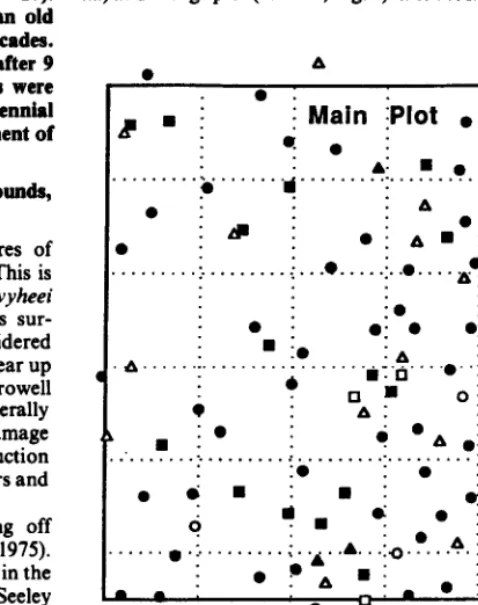
we mltially mapped P. owyheei mounds at 3 small plots (0.25 ha) and 1 large plot (2.72 ha, Fig. 1) in 1977. Mounds and clearings
0 :
: Main
iPlot
0.
4.:
. j
o
; .1. A .:A
Key Words:
Pogonomyrmex,
persistence, survivorship, mounds,clearing
Pogonomyrmex harvester ants are conspicuous features of rangelands throughout much of western North America. This is especially true of the northwest species, Pogonomyrmex owyheei
Cole, which constructs distinctive gravelcovered mounds sur- rounded by large clearings. Harvester ants have been considered pests (Crowell 1963, List 1954) because they occasionally clear up to 1% of range area (Sharp and Barr 1960, Willard and Crowell 1965). Fortunately, the percentage of land cleared is generally much less (Sneva 1979, Rogers and L.avigne 1974) and the damage is largely compensated by increased vegetational production around clearing perimeters (Wight and Nichols 1966, Rogers and Lavigne 1974).
. . . . . . . , . . . . .*
i.. . . . . .‘i. . .!. .$. i *. . .;. . . ;. .
0 : . A
:a. : 0:s :
.: Am : A:
L .A
I
. . . . .I. . . . :‘...a . . .
..a . . . .
a$o..*.&..
‘e
~A.A i
0 :n . . A. . .:. . . .
6 i
:o
!
w .
: . . . i . . . :.
0: 0 0: 00:
:A
:,,
:
m.. . _. . . .a. . . . . . . . .
n .0 . 0 =
. :
0.
A : :. ?
i ‘A..
00.
:A( . . . l ..:...:o.
Colonies construct clearings by systematically clipping off plants emerging too near their mounds (Clark and Comanor 1975). This behavior exposes the mounds to direct sunlight earlier in the morning when it is most beneficial for thermoregulation (Seeley and Heinrich 1981). Clearings may also benefit the colony by speeding transit of foragers and eliminating hiding places for har- vester ant predators (Clark and Comanor 1975).
.+m:
n:
.A :II
e
6
_aF
0 :.0.
4 . . . . . a.: . . . ;.. ..A..;,.‘..a.. . . .
0 ?
A
W: 0 ‘* *
A .
c e .
0
-’
1 0
1
0 0 0 n 0
A
.15m.
Earlier observations indicated that harvester ant mounds andclearings changed little from year to year (Sharp and Barr 1960), and that the colonies themselves may be very long-lived (Michener
1942, Wildermuth and Davis 1931). In order to investigate the longevity of harvester ant colonies, we monitored approximately 120 mounds over a 9-year period, 1977-1986.
1977-
0
Active entire period 0 Inactive entire period1986
A
H Died but reactivated A Died during study New Colony. active Cl New colony, diedFig. 1. Distribution and activity of Pogonomynnex owyheei mounds on rhe mainplotfrom 1977-1986. Closedsymbols indicateactivemounds in 1986 and open symbols indicate the inactive ones.
Methods
This study was undertaken in Raft River Valley, Ida., as part of a larger environmental monitoring program (Jorgensen 1979). All plots were located in mixed sagebrush (Artemisia tridentata wyomingensis) and greasewood (Sarcobatus vermiculatus) plant associations. These shrubs together with Lepidium perfoliatum, Sitanion hystrix. Descurainia richardsonii, Bromus tectorum and Ceratoides lanata accounted for X5% of the vegetation. Rainfall averaged about 24 cm (9.5 inches) in 1977 and 1978. Plots were located on the lower parts of alluvial gravel deposits interspersed with intermittent drainage streams. Livestock grazing was gener- ally moderate from November to May, leaving range condition fair
Authors are research associate, Department of Zoology, University of Texas,
Austin 78712, and professor, Department of Zoology, Brigham Young University, Provo, Utah 84602. During this Frch, the senior author was a gra$ate student $lli’~‘~O) and a lecturer (1986) m the Department of Zoology, B&am Young
Research was funded in part by the Department of Zoology, Brigham Young University, Department of Energy contract DEASO7-77IDO1674, the Julia Green- well Award, and the D. Eldon Beck Award. Thanks are extended to W.P. MacKay and to L.A. Sharp for use of his published data and also for reading the manuscript.
in 2 of the small plots (A and B) were measured and checked for activity several times a year during 1977-1980 and again in 1986. Colonies at the third small plot (removal) were poisoned with Diazinon (1977) to determine how rapidly an area was reinvaded after the inhabitants died. Mounds at the main plot (Fig. 1) were mapped and checked for activity in 1977, 1979, partially in 1980, and again in 1986. These mounds were assigned to size classes according to their diameters: small (<30 cm), medium (30-60 cm), and large (>a0 cm). Mound activity was determined either by the presence of ants or fresh piles of chaff deposited near the mound. If a mound appeared to be inactive, we dug into the mound to confirm the absence of ants; this avoided the possibility that a mound would be declared inactive simply because the colony had not been foraging recently. Vegetational cover for the main plot and plots A and B was l8%, 31%, and 15%, respectively.
Results
Persistence of Mounds
Manuscript accepted 29 October 1987.
Mound densities on our study plots averaged 401 ha with about 4vo of the area included in clearings. The total number of active
mounds remained relatively stable at 122,128, and 119 mounds in 1977, 1979, and 1986, respectively. Gf the original 122 active mounds, 80% (97 mounds) were still active after the 9 years (see Figure 1 for activity changes on the main plot). At least 6 of these mounds were temporarily abandoned and then reactivated by a new colony. A total of at least 36 colonies died during the study and 30 new colonies were established. Six mounds remained recogniz- able even after more than 9 years of inactivity. Mortality rates appeared to be associated with mound size. Approximately 50% of small, 30% of medium, and 25% of large mounds were abandoned between 1977 and 1986. This relationship suggests that colonies in small mounds are shorter lived, but this could also result because smaller mounds were less likely to be reactivated during the S-year interval when the plots were not monitored (1981-1985).
Colony Longevity
Longevity was calculated by dividing the number of colonies alive over a specific time period by the number which died (Table 1). For example, 23 mounds on plots A and B were monitored for 3 Table 1. E&m&d longevity of harvester ant coioniea pogonomymaex
owyhcci) in the R8ft River Vdiey of soutbem Idaho.
Vegetation Sagebrush and
Greasewood Plots A & B Main Plot Shadscale Saitsage Depleted Saitsage
Nuiber Number Longevity
Sample Of Mound of in
Dates Mounds Years Deaths Years
1977-80 61 4 15
1979-80 68 5 14
1956-58 61 121 4 30.
195658 28 56 2 28*
195658 ii2 223 16 14+
Total 529 31 17
*Calculated from Sharp and Barr (1964)
years. During this time, we accumulated 61 active colony years and observed 4 deaths; thus the estimated longevity was 15 years. We also checked the activity of 68 colonies at the main plot for 1 year; 5 colonies died during this year producing an estimate of 14 years. Sharp and Barr (1960) monitored the activity of colonies over 2 yearsat study sites in the same valley. Their 3 sites were located in shadscale (Atriplex confertifolia), saltsage (Atriplex trt’dentata), and “depleted” or heavily foraged saltsage. Longevity estimates calculated from their data ranged from 14-30 years (Table 1).
wave, the longevity estimate would have been too high, while if we sampled late in the cycle, it would have been too low. Problems with thii assumption may account for some of the variation in Table 1; however, the fact that all 5 estimates exceed 10 years supports the conclusion that harvester ant colonies are very long-lived.
Mound Dimensions
Seventeen of the 22 mounds on plots A and B were active throughout the study. The average diameter of these mounds changed little during the course of our study; however, mound heights increased 20-50% between 1977-79 and 1986 (Fig. 2, repeated measures ANOVA, Scheffe F-test,p<O.OS). This increase
Year
Fig. 2. Average changes in Pogonomyrmex owyheei mound height and diameter of llmounakjirom 1977 to 1986. Standorderrorsareshownfor each point.
could be due to either a gradual accumulation of rocks over the years, or a general increase in colony size, perhaps as a result of almost 5 years of above-normal precipitation in the valley. Active mounds at the main plot also seemed to increase in size, but 70% did not change enough to switch size classes. Five mounds remained small throughout the study. Twelve mounds grew from small to medium, and another 13 from medium to large. Two mounds grew all the way from small to large. The only mounds which lost size were those in which the colony died.
The longevity estimates in Table 1 require the satisfaction of 3 assumptions: (1) colonies died rather than emigrated, (2) sampling frequency was sufficient to detect mortality, and (3) populations retained stable age-distributions during the study. The assumption that inactive colonies died rather than emigrated is fairly robust and acceptable. Unlike other members of its genus (Carlson and Gentry 1973, Van Pelt 1976), mature P. owyheei colonies rarely emigrate unless they are poisoned or severely disturbed (Willard and Crowelll965). In 4 years of intensive study, we observed only 1 naturally occurring emigration, and it was eventually aborted. The second assumption, that sampling frequency was sufficient to detect mortality, also seems to be satisfied. Plots A and B were checked at least monthly (1977-1980) so it is highly unlikely that colony death and reestablishment could have occurred unnoticed. Other plots were surveyed once a year, but this was probably also sufficient because recolonization by founding queens could occur only in August and at least a year would be required before an incipient colony grew enough to be noticeable. Also, successful “yearling”colonies were very uncommon. The third assumption, a stable age distribution, is more questionable because we could not determine how long colonies had been at the plots prior to sam- pling. The main problem would be if our study populations had been founded in waves. Thus, if we sampled soon after a founding
Clearings
After 9 years, the size and shape of clearings on plots A and B changed very little. In fact, comparison of photographs taken in 1977 and 1986 revealed a remarkable lack of change (Fig. 3A). Many dead sticks and branches were still in the same locations they had been 9 years earlier. Most bushes were even the same general shape and size; a fact not too surprising considering sagebrush is often very long lived and slow growing (Ferguson 1964). The diameters of the clearings, however, averaged about 8% smaller in 1986 than in 1977-1979 (3.5fl.l m versus 3.8fl.l m; pCO.05, Scheffe F-test). This change may reflect increased growth of vege- tation during a period of wet years, or it may simply indicate that clearings are often irregular and measuring them is difficult to standardize.
Removal Plot
were badly deteriorated and not more than 2-4 cm in height. Clearings associated with those mounds had also deteriorated, and most had young sagebrush (Fig. 3B) or perennial grasses growing on them.
Discussion
Colony Longevity
Harvester ant colonies arc apparently very long lived once they become established. Estimates of longevity ranged from 14 to 30 years with a mean of about 17 years (Table 1). We were not able to determine the age distribution of these colonies, but the fact that substantial mortality occurred in all mound sizes indicates that survivorship is probably closer to a type II curve (mortality inde- pendent of age) than a type I curve (old-age mortality). If this is the case, then the age ofcolonies at death would varyconsiderablyand some would easily reach 25-30 years. Colony longevity has been reported for a number of other ants, but most of these reports are fragmentary or based on single laboratory colonies. Colonies with multiple queens are potentially immortal because new queens are recruited as old ones die (Wilson 1971). Colonies with a single queen may live 5-30 years (Baroni-Urbani et al. 1978, Chew 1987, Tschinkel 1987, Weber 1972), but most species probably do not survive nearly as long in the field due to the rigors of competition, predation, pathogens, and habitat change.
Of the original mounds in our study, almost 75% (911122) were still active 9 years later--excluding 6 which were known to have died and then been reactivated. This activity rate was almost 30% higher than would have been predicted assuming a I7-year longev- ity and a type II survivorship curve. Several possibilities may account for this discrepancy. The most likely one is that some active mounds probably died and then were recolonized during the 5-year period (1981-U) whendata were not collected. Also, the age distribution may not have been stable or 17 years may be an underestimate of actual longevity.
Another possibility which could confuse the results would be if mature queens were replaced by young queens after they died; fortunately, this does not appear to be the case. Pogonomyrmex colonies are uniformly single-queened (Iavigne 1969, MacKay
1981, unpublished data) and hostile to foreign queens (Hiilldobler 1976). The possibility of queen replacement was s@iically tested with P. owyheei’s sister species P. occident&s (Cole 1968). We introduced l-month-old founding queens into 8 mature laboratory colonies which had been deprived of their mother queens first for 1 week and then for 1 month. Workers in these colonies immediately attacked and eventually killed the introduced queens. In short, these colonies did not replace their mother queen when she died; consequently, colony longevity should be the same as queen longevity.