A Framework for the Sound Specification of Cryptographic Tasks
Juan A. Garay AT&T Labs – Research [email protected]
Aggelos Kiayias University of Connecticut [email protected]
Hong-Sheng Zhou University of Connecticut [email protected]
March 12, 2010
Abstract
Nowadays it is widely accepted to formulate the security of a protocol carrying out a given task via the “trusted-party paradigm,” where the protocol execution is compared with an ideal process where the outputs are computed by a trusted party that sees all the inputs. A protocol is said to securely carry out a given task if running the protocol with a realistic adversary amounts to “emulating” the ideal process with the appropriate trusted party. In the Universal Composability (UC) framework the program run by the trusted party is called anideal functionality. While this simulation-based security formulation provides strong security guarantees, its usefulness is contingent on the properties and correct specification of the ideal functionality, which, as demon-strated in recent years by the coexistence of complex, multiple functionalities for the same task as well as by their “unstable” nature, does not seem to be an easy task.
In this paper we address this problem, by introducing a general methodology for the sound specification of ideal functionalities. First, we introduce the class ofcanonicalideal functionalities for a cryptographic task, which unifies the syntactic specification of a large class of cryptographic tasks under the same basic template functionality. Furthermore, this representation enables the isolation of the individual properties of a crypto-graphic task as separate members of the corresponding class. By endowing the class of canonical functionalities with an algebraic structure we are able to combine basic functionalities to a single final canonical functionality for a given task. Effectively, this puts forth a bottom-up approach for the specification of ideal functionalities: first one defines a set of basic constituent functionalities for the task at hand, and then combines them into a single ideal functionality taking advantage of the algebraic structure.
In our framework, the constituent functionalities of a task can be derived either directly or, following a translation strategy we introduce, from existing game-based definitions; such definitions have in many cases captured desired individual properties of cryptographic tasks, albeit in less adversarial settings. Our translation methodology entails a sequence of steps that systematically derive a corresponding canonical functionality given a game-based definition, effectively “lifting” the game-based definition to its composition-safe version.
We showcase our methodology by applying it to a variety of basic cryptographic tasks, including com-mitments, digital signatures, zero-knowledge proofs, and oblivious transfer. While in some cases our derived canonical functionalities are equivalent to existing formulations, thus attesting to the validity of our approach, in others they differ, enabling us to “debug” previous definitions and pinpoint their shortcomings.
Contents
1 Introduction 3
2 Preliminaries 5
3 Canonical Ideal Functionalities 6
3.1 The communication language of ideal functionalities . . . 6
3.2 The canonical functionality of a cryptographic task . . . 7
3.3 The algebraic structure of canonical functionality classes . . . 8
4 Deriving Canonical Ideal Functionalities 11 4.1 The general approach . . . 11
4.2 Ideal functionalities from game-based security definitions . . . 11
4.2.1 Ideal functionalities from consistency games . . . 12
4.2.2 Ideal functionalities from hiding games . . . 13
5 Applying the Methodology 14 5.1 Digital signatures . . . 14
5.1.1 Unforgeability . . . 14
5.1.2 Completeness . . . 15
5.1.3 Consistency . . . 16
5.1.4 The canonical ideal signature functionality . . . 18
5.1.5 Comparison to previous signature functionalities . . . 18
5.2 Oblivious transfer . . . 19
5.2.1 Correctness . . . 19
5.2.2 Sender and receiver privacy . . . 19
5.2.3 The canonical ideal oblivious transfer functionality . . . 20
5.2.4 Comparison to previous OT functionalities . . . 20
5.3 Commitments . . . 21
5.3.1 Correctness . . . 21
5.3.2 Binding . . . 21
5.3.3 Hiding . . . 22
5.3.4 The canonical ideal commitment functionality. . . 22
5.4 Zero-knowledge proofs . . . 23
5.4.1 Completeness . . . 23
5.4.2 Soundness . . . 24
5.4.3 Zero-knowledge . . . 24
5.4.4 The canonical ideal ZK functionality . . . 24
A Digital Signatures (cont’d) 26
1
Introduction
The Universal Composability (UC) framework proposed by Canetti [Can05], culminating a long sequence of simulation-based security definitions (cf. [GMW87,GL90,MR91,Bea91,Can00]; see also [PW01,BPW04,PS04, K¨us06,CDPW07,LPV09] for alternative/extended frameworks), allows for arguing the security of cryptographic protocols in arbitrary settings where executions can be concurrent and adversarially interleaved. The framework is particularly attractive for the design of secure systems as it supports modularity, provides non-malleability across sessions [DDN00], and preserves security under composition.
In the UC framework, security is argued by providing a proof that a protocol realizes anideal functionalityF
for the cryptographic task. While this simulation-based formulation provides compelling security guarantees, its usefulness is contingent on the properties of the realized ideal functionality. In particular, any ideal functionality is required to interact with an ideal-world adversary to whom it reveals aspects of its internal state. Thus, such a program can be quite far from anidealizationof a given cryptographic task. To make things worse, the appli-cation of the framework to the analysis of many cryptographic schemes has shown that relatively complex ideal functionalities are the norm. This has frequently led to successive revisions of ideal functionality programs, the simultaneous coexistence of multiple different ideal functionalities for the same task, and the discovery of errors in their specification, which in turn would lead to flawed security guarantees for the protocols realizing them. A quick inspection of recent papers providing UC formulations of cryptographic tasks should suffice to support the claim about their complexity; see the initial treatment of digital signatures [Can01,BH04,Can04] for an example of need-to-revise and error-prone formulations of ideal functionalities.
In this paper we address this problem by introducing a general methodology for the sound specification of ideal functionalities. Following our methodology each task gives rise to a class of ideal functionalities that are consistent with the cryptographic task in terms of its actions. This representation unifies the syntactic specification of a large class of cryptographic tasks under the same basic template functionality, and, furthermore, it enables the isolation of the individual properties of a cryptographic task as separate members of the corresponding functionality class. This facilitates a fine-grain specification of the basic constituent properties of the ideal version of a task. At the same time, our methodology provides a way to combine constituent functionalities of a task to a single “supremum” ideal functionality that encompasses all constituent properties. This amounts to abottom-up approachfor achieving the original goal of expressing all required properties of a cryptographic task with a single functionality. This approach can be contrasted with the common “top-down” approach that specifies an ideal functionality capturing all essential properties at once, and then possibly relaxing it to bring it closer to realizability.
In addition, our methodology makes it easy to lift existing formulations of cryptographic properties for a task in case those have already been investigated in the form ofgame-based definitionsto their corresponding UC coun-terparts. While such definitions are frequently easier to specify and understand as the appropriate formulations of the natural properties of the underlying cryptographic task, they typically provide a less satisfying level of security guarantees (as they may exclude composition, adaptive corruptions, non-malleability and other properties offered by the UC framework). Examples include the existential unforgeability notion for digital signatures [GMR88], IND-CPA security for public-key encryption, the hiding property of commitment schemes, and others.
Our results. We summarize our results in more detail:
ideal-world simulation which is instrumental in our methodology. These results are presented inSection 3. We remark that the canonical functionality template abstracts all the common elements that are shared among ideal functionalities for many cryptographic tasks in the UC framework1. Once we have this formalism in place, this enables us to give very simple and concise formal definitions of the ideal functionalities for vari-ous different cryptographic tasks. When compared to the approach of defining functionalities of cryptographic tasks individually, our approach “contains” the complexity of such definitions in the template canonical func-tionality specification. This minimizes the effort of defining tasks in the UC framework without sacrificing rigor.
We further remark that while our canonical template and the algebraic structure helps understand the requirements for realizing a given functionality, it is not intended to be a tool for deciding the realizability of cryptographic tasks. Specifically, we prove that it is possible to draw arealizability horizonat some level of the semilattice of canonical functionalities that separates realizable functionalities from those that are impossible to realize (in the plain model). We note that setup assumptions (such as the existence of a CRS) can be viewed as modifiers to the level of the realizability horizon; specifically, as ways to increase the number of properties that can be achieved by a certain cryptographic task.
2. We propose a new methodology for the sound writing of functionality programs. We follow a bottom-up approach: we first define basic constituent functionalities for a cryptographic task and then we combine them taking advantage of the algebraic structure of the canonical functionality class. Next, we turn to the derivation of such constituent functionalities. These basic functionalities can be derived eitherdirectlyor, following a translation strategy we introduce, from existing game-based definitions. Our game-to-functionality translation operates as follows. We divide games into two general types: consistency games andhiding games. The former capture properties such as correctness, unforgeability and binding, while the latter capture properties such as IND-CPA security and commitment hiding. Depending on the type of game, we present a sequence of steps that transform a game-based definition (whenever it exists or it is easily defined) into its corresponding canonical functionality. We demonstrate the soundness of this translation by showing that any scheme that realizes the resulting ideal functionality also possesses the properties offered by the game-based definition (Section 4).
3. We showcase our methodology by applying it to a variety of basic cryptographic tasks.We obtain ideal func-tionalities for digital signatures, oblivious transfer, commitments and zero-knowledge proofs of knowledge. In some cases (commitment, zero-knowledge) our derived canonical functionalities are equivalent to previously proposed functionalities in the literature, something that attests to the soundness of the bottom up approach; in others (signatures and oblivious transfer), our derived canonical functionalities differ from some previ-ous definitions, allowing us to pinpoint their shortcomings. Specifically, in the case of signatures, we find that although the digital signature functionality presented in [Can04] in fact corresponds to the systematic transfor-mation (using our methodology) of the game-based formulation of the Goldwasseret al.notion [GMR88], the attacker considered in [Can04] for the consistency game is more restricted than the one implied in [GMR88], which would result in a more relaxed functionality than the one actually presented there. In the case of oblivi-ous transfer, the “debugging” goes beyond the specification of particular tasks, as in this case our methodology discovers a (fixable) structural inadequacy in the UC notion of “delayed output” in the ideal process. These results are presented inSection 5.
Related work. The work of Dattaet al.[DDM+06] also relates individual properties of cryptographic tasks to sets of ideal functionalities. In their work each game-based property of a cryptographic task is mapped to a syntactic expression in process calculus that the ideal functionality program needs to satisfy. Based on this, they were able to generalize impossibility results on the realizability of specific cryptographic tasks such as bit commitment and group signatures. In contrast, while the current work also abstracts the basic properties of a cryptographic task in a syntactic fashion, it further provides a methodology to explicitly (and easily) write ideal functionality programs
1
within the UC framework that provably satisfy such properties.
Although in a different context, the work of Backes et al. [BPW04] also considers the transformation of an arbitrary consistency (called integrity in [BPW04]) property into a (low-level) ideal functionality that enjoys that property. As a general methodology, distinguishing features of our approach include applicability to arbitrary se-curity properties (i.e., also hiding, not just consistency properties), being able to obtain algorithm-independent functionalities, and the ability to treat individual security properties separately, together with a mechanism to com-bine the derived functionalities into one end result.
Differences with the previous version of this report [GKZ09]. As mentioned above, our specification approach is based on a well-defined communication language between ideal functionalities and the other ideal-world entities, with tasks’ consistency properties essentially being mapped to classes of strings in that language. In turn, these strings (in fact, “bad” strings, which correspond to properties not being satisfied) are to be recognizable within com-plex executions where symbols may be interleaved with other symbols. Our previous approach was not complete in the sense of capturing all possible interleaving scenarios, something that we address here (SeeSection 4.2.1).
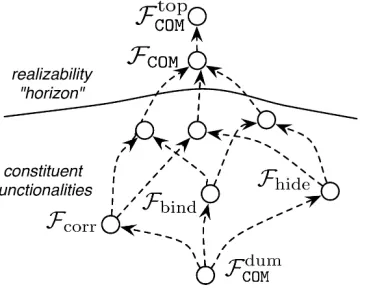
The semilattice structure of our canonical functionalities allows us to draw a “realizability horizon,” separating functionalities that can be realized (in the plain model) from those that cannot. We illustrate such a semilattice with the case of the commitment task, known to be unrealizable. The current version sheds additional light on this issue, by containing protocols realizing the functionalities resulting from the pair-wise combination of the task’s properties (hiding, binding, and correctness). (SeeFigure 3andSection 5.3.)
Comparisons of our derived functionalities, in particular for signatures and oblivious transfer, with correspond-ing previous functionalities has been expanded, as well as comparisons with additional related work, and proofs have been added. Finally, the change of title emphasizes our intent of presenting and promoting this work as a methodology for the (sound) specification of cryptographic tasks.
2
Preliminaries
We will lay out our results following the Universal Composability framework of Canetti [Can05]. Recall that in the UC framework, the environment is creating processes which are entities maintaining state across actions. Further, a cryptographic taskT is associated with an ideal functionality which is a stateful entity. The functionalityFT is a “packaging” of the actions of the taskT together with data fields that are persistent across action invocations. For example, an ideal functionality for the commitment task offers two actions, commit and open, and has a persistent data field that is generated by the commit action and used by the corresponding open action (the decommitment information). Similarly, an ideal functionality for the digital signature task offers three actions, key-generation, signature-generation, and signature-verification, and has a persistent data field that is updated by the signing action and used by the verification action (this is the list of messages that have been signed).
Given that the environment is generating all actions for the ideal functionality of a task, not all sequences of actions are sensible, as the environment is assumed adversarial. Actions that are deemed inconsistent with the current state are ignored by the ideal functionality. This implicitly determines a notion of “well-formedness” of action sequences that we will formalize in the next section. Furthermore, the ideal functionality may generate output to a party depending on its internal state and the influence of the adversary; to formalize the interaction between the functionality and the adversary with respect to output generation we will define in the next section two functions that we call the “public output” and “secret output” of the functionality.
Our definitions of well-formedness and public/secret output for a functionality will also require basic string operations. Given a sequencewconsisting of elements from an alphabetΣ ={a1, . . . ,ak}, we letwi denote the i-th element in w. We can obtain a subsequenceofw, call itw0, by erasing some of the elements in wwithout disturbing the relative positions of the remaining elements. We denote this byw0 4wand we remark that4w for any stringw(hereis the empty string). For a given set of stringsSwe defineS4={w0 | ∃w∈S:w04w}. For anyw ∈ Σ∗ we writew0wwhenw
0 is derived fromwafter substituting at least one symbol ofwwith the
Amonoid(A,+)is a semigroup with an identity element. Any monoid possesses a preorder relation denoted by.such thata.biff∃c:a+c=b.
3
Canonical Ideal Functionalities
In this section we provide an explicit syntax for a class of functionalities that idealize the cryptographic taskT — this is theclass of canonical functionalitiesfor the cryptographic taskT. In this first formulation of canonical functionalities we focus on a wide class of cryptographic tasks whose action outputs are not required to follow an ideal probability distribution, i.e., the ideal functionality can be deterministic. Such tasks include digital signatures, commitment, public-key encryption, secure message transmission, zero-knowledge proofs, secure deterministic function evaluation, etc.
3.1 The communication language of ideal functionalities
We start by specifying the language of the communication between the ideal functionalityFT of a taskT and the environment. The alphabet over which the environment communicates with the ideal functionality is parameterized by the security parameterλ∈Nand is a finite set of symbols of the form(ACTION,P, x); note that we will usually omit reference toλfor simplicity. Here ACTIONis a label that determines the action the environment instructs the functionality to do (e.g., COMMIT,SIGN, etc.). Pis a tuple that designates the identifiers of the entities and their roles in the particular action, in particular which parties provided the input to the action and which parties should receive output. To differentiate multiple invocations of the functionality by the same group of entities, P may also include a session identifiersid. Finally, the valuexis an encoding of the input to the action whose length is polynomial inλ; note that wheneverx=, we will dropxfrom the symbol notation for ease of reading.
In response to a symbol (ACTION,P, x), the ideal functionality may return a symbol (ACTIONRETURN,
P, y) to some party (see below in what circumstances). The set of all symbols of the form (ACTION,P, x)and
(ACTIONRETURN,P, y), constitutes the finite I/O alphabet of the ideal functionality, i.e., the communication al-phabet between the functionality and the environment, and is denoted byΣT.
As mentioned inSection 2, the actions of a cryptographic scheme make sense only in certain order; for this reason not all strings overΣT are valid as action sequences. To formalize this, we associate with the ideal function-ality the predicateWFT called thewell-formedness predicate. For any stringw∈ (ΣT)∗ and symbola∈ ΣT, the well-formedness predicateWFT(w,a)decides whether the stringwais sensible with respect toFT.
We also mentioned before that the ideal functionality may produce output based on its internal state and the current action symbol following the influence of the adversary. In order to enable an informed influence the adver-sary needs to know some information about the internal state of the functionality. This will be formally captured by a polynomial-time string mappingPOT called the public outputmapping, that given a stringw ∈ (ΣT)∗ and a symbola ∈ ΣT that satisfiesWFT(w,a), may return a value that is a part of the suggested output of the ideal functionality on action symbolagiven the historyw. For example, in the case of a zero-knowledge taskT =ZK, upon receiving(PROVE,hP, V,sidi,hx, mi),POZKwill output the pairhx, φi whereφ = 1if and only ifhx, mi
belongs to the relation that parameterizes the zero-knowledge functionality. Depending on the task, the adversary may not need to know the correct output to influence the functionality. To capture this, another string mappingSOT called thesecret outputmapping is defined. For example, for the taskT =OTof oblivious transfer, upon receiving symbols(TRANSFER,hS, R,sidi,hm0, m1i) and (TRANSFER,hS, R,sidi, i), the mapping SOOT will return mi and the adversary will not need to know this value to influence the functionality to return it. On the other hand, in some cases, the ideal functionality will not suggest any output, i.e., theSOT,POT mappings will be empty, and then the adversary will be entirely responsible for the choice of output to the parties. For example, in the digital sig-nature taskT =SIG, on action symbol(KEYGEN,hS,sidi)the mappingsPOSIGandSOSIGwill output the empty
string as there is no need for the functionality to suggest any distribution on the public keypkthat is returned in the symbol(KEYGENRETURN,hS,sidi, pk)and is selected by the adversary.
This interaction defines another communication language that is not bound by the alphabet of the real world. We next define this language formally. For each input action symbol (ACTION,P, x), the ideal functionality may want to notify the ideal world adversary. We capture this by introducing a set of “leaking-action” symbols
(LEAKACTION,P, x0) where x0 will have a functional dependency on x according to the program of the ideal functionality. The public output of the ideal functionality (as defined by thePOT mapping) will also be sent out with the LEAKACTIONsymbol to the adversary.
Conversely, the ideal world adversary may also communicate with the ideal functionality; to capture this in-teraction we introduce the “influence-action” symbols denoted by(INFLACTION,P,·). Such symbols are used byS to influence the output of a particular action that is currently under-way. Moreover, the adversary may in-form the functionality that a certain party is corrupted; for this purpose symbols of the in-form(CORRUPT,·)will be used. Finally, the adversary can control the way the ideal functionality handles corrupted parties through the use of
(PATCH,·)symbols which enable the adversary to specify the inputs of corrupted parties as well as their state with respect to all currently ongoing actions. The exact syntax of(CORRUPT,·),(PATCH,·)symbols is explained below. The extended communication alphabet of the ideal functionality is denoted byΣextT and includes all I/O symbols of ΣT as well as the corresponding INFLACTION,LEAKACTION,CORRUPTand PATCHsymbols.
So far we introduced a syntax for the communication language between the ideal functionality and the other entities of the ideal world. Next, we will describe a well-defined class of structured ideal functionalities for a cryptographic task. We call this the class ofcanonical functionalitiesfor the task.
3.2 The canonical functionality of a cryptographic task
The functionalities that we consider in this paper adhere to the following design choices: (i) the adversary is notified of all input actions (by means of LEAKACTION symbols), (ii) the ideal functionality produces output only after being instructed by the adversary through an INFLACTIONsymbol (this captures the “delayed output” property of [Can05]), (iii) the ideal functionality is a deterministic TM, and (iv) outputs are always given sequentially2.
A canonical functionality is essentially defined by two functions: suppress()andvalidate(). As stated in (i) above, given an action symbol(ACTION,P, x) a canonical ideal functionality will always notify the adversary about this input. The functionsuppress()will determine what information aboutxthe ideal world adversary will learn. The output ofsuppress()will be passed into the LEAKACTIONsymbol. Specifically, thesuppress()function is defined over(ACTION,P, x)symbols and will output somex0x. We require that thesuppress()function will always substitute with “−” the same locations ofx, independently ofx.
Together with a LEAKACTIONsymbol the adversary will also be given the public output of the ideal functional-ity. Furthermore, the canonical functionality will return output to some party whenever it receives an INFLACTION symbol. In particular given(INFLACTION,P, y0)it will return(ACTIONRETURN,P, y)to the party inPthat is supposed to receive output, whereyconsists ofy0(which may be empty) concatenated with the secret output of the functionality (which may also be empty).
Given that not all output influences are consistent with the intended security properties of the cryptographic task, thevalidate()predicate is defined over strings ofΣ∗and determines when the canonical functionality will halt. We note thatsuppress()is history independent while validate()is not. The intuition is that the suppress() function abstracts what the adversary learns about the possibly private inputs of parties (i.e., it captures the hiding aspects of the functionality) whereas thevalidate()predicate makes sure that the outputs produced by the functionality are consistent with its history according to the intended consistency properties of the task.
In order to perform thevalidate()check a canonical functionality needs to be stateful. The state of the func-tionality, denoted byhistory, is the sequence of all I/O symbols ordered chronologically as received from and sent to the environment. We use historyPj to denote all symbols associated to party Pj in history, i.e., the ACTION symbols that were provided byPj and ACTIONRETURNsymbols that were returned toPj.
2
The CORRUPT and PATCH symbols are used to handle the behavior of corrupted parties. When a partyPj is corrupted, we allow the adversary to learnhistoryPj3. Moreover, to handle adaptive corruptions, we allow the adversary to rewrite the history of corrupted parties using the PATCHsymbols in the following manner: a certain symbol that was provided by a corrupted party can be modified provided this symbol has not contributed to the view of any honest party. To facilitate this checking the canonical functionality will use an array calledbinding[·]
that for each symbol in history, records the set of honest parties whose view could have been affected by that symbol. In particular each time an honest partyPjreceives output from the ideal functionality all previous symbols inhistoryare marked withPjin thebinding[·]table (binding all symbols is suitable as an instance of our canonical functionality that is supposed to capture a single session only).
We now have all the elements to present the exact formulation of the class of canonical functionalitiesFT. Each member of the class is specified by a pair of functions suppress(),validate() as defined above. Specifi-cally, the functionality responds tomsg = (ACTION,P, x) symbols by issuing (LEAKACTION,P, x0) symbols to the adversary where x0 = suppress(msg) and tomsg = (INFLACTION,P, y) from the adversary by issuing
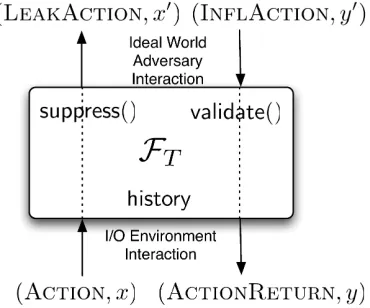
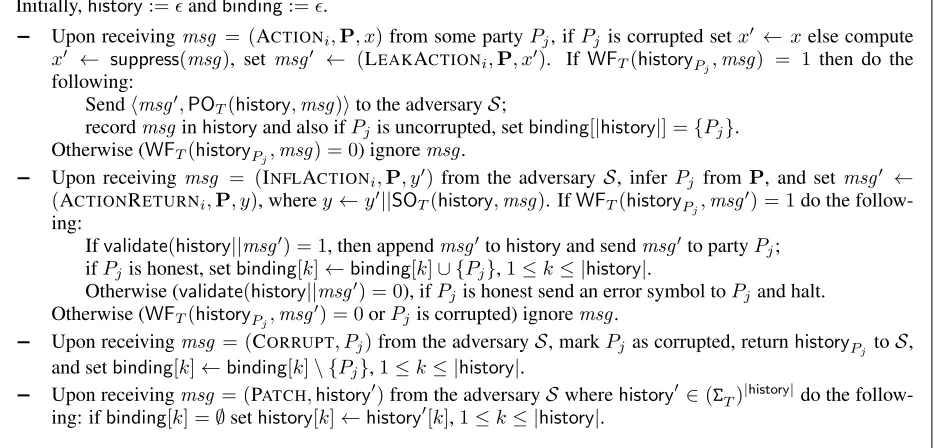
(ACTIONRETURN,P, y)symbols to the parties specified inPas long asvalidate(history||msg) = 1. Additionally it responds to CORRUPT,PATCHsymbols as one would expect: given a CORRUPT(Pj) symbol, it returns to the adversary the history of partyPj and given a PATCH(history0)it modifies its internal state with respect to corrupted parties followinghistory0. A pictorial representation can be found inFigure 1, and a detailed description is given inFigure 2.
Figure 1: The canonical functionality: communication flows with the environment and adversary.
A canonical functionality defines a language over the symbols that are used by the functionality to communicate with the environment. We formalize this language as follows:
Definition 3.1. Given a canonical functionalityFT, an environmentZand an adversaryS, we defineLF
T,Z,S =
{w|w∈(ΣT)∗such thatwis equal tohistoryofFT in an execution withZ andS }.
Essentially the above language contains all possible execution histories. SinceZ,Sare PPT there may be a different executionhistoryfor each choice of the random tapes of these machines. We may quantify the language over all possible environmentsZ and ideal world adversariesS in which case we will omit referencing them. Moreover, we may consider only those strings inhistory ofFT for which the environmentZ returns 1; we will denote this (“bad”) language asBF
T,Z,S.
3.3 The algebraic structure of canonical functionality classes
Thesuppress(),validate()parameterization effectively gives a range of canonical functionalities with security and correctness properties of different strength for the same cryptographic task. We next endow this class with an
3
Canonical FunctionalityFTsuppress,validate
Initially,history:=andbinding:=.
Upon receivingmsg = (ACTIONi,P, x)from some partyPj, ifPj is corrupted setx0 ← xelse compute x0 ← suppress(msg), set msg0 ← (LEAKACTION
i,P, x0). If WFT(historyPj,msg) = 1 then do the following:
Sendhmsg0,POT(history,msg)ito the adversaryS;
recordmsg inhistoryand also ifPjis uncorrupted, setbinding[|history|] ={Pj}.
Otherwise (WFT(historyPj,msg) = 0) ignoremsg.
Upon receivingmsg = (INFLACTIONi,P, y0)from the adversary S, inferPj fromP, and set msg0 ←
(ACTIONRETURNi,P, y), wherey ←y0||SOT(history,msg). IfWFT(historyPj,msg
0) = 1do the
follow-ing:
Ifvalidate(history||msg0) = 1, then appendmsg0tohistoryand sendmsg0to partyPj;
ifPjis honest, setbinding[k]←binding[k]∪ {Pj},1≤k≤ |history|.
Otherwise (validate(history||msg0) = 0), ifPjis honest send an error symbol toPjand halt.
Otherwise (WFT(historyPj,msg
0) = 0orP
jis corrupted) ignoremsg.
Upon receivingmsg = (CORRUPT, Pj)from the adversaryS, markPj as corrupted, returnhistoryPj toS, and setbinding[k]←binding[k]\ {Pj},1≤k≤ |history|.
Upon receivingmsg = (PATCH,history0)from the adversarySwherehistory0 ∈(ΣT)|history|do the
follow-ing: ifbinding[k] =∅sethistory[k]←history0[k],1≤k≤ |history|.
Figure 2: Definition of the class of canonical functionalitiesFT for a taskT quantifying over all admissible pairs suppress(),validate().
algebraic structure that will be helpful in classifying and combining the various canonical functionalities for the same cryptographic task.
We define a conjunction operation denoted by ∧on the class of canonical functionalities for a taskT. This operation will enable us to combine canonical functionalities for a task T, while providing a concise way of representing members of the class in terms of “simpler” members. Observe that for any two members of the canonical functionality class that are parameterized by the functionssuppress1 andsuppress2, respectively, for any symbola = (ACTIONi,P, x), it holds that suppress1((ACTIONi,P,suppress2(a))) = suppress2((ACTIONi,P, suppress1(a))). This fact will be handy in the definition below.
Definition 3.2 (Conjuncting Functionalities). Given F1 = FTsuppress1,validate1,F2 = FTsuppress2,validate2 ∈ FT
we define the conjunctionF1 ∧ F2 of the two functionalities as the functionalityFTsuppress,validate ∈ FT, where
(1) for anya= (ACTION,P, x) ∈Σ,suppress(a) = suppress1(ACTIONi,P,suppress2(a)), and (2)validate() =
validate1()∧validate2(), i.e., the logical conjunction of the two validate predicates ofF1,F2.
We next show that the canonical functionality class for a taskT has a monoid structure with identity element a canonical functionality that we call thedummy functionalityforT defined as follows:
Definition 3.3(Dummy Functionality). We call the canonical functionalityFdum
T ∈ FT dummy if (1) for allx and anyACTION,suppress((ACTION,P, x)) =x, and (2)validate() = 1always.
Observe that the dummy functionality does not capture any of the intended correctness or security properties of the cryptographic taskT. This means that any protocolπUC-realizingFdum
T will merely syntactically match the purpose ofT but will lack any useful property.
Proposition 3.4. (FT,∧)is a commutative monoid with the dummy functionalityFdum
T as the identity element.
FT together with ∧ forms a bounded (join-)semilattice, i.e., every set of elements in FT has a least upper bound. Note that (1) we use∧in place of the standard∨in lattice theory as it is more consistent as an operator in our setting where lattice elements would capture security properties (and going higher in the lattice means that security increases), and (2) given that (FT,∧) as a commutative monoid lacks the antisymmetric property, the semilattice would be in fact over the quotientFT/ whereis the equivalence relation defined asF1 F2 iff F1.F2andF2.F1.
We next define thetop canonical functionalityFTtop which is the supremum of all canonical functionalities in FT representing the most stringent idealization of a cryptographic task. The top functionality suppresses all inputs (but allows the adversary to see the length of them), while it restricts all output influences of the adversary.
Definition 3.5(Top Functionality). We call the canonical functionalityFTtop ∈FT topif for anyACTION, (1) for allx,suppress((ACTION,P, x)) = (−)|x|, and (2) for allw,a,validate(wa) = 0.
While the top functionality offers security it does so at the expense of providing no response to the parties that employ it, i.e., it never produces any output. Thus it is the dual from a security point of view to the dummy functionality and due to its unresponsiveness it is equally meaningless as an idealization of a cryptographic task. Useful functionalities will lie somewhere in between these two extremes.
This completes the description of the algebraic structure of the class of canonical functionalities. The lattice of canonical functionalities for a task can be represented by a directed graph where theFTtopis placed at the top level andFdum
T at the bottom. An example of such a lattice for the commitment task is given inFigure 3.
Figure 3: The lattice of canonical functionalities for commitment showing relations between the constituent func-tionalities. Functionalities below the “realizability horizon” can be realized in the plain model (Remark 5.28).
Given the lattice of canonical functionalities we will show that we can identify a level of the lattice as the “realizability horizon.” As in [CLOS02, page 15] our notion of realizability refers only to non-trivial protocols, i.e., protocols that always generate output in the absense of adversarial interference (since a trivial protocol can realize any functionality including theFTtopfor anyT). We will show that all canonical functionalities at and below this level are realizable (in the plain model) whereas all canonical functionalities above the level are unrealizable. As seen inFigure 2we employ an error symbol for the ideal functionality to signal an inconsistency to the environment; non-trivial protocols never output this reserved error symbol (but may use other symbols for error-reporting).
Theorem 3.6. For every taskT, there is a (non-trivial) protocolπthat UC-realizes the dummy functionalityFdum
T . The top functionalityFTtopcan only be UC-realized by a trivial protocol.
Next, we show that UC-realizing any pointFofFT would imply that any lattice point dominated byFis also UC-realizable.
As it will become apparent, the usefulness of the lattice is in the fact that it is natural to identify individual desired properties of the task, map them to canonical functionalities in the lattice and then use the conjunction operation to derive the (local) supremum of these lattice points that will yield the final functionality for the task. In this way, an idealization of a cryptographic task can be solidly “defended” by presenting its constituent canonical functionalities.
4
Deriving Canonical Ideal Functionalities
4.1 The general approach
In this section we outline a methodology for deriving canonical ideal functionalities. Given a cryptographic taskT, the first step is to identify a set of consistency (including correctness) and privacy properties:
Consistency properties are expressed in terms of languages over the I/O alphabetΣT. In particular one needs to identify sets of strings overΣT that violate a certain consistency aspect of the underlying task. Provided that the set of strings identified is polynomial-time decidable a corresponding canonical functionality is derived by setting thevalidate()predicate to reject all strings that violate the consistency property.
Privacy properties are expressed in terms of suppression of input values that accompany action symbols. In particular, if a certain actiona = (ACTION,P, x) is supposed to maintain the privacy of a portion x0 of the inputx, we definesuppress(a)to be equal toxwith all locations corresponding tox0substituted by “−”. Now, using the above guidelines one can define a set of canonical functionalities each one corresponding to different security or consistency aspects of a cryptographic task. Then, given the canonical functionalities F1, . . . ,Fk so defined, one can derive the canonical ideal functionality of the cryptographic task by combining the functionalities asF = F1∧. . .∧ Fk. In such case we callF1, . . . ,Fktheconstituentcanonical functionalities ofF (note that typically there will be a unique set of natural constituent functionalities although the functionality may have many different sets of possible constituents). It follows thatFi . F and, based on Theorem 3.7, we have that any protocol that realizesF also realizesFifor alli= 1, . . . , k, thus the canonical ideal functionalityF preserves all consistency and privacy properties identified individually inF1, . . . ,Fk.
As an example of applying this general approach for deriving the ideal functionality of a cryptographic task the reader is referred toSection 5.2where we apply this strategy to the case of oblivious transfer.
Depending on the cryptographic task, it may not always be easy to properly identify the required set of con-sistency and privacy properties that will yield the constituent canonical functionalities of the task. Fortunately, for many of them substantial effort has been spent in identifying individual security properties formalized in terms of “security games.” Examples include the unforgeability game of digital signatures [GMR88] and IND-CPA game of public key encryption [GM84].
Next we show how one can leverage on existing game-based definitions of a cryptographic task to derive constituent canonical ideal functionalities in a systematic way. Importantly, our formal transformation approach from games to functionalities provably maintains the underlying game-based security notions. This translation methodology can be applied whenever game-based definitions have been identified. In fact, it is even possible to specify games for desired security properties “on demand” and apply the translation methodology to them as well.
4.2 Ideal functionalities from game-based security definitions
A game-based definition G for a cryptographic task T involves two PPT interactive Turing machines, the challengerC and the attackerA. The challenger uses the actions of the cryptographic task as oracles. When the interaction terminates, a Turing machine called the judge4 Jreads the transcript of the interaction as well as the internal state of the challenger and decides which party won the game. We denote the success probability of the attacker when playing the gameGby SuccGA; it equals the probability of the event that the judge decides that the attacker wins the game.
Consistency gamesare restricted to be deterministic programs (note that the task actions invoked by the game may be probabilistic). We say that a cryptographic scheme that implements a taskT satisfies the property defined by a gameGif for all PPT attackersAit holds thatSuccGA is a negligible function in the security parameterλ.
In ahiding game, the attacker focuses on a particular action of the cryptographic task. At some point of the interaction with the challenger, the attacker provides two input strings x0, x1 for a certain action wherex0 = hxL0, xR0i,x1 =hxL1, xR1isuch that either the left or the right parts of the strings are required to be different while
the other parts are required to be equal (for example in the witness hiding game for zero-knowledge, xL0 = xL1 will be the statement whilexR0, xR1 will be two distinct witnesses). In response, the challenger flips a coinband executes the action that is attacked on inputxb. The interaction provides the output of the action to the attacker who is supposed to provide a guessb∗forb. The judge decides that the attacker wins wheneverb=b∗. We say that a cryptographic scheme that implements a taskT satisfies the property defined by the hiding gameGif for all PPT attackersAit holds that the function|SuccGA −12|is a negligible function inλ.
4.2.1 Ideal functionalities from consistency games
Suppose thatGis a consistency game for a cryptographic taskT that involves a challengerC, an attacker Aand a judge J. LetΣ be any cryptographic scheme that implements the task T. Recall that our goal is to obtain a canonical functionalityFG ∈ FT such that if a protocol πΣ UC-realizes any F & FG then the cryptographic schemeΣsatisfies the property defined by the gameG. Our methodology proceeds in three steps: we first define an environment (and also the corresponding ideal world) based on the gameG. Second, based on this environment, we define a language that corresponds to the event where the attacker wins the game. Third, provided that the language is decidable, we obtain a canonical functionality by incorporating the language decider as part of the functionality’svalidate()predicate. We describe the three steps in more detail below.
Step 1: Defining the environment and simulator.We first present the transformation from the gameGfor a task T implemented by a schemeΣto the corresponding environmentZA
Gand the ideal world adversarySGΣ. We say that the transformation is sound, provided that the judgeJdecides that the attacker wins the game if and only if
ZA
Greturns 1 in an execution withFTdumandSGΣ. More specifically, it holds thatPr[IDEALFdum
T ,ZAG,SGΣ(1
λ) = 1] =
SuccGA.
First, we describe how we derive the environmentZA
Gbased on the gameG.ZGAwill simulate both the attacker
Aand the challengerC; wheneverC makes an oracle call to some action of the task, the environmentZA
G issues the corresponding ACTION symbol. The program of C will be executed by ZGA. For example, in the unforge-ability game for digital signatures, an oracle call to the key generation operation will result in issuing the symbol
(KEYGEN,hS,sidi)to a party called S, whereS is a random name from the namespace for some random sid; subsequent calls byCto the signing oracle for a messagem, will result in the symbols(SIGN,hS,sidi, m)directed to the same partyS. Continuing with the description ofZA
G, if the attackerAneeds to play the role of some party of the cryptographic taskT, ZA
G will need to spawn a party and corrupt it and then simulate it according to the operation ofA.
Second, we define an ideal world adversary SΣ
G that will be paired with ZGA. SGΣ will interact with ZGA to corrupt parties if the environment requests it and it will also provide influence action symbols whenever a leak action symbol occurs following the program of the schemeΣ.
4Typically, the functionality of the judge is incorporated as part of the challenger program; we find it more convenient to specify it as a
Step 2: Defining the “bad language.”This language will correspond to the event that the attacker wins the game. It is denoted byBT,G ⊆ S
A,ΣLFdum T ,ZGA,SGΣ
and contains those strings for whichZA
Greturns 1. It is easy to see that given the way the transformation of the gameGto the environmentZA
Gwas performed, those strings exactly correspond to the event when the attackerAwins the gameGagainst the challengerC.
Now, while this language captures the event that the attacker wins the game, it is not sufficient for describing the winning event within more complex executions because the bad sequence of symbols may be interleaved with other actions. This calls for the specification of anextended bad language that would contain all possible bad symbol sequences. It is tempting to define such language as the set of all strings that have a substring inBT ,G. However, while this works in many cases it would fail for any property where it is possible for good strings to be superstrings of bad ones (for example, in the case of signatures, a single valid VERIFYsymbol is a bad string while if the same symbol is preceded by a corresponding SIGNsymbol is a good string). To address this monotonicity issue a point of reference in the form of a (restricted) good language would be helpful.
It turns out that this role can be played successfully by the “attack-fail” language, denoted by AT,G ⊆ S
A,ΣLFdum T ,ZGA,SGΣ
, that we define as the set of all strings that the environmentZA
G returns 0; in other words, these are strings that structurally resemble the strings in the bad language but where the judge predicate proclaims the challenger as the winner. Armed with these notions, we now define theextendedbad language to be those stringswofLFdum
T
that contain as a subsequence a stringw0in languageBT ,Gwherew0has no supersequence in languageAT ,G(which in turn is a subsequence ofw). Formally, we write this language as
BT ,Gext =
n
w | ∃w04ws.t.w0 ∈BT ,G∧w0 6∈A4T,G∩ {w}4o.
Step 3: Defining the ideal functionality. In order to define the class of canonical functionalities that capture the gameGwe need first to show that the extended bad languageBext
T,Gdefined in step 2 is polynomial-time decidable. Then, given the deciderDfor the language, we define the canonical functionalityFG that captures the gameG by requiring thatvalidate(w) = 0if and only ifw ∈ BextT,G; in other words, the functionvalidate()simulates the deciderD, and whenever the decider accepts the functionality halts.
We now show that the translation detailed above is sound.
Theorem 4.1. Assume that a schemeΣimplements a taskTandGis a consistency game forT. It holds that ifπΣ
UC-realizes someF &FGthenΣsatisfies the property defined byG.
Remark 4.2. While investigating the opposite direction of the above theorem for arbitrary consistency games (namely, if a given scheme satisfies a property, then the corresponding protocol UC-realizes the derived func-tionality) is beyond the scope of this paper, we note that for the consistency games studied in this paper (i.e., unforgeability, consistency, and completeness games for digital signatures), we show that the opposite direction also holds.
4.2.2 Ideal functionalities from hiding games
LetGbe a hiding game for a cryptographic taskT. We show how to define a canonical functionality for the task that implies the hiding property. In this case, our methodology proceeds in two steps: we first define an environment and an ideal world simulator based on the gameG. Second, based on the environment’s operation we define the canonical functionality by appropriately modifying thesuppressfunction.
Step 1: Defining the environment and simulator. As in the case of consistency games, we define an environment
ZA
Gand simulatorSGΣbased on the operation of the challengerC, the attackerA, the judgeJand the schemeΣ. The transformation is identical to the one in step 1 inSection 4.2.1.
Step 2: Defining the canonical functionality.During any execution of the environmentZA
GwithSGΣ, it holds that the environment issues an ACTIONsymbol with inputxbwherebis a random bit selected byZGA andx0, x1were
provided by the attackerA(which is simulated byZA
G). Assuming thatx0 =hxL0, xR0iandx1 =hxL1, xR1iand the
gameGcontains the testxL0 =xL1 andxR0 6=xR1, we define thesuppressfunction for symbola= (ACTION,P, xb) whereb∈ {0,1}bysuppress(a) =hxLb,(−)|xR
Theorem 4.3. Suppose that a cryptographic schemeΣimplements a cryptographic taskT andGis a hiding game forT. Then it holds that ifπΣUC-realizes someF &FG, thenΣsatisfies the hiding property defined by gameG.
5
Applying the Methodology
We now apply our methodology to a variety of cryptographic tasks, including digital signatures, oblivious transfer, commitments and ZK proofs of knowledge. In some cases the canonical functionalities we derive are equivalent to the ones that have been identified before, where in others their differences point to subtle definitional problems in their previous formulations (despite successive revisions).
5.1 Digital signatures
The basic requirements for digital signatures, completeness, consistency and unforgeability, were first formulated in [GMR88]5. Each property is specified by a consistency game. In this section we show how to translate these traditional notions into the corresponding canonical functionalities, from which we obtainFSIG, and conclude with
a comparison to previous signature functionalities.
FollowingFigure 2, any canonical signature functionalityFSIG is defined for two types of roles, the signerS
and the verifierV, with three actions, KEYGEN,SIGN,VERIFY. We denote the canonical signature functionality class asFSIG.
5.1.1 Unforgeability
Definition 5.1(Unforgeability [GMR88]). A signature schemeΣ(SIG) = hgen,sign,verifyiisunforgeableif for all PPT attackersA,
Pr
(vk, sk)←gen(1λ); (m, σ)←Asign(vk,sk,·)(vk);φ←
verify(vk, m, σ) : φ= 1andAnever submittedmto thesign(vk, sk,·)oracle
≤negl(λ)
The above definition can be formulated as a consistency gameGuf for the taskSIGas follows: the challenger
Cuses algorithmsgen(),sign(),verify()as oracles, and interacts with the attackerA: the challengerCqueries thegen()oracle and obtainshsk, vki, and then sends suchvktoA; each time upon receivingmfrom the attacker A, the challengerCqueries thesign()oracle withmand obtainsσ, and then returnsσtoA; upon receiving from Aa pairhm0, σ0i,Cqueries theverify()oracle withhm0, σ0, vkiand obtains the verification result. The judgeJ decides thatAwins the game ifm0has never been queried before and the verification result is1.
Step 1. Based on the gameGuf described above, we can construct an environment ZufA and the corresponding
ideal world adversarySΣ
uf as follows. In order to simulate the game, the environment first picks S and V from
the namespace at random as well as a randomsid. The environment sends(KEYGEN,hS,sidi) to partyS and receives(KEYGENRETURN,hS,sidi,vk); then the environment simulates Aon inputvk; whenAqueries mto its signing oracle, the environment sends(SIGN,hS,sidi, m)to partySand returns the output ofStoA. OnceA outputs a pairhm, σi, the environment sends(VERIFYRETURN,hV,sidi,hm, σ,vki)to some partyV and receives the verification resultφ. In the case thatmhas never been queried andφ= 1, the environment terminates with1; otherwise with0.
We next define the ideal-world adversarySΣ
uf. Each timeSufΣ receives(LEAKKEYGEN,hS,sidi)from the ideal
functionality, it runs (vk, sk) ← gen(1λ) and sends (INFLKEYGEN,hS,sidi, vk) to the functionality. When
SΣ
uf receives (LEAKSIGN,hS,sidi, m) from the ideal functionality, it runs σ ← sign(vk, sk, m), and sends (INFLSIGN,hS,sidi, σ) to the functionality. When SufΣ receives (LEAKVERIFY, hV,sidi,hm, σ, vki) from the ideal functionality, it runsφ←verify(vk, sk, m, σ), and sends(INFLVERIFY,hV,sidi, φ)to the functionality.
5
Step 2. For any adversary Aand signature schemeΣwe define LFdum
SIG ,Z
A uf,S
Σ uf
(cf. Section 3.2) withZA
uf,SufΣ as
defined in step 1. We next define the set of stringsBSIG,uf as the subset ofS
A,ΣLFdum
SIG ,Z
A uf,S
Σ uf
that contains exactly those strings for which the environment returns1.
Lemma 5.2. (1)BSIG,uf =
w
w= (KEYGEN,hS,sidi)
(KEYGENRETURN,hS,sidi,vk)
(SIGN,hS,sidi, m1)
(SIGNRETURN,hS,sidi, σ1) · · ·
(SIGN,hS,sidi, m`)
(SIGNRETURN,hS,sidi, σ`)
(VERIFY,hV,sidi,hm0, σ0,vki)
(VERIFYRETURN,hV,sidi, φ) such that
φ= 1∧m06∈ {m1, . . . , m`}
,
and (2)BSIG,ufis decidable in polynomial time.
Following the methodology in Section 4.2, by changing the judge decision condition into its negation, i.e., φ = 0∨m0 ∈ {m1, . . . , m`}, we can define the “attack-fail” languageASIG,uf (in fact in this way we define a
strict subset of the attack-fail language but this is sufficient for our purposes; for the complete specification of this language refer toAppendix A). We further define the extended bad languageBSIGext,uf as indicated there, and observe thatBSIGext,uf is also decidable in polynomial time.
Step 3.Next we define the class of ideal functionalities that corresponds to the unforgeability property.
Definition 5.3 (Canonical FunctionalityFuf). The functionalityFuf ∈ FSIG equalsFSIGsuppress,validate, where (1)
suppress()satisfies that for allxand anyACTION∈ {KEYGEN,SIGN,VERIFY},suppress((ACTION,P, x)) =x, (i.e., the same as inFdum
SIG ), and (2)validate(w) = 0if and only ifw∈BSIGext,uf.
Based onTheorem 4.1, we have the following corollary:
Corollary 5.4. IfπΣ(SIG)realizes someF &Fuf, thenΣ(SIG)is unforgeable.
Further, we show that for unforgeability the other direction also holds – i.e., the transformation is tight.
Theorem 5.5. IfΣ(SIG)is unforgeable, thenπΣ(SIG)realizesFuf.
5.1.2 Completeness
Informally, completeness means that the verification value of an honestly generated message-signature pair should be true except with negligible probability.
Definition 5.6 (Completeness). A signature scheme Σ(SIG) = hgen,sign,verifyi is complete if for all PPT attackersA,
Pr m←A(1λ); (vk, sk)←gen(1λ);σ ←sign(vk, sk, m);φ←verify(vk, m, σ) : φ= 0 ≤negl(λ).
The above definition can be modeled as a consistency game,Gcompas follows. The challengerCuses algorithms
gen(),sign(),verify() as oracles, and interacts with completeness attacker A: after receivingm produced by A, the challengerCqueries thegen()oracle and obtainssk, vk; thenCqueries thesign()oracle withsk, mand obtainsσ; laterCqueries theverify()oracle withhm, σ, vkito obtains the verification result. The judgeJdecides thatAwins the game if the verification result is0.
Step 1.Based on the gameGcompdescribed above, we can construct an environmentZcompA and the corresponding
ideal world adversarySΣ
picksSandV from the namespace at random as well as a randomsid. The environment simulatesAwith input1λ
and obtainsm; it then sends(KEYGEN,hS,sidi) to partyS and receives(KEYGENRETURN,hS,sidi,vk)from the party S; later the environment sends (SIGN,hS,sidi, m) to partyS and receives σ; the environment inputs
(VERIFYRETURN,hV,sidi,hm, σ,vki) toV and receives the verification result. If the verification resultφ = 0, the environment terminates with1; otherwise with0. The adversarySΣ
compis defined similarly to the adversarySufΣ
in the previous section.
Step 2. For any completeness attacker A and scheme Σ, the environment ZA
comp, the adversary ScompΣ , and the
dummy canonical signature functionality together give rise to the languageLFdum
SIG ,ZcompA ,ScompΣ . We consider the subset of stringsBSIG,comp of the union of all the languages quantified over all possible completeness attackers Aand schemesΣthat contains exactly those strings for which the environment returns1. Formally,BSIG,comp ⊆
S
A,ΣLFdum
SIG ,ZcompA ,ScompΣ .
We next prove the following characterization of this language as well as determine its time complexity:
Lemma 5.7. (1)BSIG,comp=
w
w= (KEYGEN,hS,sidi)
(KEYGENRETURN,hS,sidi,vk)
(SIGN,hS,sidi, m)
(SIGNRETURN,hS,sidi, σ) (VERIFY,hV,sidi,hm, σ,vki)
(VERIFYRETURN,hV,sidi, φ)
such thatφ= 0
,
(2)BSIG,compis decidable in polynomial time.
Following the methodology inSection 4.2, by changing the judge decision conditionφ= 0inBSIG,compinto its negation, i.e.,φ= 1, we can similarly define the attack-fail languageASIG,comp. Note thatBSIG,compandA4SIG,comp are disjoint. We observe thatBSIGext,compis also decidable in polynomial time.
Step 3.We now define the class of ideal functionalities that corresponds to the completeness property.
Definition 5.8(Canonical FunctionalityFcomp). The functionalityFcomp ∈ FSIGequalsFSIGsuppress,validate, where (1)suppress()is the same as inFdum
SIG , and (2)validate(w) = 0if and only ifw∈BSIGext,comp.
The following corollary follows fromTheorem 4.1.
Corollary 5.9. IfπΣ(SIG)realizes someF &Fcomp, thenΣ(SIG)is complete.
The other direction also holds in this case:
Theorem 5.10. IfΣ(SIG)is complete, thenπΣ(SIG)realizesFcomp.
5.1.3 Consistency
Informally, consistency of a signature scheme means that verifying the same message-signature pair twice will return two different verification values with only negligible probability. More formally:
Definition 5.11 (Consistency). A signature schemeΣ(SIG) = hgen,sign,verifyiis consistent if for all PPT attackersA,
Pr
(vk, m, σ)←A(1λ);φ
1←verify(vk, m, σ);φ2←verify(vk, m, σ) : φ1 6=φ2
≤negl(λ).
The above definition can also be modeled by a consistency game,Gcons, as follows. The challengerC uses
algo-rithmsgen(),sign(),verify()as oracles, and interacts with the consistency attackerA: CsimulatesAon input
1λ to obtainhvk, m, σiand then calls the theverify()oracle with hm, σ,vkitwice and obtains the verification resultsφ1andφ2respectively. The judgeJdecides thatAwins the game if the two verification results are different,
Step 1. Based on the gameGcons described above, we can construct an environment ZconsA and the
correspond-ing ideal world adversary SΣ
cons as follows. The environment first picks S and two V’s from the namespace at
random as well as a random sid. Then the environment simulates A to obtain hvk, m, σi and gives the sym-bols(VERIFY,hV1,sidi,hm, σ, vki)and(VERIFY,hV2,sidi,hm, σ, vki)to obtain the symbols(VERIFYRETURN, hV1,sidi, φ1)and(VERIFYRETURN,hV2,sidi, φ2). In the case thatφ1 6=φ2, the environment terminates with1
otherwise with0.SΣ
consis defined similarly toSufΣ.
Step 2. For any consistency attacker Aand schemeΣ, the environmentZA
cons, the ideal adversarySconsΣ , and the
dummy canonical signature functionality together give rise to the language LFdum
SIG ,ZconsA ,SconsΣ . We consider the subset of stringsBSIG,cons of the union of all the languages quantified over all possible consistency attackersA and schemesΣ that contains exactly those strings for which the environment returns 1. Formally, BSIG,cons ⊆
S
A,ΣLFdum
SIG ,ZconsA ,SconsΣ .We next prove the following characterization of this language as well as determine its time complexity:
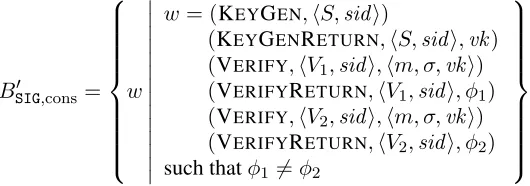
Lemma 5.12. (1)BSIG,cons=
w
w= (VERIFY,hV1,sidi,hm, σ,vki) (VERIFYRETURN,hV1,sidi, φ1) (VERIFY,hV2,sidi,hm, σ,vki) (VERIFYRETURN,hV2,sidi, φ2)
such thatφ1 6=φ2
,
and (2)BSIG,consis decidable in polynomial time.
Following the methodology in Section 4.2, by changing the judge decision condition φ1 6= φ2 inBSIG,cons
into its negation, i.e.,φ1 =φ2, we can similarly define the attack-fail languageASIG,cons. Note thatBSIG,consand
A4SIG,consare disjoint. We observe thatBSIGext,consis also decidable in polynomial time.
Step 3.We proceed next to define the canonical functionality that corresponds to the consistency property.
Definition 5.13(Canonical FunctionalityFcons). The functionality Fcons ∈ FSIG equalsFSIGsuppress,validate, where
(1)suppress()is the same as inFdum
SIG , and (2)validate(w) = 0if and only ifw∈BSIGext,cons.
The following corollary also follows fromTheorem 4.1:
Corollary 5.14. IfπΣ(SIG)realizes someF &Fcons, thenΣ(SIG)is consistent.
In the case of consistency, the other direction also holds:
Theorem 5.15. IfΣ(SIG)is consistent, thenπΣ(SIG)realizesFcons.
Remark 5.16. We first recall the definition of consistency as given in [Can04]. We call it “weak consistency” as it restricts the adversary by requiring honest key generation.
Definition 5.17. A schemeΣ(SIG) =hgen,sign,verifyiisweakly consistentif for all PPT attackersA,
Pr
(vk, sk)←gen(1λ); (m, σ)←Asign(vk,sk,·)(vk);
φ1←verify(vk, m, σ);φ2 ←verify(vk, m, σ) : φ1 6=φ2
≤negl(λ).
We now construct a counterexampleΣ0 which satisfies completeness, unforgeability and weak consistency as de-fined above, but in which the correspondingπΣ0does not realizeFSIGin [Can04] (or theFSIGthat is produced from
our translation methodology).
LetΣbe a scheme that satisfies completeness, unforgeability and weak consistency. We modify suchΣinto
Σ0: (1) prepend a bit b to the verification key; if b = 0 then the verification procedure remains the same; if b = 1then the verification procedure accepts its input message-signature pair with probability 1/2; (2) the key generation algorithm returns a verification key starting with bit0. Notice thatΣ0still satisfies the three properties, completeness, unforgeability and weak consistency, since the honest key generation will never return a verification key starting with bit 1. According to Theorem 2 in [Can04], the corresponding πΣ0 would realize FSIG. This,
5.1.4 The canonical ideal signature functionality
The (canonical) ideal signature functionalityFSIG = Fuf ∧ Fcomp∧ Fcons and is shown inFigure 4. In light of
Theorem 3.7we obtain the following:
Corollary 5.18. IfπΣ(SIG)realizes someF & Fuf ∧ Fcomp∧ Fcons, then the signature schemeΣ(SIG)satisfies
the game-based properties of unforgeability, completeness, and consistency.
Canonical Signature FunctionalityFSIG
Actions: KEYGEN,SIGN,VERIFY
Well-formedness(WFSIG): Any(SIGN,hS,sidi,·)symbol must be preceded by a(KEYGEN,hS,sidi)symbol.
Public and Secret Outputs(POSIG,SOSIG): For allw,a,POSIG(w,a) =, andSOSIG(w,a) =.
Suppress and Validate: (1) suppress() satisfies that for all x and any ACTION ∈ {KEYGEN,SIGN,VERIFY},
suppress((ACTION,P, x)) =x, (2)validate(w) = 1iffw6∈Bext
SIG,uf andw6∈B ext
SIG,compandw6∈BSIGext,cons.
Figure 4: Ideal functionality for digital signature based on the canonical functionality template.
5.1.5 Comparison to previous signature functionalities
Canonical functionalityFSIGfromFigure 4can be shown to be UC-equivalent to the digital signature ideal func-tionality given in [Can04]. This can be done by showing that the dummy protocol in theFSIG-hybrid world realizes unconditionallyFCan
SIG as well as the dummy protocol in theFSIGCan-hybrid world realizes unconditionally ourFSIG.
The proof requires the construction of two ideal world simulators, one that interacts with the ideal functionality
FSIG and simulates the view of any environment operating in theFCan
SIG hybrid world as well as a simulator that
interacts with the functionalityFCan
SIG and simulates the view of any environment that operates in theFSIGhybrid
world. The proof is similar to the proof of Proposition5.22, where we demonstrate that our canonical oblivious transfer ideal functionality is UC equivalent to that of [CLOS02]); we refer to that section for more details.
However, our canonical functionality capturing the consistency property as described above is derived from a game-based definition for consistency that isdifferentfrom the one in [Can04]. The reason is that the consistency formulation given there falls short of capturing the intended properties for the digital signature task in the UC setting. We elaborate on this issue below.
Recall that a first rendering ofFSIG[Can01] failed to capture the consistency property, as pointed out in [BH04].
The latter work, however, did not capture consistency fully either as was in turn pointed out in [Can04], which performed a thorough investigation between the correspondence of the game-based security formulation of the Goldwasseret al.[GMR88] notion for digital signatures and theFSIGideal functionality. Indeed, a correspondence
theorem was shown in [Can04] establishing that any digital signature scheme secure in the GMR sense would result in a UC-secure signature protocol.
However, as we now show with the help of our methodology, this correspondence does not stand. In fact, when one applies our translation methodology to the three game-based definitions that are put forth in [Can04] to capture the [GMR88] notion of security, the resulting functionality is not theFSIG functionality as defined above. This is due to the fact that the consistency game as defined in [Can04] (cf. page 12, Definition 1) assumes an honest key generation. More specifically, if our consistency game translation is applied to that game, it results in the following bad language (seeLemma 5.12):
BSIG0 ,cons =
w
w= (KEYGEN,hS,sidi)
(KEYGENRETURN,hS,sidi,vk) (VERIFY,hV1,sidi,hm, σ,vki) (VERIFYRETURN,hV1,sidi, φ1) (VERIFY,hV2,sidi,hm, σ,vki) (VERIFYRETURN,hV2,sidi, φ2)
such thatφ16=φ2
It follows that the corresponding canonical functionality F0
cons would have a validate predicate that checks for
verification inconsistencyonly in the casethat a KEYGENsymbol has been recorded in thehistoryof the function-ality. This is too restrictive as it precludes corrupted signers that may never register a KEYGEN symbol with the functionality (and in fact this is exactly the issue pointed out in [Can04] regarding the previous work of [BH04]).
It is easy to see that the resulting (weaker) canonical functionality FSIG0 = Fuf ∧ Fcomp∧ Fcons0 resides at
a lower point compared to FSIG in the FSIG lattice. This is due to the fact that BSIGext,cons ⊇ B0SIGext,cons where
BSIG0ext,cons is the extended bad language that corresponds to the bad language BSIG0 ,cons. Furthermore, as shown inRemark 5.16, it is possible to design a digital signature schemeΣ0 so that its corresponding protocol πΣ0
UC-realizesFSIG0 but fails to realizeFSIG. This scheme passes the game-based formulation in [Can04] and, based on
our methodology, it will UC-realizeFSIG0 ; nonetheless, FSIG will not be realized by this digital signature. As a
result, the appropriate formulation of the consistency game (from which we derive the languageBSIG,cons) is the one presented in Definition 5.11, and this provides the exact game-based correspondence to the FSIG canonical
functionality.
Finally, as mentioned inSection 3, the current formulation of our framework does not attempt to capture the “object-oriented insulation” of functionalities. Thus, in the case of signatures, the adversary is notified of the event of a signature generation and is capable of influencing the way the signatures are represented as strings. While this formulation is more general, see the treatment of signatures and discussions in [Can05,Pat05] about applica-tions where the locally run, “object” approach where the functionality does more than providing an authenticated message delivery service might be desired.
5.2 Oblivious transfer
We consider the 1-out-of-2 version of oblivious transfer [Rab81,EGL85,Cr´e87]. TheFOTfunctionality is defined
for two roles, the senderSand the receiverR. The actions, well-formedness, and public and secret outputs ofFOT
are given in Figure 5. We next describe the three constituent canonical functionalities of oblivious transfer that correspond to its three basic properties: correctness, sender privacy and receiver privacy.
5.2.1 Correctness
In order to obtain the bad language for correctness, we observe that for every two messages (m0, m1) from the
sender and every selection bitifrom the receiver, the value the receiver obtains should be equal tomi. Based on this, we identify the set of strings that are inconsistent with the correctness property as:
BOT,corr=
w
w=abcorbacwhere
a= (TRANSFER,hhS, R,sidi, Si,hm0, m1i),
b= (TRANSFER,hhS, R,sidi, Ri, i),
c= (TRANSFERRETURN,hhS, R,sidi, Ri, m0), such thatm0 6=mi
Following the methodology inSection 4.2, by changing the judge decision condition inBOT,corrinto its nega-tion, i.e.,m0 =mi, we can similarly define the “attack-fail” languageAOT,corr; note thatBOT,corrandA4OT,corrare
disjoint. We observe thatBOText,corris also decidable in polynomial time.
Definition 5.19(Canonical Functionality Fcorr). The functionality Fcorr ∈ FOT equals FOTsuppress,validate, where
(1) suppress()satisfies that for all x, suppress((TRANSFER,P, x)) = x, (i.e., the same as in Fdum
OT ), and (2)
validate(w) = 0if and only ifw∈BOText,corr.
5.2.2 Sender and receiver privacy