TABLE OF CONTENTS:
Vol. 41, No. 1, January 1988
ARTICLESImprovements
2 .( Response of false broomweed and associated berbeccous sue&s to fire by Herman S. 7’
Mayeux, Jr., and Wayne T. Hamilton
Coastal bermudagrass and Renner lovegrass fertiiiution reaponsee in a subtropical climate by Robert P. Wiedenfeld
12 16
Seasonal burning and mowing impacts on Sporobolus wrfgkti grussfan& by Jerry R. Cox Response of three shrub communities in southeastern Idaho to spring-appiied tebuthiuron by Robert B. Murray
22 Soil nitrogen accumuiation in fertilized pastures of tbe Southern Piahts by William A. Berg Plant Phvsiolnpv ---z---o,
26’
30
35
4Q
48 53
58
63 66
The effect of clipping on the growth and miserotoxin content of Columbia miikvetch by W. Majak, D.A. Quinton, H.E. Douwes, J.W. Hall, and A.D. Muir
Seedling competition between mountain rye, ‘Hycrest’crested wheatgrass, end downy brome by Robert A. Buman, Stephen B. Monsen, and Rollin H. Abernethy
Temperature requirements for mountain rye, ‘Hycrest’crested wheatgrass, end downy brome gennhtion by Robert A. Buman and Rollin H. Abernethy
Chemical composition of old world biuestem grassee as effected by cuitivar and maturity by S.M. Dabo, C.M. Taliaferro, S.W. Coleman, F.P. Horn, and P.L. Claypool
Germination requirements of fiameieaf sumac by G. Allen Rasmussen and Henry A. Wright Estabiisbment of winter versus spring aerial seedings of domestic grasses and iegumcs on logged sites by R.M. Brooke and F.B. Ho11
Comparison of water use by Artemisia tridentata spp. wyomingends and Chrysothamnus viscid#ikus spp. viscid#lorus by Richard F. Miller
Predicting biomess of five shrub species in northeastern Ceiifomia by Robin S. Vora Defoiiation impacts on coppicing browse species in northeast Brazil by L.H. Hardesty and T.W. Box
Animal Ecology
70 lnfiuence of hunting on movements of female mule deer by Roland C. Kufeld, David C. Bowden, and Donald L. Schrupp
Plant-Animal Interactions
73 Grazing of crested wheatgrass, with particular reference to effects of pasture size by R.B. Hacker, B.E. Norton, M.K. Owens, and D.O. Frye
78 Seaaonrl stocking of tobose mrnrged under continuous end rotation grazing by D.M. Anderson
Plant Ecology
83 Design of rein shelters for studying water reiations of rangeimnd shrubs by Pete W. Jacoby, R. James Ansley, and B.K. Lawrence
86 Aiieiopathic effects of sandbur leachate on switchgress germinetion: observations by W. Roder, S.S. Waller, and J.L. Stubbendieck
TECHNICAL NOTES
88 Seem biuebuncb wheatgraas es 8 competitor to medusaheed by Carl J. Goebel, Mohammed Tazi, and Grant A. Harris
96 Root containerization for physiological studies of shrubs and treee on rangeiand by R.J. Ansley, P.W. Jacoby, and B.K. Lawrence
Published bimonthly-January, March, May, July, September, November
Copyright 1988 by the Society for Range Manage- ment
lNDlVlDUALSUBSCRlPTlONisbymembershipin INSTITUTIONAL SUBSCRIPTIONS on a calendar year basis are $56.00 for the United States postpaid and the Society for Range Management.
LIBRARY or other $66.00 for other countries, post- paid. Payment from outside the United States should be remitted in US dollars by international money order or draft on a New York bank.
BUSINESS CORRESPONDENCE, concerning sub- scriptions, advertising, reprints, back issues, and related matters, should bs addressed to the Manag- ing Editor, 1839 York Street, Denver, Colo. 80206. EDITORIALCORRESPONDENCE,concemingmanu- scriptsorothereditorial matters, should beaddressed to the Editor, 1839 York Street 80206.
INSTRUCTIONS FOR AUTHORS appear on the inside back cover of each issue. A Style Manual is also available from the Society for Range Manage- ment at the above address eS1.25 for single copies; $1 .OO each for 2 or more.
THE JOURNAL OF RANGE MANAGEMENT (ISSN 0022-409X) is published six times yearly for $56.00 per year by the Society for Range Management, 1839 York Street, Denver, Cola. 80206. SECOND CLASS POSTAGE paid at Denver, Colo. POSTMASTER: Return antira Journal with address change-RETURN POSTAGE GUARANTEED-to Society for Range Management, 1839 York Street, Denver. Colo. 80206.
The Journal of Range Management serves as a forum for the presentation and discussion of facts, ideas, and philosophies pertaining to the study, management and use of range- lands and their several resources. Accord- ingly, all material published herein is signed and reflects the individual views of theauthors and is not necessarily an official position of the Society. Manuscripts from any source- nonmembers as well as members-are wel- come and will be given every consideration by the editors. Submissions need not be of a technical nature, but should be germane to the broad field of range management Editor- ial comment by an individual is also welcome and subject to acceptance by the editor, will be published as a “Viewpoint.”
BOOK REVIEWS
94 Conserving Soil. lnslgbts from Socioeconomic Research edited by Stephen B. Lovejoy and Ted L. Napier; Cattle in the Cold Desert by James A. Young and B. Abbott Sparks; Wlldllfe Conservation Evaluation edited by Michael B. Usher; C4 Gassea and Cereals by C. Allan Jones; International Savanna Symposlum 1984 edited by J.C. Tothill and J.J. Mott; Deer- Brush Relationships on the Rio Cnnde Plain, Texas by Jack M. Inglis, Bennett A. Brown, Craig A. McMahan, and Ronald E. Hood; Bill & Bev Beattyb WILD PLANT COOKBOOK by Bill & Bev Beatty; The Mushroom Manual by Lore& C. Pearson.
Managlng Edltor PETER V. JACKSON Ill
1839 York Street Denver, Colorado 80206 Edltor
PATRICIA G. SMITH
Society for Range Management 1839 York Street
Denver, Colorado 80206 Book Ravlaw Editor GRANT A. HARRIS
Forestry and Range Management Washington State University Pullman, Washington 99164-6410 ASSOCIATE EDITORS
G. FRED GIFFORD
Dept. of Range Wildlife, and Forestry University of Nevada
Rena, Nev. 89506 THOMAS A. HANLEY
Forestry Sciences Lab. Box 20909
Juneau, Alaska 99802 RICHARD H. HART
USDA-ARS 8400 Hildreth Rd. Cheyenne, Wyoming 82009 N. THOMPSON HOBBS
Colorado Div. of Wildlife 317 W. Prospect
Fort Collins, Colorado 80526 W.K. LAUENROTH
Department of Range Science Colorado State University Fort Collins, Colorado 80523 HOWARD MORTON
2000 E. Allen Road Tucson, Arizona 85719
BRUCE ROUNDY 325 Biological Sciences East Building, Univ. Arizona Tucson, AZ 65721 NEIL E. WEST
Range Science Department Utah State University UMC 52 Logan, Utah 84322
LARRY M. WHITE USDA ARS
S. Plains Range Research Station 2000 18th St.
Woodward, Oklahoma 73601 RICHARDS. WHITE
KSU Extension Center Colby, Kansas 67701 STEVE WHISENANT
401 Widtsoe Building Brigham Young Univ. Provo, Utah 64602 JAMES YOUNG
USDA ARS
Response of false broomweed and associated herbaceous
species to fire
HERMAN S. MAYEUX, JR, AND WAYNE T. HAMILTON
Folk cover of tbc &rub falee broomweed (Eflcanba uustro- texunu M.C. Jobndon) wu reduced 45 to 65% at the end of the,
first poet-burn growing seaeon end by an average of 2% at 4 ycere after controlled burning in August. F&e broomweed’r raponee to
February burne wee more variable, ranging from 36 to 77% cenopy reduction after tbe first growing eeeeon end 3 to 54% after 4 yeus. Burning in Auguet or Februery temporarily decree& standing crop of tbe meet common buncbgrauee, pi& pappusgraee (Pqp pophomm b&ofor Foum.) and whipleeb pappusgraee (P. -o-
a&urn Nees.), without influencing frequency of occurrence, lndl- eating that fire reduced vigor of tbeae graeees. Total end-of-season standing crop reflected reductiona in pappusgraea production. Fire tended to favor or bad no effect on other bunchgrasees, and gener- ally euppreaeed frequency and &n&g crop of undairable graesee such aa red grama (Eouteloua &#&&I Tburb.). Burning ln either seuon had little effect on common curlymesqulte [H&r& b&m- g& (Steud.) N-h).
Key Wordsr Erihmeda austrotex~ common curlymeequite, paPPWg==
Fire is as an economical method of suppressing woody species and enhancing forage availability and utilization. Controlled fire alone provides only temporary and partial suppression of the resprouting brush species characteristic of south Texas (Hamilton and Scifres 1982), but fire readily fits into brush management systems designed to provide long-term suppression of woody spe- cies (S&es 1980).
False broomweed (Ericameria austrotexana M.C. Johnston) is one of several small, multistemmed shrubs which interfere with forage production on grasslands interspersed within the brush on the Rio Grande Plains and adjacent Coastal Prairie. It resprouts readily after mechanical control treatments or other disturbance. False broomweed is not controlled by herbicides normally used on rangelands as sprays, but carrying capacity was almost doubled when the shrub was controlled with the non-selective herbicide glyphosate (N-phosphonomethyl glycine) (Mayeux et al. 1980). Aerial applications of picloram @amino-3,5,6_trichloropicolinic acid) and tebuthiuron {N-ES-( 1, ldimethylethyl) 1,3,4_thiadiaxol- 2-yll_N.N-dimethylurea} pellets were also effective (Mayeux and Chamrad 1982). Picloram reduced density of the dominant grass species, common curlymesquite [Hilaria berlangeri (Steud.) Nash], but had little effect on other components of the herbaceous vegeta- tion. Density of common curlymesquite increased substantially at the expense of annual and short-lived perennial grasses and forbs where tebuthiuron was applied for control of false broomweed (Mayeux and Chamrad 1982).
Fire has potential for use in management of rangeland domi- nated by other shrubs which are closely related to false broomweed and are also resistent to other control practices. Burning during winter in south Texas reduced density of common goldenweed [Isocoma coronopi$olia (Gray) Greene] by 33 to 44% and sup
Authors arc ran scientist, USDA, Agricultural Research Service, P.O. Box61 12, Temple, Texas 76 034112, and acnior lecturer, Texas Agricultural Ex F riment Sta- tion, Department of Range Science, Texas A&M University, College ,F tation 77843. This article is published with the approval of the Director, Texas Agricultural Ex
g
riment Station, as TA 22548.
eauthorsacknowlcdpthetechnicalassistanccprovidcd byR.A. CraneandT.R. Neidlinger. Acccsa to land and other as&stance was provided by Chester Kiefer. The research was partially funded by USDA, CSRS Special Grant 810-15-28.
Manuscript accepted 6 August 1987.
2
pressed canopy cover and height of survivors for 2 years (Mayeux and Hamilton 1983). Fire did not reduce density of the associated buffelgrass (Cenchrup ciliarb L.), but caused slight and temporary increases in standing crop. Burning during late winter removed 18 to 41% of the rayless goldenrod [Isocoma wrightii (Gray) Rydb.] plants growing on native rangeland in west Texas (Ueckert et al.
1983).
The objectives of this study were to evaluate the effectiveness of single controlled fires in summer and winter for suppression of false broomweed, and to assess the effects of fire on the composi- tion and productivity of associated herbaceous plants. Grasslands vary widely in the nature and extent of their response to fire (Vogl
1974, Wright and Bailey 1982), exhibiting responses similar to those caused by herbicides and mechanical treatments in some plant communities (Scifres 1980). An understanding of these responses is basic to the evaluation of fire as a brush management practice.
Methods Site Deecription
Experimental bums were conducted on a rolling hardland range site near Batesville, Texas, in the northwest comer of the Rio Grande Plains. The area is semiarid, with warm winters, extended periods of high temperatures in summer, and a growing season of about 280 days. Average annual rainfall is 52 cm, with most rains occurring in spring months. Little rainfall is recorded in summer, and herbaceous vegetation is often dormant in late summer. The site was grazed by cows and calves and occasionally by mohair goats at 1 AU/ 7 ha for 8 months from early spring to late fall until all grazing was excluded I year before the study was begun. Soils were saline Maverick clay loams (Ustollic Camborthids).
Scattered honey mesquite [Prosopis julifora var. glandulosa (Torr.) Cockerell], blackbrush acacia (Acacia rigid& Benth.), and spiny hackberry (Celtispallidk Torr.) occurred at the site, but the area was dominated by a mature stand of false broomweed which varied in density and foliir cover across the site. Herbaceous vegetation consisted of areas occupied by the stoloniferous, sod- forming shortgrass common curlymesquite interspersed within a midgrass community of warm-season perennial bunchgrasses. The more important and desirable of these were pink pappusgrass (Pappophorum bicolor Foum.), whiplash pappusgrass (P. mucro- nulatum Nets.), two-flower trichloris [Zkichlorti crinata (Lag.) Pa&i], Texas bristlegrass (Setaria texana Emery), white tridens [ Zkiokns albescens (Vasey) Woot. & Standl.], the introduced King Range bluestem (Andropogon ischaemum L. var. songaricus Rupr.), and Hall’s panicum (Panicum hallii Vasey var. hallii). Less valuable perennials included purple threeawn (Aristida purpurea Nutt.), red grama (Bouteloua trifida Thurb.), and whorled drop- seed [Sporobolw pyramidatus (Lam.) Hitch.]. Almost no annual or cool-season grasses were present. Forbs occurring on the site were smallhead sneezewead (Helenium microcephalum DC.), dog- weed [Dyssodia tenuiloba (DC.) Robins], purslanes (Portulaca oleracea L. and P. retusa Engelm.), a mat spurge (Euphorbia sp.), bundleflower (Desmanthus virgatus L.), globemallow (Sphaeral- tea sp.), wild petunia (Ruellia sp.), false ragweed (Parthenium confertum Gray), and prairie tea (Croton monanthogynus Michx.). Burning and Sampling Procedures
Headfires were applied to duplicate l-ha plots (92 by 110 m) in
Tabk 1. Weather amI fuel coaditlona duing controlkd burning of MUVC nn&nd dominated by fhke broomweed near Batavih Texas.
Relative Wind Soil water Fuel water Fuel load (k8/ ha) Air temp. humidity spe=J content1 content
Bum date (C) (%) (km/hr) (%) (%) Litter Standing Total
Aug. 1979 33 :; o-12 6-11 22 592 1782 2314
Feb. 1980 o-11 13-10 630 1622
Aug. 1981 :; 65 5-16 10-l 1 :: 552 3E 3842
Feb. 1982 31 20 13-U) 13-16 8 852 1556 2408
ISoil water contents arc averages of 6 samples from depths of 0 to IS and 30 to 45 cm, expressed on a dry weight basis.
the afternoon hours on 4 dates: 22 August 1979,l February 1980, 25 August 198 1, and 17 February 1982. Fire lanes were established to a width of 4 m with a motor grader. Separate plots were burned on each date, and each plot was burned only once. Bums were conducted during water stress-induced dormancy of herbaceous vegetation in late summer and during winter dormancy, just before the onset of growth of herbaceous species in early spring. False broomweed, a drought-resistant, evergreen shrub, remains physio- logically active in summer and winter.
Fine fuel loads were calculated from pre-bum determinations of herbaceous standing crop, as described later. Soil samples of 400 to 500 g each were collected from the upper 15 cm and at depths of 30 to 45 cm at 3 locations in each plot for gravimetric determination of water content just before burning. Samples of the fine fuel weigh- ing about 25 g were clipped at 5 locations in each plot. Soil and fine fuel were weighed before and after drying at 600 C and water content was calculated on the dry weight basis. Temperature sensi- tive pellets (‘Yempils”) were suspended at heights of 10 and 60 cm on steel posts at 2 locations in each plot to provide an estimate of maximum fire temperatures. Air temperature and relative humid- ity were recorded with a hygrothermograph, and wind speed was estimated with a ball-in-tube anemometer. A raingauge was main- tained about 1.5 km from the site,
Three sets of paired 30-m line transects were permanently estab- lished in each plot during the days preceding burning. Transect pairs were positioned by locating the first of each pair through a representative portion of the false broomweed stand, such that foliar interception of the shrub approached 509Z1. The second line was placed parallel and adjacent to the first, at a distance of 4 m. Foliar cover of false broomweed was recorded as live canopy interception along the first transect of each pair on the day before burning and again near the end of the growing season (August, September, or October) in each year for 4 years after burning. At the same times, standing crop by species and litter were harvested to a height of 1 cm from five l-m2 quadrats placed at points equally spaced along the second transect in each pair. Quadrats were rotated about the points annually so that the same herbaceous plants were not clipped repeatedly. Clipping samples and litter were oven dried, weighed, and converted to kg/ ha. Species present in the clipped quadrats were recorded so that changes in frequency of occurrence could be detected. Frequency and standing crop of herbaceous species were sampled in the same manner on an unburned plot during the course of the study.
Statfatieal
Analysa~
Foliar cover of false broomweed was analyzed as the percent decrease relative to the pre-burn cover. Data were subjected to analysis of variance with subsamples (transects) (Steel and Torrie 1980), by year after burning. Treatment effects were assigned to individual bum dates because of considerable variation in response to burns conducted in the same month of different years. The data were transformed to the arcsin of the square root prior to analysis, but transformation did not reduce the error mean square. Means were separated with Duncan’s multiple range test.
Responses of herbaceous species were compared to pre-bum conditions rather than the unburned because of inherent differen-
JOURNAL OF RANGE MANAGEMENT 41(l), January 1988
ces in species composition between plots burned in August and those not burned or burned in February. Data from the 2 burns in the same month of different years were pooled prior to analysis. Frequency of occurrence of major grasses by species and all forbs as a group in each year following burning was compared with that of the pre-bum evaluation with the chi-square test. Chi-square values for each year after burning, unadjusted for continuity, were totaled to provide a comparison of pre-bum frequency with that of the entire 4-year period following burning (Steel and Torrie 1980). Analyses of variance of standing crop were conducted by individ- ual species and groups of species, with the 5 quadrats associated with each transect summed to provide a single datum. The 3 transects in each replicate plot were considered subsamples. Treatment effects were assigned to month of burning, and post- bum evalutions were compared with the pre-bum standing crop with paired r-tests.
Resulta
and Discussion
Weather and fuel conditions varied widely on the 4 dates when bums were conducted (Table 1). Air temperatures were high dur- ing all bums except those applied in February 1980. Wind speeds were lower than desired in August 1979 and February 1980. Water content of the fine fuel was especially variable, ranging from only 7% in February 1982 to 33% in August 198 1. The deleterious effect of the high water content of the fine fuel in August 1981 was partially offset by a high fuel load. Only 992 kg/ ha of standing fuel was available in February 1980. Maximum fire temperatures indi- cated by the tempils were very low at 150” Cat 10 cm and 93” C at 60 cm because of the low fuel load and lack of steady winds in February 1980. However, all bums were relatively cool in compari- son with other controlled bums on the Rio Grande Plains (Stinson and Wright 1%9). Maximum temperatures at 10 cm during the other 3 bums were 260 to 3 16” C. At a height of 60 cm, tempera- .
turcs reached 3 16” C in August 198 1, but were only 150 to 2600 C in August 1979 and February 1982, depending upon location of the steel post supporting the tempils. Estimates of the proportion of plot areas burned were 90% or more in August 1979 and 1981 and between 80 and 90% in February 1980 and 1982.
Fake Broomweed Raponae
The reduction in foliar cover of false broomweed, relative to prebum foliar cover, varied from 77 to 36% at 1 year after treat-
Table 2. Percent decruae ia folkr cover of fake broomweed 1 to 4 yean
after controlled burning on four dater near Batavilk, Texn.
Year after burning’
Bum date 1 2 3 4
Aug. 1979 65b 45b 3lab 34b
Feb. 1980 77b 69c 61b
Aug. 1981 45a 42b 42ab z
Feb. 1982 36a 25a 24a 3a
‘Means within a column followed by the same letter do not diier significantly at the 95% level according to Duncan’s multiple range test.
ment (Table 2). Bum conditions such as fuel load and fiie tempera- tures were not reflected in the response of false broomweed. Season of burning appeared to have little influence on the effectiveness of fire for suppressing false broomweed; summer bums were not uniformly more effective, as has been demonstrated with other brush species (Scifres 1980). Decreases in foliar cover did not differ significantly 1 year after the August 1979 and February 1980 burns were applied, not did they differ significantly 1 year after.bums were applied in August 198 1 and February 1982. Bums applied in
1981 and 1982 were considerably less effective than those applied in 1979 and 1980, but no reason for this was apparent.
Resprouting and regrowth replaced foliar cover to some extent in plots burned on all dates during the second, third, and fourth growing seasons (Table 2). Reductions in foliar cover varied widely with bum date at the end of the fourth growing season. Less than half of the original topgrowth was replaced over the 4-year period in plots burned in February 1980, while false broomweed had almost completely recovered in plots burned in February 1982. The reduction in false broomweed folk cover was almost 30% after 4 years when averaged over all bum dates.
Frequency of Occurrenec of Herbaeeo~ Speciee
Frequency of the most common grasses in the unburned control was relatively uniform over the entire sampling period, 1979 to
1985 (data not shown). Few significant changes in frequency were apparent in the burned plots. Commonly curlymesquite was
Table 3. Frequency of occurrence (96) of major gram speciea end eU forbs
immedi8tely before (year 0) and 1 to 4 yeerr after controlled buming in Auguell979 end 1981 near Bateaville, Texae. Sums of the mudjuehd x*‘e ecrom ell yeus after burning are given for comparieon of frequency during tbeentirepost-burnperiodwiththe prebumfrquency.
Year after burninn’
SpXiCS 0 1 2 3 4 x2
Common curlymesquite Pappusgrasses Texas bristlegrass White tridens Two-flower trichloxis King Ranch bluestem Hall’s panicum Purple threeawn Red grama Whorled drop& Forbs
28 43 38 43 47 87 75 77 88 78 60 65 55 52 63 12 38. 18 18 22 15 22 25 15 22 9 13 13 12 15 7 23** 28** 18. 20. 13 12 17 22 17 35 13** 8** 7++ lo**
11.5* :: 19:6**
3.7 8.1 31.4”
7.4 45.6..
10.8* 2.5 IA single asterisk indicates that the post-bum frequency is signScantly different from the prebum frequency at the 95% level according to ,$. Two asterisks denote signifi- cance at the 99% kvel.
slightly but not significantly more frequent each year after burning in August (Table 3), although its initial frequency in plots burned in August was relatively low in comparison with those burned in February (Table 4) and in the unburned control. Although com- mon curlymesquite frequencies did not differ when individual years were compared with the August prebum sampling, the sum of &i-squares across post-treatment evaluations differed from the prebum frequency at the 5% level. Frequency of common curly- mesquite was less affected by burning in February.
Pink and whiplash pappusgrasses were encountered in about twice as many quadrats in plots burned in August (Table 3) as in plots burned in February (Table 4), before and after burning. Occurrence of pappusgrasses and most other midgrasses was not greatly affected by burning in either season. However, white trid- ens was considerably more abundant during the first growing season after burning in August (Table 3) and in the second and fourth growing seasons after burning in February (Table 4). Bum- ing in either month favored white tridens to some extent for at least 4 years. Frequency of Hall’s panicum more than doubled following
Table 4. Frequency of occurrence (%) of major gram specks end alI forba immedhtely before (yew 0) end 1 to 4 yeera after controlled burning in Febnky 1980 end 1982 near B&evUle, Teree. Sume of tbe wudjuded x*‘s l crom all yeur after burning are given for compuiaoa of frqueocy during tbe entire poet-burn period with the prebum frquency.
Year after burning*
Species 0 1 2 3 4 xz
Common curlymesquite 72 83 82 85 90 4.0 Pappusgrasses 42 38 48 42 57 2.9 Texas bristlegrass 48 57 37 22’ 32 15.4** White tridens 5 17 23’. 18 22’ 24.9** Two-flower trichloris 3 3 5 0 0 4.3 King Ranch bluestem 9 10 12 3 3 2.7
Hall’s panicum 12’ 5* 23 8*+
Purple threeawn z 10 :: 2:* 18 2:8 Red grama 28 10 10 8’ 7* 22.9** Whorled dropseed 13 13 10 12 10 0.7 Forbs 18 43*+ 58*+ 47’. 65** 81.3**
1 A single asterisk indicates that the post-bum frequency is signiticantlydiffennt from the erebum frequency at the 95% level according to the xf test. Two asterisks denote sigmficance at the 99% level.
August bums and slightly decreased after burning in February. Texas bristlegrass was less abundant at the end of the third growing season after burning in February.
Red grama, 1 of 3 perennial species of low forage value which were common on the site, responded negatively to burning in August or February. Purple threeawn was unaffected by burning in August. Burning in February decreased abundance of purple thceeawn during the first post-bum growing season, although this temporary decrease was not statistically sign&ant (Table 4). Abundance of whorled dropseed was slightly suppressed in all years after burning in August but not in February.
Frequency of occurrence of forbs was fairly uniform over time in plots burned in August (Table 3). Occurrence of forbs appeared to increase dramatically after burning in February (Table 4), but this response was attributed to the comparison of post-treatment samp ling at the end of the growing season, when forbs were common, to pre-treatment sampling in February, when many species of annual broadleafed plants were not in evidence.
St8nding Crop of Herb8ceous Species
Standing crop of grasses and forbs varied widely in the unburned area over the course of the study (Table 5). Standing crop of
Table 5. Oven-dry standing crop (kg/be) of prhcipal gruw ape&s, groupe of grueee, 811 forbe, and litter on tbe unburned plot on dates when controlled bume were sempled near BehwUk, Texu.
Sampling dates
Species or group Aug. Oct. Aug. Sept. Aug. Oct. Oct. 1979 1980 1981 1982 1983 1984 1985 Common curlymesquite 616 311 1010 437 222 608 514 Pappusgrasses 313 211 279 202 238 217 194 Texas bristlegrass 148 344 172 1% 126 151 54 White tridens 49 140 209 66 25 61 Two-flower trichloris 65 132 97 54 105 60 2: King Ranch bluestem 10 28 45 12 2 0 0 Hall’s panicum
All bunchgrasses 58: 85: 80: 3: 49: 48: 28: Purple threeawn 16 4 69 17 8 0 46 Red grama 146 129 126 229 97 56 16 Whorled dropseed 22 18 2 28 40 1 8 All minor grasses 184 151 198 349 146 60 61 All grasses 1386 1318 2011 1353 865 1157 856
All forbs 55 28 32 4 12 15 30
Litter 580 287 352 407 175 100 305
common curlymesquite was especially variable, ranging from a low of 222 kg/ha in 1983 to 1,010 kg/ha in 1981. No reason was apparent for the low standing crop in 1983, but other variation was probably attributed to timing and amounts of rainfall. For instance, end-of-season standing crop of common curlymesquite in 1980 was only 311 kg/ha, and total rainfall during the 1Zmonth period prior to sampling in 1980 was only 35 cm (Table 6), with almost no rain recorded from February to August. A total of 65 cm was recorded during the 12 months preceding sampling in 1981, when standing crop was highest. Rainfall was also well below normal in 1982, again with a total of 35 cm recorded in the 12 months prior to sampling in September.
Table 6. Cumulative reihii during tbe ltmonth period prior to sampiing controiied bumr near Beteeviiie, Texas.
1Zmonth period Nov. 1979 to Oct. 1980 Sep. 1980 to Aug. 1981 Oct. 1981 to Sep. 1982 Sep. 1982 to Aug. 1983 Nov. 1983 to Oct. 1984 Nov. 1984 to Oct. 1985
Rainfall (rrn) 35 65 35 50 23 54
Burning in August had little effect on standing crop of common curlymesquite when averaged across both summer bums (Table 7). A decrease in standing crop during the first growing season after burning was expected because of the drought conditions that pre- vailed after burning in August of 1979 and 198 1. Standing crop of common curlymesquite was low in the unburned control in 1980 (the first growing season after burning in 1979) and 1982 through
1983 (the tint and second growing seasons after burning in 1981) (Table 5).
Standing crop of pappusgrasses was suppressed by burning in August (Table 7). Pappusgrass production was reduced from 1,322 kg/ha before burning to only 342 kg/ha at the end of the first growing season. Pappusgrass standing crop partially recovered during the second and third growing seasons, but was again signifi- cantly lower than the prebum standing crop at 4 years after bum- ing, when rainfall was limited. Drought conditions during the fit
Table 7. Ovebdry standlag crop (kg/ha) 01 principal gram species, aii lorbe, and Utter immedieteiy before (year 0) end 1 to 4 years after controiied burning in August 1979 end 1981 near Batesviiie, Term.
Species or group Common curlymesquite Pappusgrasses Texas bristlegrass White tridens Two-flower trichloris King Ranch biuestem Hall’s panicum All bunchgrasses Purple threeawn Red gmma Whorled dropseed Ail minor grasses Ail grasses All forbs
Yaw after burning’
0 1 2 3 4
318 325 448 434 335 1322 342** 963 1048 500.’
529 338 315 426 161. 18 204+* 74. 57’ 45 84 18 2016 13 44 38 85 2419 91
52 60 86
66 80 49
20 59. 43 1022. 1551 1709 29’ 20 12 3’. lo** 3** 8** iI+* i** 40’ 41. 16’. 1387* 2040 2159
48 168 58
60. 50 145 14 799’ 12 7++ 9*+ 28’ 162* 38 1
Litter 572 102+* 285** 550 555
IA single asterisk indicates that the post-bum standing crop is significantly different from the prebum standing crop at the 95% level according to paired t-tests. Two asterisks denote @i!icance at the 99% level.
JOURNAL OF RANGE MANAGEMENT 41(l), January 1988 5
growing seasons after burning in August 1979 and 1981 may also have contributed to the temporary reduction in standing crop of this species. Standing crop of Texas bristlegrass was lower than the prebum level in each year after burning in August, but differences were not significant until the fourth year. Conversely, burning greatly promoted productivity of white tridens, especially in the first post-bum year, as observed with frequency of occurrence. Hall’s panicum was most productive in the second and third years after burning, while standing crop of two-flower trichloris and King Ranch bluestem remained unaffected. Standing crop of all bunchgrasses was about half that of the prebum standing crop at the end of the first and fourth growing seasons following August bums.
Although purple threeawn was no more frequent following August bums (Table 3), standing crop was significantly higher at 1 year and tended to be higher at 2 years after burning (Table 7). Standing crop of red grama and whorled dropseed was substan- tially reduced in each year following summer bums, as would be expected in view of the decreases in frequency. These responses were reflected in the total standing crop of the 3 undesirable bunchgrasses, which was reduced to half or less of the prebum standing crop in each year.
Total production of all grasses in plots burned in August fell from 2,419 kg/ha before burning to 1,387 kg/haabout 1 yearafter burning (Table 7), a significant decrease of over 1,000 kg/ha. Losses in the second and third years were about 400 and 300 kg/ ha, respectively. In each of these years, the decrease in total grass production relative to the prebum sampling was essentially equal to the decrease in standing crop of pappusgrasses.
Forb standing crop in plots burned in August was highly vari- able and apparently associated with rainfall. An average of 572 kg/ha of litter occurred on plots immediately before burning in August (Table 7). Almost all of this was consumed by the fires, and a total of 102 kg/ ha accumulated during the following growing season. Despite relatively poor growing conditions due to limited rainfall, only 3 years were required for litter accumulation to completely replace that harvested just before burning.
Burning in February had little effect on standing crop of com- mon curlymesquite (Table 8). Production of desirable bunch- grasses was much less on plots burned in February 1980 and 198 1 than on plots burned in August. In general, the responses of bunchgrasses to burning in February and August were similar. Standing crop of pappusgrasses was suppressed during the grow- ing season following burning, recovered during the second and
Table 8. Oven-dry stending crop (kg/be) of principai gmu species, l ii forbe, and litter immediately before (year 0) end 1 to 4 years after controlled burning in Febnuq 1980 l tul 1982 near Batewiiie, Teru.
Year after burning1
Species or group 0 1 2 3 4
Common curlymesquite 714 597 1066 850 694 Pappusgrasses 212 87* 287 212 Texas bristlegrass 150 106 135 42+* ‘&
White tridens 40 40 i12*+ 42 40
Two-flower trichloris 4 3 6 0 0 King Ranch bluestem 51 57 29. 6** 2** Hail’s panicum 15 27*
5;: 37:
2*
All bunchgrasses 472 320 236.
Purple threeawn 38 16*+ 18+* 22. 1 I**
Red grama 22 8** 8** 9.0 5*+
Whoried dropseed 6 5 2 1 6
All minor grasses 86 3i+* 4i** 48+* 23** All grasses 1262 948 1705 1272 953
All forbs 17 28 53** 30 40*
Litter 626 42** i83’* 527 552
IA single asterisk indicates that the post-bum standing crop is significantly different from the prebum standing crop at the 9S% level according to paired t-tests. Two
third growing seasons, and was again significantly less in the fourth year (Table 8).
Standing crop of purple threeawn and red grama was signifi- cantly less in all 4 years after burning in February. Total standing crop of these small, weak perennials was about half the prebum standing crop in the years after burning in February, as occurred after burning in August. Forbs appeared to be more productive after burning, but this response was probably caused by the com- parison of post-treatment samplings in August to the prebum sampling in February, as with frequency of occurrence. Species composition and productivity of forbs were probably unaffected by fire in either season, in contrast to reports of other research in south Texas (Box et al. 1967, Box and White 1969, Gordon and Scifres 1977). Standing crop of litter was replaced by the end of the third growing season after the February burns, as in plots burned in August, suggesting that burning could be repeated on these rolling hardland sites as often as every 3 or 4 years.
Standing crop of the less productive grasses such as red grama was decreased by fire, a response that is largely positive by virtue of their lack of importance as forage for livestock or food for wildlife. Substantial decreases in frequency of occurrence of red grama and whorled dropseed, especially after August burns, indicate that reductions in standing crop of these weak perennials occurred because individuals were killed by the fires and not replaced by establishment of new seedlings in subsequent years.
The reduction in standing crop of the predominant bunch- grasses, pink and whiplash pappusgrasses, must be viewed as a negative response. The loss in yield of these species was temporary, occurring in the first growing season after burning in February or August. The lack of comparable changes in frequency of occur- rence of pappusgrasses would suggest that decreases in standing crop were caused by low productivity of surviving plants, rather than a decrease in the number of individuals. Decreases in pappus- grasses standing crop in the fourth year paralleled decreases in standing crop of other species, and may have been caused by drought in those years. The confounding influence of continued protection from grazing and associated decadence of the herbace- ous plants may have become apparent at the later evaluation.
Conclusions
Although the reductions in foliar cover varied widely among bum dates, reductions in the shrub’s competitive potential of up to 5% after 4 years suggest that fire has value as a management practice for rangeland dominated by false broomweed. Reductions in foliar cover for several years appeared to be a result of mortality and a relatively slow rate of regrowth of plants surviving the fires. Mortality was not quantitatively determined, but visual observa- tions indicated that about one-third of the shrubs burned in 1979 and 1980 failed to resprout, while mortality in plots burned in 1981 and 1982 appeared to be less than a third.
Burning false broomweed-infested rangeland near Batesville in either season did not increase forage standing crop, but compari- sons of standing crop of individual species before and after burning suggest that fire altered the composition of the herbaceous stand- ing crop. The adverse effect of fire on pappusgras~, the most common and productive species on plots burned in August, caused substantial decreases in total standing crop of forage during the first growing season after treatment. The decrease in total produc- tion after burning in February was slight, but it might have been equal to that in August burns if pappusgrasses had contributed a larger proportion of the pre-bum standing crop. Plots burned in Feburary were dominated by the stoloniferous common curlymes- quite, which was neither damaged nor favored to an appreciable extent by fire, even when recovery was limited by inadequate rainfall.
Controlled or prescribed burning increased forage standing crop (Box et al. 1967, Box and White 1969, Gordon and Scifres 1977, Scifres and Kelley 1979) and improved species composition of the
grass component (Box and White 1969, Mutz et al. 1985, Scifres and Kelley 1979) in other research in south Texas, especially when bums were conducted in winter or early spring in years with adequate rainfall. Exceptions have been noted, such as the supres- sion of gulf cordgrass [Spurrim spurtinue (Trin.) Hitchc.] produc- tion following a bum in June (McAtee et al. 1979). However, these studies were conducted in the eastern Rio Grande Plains and Coastal Prairies, where average annual rainfall is higher, rainfall following burning is more dependable, and the herbaceous species differ from those of the northwestern Rio Grande Plains. Burning buffelgrass in late winter reduced production when followed by a dry spring and summer in the southwestern portion of the Rio Grande Plains, where average annual rainfall is 50 cm (Hamilton and Scifres 1982).
Fire may be more useful in management of false broomweed in the more mesic eastern portion of the Rio Grande Plains and
adjacent Coastal Prairies, where the shrub frequently occurs in dense stands. A bum applied in February 1979 near the Gulf coast, about 400 km southeast of the Batesville site, killed almost 50% of the false broomweeds and severely reduced foliar cover for several years.1 Fuel conditions created intense fires, with fine fuel loads ranging from 3,700 to 5,185 kg/ha. Grass standing crop was 15% greater and forb standing crop was 7 1% greater in the burned area than in an adjacent unburned area at the end of the first growing season after burning. Forage quality of grasses was also signifi- cantly higher during most of the 1979 growing season (Everitt and
Mayeux 1983). .
XJnpublishcd data
we~lac.0, TCX~S 78 P 96. rovidcd by J.H. Evcritt, USDA, Agricultural Research Service,
Literature Cited
Box, T.W., J. Powell, 8nd D.L. Dnwe. 1%7. Influence of fit8 on south Texas chaparral communities. Ecology 4gz955-961.
Box, T.W., 8nd R.S. Wldtc. 1969. Fall and winter burning of south Texas brush ranges. J. Range Manage. 22373-376.
Everitt, J.H., and H.S. Ibhyeux, Jr. 1#3. Nutritive contents of two grasses and one browse species following rangeland burning in south Texas. Southwest. Natur. 28242-244.
Gordon, R.A., 8nd CJ. Scifree. 1977. Burning for improvement of Macattncy rose-infested coastal prairie. Texas Agr. Exp. Sta. Bull. 1183. H8milton, W.T., mod C J. Scifree. 1982. Prescribed burning during winter
for maintenance of buffelgrass. J. Range Manage. 359-12.
M8yeux, H.S., Jr., 8tId A.D. Cimmnd. 1982. Response of false broom- weed (Ericamcria austrotexana) and associated herbaccous vegetation to pelleted herbicides. Weed Sci. 3k668-671.
M8yeux, H.S., Jr., 8nd W.T. H8milton. 1983. Response of common gol- denweed (Isocoma coronopifolia) and buffelgmss (Cenchrus ciliaris) to fire and soil-applied herbicides. Weed Sci. 31:355-360.
M8yeux, H.S., Jr., C J. Scifree, 8nd R.A. Cnnc. 1980. Ericamerfa austro- texana and associated range forage response to herbicides. Weed Sci. 28:602-606.
McAtee, J.W., C.J. Scilree, 8nd D.L. Dnwe. 1979. Improvement of gulf cordgmss range with burning or shredding. J. Range Manage. 32~372-375.
Mutz, J.L., T.G. Green, CJ. Se&e, 8nd B.H. Koertk. 1985. Response of Pan American balsamscale, soil, and livestock to prescribed burning. Texas Agr. Exp. Sta. Bull. 1492.
Scifree, C J. 1980. Brush management. Principles and practices for Texas 8ttd the Southwest. Texas A&M Univ. Press, College Station. Scifres, C J., 8Dd D.M. Keller. 1979. Range vegetation response to burning
thicketizcd live oak savannah. Texas Agr. Exp. Sta. Bull. 1246.
Steel, R&D., 8nd J.H. Torrie. 1980. Principles and procedures of statis- tics. McGraw-Hill Book Co.. New York. N.Y.
Stinlon, J.J., 8nd H.A. Wri&. 1969. Te&eraturcs of head firzs in the southern mixed prairie of Texas. J. Range Manage. 22~169-174. Ueckert, D.N., S.C. WMeen8nt, 8nd G.W Sultemcler. 1983. Control of
rayless goldenrod (Isocoma wrightii) with soil-applied herbicides. Weed Sci. 31:143-147.
Vogl, RJ. 1974. Effects of fire on grasslands. P. 139-194. In: T.T. Koz- lowski and C.E. Ahlgrcn, eds. Fire and Ecosystems. Academic Press, New York. N.Y.
Wright, H.A., 8nd A.W. B8iky. 1982. Fin ecology. United States and Southern Canada. John Wiley and Sons, new York, N.Y.
Coastal bermudagrass and Renner lovegrass fertilization
responses in a subtropical climate
ROBERT P. WIEDENFELD
AbStUCt
Forage production ia aubtroperrl redone uaully requirea festil- i&ion to meet pht nutrient neede. Thie study w8a conducted to determine the Influence of N 8od P 8ppUerrtion on yield response, nutrient uphke, 8nd 8ppucnt fertilixer 8nd wrta uee efficiency of 2 gr8seea on 8 rubtropic coorW prrlrie. Tre8tmente co&sting of Lctorrrl combin8tione of 0,112,8nd 224 kg N/b8 8nd 0, 15,8od 29 kg P/h8 were 8nmully rpplled to co8st8l bermud8gr8m (Cynodon diwtybn (L.) Pere.) 8nd Renner lovepur (EnyrarHs curvuh
(Scbud.) Nea) on 8 hit8 fine mnd (groemrenic p8lewhlf) in South Texu. Cuttinga were mrde 2 to 4 tima per year for 4 ye8rs. Soil s8mples t8ken 8anu8Ky 8nd pht ruaplee from each cutting were wlyxed for N md P concenhtion. Forllge yields by both gr86een hIprOVed dr8m8tially with N 8p@k8tiOll, but to 8 much
hser degree with P 8pplkation. WkUe yield8 were 8bo strongly dependent on r8inf8ll level, N subet8nt&Uy Improved fonge yield per unit of minf8ll recdved. Forage concentration ofbotb N and P incre8sed with incre8hg 8ppiiC8tiOO r8tes of uch nutrient. Appuent fertilher recovery fluctu8ted between ye8m, reflecting shnd 8ge rad r8inf8& however, fertihr rate bad no effect. None of tbe fertilizer N not removed in the forage could be found m inorganic N 8t the 0 to .3-m soil depth, wbik up to 20% of the P 8pp&d remrincd 8v8hbk in tbc rdl. Retwee~~ 65 iad so9b Of tbc ferther 8pplied wu not ueed by the fOr8ge gr8mee. htprOVemCnt8 in forage yield 8nd qu8lity with N 8nd P fertiliath justify their uee, even though inefficiency of fertilixer recovery urd use b subst8nti8l.
Key Worde: Cyncubn tibc@h, Eragroslh cuwuh, nitrogen, phaepbon&yie@8pp8rentfertukerrecovery,r8inf8nueeeffMency
Forage production from native rangeland and improved pas- tures is a major land use in dry, subtropical regions. Forage grasses constitute the primary crops on most of the mixed-brush rangeland in the southern Texas and northern Mexico resource area known as the Rio Grande Plain. Coastal bermudagrass (Cynodon drrc-
tylon (L.) Pers.) and ‘Renner’ weeping lovegrass (Erugrostis cur- vuh (Schrad.) Nets) arc subtropical grasses well adapted to sandy sites. Coastal bermudagrass is grown extensively throughout the southeastern United States. It is a stoloniferous, warm-season perennial with good yield and moderate forage quality. Renner lovegrass is a stiff perennial bunchgrass introduced from Africa. It is planted extensively in the southern United States for conserva- tion and forage. Lovegrass palatability to graxing animals is lower than that of many cultivated grasses, frequently giving low rates of gain (Holt and Dahymple 1979).
Subtropical conditions increase nutrient requirements by accel- erating nutrient cycling in the ecosystem (Russel et al. 1974), and subtropical soils arc typically infertile. Forage yields on sandy soils have shown good responses to applied N in Florida (Blue 1971, Wallace et al. 1955) and in southern Texas (Mutz and Drawe 1983, Wicdenfeld et al. 1985). Forage yield responses to P fertilization have occurred primarily as N becomes nonlimiting (Lorenz and
Author ia emxietc professor, Tcxe~ A&M Univ. Agr. Red. and Ext. Center, Wuleco. Texea 785%.
TbisstudybecontributionoftbcTexes Agr. Exp. Ste.,Texa~MM Ueiv.,Colkgc Station, TX 77843 and wee pertMy m~ppottcd by Mctz C Rep
Rio-& Products); Amcricen Agri-Services. Else (now Rio Ag %
Icr, Edinburg (now Products, Edinburg.
roducts); end Tiie Menuscript ecceptod 13 Auguet 1987.
JOURNAL OF RANGE MANAGEMENT 41 (l), January 1988 7
Rogler 1972, Wight 1976, Wight and Black 1979). Fertilization has been shown to increase soil water extraction by forages (Fairboum 1982, Thomas and Gscnbrug 1964, Wight and Black 1978) and to improve rainfall use efficiency (Wiedenfeld et al. 1985, Wight and Black 1979). Forage nutrient content in subtropical regions is typically low (Holt and Dahymple 1979, Gonzalez and Everett
1982) but increases with fertilization (Prine and Burton 1956, Wicdenfeld et al. 1985). Nutrient uptake by forages in drier sub- tropical environments has been shown to be affected by species (Impithuksa and Blue 1985) as well as by application rate and rainfall.
This study was conducted to determine the influence of N and P fertilization on yield response, nutrient uptake, and apparent fertil- izer and water use efficiency of 2 grasses established on a dry, subtropical coastal prairie. 3
Materials and Methods
A field study was initiated in the spring of 1980 in northern Willacy County of Texas on a Sarita fine sand (loamy, mixed, hypcrthcrmic Grossarenic Paleustalfs); a deep, gently undulating, welldrained soil with an average pH of 6.7 and less than 1% organic matter content. The area is semi-arid, averaging 68.6 cm of rainfall annually with peaks in May and August, and subtropical with an average growing season of 331 days. The study area was prepared by disking several times to remove native grass compcti- tion and to provide a good seed bed. Coastal bcrmudagrass sprigs were hand planted in one 0.2~ha area on 0.5-m centers. Renner lovegrass seed was broadcast on another 0.2-ha area at a rate of 2.24 kg/ ha and incorporated by rolling.
Plots 3.1 by 10.2 m were established on each area for annual fertilizer treatments consisting of 0,112, and 224 kg N/ ha and 0,15 and 29 kg P/ha combined in a factorial arrangements. The 9 treatments were replicated 4 times in a randomized complete block design for each grass. All fertilizers were applied broadcast, with P applied as a single application in the spring of each year as concentrated super phosphate (044-O), and N applied annually as ammonium nitrate (33-00) in 3 split applications (once in the spring and after each of the first 2 harvests). Rainfall received annually is shown in Table 1. Adequate rainfall was received in May 1980 (12.0 cm) to insure establishment of the coastal bcrmu- dagrass and germination of the lovegrass; however, during June and July only 2.3 cm of rainfall was received and neither grass grew adequately to permit a harvest. All of the P, but only one third of the N prescribed by the treatment plan were applied in 1980. In
Table 1. Annual rainldl received at the nhdy site in northern Willacy Cotmty of Texas.
Year
1980 1981 1982 1983 1984
Rainfall
1982, the third application of N was made in September even though there was no second harvest.
Prior to the fertilizer applications, soil samples were taken in the spring of each year from 1980 through 1985. In 1980, soil samples were taken from random spots throughout the area in depth increments of O-0.3, 0.34.6, and 0.6-0.9 m. Soil NOs=N was determined by using a salicylic-sulfuric acid calorimetric proce- dure on a CaClz extract. Soil P was determined by extracting with N&AC-HCl-EDTA at pH 4.2 then using the molybdenum blue calorimetric method (Jackson 1970). In subsequent years, one soil sample was taken from each plot to a depth of 0.3 m. These samples were analyzed for NH4+- and NOs=N content using KCl extraction and Kjeldahl distillation (Bremner l%S). Available soil P was extracted with NHdAc-HCl at pH 4.2 and then the molybdenum blue calorimetric method.
Yields were determined by harvesting all plots 1 to 3 times each year. A strip 1.0 by 8.2 m was cut from each plot using a flail-type harvester and samples were weighed to determine fresh weight. All remaining forage was removed with the harvester from each plot. Subsamples were dried at 600 C for 48 hr to convert fresh weights to a dry weight basis. The forage subsamples were then ground and analyzed for N and P content. Nitrogen was determined by a sulfuric-salicylic acid digestion and Kjeldahl distillation; and P was determined by a dry ashing then a vanadomolybdophosphoric yellow calorimetric method in a sulfuric acid system (Jackson
1970).
Soil analyses prior to the first fertilizer applications showed NOs--N levels averaged 9 ppm, and P levels were low to very lowi in the surface 0.3 m. Soil levels of both plant nutrients decreased with depth. Other plant nutrients were at levels (data not included) considered not limiting for plant growth.
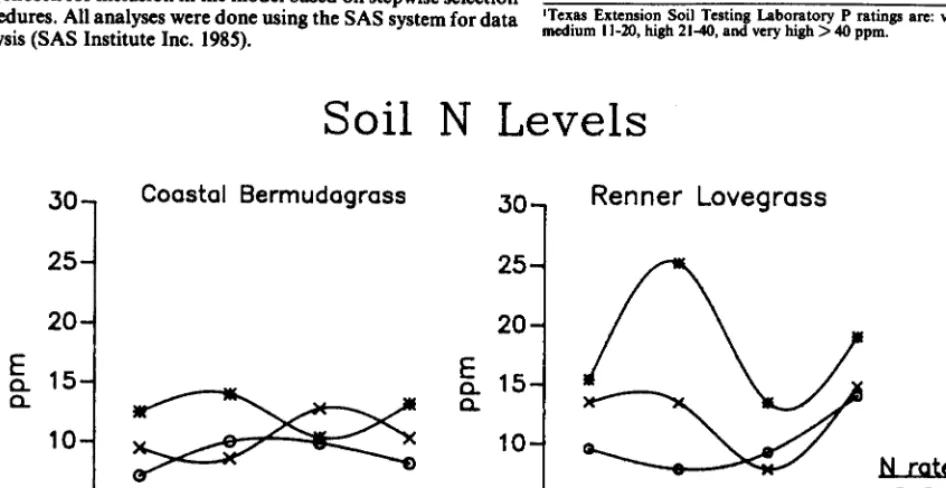
Increasing N application caused significant linear increases in total soil inorganic N (NH4+-N + NOS--N) for Renner lovegrass in 1982 and 1983, but only in 1985 for coastal bermudagrass (Fig. 1). Increases in inorganic soil N with N applied, and increased overall soil N levels were more likely following drier years and for the grass having lower N uptake. Such patterns were small in magnitude and duration, indicating no long-term trend in inorganic soil N.
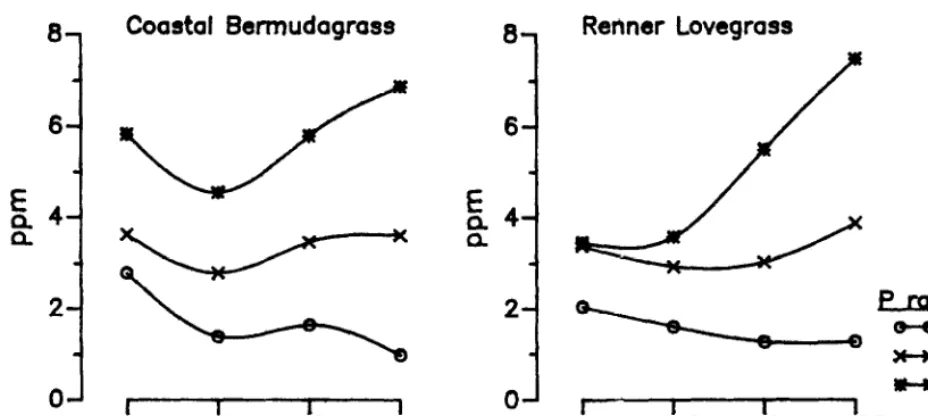
Soil P levels showed a significant linear relationship with P application rate for both grasses each year (Fig. 2). Furthermore, trends over the four-year period indicated that soil P was being depleted where No P was being applied, but remained constant where 15 kg P ha/ yr was being applied and accumulated when 29 kg P/ha/ yr was being applied. Nitrogen application affected soil P levels on both grasses in 1985, and N and P application had an interactive effect on soil P levels in 1982 on Renner lovegrass and in 1983 on coastal bermudagrass (data not shown), each case indicat- ing a decrease in soil P as N increased.
Yields and tissue nutrient concentrations were used to calculate total N and P removal in each harvest; then N, P, and dry matter yields were accumulated on an annual basis. Apparent fertilizer recovery was calculated as the amount of each nutrient in the forage harvested minus the amount removed from the check plot for that block where no fertilizer was applied, divided by the amount of nutrient applied in the fertilizer (Wiedenfeld et al. 1985). Data were analyzed statistically using response surface-type multiple linear regression models which included linear and quad- ratic elements for treatment main effects and also a linear cross- product term. Where model parameter estimates are given, factors were chosen for inclusion in the model based on stepwise selection procedures. All analyses were done using the SAS system for data analysis (SAS Institute Inc. 1985).
Forage yields in this study were affected by fertilizer application, rainfall received, and also by the chronological age of the grasses.
Response surface regression analyses showed forage yield responses to fertilizer application by both grasses over all years studied (Figs. 3 and 4). A positive parameter estimate for Nr in the equations for coastal bermudagrass 3 out of 4 years indicated increasing yield response per unit of N with increasing N rates. In the 2 years that the parameter for Nr was significant for Renner lovegrass yield, the value was negative and indicated a decreasing marginal benefit from N application. Yield responses indicated that coastal bermudagrass could have made efficient use of N rates above those established in this study, while lovegrass yield patterns suggest a less efficient use of N rates greater than those applied. A
‘Texas Extension Soil Testing Laboratory P ratings arc: very low O-5, low 6-10, medium I I-20, high 21-40, and very high > 40 ppm.
ry l 1 Irl- T
3011
1.
Levels30-
Coastal Bermudagrass
25-
20-
E
a
15-
a
lo-
5-
O-
I I I IResults and Discussion
19’82
19’83
19i34
19k5
Year
30
1
Renner
Lovegrass
25-
20-
5
15-
0.
10-
5-
OJ
H-M 224
1
g-85
Year
Fig. 1. Residual soil inorganic N (Hd+-N + NOgN) at O-O.3 m depth for 3 rates of Nfertiiizer application in previous years on 2 grasses.
Table 2. Fcrtiliution effects OII nutrient concentration of the forage gmsem at the different barvest dates.
1981 1982 1983 1984
Treatments ChSS 06123 10/06 12/ 18 06110 06129 09/15 12/08 06/10 12110
N rate (kg/ ha) 0 112 224 Significance’
0 112 224 Significance P rate (kg/ ha)
0 15 29 Significance
0 15 29 Significance
1Differences between means were non-significant (ns) or showed linear(L) or quadratic(Q) responses at the 5% (*), l%(**) or 0. I%***) level. Where significance is not shown, interactions occurred.
N concentration (%)
Coastal 1.94 0.66 1.06 0.82 1.08 0.82 0.86 1.15 0.89
bermudagrass 1.80 0.63 1.37 0.77 1.22 0.84 1.01 1.55 1.17
1.43 0.73 1.46 0.82 1.50 1.12 1.19 1.64 1.38
ns ns L*** ns L.** t-p+ L**+ Q l * L***
Renner 1.67 0.78 1.09 0.65 0.79 0.87 0.98 0.90
Lovegrass 1.69 0.77 I .27 0.72 8.: 0.97 1.03 1.19 1.18
1.45 0.85 1.54 0.84 1:10 1.18 1.14 1.36 1.36
ns - L.., L.S. L... Le.* L+** L**. L***
P concentration (%)
Coastal 0.08 0.08 0.09 0.07 0.08 0.09 0.10 0.10 0.07
bermudagrass 0.11 0.11 0.12 0.13 0.15 0.16 0.14 0.16 0.11
0.12 0.14 0.14 0.16 0.18 0.20 0.18 0.19 0.13
L+* L*** L**+ Le.* Q +* L... L*+* - -
Rcnner 0.08 0.08 0.09 0.07 0.06 0.09 0.09 0.07 0.07
Lovegrass 0.11 0.12 0.11 0.10 0.09 0.14 0.11 0.11 0.10
0.18 0.15 0.15 0.12 0.10 0.16 0.14 0.13 0.13
L*** L+‘* L*+* L’.. Q+ I_*** L.S. L... L*++
Table 3. Fertilization effects on total l nnud nutrient removd by 2 grmwa over 4 years.
Treatments N rate (kg/ ha)
0 112 224 Significance1 P rate (kg/ ha)
0 15 29 Significance N rate (kg/ ha)
0 112 224 Significance
1981
54.0 59.7 85.1 Lf**
4.21 6.86 9.14 L++*
5.64 6.24 8.33 I ,***
Coastal bermudagrass
1982 1983
9.2 43.2
18.9 87.8
37.5 143.7
Q’ L***
1.54 7.98
3.24 12.80
4.77 16.74
- L++*
1.45 7.86
3.03 13.09
5.08 16.57
- L..S
1984 1981
N removal (kg/ ha)
32.9 34.2
55.5 45.8
84.6 55.1
f_*** L***
P removal 3.91 (p/&a)
5.19 5:07
6.25 7.50
L+*+ L***
4.13 4.24
4.48 5.60
6.73 5.71
L... ns
Renner LovegraSs
1982 1983
11.2 63.4
31.2 115.9
47.1 121.7
L*** v**
2.55 7.16
4.02 12.09
5.21 14.18
l +*
L..’ Q
1.64 8.65
4.41 13.23
5.73 11.55
L... Q*
1984
32.7 52.7 63.1 I_++*
3.04 4.57 5.03 L**+
3.42 4.42 4.80 L+*+
lDiierenccs between means were nonsigificant (ns), or showed linear(L) or quadratic (Q) responses at the ST$*), I%(**) or O.lw***) level. Where significance is not shown, interactions occurred.
Table 4. Effects of N application on l ppuent N end P fertiker ose ef!iciency.
Cqastal bermudagrass Renner Lovegrass
Treatments 1981 1982 1983 1984 1981 1982 1983 1984
N rate (kg/ ha) N fertilizer use efficiency (%)
112 5.2 8.6 39.8 17.5 10.4 17.8 46.9 17.8
224 13.9 12.6 44.9 23.1 9.4 16.0 26.1 13.6
Significance1 ns l ns ns ns ns l * ns
N rate (kg/ ha) - P fertilizer use efficiency (%)
0 13.1 5.2 28.8 8.7 10.2 1.1 22.5 6.7
112 16.6 10.3 30.1 6.3 15.9 15.4 35.0 9.7
224 22.4 18.3 33.8 9.9 18.3 11.9 28.1 9.3
Significance ns L’S* ns ns ns Q’ ns ns
‘Differewes between mesas were nonsignificant (ns). or signitlcant at the 5%*), l%(**) or O.l%(***)level. For Pfertilizar usetieiency,significpnt responses were lincu~or qoadmtie (Q).