CONTRACT MANAGEMENT PRACTICES AND PERFORMANCE OF HOUSING CONSTRUCTION PROJECTS IN NAIROBI CITY COUNTY, KENYA: A CASE OF
NATIONAL CONSTRUCTION AUTHORITY
OCHOLA LOY SALOME D53/CTY/OL/24472/2014
A RESEARCH PROJECT SUBMITTED TO THE SCHOOL OF BUSINESS IN PARTIAL FULFILLMENT OF THE REQUIREMENTS FOR THE AWARD OF THE
DEGREE OF MASTER OF BUSINESS ADMINISTRATION (PROJECT MANAGEMENT)OF KENYATTA UNIVERSITY
DECLARATION
This research project is my original work and has not been submitted for a degree course or any other award in any other University. No part of this project should be reproduced without the authority of the author and/or Kenyatta University
Sign _______________________ Date _________________________ Loy Ochola
D53/CTY/OL/24472/2014
This research project has been submitted for examination with my approval as the appointed university supervisor.
For and on behalf of Kenyatta University
Signature ___________________ Date ________________________ Dr. Caleb Kirui
Department of Management Science School of Business
DEDICATION
ACKNOWLEDGEMENT
I would like to acknowledge my supervisor, Dr. Caleb Kirui, for his support and guidance.I would also like to acknowledge my entire family: My sisters and brotherfor their prayers, guidance, and support throughout the program. Thank you for believing in me.
TABLE OF CONTENTS
DECLARATION... ii
DEDICATION... iii
ACKNOWLEDGEMENT ... iv
LIST OF TABLES ... viii
LIST OF FIGURES ... ix
ABBREVIATIONS AND ACRONYMS ... x
OPERATIONAL DEFINITION OF TERMS ... xi
ABSTRACT ... xii
CHAPTER ONE: INTRODUCTION ... 1
1.1 Background of the Study ... 1
1.1.1 Performance of Projects ... 2
1.1.2 Contract Management Practices ... 4
1.1.3 Construction Industry in Kenya ... 6
1.2 Statement of the Problem ... 7
1.3 Objectives of the Study ... 8
1.3.1 General Objective ... 8
1.3.2 Specific Objectives ... 9
1.4 Research Questions ... 9
1.5 Significance of the Study ... 9
1.6 Scope of the Study ... 10
1.7 Limitations of the Study... 10
1.8 Organization of the Study ... 10
CHAPTER TWO: LITERATURE REVIEW ... 12
2.1 Introduction ... 12
2.2 Theoretical Review ... 12
2.2.1 Principal-Agency Theory ... 12
2.2.2 Project Management Competency Theory... 12
2.2.3 Public Interest Theory ... 13
2.2.4 Leadership Contingency Theory ... 14
2.3.1 Contract Management and Performance of Construction Projects ... 15
2.3.2 Contractor Pre-qualification Practices and Performance ... 16
2.3.3 Contractor Regulation Practices and Performance ... 17
2.3.3 Contract Supervision Practices ... 18
2.3.4 Sub- Contracting Practices and Performance ... 19
2.4 Summary of Literature Review and Gaps ... 21
2.5 Conceptual Framework ... 23
CHAPTER THREE: RESEARCH METHODOLOGY ... 24
3.1 Introduction ... 24
3.2 Research Design... 24
3.3 Target Population ... 24
3.4 Sampling Techniques and Sample Size ... 24
3.5 Data Collection Instruments ... 25
3.6 Data Collection Procedure ... 25
3.7 Pilot Study ... 25
3.7.1 Validity of the Instruments ... 25
3.7.2 Reliability of the Instruments... 26
3.8 Data Analysis and Presentation ... 27
3.9 Ethical Practices ... 27
CHAPTER FOUR: RESEARCH FINDINGS AND DISCUSSION ... 29
4.1 Introduction ... 29
4.2 Response Rate ... 29
4.3 Background Information ... 29
4.3.1 Gender ... 29
4.3.2 Work Experience ... 30
4.3.3 Level of Education ... 31
4.4 Descriptive Statistics ... 32
4.4.1 Contractor Pre-qualification Practices ... 32
4.4.2 Contractor Regulation Practices ... 34
4.4.3 Contractor Supervision Practices ... 35
4.4.5 Performance of Housing Construction Projects ... 39
4.5 Inferential Statistics ... 40
4.5.1 Correlation Analysis ... 40
4.5.2 Regression Analysis ... 41
4.5.3 Analysis of Variance (ANOVA) ... 42
4.5.4 Coefficient Determination ... 43
CHAPTER FIVE: SUMMARY, CONCLUSIONS AND RECOMMENDATIONS ... 45
5.1 Introduction ... 45
5.2 Summary of Findings ... 45
5.3 Conclusions ... 46
5.4 Recommendations ... 47
5.5 Suggestion for Further Research ... 48
REFERENCES ... 49
APPENDICES ... 54
Appendix I:Letter of Introduction ... 54
Appendix II: Questionnaire ... 55
Appendix III: University Approval Letter ... 59
Appendix IV: Research Permit ... 60
LIST OF TABLES
Table 2.1: Summary of Gaps ... 21
Table 3.1: Target Population... 24
Table 3.2: Reliability Test Results ... 26
Table 4.1: Response Rate ... 29
Table 4.2: Respondents’ Work Experience ... 30
Table 4.3: Contractor Pre-qualification Practices ... 32
Table 4.4: Contractor Regulation Practices ... 34
Table 4.5: Contractor Supervision Practices ... 36
Table 4.6: Sub-contracting Practices ... 37
Table 4.7: Performance of Construction Housing Projects ... 39
Table 4.8: Correlation Analysis ... 40
Table 4.9: Model Summary ... 41
Table 4.10: Analysis of Variance... 42
LIST OF FIGURES
ABBREVIATIONS AND ACRONYMS AAK: Architectural Association of Kenya
C.V.I: Content validity Index
G.O.K: Government of Kenya
GNP: Gross National Product
NACOSTI: National Council for Science and Technology NCA: National Construction Authority of Kenya NEMA: National Environment Management Authority SPSS: Statistical Package for Social Sciences
MTIF: Ministry of Transport and Infrastructure
OPERATIONAL DEFINITION OF TERMS
Contract Management Practices: Refers to all the activities done by NCA to ensure that all contractors undertake their duties in the house construction industry to the satisfaction and according to all the set standards in the construction industry
Contractor Pre-qualification Practices: Refers to all screening activities undertaken by NCA to ensure that only competent and qualified contractors undertake construction of houses
Contractor Regulation Practices: Refers actions taken by NCA to ensure discipline, ethics and compliance to policies and laws by contractors in the construction industry
Contractor Sub-Contracting Practices: Refers to the act of the NCA engaging other contractors to undertake whole or some of the work they were initially contracted to do and the considerations considered in doing so
Contractor Supervision Activities: Refer to activities undertaken by NCA and procuring entities to ensure that houses are constructed in strict adherence to industry standards on personnel qualification, materials and building technology
ABSTRACT
CHAPTER ONE: INTRODUCTION 1.1Background of the Study
Construction is a critical industry for all societies across the world. When the construction industry is examined from a global context, its socio-economic significance becomes obvious. Construction industry performs a prime function in improvement and success the objectives of society. Construction is one of the biggest industries and contributes to approximately ten percent of the Gross Domestic Product (GDP) in industrialized countries. Generally, the industry contributes to eleven percent of GDP in the majority of developing nations (Giang & Pheng, 2010).
The need and demand for housing is on an ever increasing trajectory. UN-Habitat (2010) reported that the urban population is rapidly increasing, especially in the developing world, and thus national governments are challenged with the major task of providing decent accommodation for their people. For instance, UN-Habitat (2013) reveals that the world’s city populace in 2011 was 3.63 billion citizens, equivalent to 52.1percent of the sector’s general populace; this figure will amount to 6.25 billion citizens by 2050 and will make up 67.2percent of the global population. In developing nations, 5.12 billion citizens are expected occupy urban centres by the year 2050. Kenya has a deficit as far as housing of its population is concerned. The estimated housing demand in urban areas is approximately 150,000 units per year yet the current supply is about 30,000 units (HASS, 2013)
Apart from the shortage of housing units, other challenges facing housing construction projects include failure of started housing projects, poor quality of housing projects and non-completion of houses which is rampant. Non-completion and underperformance in contracted construction projects is a global phenomenon that has attracted the attention of researchers, scholars and industry players. A study Aberdeen Group (2013) - a research and consultancy firm in the energy sector in the United Kingdom- suggest that there is a good sized loss of money because of ineffective management of project contracts. The study found out that enterprises lose US$153 billion each year due to ineffective project contract management.
There are many causes of the failures of housing projects. A study done by Fapohunda and Stephenson(2010) in UK found that in construction,disagreement exists between the projects stated objectives with respect cost, time and value. In Ghana, Ofori (2012) diagnosed 5 elements as the critical reasons of delays to initiatives. They embody month-to-month rate problems to contractors, terrible contract management, material procurement issues, and horrific technical performance and fabric rate escalations. Terrible professional management, fluctuation of costs, developing price of substances and negative web page manage have moreover been diagnosed as factors contributing to undertaking not being complete on time.
There is evidence that the performance of contracted construction in Kenya is poor. One study established that over 70percent of the projects initiated are likely to escalate with time and costs (Nyangilo, 2012). This has been justified through research in the Kenya’s construction enterprise that have made findings to the impact that value overrun, not on time of completion duration, conflicts in the complex vendor relationship, poor agreement control practices, extortion and corruption, awful risk mitigation and awful best work are the norm instead of exception in the task of contracted creation tasks (Kibuchi & Muchungu, 2012; Lepartobiko, 2012; Chuah et al., 2010). That is the motivation of undertaking this study.
1.1.1 Performance of Projects
authors also note that project participants, adequate schedule and adequate cost estimating and budget contribute to a project being successfully implemented relative to completing the grant scope within budget, on schedule, and meeting quality requirements.
There are many definitions of a project. According to Cho and Gibson (2011) define project as a chain of duties or events desired to attain a precise objective within specific technical specifications, in a distinct start and end, and with respect to grant confines and useful resource availability. Similarly, Nogeste and Walker (2013) define a project as a unique procedure, which include a fixed of co-coordinated and controlled events with a start and an end, undertaken to reap an objective conforming to unique necessities, along with constraints of time, value and assets.
The success of any project according to Ashley et al (2012)is fairly depending on its finishing time from start to the delivery of results. This has a proper away referring to management selections which include budgets, goals and standards. The whole project is made from complex series of movements that combine capabilities and know-how to produce a precious end result. A fully completed project has been defined because the extent of success of high quality try or project which pertains to the prescribed goals or dreams that form the venture parameters. It’s the crowning glory of the project goal that allows achieving the preferred overall performance signs in three key regions: scope, schedule and finances(Amin, 2011).
According to Akintoye and Takim (2002) project completion enables the evaluation of seven undertaking performance signs, specifically: construction cost, creation time, value predictability, time predictability, defects, client satisfaction with the product and patron pleasure with the service; and 3 enterprise performance indicators, particularly: protection, profitability and productivity. That is compounded by the fact that projects in the construction enterprise have complexity in their nature because they consists of a large wide variety of events inclusive of customers, contractors, experts, stakeholders, shareholders, regulators and be afflicted by many problems and complicated troubles in performance, along with cost, time and protection (Shaban, 2008).
construction project. The fundamental demanding situations impeding crowning glory of projects can be resolved through the usage of effective settlement control due to the fact they may be basically human, substances and logistics trinity.
1.1.2 Contract Management Practices
There are many definitions of contract management because of the breadth of the activities involved. Contract management consists of negotiating about terms and situations in contracts, adhering to compliance and documentation ofarising deviation that might happen during project implementation process. It is able to be summarized as the procedure of systematically and effectively dealing with settlement introduction, execution, and assessment for the principle of maximum utilization of financial and operational performance and risk minimization (Bhardwaj,2011).Some other definition of settlement control is the technique that guarantees that all events to a contract fully meet their responsibilities, so that it will fulfill the operational objectives of the settlement and the strategic enterprise dreams of the client (Van Weele& Vander Puil, 2013).
The reasons for contract management are many, varied and sometimes inevitable especially in the construction industry. It is a regular practice for corporations to involve contractors or suppliers in a single manner or some other to help in presenting service or product to satisfy its supposed requirements in some form of contracts that require being controlled. Adoption of outsourcing and subsequent contract control events were intended to permit effective service delivery which refers to generating work that is of excessive great and diagnosed as proficient(Akintoye & MacLeod, 2014).
Simon (2015) observe that regulatory framework in which regulators challenge firms to improve based on constructive and active engagement can be effective in ensuring compliance before a serious problem emerges and regulatory framework governing the construction industry could seek legal capacity to prosecute errant developers. The author further observes that the composition of the regulatory framework that governs the Kenyan construction industry should include specialized bodies mandated to champion for regulations in order to streamline the building industry.
Robert (2016) indicates that contractor supervision is the least glamorous part of project work, but in several respects it is the most important. It is an exercise in collective problem solving, and as such, is one of the most effective ways of ensuring project success. Construction supervision is aimed at ensuring that a high standard of supervision of building project is systematically carried out by the project parties diligently throughout the construction period. According to Mastrandera (2016) construction supervision is therefore a continuous, participatory process as opposite to traditional supervisory visits which focus more on inspection and fault finding rather than on problem solving to improve performance.
Sturts and Schunk (2017) indicates that contractor subcontracting allow the subcontractor to be less vulnerable to fluctuation in business, have more flexibility in workforce coordination, and be able to reduce cost of management. According to Shimizu and Cardoso (2012) construction mismanagement might start with a single subcontractor, and cascade through the work force chain to affect the schedule and leading to damages to multiple parties. Therefore, issues in subcontractor should not be overlooked in defeating the challenge of achieving planned budget, cost and schedule.
1.1.3 Construction Industry in Kenya
The collapse of buildings in Kenya has been on the rise killing many people. For example, a building was ordered to be demolished on 8th November 2013 when it nearly collapsed in Mombasa. Secondly, several people were feared to have died after a four storey building under construction came tumbling down at Spaki in Mombasa on Thursday 9th April 2013. Moreover, in Nairobi several cases have been reported like the infamous Kahonge building in river road which collapsed on 26th January 2014, another one in Kiambu in October 2015, in July 2015 in pipeline estate in Nairobi’s Embakasi a 6 storey building was halted and 14 people trapped, June 2011, The Langata Building near Carnivore restaurant along the bypass collapsed (NCA, 2016). The construction industry in Kenya is one of the key drivers of growth in the Kenyan economy. Indeed Kenya’s vision 2030 has identified infrastructure development as one of the key enablers that will drive this country to become worldwide competitive and wealthy country with a high satisfactory of life by 2030. According to the Economic Survey of 2013, the industry accounts for about 7percent of the country’s national income and absorbs about 1 million people with apredictableyearly wage bill of Sh 3.2 Billion. Construction is a critical component towards attainment of Kenya’s sustainable economic growth and development. The industry has thus continued to make valuable contributions in transforming Kenya it a regional business hub. Many public and private infrastructure projects vital for the long term development of Kenya are being constructed thus spurring the growth of the Kenya’s economy.
The studies investigated a myriad of factors but hardly on contract management. Were and Ngugi (2015) investigated the influence of technology on the performance of construction projects in Nairobi County. The study established that many projects do not succeed due to failure to utilize the suitable project management software to administer the budget, schedule, project activities and labour. Mungeria (2012) investigated the use of teamwork in construction projects and found out that teamwork has a strong, positive and statistically significant effect on the performance of construction projects.
of Nairobi had a regulatory regime in place and that they had a code of conduct for all the professionals involved in construction projects. However, they identified that the compliance levels remain unclear.
Mbugua (2014) investigated the causes of failure in buildings in Nairobi and seemed to exonerate professionals in the construction industry from culpability in the cases of massive failures of construction projects in Nairobi. It was found out that most challenges local contractors face were caused by factors which are not within their control. The challenges included delayed payment by clients, suppliers default, government, delayed instructions by the architect and lack of sufficient involvement by structural engineers and quantity surveyors. Kihoro (2015) on the factors affecting the performance of construction of gated communities in Nairobi found a strong positive association linking project preparation, stakeholder management, competence of project team and performance of the project.
In Kenya, the construction practice is implemented by a range of professionals of variededucation and expertise, namely: Land Surveyors, Project Managers, Architects and designers, Quantity Surveyors, Engineers, Contractors, Builders, Estate and marketing agents and Facility Managers (Buildafrique Consulting Limited, 2011).The National Construction Authority Act was assented to on 2nd December 2011. It was formed with the aim of overseeing the construction industry and coordinating its development. The authority was established whilst the industry was beneath amazing stress to counter numerous challenges, especially the ones relating best warranty. There is an urgent need to streamline the construction industry as a way to develop Kenya’s economic system.
1.2 Statement of the Problem
of America (2014), most of the cases are in low income neighborhoods where there is little or no inspection. According to Transparency International (2014), contractors and owners of the buildings bribe the inspection unit of the Nairobi City County Government to bypass the inspection process. Endemic corruption and poor reporting structures have also been faulted (DFID, 2013).
Ministry of Transport and Infrastructure Development (MTID) reports on collapsed structures apportions the blame to lack of proper supervision and poor construction procedures (MTID, 2016). Other challenges cited ranging from loopholes in contractors registration, irregularities in contracts award, unprecedented project failures, lack of capital and corruption in the building sector among others (National Construction Authority, 2011). The unexplained pattern of massive failure of housing construction projects has resulted to a number of questions.
Contract management practices have been investigated and confirmed as one of the causes of failure in construction projects. The studies have found that conflicts in the complicated seller association, terrible contract management practices, extortion and bribery, bad risk mitigation and negative first-class work are the norm as opposed to exception within the task of gotten smaller construction tasks (Kibuchi & Muchungu, 2012; Cleland and Bidanda, 2009; Lepartobiko, 2012; Chuah et al., 2010). Kibuchi and Muchungu (2012) observed that notwithstanding high education levels of experts within the building industry in Kenya and regulation of the enterprise in essential urban regions, production initiatives do now not continually meet their objectives. This is manifested by using countless tasks which have value overruns, behind schedule duration and low standards resulting to collapsed buildings in numerous parts of the country, high upkeep costs, disillusioned clients or even homes which are not functional.There is hardly any study investigating contract management practices in the housing construction industry. This is the research gap that this study sought to fill and generate knowledge on the gaps in contracting practices that has resulted in noticeable failure in performance of housing projects in Nairobi County.
1.3 Objectives of the Study 1.3.1 General Objective
1.3.2 Specific Objectives
i. To investigate the effects of pre-qualification practices on the performance of housing construction projects in National Construction Authority.
ii. To assess the effect of regulations practices on the performance of housing construction projects in National Construction Authority
iii. To find out the effect of supervision practices on the performance of housing construction projects in National Construction Authority
iv. To determine the effects of sub- contracting practices on the performance of housing construction projects in National Construction Authority
1.4 Research Questions
i. How do pre-qualification practices affect the performance of housing construction projects in National Construction Authority?
ii. What are the effects of regulation practices on the performance of housing construction projects in National Construction Authority?
iii. What are the effects of supervision practices on the performance of housing construction projects in National Construction Authority?
iv. How does sub-contracting practices affect the performance of housing construction projects inNational Construction Authority?
1.5 Significance of the Study
1.6 Scope of the Study
The study was carried out inNational Construction Authority (NCA) in the county of Nairobi. The respondents wereengineers in the departments that regulate construction projects in NCA. The study usedquestionnaires as data collection instrument. The scope of investigating the contract management practices was limited to the study variables of pre-qualification practices, contract regulation practices, contract supervision practices and sub-contracting practices. Other contract management practices were not studied. The study focused on the performance of housing projects for the last 5 years (2012-2016).
1.7 Limitations of the Study
The study met several limitationsparticularly in the data collection phase. The respondents were reluctant to offer some critical information that they consider as an indictment to their work and fear negative reprisals by participating in the study. They were guaranteed of the discretion of the information they expose. Further assurances were made that the study would only be used for academic purposes only. Letters of authorization to collect data from the university and National Council for Science and Technology (NACOSTI) were used to persuade them to participate in the study as well as verbal persuasion on the same. The respondents could be too busy to fill in the questionnaire in a single sitting and to surmount this challenge the study adopted drop and pick method of data collection to ensure a high response rate. The respondents of the study were likely to be working in the field in different part of the city making data collection a laborious task.
1.8 Organization of the Study
CHAPTER TWO: LITERATURE REVIEW 2.1 Introduction
This chapter contains a review of theoretical and empirical literature on the study variable. It also contains a conceptual framework graphically showing the relationship between study variables. It is organized as follows;
2.2 Theoretical Review
The study will be guided by the following theories; 2.2.1 Principal-Agency Theory
The regulator and the contractors undertake their mandate on behalf of the people and thus the relevance of the principal- agency theory with the public as the principal and the actors in the construction industry as the agents. According to Oluka and Basheka (2012)the underlying principle of the major-enterprise concept is that there ought to be a clean know-how of the desires of the most important and potential of the agent to meet those desires adequately. Main need to carefully monitor marketers’ performance; create praise structures that strengthen favored overall performance.
Whilst a procurement agreement is nicely defined and deliberate, the predominant and marketers locate it clean to meet desires of each other in an green way ensuing into well timed execution of the agreement (Oluka & Basheka, 2012). The theory is crucial to the study as it highlights the need for robust settlement necessities and specs as well as the objectively system of monitoring contractors’ standard overall performance. The theory also is relevant to the study in establishing the quantity the regulators and contractors act on public hobby and the issues inflicting the breaches of foremost corporation dating. The theory will guide in evaluating the activities of the National Construction Authority as the agent of the people of Kenya in supervising and regulating contractors. This theory explains sub- contracting practices variable.
2.2.2 Project Management Competency Theory
universal, but, as encompassing information, capabilities, attitudes and behaviors which are causally related to advanced process overall performance.
Crawford and Bryce (2013) said that professional competence in task control is attained by using mixture of knowledge received from education and its next utility and other capabilities evolved inside the course of labor. Previous management studies have investigated the impact of competency on performance. Smith et al (2009) have argued for a competency based performance model for construction project managers in which managerial conduct enter is appraised and 9 overall performance signs for PM competency are developed to include group constructing, management, selection-making, mutuality and approachability, honesty and integrity, communication, education, know-how and application, self-efficacy, and protection of outside relations. In the context of construction project management; it is assumed that if the project manager and the project team have all the required competence for the work then the project implementation will be successful.
This theory will guide the study in establishing competency in all areas of contracting including pre-qualification, regulation, supervision and pre-qualification. The project management competency theory will guide the study in establishing if the contract management practices are done in favour of public good or self-interest of the players involved. More so the pre-qualification of contractors and sub-contracting that is done without much public participation or involvement of the procuring entities. This theory explains the contractor pre-qualification practices variable.
2.2.3 Public Interest Theory
theory of regulatory capture. Whilst the predator's authority is critical, it isn't always decisive. The general public's interest may be and is maintained in lots of states.
A third conclusion which can be drawn concerns the protection of the public interest. We now have some initial evidence which presents an explanation as to why the public interest is in some cases included, even when it is in direct war with the interests of an industry or professional group. What the evidence suggests is that it isn't always the compassion of the legislator which yields this result. To the contrary, it is the self-pastimes of the legislator and the motivation to shield the ones self-hobbies which results in this end result, in particular when the public's awareness and voting participation are high (Schubert, 2009).
Estlund et al. (2009) show that the exchange of products and production factors in markets assumes the definition, allocation and announcement of character assets rights and freedom to contract. The assurance of property rights and any critical enforcement of agreement compliance can be greater successfully prepared collectively than for my part. Furthermore, the prices of marketplace transactions are decreased via manner of assets and settlement regulation. The liberty to agreement can, however, additionally be used to advantage cooperation amongst occasions against market operation. Agreements amongst producers deliver upward push to prices deviating from the marginal fees and an inefficient amount of products is located in the marketplace.
This theory on public interest will guide in establishing if the technical bits of contract management practices are in sync with the public interest requirement as captured in the existing statutes, policies and code of conduct of the involved professionals. As such all the contract management practices will be evaluated on the provision of public interest elucidated in this theory. This theory explains contractor regulations practices variable.
2.2.4 Leadership Contingency Theory
should adopt that style which best to the situation and immediately stimulate the employee performance.
This theory is relevant to the study as it shows that an effective leader has a responsibility to provide guidance and share the knowledge to the employee to lead them for better performance and make them expert for maintaining the quality of work during project implementation process and providing necessary support to project team members is such a great responsibility. The introduction of clear standards of leadership promotes the core values and maturity on their role and responsibility thus effective and efficient project implementation. The theory explains contractor supervision practices variable.
2.3 Empirical Review of Literature
The empirical literature for the study as guided by study variables are organized as follows. 2.3.1 Contract Management and Performance of Construction Projects
Mutua, Waiganjo and Otayo (2015) study assessed the effect of contract management on performance of outsourced projects in Nairobi. They found out that essentially contract management had a positive relationship with project performance. Contract management and other factors led to 66percentdifference in project performance and dispute resolution mechanism were rated as important contractual devices. The study recommends the introduction of contract management training and certification for project managers and project team members to enhance project performance. Camen, Gottfridss on and Rundh (2012)also studied operational factors influencing strategic partnerships social housing in the UK. They conclude that poor management of expectations between partners undermines trust and confidence in the process. As the authors suggest, contracts function as a basis in building relationships.
2.3.2 Contractor Pre-qualification Practices and Performance
Cases of incompetent contractors in practice have been cited as an indictment on the pre-qualification process. Cases of collapse of buildings which lead to subsequent loss of lives and property are prevalent in Kenya. This can be attributed to a variety of reasons which include poor designs and non-compliance, greedy property owners, cost cutting and use of sub-standard materials, lack of quality control, and use of incompetent contactors (Lidonga, 2014).Registration is a key determinant on the quality of any profession. The contractors in the construction industry are registered by NCA but not without challenges as captured by empirical literature.
The role of authorities in pre-qualification has been assessed. Gacheru and Diang’a (2015) studied the regulation of building contractors in Kenya and challenges of enforcing the National Construction Authority mandate. Data was obtained from building contractors by means of questionnaires. Results showed that the major challenges to the effectiveness of the NCA in registering and regulating the practices of building contractors were corruption, poor sensitization, lack of proper organization of the NCA contractor training programs and centralization of the NCA services.
Pre-qualification of contractors has been assessed in housing construction projects and other quarters but not in Nairobi County. Gudah, Omboto and Tubey (2017) found out that contractor selection criteria affected implementation of housing projects in Kisumu County. contract initiation activities have many events. Rendon (2010) defined that at pre–qualification phase, there must be education of body of workers, clear strategies of engagement, relationships constructing, resource allocation to initiatives, leadership and regulations all of that have direct effect on ensuing contractors’ overall performance consequences. The agreement introduction action installation the performance expectations for the challenge.
was also revealed that there was bidding for works by contractors which many lack capacity to execute.
2.3.3 Contractor Regulation Practices and Performance
Building guidelines are statutory units that are seeking for to make sure that the constructing guidelines set out within the relevant rules are completed. In constructing, law includes registration of contractors, initiatives, skilled construction workers, production website online supervisors, education establishments, and provisions referring to series and price of the construction levy (G.O.K, 2012).
Umeokafor, Umeadi and Jones (2014) reviewed the compliance with occupational safety and health regulations in Nigeria’s construction industry. Results showed that key issues to compliance with occupational safety and health regulations in the Nigerian construction industry include: client’s influence, inadequate enforcement (which ranked highest), lack of adequate regulations and unemployment, which ranked lowest.
There are various ways regulators intervene in the construction industry. The construction regulation authorities cast off corruption instances within the constructing industry, emphasize on each cloth exceptional and contractor overall performance, and revise the constructing codes to make certain relevance (Nahinja, 2014). In line with Mohammed (2010), construction guidelines need to contain a provision that the contractor who plans to carry out any creation shall earlier than sporting the paintings notify in writing the in a position authority for construction making plans.
active engagement may be powerful in ensuring compliance earlier than a extreme hassle emerges and regulatory framework governing the development enterprise should are seeking for prison capability to bring to court naughty developers.
The quality of the regulation of contractors in Kenya looks ominous. Gatheru (2015) investigated the challenges facing the NCA and made damning indictment of the capacity of the regulator because of the challenges they encounter. These challenges included: Inadequate capacity to detect errant behaviour in contractors by conducting frequent random surveys; poor enforcement of regulations; inadequate sensitization; and poor attitude of contractors towards the NCA
2.3.3 Contract Supervision Practices
A study by Bhardwaj (2011) on the Ministry of Transport and Infrastructure Development (MTID) reports on collapsed structures apportion the blame to lack of proper supervision and poor construction procedures (MTID, 2016). Wambugu, (2013) concluded that insufficient supervision and inspection of work in construction project led to rework in times of poor workmanship and this caused delay in assignment well timed of entirety. This also ends in venture price overrun and may end result to project abandonment. Insufficient site inspection is one of the elements recognized as causing undertaking delays 16 in well timed completions. Githenya and Ngugi (2014) on implementation of housing projects in Kenya and underscored the need to supervise contractor especially on competency of contractors.The study aim was to assess project planning, project control, motivated project team and project management competency, on housing project implementation in Kenya. It was found out that that project planning, project control, motivated project team and project management competency have a great influence on housing project implementation in Kenya. Project Control measures was found to be the most significant with correlation coefficient of 76.6percent element influencing implementation housing projects in Kenya.
Rendon(2010) observes that the best protect against agreement termination via the contractor need to be availing of qualified personnel, clean procedures, assets, relationships rules and management all of which have direct effect on ensuing contractors’ performance effects.
Mwangi (2015)in his study identified risk management practices at construction project planning phase include: risk identification and profiling, architect/engineer selection; site selection and validation, needs identification and validation and cost and schedule development. Auma (2014) results showed that contractors should occasionally perform quality assurance training and follow up since a higher percentage of respondent have agreed that quality assurance training and follow up is a factor that affect the performance of construction projects.
Githenya and Ngugi (2014) assessed project planning, project control, motivated project team and project management competency, on housing project implementation in Kenya. The study employed descriptive study. Data was collected using questionnaires for project managers. The study found that project planning, project control, motivated project team and project management competency have a great influence on housing project implementation in Kenya. Project Control measures were found to be the most significant with correlation coefficient of 76.6percent element influencing implementation housing projects in Kenya.
2.3.4 Sub- Contracting Practices and Performance
focusing at the traits of each assignment, the contractor’s level of participation, and how that impacts contractor performance. Abbasnejad and Moud (2013) discovered that most tasks writhed from delays, implementing foremost damage on contractors, and that these damages had been insupportable and deeply motivated the contractor performance, Additionally, Oshodi and Iyagba (2015) investigated the effects of sub-contracting and concluded clients, consultants and contractors must ensure that clients recruits equipped specialists and make progress price on time. Specialists need to manage the design and construction phase professionally that allows you to reduce changes all through production and not depart this to sub-contractors. Contractors have installed-vicinity adequate finance, material and agenda control system to manage the development segment of any project.
Kimani and Kimwele (2015) study aimed at identifying factors that influence project delays in Kenya: a case of National Housing Corporation. The study found that majority of the respondents agreed that organizational structure, finance, contract management and labour influence project delays whenever projects are sub-contracted. Pourrostam and Ismail (2011) on effects of contractors on performance of construction projects that for the period of construction, inaccurate estimates, lack of conversation between the events, barriers from authorities, past due in reviewing and approving design documents by using consumer, lack of consultant’s experience, fallacious construction approach by means of subcontractors, bad climate, bad settlement management by way of consultant, low productiveness level of labours, troubles with subcontractors, sort of venture bidding and award, trouble with neighbours and placement situation and shortage of labourers.
constructing industry is not clear for lack of a comprehensive study on the same. That will be the province of this study.
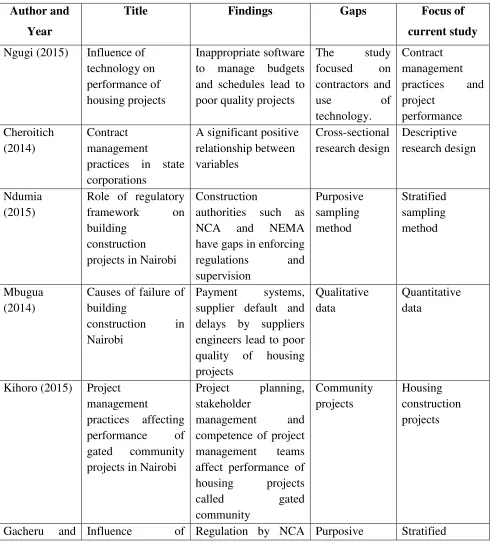
2.4 Summary of Literature Review and Gaps
Table 2.1: Summary of Literature and Research Gaps Author and
Year
Title Findings Gaps Focus of
current study Ngugi (2015) Influence of
technology on performance of housing projects
Inappropriate software to manage budgets and schedules lead to poor quality projects
The study focused on contractors and
use of
technology.
Contract management practices and project performance Cheroitich (2014) Contract management
practices in state corporations
A significant positive relationship between variables Cross-sectional research design Descriptive research design Ndumia (2015)
Role of regulatory framework on building
construction projects in Nairobi
Construction
authorities such as NCA and NEMA have gaps in enforcing regulations and supervision Purposive sampling method Stratified sampling method Mbugua (2014)
Causes of failure of building
construction in Nairobi
Payment systems, supplier default and delays by suppliers engineers lead to poor quality of housing projects
Qualitative data
Quantitative data
Kihoro (2015) Project management
practices affecting performance of gated community projects in Nairobi
Project planning, stakeholder
management and competence of project management teams affect performance of housing projects called gated community Community projects Housing construction projects
Ndianga(2016) regulation of contractors on performance of building projects
were inadequate and sensitization by NCA affect building projects
sampling method
sampling method
Gruah,
Ambuto and Tubey (2017)
Contract management
practices and implementation of construction
projects in Kisumu
Contractor selection and contract initiation practices affected implementation of construction projects
Project
implementation
Project performance
2.5 Conceptual Framework
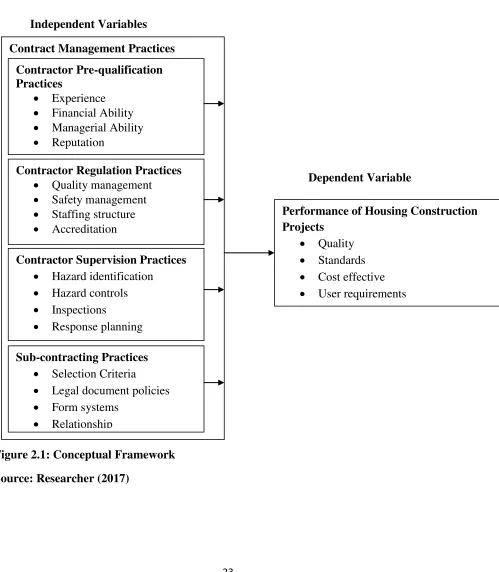
The conceptual framework shows the relationship between variables. The independent variables are contractor pre-qualification practices, contractor regulation services, contractor supervisory practices and sub-contracting practices and the dependent variable is performance of housing construction projects.
Independent Variables
Dependent Variable
Figure 2.1: Conceptual Framework Source: Researcher (2017)
Contract Management Practices Contractor Pre-qualification Practices
Experience
Financial Ability
Managerial Ability
Reputation
Contractor Regulation Practices
Quality management
Safety management
Staffing structure
Accreditation
Contractor Supervision Practices
Hazard identification
Hazard controls
Inspections
Response planning
Sub-contracting Practices
Selection Criteria
Legal document policies
Form systems
Relationship
Performance of Housing Construction Projects
Quality
Standards
Cost effective
CHAPTER THREE: RESEARCH METHODOLOGY 3.1 Introduction
This chapter describes the definition of research design, type of research design, justification for the choice of research design, the identification of the population and target population, sampling frame, sampling technique, research instrument, data collection procedure and data processing and analysis
3.2 Research Design
The study adopted a descriptive survey research design and explanatory research design. As noted by Orodho (2005) explanatory research design attempts to connect ideas so as to establish cause and effects relationship between research variables. Descriptive survey research design was used due to the fact it would permit the researcher to generalize the findings to a larger populace. Surveys allowed the gathering of big amount of data from a big population in a cheaper way. It allowed one to accumulate quantitative facts which could be analyzed quantitatively using descriptive and inferential facts. Consequently, the descriptive survey was of high-quality approach to fulfill the objectives of this study.
3.3 Target Population
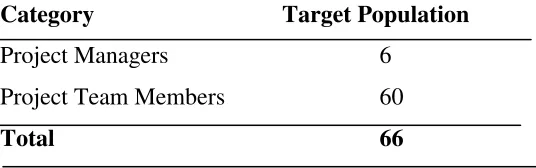
The study’s unit of analysis was National Construction Authority and the unit of observation was project managers and project team members of NCA. The total number of respondents was 66 comprising of 6 project managers and 60 Project Team members from as shown in table 3.1. Table 3.1: Target Population
Category Target Population
Project Managers 6
Project Team Members 60
Total 66
Source: NCA HRM Department (2015) 3.4 Sampling Techniques and Sample Size
sampling may be to determine parameters or traits of the complete population with the intention to generalize the outcomes of the study. A census of 66 respondents was carried out.
3.5 Data Collection Instruments
The study used questionnaires. The selection of questionnaire was guided through the nature of facts with a view to be accumulated, time to be had in addition to the objectives of the study. It enabled the researcher to collect more data over a short period of time. The questionnaire contained both closed and open-ended questions drawn in accordance with the set objectives of the study.
3.6 Data Collection Procedure
Data collection equipment is the contraptions that are used to gather the necessary statistics had to serve or prove some facts (Mugenda & Mugenda, 2003). The study acquired primary data. The questionnaire comprised of two sections. The section one obtained the demographic characteristics of the respondent, while the second par consisted of questions in which the four variables are targeted. The questionnaire was designed in step with the targets of the study. Structured questions were used so that one can conserve time and money as well as to facilitate simpler analysis as they are in on the usable form; even the unstructured questions were used which encouraged the respondent to give an in-depth and felt reaction without feeling held again in revealing of any facts as observed by (Mugenda & Mugenda, 2003).
3.7Pilot Study
The pilot test comprised of 2 architects, building contractors and quantity surveyors. However, to make certain that the study findings are not compromised the respondents who participated inside the pilot examination were not involved in the final study. The pilot study was carried to assess the validity and reliability of the questionnaires.
3.7.1 Validity of the Instruments
corrections to be made to the shape of the research equipment. This assisted in improving the content material validity of the instruments. Moreover, provided the important revision and modification of the research tool thereby improving validity.
3.7.2 Reliability of the Instruments
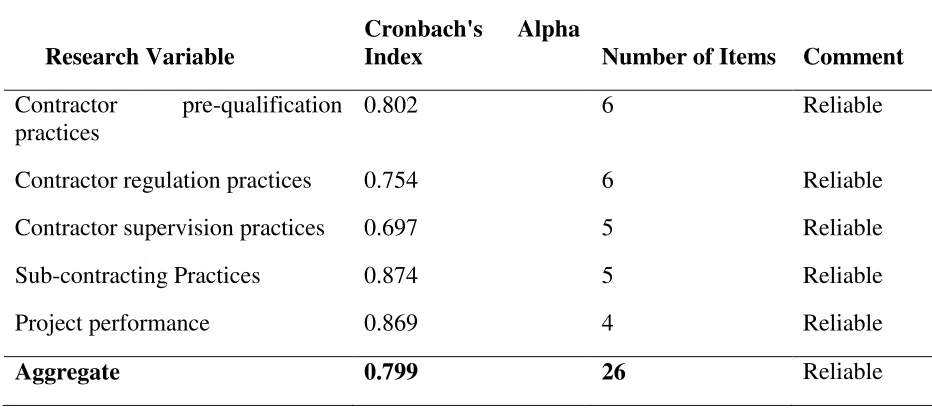
Reliability was advanced by using many comparable objects on a measure, by way of trying out a numerous sample of people and by means of the usage of uniform check approaches as proposed by Mugenda and Mugenda (2003). A pilot test of 10 respondents from the sampled population was selected to test the reliability of the research instruments. In order to test the reliability of the instruments, internal consistency techniques will be applied using Cronbach’s Alpha. The alpha value ranges between 0 and 1 with reliability increasing with the increase in value. Coefficient of 0.7 is a commonly accepted rule of thumb that indicates acceptable reliability and 0.8 or higher indicate good reliability (Mugenda & Mugenda, 2003). Therefore, a coefficient of 0.8 was acceptable for the study. Therefore, a coefficient of 0.801 was obtained which showed that the instruments were reliable. This is shown in Table 3.2.
Table 3.2: Reliability Test Results
Source: Research Data (2018) Research Variable
Cronbach's Alpha
Index Number of Items Comment
Contractor pre-qualification practices
0.802 6 Reliable
Contractor regulation practices 0.754 6 Reliable Contractor supervision practices 0.697 5 Reliable
Sub-contracting Practices 0.874 5 Reliable
Project performance 0.869 4 Reliable
3.8 Data Analysis and Presentation
Before processing the responses, the completed questionnaires were checked for completeness to ensure consistency. The data was then coded to enable the responses to be grouped into various categories. Quantitative data was analyzed by descriptive analysis using SPSS (V. 17.0) to describe the influence of contract management practices on the performance of housing construction projects in Nairobi. Findings were presented using tables and charts. A Likert scale was used to analyze the mean score and standard deviation. Percentages, tabulations, means and other measures of central tendencies were used to present the data.
In addition, a multiple regression analysis was conducted in order to establish the influence of contract management practices on the performance of building construction projects. Regression analysis was used to predict the value of the dependent variable on the basis of the independent variables. The model for the regression analysis was as follows:
Y = β0+ β1X1+ β2X2+ β3X3+ β4X4+ ε Whereby:
Y = Performance of housing construction projects X1= Contractor prequalification practices
X2= Contract regulatory practices X3= Contract supervision practices X4= Subcontracting practices ε = Error term/Erroneous variables
β0= the minimum change in Y when the rest of the variables are held at a constant zero
β = measure of the rate of change i.e. β1measures the rate of change in Y as a result of a unit change in X1.
3.9 Ethical Practices
CHAPTER FOUR: RESEARCH FINDINGS AND DISCUSSION 4.1Introduction
The chapter presents the background information of the respondents, findings of the analysis based on the research objectives of the study. Descriptive and inferential statistics have been used to discuss the findings of the study.
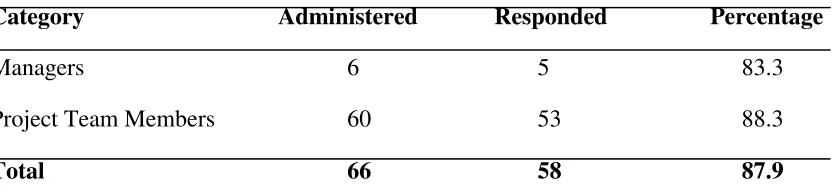
4.2Response Rate
The study targeted a sample size of 66 respondents comprising of 6 project managers and 60 project team members. Their response rate is shown in Table 4.1.
Table 4.1: Response Rate
Category Administered Responded Percentage
Managers 6 5 83.3
Project Team Members 60 53 88.3
Total 66 58 87.9
Source: Research Data (2018)
Table 4.1 shows that managers had a response rate of 83.3 percent and project team members 88.3percent. The overall response rate was 87.9 percent. Baruch and Holtom (2014) recommends that a response rate of greater of equal to 80.0 percent is sufficient for data analysis. This therefore meant that the overall response rate of 87.9 percent was appropriate for the study. 4.3Background Information
On the background information of the respondents, the researcher was interested in knowing the gender, work experience, level of education and project management certification.
4.3.1 Gender
Figure 4.1: Respondents’ Gender Source: Research Data (2018)
Figure 4.1 shows that majority of the respondents were male at 56.9 percent and female respondents accounted for 43.1 percent. This shows that both genders were well represented and the study could not suffer from gender bias.
4.3.2 Work Experience
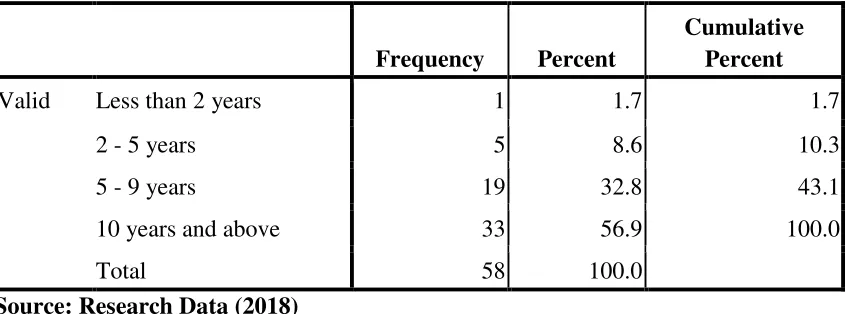
The study sought to find the number of years the respondents had worked. The findings are presented in Table 4.2.
Table 4.2: Respondents’ Work Experience
Frequency Percent
Cumulative Percent
Valid Less than 2 years 1 1.7 1.7
2 - 5 years 5 8.6 10.3
5 - 9 years 19 32.8 43.1
10 years and above 33 56.9 100.0
Total 58 100.0
Source: Research Data (2018)
years, 8.6 percent between 2 to 5 years and 1.7 percent less than 2 years. The cumulative frequency of 43.1percent indicated that majority of the respondents had worked for more than 5 years. These findings show that majority of the respondents had worked for a long period and so they had a wealthy experience on how contract management practices influences the performance of housing construction projects.
4.3.3 Level of Education
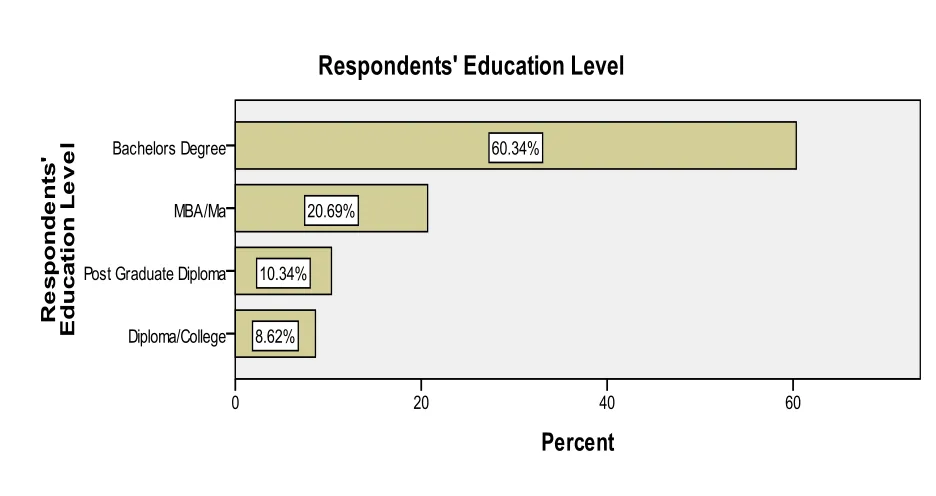
The study sought to the level of education of the respondents. The findings are presented in Figure 4.2.
Figure 4.2: Respondents’ Education Level Source: Research Data (2018)
4.4Descriptive Statistics
Descriptive statistics such as means and standard deviations were used to present that quantitative data with the use of Statistical Package for Social Sciences (SPSS) version 17.0. These were presented as per the study objectives as follows
4.4.1 Contractor Pre-qualification Practices
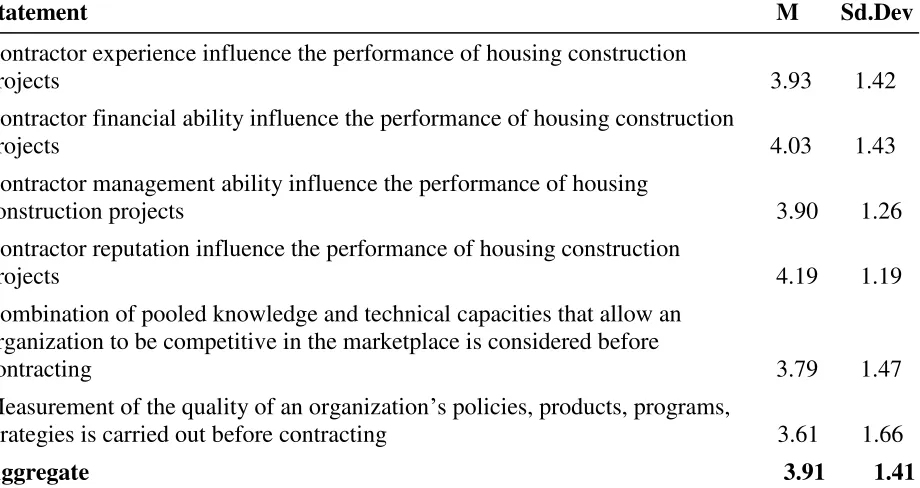
The first research objective sought to investigate the effects of contractor pre-qualification practices on the performance of housing construction projects in National Construction Authority. The findings are shown in Table 4.3.
Table 4.3: Contractor Pre-qualification Practices
Statement M Sd.Dev
Contractor experience influence the performance of housing construction
projects 3.93 1.42
Contractor financial ability influence the performance of housing construction
projects 4.03 1.43
Contractor management ability influence the performance of housing
construction projects 3.90 1.26
Contractor reputation influence the performance of housing construction
projects 4.19 1.19
Combination of pooled knowledge and technical capacities that allow an organization to be competitive in the marketplace is considered before
contracting 3.79 1.47 Measurement of the quality of an organization’s policies, products, programs,
strategies is carried out before contracting 3.61 1.66
Aggregate 3.91 1.41
Key:M – Mean; Sd.Dev– Standard Deviation Source: Research Data (2018)
housing construction projects as indicated by the mean of 4.03 which varied significantly as indicated by standard deviation of 1.43. These were followed by the statements that contractor experience influences the performance of housing construction projects (M=3.93, Sd.Dev=1.42), contractor management ability influence the performance of housing construction projects (M=3.90, Sd.Dev=1.26), combination of pooled knowledge and technical capacities that allow an organization to be competitive in the marketplace is considered before contracting (M=3.79, Sd.Dev=1.47) and measurement of the quality of an organization’s policies, products, programs, strategies is carried out before contracting (M=3.61, Sd.Dev=1.66).
These findings concur with the findings of Gudah, Omboto and Tubey (2017) who found out that contractor selection criteria affected implementation of housing projects in Kisumu County. contract initiation activities have many events. Rendon (2010) defined that at pre–qualification phase, there must be education of body of workers, clear strategies of engagement, relationships constructing, resource allocation to initiatives, leadership and regulations all of that have direct effect on ensuing contractors’ overall performance consequences. The agreement introduction action installation the performance expectations for the challenge.
Kuta and Nyaanga (2014) investigated the effect of competence of contractors on the construction of substandard buildings in Kenya. The study targeted contractors operating in Nairobi metropolitan. Results showed that competence and qualifications of contractors influenced construction of standard buildings. It was also revealed that there was bidding for works by contractors which many lack capacity to execute.
4.4.2 Contractor Regulation Practices
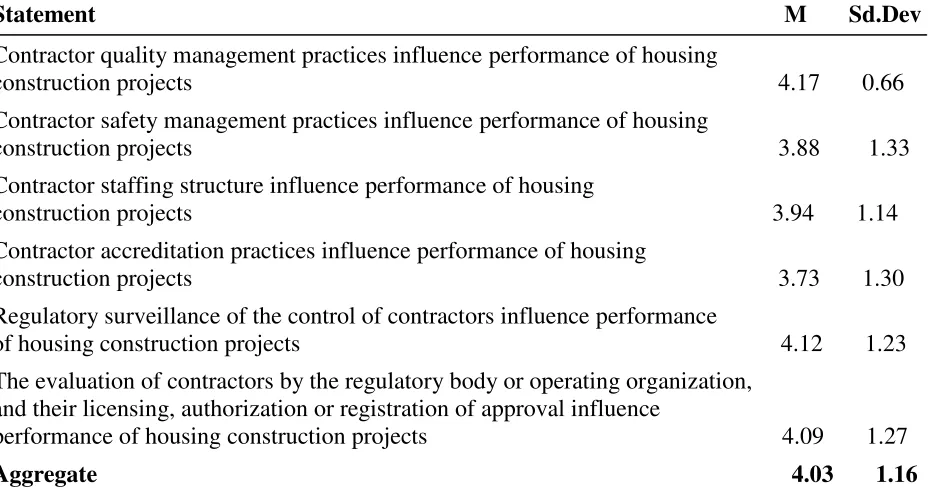
The second research objective sought to assess the effect of contractor regulations practices on the performance of housing construction projects in National Construction Authority. The findings are shown in Table 4.4.
Table 4.4: Contractor Regulation Practices
Statement M Sd.Dev
Contractor quality management practices influence performance of housing
construction projects 4.17 0.66
Contractor safety management practices influence performance of housing
construction projects 3.88 1.33 Contractor staffing structure influence performance of housing
construction projects 3.94 1.14
Contractor accreditation practices influence performance of housing
construction projects 3.73 1.30 Regulatory surveillance of the control of contractors influence performance
of housing construction projects 4.12 1.23 The evaluation of contractors by the regulatory body or operating organization,
and their licensing, authorization or registration of approval influence
performance of housing construction projects 4.09 1.27
Aggregate 4.03 1.16
Key:M – Mean; Sd.Dev– Standard Deviation Source: Research Data (2018)
contractor safety management practices influence performance of housing construction projects (M=3.88. Sd.Dev=1.33) and contractor accreditation practices influence performance of housing construction projects (M=3.73, Sd.Dev=1.30).
These findings are in line with the findings of Umeokafor, Umeadi and Jones (2014) who reviewed the compliance with occupational safety and health regulations in Nigeria’s construction industry. Results showed that key issues to compliance with occupational safety and health regulations in the Nigerian construction industry include: client’s influence, inadequate enforcement (which ranked highest), lack of adequate regulations and unemployment, which ranked lowest.
Ndumia (2015) conducted a study on the role of regulatory framework on the performance of building construction projects in Nairobi. The study found out that the regulators who included NCA, NEMA and the county government of Nairobi had formulated a statutory and regulatory framework to include virtual device for management of developments applications. Gatheru (2015) investigated the challenges facing the NCA and made damning indictment of the capacity of the regulator because of the challenges they encounter. These challenges included: Inadequate capacity to detect errant behaviour in contractors by conducting frequent random surveys; poor enforcement of regulations; inadequate sensitization; and poor attitude of contractors towards the NCA.
The respondents further indicated that regulatory strategy may vary between organizations projects with regard to the degree of regulatory body involvement in the contractor’s authorization process. Regulatory practice is based on the requirement that competence, quality standards and safety expectations are never to be compromised, whether work is carried out by contractors or permanent staff. A regulatory body may have a strategy concerning its expectation regarding the staffing, structure and organization of an operating organization.
4.4.3 Contractor Supervision Practices
Table 4.5:Contractor Supervision Practices
Statement M Sd.Dev
Construction site hazard identification influence performance of housing
construction projects 3.89 1.21
Construction site hazard controls influence performance of housing
construction projects 4.17 0.86
Construction site project ongoing inspections influence performance of
housing construction projects 4.30 0.82
Construction site emergency response planning influence performance of
housing construction projects 4.28 0.68
Construction site health and safety program identification influence
performance of housing construction projects 4.15 1.13
Aggregate 4.16 0.94
Key:M – Mean; Sd.Dev– Standard Deviation Source: Research Data (2018)
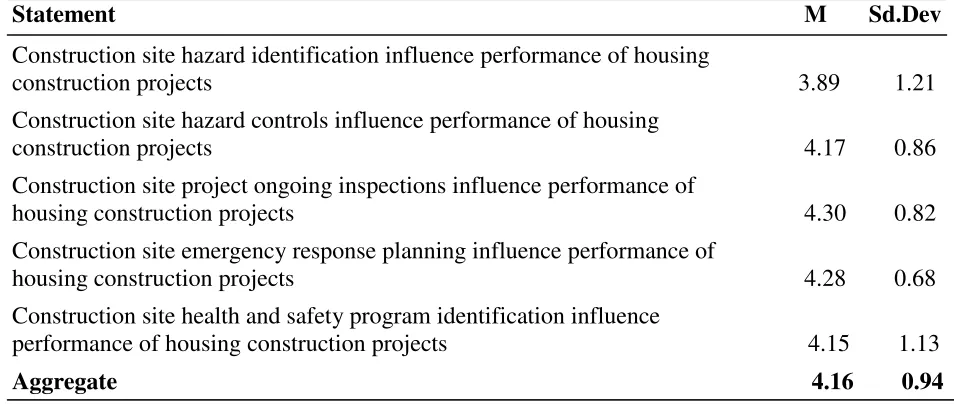
The results in Table 4.5 indicates the aggregate mean score was 4.16 with a varied significance of 0.94 which implies that contractor supervision practices influences the performance of housing construction projects in National Construction Authority to a very great extent. Majority of the respondents strongly agreed that construction site project ongoing inspections influence performance of housing construction projects with a mean of 4.30 and a significance variance of 0.82 and that construction site emergency response planning influence performance of housing construction projects with a mean of 4.28 and a standard deviation of 0.68. These were followed by the statements that construction site hazard controls influence performance of housing construction projects (M=4.17, Sd,Dev=0.86), construction site health and safety program identification influence performance of housing construction projects (M=4.15, Sd.Dev=1.13) and that construction site hazard identification influence performance of housing construction projects (3.89, Sd.Dev=1.21).
recommends the introduction of contract management training and certification for project managers and project team members to enhance project performance.
Camen, Gottfridss on and Rundh (2012) also studied operational factors influencing strategic partnerships social housing in the UK. They conclude that poor management of expectations between partners undermines trust and confidence in the process. As the authors suggest, contracts function as a basis in building relationships. In a study done by Ronnberg- Sijodin (2013) on life cycle viewpoint on buyer-supplier relationship in process the process of developing projects, it was concluded that close contact and training with end-users is essential for enhanced operational performance.
The respondents further indicated that it’s the responsibility of the supervisor to make sure the workers he/she supervises not only understand the organization’s health and safety expectations, but that they live up to them. The supervisor helps the people he/she supervises understand the organizations expectations by planning their work and provide support to help them succeed. The supervisor monitors their individual employee performance to ensure they deliver, and provides feedback to the management with results and/or any concerns.
4.4.4 Sub-contracting Practices
The fourth research objective sought to determine the effects of sub- contracting practices on the performance of housing construction projects in National Construction Authority. The findings are shown in Table 4.6.
Table 4.6: Sub-contracting Practices
Statement M Sd.Dev
Rigorous analysis is carried out to identify the best sub-contractor 4.17 1.05 Once the contractor is selected, the organization enters into legal contract
with the contractor 3.94 1.20
There is a well defined and implemented structures and reporting lines for
sub-contracting 3.61 1.66
Legal agreement regulatory controls are clearly specified when sub-contracting 3.80 1.31 Standards and procedures are clearly specified when sub-contracting 4.01 1.24
Aggregate 3.87 1.29