and Lazy Reduction
Gavin Xiaoxu Yao1, Junfeng Fan2, Ray C.C. Cheung1, and Ingrid Verbauwhede2
1
Department of Electronic Engineering City University of Hong Kong, Hong Kong SAR, Email: [email protected], [email protected]
2 Katholieke Universiteit Leuven, ESAT/SCD-COSIC Kasteelpark Arenberg 10, B-3001 Leuven-Heverlee, Belgium Email:{Junfeng.Fan, Ingrid.Verbauwhede}@esat.kuleuven.be
Abstract. In this paper, we present a high speed pairing coprocessor using Residue Number System (RNS) and lazy reduction. We show that combining RNS, which are naturally suitable for parallel architectures, and lazy reduction, which performs one reduction for more than one multiplication, the computational complexity of pairings can be largely reduced. The design is prototyped on a Xilinx Virtex-6 FPGA, which utilizes 7023 slices and 32 DSPs, and finishes one 254-bit optimal ate pairing computation in 0.664 ms.
Keywords: RNS, Moduli Selection, Hardware Implementation of Pairing, FPGA
1
Introduction
Pairing-Based Cryptography (PBC) has been utilised to provide efficient and elegant solutions to several long-standing problems in cryptography, such as three-way key exchange [23], identity-based encryption [9], identity-based sig-natures [10], and non-interactive zero-knowledge proof systems [19]. As crypto-graphic schemes based on pairings are introduced and investigated, the perfor-mance of pairing computation also receives increasing interests.
The complex pairing computation can be broken down to multiplications and additions in the underling fields. For example, one 256-bit optimal ate pairing consists of around ten thousand modular multiplications [1]. Thus, having an efficient multiplier is the key step to a high performance pairing processor. For pairings over ordinary curves defined over prime fields Fp, Montgomery
algo-rithm [31] is the most widely deployed reduction algoalgo-rithm. Using Montgomery algorithm, the complexity of both multiplication and reduction is Ops2q using
schoolbook method, orOpslog23qusing Karatsuba algorithm [25], wheresis the number of machine-words to representp.
are naturally suitable for parallel implementations. For this reason, RNS has been studied for cryptographic applications and Montgomery algorithm in RNS context was proposed [3, 26, 35, 38].
On the other hand, the Montgomery reduction in RNS has a higher com-plexity than ordinary Montgomery reduction. Fortunately, this overhead of slow reduction can be partially removed by reducing the number of reductions, also known as lazy reduction. Lazy reduction in pairing computation was introduced by Scott [36] and then generalised by Aranhaet al.in [1]. In short, it performs one reduction for multiple multiplications. This is possible for expressions like
ABCDEF in Fp. As such, lazy reduction brings a significant reduction of
the complexity.
In this paper, we first illustrate how RNS moduli selection can reduce the complexity of modular reduction. Then, a pairing coprocessor is proposed using RNS multiplier. The major contributions of this work are as follows.
– We propose a set of base moduli to reduce the complexity of modular reduc-tion in RNS.
– We present an efficientFp multiplier using RNS Montgomery.
– We describe a high-speed pairing processor using the proposed multiplier. This paper is organised as follows: Section 2 provides the backgrounds on RNS and pairing. Section 3 introduces a novel specification on RNS parameter selection to reduce the complexity of modular reduction, and optimised param-eters are provided for pairing. In Section 4, hardware architecture of the pairing coprocessor is described. Section 5 illustrates how to perform pairing computa-tion efficiently on the proposed architecture. Seccomputa-tion 6 provides the experimental results and its analysis. In Section 7, we conclude the paper.
2
Backgrounds and Preliminaries
2.1 Bilinear Pairing
A bilinear pairing is a non-degenerate mape:G1G2ÑGT, whereG1andG2
are additive groups and GT is a subgroup of a multiplicative group. The core
property of mapeis linearity in both components, which allows the construction of novel cryptographic protocols. Popular pairings such as Tate pairing [4], ate pairing [22], R-ate pairing [28], optimal pairing [39] choose G1 and G2 to be
specific cyclic subgroups ofEpFpkq, andGT to be a subgroup ofFpk.
The selection of parameters has an essential impact on the security and performance of a pairing computation. Not all the elliptic curves are suitable for pairings. Indeed, to achieve higher performance and security, a group of pairing-friendly curves are constructed. We refer to Freeman [16] for a summary of known pairing-friendly curves. Barreto and Naehrig [5] (BN) described a parameterised family of elliptic curves, and it is well-suited for computing asymmetric parings. BN-curves are defined with E :y2 x3 b, b 0 over Fp, where p36u4
Note that anyuPZ that generates primepand nwill suffice. BN-curves have embedding degreek12. Because of the limited space, we mainly focus on the discussion of optimal ate pairing on BN-curves.
LetE1:y2x3 b{ζbe a sextic twist ofE withζnot a cube nor a square inFp2, andErnsbe the subgroup ofn-torsion points ofE, then the optimal ate pairing is defined as [1, 32]:
aopt:G2G1ÑGT
pQ, Pq Ñ pfr,QpPq lrrsQ,πppQqpPq lrrsQ πppQq,π2ppQqpPqq p121
n
where r 6u 2. The group G1 Erns
Kerpπp r1sq EpFpqrns and
G2 is the preimageE1pFp2qrns of Erns
Kerpπp rpsq EpFp12qrnsunder the twisting isomorphismψ:E1 ÑE. The groupGT is the subgroup of n-th roots
of unity µn Fp12. The map πp : E Ñ E is the Frobenius endomorphism
πppx, yq pxp, ypq, andfr,QpPqis a normalized function with divisor pfr,Qq
rpQq prrsQq pr1qpOq. The line function, lQ1,Q2pPq, is the line arising in the addition ofQ1andQ2 evaluated at pointP.
Miller [29] proposed an algorithm that constructs fr,Q in stages by suing
double-and-add method. When u is selected as a negative integer, the corre-sponding Miller algorithm is given as Algorithm 1 [1].
Algorithm 1Optimal ate pairing on BN curves foru 0 Require: P PG1, QPG2, r |6u 2| °tilog02ruri2
i
, whereu 0 Ensure: aoptpQ, Pq
1: TÐQ, fÐ1
2: fori tlog2ru 1 downto 0do 3: fÐf2lT ,TpPq, T Ð2T
4: if ri1then
5: fÐflT ,QpPq, T ÐT Q
6: end if 7: end for
8: Q1ÐπppQq, Q2Ðπp2pQq
9: TÐ T, fÐfp6
10: fÐflT ,Q1pPq, T ÐT Q1 11: fÐflT ,Q2pPq, T ÐTQ2 12: fÐfpp61qpp2 1qpp4p2 1q{n 13: return f
Lazy reduction saves expensive modular reduction computation, especially in RNS context. Essentially, at leastkreductions are required for a multiplication inFpk, as the result haskcoefficients. We deploy the same tower extension field
as in [1], and only 12 reductions are required for a multiplication inFp12:
– Fp6 Fp2rvs{pv3ζq, whereζ1 i
– Fp12 Fp6rws{pw2vqorFp12 Fp2rWs{pW6ζq
Hence, an element α P Fp12 can be represented in any of the following three ways:
αa0 a1w, wherea0, a1PFp6
pa0,0 a0,1v a0,2v2q pa1,0 a1,1v a1,2v2qw, whereai,jPFp2
a0,0 a1,0W a0,1W2 a1,1W3 a0,2W4 a1,2W5
2.2 Residue Number System
A Residue Number System (RNS) represents a large integer with a set of smaller integers. Let B tb1, b2, . . . , bsu be a set of pairwise co-prime integers, and
MB±si1bi. The unique RNS representation of any integerX, 0¤X MB,
is tXuB tx1, x2, . . . , xsu, where xi |X|bi, 1 ¤ i ¤ s. Using RNS,
arith-metic operations in Z{MBZ can be efficiently performed. Consider two inte-gersX, Y and their RNS representationstXuB tx1, x2, . . . , xsuand tYuB
ty1, y2, . . . , ysu, then
t|XdY|MBuB t|x1dy1|b1, . . . ,|xsdys|bsu.
for d P t ,,,{u. The division is available only if Y is coprime with MB, i.e. the multiplicative inverse of Y exists in B. The set B is also known as a
base, and the element bi, 1¤i ¤s, is calledRNS modulus (pl. moduli). Each
modulus forms a RNS channel, and the operation is carried out independently in each channel.
Also, the original value ofX can be restored fromtXuB using the Chinese Remainder Theorem (CRT):
X
s
¸
i1
xiBi1 bi
Bi
MB
(1)
where
Bi
MB
bi
s
¹
j1,ji
bj, 1¤i¤s. (2)
What makes RNS extremely interesting is the natural ease for parallel imple-mentations. For all the basic operations ( ,,,{), computations betweenxi
and yi have no dependency on other channels. Besides, the complexity of
mul-tiplication is Opsq, while the complexity of naive multiplication is Ops2q, and that of Karatsuba multiplication isOpslog 3{log 2q[25, 30]3,4. In order to simplify 3 For the simplicity of the paper, we only use naive multiplication method to count the number of multiplications and complexity analysis in the remaining paper. Readers can easily derive the results using Karatsuba method.
4
channel reduction, pseudo-Mersenne numbers of the form bi 2wα, where
α 2w2 are chosen as moduli [37].
2.3 RNS Montgomery Reduction
Algorithm 2 shows the Montgomery modular reduction algorithm in RNS con-text, and for comparison reason, redundant Montgomery algorithm is also pro-vided. RNS Montgomery algorithm is consistent with the redundant Mont-gomery algorithm without conditional subtraction in [31,40], with the parameter
R setting to MB. Since R1 (i.e.MB1) does not exist in base B, a new base,
C tc1, c2, . . . , csu, where MC is co-prime with MB, is introduced to perform
the division (i.e. pT QNq{R). Note that all the moduli from both B and C are pairwise coprime as MB and MC are coprime. The overhead is two base
extensions required in Algorithm 2.
Algorithm 2 RNS Montgomery Reduction [26] and Redundant Montgomery Reduction [40]
Require: RNS basesBandCwithMB, MC¡2N
Require: N,MB,MC are pairwise coprime
Require: tXuB,tXuC,tYuB,tYuC withX, Y 2N
Precompute:tN1uBÐ t| N1|MBuB
Precompute:tM1uCÐ t|MB1|MCuC andtNuC
Ensure: tUuB,tUuC s.t.|U|N |XY MB1|N,U 2N
RNS Montgomery Redundant Montgomery 1 tQuBÐ tTuB tN1uB QÐ|T|RN1R
2 tQuB
Base Extension1
ÝÝÝÝÝÝÝÝÝÝÝÝÑ tQuC 3 tUuCÐ tTuC tQuC tNuC
tM1uC U Ð pT QNq{R
4 tUuB
Base Extension2
ÐÝÝÝÝÝÝÝÝÝÝÝÝ tUuC
The operation to transform the representation in one RNS base to that in other base is called Base Extension (BE). To compute tXuC tx11, x12, . . . , x1su
giventXuB tx1, x2, . . . , xsu, one can use Posch-Posch Method [26, 34].
GiventXuB, for Eqn(1), there must exist certain integerγ ssuch that:
X
s
¸
i1
xiBi 1
bi Bi
MB
s
¸
i1 ξiBi
MB
s
¸
i1
ξiBiγMB (3)
where ξi xiBi1 bi
, 1¤i¤s. In Posch-Posch method, γ can be calculated by the following equation:
γ
Z¸s
i1 ξiBi
MB ^
Z¸s
i1 ξi
bi
^
In [26], ξi{bi is further approximated by ξi{2w as bi is chosen as a
pseudo-Mersenne number near 2w. Once γ is obtained, tXuC tx11, . . . , x1su can be computed as follows:
x1j
s
¸
i1
ξiBiγMB
cj s ¸
i1
ξi |Bi|cjγ |MB|cj
cj
. (5)
The|Bi|cj and|MB|cj, 1¤i, j¤s, can be precomputed onceBandCare fixed.
Lazy reduction performs only one reduction for patten likeABCDEF, hence, it trades expensive reduction with multi-precision addition. In RNS con-text, as multiplication takes only 2s word operations, lazy reduction dramati-cally decreases the complexity. For instance, to computeABCDEF, it takes 2s2 11sword multiplications in RNS, while it takes 4s2 susing digit-serial
Montgomery modular multiplication [27].
3
RNS and Pairing Parameter Selection
3.1 Specifications on RNS Base Selection
The selection of RNS base has a huge impact on the complexity of reduction. Clearly, one should choose pseudo-Mersenne numbers as the RNS moduli, since the reduction by each modulus will be largely simplified. We notice that the complexity of RNS modular reduction can be reduced when the moduli are near the same power of 2 and close to each other.
The BE step [Eqn(5)] is the most computational expensive operation in the RNS Montgomery algorithm. It requires arounds2 sword-size multiplications.
Eqn(5) is essentially a matrix multiplication followed by reduction.
x21
.. .
x2s :
|B1|c1 |Bs|c1 ..
. . .. ...
|B1|cs |Bs|cs ξ1 .. . ξs γ
|MB|c1 .. .
|MB|cs
(6)
tXuC tx11, . . . , x1s1u: t|x21|c1, . . . ,|x 2
s1|csu (7)
The computational intensiveness comes from Eqn(6), which involvess2
word-size multiplications. Note the element in the matrix |Bi|cj, 1¤i, j¤s, can be
computed as follows:
|Bi|cj ¹s
k1,ki
bk cj s ¹
k1,ki
pbkcjq
cj
(8)
Define ˜Bi,j:
±s
k1,kipbkcjq. When the modulibkandcjare close to each
other, the differencebkcj is small. In practice, the absolute value of ˜Bi,jcould
be much less than the value of cj ( ˜Bi,j could be a negative number). In other
words, if ˜Bi,j substitutes |Bi|cj to perform the matrix multiplication, the
of|Bi|cj with ˜Bi,j will not affect the final result as the possible negative result
is corrected by the following Eqn(7).
Furthermore, there could be at most one even number among all the moduli because all the moduli are pairwise co-prime. For an odd moduluscj, 2s1|B˜i,j,
because there is at most onepbkcjqterm cannot be divided by 2. In practice,
the number of zeros at the least significant bits are usually more than s1, because bkcj can be 2i, where i ¡ 1. Hence, we can further save the
bit-length by truncation of the least significant zeros, and compensate the result by left-shifting. We denote ˜Bi,j after truncation of zeros as ˜Bi,j1 .
As the bit-length of ˜B1i,j is much shorter than the standard word-size, one can employ asymmetric multiplier whose inputs are of different bit-length. The asymmetric multiplier takes less area and is faster than the symmetric standard word-size multiplier (cf. Sec. 4.1). We denote the bit-length of all ˜Bi,j in
ma-trix format as LB˜, and the bit-length matrix of all ˜B1 as LB˜1. The mechanism of denotation also works for base C, and one operand size of the asymmetric multiplier inputs is shown by LB˜1 andLC˜1.
3.2 RNS Parameter Selection
To achieve 128-bit security level,pshould be around 256 bits, whereFpk is the
operating field. We set s, the number of moduli in each base to be 8 and the moduli are chosen near 233 considering the following facts:
– The channel multipliers should be symmetric, because the inputs are of the same bit-length for all channel multiplications except the matrix multiplica-tions in BEs.
– In modern FPGA device, DSP slices with 2’s complement 2518 multipliers are embedded [41]. To construct a symmetric multiplier using these slices, the standard word-size (i.e. the bit-length of a modulus) should be equal to or a little bit less than a multiple of 17 excluding the sign bit.
– s 8 are the most suitable trade-off. Fors 4, the parallelism is under-mined, and it needs 9 DSP slices to construct a 5151 multiplier. Fors16, it takess16 loops to perform one matrix multiplication in cox-rower de-sign [26], while fors8, it takes half less loops.
– We select moduli near 233because some of the moduli are a slightly greater than 233, and hence all the moduli fit in 34-bit multiplier. If one chooses all the moduli less than a power of 2, some moduli will have a large Hamming weight, which implies the channel reduction is expensive.
As the number of moduli and moduli range are decided, we choose the fol-lowing bases.
B t2w1, 2w9, 2w 3, 2w 11, 2w 5, 2w 9, 2w31, 2w 15}
wherew33. Consequently,
LB˜
23 20 21 20 21 20 18 19 22 20 22 20 21 20 18 19 25 23 23 22 23 22 21 22 25 24 25 26 25 26 23 28 29 30 28 28 28 28 28 27 32 33 32 31 31 31 33 31 32 33 32 32 32 32 34 32 33 33 33 32 33 33 37 32
, LC˜
24 23 23 20 21 20 20 19 25 25 26 24 26 25 24 24 26 27 25 24 24 23 23 23 30 31 30 31 29 29 29 28 28 28 27 27 26 26 26 25 30 30 30 30 29 28 28 28 27 27 27 26 28 29 29 31 30 30 30 33 29 29 29 29
After truncation of least significant zeros of ˜Bi,j, we get:
LB˜1
23 20 21 20 21 20 18 19 20 18 20 18 19 18 16 17 22 20 20 19 20 19 18 19 18 17 18 19 18 19 16 21 23 24 22 22 22 22 22 21 22 23 22 21 21 21 23 21 23 24 23 23 23 23 24 23 20 20 20 19 20 20 24 19
, LC˜1
24 23 23 20 21 20 20 19 23 23 24 22 24 23 22 22 23 24 22 21 21 20 20 20 23 24 23 24 22 22 22 21 22 22 21 21 20 20 20 19 20 20 20 20 19 18 18 18 18 18 18 17 19 20 20 22 21 21 21 24 20 20 20 20
Notice that all of ˜Bi,j1 and ˜Ci,j1 are less than 25 bits, and they fit in one operand of FPGA DSP slice, while the standard 34-bit operands do not. For the ease of implementation, we do not truncate all the least significant zeros. Instead, all the ˜Bi,j in the same row are truncated with the same number of zeros, and we
do not truncate more zeros when all elements in a row fit in 25 bits.
3.3 Pairing Parameter Selection
Lazy reduction reduces complexity in RNS (cf. Sec. 2.3). In order to perform lazy reduction, the allowed range for input to reduction should be big enough. For instance, to computeABCDEF, the allowed input should be as big as 3p2instead ofp2. In normal binary number system, one can perform conditional correction to keep the sum always in the operating range, and the redundancy is no need too much. However, in RNS, as the comparison of two number values are prohibitive computational intensive, one can hardly tell whether to perform the conditional correction. Hence, the actual operating range should have enough redundancy to perform lazy reduction.
According to our observation, the operating range should be greater than 22p2 (the computation of f
0,0 requests the largest operating range, c.f. Sec.5).
Furthermore, the redundant Montgomery algorithm along with the approxima-tion of ξi{bi in Eqn(4) requires 9 times of redundancy [20, 26]. Thus, MB
±s
i1bi, wherebiPB, should be greater than 922p[20].
35x35 35x25 35x25 << 17
<< 17 << 17
PE_0
Controller ROM
(BRAM)
PE_1
...
PE_7 DATA CTRLξ register cox
D
S
P
35x25 35x35
R
A
M
1
R
A
M
2
R
A
M
3
+
R
A
M
0
+
Matrix MUL
Acc ξ
ξi cox
35x25
Shift +
mod
Acc 0 Acc 1
(a) Dual mode multiplier
`
(c) Coprocessor architecture (b) Processing element (PE) architecture
D
S
P
D
S
P
D
S
P
Fig. 1.Pairing coprocessor hardware architecture
4
Coprocessor Architecture Design
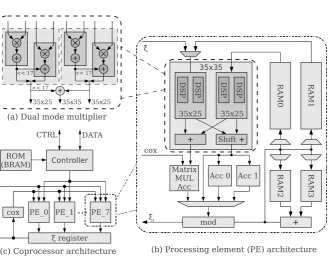
Fig. 1 shows the whole hardware architecture of the proposed pairing coproces-sor, which contains 8 processing elements (PEs) and each PE employs one dual mode multiplier.
4.1 Dual Mode Multiplier
Using the DSP slices embedded in FPGA can improve the performance dramat-ically. The dominating DSP slice in advanced FPGAs is made of a signed 2518 bit multiplier, a 17-bit left shifter, an accumulator, and other processing ele-ments. Excluding the sign bit, it is actually a 2417 multiplier. Two such DSPs can form a signed 3525 multiplier, and four DSPs can form a signed 3535 multiplier in a speed-optimised fashion (in fact, 4 DSPs can form an 3542 multiplier without external logic, but it is useless in this work).
The advantages of the dual mode multiplier are:
– The same hardware for standard word-size multiplication can perform two matrix multiplication at the same time, which saves area.
– It saves half of the matrix multiplication time as the two multiplications are taken at the same time.
– The time to perform 3525 multiplication is shorter than that of 3535 multiplication, as there are less partial products to accumulate.
4.2 Processing Elements
Each Processing Element (PE) preforms operations in one channel of B and one channel of C. Fig. 1(b) shows the internal design of a PE. There is a dual mode multiplier, an adder, 2 RAMs for multiplier inputs and 2 RAMs for adder inputs, 3 accumulators, and a channel reduction module. In order to avoid data fetch latency, two RAMs are attached to the dual mode multiplier and the two operands are supplied simultaneously. As addition is also an important channel operation, dedicated adder and RAMs are designed. The two 3525 products are added directly as such mode is dedicated to the matrix multiplication step, and all the products should be added together finally in matrix multiplication.
One accumulator is dedicated for matrix multiplication of the base extension step, which can shift to compensate the truncated zeros, and handle cox value (cf. Alg. 3). The other two accumulators are to compute polynomial multiplication. As modular reduction will not takes simultaneously, only one modular reduction module is employed for each PE.
4.3 Coprocessor Architecture
We deploy the cox-rower architecture model [26]. The design of pairing copro-cessor is showed in Fig. 1(c). There are s8 PEs, and each PE performs the operations in its channel. The modulecox, named by the authors of [26], is an accumulator to provide result correction information for all PEs in the BE op-eration. The ξ register receives the ξ values from every PE and delivers two ξ
values to all PEs at a time.
A ROM is deployed in the top level, which stores the assembly code for all PEs. The controller reads these instructions from the ROM, distributes the control signals to all PEs andξregisters, and renews the instruction pointer. One can program his own code to control the data flow. This provides high flexibility to different applications. Indeed, one can perform almost all algorithms on Fp
where pis around 256-bit, not only optimal ate pairing on BN curves, but also other pairing on other curves or ECC.
5
Pairing Computation on the Proposed Coprocessor
5.1 RNS Modular Reduction
matrix multiplication in the BE operation. Hence, the cox-rower algorithm is modified as Algorithm 3. In this algorithm, Step 4-6 distribute the computation ofγin Eqn(6) to each loop, and the operations are the same for all the channels. The cox module performs these accumulations and provides value l to each PE for result correction. As the number of loops is reduced from s tos{2, the modular reduction operation is essentially accelerated.
Algorithm 3Cox-rower algorithm fork-th PE with two element multiplications at a time
Require: |X|bk
Ensure: |X|ck
Precompute:Bk1,B˜i,k1 ,1¤i¤s,|MB|ck,biasck
1: ξkÐxkBk1
2: y0, z0
3: fori0 tops{21qdo 4: yÐy ξi ξi s{2 5: lÐ ty{2wu,{lP0,1,2}
6: yÐ |y|2w
7: zÐz pξiB˜1i,k ξi s{2B˜p1i s{2q,kq 2
biasckl |M
B|ck
8: end for 9: return z
5.2 Back to Schoolbook Method for Field Operations
Karatsuba-like method has been used intensively in field operations in literature to save the expensive multiplication [1, 6, 21, 36]. For a Fp2 multiplication, it is computed as follows:
pa0 a1iqpb0 b1iq pa0b0a1b1q pa0b1 a1b0qi
pa0b0a1b1q rpa0 a1qpb0 b1q a0b0b0b1si (9)
In Eqn(9), 3 multiplications are deployed instead of 4 using schoolbook or naive method, but the overhead is 3 more additions. In normal positional nubmer system, this method saves computation power, as multiplication, with complexity ofOps2q, is much more expensive than addition, whose complexity isOpsq.
How-ever, in RNS, the complexities of multiplication and addition are the same. Both multiplication and addition take 2s operations. Hence, the schoolbook method involves less operations (counting both additions and multiplications) and is employed.
ForFp12 multiplication, the schoolbook method also provides an elegant so-lution. Using lazy reduction, one multiplication inFp12 needs only 12 reductions and it is computed as follows:
f g ¸
j k 6
fjgkWj k p
¸
j k¥6
fjgkq ζWj k6 (10)
wheref, gPFp2rWs{pW6ζq, andfj, gk PFp2,1¤j, k¤6, are the coefficients off, g, respectively. The two coefficients of the intermediate results offjgk are
less than 2p2, and the coefficients offjgkζis less than 4p2.
According to Eqn(10), fj gk ζ is one fundamental operation (such kind
of computation also exists in point doubling and addition formulas). Let fj
f0 f1iandgkg0 g1i, then
fjgkζ pf0g0f1g1f0g1f1g0q pf0g0f1g1 f0g1 f1g0q i
Note that all the four products,f0g0, f1g1, f0g1, f1g0, are used to compute both
the results, and the two accumulator design can calculate the two results at the same time with the same product inputs.
5.3 High Level Operations in Pairing Algorithm
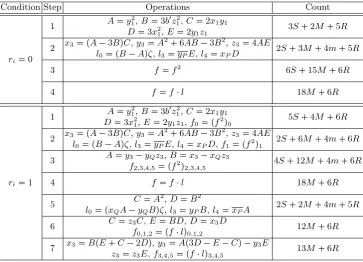
Miller Loop We adopt the homogeneous coordinates proposed in [11]. Again, we use schoolbook method to avoid more additions. Table 1 provides the formulas for point doubling, addition and line raising, along with the pipeline groups and operation counts.M, S, Rrepresent square, multiplication and reduction inFp2, respectively, andm, rrepresent multiplication and reduction inFp. The cost of
square inFp is also denoted asmas there is no dedicated hardware to optimize
it. As we use schoolbook method,M 4m,S3m, andR2r. Each pipeline group has 5R or 6R, and this way of grouping makes the best effort to squeeze the pipeline bubbles.
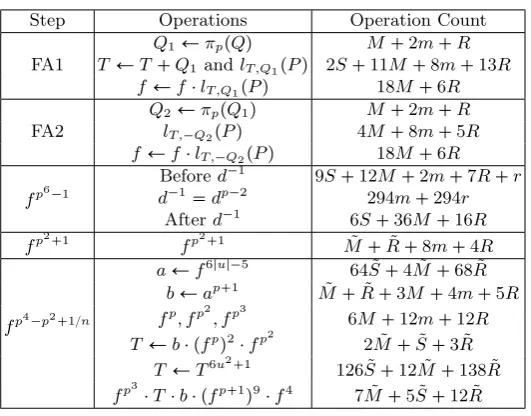
Finial Steps The finial steps of an optimal pairing include Final Addition (FA, Line 10, 11 in Alg. 1) and Final Exponentiation (FE, Line 12 in Alg. 1). The operation count is given in Table 2. The formulas for FA are the same with the point addition formulas in the Miller loop, but for the second step, only line raising is kept and the computation for T Ð T Q2 is skipped because the
point value will not be used any more. The Frobenius endomorphism ofQ1, Q2
computation is also included in FA count in Table 2.
Table 1.Pipeline design and operation count of Miller loop
Condition Step Operations Count
ri0
1 Ay
2
1,B3b1z 2
1,C2x1y1 3S 2M 5R D3x2
1,E2y1z1 2 x3 pA3BqC,y3A
2
6AB3B2,z34AE
2S 3M 4m 5R l0 pBAqζ,l3yPE,l4xPD
3 ff2 6S 15M 6R
4 ffl 18M 6R
ri1
1 Ay
2
1,B3b1z21,C2x1y1
5S 4M 6R D3x2
1,E2y1z1,f0 pf2q0 2 x3 pA3BqC,y3A
2
6AB3B2,z34AE
2S 6M 4m 6R l0 pBAqζ,l3yPE,l4xPD,f1 pf2q1
3 Ay3yQz3,Bx3xQz3 4S 12M 4m 6R f2,3,4,5 pf2q2,3,4,5
4 ffl 18M 6R
5 CA
2,DB2
2S 2M 4m 5R l0 pxQAyQBqζ,l3yPB,l4xPA
6 Cz3C,EBD,Dx3D 12M 6R f0,1,2 pflq0,1,2
7 x3BpE C2Dq,y3Ap3DECq y3E 13M 6R z3z3E,f3,4,5 pflq3,4,5
if p is prime. This is because the proposed coprocessor has no ability to per-form extended Euclidean algorithm or other algorithms which have less complex-ity, otherwise new module dedicated for these algorithms should be developed. The problem with this exponentiation inFp is that the computation cannot be
pipelined. Indeed, only one stage is taken out of all pipeline stages, which causes low pipeline occupation rate and a huge waste (c.f. Sec. 6).
The formula for the last exponentiation comes from [12]. In a recently paper [1], using cyclotomic subgroup structure to accelerate thishard exponentiation is proposed. However, it requires three more inversions, and as we stated, inversion is very expensive and inefficient on our platform, hence this method is not used.
6
Experimental Results and Discussion
6.1 Experimental Results
The prototype of the prposed pairing coprocessor design is implemented on Xil-inx Virtex-6 XC6VLX240T-2 FPGA. The tool for synthesise, simulation and implementation is Xilinx ISE 12.4.
Algorithm 4Computation offp61 inFp12 Require: fPFp12 Fp2rWs{pW6ζq, andf
°5
j0fjW
j, wheref
jPFp2
Ensure: fp61 1: fа5j0p1qjf
jWj
2: aÐf2
0 p2f1f5 2f2f4f32qζ bÐ2f0f2f12 p2f3f5 f42qζ cÐ2f0f42f1f3 f22f
2 5ζ
3: AÐa2bcζ,BÐcζab,CÐb2ac
4: FF0 F1iÐaA pbC cBqζ, whereF0, F1PFp
5: dÐF2 0 F12 6: dÐd1
7: FÐdF0dF1i
8: fÐf2 pAF BFW2 CFW4q 9: return f
Table 2.Operation count of final steps Step Operations Operation Count FA1
Q1ÐπppQq M 2m R
T ÐT Q1 andlT ,Q1pPq 2S 11M 8m 13R fÐflT ,Q1pPq 18M 6R FA2
Q2ÐπppQ1q M 2m R
lT ,Q2pPq 4M 8m 5R fÐflT ,Q2pPq 18M 6R fp61
Befored1 9S 12M 2m 7R r d1dp2 294m 294r
Afterd1 6S 36M 16R fp2 1 fp2 1 M˜ R˜ 8m 4R
fp4p2 1{n
aÐf6|u|5 64 ˜S 4 ˜M 68 ˜R bÐap 1 M˜ R˜ 3M 4m 5R fp, fp2, fp3 6M 12m 12R T Ðb pfpq2fp2 2 ˜M S˜ 3 ˜R
T ÐT6u2 1 126 ˜S 12 ˜M 138 ˜R fp3Tb pfp 1q9f4 7 ˜M 5 ˜S 12 ˜R
(BRAM) serves as the ROM and stores the assembly code. With fine tuned pipeline steps, the coprocessor can operate at 250MHz. The pipeline depth is 8 cycles (bypass the accumulator), or 9 cycles (with accumulation). With latency hidden by pipeline, a multiplication only takes 2 cycles and a reduction takes 13 cycles. Due to the addition at Step 3 in Alg. 2, there will be an idle cycle for each pipeline group. Note that it would take 21 cycles for reduction without dual mode multiplier, and our design saves 38% of the time for reduction with the same hardware.
Table 4 gives the number of multiplications and reductions inFp for all the
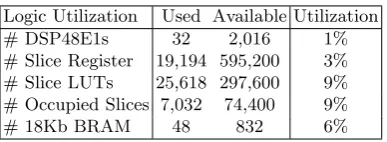
Table 3.Logic Utilization
Logic Utilization Used Available Utilization # DSP48E1s 32 2,016 1% # Slice Register 19,194 595,200 3% # Slice LUTs 25,618 297,600 9% # Occupied Slices 7,032 74,400 9% # 18Kb BRAM 48 832 6%
Table 4.Number of operations and cycles per computation in Miller loop 2T and T+Q and f2 fl Miller’s loop lT ,TpPq lT ,QpPq Ate Optimal
#Multiplication 39 54 78 72 -
-#Reduction 20 26 12 12 -
-#Cycles 340 456 313 301 128531 64084 Table 5.Number of operations and cycles per computation in final steps
Step Operation # Cycles # Idle Cycles Occupation Rate
Final Addition FA1 799 7 99.1%
FA2 566 50 91.2%
fp61 d
p2
modp 25537 21127 17.3 %
Others 1333 240 82.0%
fp2 1 fp2 1 573 9 98.4%
fp4p2 1{n
f6|u|5 21812 68 99.7% T6u2 1 44778 138 99.7%
Others 6905 47 99.3%
Total Ate 100578 21629 78.5% Optimal 101943 21686 78.7%
accumulators and carefully-designed pipeline input sequence. The cycle counting for each operation are also shown in Table 4. Out of the 64084 cycles, the multi-plier is left idle for only 268 cycles. In other words, the pipeline occupation rate is 99.58%. Table 5 provides the timing information for the final exponentiation. The efficiency is very poor in the inversion operation, as most of the pipeline is left idle and theξdelivery latency cannot be hidden in this stage. However, the occupation rate for other steps is high, especially for multiplication and square in Fp12.
6.2 Comparison and Discussion
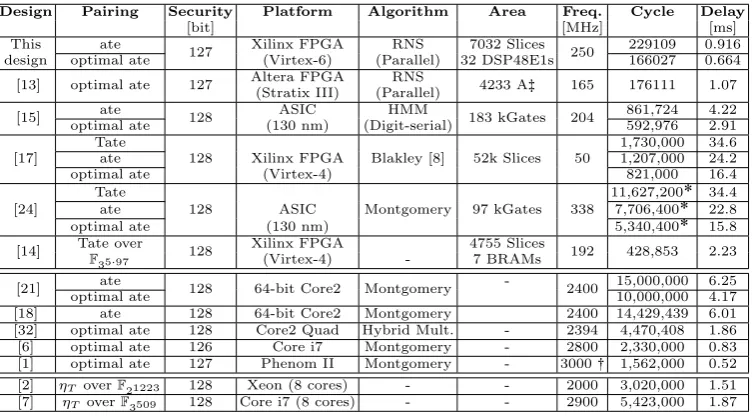
Table 6.Performance comparison of software and hardware implementations of pair-ings
Design Pairing Security Platform Algorithm Area Freq. Cycle Delay
[bit] [MHz] [ms]
This ate
127 Xilinx FPGA RNS 7032 Slices 250 229109 0.916 design optimal ate (Virtex-6) (Parallel) 32 DSP48E1s 166027 0.664
[13] optimal ate 127 Altera FPGA RNS 4233 A; 165 176111 1.07
(Stratix III) (Parallel)
[15] ate 128 ASIC HMM 183 kGates 204 861,724 4.22
optimal ate (130 nm) (Digit-serial) 592,976 2.91
Tate 1,730,000 34.6
[17] ate 128 Xilinx FPGA Blakley [8] 52k Slices 50 1,207,000 24.2
optimal ate (Virtex-4) 821,000 16.4
Tate 11,627,200 34.4
[24] ate 128 ASIC Montgomery 97 kGates 338 7,706,400 22.8
optimal ate (130 nm) 5,340,400 15.8
[14] Tate over 128 Xilinx FPGA 4755 Slices 192 428,853 2.23
F3597 (Virtex-4) - 7 BRAMs
[21] ate 128 64-bit Core2 Montgomery - 2400 15,000,000 6.25
optimal ate 10,000,000 4.17
[18] ate 128 64-bit Core2 Montgomery 2400 14,429,439 6.01
[32] optimal ate 128 Core2 Quad Hybrid Mult. - 2394 4,470,408 1.86
[6] optimal ate 126 Core i7 Montgomery - 2800 2,330,000 0.83
[1] optimal ate 127 Phenom II Montgomery - 3000: 1,562,000 0.52 [2] ηT overF21223 128 Xeon (8 cores) - - 2000 3,020,000 1.51 [7] ηT overF3509 128 Core i7 (8 cores) - - 2900 5,423,000 1.87
Estimated by the authors.
:Processor frequency is not mentioned in the original paper. We take 3.0 GHz (typical frequency) for delay estimation.
;It has 8 Rowers, each consisting of 2 36x36 DSP blocks and one 9x9 multiplier.
of the powerful 64-bit CPUs. Although it have not broken the software record, the speed of our work is already close to that of software.
An independent work using RNS and lazy reduction to compute crypto-graphic pairing is reported by Duquesne and Guillermin [13]5. Our design differs from this implementation mainly in two steps: the selection of the base for RNS and the architecture of the processing elements. By selecting the RNS bases (un-der certain specification), we reduce the size of multipliers for base extension and thus speed up the reduction. Furthermore, although both works use schoolbook multiplication, the accumulator used in our PE hides the lattency introduced by addition and subtraction. Our design is about 37% faster than the design in [13]. However, due to the difference in the platform, it is difficult to give a fair comparison on the efficiency of the architectures.
Both RNS-based pairing processors achieve higher performance than the ones using Montgomery (e.g. [24]), Hybrid Montgomery [15] and Blakley [17] algo-rithms. The results confirm the reduction of computational complexity by RNS. Indeed, multiplying two 256-bit integers (without considering the reduction)
quires only 16 times 32x32-bit multiplications, while Karatsuba multiplication requires 27 of them. The RNS reduction is indeed slower than traditional Mont-gomery reduction, but this overhead is largely reduced by lazy reduction. The results of [13] and the results of our implementation have demonstrated the efficiency of RNS in pairing implementations.
7
Conclusions
In this paper we present an efficient pairing processor that utilises RNS and lazy reduction. We describe a set of moduli that are suitable for RNS base for 254-bit multiplications. The proposed architecture is prototyped on Xilinx Virtex-6 FPGA, which utilizs 7032 slices and 32 DSPs and can run at 250 MHz. The coprocessor finishes one optimal pairing in 0.664 ms. To the best of our knowledge, this is by far the fastest hardware implementation for pairings that achieves 127-bit security.
References
1. Aranha, D., Karabina, K., Longa, P., Gebotys, C.H., L´opez, J.: Faster explicit for-mulas for computing pairings over ordinary curves. In: Eurocrypt 2011. To appear 2. Aranha, D., L´opez, J., Hankerson, D.: High-speed parallel software implementation of the ηT pairing. In: Pieprzyk, J. (ed.) Topics in Cryptology - CT-RSA 2010,
LNCS, vol. 5985, pp. 89–105. Springer Berlin / Heidelberg (2010)
3. Bajard, J.C., Kaihara, M., Plantard, T.: Selected RNS bases for modular mul-tiplication. In: ARITH ’09: Proceedings of the 2009 19th IEEE Symposium on Computer Arithmetic. pp. 25–32. IEEE Computer Society, Washington, DC, USA (2009)
4. Barreto, P., Kim, H., Lynn, B., Scott, M.: Efficient algorithms for pairing-based cryptosystems. In: Yung, M. (ed.) Advances in Cryptology CRYPTO 2002, LNCS, vol. 2442, pp. 354–369. Springer Berlin / Heidelberg (2002)
5. Barreto, P. and Naehrig, M. : Pairing-friendly elliptic curves of prime order. In: Proceedings of SAC 2005, volume 3897 of LNCS. pp. 319–331. Springer-Verlag (2006)
6. Beuchat, J.L., Gonz´alez-D´ıaz, J., Mitsunari, S., Okamoto, E., Rodr´ıguez-Henr´ıquez, F., Teruya, T.: High-speed software implementation of the optimal ate pairing over Barreto-Naehrig curves. In: Joye, M., Miyaji, A., Otsuka, A. (eds.) Pairing-Based Cryptography - Pairing 2010, LNCS, vol. 6487, pp. 21–39. Springer Berlin / Heidelberg (2010)
7. Beuchat, J.L., L´opez-Trejo, E., Mart´ınez-Ramos, L., Mitsunari, S., Rodr´ıguez-Henr´ıquez, F.: Multi-core implementation of the Tate pairing over supersingular elliptic curves. In: Garay, J., Miyaji, A., Otsuka, A. (eds.) Cryptology and Network Security, LNCS, vol. 5888, pp. 413–432. Springer Berlin / Heidelberg (2009) 8. Blakely, G.: A computer algorithm for calculating the product AB modulo M.
IEEE Transactions on Computers C-32(5), 497 –500 (1983)
10. Cha, J.C., Cheon, J.H.: An identity-based signature from gap Diffie-Hellman groups. In: Proceedings of the 6th International Workshop on Theory and Prac-tice in Public Key Cryptography: Public Key Cryptography. pp. 18–30. PKC ’03, Springer-Verlag, London, UK, UK (2003)
11. Costello, C., Lange, T., Naehrig, M.: Faster pairing computations on curves with high-degree twists. In: Nguyen, P., Pointcheval, D. (eds.) Public Key Cryptography PKC 2010, LNCS, vol. 6056, pp. 224–242. Springer Berlin / Heidelberg (2010) 12. Devegili, A., Scott, M., Dahab, R.: Implementing cryptographic pairings over
barreto-naehrig curves. In: Takagi, T., Okamoto, T., Okamoto, E., Okamoto, T. (eds.) Pairing-Based Cryptography Pairing 2007, Lecture Notes in Computer Sci-ence, vol. 4575, pp. 197–207. Springer Berlin / Heidelberg (2007)
13. Duquesne, S., Guillermin, N.: A FPGA pairing implementation using the residue number system. Cryptology ePrint Archive, Report 2011/176 (2011), http:// eprint.iacr.org/
14. Estibals, N.: Compact hardware for computing the Tate pairing over 128-bit-security supersingular curves. In: Joye, M., Miyaji, A., Otsuka, A. (eds.) Pairing-Based Cryptography - Pairing 2010, LNCS, vol. 6487, pp. 397–416. Springer Berlin / Heidelberg (2010)
15. Fan, J., Vercauteren, F., Verbauwhede, I.: Faster Fp-arithmetic for cryptographic
pairings on Barreto-Naehrig curves. In: Clavier, C., Gaj, K. (eds.) CHES 2009, LNCS, vol. 5747, pp. 240–253. Springer Berlin / Heidelberg (2009)
16. Freeman, D., Scott, M., Teske, E.: A taxonomy of pairing-friendly elliptic curves. Journal of Cryptology 23, 224–280 (2010)
17. Ghosh, S., Mukhopadhyay, D., Roychowdhury, D.: High speed flexible pairing cryp-toprocessor on FPGA platform. In: Joye, M., Miyaji, A., Otsuka, A. (eds.) Pairing-Based Cryptography - Pairing 2010, LNCS, vol. 6487, pp. 450–466. Springer Berlin / Heidelberg (2010)
18. Grabher, P., Großsch¨adl, J., Page, D.: On software parallel implementation of cryptographic pairings. In: Avanzi, R., Keliher, L., Sica, F. (eds.) Selected Areas in Cryptography, LNCS, vol. 5381, pp. 35–50. Springer Berlin / Heidelberg (2009) 19. Groth, J., Sahai, A.: Efficient non-interactive proof systems for bilinear groups. In: Proceedings of the theory and applications of cryptographic techniques 27th annual international conference on Advances in cryptology. pp. 415–432. EURO-CRYPT’08, Springer-Verlag, Berlin, Heidelberg (2008)
20. Guillermin, N.: A high speed coprocessor for elliptic curve scalar multiplications over Fp. In: Proceedings of the 12th international conference on Cryptographic
hardware and embedded systems. pp. 48–64. CHES’10, Springer-Verlag, Berlin, Heidelberg (2010)
21. Hankerson, D., Menezes, A., Scott, M.: Software implementation of Pairings. In: Joye, M., Neven, G. (eds.) Identity-Based Cryptography (2008)
22. Hess, F., Smart, N., Vercauteren, F.: The Eta pairing revisited. IEEE Transactions on Information Theory 52(10), 4595 –4602 (2006)
23. Joux, A.: A one round protocol for tripartite Diffie-Hellman. Journal of Cryptology 17, 263–276 (2004)
24. Kammler, D., Zhang, D., Schwabe, P., Scharwaechter, H., Langenberg, M., Auras, D., Ascheid, G., Mathar, R.: Designing an ASIP for cryptographic pairings over Barreto-Naehrig curves. In: Clavier, C., Gaj, K. (eds.) Cryptographic Hardware and Embedded Systems - CHES 2009, LNCS, vol. 5747, pp. 254–271. Springer Berlin / Heidelberg (2009)
26. Kawamura, S., Koike, M., Sano, F., Shimbo, A.: Cox-rower architecture for fast parallel Montgomery multiplication. In: Proceedings of EUROCRYPT 2000, vol. 1807, pp. 523–538. LNCS (2000)
27. Ko¸c, C¸ .K., Acar, T., Kaliski, B.S.: Analyzing and comparing Montgomery multi-plication algorithms. IEEE Micro 16, 26–33 (1996)
28. Lee, E., Lee, H.S., Park, C.M.: Efficient and generalized pairing computation on abelian varieties. IEEE Transactions on Information Theory 55(4), 1793 –1803 (2009)
29. Miller, V.S.: The Weil pairing, and its efficient calculation. Journal of Cryptology 17, 235–261 (2004), 10.1007/s00145-004-0315-8
30. Montgomery, P.L.: Five, six, and seven-term Karatsuba-like formulae. IEEE Trans-actions on Computer 54(3), 362 – 369 (2005)
31. Montgomery, P.L.: Modular multiplication without trial division. Mathematics of Computation 44(170), 519–521 (1985)
32. Naehrig, M., Niederhagen, R., Schwabe, P.: New software speed records for crypto-graphic pairings. In: Abdalla, M., Barreto, P. (eds.) Progress in Cryptology LAT-INCRYPT 2010, LNCS, vol. 6212, pp. 109–123. Springer Berlin / Heidelberg (2010) 33. Pereira, G., Simplcio, M.J., Naehrig, M., Barreto, P.: A family of implementation-friendly BN elliptic curves. Cryptology ePrint Archive, Report 2010/429 (2010),
http://eprint.iacr.org/
34. Posch, K., Posch, R.: Base extension using a convolution sum in residue number systems. Computing 50, 93–104 (1993)
35. Posch, K., Posch, R.: Modulo reduction in residue number systems. IEEE Trans-actions on Parallel and Distributed Systems 6(5), 449 –454 (May 1995)
36. Scott, M.: Implementing cryptographic pairings. In: Takagi, T., Okamoto, T., Okamoto, E., Okamoto, T. (eds.) Pairing-Based Cryptography - Pairing 2007, LNCS, vol. 4575, pp. 117–196. Springer (2007)
37. Solinas, J.: Generalized Mersenne numbers. Tech. rep., Combinatorics and Opti-mization Department, University of Waterloo (1999)
38. Szerwinski, R., G¨uneysu, T.: Exploiting the power of GPUs for asymmetric cryp-tography. In: Oswald, E., Rohatgi, P. (eds.) Cryptographic Hardware and Embed-ded Systems CHES 2008, Lecture Notes in Computer Science, vol. 5154, pp. 79–99. Springer Berlin / Heidelberg (2008)
39. Vercauteren, F.: Optimal pairings. IEEE Transactions on Information Theory 56(1), 455 –461 (2010)
40. Walter, C.: Montgomery exponentiation needs no final subtractions. Electronics Letters 35(21), 1831 –1832 (1999)