NEAL KOBLITZ AND ALFRED MENEZES
Abstract. We take a critical look at security models that are often used to give “provable security” guarantees. We pay particular attention to digital signatures, symmetric-key encryption, and leakage resilience. We find that there has been a surprising amount of uncertainty about what the “right” definitions might be. Even when definitions have an appealing logical elegance and nicely reflect certain notions of security, they fail to take into account many types of attacks and do not provide a comprehensive model of adversarial behavior.
1. Introduction
Until the 1970s, cryptography was generally viewed as a “dark art” practiced by secret government agencies and a few eccentric amateurs. Soon after the invention of public-key cryptography, this image changed rapidly. As major sectors of the economy started to become computerized — and large numbers of mathematicians and computer scientists entered the field of information security — cryptography became profession-alized. By the 1990s, cryptographers could plausibly claim to occupy a subbranch of the natural sciences. In 1996 the Handbook of Applied Cryptography [69] proclaimed:
The last twenty years have been a period of transition as the discipline moved from an art to a science. There are now several international scientific confer-ences devoted exclusively to cryptography and also an international scientific organization, the International Association for Cryptologic Research (IACR), aimed at furthering research in the area. (p. 6)
In addition to the professionalization of cryptography, there were two other reasons to view the field as becoming more “scientific” — the increasing use of sophisticated mathematical techniques and the development of rigorous theoretical foundations. The latter work could be seen in some sense as a continuation of the program initiated by the founders of modern computer science and information theory, Alan Turing and Claude Shannon, who set out to put those fields on a solid mathematical footing. As we explained in our first article on “provable security” [54],
Starting in the 1980s it became clear that there is a lot more to security of a public-key cryptographic system than just having a one-way function, and researchers with a background in theoretical computer science set out to sys-tematically develop precise definitions and appropriate “models” of security for various types of cryptographic protocols.
The exuberant mood during this early period has been vividly described by Phil Rogaway [84]:
It [the mid-1980s] was an extraordinarily exciting time to be at MIT study-ing theoretical computer science and cryptography. To begin with, it was a strangely young and vibrant place.... The theory group had three cryptogra-phers, Shafi Goldwasser, Silvio Micali, and Ron Rivest.... Many of the papers that flowed from these people were absolutely visionary, paradigmatic creations. One has only to re-read some of their fantastical titles to re-live a bit of the other-worldliness of the time. How to play mental poker (1982). Paradoxical signatures (1984). Knowledge complexity and interactive proofs (1985). Proofs that yield nothing but their validity (1986). How to play any mental game (1987). The MIT cryptographers seemed to live in a world of unbridled imagi-nation.
As I saw it... cryptography at MIT did not much countenance pragmatic concerns... practical considerations would have to wait for some distant, less ecstatic, day. My wonderful advisor, Silvio Micali, would wax philosophically about how some definition or proof should go, and it is no exaggeration to claim that, as I saw it, philosophy and beauty had unquestioned primacy over utility in determining what was something good to do.
In developing a strong foundation for modern cryptography, a central task was to decide on the “right” definitions for security of various types of protocols. For example, the 1984 paper on “paradoxical signatures” by Goldwasser, Micali, and Rivest that Rogaway refers to contained a definition of security of a signature scheme that ever since has been central to any discussion of secure digital signatures. Informally speaking, they defined “existentially unforgeable against an adaptive chosen-message attack” to mean that even an adversary who is permitted to request valid signatures for any messages of his choice cannot feasibly produce a valid signature for any other message.
There are several reasons why definitions are important. In the first place, good definitions are needed in order to discuss security issues with clarity and precision. In the second place, such definitions allow analysts to know exactly what they’re dealing with. When a protocol designer makes a security claim and a cryptanalyst then devises a break, the designer cannot simply say “that’s not what I meant by security.” If it weren’t for precise definitions, security claims would be a moving target for analysts. In the third place, if one wants to be able to prove mathematical theorems, one needs precise definitions of what one is talking about. Thus, in their definitive textbook [48] on the foundations of cryptography, Katz and Lindell list “formulation of exact definitions” as Principle 1 in their list of “basic principles of modern cryptography.” As they put it,
One of the key intellectual contributions of modern cryptography has been the realization that formal definitions of security areessential prerequisites for the design, usage, or study of any cryptographic primitive or protocol.
Another benefit that is sometimes mentioned is that precise definitions enable cryp-tographers to avoid including features that are not needed for the security proofs. In [12] (p. 5 of the extended version) Bellare and Rogaway state:
definition, previous solutions encumbered their protocols with unnecessary fea-tures.
In §5 we’ll raise some concerns about over-reliance on formal security definitions as a guide for protocol construction.
There is one final “advantage” of precise definitions that is rarely mentioned in dis-cussions of the subject. They are helpful for the attackers. Like everyone else, the adversaries have limited resources and a desire to concentrate them where they’ll do the most good (or rather, the most bad). When publicity about a protocol specifies the security model that served as a guide for its design and a basis for the security guar-antee, adversaries can also use that model as a guide, focusing their efforts on devising attacks that are outside the model. Experienced cryptanalysts are well aware of this use of precise descriptions of security models.1
* * *
This article is written for a general cryptographic readership, and hence does not assume any specific area of expertise on the reader’s part. We have endeavored to make the exposition as self-contained and broadly accessible as possible.
The paper is organized as follows. We first discuss signature schemes and show that, despite being provably secure under the standard Goldwasser–Micali–Rivest (GMR) definition, several schemes are vulnerable to Duplicate Signature Key Selection (DSKS) attacks. We describe some real-world settings where DSKS attacks could undermine the usability of digital signatures. In§3 we examine some security issues in symmetric-key encryption. Focusing on Secure Shell (SSH) protocols, we find that provable security under the standard definitions does not give any assurance against certain classes of practical attacks.
We start§4 with a brief history of side-channel attacks and then comment on the long delay before theoreticians attempted to incorporate such attacks into their models of adversarial behavior. When they finally tried to do that – most notably by developing the concepts of leakage resilience and bounded retrieval – the practical relevance of their results has been questionable at best. In §5 we comment on the indispensable role of safety margins and dispute the claim that such features can be dropped in order to achieve greater efficiency whenever the security proof goes through without them. Finally, in§6 we make an analogy between the difficulty of modeling adversarial behavior in cryptography and the difficulty of applying mathematical models in economics. In
§7 we list some conclusions.
2. Signatures
According to the Goldwasser–Micali–Rivest (GMR) definition [41], a signature scheme is (t, ǫ, q)-secure in the sense of unforgeability under adaptive chosen-message attack if no adversary that is allowed signature queries for≤qmessages of its choice can produce a valid signature of an unqueried message in time ≤twith success probability ≥ǫ.
1
In this section we discuss a type of attack on signature schemes that does not vio-late the GMR definition of a secure signature scheme but which, in our view, should nevertheless be a matter of concern for designers and users of digital signatures.
2.1. The Duplicate Signature Key Selection (DSKS) attack. In a DSKS attack we suppose that Bob, whose public key is accompanied by a certificate, has sent Alice his signatureson a messagem. A successful DSKS attacker Chris is able to produce a certified public key of his own under which the same signaturesverifies as his signature on the same messagem. We are not interested in the trivial attack where Chris simply claims Bob’s public key as his own, and so we shall suppose that the certification authority (CA) demands a proof of knowledge of the corresponding private key before granting a certificate for the public key (this is required by several widely-used standards for public-key infrastructure, such as [73, 88]). Following [16, 68], we give some examples of DSKS attacks on well-known signature schemes. After that we discuss the potential damage that DSKS attacks can cause.
It should be noted that in all of these attacks the adversary needs to carry out only a modest amount of computation. In fact, in the first example in§2.2.1 he expends no more computational effort than a legitimate user.
2.2. Examples of DSKS attacks on standard schemes.
2.2.1. GHR. The Gennaro–Halevi–Rabin signature scheme [39] is a clever twist on RSA signatures that allowed the authors to prove existential unforgeability against chosen-message attack without using random oracles. It works as follows. Suppose that Bob wants to sign a messagem. His public key consists of an RSA modulusN and a random integer t; here N =pq is chosen so that p and q are “safe” primes (that is, (p−1)/2 and (q −1)/2 are prime). Let h = H(m) be the hash value, where we assume that the hash functionH takes odd values (so that there is negligible probability that h has a common factor with p−1 or q−1). Bob now computes eh such that ehh ≡ 1 (mod
p−1) and (modq−1). His signatures isteh mod N. Alice verifies Bob’s signature by computingh and thensh modN, which should equal t.
Suppose that an adversary Chris wants to mount a Duplicate Signature Key Selection attack. That is, he wants to find N′ and t′ such that sh ≡ t′ (mod N′). But this is
simple. He can take an arbitrary RSA modulusN′ and then just set t′ =sh mod N′.
Remark 1. In [54] we argued that there is no evidence that the use of random oracles in security proofs indicates a weakness in the true security of the protocol. Thus, it does not make much sense to sacrifice either efficiency or true security for the sole purpose of getting security proofs without random oracles. Note that in [39] the main motive for introducing GHR signatures was to avoid the use of random oracles. The ease of carrying out a DSKS attack on GHR illustrates a danger in redesigning protocols so as not to need random oracles in a proof — doing so might open up new vulnerabilities to attacks that are outside the security model used in the proof.
2.2.2. RSA. Suppose that Bob has an RSA public key (N, e) and private key d. His signature s on a message m with hash value h = H(m) is then hdmodN. To verify the signature, Alice checks that se ≡h (mod N). The DSKS attacker Chris wants to construct a new public-private key pair (N′, e′), d′ such that se′
Chris chooses two primes p′ and q′ such that (1) the product N′ = p′q′ has the right
bitlength to be an RSA modulus for the signature protocol; (2) bothp′−1 andq′−1 are
smooth, that is, they’re products of small primes; (3) bothsandhare generators ofF∗
p′ andF∗
q′; and (4) (p′−1)/2 and (q′−1)/2 are relatively prime. Because of (2) and (3), Chris can easily solve the discrete log problemssx ≡h (mod p′) andsy ≡h (modq′),
using Pohlig-Hellman [80]. By the Chinese Remainder Theorem (which applies because of conditions (3) and (4)), he can finde′ such thate′ ≡x(modp′−1) ande′ ≡y (mod q′ −1). Since Chris knows the factorization of N′ = p′q′, he can easily compute the
private keyd′ and get a valid public key certification (which presumably requires him
to prove possession of the private key). It is easy to see that with the public key (N′, e′)
the verifier accepts sas Chris’s signature on the message m.
Remark 2. One could argue that Chris’s RSA modulusN′ was not properly formed,
because it is well known that Pollard’sp−1 algorithm [81, 72] can factor N′ efficiently
if eitherp′−1 or q′−1 is smooth. However, in the first place, Chris can easily choose p′−1 andq′−1 to be smooth enough for his purposes, but not smooth enough forN′
to be factored feasibly. This is because, ifp′−1 andq′−1 each have their two largest
prime factors randomly chosen and of the same bitlength as r, then Chris’s discrete logarithm problems can be solved in time roughly√r, whereas factorization ofN′ takes
time roughly r. If, for example, r has in the range of 60 to 70 bits, then the Pollard
p−1 algorithm involves raising to a power moduloN′ that is the product of all primes <260 or <270, and this is not practical.
In the second place, some of the widely-used industry standards for RSA encryption and signature do not make any stipulations on the selection of the prime factors of the modulus. For example, RSA PKCS #1 v2.1 [87] even permitsN to be the product of more than two primes, and it also allows each user to select a different e of arbitrary bitlength. Thus, there is nothing in those standards to preclude Chris’s parameter selection.
Remark 3. The conventional wisdom about parameter selection is that for greatest security it is best to choose parameters as randomly as possible. If special choices are made in order to increase efficiency, the presumption is that the reduced randomness might at some point make an adversary’s task easier. In [52] we described scenarios in which these assumptions might be wrong. One finds further counterexamples to the conventional wisdom if one is worried about Duplicate Signature Key Selection attacks, because the greater the number of random choices in the key generation algorithm, the easier the adversary’s task.
For example, we just saw how to mount a DSKS attack on RSA signatures if each user chooses her own (supposedly random) encryption exponente. However, ifeis fixed for all users — say,e= 3 — then for most hash valuesh— that is, for most messagesm— the adversary Chris cannot find an RSA modulusN′ for the attack. This is becauseN′
would have to be ann-bit divisor (wherenis the bitlength of RSA moduli in the given implementation) of the 2n-bit integer (s3 −(s3modN))/N, and Chris must be able to compute the factorization of N′. For most random s this cannot feasibly be done.
is fixed for all users, this attack will not work. Thus, for purposes of avoiding DSKS attacks the conventional wisdom about randomness in parameter selection is wrong.
2.2.3. Rabin signatures. Roughly speaking, Rabin signatures [82] are a variant of RSA with public exponent 2. Bob’s public key is an RSA modulusN and his secret key is the factorization ofN. Ifh=H(m) is the hash value of a message, then Bob’s signature s
is the squareroot ofh modulo N. (Some modifications are necessary because only 1/4 of the residues have squareroots, and such a residue has 4 squareroots; but we shall not dwell on the details.) The verifier checks thats2 ≡h (modN). All the DSKS attacker Chris has to do is chooseN′ to be the odd part of (s2−h)/N, which is likely to have the right bitlength to be an RSA-Rabin modulus. Then clearly s verifies as the signature ofm under the public keyN′.
Chris will succeed in this DSKS attack for a substantial fraction of all possible mes-sagesm. In order to get a certificate for his public keyN′, he will have to demonstrate
to the CA that he knows its factorization. He can factor N′ using the Elliptic Curve
Method ifN′ is the product of a prime and a smooth number. From a remark in §4.2
of [16] it follows that there is a roughly 50% probability that a random 1024-bit integer
N′ is the product of a prime and a number that is sufficiently smooth so that N′ is
ECM-factorizable with current techniques.
2.2.4. ECDSA. The system-wide parameters consist of an elliptic curveE defined over a prime fieldFp such that #E(Fp) has a large prime factor n. Bob’s private key is an
integer d, 0 < d < n, and his public key is a point P ∈E(Fp) of ordern and the point
Q = dP. To sign a message m with hash value h, Bob chooses a random integer k, 0 < k < n, and computes r = x(kP) modn, where x(kP) denotes the x-coordinate of the point kP. He also computes s = k−1(h+rd) modn; his signature is the pair (r, s). Signature verification consists of computing R = s−1hP +s−1rQ and checking thatr=x(R) modn.
Given Bob’s public key and his signature (r, s) on a messagemwith hash valueh, the DSKS attacker Chris chooses an arbitrary integerd′, 1< d′ < n, such that the integert
defined ast=s−1h+s−1rd′ modnis nonzero. Chris then computesR=s−1hP+s−1rQ, and then P′ = (t−1 modn)R and Q′ = d′P′. His public key is (P′, Q′). Then (r, s)
verifies under this public key, becauses−1hP′+s−1rQ′= (s−1h+s−1rd′)P′=tP′ =R.
As mentioned before, this attack works only because each user gets to choose her or his own generating pointP of the order-nsubgroup. If this point is fixed as part of the domain parameters, then this DSKS attack does not work. In §2.6 we shall see that a somewhat weaker type of attack can still be launched in that case.
Remark 4. In a generalization of the DSKS attack that is of interest in Unknown Key Share attacks on key agreement protocols (see [16]), Chris has a messagem′ that may
be different fromm and wants to choose a key pair so that Bob’s signatureson malso verifies as Chris’s signature onm′. In the case of GHR, RSA, and ECDSA, the DSKS
attacks described above immediately carry over to this generalized version — all one has to do is replace h = H(m) by h′ =H(m′) in the description of what Chris does.
However, the DSKS attack on Rabin signatures does not carry over, because Bob’s RSA modulusN does not divides2−h′, and for almost all randomh′ Chris wouldn’t be able
Remark 5. A distinction should be made between DSKS attacks that require only knowledge of the message and signature and attacks that also require knowledge of the signer’s public key. Among the DSKS attacks described above, the ones on GHR and RSA signatures are in the former category, while the attacks on Rabin and ECDSA signatures are in the latter category. In situations where the signer is known to come from a fairly small set of parties whose public keys are readily accessible, it is possible to determine the identity of the signer from the signature by simply attempting to verify the signature using all possible public keys. However, in other situations it might not be practical to do this, and so one should distinguish between signature-only DSKS, which can be used to attack anonymous contests, auctions, etc. (see§§2.3.2 and 2.3.3), and DSKS attacks that require knowledge of the signer’s identity.
2.3. Real-world impact of DSKS attacks.
2.3.1. Double-blind refereeing and plagiarism. A DSKS attack can be most effective when the message that was signed did not contain identifying information about the sender. For example, at Crypto and some other conferences that use double-blind refereeing, it is forbidden for authors to include identifying information in the submitted version of a paper. Suppose that Bob emails his submission to the program chair Alice. He also sends her his signature so that his archrival Chris, who he believes lacks any sense of professional ethics, can’t steal his work. The paper is rejected from Crypto, but a few months later appears somewhere else under Chris’s name. Bob appeals to Alice, sending her his certificate for the public key that she uses to verify his signature, and she then confirms that Bob was the one who submitted the paper to Crypto. However, Chris points out that the signature actually verifies under Chris’s certified public key. In anticipation of Bob’s plagiarism complaint, Chris created his own keys so that the signature would verify as his.
Perhaps this scenario is not very realistic. Chris might have difficulty explaining why Alice’s email records show Bob’s return address on the submission. (This is assuming that Bob does not use an anonymizer such as Tor for his submission.) In addition, public key certificates normally include a date of issue. If Chris received his certificate after Bob, that means that Chris must have carried out the DSKS attack on Bob, rather than vice-versa. But what if Bob, who was frantically rushing to meet the submission deadline, signed the submission before getting his public key certified? In that case Chris might have been able to get his public key certified before Bob does. Moreover, note that neither the GMR security model nor the commonly-used digital signature standards require that messages or certificates include dates or timestamps, or that senders use valid return addresses.
from Bob, and when the message arrives her computer verifies his signature, then it seems pointless also to include Bob’s name and address in the message.
2.3.2. Anonymous contests. The idea of anonymous contest entries — presumably to prevent jury bias — goes back a long way. For example, the Prix Bordin of the French Academy of Sciences, which Sofia Kovalevskaia won in 1888 for her work on rotation of a solid object about a fixed point, worked as follows. The contestant submitted her manuscript anonymously and wrote an epigram at the top that served as an identifi-cation number. She wrote the same epigram on a sealed envelope that contained her name and address. The judges would open the envelope of the winning entry only after the selection was complete.2 An interesting feature of the Prix Bordin was that the judges promised to open the envelope only of the winner; the unsuccessful contestants were guaranteed anonymity [24]. Perhaps prominent mathematicians felt that it would have been embarrassing for the public to know that they had entered the competition and not been selected.
Returning to the present, let’s suppose that an anonymous contest with a monetary award uses a digital signature scheme that is vulnerable to a signature-only DSKS attack. Alice, as one of the judges, receives the anonymous submissions with signatures. (In [102] it is proposed that to better preserve anonymity only part of the signature should be sent in; the winner sends the rest of the signature later when proving ownership.) When the finalists are chosen, Alice shares this data with her boyfriend, who has social ties to the cybercrime underworld of which she is unaware, and he sends it to his friend Chris, who immediately gets a certified key pair for each finalist’s signature. (If only part of the signature is given, he can fill in the rest randomly and get a key pair for the resulting signature.) As soon as the winning entry is announced, Chris claims the prize and disappears with it. When the legitimate winner appears, Chris is nowhere to be found.
2.3.3. Coupons. Two other scenarios for Duplicate Signature Key Selection attacks are suggested in [95]. (1) Suppose that an electronic lottery system works as follows. Bob buys a lottery ticket consisting of a serial number that he signs. The lottery company keeps a record of the number and his signature. When the winning lottery numbers are announced, if Bob’s is one of them he can prove ownership because the signature verifies under his certified public key.
(2) Let us say that a shop issues electronic coupons worth $10 on future purchases to shoppers who have spent $500 there. Once again, the coupon consists of a number that the shopper Bob signs. The shop saves a copy of the signed coupon. When Bob wants to use it, the shop verifies the signature and redeems the coupon.
As in the case of anonymous contests, a DSKS attacker can claim the lottery winnings or redeem the coupon before the legitimate buyer does. In addition, if an electronic coupon or lottery system does not have a mechanism for removal or expiration as soon as payment is made, then it can be undermined by a weaker type of attack than DSKS, where one supposes that the original signer is dishonest and arranges for both himself and a friend to claim the award or redeem the coupon; we discuss this briefly in §2.6.
Remark 7. A recent paper of Bellare and Duan [7] defines a type of anonymous signa-ture that can be used in any of the scenarios discussed above. In one of their construc-tions, in order to sign a message m Bob first uses a conventional signature scheme to produce a signatures. He then selects a random stringr and computesw=H(s, r, pk), where pk denotes his public key for the signature s and H is a hash function. His anonymous signature on m is w. When Bob is ready to claim his signature, he reveals (s, r) and produces his public-key certificate.
Note that this scheme prevents DSKS attacks for the same reason that including the public key in the message does [68]: Chris has no way to replace Bob’s public key with his own and have the signature still verify.
2.3.4. Digital vs. handwritten signatures. The usual way that digital signatures are ex-plained to the general public is that they have all the advantages of traditional hand-written signatures, but are much better. In the first place, they are much harder (in popular accounts the word “impossible” is sometimes used) to forge. In the second place, digital signatures authenticate not only the source, but also message integrity. A hand-signed document is much easier to tamper with undetected; in practice, an im-portant document is required to be signed on each page, and it is assumed that a hard copy page with signature would be hard to alter without leaving a trace.3
Popular explanations of digital signatures do not usually delve into the familiar fea-tures of handwritten signafea-tures that do not carry over. In the first place, an old-fashioned signature is an intrinsic feature of the signer, whereas an electronic one (ex-cept for biometrics) is to all appearances nothing but a random sequence of bits. In the second place, handwritten signatures provide a direct link from the signer to the document. For example, a user’s bank branch kept a signature card, which in the case of a large check would be compared with the handwritten name on the document. In contrast, digital signatures are more indirect: they link the document to a key-pair, which, in turn, is linked to the signer’s identity by means of a certificate. In the third place, old-fashioned signatures were (at least in theory) unique. No two people would have identical signatures. In the fourth place, a given signer would have only one or two signatures (perhaps a quick one for informal uses and a long one for important doc-uments). In the digital world a user can create an arbitrary number of authenticated key-pairs for signatures, provided that he is willing to pay the CA’s fee for certifying them.
It is because of these differences between digital and handwritten signatures that we have to worry about another damaging potential use of DSKS attacks: to undermine non-repudiation.
2.4. The weakening of non-repudiation. Since ancient times the function of signa-ture systems has been twofold: source-authentication and non-repudiation. You needed to be sure who sent the message or document, and you wanted the sender not to be able to later deny having signed it. In many settings non-repudiation rather than au-thentication has been the most important need.
For example, in America, where illiterates have traditionally been permitted to sign with an X, such signatures are required to be witnessed. The reason is to prevent Bubba4from later claiming
Ain’t my fuckin’ X. Must be somebody else’s fuckin’ X. Roll Tide!
We the people!5
In the digital age, the authentication requirement can be met by symmetric-key cryptography — namely, by message authentication codes (MAC schemes) or the more general MA schemes. It is the second property — non-repudiation — that required the invention of public-key cryptography. Indeed, the ability to achieve non-repudiation in electronic communication was a central achievement — arguably even more important than public-key encryption — of the historic RSA paper [83].
The first U.S. government standard for digital signatures [74] makes it clear that non-repudiation is a central feature of a signature scheme:
This Standard specifies a suite of algorithms that can be used to generate a digital signature. Digital signatures are used to detect unauthorized modifica-tions to data and to authenticate the identity of the signatory. In addition, the recipient of signed data can use a digital signature as evidence in demonstrat-ing to a third party that the signature was, in fact, generated by the claimed signatory. This is known as non-repudiation, since the signatory cannot easily repudiate the signature at a later time.
A serious practical danger of Duplicate Signature Key Selection attacks is that they’ll undermine non-repudiation. Suppose that Bob signed a contract promising something to Alice. Later he refuses to honor the contract, and she takes him to court. Bob denies having signed the document, and hires a lawyer. What happened was that Bob never intended to carry out his promise, and before sending the contract to Alice he created a half-dozen entities with certified public keys such that his signature on the contract verifies under any of those keys.6 His lawyer has an expert witness testify that there are many people other than Bob who could have sent the document and signature to Alice. In essence, Bob is able to say what Bubba said before him — “Ain’t my fuckin’ X!”
One can argue, of course, that the lawyer’s strategy might not work. Most likely the contract included identifying information about Bob, who might not have a plausible explanation of why someone else would have signed a contract with Bob’s name on it. If the lawyer says that perhaps someone was trying to harm Bob by falsely transmitting a promise that appeared to come from him, then Alice’s lawyer might get the expert witness under cross-examination to admit that a duplicate signature is possible only if
4We chose the name Bubba rather than Bob because in all protocol descriptions of which we’re aware Bob is assumed to be literate.
5The first slogan refers to the football team of the University of Alabama, which is nicknamed the
Crimson Tide. Bubba is a proud alumnus of that institution, and played football for them when he was a “student.” The second slogan is the motto of the Tea Party movement, which Bubba strongly supports. He doesn’t believe in evolution or global warming, and is very proud to be an American because only in America do people like Bubba wield great political influence.
Bob’s valid signature was first available to the attacker. And no one but Bob could have created that valid signature (since the signature scheme is secure in the GMR sense). So if Alice has a good lawyer, Bob might lose in court. However, the signature scheme’s failure to resist DSKS attacks at the very least muddies the water. The cryptographic weakness turns a simple court case into a more difficult one.
Moreover, Alice might lose in court for the simple reason that judges and jurors would be inclined to regard a signature scheme as faulty if it allows for different parties to have identical signatures on a document. That is, Bob’s lawyer might not have to reconstruct a plausible scenario in which Bob did not really sign the document; it might be enough for him to impugn the credibility of the entire signature scheme. It’s not clear how the courts would rule on the issue of whether a signature system that seems to have a serious flaw can still be used to establish the validity of a contract.
Even if a convincing mathematical argument can be made to the effect that Bob truly must have signed the contract, and that the other parties’ identical signatures are either later fabrications or else irrelevant, that line of argument might not completely restore the judge’s or jury’s confidence in the signature scheme. After all, in many parts of the world, including the United States, the legal status of digital signatures remains unresolved, and there is still some resistance and mistrust. In such a social context, trying to get a court to accept the use of an apparently flawed digital signature scheme might be an uphill battle.
Remark 8. Recently A. K. Lenstra et al. [61] discovered that about 0.2% of users of RSA share a public or private key with another user (that is, either their modulus N
is the same or else one of the prime factors is the same). As a result there has been great public concern about the problem of duplicate keys — the paper [61] was, for example, the subject of an article [65] in the business section ofThe New York Times. In this climate, the task of Alice’s lawyer in convincing a jury of the legitimacy of Bob’s signature would be particularly difficult. The jury would think that the situation created by the DSKS attack was very similar to different users sharing the same RSA modulus (or being able to determine another user’s RSA secret because of a shared prime factor). It would be very hard to convince them that, unlike in the duplicate key scenario, Bob’s signature was valid and the DSKS obfuscation by Bob’s lawyer should be disregarded. Alice’s lawyer would have to try to educate the jury about the difference between duplicate-signature key selection and duplicate keys. Good luck explaining that to a jury!
2.5. The history of DSKS. Duplicate Signature Key Selection attacks were first de-veloped in 1998 not for the purpose of critiquing signature schemes, but rather in order to demonstrate the possibility of Unknown Key Share (UKS) attacks on station-to-station (STS) key agreement [30]. The occasion was a July 1998 ANSI standards meeting that discussed and compared the Menezes–Qu–Vanstone (MQV) and STS key agreement protocols. In response to Kaliski’s UKS attack on MQV [46], Menezes demonstrated that a UKS attack was also possible on STS.
It must be emphasized that possession of the duplicate-signature key selection property does not constitute a weakness of the signature scheme — the goal of a signature scheme is to be existentially unforgeable against an adaptive chosen-message attack [41].
Thus, their confidence in the Goldwasser–Micali–Rivest [41] definition of a secure signa-ture scheme caused them to underestimate the significance of their attack for signasigna-ture schemes.
There are two questions one can ask after one devises a type of attack on a signature scheme: (1) “Are there practical scenarios in which susceptibility to our attack would be a very bad property for a signature scheme to have?” (2) “Is vulnerability to our attack a violation of the GMR definition of a secure signature scheme?” When the answer to the second question is “no,” one is less likely to ask the first question. Thus, over-reliance on the GMR definition can cause one to overlook a security issue that might be important in certain settings.
Five years later in [68] the question of DSKS attacks was finally treated as an issue for signature schemes.
By considering the so-called “duplicate-signature key selection” attacks [16] on some commonly-used signature schemes, we argue that the well-accepted secu-rity definition for signature schemes (existential unforgeability against adaptive chosen-message attacks) by Goldwasser, Micali and Rivest [41] is not adequate for the multi-user setting...
The question then is whether a [DS]KS attack really constitutes an attack on the signature scheme, or whether it is the result of an improper use of the signature scheme. Certainly, a successful [DS]KS attack does not violate the GMR security definition since there is only one public key in the single-user set-ting... On the other hand, it was shown in [16] that the station-to-station (STS) key agreement protocol [30] when used with a MAC algorithm for key confir-mation succumbs to an unknown key-share attack when the signature scheme employed is susceptible to [DS]KS attacks. Since unknown key-share attacks can be damaging in practice, a [DS]KS attack in this application can have dam-aging consequences. Moreover, in the physical world of hand-written signatures, one would certainly judge an adversary to be successful if she can pass off a message signed byAas her own without having to modify the signature.
Our thesis then is that a [DS]KS attack should be considered an attack on a signature scheme in the multi-user setting.
honest signer’s public key.) Again it is questionable whether such a scenario should be classified as a multi-user setting.
The main result in [68] was to show that DSKS attacks on the standard signature schemes can be prevented if the signer’s public key is always included in the message. However, signature standards do not normally include such a requirement.
The reaction to DSKS attacks by some of the leading researchers in provable security has been curious. These researchers have written extensively about the formulation of comprehensive definitions of security of signature schemes in settings where they’re being used in conjunction with public-key certificates, key agreement schemes, and other protocols. However, they have not dealt with DSKS attacks. On rare occasions (see [19, 20, 31]) they have briefly acknowledged the possibility of DSKS attacks. In [31] in reference to [68] Dodiset al. commented:
However, their duplicate-signature key selection attack is not a flaw from the view of standard security notions and can be thwarted with ease.
But even if the DSKS attacks “can be thwarted with ease” — which might be true in some settings, but is probably false in others — it should still be a matter of concern that the need for such modifications in protocols (such as requiring the sender to include his public key in the message and requiring the recipient to check that it’s there) was not anticipated when standards were drawn up, in part because the GMR “standard security notion” didn’t require them. After all, why burden a protocol with unnecessary validation steps if it’s “provably secure” under the GMR definition without them?
The viewpoint on DSKS attacks of other prominent researchers in provable security seems to be similar to that of Dodis et al. In his treatment of the theory of signature schemes [20], Canetti dismissed DSKS attacks in a footnote, in which he cited [68], explained what a DSKS attack is, and then said that while resistance to such attacks
may be convenient in some specific uses, it is arguably not a basic requirement [for] signature schemes in general protocol settings.
It is peculiar that, despite their potential use to undermine non-repudiation and to break anonymous contest and coupon systems, Duplicate Signature Key Selection attacks are not perceived as important by leading researchers, such as Dodis and Canetti.
Remark 10. A possible defense of the GMR definition is that it was never intended to cover some of the types of applications described above. In other words, a GMR-secure signature scheme should not necessarily be used in applications such as double-blind refereeing, anonymous contests, and coupons. However, in general no such warning or qualification is given when leading researchers in provable security write about the GMR definition. For example, Cramer and Shoup [26] write:
This is the strongest type of security for a digital signature scheme that one can expect, and a signature scheme that is secure in this sense can be safely deployed in the widest possible range of applications.
to be the “right” one, we think this is an unreasonable demand to make of the users of a “provably GMR-secure signature scheme”. The need for additional scrutiny of protocols illustrates a limitation of the GMR definition.
Remark 11. As mentioned above, a proof of security of a signature scheme under the GMR definition gives no assurance of how it will behave in the multi-user setting. An-other class of protocols where the multi-user setting has been neglected in the literature is MAC schemes, where the conventional security definition is concerned with only one legitimate pair of users. However, in practice MAC schemes are typically deployed in the multi-user setting where new attacks may be possible. An example of such an attack can be found in [22]. It is worth pointing out that this attack is applicable when the MAC scheme is used precisely for its intended purpose — for authenticating the origin and content of messages — and not in some complicated protocol that employs a MAC scheme along with other components.
2.6. Another twist. In [18] the authors proposed a type of attack in which a dishonest signer colludes with a friend, giving him keys under which the signature will verify for either of them. The victim, then, is some third party. Although there are perhaps fewer practical scenarios than in the case of DSKS where this type of attack does real damage, one would want a signature scheme to resist this kind of compromise in the settings from [95] that we described in §2.3.3.
Suppose that Bob has signed the message m with hash value h using ECDSA, as described in §2.2.4, except that now the generating pointP is fixed for all users, and a public key consists only of the pointQ=dP, wheredis the private key. Bob is dishonest, and is in cahoots with his friend Chris, whom he wants to have a public-private key pair under which Bob’s signature (r, s) will also verify for Chris. He uses the fact that a verifier looks only at the x-coordinate of the point R, where R = s−1hP +s−1rQ, and on an elliptic curve in Weierstrass form the point −R has the same x-coordinate as R. Thus, Chris takes d′ = (−2r−1h−d) modn,Q′ =d′P. Since s−1hP +s−1rQ′ =
(s−1h+s−1r(−2r−1h−d))P =−(s−1h+s−1rd)P =−R, the signature also verifies as Chris’s. Notice that, unlike DSKS (see§2.2.4), this weaker kind of attack works even if the generating point P is fixed for all users.
3. Symmetric-Key Encryption
Finding the “right” definition of security is often elusive. Concepts such as symmetric-and public-key encryption, hash functions, symmetric-and message authentication have been around for decades, but the choice of security models is still fraught with unsettled issues.
However, there are four variants of this definition, depending on whether or not Chris is forbidden from querying the target ciphertext before as well as after he knows that it is the target ciphertext (in [9] the variant is denoted B if the ban applies to both stages and S if it applies only to the later stage after Chris is given the target ciphertext), and whether Alice’s response to a request to decipher the target ciphertext is to refuse to do it or just to disregard the given run of the attack in the count of Chris’ success rate (in [9] the former is denoted E and the latter is denoted P). In [9] the authors showed, somewhat surprisingly, that variant SP is a strictly stronger notion of security than BP, and that variant BP is strictly stronger than BE. This result does not seem to have any practical significance, because the examples used to separate SP, BP, and BE are contrived. However, in view of the importance that leading researchers attach to definitions as “essential prerequisites for the design, usage, or study of any cryptographic primitive or protocol” ([48], emphasis in original), it is curious that there is still no agreement on which variant should be used to define secure encryption.
3.2. Hash functions. It seems to be very difficult to come up with a definition of a secure hash function that, first of all, is adequate for all likely uses to which it will be put and, second of all, is not so strong as to make it impossible to prove security results. During the NIST competition to design a new Secure Hash Algorithm (SHA-3), there was considerable debate and no consensus about what security model should be used in “proofs” of security that would accompany proposed protocols. When NIST finally announced the five finalists and explained the reasons for the selection [96], surprisingly little mention was made of security proofs; the decisions were explained almost entirely in terms of concrete cryptanalysis, qualitative assessments of security margins, and efficiency considerations.
3.3. Message authentication. Message authentication protocols can be of two types. In a message authentication code (MAC) any message M is given a tag tM using a key-dependent deterministic function. In a more general message authentication (MA) scheme, the tag tM is computed using a randomized function. Generally speaking, security of either a MAC or MA scheme is defined in the same way as for a signature scheme (see §1). Namely, the adversary Chris, who is allowed to query the tags of any messages of his choice — that is, he is given a message-tagging oracle — then must produce a valid tag of any message other than the ones he queried. However, there are two variants of this definition for a general MA scheme, depending on whether or not Chris is also given a tag-checking oracle that, givenM andt, tells him whether or not t
is a tag ofM. In [8] the authors showed that these two variants are not equivalent. Even though the notion of an MA scheme is fundamental, it is not yet clear whether or not the “right” definition of security needs to allow the adversary the use of a tag-checking oracle.
3.4. Attacks on symmetric-key encryption schemes. Similar difficulties have arisen in the search for definitions that could be used in proofs that symmetric-key encryption schemes will not succumb to specific types of attacks:
differentials not considered in Vaudenay’s security model; this attack was demon-strated to be effective on a block cipher constructed using Vaudenay’s method-ology.
(2) There has been a lot of controversy (see, for example, [1]) over whether or not related-key attacks (RKA) on the Advanced Encryption Standard (AES) and KASUMI (as reported in [15, 34]) are a practical threat. The main justification for considering RKA to be a legitimate attack is the possibility of side-channel attacks (see §4.1) that induce faults in the encrypting device. Attempts to con-struct theoretical models of RKA-resistance have fallen far short of what would be needed to provide realistic assurances. A recent version of RKA-resistance for pseudorandom permutations developed by Bellare and Cash [6], which they describe as an improvement over [10], assumes that the keys are elements of some group and the key perturbations arise from the group operation; as the authors of [6] acknowledge, this is almost never the case in practice.
(3) In [22] plausible attacks are described on several “provably secure” authenticated encryption schemes, including Offset Codebook Mode (OCB) [85] and Synthetic Initialization Vector (SIV) [86]. The attacks do not contradict the security proofs for OCB and SIV since the security definitions are in the ‘single-user setting’, which considers only one legitimate pair of communicating parties, whereas there are many pairs of communicating parties in real-world deployments of encryption schemes.
3.5. Provable security of SSH. The Secure Shell (SSH) protocol is a widely-used mechanism for securing remote login and other secure network services over an unse-cured network [103]. Attempts to rigorously establish its security have an interesting history. In this section we shall describe an episode that illustrates how difficult it is to find an adequate formal model and suggests that there is some justification for Kevin McCurley’s remark in his invited talk [66] at Eurocrypt 2006 that
...the structure of the Internet as we know it may actually preclude the existence of any reasonable model for completely secure encryption. (emphasis in original)
We shall neglect some details and variants of SSH and consider only a few versions in a somewhat simplified form. We shall consider SSH in cipher-block-chaining (CBC) mode using AES as the underlying block cipher. Let us first review how data is encrypted and authenticated in SSH using CBC mode with AES. We suppose that Bob and Alice have already agreed upon a shared secret key for AES (which was presumably exchanged using a public-key protocol), and Bob wants to send Alice a long message. The message is divided into pieces that are each sent in a single “packet.” The data “payload” making up each piece has a certain bytelength ℓd, and some padding (usually random) of bytelength ℓp is appended. A packet-length field and a padding-length field are placed in front of the payload, so that the packet has the following appearance:
Packet−length Padding−length Payload Padding
number 1 +ℓd+ℓp) has 4 bytes allotted to it (and there might be further restrictions on this number).
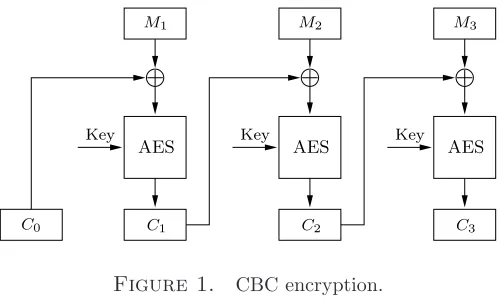
In SSH using CBC mode with AES, the packet is split into blocks, each of length 16 bytes. An initialization vector (IV) is chosen; this IV is prepended to the ciphertext as the 0-th ciphertext blockC0. As depicted in Figure 1, the first block M1 of the packet is XORed with the IV, and the result is put through AES to get the first ciphertext block
C1. Next, the second plaintext block M2 is XORed withC1 (this is called “chaining”), and the result is put through AES to get C2. This process continues until the entire packet has been converted into ciphertext.
C0
Key
AES
C2
Key M3
AES
Key M1
AES
C1
M2
C3
Figure 1. CBC encryption.
In addition, the packet (with a packet number prepended) is put through a Message Authentication Code (MAC) to get a tag. Bob sends Alice the encrypted packet and its tag. Alice then uses the secret AES key and the initialization vectorC0 to decrypt the message — starting withC1, at which point she knows the packet-length and the padding-length — and verifies the MAC tag.
The most commonly used variant of SSH in CBC mode with AES has a feature called inter-packet chaining (IPC). This means that only the IV of the first packet is chosen randomly; each subsequent packet sets its IV equal to the last block of ciphertext from the previous packet. In addition, Bob typically chooses new pseudorandom padding for each packet (although the standards allow a fixed padding that’s the same for all packets).
In [11] Bellare, Kohno, and Namprempre found a chosen-plaintext attack on SSH-IPC. This type of attack is of practical value in situations where the plaintext is known to come from a small set of possibilities (“buy” or “sell”; “attack now” or “delay attack”). The attack in [11] proceeds as follows. Chris has a target ciphertext blockC∗, which is
assumed to be the first block of an encrypted packet that Bob sent to Alice, and he has a guessP about what the corresponding plaintext block is. He knows the initialization vector (IV) for that block (which was the last ciphertext block of the previous packet). He also knows the last ciphertext block of the last packet that Bob encrypted, which is the IV for the first block of the next packet that Bob will send. Chris XORs the two IV’s, and then XORs the result with P to get P′, and somehow he persuades Bob to
encrypt P′ and send the ciphertext to Alice. If the ciphertext that Bob sends is C∗,
This attack is not very practical because Chris has to compute P′ and get Bob to
encrypt it during the time between two packets. In addition, as in any chosen-plaintext attack, Bob has to be willing to encrypt a plaintext chosen by the adversary. However, whether or not this vulnerability has practical significance, resistance to chosen-plaintext attack is widely viewed as important, and so the authors of [11] argue that SSH-IPC needs to be modified.
The first modification they consider, which they call “no packet chaining” (NPC), changes IPC in two ways. First, a fixed padding is used for all packets. Secondly, the IV for a packet is always a newly-chosen pseudorandom bitstring. In other words, in going from IPC to NPC the randomization is shifted from the padding to the IV. The authors of [11] say that it is possible to prove that SSH-NPC preserves confidentiality against chosen-plaintext attacks (and also integrity under a suitable definition). However, they do not give the proof because they found an attack on SSH-NPC that caused them to modify the protocol once again.
The attack on SSH-NPC in [11] is what’s called a reaction-response attack. The adversary intercepts two ciphertextsC1 and C2 that Bob sent to Alice, and from them composes a new ciphertextCthat he sends to Alice. He is able to deduce some informa-tion about the plaintexts corresponding toC1 andC2 based on whether Alice accepts or rejectsC. (We omit the details.) This type of attack would be ruled out by a proof of security against chosen-ciphertext attacks, but not by the proof of security of SSH-NPC against chosen-plaintext attacks.
Then Bellare, Kohno, and Namprempre modify SSH-NPC in such a way as to preclude their reaction-response attack. The new protocol, which they denote SSH-$NPC, differs from SSH-NPC in that randomness is restored to the padding, which is newly generated for each packet. The big advantage of SSH-$NPC is that it prevents not only their attack on SSH-NPC, but in fact any chosen-ciphertext attack. That is, [11] contains a proof of security of SSH-$NPC against chosen-ciphertext attacks. The authors acknowledge that their attacks against SSH-IPC and SSH-NPC are theoretical and not very practical. However, they advise replacing SSH-IPC by SSH-$NPC on the grounds that at little additional cost one gets a protocol that’sprovablysecure against a wide range of attacks, including the ones in their paper.7
3.6. The Albrecht–Paterson–Watson attack on SSH-$NPC. The attack in [2] applies to any of the versions of SSH discussed above — SSH-IPC, SSH-NPC, and SSH-$NPC — even though the last of these was “proved secure” in [11]. The Albrecht– Paterson–Watson attack enables the adversary to learn the first 32 bits of a target ciphertext block (at least a non-negligible proportion of the time). This is not as bad as recovering the key or the complete plaintext, but it is nevertheless a very serious weakness to have in a system for authenticated encryption. The attack is practical; it is of much greater concern in the real world than the theoretical attack on SSH-NPC in [11] that SSH-$NPC was designed to avoid.
Again suppose that Bob sends Alice some packets that are encrypted and authenti-cated using one of the above variants of SSH. LetC∗ denote the target ciphertext block
that Chris wants to know about; perhaps the first 4 bytes of the corresponding plaintext
7The authors of [11] offer several other replacements for SSH-IPC, including one they call SSH-CTR,
contain some important personal data. During a pause in the transmission Chris sends Alice:
(1) a random blockC0 for the initialization vector (except in the case of SSH-IPC, when the IV is the last block of ciphertext in the previous encrypted packet); (2) the blockC1 =C∗;
(3) a continuous stream of random bytes that make up the ciphertext blocksC2, C3, C4, . . ..
Chris simply waits until Alice rejects the message, and this tells him what he wants to know. This is because the first 4 bytes of Alice’s decryption P of C∗ are in the
packet-length field, and so Alice uses that information to determine after what Cj to stop decrypting and verify the supposed tag Cj+1. Of course, the verification fails, so she rejects the message. The actual decryption of the ciphertext blockC∗ of the earlier
packet is notP, because the IV in the earlier transmission ofC∗ was notC
0, but rather the previous ciphertext block C′. Of course, Chris knows both C
0 and C′, and so can compute the first 32 bits of the true decryption ofC∗, which isP ⊕C
0⊕C′.
Remark 12. The packet-length is generally required to be less than some bound and a multiple of the block-length. In the most common implementation of SSH, these two conditions restrict the number in the 4-byte packet-length field to 214 out of 232 possible integers. Thus, each Albrecht–Paterson–Watson attack has only a 2−18 chance of succeeding. Moreover, since Alice will terminate her connection with Bob if the decrypted text does not have the correct format, Chris will not be able to iterate the attack with the same target ciphertext.
Does this mean that the Albrecht–Paterson–Watson attack is not practical? Hardly. First, Chris might be able to iterate the attack over many sessions if some fixed plaintext (such as a password) is being encrypted in multiple sessions [2]. Second, Chris might be simultaneously attacking a large number of users, and he might consider himself successful if he captures 32 bits of personal data from any of them. (See§5 of [55] for an analogous discussion of the distinction between universal and existential key recovery.) If Chris is attacking a million users, he has a success probability of 1− 1−2−1810
6
≈98%. A noteworthy feature of the Albrecht–Paterson–Watson attack is that it is of the same general type as the Bellare–Kohno–Namprempre one. Both are reaction-response attacks, that is, they use information obtained from Alice’s response to the adversary. In other words, the failure of the security model in [11] was due not to a new type of attack, but rather to a clever variant on the same type of attack that the security proof was supposed to guarantee could not happen. The authors of [2] explain this paradoxical situation as follows:
Remark 13. Paterson and Watson [79] developed a security model for authenticated encryption that more accurately captures the manner in which encryption is described in the SSH standards. They prove that SSH-CTR is secure in this model, thereby providing some assurances that implementations of SSH-CTR resist the attacks described in [2].
Remark 14. In [28], the authors describe successful attacks on the authenticated en-cryption schemes in two widely-used communications protocols — SSL/TLS and IPsec. More recently, distinguishing attacks on the TLS authenticated encryption scheme have been presented in [78]. The gap between theory and practice that is demonstrated by these attacks is strikingly similar to the gap exposed by the Albrecht–Paterson–Watson attack on SSH-$NPC. In a section of [28] titled “Cultures in Cryptography” the authors make the following comments:
It might seem strange that there can be such an obvious discrepancy between the theory and practice of cryptography.... Provable security has become an important research area in modern cryptography but is still met with skepticism by many in the practical community. This is understandable considering the types of attack that we outline here. Practitioners might think provable security results provide an absolute statement of security, especially if they’re presented in such a manner. When they later discover that a scheme is insecure because of an attack outside the security model, this might damage their confidence in the whole enterprise of provable security.
4. Leakage Resilience
4.1. Brief history of side-channel attacks. So-called “side-channel” attacks on cryptographic systems — based on information leaked as a consequence of physical processes or implementation features, including power consumption, electromagnetic radiation, timing of operations, induced faults, and error messages — go back a long way. It’s a rich and colorful history that we shall just touch upon briefly (more details can be found in [5, 59]; see also [75, 89, 101]). In the West it was at Bell Labs during World War II where engineers first realized that the electromagnetic emanations from cryptographic hardware could be observed at a distance and used to uncover the plain-text. During the Cold War the U.S. and Soviet sides devoted considerable resources both to carrying out and to protecting themselves from this type of attack. And side-channel eavesdropping was also carried out among allies:
In 1960, after the [British] Prime Minister ordered surveillance on the French embassy during negotiations about joining the European Economic Commu-nity, his security service’s scientists noticed that the enciphered traffic from the embassy carried a faint secondary signal, and constructed equipment to recover it. It turned out to be the plaintext... ([5], p. 525; see also [101], pp. 109-112)
A recently declassified NSA report [75] makes it clear that by the 1950s side-channel attacks were perceived as a major problem. The article describes how extensive the leakage of radiation was:
In addition, these tests revealed the possibility of power analysis attacks (which were not developed in the open cryptographic literature until almost a half century later in [57]):
With rotor machines, the voltage on their power lines tended to fluctuate as a function of the number of rotors moving, and so a fourth phenomenon, called
power line modulation, was discovered. ([75], p. 28)
Another disturbing discovery in those early years was that when one goes to great lengths to introduce countermeasures against one type of side-channel attack, that might just increase vulnerability to another type [75]. This situation, where “no good deed goes unpunished,” persists to the present day.
According to [59], perhaps the first published mention of electromagnetic radiation as a computer security issue was in an article by R. L. Dennis [29] in 1966. The general public became aware of the problem in 1985 when the Dutch researcher Wim van Eck published an article [97] describing how one can use a device that’s easy to build (essentially a modified TV set) to reconstruct the image that’s on a TV monitor in the next room. This made quite a sensation, and the BBC ran a demonstration by Van Eck of what later came to be known as Van Eck phreaking. In the 1980s and 1990s Van Eck phreaking was the most widely publicized example of a side-channel attack on a supposedly secure set-up. It became so well known that it was even a major plot element in Cryptonomicon [94], which the literary critic Jay Clayton [23] called the “ultimate geek novel” and which has been quite popular among math, computer science, and crypto people.
The first presentation of a side-channel attack at a major cryptography conference was Paul Kocher’s Crypto 1996 paper [56] about timing attacks; it was followed two years later by his power analysis attacks [57]. It was Kocher’s papers that first brought these attacks to the center of attention of academic researchers on cryptography.
But even after Kocher’s work, several years went by before any attempt was made to take side-channel attacks into account in the formal models of security. Theoreticians continued to concentrate their efforts on preventing attacks that were probably much less serious threats. This was a source of frustration for many of the practitioners who were trying to better understand side-channel attacks:
Compared to the large number of minor and highly theoretical vulnerabilities of cryptographic primitives and protocols discussed in much of the current computer science literature, compromising emanations are a risk of practical interest that has so far [as of 2003] remained mostly undocumented. ([59], p. 133)
Despite the complaints of applied cryptographers, theoreticians continued to have confidence in the classical theoretical models. During this period the self-confidence of researchers and their faith in the provable security paradigm were forcefully articulated by Victor Shoup [91]:
be very hard. Turning this logic around: if the “hardness assumption” is cor-rect as presumed, the cryptosystem is secure. This approach is about the best we can do. If we can prove security in this way, then we essentially rule out all possible shortcuts, even oneswe have not yet even imagined. The only way to attack the cryptosystem is a full-frontal attack on the underlying hard problem. Period. (p. 15; emphasis in original)
Ironically, this bold statement came in 1998, just as the cryptographic research com-munity was becoming increasingly aware of the side-channel threat. It turned out that provably secure cryptosystems could be successfully attacked by “shortcuts” that had been around for many years. And new side-channel attacks were continually being devel-oped. For example, in 2001 Manger [64] mounted a successful chosen-ciphertext attack on a version of RSA encryption in which he used information learned when ciphertexts are rejected — such as the time it took the decryption to fail or the nature of the error messages that were returned.
It is no wonder that some practitioners reacted with dismay to statements such as Shoup’s (quoted above). They concluded that theoreticians were burying their heads in the sand by insisting on the rock-solid reliability of their models.
Finally, seven years after Kocher’s timing attacks paper and two decades after the Van Eck phreaking paper, the first work appeared [71] that attempted to incorporate side-channel attacks into a theoretical model of security. The authors of [71] described what they called a “crisis” in complexity-theoretic cryptography:
Complexity-theoretic cryptography considers only abstract notions of compu-tation, and hence cannot protect against attacks that exploit the information leakage (via electromagnetic fields, power consumption, etc.) inherent in the physical execution of any cryptographic algorithm. Such physical observation attacks bypass the impressive barrier of mathematical security erected so far, and successfully break mathematically impregnable systems. The great prac-ticality and the inherent availability of physical attacks threaten the very rele-vance of complexity-theoretic security.
One of the most dramatic examples of a successful side-channel attack is also one of the most recent. A group at the Norwegian University of Science and Technology were able to demonstrate a complete break of commercial implementations of quantum key exchange (see [70, 63]). By shining a small laser at Bob’s detector, they could disable the detector, intercept the quantum key bit, and convert it to a classical bit for Bob that agrees with Alice’s bit. They showed how to construct “an eavesdropping apparatus built from off-the-shelf components [that] makes it possible to tracelessly acquire the full secret key” [63]. Although quantum key agreement supposedly is “provably secure” — in fact, in the same strong, information-theoretic sense as one-time pads — the laser attack in [63], which revealed the protocol to be completely insecure, was simply outside the security model in the proof.
To respond to the present crisis, we put forward physically observable cryptog-raphy: a powerful, comprehensive, and precise model for defining and deliver-ing cryptographic security against an adversary that has access to information leaked from the physical execution of cryptographic algorithms. Our general model allows for a variety of adversaries. In this paper, however, we focus on the strongest possible adversary, so as to capture what is cryptographically possible in the worst possible, physically observable setting. In particular, we
• consider an adversary that has full (and indeed adaptive) access to any leaked information;
• show that some of the basic theorems and intuitions of traditional cryp-tography no longer hold in a physically observable setting; and
• construct pseudorandom generators that are provably secure against all physical-observation attacks.
Our model makes it easy to meaningfully restrict the power of our general physically observing adversary. Such restrictions may enable schemes that are more efficient or rely on weaker assumptions, while retaining security against meaningful physical observations attacks.
Reading these paragraphs could give the practical cryptographer false hopes. De-spite the extravagant promises, the paper [71] contains no concrete construction of any pseudorandom generator, let alone one that resists side-channel attacks. Nor does [71] describe any techniques that “make it easy to meaningfully restrict the power” of the side-channel attacker.
Rather, what [71] does contain is “philosophy” in the sense that Rogaway uses that term in the passage quoted in the Introduction — that is, a high-level discussion of some of the general issues involved in security against a “physically observing adversary.” For example, the authors note that the classical theorem about pseudorandom generators that says that unpredictability and indistinguishability are equivalent (in the earlier theoretical models) no longer holds if one allows for adversaries that observe traces of the physical act of computation. It is possible that such an adversary may be unable to make any prediction about the output, but nevertheless can distinguish the output from random output.
Despite readers’ disappointment in finding that everything in [71] is on a broad philo-sophical plane and that they are no better able to develop countermeasures or evaluate protocols for resistance to side-channel attacks after reading the paper than they were before reading it, the authors deserve credit for opening up a new area of research and for having the courage to criticize the earlier theoretical models that ignored side-channel adversaries.
A similar remark applies to another widely-cited article that also attempted to present a broad theoretical framework for analyzing resistance to side-channel attacks. The paper [93] by Standaert, Malkin, and Yung, which was posted in 2006 but not published until 2009, promises to present