Plaintext-Dependent Decryption:
A Formal Security Treatment of SSH-CTR
⋆Kenneth G. Paterson⋆⋆ and Gaven J. Watson⋆ ⋆ ⋆
Information Security Group, Royal Holloway, University of London,
Egham, Surrey, TW20 0EX, U.K.
[email protected], [email protected]
Abstract. This paper presents a formal security analysis of SSH in counter mode in a security model that accurately captures the capabilities of real-world attackers, as well as security-relevant features of the SSH specifications and the OpenSSH implementation of SSH. Under reasonable assumptions on the block cipher and MAC algorithms used to construct the SSH Binary Packet Protocol (BPP), we are able to show that the SSH BPP meets a strong and appropriate notion of security: indistinguishability under buffered, stateful chosen-ciphertext attacks. This result helps to bridge the gap between the existing security analysis of the SSH BPP by Bellareet al.and the recently discovered attacks against the SSH BPP by Albrechtet al.which partially invalidate that analysis.
Keywords:SSH; counter mode; security proof
1 Introduction
SSH is one of the most widely used secure network protocols. Originally designed as a replacement for insecure remote login procedures which sent information in plaintext, it has since become a general purpose tool for securing Internet traffic. The current version of SSH, SSHv2, was designed in 1996, and it is this version to which we refer throughout this paper. The SSHv2 protocols are defined in a collection of RFCs [6, 17–20].
The SSH Binary Packet Protocol (BPP), as specified in [19], is the component of SSH that is responsible for providing confidentiality and integrity services to all messages exchanged over an SSH connection. It was subjected to a formal cryptographic security analysis using the methods of provable security by Bellareet al.[5]. Bellareet al.introduced a stateful security model and notion for SSH-style protocols. They also proved that several minor variants of the SSH BPP meet their security notion, given reasonable assumptions about the cryptographic primitives. In particular, they showed that, while the SSH BPP using CBC mode encryption with IV chaining (SSH-IPC) is insecure, the SSH BPP using either CBC mode encryption with explicit random IVs and random padding (SSH-$NPC), or counter mode encryption (SSH-CTR), is secure in their model.
However, the recent work of Albrecht et al. [1] has demonstrated plaintext recovery attacks against both SSH-IPC and SSH-$NPC, despite the proof of security for SSH-$NPC in [5]. The attacks in [1] exploit several features that are intrinsic to the SSH specification and to imple-mentations, but that are not captured in the security model of [5]: firstly, the decryption process depends on the packet length field, which itself forms part of the plaintext data; secondly, data can be delivered to the decrypting party in a byte-by-byte manner by an attacker, allowing the attacker to observe the behaviour of the decrypting party after each byte is received; and, thirdly, the attacker can distinguish various kinds of decryption failure (most importantly, the attacker can tell exactly when a MAC fails to verify). As a consequence of these attacks, versions 5.2 and
⋆This research was supported in part by the European Commission under contract ICT-2007-216676 (ECRYPT-II). A short version of this paper is to appear in the proceedings of Eurocrypt 2010. This is the full version.
⋆⋆ This author supported by an EPSRC Leadership Fellowship, EP/H005455/1.
higher of OpenSSH, the leading implementation of SSH, now negotiate the selection of counter mode in preference to CBC mode. This follows the recommendation of the CPNI vulnerability announcement [10]. OpenSSH versions 5.2 and higher also include specific counter-measures for CBC mode to frustrate the CBC-specific attacks of [1].
No attacks are known against the SSH BPP using counter mode, and the security model and proof for the relevant scheme SSH-CTR provided in [5] does rule out many classes of attack. Yet it is evident, in view of the attacks in [1], that the current formal security analysis of SSH-CTR in [5] is inadequate. In particular, the current analysis of SSH-CTR does not take into account the plaintext-dependent nature of the decryption process, nor the ability of the attacker to interact in a byte-by-byte manner with the decryption process. Indeed, the length field which turns out to be so critical to breaking SSH in [1] is ignored in the security analysis of [5], while it is assumed in [5] that ciphertexts are processed in an atomic fashion. Moreover, while the model of [5] does include errors arising from cryptographic processing, it does not do so in a way that accurately reflects the reality of SSH implementations such as OpenSSH – in the model of [5], any error condition leads to an identical error message, while in reality, the error type and the timing of the error can both leak to the adversary. This additional information was also exploited in the attacks of [1].
1.1 Our contribution
This paper aims to bridge the gap between the current security analysis of the SSH-CTR in [5] on the one hand, and the reality of the SSH specifications in the RFCs and the OpenSSH implementation of the SSH BPP using counter mode on the other. We develop a security model for the SSH BPP that extends the stateful model introduced in [5] and that is driven by our desire to more closely align the security model with the SSH specifications and the OpenSSH implementation. We focus on the OpenSSH implementation in preference to any of the many other SSH implementations available because of its widespread use [16]. A novel aspect of our security model is its ability to allow the attacker to interact with the decryption oracle in a byte-by-byte fashion, with ciphertext bytes being buffered until they can be processed. Novel aspects of our description of the SSH BPP using counter mode include its provision for plaintext-dependent decryption, and accurate modeling of all the error events that arise during decryption in the OpenSSH implementation of the SSH BPP in counter mode. We prove that the SSH BPP using counter mode is secure in our model, under standard assumptions concerning the cryptographic components used in the construction. This requires significant reworking of the security analysis for counter mode in [5] to take account of the new features of our model and our description of the SSH BPP. Our analysis is sufficient to show that the SSH BPP using counter mode is immune to the type of attacks reported in [1].
1.2 Related Work
The way in which decryption operates in SSH is related to a branch of cryptography called online encryption, as studied in [8, 3, 2, 11–14]. These papers all investigate blockwise adaptive attackers against the encryption process rather than against the decryption process, so that the attacker chooses plaintext blocks in an adaptive manner, seeing the corresponding ciphertext blocks one-by-one as the chosen plaintext blocks are encrypted. This approach is motivated by cryptographic applications for small devices such as smart cards which cannot store a whole ciphertext in internal buffers and which must therefore output ciphertext blocks as the buffer fills. As we will see, while the encryption process used in the SSH BPP could in principle be on-line, in practice (e.g. in the OpenSSH implementation) it is not. On the other hand, the adversary can interact with the decryption process in a block-by-block (or even byte-by-byte) manner, and, as the attacks of [1] show, can gain significant advantage by doing so. So while the online encryption literature appears to be related to our work, the link is superficial and the work is not directly applicable to the case of SSH.
1.3 Paper Organisation
We begin by giving a description of the SSH Binary Packet Protocol in Section 2, using this to identify the key features required in our modeling of the SSH BPP and its security. In Section 3 we define the building blocks that we use to define the SSH BPP’s Encode-then-Encrypt&MAC encryption scheme. Section 4 gives the definitions of our new security models. Section 5 contains our proof of security for SSH using counter mode encryption. Section 6 presents our conclusions.
2 SSH Binary Packet Protocol
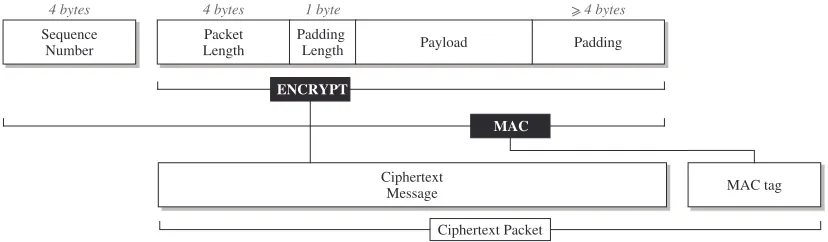
The SSH Binary Packet Protocol (BPP) is defined in RFC 4253 [19]. The SSH BPP provides both confidentiality and integrity of messages sent over an SSH connection using an encode-then-encrypt&MAC construction. A message is first encoded by prepending a 4 byte packet length field and 1 byte padding length field and appending a minimum of 4 bytes of random padding. The packet length field specifies the total length of the encoded message excluding the packet length field itself. This encoded message is then encrypted. There are various algorithms supported for encryption, but here, in the light of the attacks in [1], we only consider stateful counter mode encryption, as specified for SSH in RFC 4344 [6]. Since the SSH BPP is specified in a blockwise manner, SSH still appends padding even when using counter mode encryption. The final ciphertext is the concatenation of the encoded-then-encrypted message and a MAC value. The MAC value is computed over the concatenation of a 32-bit packet sequence number and the encoded (but not encrypted) message. The sequence number is not sent over the channel but is maintained separately by both communicating parties. Figure 1 illustrates the SSH BPP.
2.1 Modeling the SSH BPP and its Security
We now give a high-level description of the main features of our model for the SSH BPP and its security, explaining how these arise from features of the SSH BPP specification and specific implementations.
As with the model of [5], our model for the SSH BPP is a stateful one, reflecting the protocol’s use of per-packet sequence numbers. We also wish to give the adversary access to encryption and decryption oracles in a left-or-right indistinguishability game. We next discuss how these oracles should be defined, with further details to follow in the sections ahead.
> 4 bytes
Packet Length
Padding Length Sequence
Number Payload Padding
ENCRYPT
MAC
Ciphertext
Message MAC tag
Ciphertext Packet
4 bytes 4 bytes 1 byte
Fig. 1.SSH BPP packet format and cryptographic processing
least require the packet length to be fixed in advance of the first block being encrypted. In practice, the encryption is not done in an online manner. For example, in OpenSSH, the MAC on the whole plaintext is calculated prior to any encryption being performed, with the entire plaintext being buffered before this operation is carried out (see the function packet_send2_wrapped in the file packet.c of the OpenSSH source code).
At this point, our model begins to significantly diverge from the model of [5].
When decrypting a ciphertext, the receiver should first decrypt the first block received and retrieve the packet length field in order to determine how much more data must be received before the MAC tag is obtained. According to RFC 4253 [19]:
“Implementations SHOULD decrypt the length after receiving the first 8 (or cipher block size, whichever is larger) bytes of a packet.”
Thus we may expect that an SSH implementation will enter into a wait state, awaiting further data, unless sufficient data has already arrived to complete the packet. Informally speaking, this renders the entire decryption process plaintext-dependent, in the sense that the number of ciphertext bytes required before the decryption process can complete (possibly with an error message because of a MAC verification failure) is determined by the initial bytes of the plaintext. Moreover, because SSH is implemented over TCP, the attacker can deliver as few or as many bytes of ciphertext at a time as he wishes to the decrypting party. These facts are exploited in the attacks against the SSH BPP in CBC mode in [1]. Thus our security analysis for the SSH BPP needs to consider the length field and how its processing affects security, as well as allowing the adversary to deliver data to the decryption oracle in a byte-by-byte manner in the security model. However, it should be noted that the plaintext message is not made available to the adversary in a byte-by-byte manner as it is decrypted. Instead, in implementations, the plaintext is buffered until sufficient data has arrived that the MAC can be checked. Our model, therefore, needs to allow byte-by-byte delivery of ciphertext data, but also to include a buffered decryption process.
In fact, the situation is more complicated than this because implementations of SSH also follow the advice in RFC 4253 [19] to perform sanity checking of the length field as soon as it is obtained from the first block of ciphertext:
“. . . implementations SHOULD check that the packet length is reasonable in order for the implementation to avoid denial of service and/or buffer overflow attacks.”
these different error conditions is used in the attacks against OpenSSH in CBC mode in [1]. So a security model for the SSH BPP should include errors arising from length checking as well as from MAC failures, and should report these errors in such a way that they can be distinguished by the adversary. Additional errors may arise after MAC checking, because of a failure of the decoding algorithm applied to the recovered, encoded message. Again, the model should reflect this possi-bility. To comply with the SSH specifications, all of these errors should be “fatal”, leading to the destruction of the SSH connection. However, note that an adversary may be able to prevent such error messages from reaching the peer of party initiating the tear-down. We handle this aspect by having separate states for the encryption and decryption oracles in our model, and with an error arising during decryption leading to the loss of the decryption oracle, but not the encryption oracle, and vice-versa.
It is notable that SSH attempts to hide the packet length field by encrypting it. However, a simple extension of the attacks in [1] shows that this is futile: an attacker who can detect the start of a new packet simply needs to flip a bit somewhere in the ciphertext after the length field and wait for a MAC failure. Simple arithmetic involving the number of ciphertext bytes delivered before the MAC failure is seen then tells the attacker what the content of the packet length field was. Of course, the cost of this attack is to lose the SSH connection. However, it shows that the length field cannot be hidden from an active attacker. For this reason, we will insist that, in our left-or-right indistinguishability game, all pairs of messages submitted to the encryption oracle should have the same length when encoded, so that they cannot be trivially distinguished using the above attack.
3 Definitions
3.1 Notation
First let us begin by defining some notation. For a stringx, let|x|denote the length ofxin bytes, and let x[i] denote the i-th block of x, where, throughout, blocks consist of L bytes. Letx[1. . .n] denote the concatenation of the blocksx[1], x[2], . . ., x[n] ofxand letxky denote the concatenation of stringsx and y. Letεdenote the empty string. Lethiit denote thet-byte binary representation of integer i, where 0≤i <28t.
3.2 Building Blocks
Based on the discussion in the previous section, we now define the primitives which form the building blocks in our description of the SSH BBP’s encode-then-encrypt&MAC construction. These building blocks are an encoding schemeEC, an encryption scheme (we consider only counter mode encryption) and a message authentication scheme MA.
Encoding Scheme: Theencoding scheme EC= (enc,dec) used in SSH consists of an encoding
al-gorithmencand a decoding algorithmdec. The encoding algorithmencis stateful and randomised,
takes as input a message m and outputs two messages (me, mt). Here as in [5], me denotes the encoded message which will be used by any future encryption process and mt denotes the en-coded message which will be used by a MAC tagging algorithm. As required by the SSH BPP, the encoding algorithm prepends some length information about the message and appends some padding.
The decoding algorithm dec is stateful and deterministic. It takes as input the full encoded
Algorithm enc(m) if ste=⊥then
return (⊥,⊥) end if
if SNe≥232or|m| ≥232−5then
ste←⊥ return (⊥,⊥) else
P L←L−((|m|+ 5) modL) if P L <4then
P L←P L+L
end if
P D← {r 0,1}8·P L
LF ←(1 +|m|+P L)
me← hLFi4khP Li1kmkP D
mt←SNekme
SNe←SNe+ 1 return (me, mt) end if
Algorithm dec(me) if std=⊥then
return ⊥
end if
if SNd≥232then
std←⊥ return ⊥
else
Attempt to parseme as:
hLFi4khP Li1kmkP Dwhere
P L≥4,|P D|=P Land|m| ≥0. if parsing failsthen
std←⊥ return ⊥P else
SNd←SNd+ 1 return m
end if end if
Fig. 2.Encoding Scheme for SSH
only be called during the decryption process for SSH if both length checking and MAC checking have not returned errors. For correctness of the encoding scheme, we require that for any m with
enc(m) = (me, mt)6= (⊥,⊥), we havedec(me)6=⊥P.
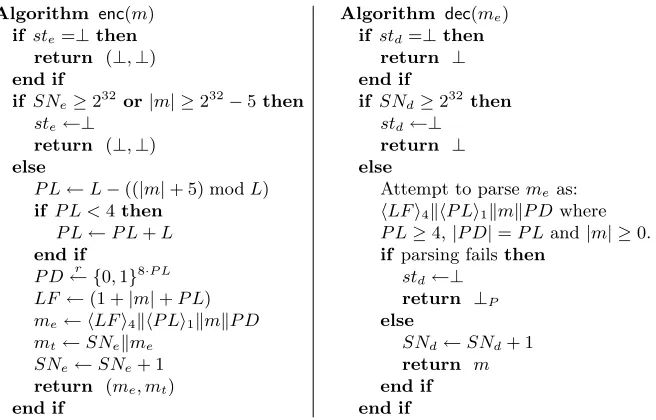
The specific encoding scheme used by the SSH BPP specification is shown in Figure 2. Here,L
denotes the block-size in bytes of the block cipher in use (or the default value of 8 if a stream cipher such as ARCFOUR is being used), LF denotes the length field, P L denotes the padding length and P D denotes the padding bytes. The padding bytes are assumed to be random in our security analysis, though our security results also hold for any distribution on the padding bytes (including fixed bytes). We test that the message m submitted for encoding contains at most 232−6 bytes, so that the length of the encoded message can be recorded in the 4-byte length field. Each of the two algorithms enc, dec maintains a separate state of the form (st, SN), initially set to (ε,0). In
each case, the first component st maintains the status of the algorithm, i.e. if the algorithm is in an error state or not. This is used to model the effect of an SSH connection tear-down when an error occurs. The second component SN denotes a 32-bit sequence number. Note that RFC 4344 [6] states that when the sequence number SN wraps around, new keys must be negotiated. For simplicity in our analysis, we model this by forcing ste (orstd) to⊥ when SNe (or SNd) reaches 232. In our full model of the SSH BPP, this has the effect of removing the adversary’s access to the
encryption or decryption oracle. This ensures that each value of SNe or SNd is used only once, and is equivalent to enforcing rekeying when the relevant sequence number wraps around. Note that in [5], the equivalent state consists of a single value which is “over-loaded” to carry both the algorithm status and sequence number. For concreteness, Figure 2 shows the specific parsing steps carried out by OpenSSH during decoding. Here, it is verified that the padding length field has a value greater than 4 and that the decoded message m has length zero or greater; other implementations may perform different checks here.
Encryption Scheme: The construction of SSH that we consider uses counter mode encryption of a block cipher, and is called SSH-CTR in [5]. When we come to formally analyze the security of SSH-CTR, we will regard the block cipher as being a pseudorandom function family rather than as a pseudorandom permutation family. This allows us to directly use some of the results from [4]. Our definition for a pseudorandom function family can be found in Appendix A.1.
the underlying pseudorandom function family F, therefore specifying a functionFKe having l-bit
inputs andL-byte outputs. Note that in practice we havel= 8Lsince all block ciphers have equal input and output size. The key generation algorithm also outputs a random l-bit initial counter
ctr, which is used to initialise counters in both the encryption and decryption algorithms. Because of the encoding algorithm used in encryption and the length checking used during decryption (see Section 3.3), we can assume that the encryption and decryption algorithms E-CTR,D-CTR both take as input a sequence of plaintext or ciphertext bytes which can be split into a sequence of
L-byte blocks.
We also define the scheme CTRE C[F] to be a combination of counter mode encryption and the encoding/decoding scheme from Figure 2, with the detailed algorithms for this scheme appearing in Appendix A.1. This construction is not used in SSH, but is needed as a step in our security analysis in Section 5. The scheme CTRE C[F] features a buffered decryption algorithm: it takes as input a string c of any length which is added to a buffer cbuff and then used as required. This reflects the way that buffered decryption occurs in our overall model for SSH-CTR.
Message Authentication Scheme: Amessage authentication scheme(MAC)MA= (Kt,T,V) consists of three algorithms. The key generation algorithmKtreturns a keyKt. The tag algorithm
T, which may be stateful and randomised, takes as input the key Kt and an encoded message
mt and returns a tag τ. The verification algorithm V, which is deterministic and stateless, takes as input the key Kt and an encoded message mt and a candidate tag τ′ and outputs a bit. For any keyKt, message mt and internal state ofTKt, we require that VKt(mt,TKt(mt)) = 1. Security
notions for MACs can be found in Appendix A.2.
3.3 Encode-then-Encrypt&MAC
With the above components defined, we are now ready to define SSH-CTR. Note that our version is significantly different from that considered in [5] because of the new features that we discussed in Section 2.1.
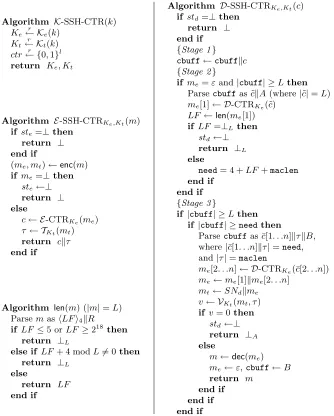
Our construction of SSH-CTR is an Encode-then-Encrypt&MAC construction with plaintext-dependent decryption. We define SSH-CTR = (K-SSH-CTR,E-SSH-CTR,D-SSH-CTR) in Figure 3. This makes use of the encoding scheme EC described in Section 3.2, the encryption scheme CTR[F] and a message authentication schemeMA, where the length of the MAC tag ismaclen. It also makes use of a length checking algorithmlenthat we discuss below. Note that this construction
is stateful. The encryption state arises from the counter mode state ctre combined with the state (ste, SNe) of the algorithmenc. The decryption state arises from the counter mode state ctrd, the state (std, SNd) of the algorithmdec, and the ciphertext buffercbuff. We will refer to the scheme SSH-CTR[F] whenever we wish to highlight the scheme’s reliance on a particular function family
F in the encryption component.
The key generation algorithm K-SSH-CTR selects keys for counter mode encryption and the MAC algorithm uniformly at random from the relevant key-spaces. This represents a significant abstraction from reality in our description of SSH-CTR, since in practice these keys and the initial counter value ctr are derived in a pseudorandom manner from the keying material established during SSH’s key exchange protocol. The decryption algorithm D-SSH-CTR is considerably more complex than one might expect. This complexity is required to accurately model all the features of the SSH specification and the OpenSSH implementation. D-SSH-CTR operates in 3 distinct stages.
In Stage 1, a sequence of ciphertext bytescof arbitrary length is received and appended to the ciphertext buffer cbuff.
Algorithm K-SSH-CTR(k)
Ke r
← Ke(k)
Kt r
← Kt(k)
ctr← {r 0,1}l return Ke, Kt
Algorithm E-SSH-CTRKe,Kt(m)
if ste=⊥then return ⊥
end if
(me, mt)←enc(m) if me=⊥then
ste←⊥ return ⊥
else
c← E-CTRKe(me) τ ← TKt(mt)
return ckτ
end if
Algorithm len(m) (|m|=L) ParsemashLFi4kR
if LF ≤5 orLF ≥218then
return ⊥L
else if LF+ 4 modL6= 0then return ⊥L
else
return LF
end if
Algorithm D-SSH-CTRKe,Kt(c)
if std=⊥then return ⊥
end if
{Stage 1} cbuff←cbuffkc {Stage 2}
if me=εand|cbuff| ≥Lthen Parsecbuffas ˜ckA(where|˜c|=L)
me[1]← D-CTRKe(˜c) LF ←len(me[1]) if LF =⊥Lthen
std←⊥ return ⊥L else
need= 4 +LF+maclen
end if end if
{Stage 3}
if |cbuff| ≥Lthen if |cbuff| ≥needthen
Parsecbuffas ¯c[1. . .n]kτkB, where|c¯[1. . .n]kτ|=need, and|τ|=maclen
me[2. . .n]← D-CTRKe(¯c[2. . .n]) me←me[1]kme[2. . .n]
mt←SNdkme
v← VKt(mt, τ)
if v= 0then
std←⊥ return ⊥A else
m←dec(me)
me←ε,cbuff←B return m
end if end if end if
Fig. 3.SSH-CTR, SSH using counter mode encryption
to the function len. This accords with our discussion in Section 2.1. The function len is shown
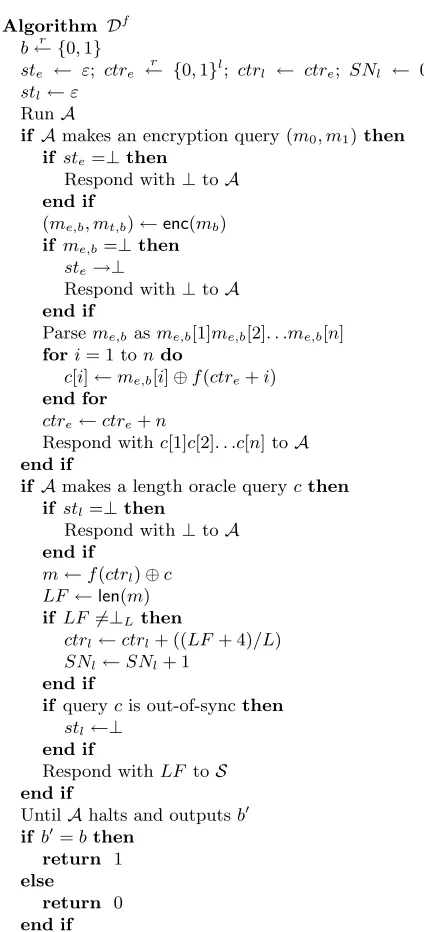
algorithm plaintext-dependent. However, it is not fully online, since no further output is produced by D-SSH-CTR until the complete ciphertext has arrived and its MAC has been checked.
In Stage 3 of D-SSH-CTR, ciphertext bytes that have been buffered in cbuff during Stage 1 are processed. Note that our model allows the recipient to receive more data than he expects; this data is denoted by B in Stage 3. This data is assumed to be the start of the next ciphertext message and so we reinitialisecbuffwith this data at the end of Stage 3. Once the buffer contains sufficient data (as determined by the variable need), the decryption algorithm uses counter mode to obtain the encoded plaintext meand the messagemtto be verified by the MAC algorithm (this consists of me with the sequence number prepended). The MAC tag is then checked, and, if it verifies successfully, the encoded plaintextmeis passed to the decalgorithm (as defined in Figure 2). Notice that three types of error can arise during this stage: a failure of the MAC verification, resulting in output ⊥A, a failure of parsing during decoding, resulting in output ⊥P, or a wrap-around of the sequence number SNd during decoding, resulting in output ⊥. When any of these errors arises, the state std of the decryption algorithm is set as ⊥. This state is checked at the start of every oracle query and if it equals ⊥, then an error message ⊥ is returned. In this way, our description of SSH-CTR models the subsequent connection tear-down seen in OpenSSH.
This description of SSH-CTR faithfully models the behaviour of OpenSSH in counter mode, in the sense of having buffered, plaintext-dependent decryption, and with errors arising at exactly the same points during decryption and based on the same failure conditions that are tested in OpenSSH. There are other ways in which to implement SSH and still be RFC-compliant. For example, the full decoding of the message, and hence parsing checks, could be performed before the MAC verification, as is the case in the construction of SSH-CTR given in [5]. However, it is not hard to derive distinguishing attacks against SSH-CTR when the OpenSSH parsing checks are carried out before MAC verification and the parsing and MAC failure errors are distinguishable (which they are not in [5]).
4 Security Models
4.1 Chosen Plaintext Security
We begin by extending the usual left-or-right (LOR) indistinguishability game for a CPA adversary from [4] to handle stateful encryption and leakage of length information. This extension is only needed at intermediate steps in our security analysis, while we are primarily interested in the security of the SSH BPP under chosen ciphertext attacks. For this reason, we content ourselves with chosen plaintext security definitions that are tied to the particular schemes SSH-CTR[F] and CTRE C[F] that we need to analyze.
In the usual LOR-CPA model the adversary is given access to a left-or-right encryption oracle
E(LR(·,·, b)), where b ∈ {0,1}. This oracle takes as input two messages m0 and m1. If b = 0 it
outputs the encryption of m0 and if b = 1 it outputs the encryption of m1. It is the adversary’s
numberSNl by 1, each time the oracle is called; at the start of the security game,ctrlandSNl are set to the corresponding values held at the encryption oracle. The detailed operation of the length oracle associated with the schemes SSH-CTR[F] and CTRE C[F] can be found in Appendix A.2. We name our new model LOR-LLSF-CPA, where “LLSF” stands for “length leaking stateful”.
In [5], decryption queries are defined to be either “in-sync” or “out-of-sync” with respect to the sequence number at the encryption oracle. We introduce a similar concept for length oracle queries in our next definition:
Definition 1. [LOR-LLSF-CPA]
Consider the stateful encryption scheme SE= (K,E,D) with an associated length oracleL(·). Let
b∈ {0,1} and k∈N. Let A be an attacker that has access to the oracles EK(LR(·,·, b)) and L(·)
The game played is as follows:
Explor-llsf-cpa-E,A b(k)
K ← Kr (k)
b′
← AEK(LR(·,·,b)),L(·) return b′
For all queries(m0, m1)toEK(LR(·,·, b)), we require that|enc(m0)|=|enc(m1)|. In this model
the adversary has the possibility of making three different types of query to L. Let SNe denote the sequence numbers at the encryption oracle and let SNl denote the sequence numbers at the length oracle.
– A query c to L when the length oracle has sequence number SNl is said to be in-sync if c is equal to the first block of ciphertext output by the encryption oracle when it had sequence numberSNe=SNl.
– A query c to L when the length oracle has sequence number SNl is said to be an out-of-sync current state query if c is not equal to the first block of ciphertext output by the encryption oracle when it had sequence number SNe=SNl.
– A query to L when the length oracle has sequence number SNl is said to be an out-of-sync future state query if SNl > SNe, where SNe is the sequence number used by the encryption oracle when responding to its most recent query.
We require that the response to any further length oracle queries following the first out-of-sync query is ⊥.
The attacker wins when b′
=b, and its advantage is defined to be:
Advlor-llsf-cpaSE,A (k) = Pr[Exp
lor-llsf-cpa-1
SE,A (k) = 1]−Pr[Exp
lor-llsf-cpa-0
SE,A (k) = 1]. The advantage function of the scheme is defined to be
Advlor-llsf-cpaSE (k, t, qe, µe, ql) = max
A {Adv
lor-llsf-cpa
SE,A (k)}
for any integerst, qe, µe, ql. The maximum is over all adversariesAwith time complexity t, making at most qe queries to the encryption oracle, totalling at most µe bits in each of the left and right inputs, and ql queries to the length revealing oracle.
4.2 Chosen Ciphertext Security
Now we consider chosen ciphertext attackers1. We introduce a new security notion for left-or-right indistinguishability against chosen-ciphertext attackers for buffered, stateful decryption (LOR-BSF-CCA). In this model, which extends the IND-SFCCA model of [5], the adversary is given
1 Note that an online encryption scheme cannot be CCA secure [8]. Despite the underlying encryption scheme we
access to an encryption oracle and to a buffered decryption oracle. The model applies for any encryption scheme in which the decryption oracle maintains a buffer of as-yet-unprocessed cipher-text bytescbuff and in which encryption and decryption states include sequence numbers which are incremented after each successful operation. For reasons explained in Section 2.1, we need to limit the attacker’s queries to the encryption oracle to pairs of messages (m0, m1) having the same
length when encoded.
Definition 2. [LOR-BSF-CCA]
Consider the symmetric encryption scheme SE = (K,E,D) with buffered, stateful decryption. Let
b∈ {0,1}andk∈N. LetAbe an attacker that has access to the oraclesEK(LR(·,·, b))andDK(·).
The game played is as follows:
Explor-bsf-cca-SE,A b(k)
K ← Kr (k)
b′
← AEK(LR(·,·,b)),DK(·) (k) return b′
We require that for all queries(m0, m1) toEK(LR(·,·, b)),|enc(m0)|=|enc(m1)|. In this model the
adversary has the possibility of making three different types of decryption query. Let SNe denote the sequence numbers at the encryption oracle and let SNd denote the sequence numbers at the decryption oracle. Recall that, since the adversary can deliver ciphertexts in a byte-wise fashion to the decryption oracle, the same value ofSNdmay be involved in processing a sequence of ciphertext queries.
– The sequence of decryption queries corresponding to the sequence number SNd is said to be in-sync if, after input of the final query in the sequence, the ciphertext buffer cbuff has as a prefix the output from the encryption oracle for sequence number SNe = SNd. The response from an in-sync query is not returned to the adversary.
– The sequence of decryption queries corresponding to the sequence number SNd is said to be an out-of-sync current state query if, after input of the final query in the sequence, the ciphertext buffercbuff does not have the output from the encryption oracle for sequence number SNe=
SNd as a prefix.
– The sequence of decryption queries corresponding to the sequence number SNd is said to be an out-of-sync future state query if SNd > SNe, where SNe is the sequence number used by the encryption oracle when responding to its most recent query.
The response to any further decryption queries following an out-of-sync query is the ⊥symbol.
The attacker wins when b′
=b, and its advantage is defined to be:
Advlor-bsf-ccaSE,A (k) = Pr[Exp
lor-bsf-cca-1
SE,A (k) = 1]−Pr[Exp
lor-bsf-cca-0
SE,A (k) = 1]. The advantage function of the scheme is defined to be
Advlor-bsf-ccaSE (k, t, qe, µe, qd, µd) = max
A {Adv
lor-bsf-cca
SE,A (k)}
for any integers t, qe, µe, qd, µd. The maximum is over all adversaries A with time complexity t, making at most qe queries to the encryption oracle, totalling at most µe bits in each of the left and right inputs, and at most qd series of queries to the decryption oracle, totalling at most µd bits.
decryption queries in order to permit the adversary to observe the system’s behaviour in encrypting messages of its choice and to let the adversary advance the sequence numbers maintained at the encryption and decryption oracles to values of its choice. We make the restriction that only one of-sync query is allowed for the same reason that this restriction is made in [5]: if the first out-of-sync query does not decrypt successfully, the decryption oracle enters a halting state anyway, while if it does, then our security analysis will show that the adversary has broken the strong unforgeability of the MAC scheme. Our security model and analysis can be extended to handle multiple out-of-sync decryption queries.
The specific decryption oracle that we consider when analyzing the security of SSH-CTR op-erates exactly as the decryption algorithm D-SSH-CTR in Section 3.3: the oracle takes as input an arbitrary number of bytes which is then added to cbuff; the decryption process uses the first plaintext block to determine how many bytes of ciphertext are needed to complete the packet; and the decryption process involves length checking, MAC checking, and decoding, with each of these steps potentially outputting a distinct error message. Also note that for SSH-CTR, the decryption oracle acts as a “bomb” oracle: when an error of any type occurs this oracle simply outputs ⊥
in response to any further query. This models an attempt by the decrypting party to initiate an SSH connection tear-down. However, note that our model for SSH-CTR has separate states for encryption and decryption, so that the encryption oracle is not “lost” if the decryption oracle is. This allows us to model an adversary that outputs the relevant error messages. This description of SSH-CTR in the context of the LOR-BSF-CCA model is sufficiently rich to give the attacker all the capabilities exploited in the attacks of Albrecht et al.[1]. Thus, if we can prove SSH-CTR to be secure in the LOR-BSF-CCA sense, then attacks of the kind developed in [1] will be prevented.
4.3 Integrity of Ciphertexts
We next extend the INT-SFCTXT model from [5] to include buffered decryption. We call our new model “integrity of ciphertexts for buffered, stateful decryption” or INT-BSF-CTXT. The model again applies for any encryption scheme in which the decryption oracle maintains a buffer of as-yet-unprocessed ciphertext bytes cbuff and in which encryption and decryption states include sequence numbers which are incremented after each successful operation.
Definition 3. [INT-BSF-CTXT]
Consider the symmetric encryption scheme SE = (K,E,D) with buffered, stateful decryption, and let k ∈ N. Let A be an attacker that has access to the oracles EK(·) and DK(·). In this game
the adversary again has the possibility of making three different types of decryption query: in-sync, out-of-sync current state and out-of-sync future state. These are defined exactly as in the LOR-BSF-CCA security game above. The response to any further decryption queries following an out-of-sync query is the ⊥symbol. The game played is as follows:
Expint-bsf-ctxtSE,A (k)
K ← Kr (k)
if AEK(·),DK(·)(k) makes an out-of-sync sequence of queries to the decryption oracleDK(·)
such that:
– there is an output from the decryption oracle; and – the output is not a member of the set {⊥L,⊥A,⊥P,⊥}. thenreturn 1
else return 0
The attacker’s advantage is defined to be:
Advint-bsf-ctxtSE,A (k) = Pr[Exp
int-bsf-ctxt
The advantage function of the scheme is defined to be
Advint-bsf-ctxtSE (k, t, qe, µe, qd, µd) = max
A {Adv
int-bsf-ctxt
SE,A (k)}
for any integerst, qe, µe, qd, µd. The maximum is over allA with time complexityt, each making at most qe queries to the encryption oracle, totalling at mostµe bits, and at mostqd series of queries to the decryption oracle, totalling at most µd bits.
Again, the specific decryption oracle that we consider when analyzing the security of SSH-CTR operates exactly as the decryption algorithm D-SSH-CTR in Section 3.3.
4.4 Security of Message Authentication Schemes
Finally, we define two security notions for MACs. We will use the LOR-DCPA notion from [5], for distinct plaintext privacy of message authentication schemes. We will also use the standard SUF-CMA model for strong unforgeability of MACs. The formal definitions for these notions can be found in Appendix A.2.
5 Security Analysis
We will now present our main result, Theorem 1. This theorem provides a concrete security guar-antee for the scheme SSH-CTR[F] in terms of security properties of the pseudorandom function family F and MAC scheme MAused in its construction. The structure of our proof follows that in [5], but with significant modifications being needed to handle the new features of our security model and adversary. Our proof is valid no matter what length checks are performed by the encod-ing scheme, so long as the minimal length check described previously is included. Our proof is also valid (and in fact can be tightened slightly) if the random padding bytes in the encoding scheme are replaced by fixed bytes. It is also valid no matter what specific parsing checks are carried out, provided that the encoding scheme is correct. With the exception of our main result, the proofs can all be found in Appendix B.
Theorem 1. Let SSH-CTR[F] be the combined encryption scheme for the encoding scheme EC, counter mode encryption CTR[F]and a message authentication scheme MA. Then SSH-CTR[F] is LOR-BSF-CCA secure if F is a pseudorandom function family, if T (the tagging algorithm from MA) is a pseudorandom function family, and if MA is SUF-CMA secure. Concretely, for
qe, qd≤232,µe ≤8L2l−8qe(8 +L) and any t, k, µd, we have:
Advlor-bsf-ccaSSH-CTR[F](k, t, qe, µe, qd, µd)
≤2Advsuf-cmaMA (k, t, qt, µt, qv, µv) + 2Adv
prf
F (k, t ′
, qF) + 4AdvprfT (k, t ′′
, qt)
where qt =qe, µt ≤µe+ 8(L+ 12)qe, qv = qd, µv ≤µd+ 32qd, qF ≤ql+µe/8L+qe(1 + 8/L),
t′
=O(t) andt′′
=O(t).
Proof of Theorem 1: This follows from Theorem 2 and Lemmas 1, 2, 3, 4 and 5. The following is an extension of a result of Bellare and Namprempre [7]; here we consider buffered, stateful decryption and include in our model potential errors arising from length checking, MAC failures and parsing failures.
is LOR-BSF-CCA secure if it is both INT-BSF-CTXT and LOR-LLSF-CPA secure. Concretely, for any k, t, qe, µe, qd, µd, we have:
Advlor-bsf-ccaSSH-CTR[F](k, t, qe, µe, qd, µd)
≤2Advint-bsf-ctxtSSH-CTR[F](k, t, qe, µe, qd, µd) +Advlor-llsf-cpaSSH-CTR[F](k, t, qe, µe, ql)
where ql=qd.
Lemma 1. Let SSH-CTR[F] be the combined encryption scheme for the encoding scheme EC, counter mode encryption CTR[F]and a message authentication scheme MA. Then SSH-CTR[F] is INT-BSF-CTXT secure if MA is SUF-CMA secure. More concretely, for qe, qd≤232 and any
k, t, µe, µd, we have:
Advint-bsf-ctxtSSH-CTR[F](k, t, qe, µe, qd, µd)≤Advsuf-cmaMA (k, t, qt, µt, qv, µv)
where qt=qe, µt≤µe+ 8(L+ 12)qe, qv =qd, andµv ≤µd+ 32qd.
Now recall the definition of the scheme CTRE C[F] that combines the encoding scheme and counter mode encryption from Section 3.2 (for the details of the scheme, see Appendix A.1).
Lemma 2. Let SSH-CTR[F] be the combined encryption scheme for the encoding scheme EC, counter mode encryption CTR[F]and a message authentication scheme MA. Then SSH-CTR[F] is LOR-LLSF-CPA secure if CTRE C[F]is LOR-LLSF-CPA secure andMAis LOR-DCPA secure. More concretely, for qe, ql≤232 and any k, t, µe, we have:
Advlor-llsf-cpaSSH-CTR[F](k, t, qe, µe, ql)
≤Advlor-llsf-cpaCTRE C [F](k, t
′
, qe, µe, ql) + 2Advlor-dcpaMA (k, t ′′
, qt, µt)
where qt=qe, t′=O(t), t′′=O(t), and µt≤µe+ 16(L+ 12)qe.
Lemma 3. SupposeF is a pseudorandom function family with input lengthlbits and output length
L bytes. Let R=Randl→L be the set of all functions mapping l-bit strings to L-byte strings. Then for any k, t, qe, µe, ql, we have:
Advlor-llsf-cpaCTRE C
[F](k, t, qe, µe, ql)≤2Adv prf
F (k, t ′
, qF) +Advlor-llsf-cpaCTRE C
[R](k, t, qe, µe, ql)
where qF ≤ql+µe/8L+qe(40 + 8(3 +L))/8L and t′=O(t).
Lemma 4. For any k, t, ql, qe and µe≤8L2l−8qe(8 +L) we have:
Advlor-llsf-cpa
CTRE C[R](k, t, qe, µe, ql) = 0.
Lemma 5. Let MA be a message authentication scheme. ThenMA is LOR-DCPA secure if T, the tagging algorithm from MA, is a pseudorandom function family. More concretely, for anyk, t
and qt, we have:
Advlor-dcpaMA (k, t, qt, µt)≤2AdvprfT (k, t ′
, qt)
where t′
6 Conclusion
We have extended the security model of Bellare et al. [5] to develop a model suited to analyzing the SSH BPP. We gave a description of SSH-CTR that is closely linked to the specification of SSH in the RFCs and the OpenSSH implementation of SSH. We then proved the security of SSH-CTR in the extended model. Our approach is sufficiently powerful to incorporate the attacks of Albrecht et al. [1]. This helps to close the gap that exists between the formal security analysis of SSH and the way in which SSH should be (and is in practice) implemented.
Our approach can be seen as an attempt to expand the scope of provable security to incorporate the fine details of cryptographic implementations. We grant the attacker a much wider and more realistic set of ways of interacting with the SSH protocol than in the previous analysis of [5]. We believe that our approach captures more of the cryptographically relevant features of the SSH BPP, including plaintext-dependent, byte-wise decryption and detailed modeling of the errors that can arise during cryptographic processing in the SSH BPP.
One drawback of our approach is that, while we have tried to be as general as possible in our modeling of SSH, our security results are now specific to one implementation of the SSH RFCs, namely OpenSSH. This seems to us to be an inevitable consequence of making the model and the security analysis more realistic. We leave it as an interesting open question as to whether similar analyses can be carried out for other network protocols. A prime example would be SSL/TLS, where the current security analysis of [15] is not stateful and does not model errors or padding, whilst attacks exploiting such features of real SSL/TLS implementations were reported in [9]. Our general approach appears to open up a rich new seam of research within provable security.
References
1. M.R. Albrecht, K.G. Paterson and G.J. Watson. Plaintext recovery attacks against SSH. InIEEE Symposium on Security and Privacy, pages 16–26. IEEE Computer Society, 2009.
2. G.V. Bard. A challenging but feasible blockwise-adaptive chosen-plaintext attack on SSL. In M. Malek, E. Fern´andez-Medina and J. Hernando, eds.,SECRYPT, pages 99–109. INSTICC Press, 2006.
3. G.V. Bard. Blockwise-adaptive chosen-plaintext attack and online modes of encryption. In S.D. Galbraith, ed.,
IMA Int. Conf., volume 4887 ofLecture Notes in Computer Science, pages 129–151. Springer, 2007.
4. M. Bellare, A. Desai, E. Jokipii, and P. Rogaway. A concrete security treatment of symmetric encryption. In
Proceedings of 38th Annual Symposium on Foundations of Computer Science (FOCS ’97), pages 394–403. IEEE, 1997.
5. M. Bellare, T. Kohno, and C. Namprempre. Breaking and provably repairing the SSH authenticated encryption scheme: A case study of the encode-then-encrypt-and-MAC paradigm. ACM Transactions on Information and Systems Security, 7(2):206–241, 2004.
6. M. Bellare, T. Kohno, and C. Namprempre. The Secure Shell (SSH) Transport Layer Encryption Modes. RFC 4344, January 2006. http://www.ietf.org/rfc/rfc4344.txt.
7. M. Bellare and C Namprempre. Authenticated encryption: Relations among notions and analysis of the generic composition paradigm. In T. Okamoto, ed.,Asiacrypt 2000, volume 1976 ofLecture Notes in Computer Science, pages 531–545. Springer, 2000.
8. A. Boldyreva and N. Taesombut. Online encryption schemes: New security notions and constructions. In T. Okamoto, ed.,CT-RSA, volume 2964 ofLecture Notes in Computer Science, pages 1–14. Springer, 2004. 9. B. Canvel, A.P. Hiltgen, S. Vaudenay, and M. Vuagnoux. Password interception in a SSL/TLS channel. In
D. Boneh, ed.,CRYPTO 2003, volume 2729 ofLecture Notes in Computer Science, pages 583–599, 2003. 10. CPNI Vulnerability Advisory. Plaintext recovery attack against SSH, 14/11/2008 (revised 17/11/2008).http:
//www.cpni.gov.uk/Docs/Vulnerability_Advisory_SSH.txt
11. P.-A. Fouque, A. Joux, G. Martinet and F. Valette. Authenticated on-line encryption. In M. Matsui and R.J. Zuccherato, eds.,SAC, volume 3006 ofLecture Notes in Computer Science, pages 145–159. Springer, 2003. 12. P.-A. Fouque, A. Joux and G. Poupard. Blockwise adversarial model for on-line ciphers and symmetric encryption schemes. In H. Handschuh and M.A. Hasan, eds., SAC, volume 3357 ofLecture Notes in Computer Science, pages 212–226. Springer, 2004.
14. A. Joux, G. Martinet and F. Valette. Blockwise-adaptive attackers: Revisiting the (in)security of some provably secure encryption models: CBC, GEM, IACBC. In M. Yung, ed.,CRYPTO 2002, volume 2442 ofLecture Notes in Computer Science, pages 17–30. Springer, 2002.
15. H. Krawczyk. The order of encryption and authentication for protecting communications (or: How secure is SSL?). In J. Kilian, ed., CRYPTO 2001, volume 2139 ofLecture Notes in Computer Science, pages 310-331, 2001.
16. SSH usage profiling,http://www.openssh.org/usage/index.html.
17. T. Ylonen and C. Lonvick. The Secure Shell (SSH) Protocol Architecture. RFC 4251, January 2006. http: //www.ietf.org/rfc/rfc4251.txt.
18. T. Ylonen and C. Lonvick. The Secure Shell (SSH) Authentication Protocol. RFC 4252, January 2006. http: //www.ietf.org/rfc/rfc4252.txt.
19. T. Ylonen and C. Lonvick. The Secure Shell (SSH) Transport Layer Protocol. RFC 4253, January 2006.
http://www.ietf.org/rfc/rfc4253.txt.
20. T. Ylonen and C. Lonvick. The Secure Shell (SSH) Connection Protocol. RFC 4254, January 2006. http: //www.ietf.org/rfc/rfc4254.txt.
A Further Definitions
A.1 Building Block Definitions
Length Checking for OpenSSH: The definition of algorithm len in Figure 3 showed the specific length checks used in OpenSSH version 5.2 (and more recent versions) in counter mode as an example of the kind of checks that may be performed. As can be seen from that figure, OpenSSH version 5.2 in counter mode performs two length checks: a packet length check which verifies that the length field is at least 5 and less than 218 and a block length check which verifies that the amount of data that is expected to be received is a multiple of the block size. If either of these checks fails the session is terminated in exactly the same way, to ensure uniform reporting of errors arising from length checks. This uniformity in checking was adopted as an initial response to the attacks of Albrecht et al.[1]; the previous versions of OpenSSH allowed the different error conditions to be distinguished. OpenSSH version 5.2 in CBC mode uses additional countermeasures in order to make length errors and MAC verification errors indistinguishable, thus preventing the attacks of [1]. This means that the length checking carried out by OpenSSH version 5.2 is different for CBC mode and counter mode. Here, we consider only counter mode.
Pseudorandom Function Family: We give a definition for a pseudorandom function family. Note that our definition requires all functions to have l-bit inputs and L-byte outputs. This is non-standard, but fits with our use of anl-bit counter for counter mode and anL-byte block-size.
Definition 4. [Pseudorandom Function (prf ) Family] Let F = {FK : K ∈ K} and FK :
{0,1}l → {0,1}8L. Here l, L, the function family F and its key-space K depend on a security parameter k. Let Randl→L be the set of all functions mapping l-bit strings to L-byte strings. Let
b∈ {0,1}. Let Dbe a distinguisher with access to an oracle for the functionfb(·) as defined in the following experiment:
Expprf-F,Db(k)
f0←r Randl→L; K ← Kr , f1←FK
b′
←Dfb(·)
return b′
The advantage of Dis defined as:
AdvprfF,D(k) = Pr[Expprf-F,D1(k) = 1]−Pr[Expprf-F,D0(k) = 1].
The advantage function of the function family F is defined as follows. For any integers k, t, qF AdvprfF (k, t, qF) = max
D {Adv
prf
F,D(k)}
Algorithm K-CTRK(k)
Ke r
← Ke(k)
ctr← {r 0,1}l return Ke, ctr
Algorithm E-CTRK(m) Parsemasm[1]m[2]. . .m[n], where|m[i]|=L,∀i
fori= 1 tondo
c[i] =FK(ctre+i)⊕mi end for
ctre←ctre+n return c[1]. . .c[n]
Algorithm D-CTRK(c) Parsecasc[1]c[2]. . .c[n], where|c[i]|=L,∀i
fori= 1 tondo
m[i] =FK(ctrd+i)⊕ci end for
ctrd←ctrd+n return m[1]. . .m[n]
Fig. 4.Counter mode encryption
Counter Mode Encryption: We define the algorithms associated with counter mode encryption, CTR[F] in Figure 4. HereF is assumed to be a function family with key-space Ke(k),l-bit inputs and L-byte outputs. The key generation algorithm K-CTRE CK(k) generates the encryption key
Ke and initial counter value ctr; the counter values ctre and ctrd are (implicitly) assumed to be initialised to this value.
Counter Mode Encryption and Encoding Scheme Combined: We give the algorithms for the scheme CTRE C
[F] in Figure 5. This is essentially the same as the full scheme SSH-CTR[F] with the omission of MAC tags. The key generation algorithm K-CTRE CK(k) generates the encryption
Ke and initial counter valuectr for counter mode encryption.
A.2 Security Definitions
Distinct Chosen Plaintext Attacks:
Definition 5. [LOR-DCPA]
Consider the message authentication scheme MA = (Kt,T,V). Let b∈ {0,1} and k∈ N. Let A be an attacker that has access to the oracle TKt(LR(·,·, b))The game played is as follows:
Explor-dcpa-MA,A b(k)
Kt r
← Kt(k)
b′
← ATKt(LR(·,·,b))
return b′
Here, it is required that all “left” messages inA’s queries be distinct and that all “right” messages in A’s queries be distinct. The attacker wins when b′
=b, and its advantage is defined to be:
Advlor-dcpaMA,A (k) = Pr[Exp
lor-dcpa-1
MA,A (k) = 1]−Pr[Exp
lor-dcpa-0
MA,A (k) = 1]. The advantage function of the scheme is defined to be
Advlor-dcpaMA (k, t, qt, µt) = max
A {Adv
lor-dcpa
MA,A (k)}
for any integers t, qt, µt. The maximum is over all adversaries A with time complexity t, making at most qt queries to the tag oracle, totalling at most µt bits.
Strong Unforgeability:
Definition 6. [SUF-CMA]
Expsuf-cmaMA,F (k)
Kt r
← Kt(k)
if FTK(·),VK(·,·) makes a query (m, τ) to VK(·,·) such that
- VK(m, τ) returns1, and
- τ was a never a response from TK(·) for a query m, thenreturn 1 else return 0
The forger’s advantage is defined to be:
Advsuf-cmaMA,F (k) = Pr[Exp
suf-cma
MA,F (k) = 1]. The advantage function of the scheme is defined to be
Advsuf-cmaMA (k, t, qt, µt, qv, µv) = max
F {Adv
suf-cma
MA,F (k)}
for any integerst, qt, µt, qv, µv. The maximum is over all forgersF with time complexityt, making at most qt queries to the tag oracle, totalling at most µt bits and making at most qv queries to the verification oracle, totalling at most µv bits.
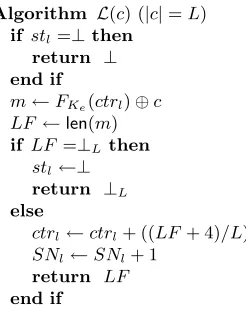
Length Oracle for Counter Mode Encryption: In Figure 6 we define the length oracle associated to the schemes SSH-CTR[F] and CTRE C[F]. This oracle maintains its own state, defined
Algorithm K-CTRE C
K(k)
Ke r
← Ke(k)
ctr← {r 0,1}l return Ke, ctr
Algorithm E-CTRE C
Ke(m)
if ste=⊥then return ⊥
end if
(me, mt)←enc(m) if me=⊥then
ste←⊥ return ⊥
else
c← E-CTRKe(me)
return c
end if
Algorithm len(m) (|m|=L) ParsemashLFi4kR
if LF ≤5 orLF ≥218then
return ⊥L
else if LF+ 4 modL6= 0then return ⊥L
else
return LF
end if
Algorithm D-CTRE C
Ke(c)
if std=⊥then return ⊥
end if
{Stage 1} cbuff←cbuffkc {Stage 2}
if me=εand|cbuff| ≥Lthen Parsecbuffas ˜ckA, (|˜c|=L)
me[1]← D-CTRKe(˜c) LF ←len(me[1]) if LF =⊥Lthen
std←⊥ return ⊥L end if end if
need= 4 +LF {Stage 3}
if |cbuff| ≥Lthen if |cbuff| ≥needthen
Parsecbuffas ¯c[1. . .n]kB, where|c¯[1. . .n]|=need
me[2. . .n]← D-CTRKe(¯c[2. . .n]) me←me[1]kme[2. . .n]
m←dec(me)
me←ε,cbuff←B return m
end if end if
Fig. 5.CT RE C
Algorithm L(c) (|c|=L) if stl=⊥then
return ⊥
end if
m←FKe(ctrl)⊕c LF ←len(m) if LF =⊥Lthen
stl←⊥ return ⊥L else
ctrl←ctrl+ ((LF+ 4)/L)
SNl←SNl+ 1 return LF
end if
Fig. 6.Length oracle for counter mode encryption
by a triple (stl, SNl, ctrl), initialised to (ε,0, ctre) where ctre denotes the counter value held by the encryption oracle at the start of the LOR-LLSF-CPA security game. In order to update the counter value, the algorithm uses the length field to determine how many more blocks should be in the ciphertext, adding (LF + 4)/L to the counter. Notice how we rely on the minimal length checking carried out by algorithmlenhere.
B Proofs
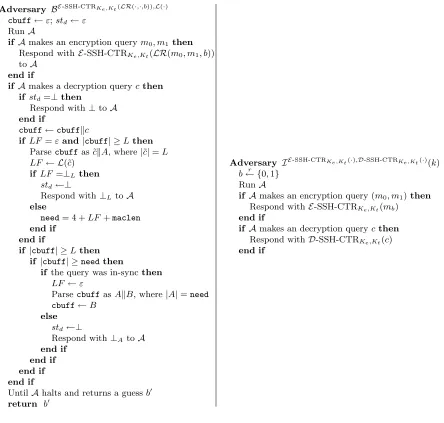
Proof of Theorem 2: Let A be an adversary attacking SSH-CTR[F] in the LOR-BSF-CCA sense. We use this adversary to construct two new adversaries B,I using their oracles to provide simulations of A’s oracles, such that:
– Battacks SSH-CTR[F] in the LOR-LLSF-CPA sense. – I attacks SSH-CTR[F] in the INT-BSF-CTXT sense.
The constructions of these adversaries can be found in Figure 7. In B’s construction, B runs A
using its own encryption oracle to provide simulations ofA’s encryption oracle and using its length oracle to provide simulations ofA’s decryption oracle, responding with⊥Aif the decryption query was out-of-sync. Note that B makes at most one out-of-sync query to its length oracle, so is a valid LOR-LLSF-CPA adversary. In I’s construction, I runs A using its own oracles to provide simulations of A’s oracles.
Now let us consider the event E that A makes an out-of-sync sequence of decryption oracle queries for which the output of the decryption oracle is not an element of {⊥A,⊥L,⊥P,⊥}. We call such a sequence a valid out-of-sync sequence.
First let us consider what happens when event E occurs. Notice that since the environment
I provides for A is indistinguishable from that in A’s real security game, if A submits a valid out-of-sync sequence of decryption queries, then I will have created a valid ciphertext forgery in its security game. The following therefore holds:
Pr[A wins∧E]≤Pr[E] = Pr[I wins]≤Advint-bsf-ctxtSSH-CTR[F].
Now let us consider what happens when E does not occur. Notice that B’s simulation of A’s environment is correct so long as event E does not occur. Thus, provided E does not occur, if A
is able to guess b correctly then so doesB. The following therefore holds:
Pr[A wins∧ ¬E]≤Pr[B wins]≤ 1
2Adv
lor-llsf-cpa SSH-CTR[F]+
Adversary BE-SSH-CTRKe,Kt(LR(·,·,b)),L(·)
cbuff←ε;std←ε RunA
if Amakes an encryption querym0, m1 then
Respond withE-SSH-CTRKe,Kt(LR(m0, m1, b))
toA
end if
if Amakes a decryption querycthen if std=⊥then
Respond with⊥toA
end if
cbuff←cbuffkc
if LF=εand|cbuff| ≥Lthen Parsecbuffas ˜ckA, where|c˜|=L LF ← L(˜c)
if LF =⊥Lthen
std←⊥
Respond with⊥LtoA else
need= 4 +LF +maclen
end if end if
if |cbuff| ≥Lthen if |cbuff| ≥needthen
if the query was in-syncthen
LF ←ε
ParsecbuffasAkB, where|A|=need cbuff←B
else
std←⊥
Respond with⊥A toA end if
end if end if end if
UntilAhalts and returns a guessb′
return b′
Adversary IE-SSH-CTRKe,Kt(·),D-SSH-CTRKe,Kt(·)(k)
b← {r 0,1}
RunA
if Amakes an encryption query (m0, m1)then
Respond withE-SSH-CTRKe,Kt(mb)
end if
if Amakes an decryption querycthen Respond withD-SSH-CTRKe,Kt(c)
end if
Fig. 7.Adversaries for proof of Theorem 2
Now we complete the proof:
Advlor-bsf-ccaSSH-CTR[F]= 2 Pr[Awins]−1
= 2 Pr[Awins∧E] + 2 Pr[A wins∧ ¬E]−1
≤2Advint-bsf-ctxtSSH-CTR[F]+Advlor-llsf-cpaSSH-CTR[F].
Proof of Lemma 1: Consider an adversary I attacking SSH-CTR[F] in the INT-BSF-CTXT sense. We will use this adversary to construct a new adversary F which will attack MA in the SUF-CMA sense. The construction ofF is shown in Figure 8. We assume thatF’s algorithmsenc
and dec maintain sequence numbersSNe,SNd for encryption and decryption.
Adversary FTKt(·),VKt(·)
Ke r
← Ke;ste←ε;std←ε;me←ε RunI
if Imakes an encryption querymthen if ste=⊥then
Respond with⊥toI
end if
(me, mt)←enc(m) if me=⊥then
ste←⊥
Respond with⊥toI
end if
τ← TKt(mt) c← E-CTRKe(me)
Respond withckτ toI
end if
if Imakes a decryption querycthen if std=⊥then
Respond with⊥toI
end if
cbuff←cbuffkc
if me=εand|cbuff| ≥Lthen Parsecbuffas ˜ckA, where|c˜|=L me[1]← D-CTRKe(˜c)
LF ←len(me[1]) if LF =⊥Lthen
std←⊥
Respond with⊥LtoI end if
need= 4 +LF+maclen
end if
if |cbuff| ≥Lthen if |cbuff| ≥needthen
Parsecbuffas ¯c[1. . .n]kτkB,
where|c¯[1. . .n]kτ|=needand|τ|=maclen me[2. . .n]← D-CTRKe(¯c[2. . .n])
me←me[1]kme[2. . .n]
mt←SNdkme
v← VKt(mt, τ) m←dec(me)
if (v= 1andthe sequence of queries incbuffwas in-sync)then
cbuff←B me←ε
else if (v= 1andthe sequence of queries incbuffwas out-of-sync)then if m=⊥P then
std←⊥ end if
Respond withmtoI
else
std←⊥
Respond with⊥A toI end if
end if end if end if
Fig. 8.Adversary for proof of Lemma 1
To justify this claim, we need to show that either this query is on a message that F did not query to its tagging oracleTKt(mt) when preparing its responses to encryption queries, or that it is a new
Experiment ExpHx
Ke r
← Ke;Kt r
← Kt;ctr← {r 0,1}l
st0←ε;st1←ε;st2←ε
SN0←0;SN1←0;SN1←0
RunS
if S makes a length oracle querycthen Respond withL(c) toS
end if
if S makes anE-SSH-CTR query (m0, m1)then
(me,0, mt,0, st0, SN0)←enc∗(m0, st0, SN0)
(me,1, mt,1, st1, SN1)←enc∗(m1, st1, SN1)
(m′
e,1, m
′
t,1, st2, SN2)←enc∗(m1, st2, SN2)
switch(x):
casex= 0:σ← E-CTRKe(me,1);τ ← TKt(mt,1)
casex= 1:σ← E-CTRKe(me,1);τ ← TKt(m
′
t,1)
casex= 2:σ← E-CTRKe(me,0);τ ← TKt(m
′
t,1)
casex= 3:σ← E-CTRKe(me,0);τ ← TKt(mt,0)
Respond withσkτ toS
end if
UntilS halts and returns a bitb′
return b′
Fig. 9.ExperimentExpHx used in the proof of Lemma 2
on whether I’s sequence of queries (as represented by the contents of cbuff) is current state or future state.
In the former case, since the query is out-of-sync, we know that ¯c[1. . .n]kτ was not output by the encryption oracle for the same value of the sequence number,SNd. It is then easy to see that either the plaintextmediffers from that encrypted, or the MAC tag τ differs from that output by the encryption oracle for the value SNd. But that value SNd was only used in one query to the encryption oracle, and hence only used in making a single query toTKt(mt) (here we use the fact
thatqe≤232). Henceτ is either a valid MAC tag on a new messagemt=SNdkme, or a new MAC tag on the existing message mt.
In the latter case, since the query is future state, we can deduce that the value SNd used in constructing the message mt = SNdkme has never been used in handling an encryption oracle query, and hence no message of the form mt =SNdkme has been queried byF to TKt(mt) (here
we use the fact that qd≤232). Thenτ is a valid MAC tag on a new message mt.
Notice that in this analysis, F is still successful in winning its game even if I’s out-of-sync decryption query results in an output m =⊥P. So F’s success probability is at least as great as that ofI. In the simulation,Fmakes at mostqequeries to its tagging oracle and at mostqdqueries to its verification oracle. Also, a routine calculation shows that the total numbers of bits in F’s queries are tightly related to those in I’s, as in the statement of the lemma.
Proof of Lemma 2: In the following proof, we let enc∗(·,·,·) denote the encoding algorithm enc(·) having some state (st, SN) as part of its input and having the new state returned as output.
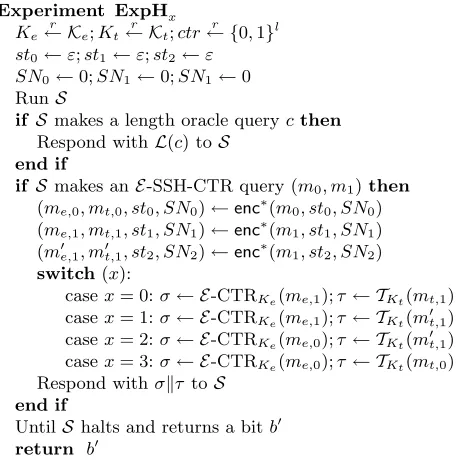
We let S denote an LOR-LLSF-CPA adversary that has oracle access to the encryption oracle
E-SSH-CTRKe,Kt(LR(·,·, b)),b∈ {0,1} and length oracleL(·). In Figure 9 we define experiments
ExpHx for x ∈ {0,1,2,3}. Notice that in the experiments (me,1, mt,1) and (m′e,1, m
′
t,1) will be
identical except possibly in the random bytes used for padding.
LetPx= Pr[ExpHx= 1], forx∈ {0,1,2,3}. By the definition ofAdv
lor-llsf-cpa
SSH-CTR[F],S(k), we have
AdvlorSSH-CTR[−llsf−cpaF],S(k) =P0−P3 = (P0−P1) + (P1−P2) + (P2−P3).
We proceed by estimating the terms Pi−Pi+1,i= 0,1,2.
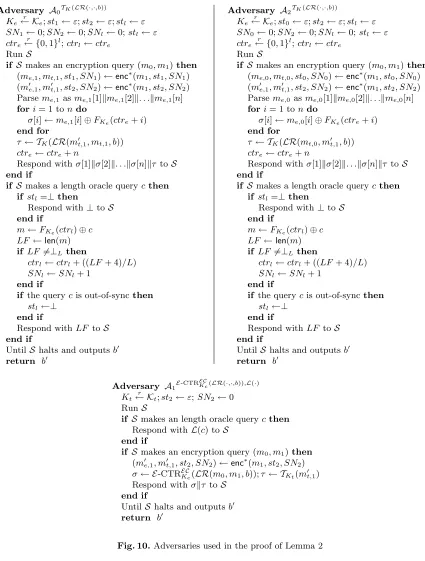
Given S, we construct three new adversaries A0, A1 and A2, using their oracles to provide
LOR-Adversary A0TK(LR(·,·,b))
Ke r
← Ke;st1←ε;st2←ε;stl←ε
SN1←0;SN2←0;SNl←0;stl←ε
ctre r
← {0,1}l;ctr l←ctre RunS
if S makes an encryption query (m0, m1)then
(me,1, mt,1, st1, SN1)←enc∗(m1, st1, SN1)
(m′
e,1, m
′
t,1, st2, SN2)←enc∗(m1, st2, SN2)
Parseme,1asme,1[1]kme,1[2]k. . .kme,1[n]
fori= 1 tondo
σ[i]←me,1[i]⊕FKe(ctre+i) end for
τ ← TK(LR(m′
t,1, mt,1, b))
ctre←ctre+n
Respond withσ[1]kσ[2]k. . .kσ[n]kτ toS
end if
if S makes a length oracle querycthen if stl=⊥then
Respond with⊥toS
end if
m←FKe(ctrl)⊕c LF ←len(m) if LF6=⊥Lthen
ctrl←ctrl+ ((LF+ 4)/L)
SNl←SNl+ 1 end if
if the querycis out-of-syncthen
stl←⊥ end if
Respond withLF toS
end if
UntilS halts and outputsb′
return b′
Adversary A2TK(LR(·,·,b))
Ke r
← Ke;st0←ε;st2←ε;stl←ε
SN0←0;SN2←0;SNl←0;stl←ε
ctre r
← {0,1}l;ctr l←ctre RunS
if S makes an encryption query (m0, m1)then
(me,0, mt,0, st0, SN0)←enc∗(m1, st0, SN0)
(m′
e,1, m
′
t,1, st2, SN2)←enc∗(m1, st2, SN2)
Parseme,0 asme,0[1]kme,0[2]k. . .kme,0[n]
fori= 1 tondo
σ[i]←me,0[i]⊕FKe(ctre+i) end for
τ ← TK(LR(mt,0, m′t,1, b))
ctre←ctre+n
Respond withσ[1]kσ[2]k. . .kσ[n]kτ toS
end if
if S makes a length oracle querycthen if stl=⊥then
Respond with⊥toS
end if
m←FKe(ctrl)⊕c LF ←len(m) if LF 6=⊥Lthen
ctrl←ctrl+ ((LF+ 4)/L)
SNl←SNl+ 1 end if
if the querycis out-of-syncthen
stl←⊥ end if
Respond withLF toS
end if
UntilS halts and outputsb′
return b′
Adversary A1
E-CTRE C
Kc(LR(·,·,b)),L(·) Kt
r
← Kt;st2←ε;SN2←0
RunS
if S makes an length oracle querycthen Respond withL(c) toS
end if
if S makes an encryption query (m0, m1)then
(m′
e,1, m
′
t,1, st2, SN2)←enc∗(m1, st2, SN2)
σ← E-CTRE C
Ke(LR(m0, m1, b));τ← TKt(m
′
t,1)
Respond withσkτ toS
end if
UntilS halts and outputsb′
return b′
Fig. 10.Adversaries used in the proof of Lemma 2
DCPA sense, whileA1 will attack CTRE C[F] in the LOR-LLSF-CPA sense. We will show that the
following equalities hold:
P0−P1=Advlor-dcpaMA,A0(k),
P1−P2=Advlor-llsf-cpaCTRE C [F],A1(k),
P2−P3=Advlor-dcpaMA,A2(k).
Let us begin by proving the first equality. In the construction ofA0, the adversary maintains
![Fig. 5. CTREC[F]: Counter mode and encoding scheme combined](https://thumb-us.123doks.com/thumbv2/123dok_us/1874124.1243983/18.595.108.481.341.717/fig-ctrec-f-counter-mode-encoding-scheme-combined.webp)