Available Online atwww.ijcsmc.com
International Journal of Computer Science and Mobile Computing
A Monthly Journal of Computer Science and Information Technology
ISSN 2320–088X
IJCSMC, Vol. 4, Issue. 6, June 2015, pg.727 – 733
RESEARCH ARTICLE
Re-allocation of Tasks according to
Weights in Cloud Architecture
LOVEPREET
, MTECH RESEARCH SCHOLAR, CECLANDRAN, PUNJAB, INDIASAHIL VASHISHT
, ASSISTANT PROFESSOR, CECLANDRAN, PUNJAB, INDIAAbstract: Cloud Computing plays an important role on achieving good performance and high system utilization. The goal of a task allocation system is to efficiently manage the cloud computing power of workstations, servers, and supercomputers in order to maximize job throughput and system utilization. There are many issues of cloud computing system which are discussed in this paper in brief. The main aim of the paper is to focus on fault tolerance and recover fault with less processing time. The proposed algorithm is assign tasks to other nodes only when master node moves from its original position. The major problem in this architecture is task scheduling, if one slave node get failed the task allocated by master node will not get completed and fault occurred. In this work, we have worked on technique which helps to reduce fault tolerance of the system and increase performance of the system.
Keywords: Cloud Computing, Task allocation, job scheduling, and scalability
1. Introduction
Cloud Computing is the environment which provides on-demand & convenient access of the network to a
computing resources like storage, servers, applications, networks and the other services which can be released
minimum efficiency way. User retrieved data and modified data which is stored by client or an organization in
centralized data called cloud. Cloud is a design, where cloud service provider provides services to user on demand
amount of applications under -different topologies and each topology gives some new specialized services [15].
Cloud computing is the environment which provides on-demand & convenient access of the network to a
computing resources like storage, servers, applications, networks and the other services which can be released
minimum efficiency way. The five essential characteristics composed by cloud design. Cloud design also promotes
the availability [15]. There are three deployment models and three services models defined by NIST.
1.1 Service Models: There are three service models of cloud:
a) Software as a Service (SaaS): This is the capability of using applications which are running on cloud infrastructure. The users access these applications through internet connections. These kinds of clouds offer the implementation of some specific business threads that gives specific cloud capabilities. For E.g. GMAIL, Facebook [2].
b) Platform as a Service (PaaS): It gives the computational resources on which services and applications can be host and develop. For E.g. Online Photo Editing, Google Docs, YouTube [9].
c) Infrastructure as a Service (IaaS): This is the capability of doing processing, storing and run software which is given to the consumer. It’s also referred as the “Resource Code” which provides resources as the services to a user. This work is done by the service provider. For E.g. Host Firewalls [14].
1.2 Deployment Models of cloud computing: There are many deployment models o cloud computing. These are:
1.2.1. Public Cloud: In this cloud, resources allocated are publically. Applications in this cloud are on pay-per-use basis. Public clouds can be managed by government organizations or business. For E. g. Sky Drive and Google Drive [2].
1.2.2 Private Cloud: In this cloud, resources are limited and used within an organization. It is more secure as employees in an organization can access the particular data only. For E. g. Banks [12].
1.2.3. Hybrid Cloud: In this cloud, there is a combination of both Public and Private cloud. The services within the organization are control by the customer and resources which need to be delivered externally are controlled by the service provider [12].
Fig.1.1 Deployment model of Cloud
2. Review of Literature
There are two types of virtualization: Full virtualization and Para virtualization and two architectures of virtualization: Hosted and Hypervisor architecture. Multi-tenancy is the ability to provide computing services to multiple customers by using a common infrastructure and code base. Multi-tenancy can be applied to different levels i.e. application level, middleware level, operating system, hardware level. Then security of virtualization and multi-tenancy has been discussed.
In this paper [2] they discussed different issues related to cloud computing security. To protect cloud computing system and to prevent various attacks many security mechanisms have been developed. To improve the security of cloud computing new technologies has been developed by the researchers. Different types of attacks like SYN flood, malware injection, account hijacking are discussed in this paper. The main focus of this paper is on detecting and preventing SYN flood in cloud computing. The author developed two algorithm one detecting algorithm and one preventing algorithm. They will implement and test these algorithms on cloud computing.
In this paper [3] the author described the data-protection-as-a-service where different services are provided for protecting data. Two techniques have discussed i.e. FDE (Full Disk Encryption) and FHE (Fully Homomorphic Encryption). There is a comparison in these techniques on the basis of key management, sharing, and ease of development, maintenance, aggregation and performance. The key management and access control are moved by DpaaS (Data-Protection-as-a-service) approach for purpose of balance easy maintenance and rapid development by user-side verification. Performance and ease of development offered by FDE is excellent.
In this paper [4] it is explained that cloud computing helps to share data and provide many resources to users. Users pay only for those resources as much they used. Cloud computing stores the data and distributed resources in the open environment. The amount of data storage increases quickly in open environment. So, load balancing is a main challenge in cloud environment. Load balancing is helped to distribute the dynamic workload across multiple nodes to ensure that no single node is overloaded. It helps in proper utilization of resources .It also improves the performance of the system. Many existing algorithms provide load balancing and better resource utilization. There are various types load are possible in cloud computing like memory, CPU and network load. Load balancing is the process of finding overloaded nodes and then transferring the extra load to other nodes.
In this paper [5] they explained the efficient task scheduling mechanism can meet users’ requirements, and improve the resource utilization, thereby enhancing the overall performance of the cloud computing environment. But the task scheduling in grid computing is often about the static task requirements, and the resources utilization rate is also low. According to the new features of cloud computing, such as flexibility, virtualization and etc, this paper discusses a two levels task scheduling mechanism based on load balancing in cloud computing. This task scheduling mechanism can not only meet user’s requirements, but also get high resource utilization, which was proved by the simulation results in the CloudSim toolkit.
3. Load Balancing in cloud computing
Load balancing is a procedure in which the total load of the network is reassigning to the individual nodes to make resource utilization successful and to enhance the response time of the job. In the meantime, remove a state in which some of the nodes are under loaded while some others are over loaded. A load balancing algorithm, it depends on the present behavior of the system and it does not consider the previous behavior of the system which is dynamic in nature. This load measured can be in terms of CPU load, amount of memory used, delay or Network load. It has following advantages:
1. It improves the performance of the system. 2. It maintains system stability.
3.1 Weighted Round Robin: It is one of the improved versions of the round robin. It was proposed to solve the problem of round robin. In this algorithm, each node is assigned with weight. According to the weight assigns to the node, it will receive suitable number of requests. Depending on its processing capability, each instance of server gets the load assigned which further depends on how that instance is behaving. Weight can be assign to each server in the group so that if one server is competent of handling the double load as the other, the commanding server gets a weight of 2. In such cases the IP sprayer will assign two requests to the powerful server for each request assigned to the weaker one. If the equal weights are assigned to all the nodes then same traffic will be received by each traffic [5].
4. Proposed Methodology
Task redundancy is provided by backup system that is attached with each node of the cloud distributed systems. Here, it is noted that backup system does not provide service to any tasks. In case of node failure backup system will perform the following operations: 1) multicast a failure notice (FN) to alert the candidate nodes about the change in the number of functioning nodes; 2) reallocate all the unfinished tasks among those candidate nodes perceived to be functioning; When any node fails or when load on any node will increase, back up node will come into existence. The backup node will execute the task allocation algorithms to balance load between the available mobile nodes. In the existing modal, we need efficient task allocation algorithms and we need to define the certain parameters on the basis of which backup node will identify that on which node load is increased. In the present techniques there is one drawback that is node failure. A node failure problem occurs due to mobility of the node. In present algorithm there are number of nodes available. From these nodes candidate node will be chose on the basis of failure rate and minimum execution time. Here Master node set threshold value which includes two parameters one is failure rate and other is maximum execution time. The nodes which have equal to and less failure rate and minimum execution time are elected as candidate nodes by the master node.In the proposed algorithm, we have added a new parameter in the present algorithm that is master node time. Master node time is the result time to join the end users. It is for node collaboration.
5. Experimental Results
The whole scenario is implemented in MATLAB.
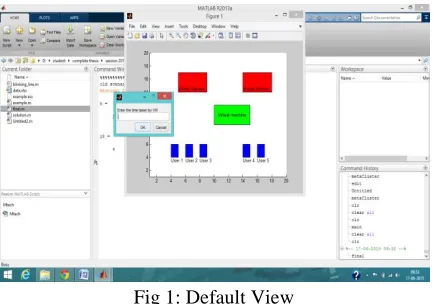
Fig 1: Default View
Fig 2: Default View
As illustrated in figure 2, the network is formed in which available nodes are deployed, virtual servers and virtual machines are deployed. The node is asking for the time taken by the virtual machine to complete the task. The interface is asking for the cost of the user 1 to executing task which is user wants to execute. The node is asking for the time of user 1 to execute for the task which is assigned by the user . The weight of the user is calculated for the task assigned to user 1.
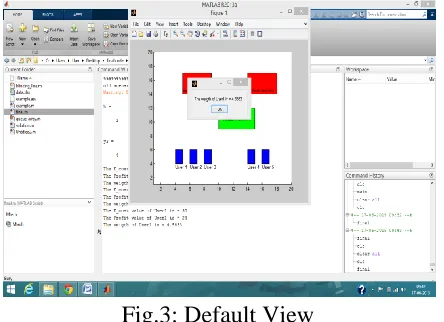
Fig.3: Default View
Fig 4: Default View
As illustrated in figure 4, the network is formed in which available nodes are deployed, virtual servers and virtual machines are deployed. The node is asking for the time taken by the virtual machine to complete the task. The interface is asking for the cost of the user 3 to executing task which is user wants to execute. The node is asking for the time of user 3 to execute for the task which is assigned by the user . The weight of the user is calculated for the task assigned to user 3
The task is allocated to nodes which has higher resources as set by the virtual machines. The node change its position and fault is occurred in the network. The task is allocated to the node which has higher weight .
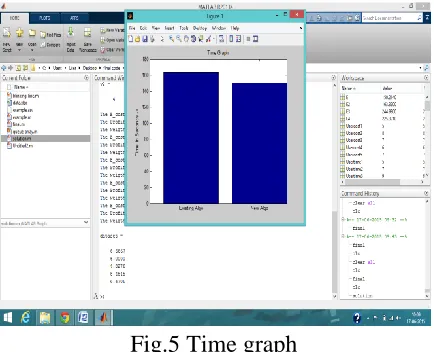
Fig.5 Time graph
As illustrated in figure 5, the time is used to calculate for the task execution. As shown in the figure, proposed algorithm use less time for the task allocation.
6. Conclusion
References
[1] Ankur Mishra, Ruchita Mathur, Shishir Jain, Jitendra Singh Rathore, 2013 “Cloud Computing Security” International Journal on Recent and Innovation Trends in Computing and Computation, pp 36-39
[2] Barron, C., Yu, H., & Zhan, J., 2013 “Cloud Computing Security Case Studies and Research”. Proceedings of
the World Congress on Engineering 2013 Vol II
[3] Dawn Song, Elaine Shi, 2012 “Cloud Data Protection for the Masses” IEEE Computer Society, pp 39-45
[4] Kaur, Rajwinder, and Pawan Luthra. "Load Balancing in Cloud Computing." Proceedings of International Conference on Recent Trends in Information, Telecommunication and Computing, ITC. 2012.
[5] Fang, Yiqiu, Fei Wang, and Junwei Ge. "A task scheduling algorithm based on load balancing in cloud computing." Web Information Systems and Mining. Springer Berlin Heidelberg, 2010. 271-277.
[6] Mohammad Sajjid and Zahid Raja, “Cloud Computing issues and challenges”, International Conference on Cloud, Big Data and Trust 2013, Nov 13-15, RGPV
[7] Rimal, B.P.; Eunmi Choi; Lumb, I., "A Taxonomy and Survey of Cloud Computing Systems," INC, IMS and IDC, 2009. NCM '09. Fifth International Joint Conference on , vol., no., pp.44,51, 25-27 Aug. 2009
[8] Linzan Jhu,Study on Cloud Computing Resource Scheduling Strategy Based on the Ant Colony Optimization Algorithm”, IJCSI International Journal of Computer Science Issues, Vol. 9, Issue 5, No 2, September 2012 ISSN (Online): 1694-0814
[9] Yogita Chawla and Mansi Bonsle, “ A Study on Scheduling Methods in Cloud Computing,International Journal of Emerging Trends & Technology in Computer Science, Volume 1, Issue 3, September -October 2012
[10] Anjali Singh and Mahinder Kumar Beniwal, “Load Balancing in Cloud Computing using Observer's Algorithm with Dynamic Weight Table”, International Journal on Recent and Innovation Trends in Computing and Communication Volume: 2 issue 11
[11] Soumya Ranjan Jeena and Zulfikar Ahmad “Response Time Minimization of Different Load Balancing Algorithms in Cloud Computing Environment”, International Journal of Computer Applications (0975 –8887) Volume 69–No.1 7, May 2013
[12] Xu Chaoqun, Zhuang Yi and Zhu Wei, “A Load Balancing Algorithm with key Resource Relevance for Virtual Cluster” , International Journal of Grid and Distributed Computing Vol.6, No.5 (2013), pp.1-16
[13] Shucheng Yu “Achieving Secure, Scalable, and Fine-grained Data Access Control in Cloud Computing”, 2010 [14] Shantanu Pal, Sunirmal Khatua ,“A New Trusted and Collaborative Agent Based Approach for Ensuring Cloud Security”, 2011
[15] Barron, C., Yu, H., & Zhan, J.,”Cloud Computing Security Case Studies and Research” In Proceedings of the