Fault-propagation Pattern Based DFA on SPN Structure Block Ciphers using
Bitwise Permutation, with Application to PRESENT and PRINTcipher
XinJie Zhao1, Tao Wang1, ShiZe Guo2,3
1(Department of Computer Engineering, Ordnance Engineering College, Shijiazhuang 050003, China) 2(The Institute of North Electronic Equipment, Beijing 100083, China)
3(School of Information Engineering, Beijing University of Posts and Telecommunications, Beijing 100876, China)
Abstract—This paper proposes a novel fault-propagation pattern based differential fault analysis method - FPP-DFA, and proves its feasibility on SPN structure block ciphers using bitwise permutation, such as PRESENT and PRINTcipher. Simulated experiments demonstrate that, with the fault model of injecting one nibble fault into the r-2th round substitution layer, on average 8 and 16 faulty samples can reduce the master key search space of PRESENT-80/128 to 214.7 and 221.1
respectively, and 12 and 24 effective faulty samples can reduce the master key search space of PRINTcipher-48/96 to 213.7 and
222.8 respectively; with the fault model of injecting one nibble
fault into the r-3th round substitution layer, 8 samples can reduce the master key search space of PRINTCipher-96 to 218.7.
Fault-propagation pattern; fault-propagation path; differential fault analysis; bitwise permutation; SPN block cipher; PRESENT; PRINTcipher (key words)
I. INTRODUCTION
The new emerging pervasive computing demands have made low-end devices, such as smart cards, RFID tags, IC-printing applications more and more popular. Such tiny computing devices are used in many applications and environments, leading to an ever increasing need of security. This has spurred the development of lightweight cryptography. Many ultra-lightweight block ciphers have been developed such as mCrypton[1], HIGHT[2], SEA[3],
DESXL[4], KATAN[5], MIBS[6].
PRESENT[7] and PRINTcipher[8] are two
hardware-optimized ultra-lightweight block ciphers presented by Bogdanov, A et al in CHES 2007 and CHES 2010 respectively. Both of the ciphers apply the SPN structure and bitwise permutation, except that the substitution- permutation sequences are different. PRESENT adopts the substitution-permutation sequence, while PRINTcipher adopts the permutation-substitution sequence. In the proposals, the cipher designers analyzed the security of PRESENT and PRINTcipher with respect to the main known cryptanalytic methods, and showed that they were quite secure from the mathematics-based cryptanalysis. However, the cipher designers didn’t consider the resilience of them against side-channel attacks. In this paper, we try to fill up this gap through cryptanalysis of the two ciphers against fault-based side channel attacks.
Fault attacks were first introduced by Boneh et al.[9] on
RSA public key cryptosystem in 1997. Shortly after, Biham, E. et al[10] proposed an attack on secret key cryptosystems
called Differential Fault Analysis (DFA), which combined the ideas of fault attack and differential attack. DFA attacks
derived information about the secret key by examining the differences between correct and faulty ciphertexts. After that, various cryptosystems have been attacked by DFA technique, such as ECC[11], 3DES[12], AES[13], Camellia[14][15][16],
MIBS[17], RC4[18], GRAIN-128[19],HC-128[20], Rabbit[21] etc.
However, to the best of our knowledge, few work except [22] and [23] has been done on DFA against PRESENT, and there is no publication about DFA on PRINTcipher.
Previous Works. Li et al[22] proposed the first DFA on
PRESENT-80. Suppose one nibble fault was injected between the r-2th and the r-1th round substitution input, they
utilized the S-box output difference set of one bit S-box input difference as a distinguisher to filter the ideal faulty sample, and showed that, on average 40-50 effective faulty samples can recover 64-bit post-whitening key, and reduce the master key search space of PRESENT-80 to 216. Wang et al[23]
proposed the first DFA on PRESENT-80 key schedule. Suppose one nibble fault was injected into the 80-bit intermediate updated key register while generating the 30th
and 31th round keys, they used about 64 pairs of faulty
samples to obtain 51-bit of the 64-bit post-whitening key, and reduced the master key search space of PRESENT-80 to 229.
Our Results. In this paper, we present a novel fault analysis method based on DFA, we name it as fault-propagation pattern based differential fault analysis—FPP-DFA. The main idea of FPP-DFA is using the output fault-propagation pattern to infer the fault location, predict the fault-propagation path, and then apply the traditional DFA technique for further key analysis. As to DFA on SPN block ciphers with bitwise permutation, the recovery of the fault-propagation path means the recovery of the S-box input difference, which is the most difficult part of DFA on SPN block ciphers. We show that FPP-DFA is quite efficient on SPN block ciphers with bitwise permutation, and apply it to PRESENT and PRINTcipher successfully.
In FPP-DFA on PRESENT, we adopt the fault model of injecting one nibble fault before the r-2th round substitution
layer. Through the analysis of the fault-propagation path and S-box differential pattern two distinguishers, the fault location and the rth round substitution input difference can be
deduced. Combing the traditional DFA technique, the post-whitening secret key and the rth round key can be obtained.
the r-2th or r-3th round substitution layer. Firstly, we compute
the faulty index set of the ciphtertext difference, and combine the fault propagating path distinguisher of PRINTcipher to predict the exact fault location. According to the faulty difference before and after the rth round
key-dependent permutation, we propose a method to compute the permutation related key. After that, we can take the permutation off, and convert DFA on PRINTcipher to a problem with known cipher algorithm. Combining the recovered permutation and fault location, we can compute the input and output difference of the r-1th round substitution,
then apply the traditional DFA technique to deduce the round key.
We analyze the attack complexity of FPP-DFA on PRESENT and PRINTcipher, and verify it through concrete simulation experiments. Experimental results show that, with the fault model of injecting one nibble fault into the r-2th
round, on average 8 and 16 faults can reduce the master key search space of PRESENT-80/128 to 214.7 and 221.1
respectively, which is more efficient than previous DFA works [22][23] on PRESENT-80; on average 12 and 24
effective faults can reduce the master key search space of PRINTcipher-48/96 to 213.7 and 222.8 respectively. With the
fault model of injecting one nibble fault into the r-3th round,
on average 8 effective faults can reduce the master key search space of PRINTCipher-96 to 218.7.
Organization of the Paper. This paper is organized as follows. The main idea of FPP-DFA is proposed in Section II. The detailed FPP-DFA attacks on PRESENT and PRINTcipher are described in Section III and Section IV respectively, and the conclusions are presented in section V.
II. MAIN IDEA OF FPP-DFA
Next, we present the main idea of the FPP-DFA. It is mainly composed of the following two phases:
1) Fault location analysis
In this phase, the attacker learns the fault-propagation pattern, and then builds the distinguisher for the enumerable faulty locations based on the fault model. As to FPP-DFA on SPN block ciphers with substitution-permutation sequence, such as PRESENT[1], the possible fault locations
can be deduced by patterns of the rth round S-box output(or
faulty ciphertext) differences. As to FPP-DFA on SPN block cipher with permutation-substitution sequence, such as PRINTCipher[8], the exact injected fault location can be
deduced by the faulty ciphertext nibble index set.
2) DFA based Key extraction
As to SPN block ciphers with bitwise permutation, after the fault location is deduced, the predicted fault location can be used to deduce the fault-propagation path, and compute the input difference of the S-box, which is the crucial part of DFA on SPN block ciphers (at most cases, only the S-box output difference can be computed directly from the ciphertext difference, and the input difference is unknown). Finally, combing the traditional DFA method, the secret key can be recovered.
It should be noted that the FPP-DFA technique above is a general framework of DFA on SPN block ciphers using bitwise permutation. In FPP-DFA on specific ciphers, the
two phases above can be divided into several steps as needed.
As shown in Section III and Section IV, we take PRESENT and PRINTCipher as two examples, and apply the FPP-DFA technique to prove its feasibility and efficiency.
III. PROPOSED FPP-DFAATTACK ON PRESENT
A. Description of PRESENT Algorithm
PRESENT is a 31-round SPN type block cipher with block size of 64 bits. It supports 80 and 128-bit secret key. Firstly, the plaintext Xored the subkey K1 as the input of the
1st round. After 31 rounds iterations, the 31th round output
Xored with the subkey K32 is the ciphertext. Each
encryption round is composed of the following 3 steps. 1) addRoundKey—AK. At the beginning of each round,
64 bits output of the last round is Xored with the subkey. 2) sBoxlayer—SL. 16 identical 4-bit to 4-bit S-boxes are
used in parallel.
3) pLayer—PL. The ith bit is moved to bit position P(i)
by a constant permutation table P.
PRESENT can take keys of either 80 or 128 bits. Below is the key schedule of 80-bit version. The 80-bit key is stored in a register K=k79||k78||…||k0. At round r (1≤r≤31), the 64-bit
round key Kris equal to the 64 leftmost bits of K. After Kr is
extracted, K is rotated by 61 bit positions to the left, then a
S-box is applied to the left-most 4 bits of K and finally the
round-counter r is Xored with bits k19||k18||k17||k16||k15 of K.
B. Notations
Here we introduce some notations in order to make our discussion conveniently. Bits are numbered from zero with bit zero on the right of a block.
We denote plaintext and ciphertext as X, Y, the output of
the ith round AK, SL, PL function as Ai,Bi,Ci (1≤i≤31). The
faulty variables above can be denoted as X’,Y’,Ai’,Bi’,Ci’,
and the jth bit of the variables above can be denoted as Xj,Yj,Aji,Bji,Cji (0≤j≤63). The differences between correct and
faulty variables above can be denoted as ∆X, ∆Y, ∆Ai, ∆Bi,
∆Ci, and the jth nibble of the variables above can be denoted
as NXj, NYj, NAji, NBji, NCji (0≤j≤15). The nibble difference
of the variables above can be denoted as ∆NXj,∆NYj,∆NAji,
∆NBji, NCji (0≤j≤15), and the related nibble length is 4. The
faulty nibble and bit index set of the variables above can be denoted as SX, SY, SAi, SBi, SCiand sx, sy, sai, sbi, sci.
C. Fault Model
The fault model of paper is shown as follows.
1) One random nibble fault is induced into the input of the r-2th (29th) round substitution. The attacker knows neither
the location nor the concrete value of the fault.
2) For any plaintext adaptively selected, two different ciphertexts under the control of the same secret key are available, the right and the faulty one. How to induce the specific fault is not covered in this paper, since this is not the main concern of our paper and many literatures on fault inductions are available in [24].
Fig.1 shows the fault-propagation path of the above fault model (the faulty nibble index is 15) with the maximal fault propagating width, and the output difference of every faulty S-box is (1111)2.
Figure 1. One nibble fault-propagation path of PRESENT
D. FPP-DFA procedure
FPP-DFA on PRESENT is composed of the following steps.
1) Fault location analysis
a) Learn the fault-propagation path
Based on the fault model above, the fault-propagation path of the 16 possible fault locations (i) can be built.
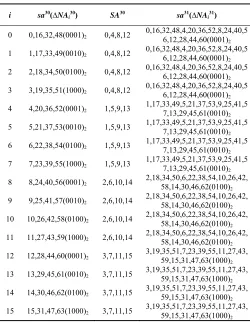
TABLE I. FAULT-PROPAGATION PATH OF PRESENT
i sa30(∆NAi30) SA30 sa31(∆NAi31)
0 0,16,32,48(0001)2 0,4,8,12 0,16,32,48,4,20,36,52,8,24,40,56,12,28,44,60(0001) 2 1 1,17,33,49(0010)2 0,4,8,12 0,16,32,48,4,20,36,52,8,24,40,56,12,28,44,60(0001)
2 2 2,18,34,50(0100)2 0,4,8,12 0,16,32,48,4,20,36,52,8,24,40,56,12,28,44,60(0001)
2 3 3,19,35,51(1000)2 0,4,8,12 0,16,32,48,4,20,36,52,8,24,40,56,12,28,44,60(0001)
2 4 4,20,36,52(0001)2 1,5,9,13 1,17,33,49,5,21,37,53,9,25,41,57,13,29,45,61(0010)
2 5 5,21,37,53(0010)2 1,5,9,13 1,17,33,49,5,21,37,53,9,25,41,57,13,29,45,61(0010)
2 6 6,22,38,54(0100)2 1,5,9,13 1,17,33,49,5,21,37,53,9,25,41,57,13,29,45,61(0010)
2 7 7,23,39,55(1000)2 1,5,9,13 1,17,33,49,5,21,37,53,9,25,41,57,13,29,45,61(0010)
2 8 8,24,40,56(0001)2 2,6,10,14 2,18,34,50,6,22,38,54,10,26,42,58,14,30,46,62(0100)
2 9 9,25,41,57(0010)2 2,6,10,14 2,18,34,50,6,22,38,54,10,26,42,58,14,30,46,62(0100)
2 10 10,26,42,58(0100)2 2,6,10,14 2,18,34,50,6,22,38,54,10,26,42,58,14,30,46,62(0100)
2 11 11,27,43,59(1000)2 2,6,10,14 2,18,34,50,6,22,38,54,10,26,42,58,14,30,46,62(0100)
2 12 12,28,44,60(0001)2 3,7,11,15 3,19,35,51,7,23,39,55,11,27,43,59,15,31,47,63(1000)
2 13 13,29,45,61(0010)2 3,7,11,15 3,19,35,51,7,23,39,55,11,27,43,59,15,31,47,63(1000)
2 14 14,30,46,62(0100)2 3,7,11,15 3,19,35,51,7,23,39,55,11,27,43,59,15,31,47,63(1000)
2 15 15,31,47,63(1000)2 3,7,11,15 3,19,35,51,7,23,39,55,11,27,43,59,15,31,47,63(1000)
2
Table I is the PRESENT faulty nibble and bit index set with maximal fault-propagation width after the 30th, 31th
round substitution. It’s obvious to see that at most 4 and 16 nibbles after the 30th and 31th round substitution become
faulty, and all faulty nibbles of ∆NA31=i/4+1, so there are
only 4 possible ∆NA31 value for 16 fault locations.
b) Learn the patterns of PRESENT differential S-box Suppose a denotes the S-box index, f1 and f2 denotes the
S-box input and output difference. a, f1, f2 are all 4-bit
variable satisfying
S[A]⊕S[A⊕F1]=F2 (1)
Table II displays all the possible f2 value when only one
bit of f1 is 1 in PRESENT S-box. It’s clear to see that at
least 2 bits of f2 is 1, which means that after 2 round fault
propagation, at least 4 and at most 16 nibbles of the ciphertext become faulty, and f2 related column value set
can become a distinguisher for f1.
TABLE II. PATTERNS OF PRESENT DIFFERENTIAL S-BOX
f2(f1=(0001)2) f2(f1=(0010)2) F2(f1=(0100)2) F2(f1=(1000)2)
(0011)2,(0111)2, (1001)2, (1101)2
(0011)2,(0101)2, (0110)2, (1010)2, (1100)2,(1101)2,
(1110)2
(0101)2,(0110)2, (0111)2, (1001)2, (1010)2,(1100)2,
(1110)2
(0011)2,(0111)2, (1001)2, (1011)2, (1101)2, (1111)2
c) Deduce the fault location
Firstly, the 31th round substitution output difference can
be computed by ∆B31=PL-1(∆Y31). For each nonzero ∆NBi31,
according to the 4 distinguishers of Table II, the possible
f1 candidate set Si can be deduced, and the intersection set
of Si is the final possible f1 candidate set. Then, according
to the location distinguishers in Table I, the fault location set can be obtained. The more faulty nibbles in ∆B31, the
less candidates of ∆A31 can be deduced.
2) DFA based Key extraction a) Deduce the round Key K32
From above, limited candidates of ∆A31 can be computed.
As ∆B31 can be computed by ∆B31=PL-1[Y]⊕PL-1[Y’], then
for each nonzero nibble of ∆NAi31 and ∆NBi31, NAi31
satisfying
SL[NAi31]⊕SL[NAi31⊕∆NAi31]= ∆NBi31 (2)
would be the correct candidate.
1 1 1 1
1(4* 3) 1(4* 2) 1(4* 1) 1( * ) i
32 32 32 32
(4* 3) (4* 2) (4* 1) (4* )
31 32 32 32 32
4 || || ||
[ ] || || ||
P i P i P i P i
P i+ P i+ P i+ P− i
Then applying equation (3), 4-bit of K32 can be
recovered. As about 4-16 nibbles of B31 is faulty, applying
the technique above, 4-16 nibbles of K32 can be obtained,
and full 64-bit of K32 can be recovered through more sample
analysis.
(3)
K K K K
SL NA Y Y Y Y
− − − −
− − −
+ + +
= ⊕
b) Deduce the round Key K31
After K32 was deduced, ∆B30 can be computed by
∆B30=SL-1[PL-1(Y)]⊕SL-1[PL-1(Y’)] (4)
Using the distinguishers in Table II, ∆A30 can be deduced.
more sample analysis. Noted that, as to the wrong K32
candidate, after the DFA analysis with about 4 faulty samples, some bits of K31 can always get an empty set,
which can be used to eliminate the wrong K32 candidates.
c) Deduce the master Key K
Combining K31, K32, PRESENT key schedule, the master
key K can be recovered.
E. Complexity Analysis
According to the patterns of the PRESENT differential S-box in Table II, at least 2-4 nibbles of B30 become faulty,
which can be used to deduce 2-4 nibbles of K31, and at least
4-16 nibbles of B31 become faulty, which can be used to
deduce 4-16 nibbles of K32. As approximately two times
analysis of the faulty nibble with the same index can recover one nibble key, about 8 faults can obtain K32 and limited
candidates of K31, which are enough to recover the
PRESENT-80 master key. 16 faults can obtain K32 and K31,
which are enough to obtain the PRESENT-128 master key.
F. Experimental Results
We have implemented our attack on a PC using Visual C++ 6.0 Compiler on a 1.81 GHz Athlon with 1GB memory, the fault induction was simulated by computer software.
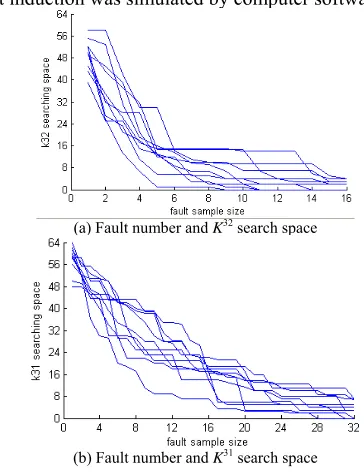
(a) Fault number and K32 search space
(b) Fault number and K31 search space Figure 2. Experimental results of 10 times PRESENT attack
In PRESENT-80 on, on average 8 samples can reduce the K32 search space to 27.6 (Fig.2(a)). Combining the step 5,
wrong candidates of K32 can be eliminated, and possible
candidates of K31 can be predicted. Then, the master key
search space of PRESENT-80 can be further reduced to 214.7.
Comparing with the previous PRESENT-80 attacks [22][23],
our attacks are much more efficient, and the result is also well agreed with the previous theoretical analysis.
Compared with the DFA on the encrypt procedure of PRESENT-80 by Li et al.[22], they supposed one nibble fault
was injected between the r-2th and r-1th round substitution,
and judged the effective faulty samples by whose 2-7
nibbles of B31 are faulty. Utilizing the S-box output
differential distinguisher when only one bit of the S-box input nibble difference is 1, the nonzero nibble of ∆A31 was
deduced one by one, and K32 can be deuced by A31 and ∆B31.
About 40-50 samples are required to obtain K32. But this
may discard those faulty samples which 8-16 nibbles are faulty, but still satisfied the one bit distinguisher and fault model above.
While the attack proposed in this paper can make full use of the faulty samples. We started by learning the fault-propagation path of the model, and utilized the one bit distinguisher of Table II to deduce the possible 4 candidates of 64-bit ∆A31, finally recovered K32 by ∆A31 and ∆B31.
Moreover, after some candidates of K32 have been deduced,
we use it to compute ∆B30, and apply the one bit
distinguisher of Table II again to predict ∆A30. Then the key
search space of K31 can be reduced, and some wrong K32
candidates can also be eliminated. Finally, combing the recovered K32 and K31 candidates, the search space of
PRESENT-80 master key can be further reduced.
Our attack technique can be adjusted to DFA on PRESENT-128 very easily without changing the fault model. In FPP-DFA attack on PRESENT-128, we shown that, on average 16 samples can reduce the K32 search space
to 21.8, the
K31 search space to 216.3(Fig.2(b)) and the
PRESENT-128 master key search space to 221.1.
IV. THE PROPOSED FPP-DFA METHOD ON PRINTCIPHER
A. Description of PRINTcipher Algorithm
PRINTcipher is a key dependant SPN structure block cipher with b-bit blocks and b rounds, b∈ {48, 96}, and an effective key length of 5b/3 bits. The 5b/3 bits user-supplied
key sk is consisted of two subkey components sk =sk1||sk2
where sk1 is a fixed b bits secret key, and sk2 is a 2b/3 bits
sub-key to generate the key-dependent permutations and derive an additional of security via the secret algorithm variability. PRINTcipher has two variants decides by b:
PRINTcipher-48 and PRINTcipher-96. Each encryption round consists of the following 5 steps.
1) Key xor—KX. The b-bit current state of the cipher is
Xored with a b-bit subkey sk1, sk1 is identical in all rounds.
2) Linear diffusion—LD. Bit i of the current state is
moved to bit position P(i)
3 mod 1 for 0 2 ( )
1 for 1
i b i b
P i
b i b
× − ≤ ≤ −
⎧
= ⎨ − = −
⎩ (5)
3) Round counter RCi xor—RX. The least significant n
-bit (n = log2r) of the cipher state is Xored with a round
constant RCi.
4) Keyed permutation—KP. The b-bit cipher state is
divided into b/3 3-bit nibbles. sk2 are divided into b/3 sets
of two bits, and each two bits quantity a1||a0 is used to pick
one of four available permutations of the three input bits state nibble. Specifically, the three input bits c2||c1||c0 are
1 0 2 1 0
1 0 1 2 0
2 1 0
1 0 2 0 1
1 0 0 1 2
=00 : || || =01 : || || : || ||
=10 : || || =11 : || ||
case a || a output c c c
case a || a output c c c
input c c c
case a || a output c c c
case a || a output c c c
⎧ ⎪ ⎪ ⇒ ⎨ ⎪ ⎪⎩
(6)
5) sBoxLayer—SL. b/3 identical 3-bit to 3-bit S-boxes
are used in parallel.
Noted that PRINTCipher has no key schedule, the master key sk is used in every round.
B. Notations
We denote the plaintext and ciphertext as X, Y, the
output of the ith round KX, LD, KP, SL function as Ai,Bi,Ci,Di(0≤i≤b-1). The faulty variants above can be
denoted as X’,Y’,Ai’,Bi’,Ci’,Di’, the jth bit of the variants
above can be denoted as Xj,Yj,Aji,Bji,Cji,Dji(0≤i,j≤b-1). The
difference between correct and faulty variants above can be denoted as ∆Xj, ∆Yj, ∆Aji, ∆Bji, ∆Cji, ∆Dji, the jth nibble of
the variants above can be denoted as NXj, NYj, NAji, NBji,
NCji, NDji(0≤j≤b-1/a), and the related nibble length a is 3.
The jth nibble difference of the variants above can be
denoted as ∆NXj, ∆NYj, ∆NAji, ∆NBji, NCji, NDji, and the
nonzero faulty nibble and bit index set of the variant above can be denoted as SX, SY, SAi, SBi, SCi, SDi.and sx, sy, sai, sbi, sci, sdi.
C. Fault Model
The fault model of FPP-DFA on PRINTCipher is the same with PRESENT, except that the injected faulty round
m has subtle difference. As to PRINTCipher-48, m= 46, and
as to PRINTCipher-96, m= 94 or 93. Next we take
FPP-DFA on PRINTCipher-48 as an example.
Figure 3. One nibble fault-propagation path of PRINTCipher-48
Fig.3 is the fault propagating procedure of one nibble fault injecting into the 15th nibble before the 46th round
substitution with the maximized width, in which all of the S-box output difference is (111)2.
D. FPP-DFA procedure
FPP-DFA on PRINTCipher is shown as follows.
1) Fault location analysis
a) Learn the fault-propagation path Based on the fault model above,
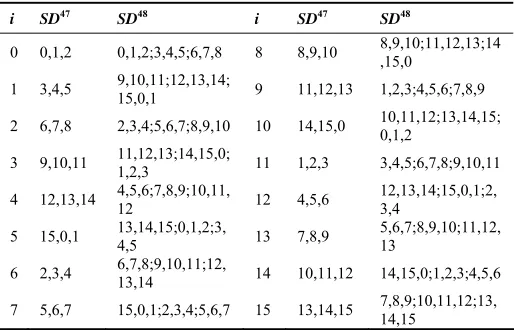
Table III is the faulty nibble index set of PRINTCipher-48 with maximal fault-propagation width after the 47th, 48th
round substitution, and at most 3 and 9 nibbles after the 47th and 48th round substitution become faulty.
b) Deduce the fault location
Take injecting fault into the 15th nibble before the 46th
round substitution as an example. According to the ciphertext difference, a distinct faulty nibble index set SD48
can be computed. Suppose SD48={7,…,15}, according to
Table III, we can deduce that the faulty nibble index is 15. And we store it as an effective fault sample. Interestingly, if the exact injected fault location i of the 46th round can be
deduced, either all 3 nibbles of ∆D47 with consecutive
indices (SD47={13,14,15}) become faulty, or 2 nibbles of
∆D47 with nonconsecutive indices (SD47={13,15}) become
faulty, which also means that ∆NDi46 can be either (101)2 or
(111)2. After the fault location is deduced, both ∆B47 and ∆B48 can be obtained.
TABLE III. FAULT-PROPAGATION PATH OF PRINTCIPHER-48
i SD47 SD48 i SD47 SD48
0 0,1,2 0,1,2;3,4,5;6,7,8 8 8,9,10 8,9,10;11,12,13;14,15,0
1 3,4,5 9,10,11;12,13,14;15,0,1 9 11,12,13 1,2,3;4,5,6;7,8,9
2 6,7,8 2,3,4;5,6,7;8,9,10 10 14,15,0 10,11,12;13,14,15;0,1,2
3 9,10,11 11,12,13;14,15,0;1,2,3 11 1,2,3 3,4,5;6,7,8;9,10,11
4 12,13,14 4,5,6;7,8,9;10,11,12 12 4,5,6 12,13,14;15,0,1;2,3,4
5 15,0,1 13,14,15;0,1,2;3,4,5 13 7,8,9 5,6,7;8,9,10;11,12,13
6 2,3,4 6,7,8;9,10,11;12,13,14 14 10,11,12 14,15,0;1,2,3;4,5,6
7 5,6,7 15,0,1;2,3,4;5,6,7 15 13,14,15 7,8,9;10,11,12;13,14,15
2) DFA based Key extraction
a) Deduce the permutation related key sk2
After the exact fault location is deduced, the permutation related key sk2 can be obtained by following algorithm.
∆C48← SL-1[D48]⊕SL-1[D48’]
∆B48 can be deduced by ∆D48
For each index i in SD48
{
j←faulty index bit of ∆NBi48
If(j == 2)
{
∆NBi48←(100)2
If (∆NBi48 == (100)2) sk22*i=(0)2
else if (∆NBi
48 == (010)2) sk22*i+1||sk22*i=(01)2
else if (∆NBi48 == (000)2)
sk22*i+1||sk22*i=(11)2
} If(j == 1)
{
∆NBi48←(010)2
If (∆NBi48 == (010)2) sk22*i+1||sk22*i={(00)2,(11)2}
else if (∆NBi
48 == (100)2)
else if (∆NBi48 == (001)2) sk22*i+1||sk22*i={10}2
} If(j==0)
{
∆NBi48←(001)2
If (∆NBi48 == (001)2) sk22*i+1={0}2
else if (∆NBi
48 == (100)2)
sk22*i+1||sk22*i={11}2
else if (∆NBi48 == (010)2) sk22*i+1||sk22*i={10}2
} }
Applying the algorithm above, after one sample analysis, at most 18 bits of sk2 can be recovered, and after more
sample analysis, full 32 bits of sk2 can be obtained.
b) Deduce the secret key sk1
Once sk2 was recovered, ∆D47 can be computed by
∆D47 = LD-1(KP-1(SL-1[D48]⊕SL-1[D48’])) (7)
Take recovering sk147||sk146||sk145 as an example,
according to Fig.3, ∆NB47 can be computed, and
∆NB1547=(100)2, then ∆NC1547 can be deduced by
KP(∆NB1547). Candidates of NC1547 satisfying
SL[NC1547]⊕SL[NC1547⊕∆NC1547]= ∆ND1547 (8)
would be the possible one. Then
sk147||sk146||sk145=SL[NC1547]⊕
LD-1(RX-1(KP-1(SL-1[D48]))) (9)
Applying the same method above, after one sample analysis, at most 9 bits of sk1 can be recovered, and after
more sample analysis, full 48 bits of sk1can be obtained.
c) Deduce the master key sk The master key sk equals to sk1||sk2.
E. Complexity Analysis
1) Probability of effective fault location deducing
Suppose the S-box index is a, the input and output
difference is f1and f2, a, f1, f2 are all 3-bit variable and
satisfy equation 1.
Table IV displays all the possible candidates of f2 when
only one bit of f1 is 1. According to sub-section D and Table
III, if the fault location i was deduced, ∆NDi46 can be either
(101)2 or (111)2, the probability is 2/7. The 1st bit of the
output difference ∆NDj47 propagated by the 1st bit of ∆NDi46
should be 1, and its probability is 16/24. The 3rd output
difference ∆NDj47 propagated by the 3rd bit of ∆NDi46 should
be 1, and its probability is 16/24. So the overall fault location deducing probability is 12.7% (2/7*((16/24)*(16/24))).
TABLE IV. PATTERNS OF PRINTCIPHER DIFFERENTIAL S-BOX
a f2(f1=(001)2) f2(f1=(010)2) f2(f1=(100)2)
(000)2 (001)2 (011)2 (111)2 (001)2 (001)2 (111)2 (101)2 (010)2 (101)2 (011)2 (110)2 (011)2 (101)2 (111)2 (100)2 (100)2 (011)2 (010)2 (111)2 (101)2 (011)2 (110)2 (101)2 (110)2 (111)2 (010)2 (110)2 (111)2 (111)2 (110)2 (100)2
2) Complexity analysisof sk2 deducing
Once the fault location is exactly located, at least 2 nibbles, at most 9 nibbles, on average 5.5 nibbles of B48 have
become faulty. According sub-section D, if one nibble faulty
difference after the KP layer changed, 2-bit of sk2 can be
deduced directly. Else, either one bit of sk2 can be deduced
directly, or 2 bits of sk2 are equal. So on average, 5/3 bits of sk2 can be deduced for each faulty B48 nibble. Then about
16/(5.5*(5/3))=3.5 faulty samples are needed to recover sk2.
3) Complexity analysisof sk1 deducing
According sub-section D, once the fault location is
exactly located, on average 2.5 nibbles of ∆NB47 become
faulty and be used to deduce sk1. As shown in Table IV, if
only one bit of ∆NB47is 1, on average 2 candidates of a can
be deduced, the key search space of one sk1 nibble can be
reduced from 8 to 2, and two times analysis of the nibble with the same index can recover the related sk1 nibble. So
1.25 nibbles of sk1 can be deduced and about 12.8 (16/1.25)
samples are required to obtain sk1.
F. Experimental Results
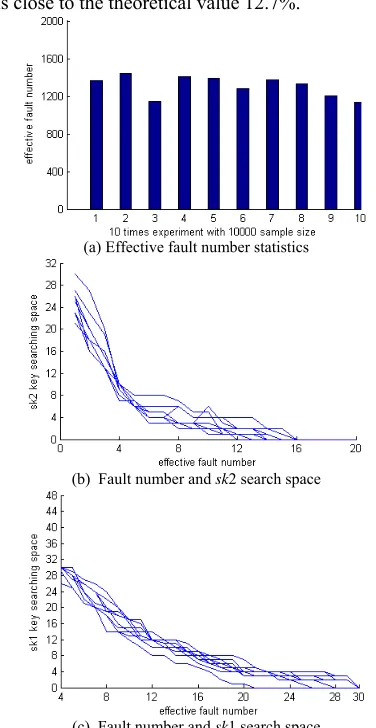
Fig.4-(a) is the effective fault number of 10 times FPP-DFA experiment on PRINTCipher-48 with 10000 samples. The average fault location deducing probability is 13.1%, which is close to the theoretical value 12.7%.
(a) Effective fault number statistics
(b) Fault number and sk2 search space
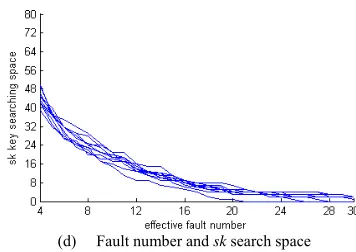
(d) Fault number and sk search space
Figure 4. Experimental results of PRINTCipher-48 attack
Fig 4-(b),(c),(d) show the relationships between the fault number and the key search space of sk2, sk1, sk. It’s clear to
see that, 4 effective faults can reduce the sk2 key search
space from 232 to 29.1, 12 effective faults can reduce the
sk1
search space from 248 to 22.1, 12 effective faults can reduce
the master key search space from 280 to 213.7, the results are
well agreed with previous theoretical analysis.
Under the r-2th round fault model, we have applied the
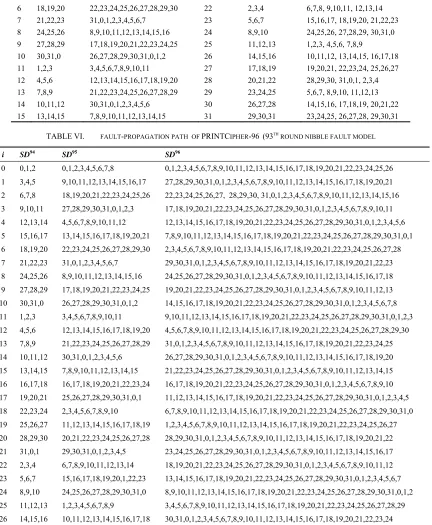
FPP-DFA on PRINTCipher-96. The fault-propagation path is shown in appendix Table V, on average 24 effective faults can reduce the 160-bit master key search space to 222.8.
Meanwhile, based on the fault model of injecting one nibble into the r-3th round substitution, we have also applied
the FPP-DFA on PRINTCipher-96. The fault-propagation path is shown in appendix Table VI, on average 8 effective faults can reduce the 160-bit master key search space to 218.7.
V. CONCLUSION
We have proposed a novel fault-propagation pattern based DFA techniques on SPN structure block ciphers with bitwise permutation, applied it to PRESENT and PRINTcipher, and proved its efficiency through concrete simulated experiments. We show that, implementing SPN structure block ciphers with bitwise permutation should take certain countermeasures of fault-based attacks; at least last 3 rounds of PRESENT-80/128, PRINTCipher-48, and at least last 4 rounds of PRINTCipher-96 should be protected.
REFERENCES
[1] Lim, C., Korkishko, T.: mCrypton - A Lightweight Block Cipher for Security of Low-cost RFID Tags and Sensors. In: Song, J., Kwon, T., Yung, M. (eds.) WISA 2005. LNCS, vol. 3786, pp. 243–258, Springer, Heidelberg(2006).
[2] Hong, D., Sung, J., Hong, S., Lim, J., Lee, S., Koo, B.-S., Lee, C., Chang, D., Lee, J., Jeong, K., Kim, H., Kim, J., Chee, S.: HIGHT: A New Block Cipher Suitable for Low-Resource Device. In: Goubin, L., Matsui, M. (eds.) CHES 2006. LNCS, vol. 4249, pp. 46–59. Springer, Heidelberg (2006)
[3] Standaert, F.-X., Piret, G., Gershenfeld, N., Quisquater, J.-J.: SEA: A Scalable Encryption Algorithm for Small Embedded Applications. In: Domingo-Ferrer, J.,Posegga, J., Schreckling, D. (eds.) CARDIS 2006. LNCS, vol. 3928, pp. 222–236. Springer, Heidelberg (2006)
[4] Leander, G., Paar, C., Poschmann, A., Schramm, K.: New Lightweight DES Variants. In: Biryukov, A. (ed.) FSE 2007. LNCS, vol. 4593, pp. 196–210. Springer, Heidelberg (2007)
[5] de Cannièe, C., Dunkelman, O., Knežević, M.: KATAN and KTANTAN–A Family of Small and Efficient Hardware-Oriented
Block Ciphers. In: Clavier, C., Gaj, K. (eds.) CHES 2009. LNCS, vol. 5747, pp. 272–288. Springer, Heidelberg (2009)
[6] Maryam Izadi, Babak Sadeghiyan, Seyed Saeed Sadeghian, et al.: MIBS: A New Lightweight Block Cipher[A]. J.A. Garay, A. Miyaji, and A. Otsuka (Eds.): CANS 2009[C], LNCS, vol.5888, Springer, pp. 334–348.(2009)
[7] Bogdanov, A., Knudsen, L.R., Leander, G., Paar, C., et al.: PRESENT: An Ultra-Lightweight Block Cipher. In: Paillier, P., Verbauwhede, I. (eds.) CHES 2007. LNCS, vol. 4727, pp. 450–466. Springer, Heidelberg (2007)
[8] Knudsen, L., Leander, G., Poschmann, A., and Robshaw, M.J.B.: PRINTcipher: A Block Cipher for IC-Printing. In: S. Mangard and F.-X. Standaert (Eds.): CHES 2010, LNCS, vol. 6225, pp. 16–32, Springer, Heidelberg (2010)
[9] Boneh, D., DeMillo, R.A., Lipton, R.J.: On the importance of checking cryptographic protocols for faults. In: Fumy, W. (ed.) EUROCRYPT 1997. LNCS, vol. 1233, pp. 37–51. Springer, Heidelberg. (1997)
[10] Biham, E., Shamir, A.: Differential Fault Analysis of Secret Key Cryptosystem. In: Kaliski Jr., B.S. (ed.) CRYPTO 1997. LNCS, vol. 1294, pp. 513–525. Springer, Heidelberg (1997)
[11] Biehl, I., Meyer, B., Muller, V. Differential fault analysis on elliptic curve cryptosystems. In: Bellare, M. (ed.) CRYPTO 2000. LNCS, vol. 1880, pp. 131–146. Springer, Heidelberg. (2000)
[12] Hemme, L.: A differential fault attack against early rounds of (Triple-) DES. In: Joye, M., Quisquater, J.-J. (eds.) CHES 2004. LNCS, vol. 3156, pp. 254–267. Springer, Heidelberg. (2004)
[13] Piret, G., Quisquater, J.J.: A Differential Fault Attack Technique against SPN Structures, with Application to the AES and Khazad. In: Walter, C.D., Koç, Ç.K., Paar, C. (eds.) CHES 2003. LNCS, vol. 2779, pp. 77–88. Springer, Heidelberg. (2003)
[14] Zhou, Y.B., Wu, W.L., Xu, N.N, e tal.: Differential Fault Attack on Camellia. Chinese Journal of Electronics, Vol.18, No.1, pp. 13–19. (2009)
[15] Zhao, X.J., Wang, T.: An Improved Differential Fault Attack on Camellia. Cryptology ePrint Archive, Report 2009/585 (2009) [16] Zhao, X.J., Wang, T.: Further Improved Differential Fault Analysis
on Camellia by Exploring Fault Width and Depth. Cryptology ePrint Archive, Report 2010/026 (2010)
[17] Zhao, X.J., Wang, T., Wang, S.Z., et al: Research on deep differential fault analysis against MIBS. Journal on Communications, Vol. 31, No.12, pp: 89-98. (2010)
[18] Hoch, J.J., Shamir, A.: Fault analysis of stream ciphers. In: Joye, M., Quisquater, J.-J. (eds.) CHES 2004. LNCS, vol. 3156, pp. 240–253. Springer, Heidelberg. (2004)
[19] Alexandre Berzati, C´ecile Canovas, Guilhem Castagnos, et al.: Fault Analysis of GRAIN-128. HOST 2009, pp.7-14.(2009)
[20] Aleksandar Kircanski and Amr M. Youssef.: Differential Fault Analysis of HC-128. In D.J. Bernstein and T. Lange (Eds.): AFRICACRYPT 2010[C], LNCS, vol. 6055, pp. 261–278. Springer, Heidelberg. (2010)
[21] Alexandre Berzati, C´ecile Canovas-Dumas, and Louis Goubin.: Fault Analysis of Rabbit: Toward a Secret Key Leakage[A]. B. Roy and N. Sendrier (Eds.): INDOCRYPT 2009[C], LNCS, vol. 5922, pp. 72–87. Springer, Heidelberg. (2009)
[22] Li, J.R., Gu, D.W.: Differential Fault Analysis on PRESENT. CHINACRYPT 2009(in chinese), pp.3-13. (2009)
[23] Wang, G.L., Wang, S.S.: Differential Fault Analysis on PRESENT Key Schedule. In Proc of International Conference on Computational Intelligence and Security (CIS 2010), pp.362-366. IEEE Computer society. (2010)
TABLE V. FAULT-PROPAGATION PATH OF PRINTCIPHER-96(94TH ROUND NIBBLE FAULT MODEL)
i SD95 SD96 i SD95 SD96
0 0,1,2 0,1,2,3,4,5,6,7,8 16 16,17,18 16,17,18,19,20,21,22,23,24 1 3,4,5 9,10,11,12,13,14,15,16,17 17 19,20,21 25,26,27,28,29,30,31,0,1 2 6,7,8 18,19,20,21,22,23,24,25,26 18 22,23,24 2,3,4,5,6,7,8,9,10 3 9,10,11 27,28,29,30,31,0,1,2,3 19 25,26,27 11,12,13,14,15,16,17,18,19 4 12,13,14 4,5,6,7,8,9,10,11,12 20 28,29,30 20,21,22,23,24,25,26,27,28 5 15,16,17 13,14,15,16,17,18,19,20,21 21 31,0,1 29,30,31, 0,1,2, 3,4,5 6 18,19,20 22,23,24,25,26,27,28,29,30 22 2,3,4 6,7,8, 9,10,11, 12,13,14 7 21,22,23 31,0,1,2,3,4,5,6,7 23 5,6,7 15,16,17, 18,19,20, 21,22,23 8 24,25,26 8,9,10,11,12,13,14,15,16 24 8,9,10 24,25,26, 27,28,29, 30,31,0 9 27,28,29 17,18,19,20,21,22,23,24,25 25 11,12,13 1,2,3, 4,5,6, 7,8,9
10 30,31,0 26,27,28,29,30,31,0,1,2 26 14,15,16 10,11,12, 13,14,15, 16,17,18 11 1,2,3 3,4,5,6,7,8,9,10,11 27 17,18,19 19,20,21, 22,23,24, 25,26,27 12 4,5,6 12,13,14,15,16,17,18,19,20 28 20,21,22 28,29,30, 31,0,1, 2,3,4 13 7,8,9 21,22,23,24,25,26,27,28,29 29 23,24,25 5,6,7, 8,9,10, 11,12,13 14 10,11,12 30,31,0,1,2,3,4,5,6 30 26,27,28 14,15,16, 17,18,19, 20,21,22 15 13,14,15 7,8,9,10,11,12,13,14,15 31 29,30,31 23,24,25, 26,27,28, 29,30,31
TABLE VI. FAULT-PROPAGATION PATH OF PRINTCIPHER-96 (93TH ROUND NIBBLE FAULT MODEL
i SD94 SD95 SD96
i SD94 SD95 SD96