Available Online atwww.ijcsmc.com
International Journal of Computer Science and Mobile Computing
A Monthly Journal of Computer Science and Information Technology
ISSN 2320–088X
IMPACT FACTOR: 6.017IJCSMC, Vol. 6, Issue. 4, April 2017, pg.104 – 110
ROBUST METHOD FOR REVERSIBLE IMAGE
WATERMARKING USING HISTOGRAM SHAPE BASED
METHOD AND WAVELET RECONSTRUCTION
Snehamol N I1, Dr. S Babu Sundar2
¹MTech, Department of CSE, Malabar College of Engineering and Technology
²HOD, Department of CSE, Malabar College of Engineering and Technology 1
Abstract: Nowadays with the rapid development of modern communication networks, information has been transmitted with speeds never seen before. At the same period, illegally manipulated copies of digital media can be easily transmitted and distributed. As a result copyright protection has become an abundant issue in the world wide. Digital watermarking is a promising technique to solve this problem. While digital watermarking can be implement to audio, image and video. This paper focus on reversible image watermarking. The filtering used here is the Gaussian filtering, after Gaussian filtering it uses the low pass Gaussian filtering component to construct histogram using a key and select pixel group. Then the watermark is embedded and high frequency component is combined to obtain the watermarked image. In the compression time the host image is need to compressed using wavelet compression method called SPIHT. The data is encoded by using the RS- encoder followed by arithmetic encoding. And different transmissions are occur. Then in receiver side it obtain a filtered low frequency component image and the histogram is reconstructed using the key. Watermarked message is extracted from the image. In the decompression, the received image is decompressed as followed by arithmetic decoding, RS decoding, and wavelet decompression. Hence we obtain the host image.
Keywords: SPIHT, HFCM, RS Algorithm, Gaussian filter
I. INTRODUCTION
protection for images. Nowadays copyright protection is a abundant challenge to the world wide. In [7]-[10] the watermarks can also be embedded it in the spatial domains for resisting it from the cropping attacks. Fourier transform of a Gaussian function is also a Gaussian, the Gaussian filter does not have a sharp cutoff at some pass band frequency beyond which all higher frequencies are removed. Instead it has a graceful and natural that becomes ever lower as the frequency increases. This means that it will behave as a low filter, but also allow in higher frequency components with how quickly its tail decays. The Gaussian low pass filtering which simply allowed to define a particular of smoothing kernel with a single number the radius of a Gaussian or normal distribution. It provides a very fine control of the amount of blurring a very large radius to produce a strengthen effect.
In this paper, it mainly explicit the reversible of image watermarking by using the histogram shape method and wavelet reconstruction. In the transmitter section, it manly explicit the watermark embedding. Here a Gaussian low pass filtering is applicable to the host image. The Gaussian filter is used to smoothen images and avoid noise. The Gaussian filters are used in image processing method because they have a property for the support in the time domain, is equal to the support in frequency domain also. Here it mainly uses the Gaussian low pass filtering. The basics of filtered operations is called low-pass method. A low-pass filtered method is also called as blurring or smoothing filter techniques, averages out immediate changes in intensity. The simplest low-pass filtering method just calculates the average of the pixel and all of the eight immediate neighbors. After that we are constructing a histogram from the filtered image in relation with the grey levels by using a key. Then we are propose to build a safe band between the selected and non selected pixel groups needed for robustness. After that a watermark bit is inserting in to the selected groups. Here HFCM is also implementing to compensate the defects of Gaussian filtering to get the robustness. After embedding the watermarks the filtered image undergoes through the compression and encoding process. For the compression uses the SPIHT(set partition in hierarchical trees) after that it undergoes through the RS(reed Solomon) encoder algorithm followed by arithmetic encoding. Then we have to obtain the final watermarked image. At the recovery and enhancement section the final watermarked image from the embedding section undergoes different attacks during transmission. After the attacks undergo through the watermarked image, we have to receive a image at the recovery section. In the receiver side image it again apply the Gaussian low pass filtering method and the histogram is constructed. After comparing both the histograms and using the key it can extract the message. In the decoding section it need to recover the host image too. For that the receiver sided image is decompressed by using arithmetic decoding, RS decoding (Reed- Solomon) and followed by SPIHT(set partition in hierarchical trees) wavelet decompression method. Hence it obtain the original host image. Now the host image will be contrast enhancement by applying histogram equalization method.
The continuation of this paper is organized as follows. Section II and III illustrate the proposed reversible image watermarking method. The simulation results are provided in section IV to show the performance of this reversible image watermarking method. Section V concludes the paper.
II. WATERMARKING-EMBEDDING PROCESS
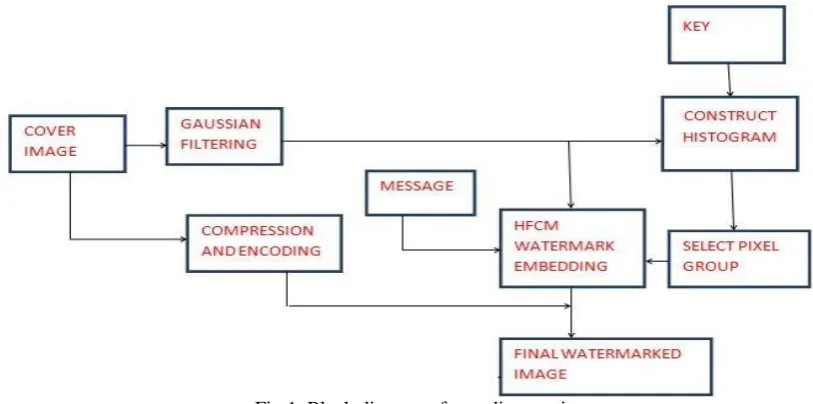
In the watermark embedding process first stage is need to apply the Gaussian low pass filtering, histogram construction, pixel group selection, HFCM based watermarking, SPIHT compression, RS encoder followed by arithmetic encoding. The proposed method of embedding process is shown fig1
:
First need to apply low pass Gaussian filter to the host image I (8 bit grey scale). After that perform the Gaussian filtering to get the low frequency image
(1)
Then find the high frequent component by image subtraction
(2)
After that the histogram is constructed by creating a pseudo noise(PN) sequence has security key.
(3)
Where ( is the number of pixels corresponding to grey level . Randomly select grey levels(s.grey levels). Construct the histogram according to the key. Then it need to select the pixels groups for implementing the watermarks. The be the number of pixels represented to the S selected grey levels.
(4)
From bins of grey levels, arrange neighboring bins to form groups. Then propose a pixel group selection criteria based on the ratio between and
g(i) = (5)
after that select suitable groups by arranging a threshold frequency. Construct a safe band using the parameter
(1- .
In the next step it need to embed the watermarking through HFCM method. Transfer pixels between bins according to the watermark message
(7)
Here in the above equation it take two bins. When the ratio of the two bins is greater than or equal to two then it can be watermarked on that section. When the ratio of the two bins is less than or equal to half then it cannot be watermarked. Then combined the watermarked low frequency image with the high frequency image to obtain the watermarked image.
=F
= (8)
III.RECOVERY AND ENHANCEMENT
In the receiver section now we have the final watermarked image. The watermarked image has been transmitted during attacks such as cropping, rotation etc. after that the image is again undergo through the low pass Gaussian filtering. After that the histogram is again constructed. By using the key in the receiver section, it can decode the message from the image. After the decoding of the message. The image can undergo through arithmetic decoding for the data decryption. After that it followed by the RS decoder algorithm. After that the image is undergo through the SPIHT wavelet decompression algorithm. In SPIHT decoder the coded image can be decoded as well as inverse transform can be applied on it. So the original image is reconstructed.
fig 2: block diagram for decoding section
So after all these steps applied in a reverse order as shown in fig 2: can obtain the restoration of host image. Then the histogram equalization method is applied to the restored host image, then it will obtain the enhanced contrast image.
IV.SIMULATION RESULTS
In this section, it evaluate the quality and robustness of proposed method by simulations. The fig 3: shows that the filtered image after applying the Gaussian low pass filter to the original image.
Fig 4: alpha variation Fig 5: beta variation
The fig 4 and fig 5 shows the graph of in accordance with PSNR and SSIM value. The fig shows the variations of alpha. It is drawn by taking the threshold value. The fig 6 shows the variations of beta according with the high frequency component modification.
Fig 6: histogram of watermarked image
The fig 6 shows the histogram of watermarked image. The histogram of one such pixel is shown here. When the Gaussian filtering is applied to the host image. It converted to low frequency and high frequency image. From the low frequency image the histogram is constructed. The fig shows the watermark of low frequency image.
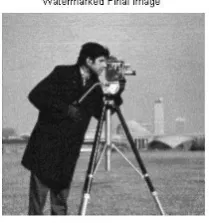
Fig 7: watermarked final image
The fig 7: shows the final watermarked image. after transferring the pixels between the bins according to the message that is watermarked. It will obtain a final watermarked image by combining with the watermarked low frequency image with the high frequency image
When the final watermarked image obtain at the receiver side, it will undergo through many attacks during the transmission. The below fig shows the different types of attacks that undergo during transmission.
After obtaining the host image, for the enhanced contrast of the host image, there apply the histogram equalization method. Hence the overall result of the proposed paper is as shown in the fig 10:
Fig 8: different attacks such as Gaussian noise, median filter, rotation, cropping
Fig 9: recovered host image
V. CONCLUSION
In this paper it can be conclude that the host image can also be extracted at receiver section. Here the host image can be reconstructed with improved signal quality. In this paper the output will be a enhanced contrast image. This paper can be implemented in special cases for military operations, hospital documents etc.. this paper is mainly dealing with the reversible image watermarking process, not only the embedded data but also the host image is also extracted from here.
REFERENCES
[1] N. K. Kalantari, S. M. Ahadi, and M. Vafadust, “A robust image watermarking in the ridgelet domain using universally
optimum decoder,” IEEE Trans. Circuits Syst. Video Technol., vol. 20, no. 3, pp. 396–406, Mar. 2010
[2] N. F. Johnson, Z. Duric, and S. Jajodia, “Recovery of watermarks from distorted images,” in Proc. 3rd Int. Workshop
Inf. Hiding, 1999, pp. 318–332
[3] F. Davoine, “Triangular meshes: A solution to resist to geometric distortions based watermark-removal softwares,” in
Proc. EURASIP Signal Process. Conf., 2000, pp. 493–496.
[4] J. J. K. Ó. Ruanaidh and T. Pun, “Rotation, scale and translation invariant spread spectrum digital image
watermarking,” Signal Process., vol. 66, no. 3, pp. 303–317, May 1998.
[5] C.-Y. Lin, M. Wu, J. A. Bloom, I. J. Cox, M. L. Miller, and Y. M. Lui, “Rotation, scale, and translation resilient
watermarking for images,” IEEE Trans. Image Process., vol. 10, no. 5, pp. 767–782, May 2001.
[6] D. Rosiyadi, S.-J. Horng, P. Fan, X. Wang, M. K. Khan, and Y. Pan, “Copyright protection for e-government document
images,” IEEE MultiMedia, vol. 19, no. 3, pp. 62–73, Jul./Sep. 2013.
[7] J. S. Seo and C. D. Yoo, “Image watermarking based on invariant regions of scale-space representation,” IEEE.,
Trans.SignalProcess vol.54,no. 4, pp. 1537–1549, Apr. 2006.
[8] J.-S. Tsai, W.-B. Huang, C.-L. Chen, and Y.-H. Kuo, “A feature based digital image watermarking for copyright
protection and content authentication,” in Proc. IEEE Int. Conf. Image Process., Sep./Oct. 2007,pp. V-469–V-472.
[9] X. Gao, C. Deng, X. Li, and D. Tao, “Geometric distortion insensitive image watermarking in affine covariant regions,”
IEEE Trans. Syst., Man, Cybern. C, Appl. Rev., vol. 40, no. 3, pp. 278–286, May 2010.