Available Online atwww.ijcsmc.com
International Journal of Computer Science and Mobile Computing
A Monthly Journal of Computer Science and Information Technology
ISSN 2320–088X
IMPACT FACTOR: 6.017IJCSMC, Vol. 5, Issue. 10, October 2016, pg.26 – 37
A Study of High Embedding Rate
Steganography Algorithm for Color Images
using Complex Wavelet Transforms
Dr. Sushil Kumar
Department of Mathematics, Rajdhani College, University of Delhi, New Delhi, India [email protected]
Abstract— The basic requisites for any steganography algorithm include imperceptibility, embedding capacity and robustness to communication attacks. To measure the quality of gray-scale or color image, the metric such as PSNR is widely used by researchers in steganography. However, for digital color image, there are many other options such as WPSNR, PSNRE, PSNRY, PSNR-HSR, CQM etc. In this paper, we have
presented a comparative study of transforms such DD DWT and DD DT DWT based high rate steganography algorithm using the Fusion method. The analysis of algorithm is done using different imperceptibility metrics, such as PSNRY, and CQM rather than PSNR, structural similarity metric, SSIM, provable security metric,
KLDiv and histogram Through experimental results, it is observed that DD DT DWT outperforms than the other transform in terms of imperceptibility, structural similarity and provable security.
Keywords— DWT; CWT;DD DWT; DD DT DWT; PSNR; PSNRY; CQM; SSIM; KLDiv I. INTRODUCTION
The basic requisite for any steganography algorithm include imperceptibility, high rate embedding and robustness to noise that may occur due to communication channel. For high rate embedding steganography algorithm, Tolba and Ghonemy [21] proposed the Wavelet Fusion method. The discrete wavelet transform (DWT) has been used widely in number of fields such as image compression, image de-noising, image restoration, digital data hiding, watermarking and steganography. But, due to the lacking of properties such as shift invariance and significant directional selectivity, researchers have explored other transforms also such as Wavelet-like transform (viz., Slantlet transform (SLT)), Contourlet transform (CTT), Complex wavelet transforms (CWT) etc.
Thompson et al [20] showed the superiority of complex wavelets over discretely sampled wavelets over the limits of watermark capacity, using established information theoretic methods. Li and Lv [6] have presented a new watermarking algorithm based on the DT-CWT and PCNN. Their experimental results show that their algorithm can combine the visual system and the embedding process perfectly to enhance the robustness and invisibility of the watermark.
DT DWT and DT CWT have also been proposed for image de-noising. Image de-noising is used to remove the noise from the cover image such that the important information of the cover is retained as much as possible. Chinnarao and Madhavilatha [3] proposed a new soft thresholding method for image de-noising using DT CWT and found less artifacts and ringing artifacts in the process of reconstruction of image. Shyam Lal et al. [17] have demonstrated that the complex DD DT DWT outperforms a number of other existing wavelet transform techniques. Kumar [8] have proposed DT-CWT based Block Non-linear de-noising and found that BlockShrink approach to DT-CWT is better than the BiShrink approach proposed by Selesnick [16].
The complex wavelet transforms have also been proposed in place of DWT for steganography schemes. Singh and Siddiqui [18] proposed a steganography technique based on complex wavelet transform, singular value decomposition and chaotic sequence which is shown to be more robust against common image processing and geometric attacks. Sathisha et al. [13] have proposed DT-CWT based high capacity steganography using coefficient replacement and adaptive scaling. The new concept of replacing HH sub band coefficients of DTCWT of cover image by LL sub band coefficients of payload is introduced to generate intermediate stego object. It is observed that
the
new coefficient replacement technique improves the security, PSNR and 100 percent hiding capacity. The adaptive scaling and use of DTCWT transformation in the proposed technique shows better results compared to the existing techniques. Kumar and Muttoo [7], [9], [10] have proposed high rate embedding steganography algorithm based on Wavelet Fusion method using DD DWT and DD DT DWT with combination of T-codes. They observed through experimental results that in terms of PSNR and embedding capacity, DD DT DWT outperforms to DWT. Kumar [7] has demonstrated that 2D DD DT DWT outperforms the other transforms such as Haar, CDF9/7, SLT, and CTT for high rate embedding steganography scheme for color images based on Wavelet Fusion method as the proposed algorithm provides higher PSNR/PSNRY/CQM, almost perfect SSIM value and good provable security as compared to other transforms.The histogram analysis included to show the degradation of the quality of images- the cover image and the stego-image. Usually when it comes to show histogram of a color image, the comparison is provided by showing histograms each for Red, Green and Blue channels, separately. However, the author provides the histogram comparison between the original color image and the corresponding stego-image in combination of all three channels. Usually, when the histograms are compared separately for each channel, it is found that 2D DD DT DWT shows not significant visual changes between the cover image and the stego-image, however when the histograms for the combined channel are compared, the visual changes are not insignificant for some of the image formats.
In this paper, a high rate embedding steganography algorithm [21] based on the two Complex Wavelet Transforms, DD DT DWT and DD DWT is proposed and compared with the existing algorithm. For the imperceptibility measures, not only the PSNR, but also PSNRY and CQM are used. Other metrics used for
comparison between the proposed algorithm and the existing algorithm include the structural similarity metric, SSIM, the provable security metric, KLDiv and histograms. The Variable length source encoder, T-codes is used in place of Huffman encoding for obtaining the secret message to be embedded from the original message. It has been shown that T-codes are better option than the Huffman as according to Manoharan [11] who proposed the use of T-codes to encode messages prior to embedding the messages in the cover media, this system will be more tolerant to media transformations that result in some bit losses or bit inversions in the hidden message.
In the subsequent subsections, we summarize the complex Wavelet transforms proposed by Selesnick [5] and the Wavelet Fusion method [21].
1.1 DD DWT and DD DT DWT
The double-density DWT (DD DWT) developed by Selesnick [14] was motivated in part by the undecimated DWT. It is based on a single scaling function (low pass) and two distinct wavelets (high pass), where the two wavelets are designed to be offset from one another by one half—the integer translates of one wavelet fall midway between the integer translates of the other wavelet: Ψ2(t) = Ψ1(t – 0.5).
The dual-tree DWT (DT DWT), also developed by Selenick [15] was motivated by the special properties of complex wavelet transforms. The DT DWT is based on concatenating two critically sampled DWTs. The filterbank structure corresponding to the Dt DWT simply consists of two critically sampled iterated filterbanks operating in parallel. The performance gains provided by the DT DWT come from designing the filters in the two filterbanks appropriately.
The double density dual-tree DWT (DD DT DWT) is a discrete wavelet transform that combines the double-density DWT and the dual-tree DWT, each of which has its own characteristics and advantages. It is based on two distinct scaling functions and four distinct wavelets Ψh,i(t) and Ψg,i(t) i = 1,2, where the two wavelets are
offset from one another by one half, as is : Ψh,1(t) = Ψh,2(t-0.5) ; Ψg,1(t) = Ψg,2(t- 0.5) and where the two
wavelets Ψh,1(t) and Ψh,2(t) form an approximate Hilbert transform pair, as do Ψg,1(t) and Ψg,2(t) .
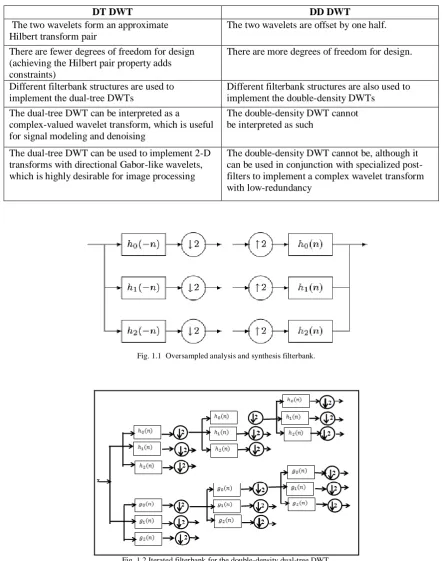
iterated oversampled filter bank, corresponding to the implementation of the double-density dual-tree, is illustrated in Fig. 1.2. We denote the filters in the first filterbank by hi (n) and the filters in the second filterbank by gi (n) , for i =0,1,2 .
Both DD DWT and DD DT DWT are over complete by a factor of two, nearly shift-invariant and are based on FIR perfect reconstruction filter banks, but they are quite different from one another in other important respects (see the table 1.1) .
Table 1.1 Differences between the double-density DWT and the dual-tree DWT [15]
DT DWT DD DWT
The two wavelets form an approximate Hilbert transform pair
The two wavelets are offset by one half.
There are fewer degrees of freedom for design (achieving the Hilbert pair property adds constraints)
There are more degrees of freedom for design.
Different filterbank structures are used to implement the dual-tree DWTs
Different filterbank structures are also used to implement the double-density DWTs
The dual-tree DWT can be interpreted as a
complex-valued wavelet transform, which is useful for signal modeling and denoising
The double-density DWT cannot be interpreted as such
The dual-tree DWT can be used to implement 2-D transforms with directional Gabor-like wavelets, which is highly desirable for image processing
The double-density DWT cannot be, although it can be used in conjunction with specialized post-filters to implement a complex wavelet transform with low-redundancy
Fig. 1.1 Oversampled analysis and synthesis filterbank.
Fig.1.3 (a) 3-level oversampled analysis filter bank of DD DWT. (b) 3-level oversampled synthesis filter bank.[24]
The 2-D DD DWT can be implemented by tree structured filter banks, where the tree propagation is done on the LL sub-band image of each stage as shown in Fig. 1.3(a). At each decomposition level, the input signal is decomposed by one low-pass (scaling) filter and two high-pass (wavelet) filters, following the down sampled by 2. In the synthesis process as shown in Fig.1.3(b) three-channel filter banks are inverted using perfect reconstruction with FIR filters.
There are two types of 2-D DD DT DWT: The 2-D DD DT real-oriented DWT and 2-D DD DT complex-oriented DWT. The first one is 2-times expansive and second is 4-time expansive to DD DWT. The 2-D DD DT Real DWT of a 2-D image is implemented by using two oversampled 2-D DD DWTs is parallel as shown in Fig. 1.2. Then, for each pair of sub-bands we take the sum and difference, whereas 2-D DD DT Complex DWT gives rise to twice as many wavelets in the same dominating orientations as the 2-D DD DT Real DWT. This transform is implemented by applying four 2-D DD DWTs in parallel to the same input data with distinct filter sets for the tows and columns. We then take the sum and difference of the sub-band images. This results into 32 oriented wavelets, as shown in Fig. 1.4(a) and the one part is shown for the image ‗Zoneplate.png‘in Fig. 1.4(b).
LL LH1
LH2
H1L H1H1 H1H2
H2L H2H1
H2H2
(b)
Fig. 1.5 (a) 1-stage decomposition of 2-D DD DT Complex DWT [15] (b) Part A demonstrated for the image ‗Zoneplate.png‘
1.2 Wavelet Fusion Method
The Wavelet fusion method is the high bit rate data hiding proposed by Tolba, Ghonemy, Taha & Khalifa [21]. Since the ordinary wavelet filters have floating point coefficients, a normalization operation is applied on the cover image so that the wavelet coefficients are converted in the range of 0.0 and 1.0. The secret message is converted to binary bits. The fusion technique follows the formula:
f* (x, y) = f(x, y) + α*g
where f* is the modified DWT coefficient, f is the normalised wavelet coefficient, g is the secret message bits and alpha (α) is the embedding strength which ranges from 0.0 to 1.0.
If the secret message bit is 1 the +alpha is added to the cover image wavelet coefficient and if it is 0 the – alpha is added to the wavelet coefficient of the cover image. The embedding is applied on each color plane separately. To overcome the problem of overflow or underflow, the cover‘s normalized pixels are adjusted before the embedding process takes place so that the reconstructed pixels do not go out of range.
In section II, we explain the proposed algorithm and section III contains the experimental results and their analysis. The conclusion is given in section IV.
II. PROPOSEDALGORITHM
In the following paragraphs the embedding method is presented.
To recover the original message, we use T-encoder in place of Huffman encoder. T-codes provides self-synchronization at the decoding stage. The high frequency sub-bands are obtained from the cover image using the CWT. The 1-stage of 2D DD DT DWT provides 8-high sub-bands, namely, LH1, LH2 , H1 L, H1H1 ,H1H2 ,
H2 L, H2 H1 and H2H2, whereas the 1-stage of 2-D DD DWT give 12 high sub-bands, when applied to the
cover image. We have embedded the binary bits of secret data using Fusion technique in the first 3-high sub-bands only, however, embedding can be done in all the high frequency sub-sub-bands and in more than 1-stage of CWT and thus high embedding rate can be obtained.
2.1 EMBEDDING PROCEDURE
Steganography embedding procedure [9] can be described using the following steps.
1. First normalize the color image by choosing alpha, preferably =0.05 and reconstruct the pixels values that lie in interval [alpha, 1-alpha].
2. Apply 1-stage of 2D DD DT real DWT or 2d DD DWT to obtain 8 high subbands for each color plane of image.
4. Generate pseudorandom permutation, using a stego-key, of the size of sub-band. 5. Enter the number of times the secret message to be embedded
6. Embed the message by adding or subtracting the alpha in the pixels according to message bit is 1 or 0. 7. Apply inverse of 2-D DD DT real DWT on each color plane separately.
8. Obtain the stego image by normalizing the resultant image.
2.2 EXTRACTION PROCEDURE
The extraction procedure [9] can be described using the following steps.
1. Apply 2-D DD DT real DWT on each color plane of the stego-image.
2. Using the pseudorandom permutation based on the stego-key, Obtain the selected embedded coefficients.
3. Obtain the secret message bit ‗s‘ by subtracting the transformed coefficients of original image from the transformed stego image coefficients obtained by using 2-D DD DT real DWT.
4. If the value of ‗s‘ is positive, embedded bit is 1 and the embedded bit is 0 if s is negative. 5. Decode the secret message into the original message using T-decoding.
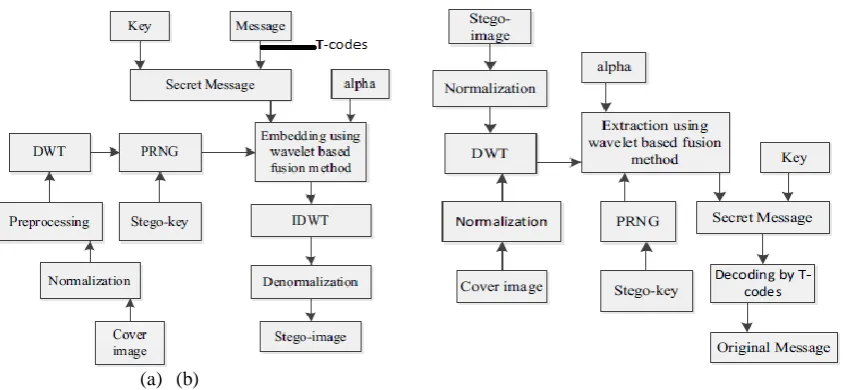
The Fig. 1.6 illustrates the embedding and extraction schemes.
(a) (b)
Fig. 1.6 (a) Embedding Process (b) Extraction process
III.EXPERIMENTALRESULTS
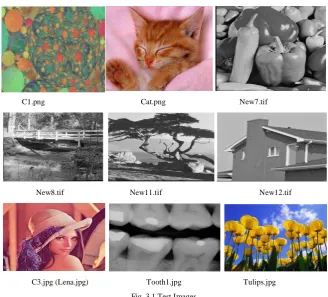
We have implemented the proposed Algo 2.1 using number of test images, results of the some of the images listed here are shown in Fig. 3.1. The embedding capacity used varying from low 500 bytes to high 6000 bytes. Experiments have been performed using MATLAB 7.0. In the consequent subsection we summarize the metrics used for comparison of the proposed algorithm and the existing algorithm
A. Imperceptibility
According to Mathworks [25], the PSNR for color images can be computed by first converting the image to a color space that separates the intensity (luma) channel, such as YCbCr and then the PSNR can be obtained only
on the luma channel, (denoted by PSNRY). The recommendation for this approach is suggested because the
human eye is most sensitive to luma information, the Y (luma), in YCbCr represents a weighted average of R, G
and B and G is given the most weight, again because the human eye perceives it most easily.
Another simple and effective full-reference color image quality measure (CQM), proposed by Yalman and Erturk [23], is based on reversible luminance and chrominance (YUV) color transformation and peak signal-to-noise ratio (PSNR) measure. The CQM value is given as:
where the CQM is composed of the weighted luminance quality measure (PSNRY×RW) and weighted color
quality measure (PSNRU + PSNRV)×CW) components. CW is the weight on the human perception of the cones
and 0.9449, respectively. The notation PSNR used for color images will mean the average value of PSNR calculated for each of the Red, Green and Blue channels.
B. Structural Similarity
The structural similarity (SSIM) [22] is composed of three values: Luminance comparison; Contrast comparison; and Structural comparison. These components are normalized such that they are 1.0 for identical images. The SSIM index is the product of these three components (raised by an exponent, if required).The formula for this measure is given by
1 2
2 2 2 2
1 2
(
) (2
)
( , )
(
) (
)
x y xy
x y x y
C
C
SSIM E F
C
C
where µx , µy , σx, σy and σxy local statistics parameters of the two images E and F and C1, C2 are constants used
to make it finite.
The SSIM index models any distortion as a combination of three different factors: loss of correlation, luminance distortion and contrast distortion. The mean similarity measure MSSIM varies in the interval [-1, 1]. The best value 1 is achieved if and only if E=F.
C. Provable Security
According to Cachin [2], a steganography algorithm is ε-secure if the relative entropy (also called K-L divergence) between distributions of cover object and stego-object is less than or equal to ε. Let random variable C and S denote the cover image and stego image respectively and let PCand PSrepresent the probability mass
functions (pmfs) of C and S, respectively. The K-L divergence between these two pmfs, PCand PS, is defined as:
D (PC||PS) =∑g∈G [PC (g) log (PC(g)/PS(g)]
where g ∈ G ≈ { 0, 1, 2, ..., 255} is the pixel value in grayscale images.
The stego system is considered perfectly secure in the Cachin‘s sense if D (PC||PS) = 0.
C1.png Cat.png New7.tif
New8.tif New11.tif New12.tif
The results of imperceptibility measures such as PSNRY, and CQM for Algo 2.1 with embedding capacity = 4000
bytes are shown in the Table 3.1.
From the Figure 3.2, it is observed that DD DT DWT based Algo 2.1 improves imperceptibility of the image in each of the measures of imperceptibility, PSNRY and CQM, used for the evaluation, assuming alpha = 0.05 and
N, number of embedding=5. In fact as the values of alpha is lowered, higher the PSNR values expected, though sacrificing the embedding rate.
Table 3.1:PSNRY and CQM values for Algo 2.1 based on DD DWT and DD DT CWT with capacity= 4000, alpha=0.05 and No. of embedding=5
Image PSNRY CQM
DD DWT DDDT DWT DD DWT DDDT DWT
C3.jpg
38.013859 44.754529 33.272689 40.345774
Tulips.jpg 38.019965 44.746557 33.332581 40.348409
Tooth1.jpg 38.182441 44.876404 33.480516 40.515707
C2.bmp 38.008482 44.734869 33.261721 40.339351
Baboo.bmp 37.999806 44.724724 33.265558 40.339568
C1.png 38.000082 44.73502 33.259316 40.339351
New7.tif 38.027834 44.740815 33.28849 40.359132
New8.tif 38.01828 44.738084 33.27612 40.353027
New11.tif 38.031939 44.749963 33.312556 40.39937
New12.tif 38.027006 44.770396 33.277464 40.360016
(b)
Fig. 3.2 (a) PSNRY and (b) CQM values of stego-images obtained using DD DWT and DD DT DWT
Table 3.2: SSIM values for Algo 2.1 based on DD DWT and DD DT DWT
Image SSIM
DD DWT DD DT CWT
C3.jpg 0.928078 0.98573
Tulips.jpg 0.942749 0.988556
Tooth1.jpg 0.884262 0.974917
C2.bmp 0.890639 0.977552
Baboo.bmp 0.9695 0.994152
C1.png 0.940342 0.988284
Cat.png 0.93736 0.987752
New7.tif 0.928298 0.985684
New8.tif 0.97509 0.995308
New11.tif 0.945528 0.989308
New12.tif 0.90596 0.981246
In Figure 3.3, we show the results obtained of structural similarity, SSIM, for the proposed algorithm 2.1 based on DD DWT and DD DT DWT using different image formats. It is observed that DD DT DWT based proposed algorithm gives almost perfect structural similarity than the other transform.
Table 3.4: KLdiv values for Algo 2.1 based on DD DWT and DD DT DWT Image KLDiv
DD DWT DD DT DWT
C3.jpg 0.00055 0.000114
Tulips.jpg 0.000516 0.000109
Tooth1.jpg 0.000627 0.00013
C2.bmp 0.000301 0.000072
Baboo.bmp 0.000446 0.000091
C1.png 0.000447 0.000093
Cat.png 0.000385 0.000083
New7.tif 0.000882 0.000212
New8.tif 0.000734 0.000154
New11.tif 0.000743 0.000177
New12.tif 0.000406 0.000083
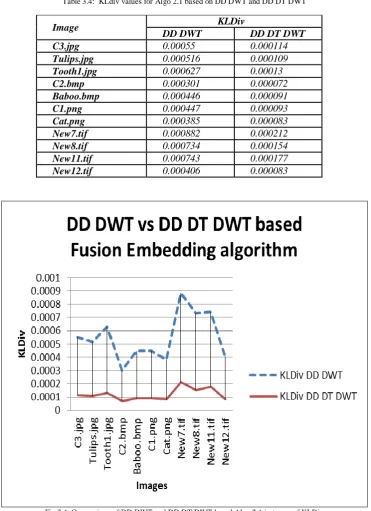
Fig.3.4 Comparison of DD DWT and DD DT DWT based Algo 2.1 in terms of KLDiv
A. 0 100 200 300
0 500 1000 1500 2000
(i) (ii) (iii)
B. 0 100 200 300
0 500 1000 1500
(i) (ii) (iii)
C. 0 100 200 300
0 200 400 600 800 1000
(i) (ii) (iii)
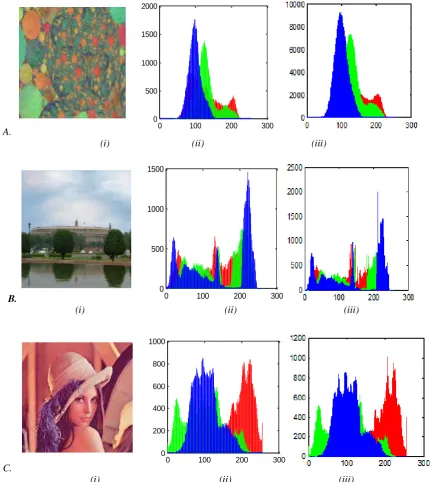
Figure 3.5 (i) Stego-image, (ii) corresponding histogram and (iii) histogram of original image for Algo 2.1 D. C1.png; B. C2.bmp C. C3.jpg [7]
In Figure 3.5, we provide the stego images and the corresponding histograms obtained after the implementation of Algo 2.1 with respect to forward real DD DT real DWT for some of the images. It can be seen from the figures that DD DT real DWT based fusion method reasonably good against the statistical attack.
IV.CONCLUSIONS
ACKNOWLEDGEMENT
The authors would like to thank W. Selesnick from Polytechnic Institute of New York University, for providing the 2-D Slantlet transform Matlab coding and the link to download complex wavelet transforms (http://eeweb.poly.edu/iselesni/WaveletSoftware/) without that it was not possible for us to proceed our research in this field.
R
EFERENCES
[1] Salih Husain Ali and Aymon Dawood Salman, ― Image compression based on 2D Dual Tree Complex Wavelet Transform (2D DT-CWT)‖, Eng., and Tech. Journal, Vol. 28, No. 7, 2010, 1290-1305.
[2] C. Cachin, ―An information-theoretic model for steganography‖, 2nd Inter-national Workshop Information Hiding, Vol. LNCS 1525, pp. 306-318.
[3] B. Chinnarao, M. Madhavilatha, ― Improved Image De-noising Algorithm using Dual Tree Complex Wavelet Transform‖, Journal of Computer Application, Vol. 44, No. 20, April 2012, 1-6
[4] N. Gayathri, A. Hazarathaia, ―Image denoising using complex framelets‖, International Journal of Innovative research in Computer and Communication Engineering‖, Vol.2, Special Issue 4, September 2014, pp.40-46
[5] N.G. Kingsbury, ―Image processing with complex wavelets‖, Philos. Trans. R. Soc. London A, Math. Phy. Sci., 357(1760) (1999), pp. 2543-2560
[6] Bo Li and Hailian Lv, ― Image Watermarking based on Dual Tree Complex Wavelet Transform and Pulse Coupled Neural Network‖, Fourth International Conference on Neural Computation, IEEE Computer Society, 2008
[7] Sushil Kumar, ― Data Hiding in Digital Images using Steganography‖, Ph.D. Thesis, University of Delhi, Delhi, December 2013. [8] Sushil Kumar, ― DT-CWT based Block Non-linear De-noising‖, International Journal of Advance Research and Innovation, Vol.
4, Issue 2, 2016, pp. 333-338.
[9] Sushil Kumar, S.K. Muttoo, ―Data Hiding techniques based on Wavelet-like Transform and Complex Wavelet Transform‖, International Symposium on Intelligence Information Processing and Trusted Computing, IPTC 2010, Huanggang, China, Oct. 28-29, 2010
[10] Sushil Kumar, S.K. Muttoo, ―A comparative study of Image algorithms in Wavelet domain‖, International Journal Of Computer Science And Mobile Computing (IJCSMC) ,February 2013.
[11] S. Manhoran, ―Towards robust steganography using T-codes‖, Video/Image Processing and Multimedia Communications, 4th EUROSIP Co., 2003
[12] S.K.Muttoo and S. Kumar, ―Robust Source coding Steganographic technique using Wavelet Transforms‖, International Journal of Information Technology(IJIT), Vol. 1, No. 2, July – December, New Delhi, 2009
[13] N. Sathisha, R. Priya, K. Suresh Babu, K.B.Raja, K.R.Venugopal, and P. Lalit, ―DT CWT based high capacity steganopgraphy using coefficient replacement and adaptive scaling‖, Sixth International Conference on Machine Vision (ICMV 2013), Antanas Verikas, Branislav Vuksanovic, Jianhong Zhou, Proc. of SPIE, Vol. 9067, 2013
[14] I.W. Selesnick, ―The double density DWT‖, in: Wavelets in Signal and Image Analysis: From theory to Practics, A. Petrosian and F. G. Meyer, (Eds), Norwell, MA: Kluwer, 2001.
[15] I.W.Selesnick, ―The Double-density dual-tree DWT‖, IEEE Trans. On Signal Processing, 52(5)(2004), pp. 1304-1314. [16] I.W.Selesnick, R. Baraniuk, and N.G. Kingsbury, ―The dual-tree complex wavelet transform: A coherent framework for multiscale signal and image processing‖, IEEE Signal Proc. Magazine, (2005), pp. 123-151.
[17] Shyam Lal, Mahesh Chander, Gopal Krishna Upadhyay and Deep Gupta, ―Removal of Additive Gaussian Noise by Complex Double Density Dual Tree Discrete Wavelet Transform‖, MIT International Journal of Electronics and Communication Engineering, Vol. 1, No. 1, Jan 2011, pp. 8-16
[18] Siddharth Singh and T. J. Siddiqui, ―Robust image steganography using complex wavelet transforms‖, International Conference on Multimedia, Signal Processing and Communication Technologies (IMPACT), 2013
[19] D. Srinivasulu Reddy, S. Varadarajan, and M.N. GiriPrasad, ―2D Dual-Tree Complex Wavelet Transform based Image Analysis‖, Contemporary Engineering Sciences, Vol. 5, no. 3, 2012, pp. 127-136
[20] A.I. Thompson, A. Bouridane, F. Kurugollu, and C. Tanooougast, ―Watermarking for Multimedia Security using Complex Wavelets‖, Journal of Multimedia, vol. 5, No. 5, Oct. 2010, pp. 443-457
[21] M. F. Tolba; M.A.S. Ghonemy; I.A.H. Taha,; A.S.Khalifa, ―High Capacity Image Steganography using Wavelet-Based Fusion‖ ,Computers and Communications, 2004. Proceedings. ISCC 2004. Ninth International Symposium on Volume 1, Issue , 28 June-1 July 2004 ,Vol.1, pp. 430-435
[22] Z.Wang, A.C. Bovik, H.R. Sheikh and E.P. Simoncelli, ―Image quality assessment: From error measurement to structural similarity‖, IEEE Trans. on Image Processing, 13(4), 2004, pp. 600-612
[23] Y. Yalman and I. Erturk, ― A new color image quality measure based on YUV transformation and PSNR for human vision system‖, Turkish Journal of Electrical Engineering and Computer Sciences, Vol. 21, 2013, pp. 603-612
[24] Phuong Pham, Li Yu and Minh Nguyen, ―Applying the Dual-tree Complex DWT and Double Density DWT for Mass Spectrometry Feature Extraction and Classification‖, International Conference on Bioinformatics and Biomedical Technology, 2010, pp. 394-399
![Fig. 1.5 (a) 1-stage decomposition of 2-D DD DT Complex DWT [15] (b) Part A demonstrated for the image (b) ‗Zoneplate.png‘](https://thumb-us.123doks.com/thumbv2/123dok_us/1915507.1251246/5.595.113.482.70.299/fig-stage-decomposition-complex-dwt-demonstrated-image-zoneplate.webp)