PARAMETER ESTIMATION AND ERROR
REDUCTION IN MULTICARRIER SYSTEMS BY TIME-DOMAIN SPREADING
E.-S. Shim and Y.-H. You School of Computer Engineering uT Communication Research Center Sejong University
98 Kunja-Dong,Kwangjin-Ku,Seoul 143-747,Korea
Abstract—This paper suggests parameter estimation and error reduction scheme in a multicarrier transmission system. A multicarrier orthogonal frequency division multiplexing (OFDM) signal by using a time-domain spreading (TDS) coupled with a cyclic time shift enables a pilot-less synchronization. Exploiting the modified OFDM signal endowed with the TDS,the proposed synchronization receiver can accurately estimate the carrier-frequency offset as well as the timing offset of OFDM signals without the use of training symbol.
1. INTRODUCTION
Orthogonal frequency division multiplexing (OFDM) has been chosen for several broadband wireless local area network (LAN) standards like IEEE802.11a and European HIPERLAN/2,and personal area network standards like ultra-wideband (UWB) WiMedia [1,2]. Many studies have been performed to improve the efficiency of components and transceivers in OFDM-based wireless systems. However,it is commonly known that OFDM systems are very sensitive to synchronization errors,which cause inter-channel interference (ICI) and inter-symbol interference (ISI) when the fast Fourier transform (FFT) window timing is not provided within the ISI-free part of the guard interval [3]. Also,frequency offset that is caused by doppler shift or misalignment between frequency oscillators exists causing ICI which leading the system performance deteriorating drastically [4].
Schemes proposed in [5–7] can estimate the frequency offset by using CP without using training sequences and hence requires no additional bandwidth,but the performance of the estimator depends on the length of CP and its estimation range does not exceed half the subcarrier spacing [6]. The Schmidl’s synchronization method uses a preamble containing the two same halves. This method gives simple and robust estimates for symbol timing and carrier frequency offset [10]. However, the timing metric of Schmidl’s method has a plateau,which causes large variance of the timing estimate. To reduce the uncertainty due to the timing metric,Minn proposed a method as modification to Schmidl’s [11]. The result of Minn’s preamble gives more sharp timing metric and smaller variance than Schmidl’s.
This paper deals with a pilot-less timing and frequency synchronization methods for OFDM systems in a multipath fading channel. To do this,we provide a modified OFDM system using a time-domain spreading (TDS) coupled with a cyclic time shift. In particular, we devise or select algorithms for the sequential estimation of symbol timing,and carrier frequency offset,which can provide benefit to the overall system performance. The proposed synchronization receiver is based on correlation methods that exploit repeated information-bearing OFDM symbols,thus removing the need of training symbols.
This paper is organized as follows. Next section suggests the OFDM system based on TDS. Section 3 deals with the pilot-less timing and frequency offset synchronization scheme. In Section 4, we then present simulation results illustrating the synchronization performance,and we conclude this paper with Section 5,which summarizes the main results.
2. OFDM SYSTEM WITH TIME-DOMAIN SPREADING In order to remove the use of training sequences,some modifications on the conventional OFDM system are highlighted at the transmitting and receiving sides. In this section,OFDM system employingN subcarrier and a cyclic prefix (CP) of lengthNg is considered.
2.1. Transmitter
For the notational convenience,we express information-bearing OFDM symbol vector during (2l+m)-th period to be composed of (N/Ng+ 1)
and is thus given by
ˆ
x2l+m = [x 2l+m(0)
CP
x2l+m(1)x2l+m(2)· · ·x2l+m(N/Ng)
x2l+m
] (1)
where x2l+m(0) denotes a vector of CP for m = 0,1 and becomes x2l+m(0) =x2l+m(N/Ng).
In our approach,x2l+1is designed to be the (N+Ng)-th (or−Ng -th) cyclic-shifted version ofx2l. Then,each component of the (2l+ 1)-th OFDM data symbol x2l+1 can be easily formulated from the 2l-th
frequency-domain OFDM symbol X2l(k) including information data and pilot symbol and reads
x2l+1(n) =
1 √
N
N−1
k=0
X2l(k)ej2πk(n+Ng)/N (2)
where we can find
X2l+1(k) =X2l(k)ej2πkNg/N. (3)
From Eqns. (2) and (3), ˆx2l+1 can be expressed as
ˆ
x2l+1 = [x 2l(1)
CP
x2l(2) x2l(3)· · ·x2l(N/Ng)x2l(1)
x2l+1
]. (4)
Using this formulation,the CP of ˆx2l+1can be viewed as a cyclic suffix
(CS) of ˆx2l. 2.2. Receiver
At the receiver,the useful part of the received signal including CP is given by
y2l+m(n) = L
i=0
h(i)x2l+m(n−i−τ)ej2π(n+m·Ne)∆/N+w2l+m(n) (5)
where Ne =N +Ng, h(i) denotes the channel impulse response with maximum delay spreadL,τ is the integer-valued unknown arrival time of symbol,∆ is the frequency offset normalized by carrier spacing, and w2l+m(n) is the samples of zero-mean complex AWGN during (2l+m)-th period. Frequency offset ∆ is divided into two parts,i.e., ∆ = ∆i+ ∆f with ∆i = int(∆) and ∆f ∈[−1/2,1/2).
the maximum channel delay spread bemax,whereNg is the length of the CP. Then,ifτ ∈ {−Ng+max,−Ng+max+1,−Ng+max+2. . .0}, the orthogonality among the subcarriers will not be destroyed and the timing offset will only introduce a phase rotation in every subcarrier symbol. When the timing estimate falls outside the ISI-free part of the GI in ordinary OFDM systems,interference will be introduced [3]. This is still true for the proposed system when−Ng ≤τ ≤ −Ng+max. Whenτ >0,on the other hand,sincex2l+1(n) is designed to be theN
e-th cyclic-shifted version ofx2l(n) at the proposed OFDM transmitter, the received FFT output can be given by
Y2l(k) = 1 √
N
N−1−τ
p=0
y2l(p+τ)e−j2πpk/N
+√1
N
N−1
p=N−τ
y2l+1(p+τ −Ne)e−j2πpk/N
= √1
N
N−1
p=0
y2l(p+τ)e−j2πpk/N (6)
which means that the orthogonality among the subcarriers will not be destroyed in the proposed OFDM system.
For demodulating the (2l+ 1)-th OFDM symbol to combine two repeated symbols,additionally,we can use a pre-advancement of FFT windowing with a length ofNa=Ng thanks to two-symbol repetition coupled with a cyclic time shifting. With this provision,the right-most term of ˆx2l+1 denoted byx2l(1) is regarded as CS of ˆx2l+1. Even
if the start position of the FFT window is out of GI interval,the orthogonality among the subcarriers will not be destroyed and the only effect suffered by the subchannel symbols is a change in phase provided that a positive timing error is less than the length of CP. So, the interference-free region of the FFT window over two consecutive OFDM symbols is given by
Ξ ={−Ng+max,−Ng+max+ 1, . . .0,1, . . . , Ng}. (7)
With this provision,we can expect that the proposed OFDM system does not suffer from timing-error-induced interference even when 0< τ ≤Ng.
the following manner: initial timing,fractional frequency offset (FFO) estimation,integer frequency offset (IFO) estimation,and fine symbol timing.
3.1. Estimation of Timing Offset
The proposed estimation method is based on Minn’s sliding window method [11] and uses the correlation between the two consecutive received information-bearing OFDM signals y2l(n) and y2l+1(n). To
avoid timing metric plateau,two correlation windows of length Ng samples are separated by 2N samples. So,2N is the distance between the periodic portion of lengthNg introduced by two-symbol repetition coupled with the cyclic time shift.
In our work,the correlation function denoted by PA(d) and the received energy denoted by RA(d) are respectively computed as
PA(d) = Ng−1
i=0
y2l(d+i)·y∗2l+1(d+i+N −Ng) (8)
and
RA(d) = 1 2
1
m=0
Ng−1
i=0
|y2l+m(d+i+m(N −Ng))|2. (9)
The timing metric function is defined as
MA(d) = 1
Ng+ 1
0
k=−Ng
|PA(d+k)|2
(RA(d+k))2. (10)
The complexity of the proposed method in Eqns. (8)–(10) is between those of Minn’s sliding window method and Minn’s training symbol method [11],which will be validated in the following section, if a sliding window of length Ng = N/4 is used. Here,we propose another low-complexity method,which is quite similar to Schmidl’s method [10]. In this case,two windows of length 2Ng samples are separated by 2N samples. With this provision,we define PB(d) and
RB(d) as follows
PB(d) = Ng−1
i=−Ng
and
RB(d) = Ng−1
i=−Ng
|y2l(d+i)|2. (12)
Plugging Eqns. (11)–(12) into|PB(d)|2/(RB(d))2yields a timing metric for this approach.
3.2. Estimation of Fractional Frequency Offset
The estimation of the fractional part has been investigated in [7–10]; many of the techniques do not require the knowledge of the integer part of the carrier frequency offset. Considering the structure of the proposed OFDM signal,estimation of FFO is achieved by calculating the phase difference between two consecutive OFDM signals. Using the proposed timing metric,symbol timing offset ˆdis estimated. Then,the FFO estimator is obtained from the argument of a correlation result as follows
ˆ ∆f =
1 2πarg
P∆f( ˆd)
(13)
where
P∆f dˆ
= N−1
i=0
y2l dˆ+i
y2∗l+1 dˆ+i−Ng
. (14)
The proposed FFO estimation method is quite similar to Schmidl’s estimation method,which uses a training symbol containing two identical halves and results in a frequency acquisition range of ±1 subcarrier spacing [10]. On the other hand,since the distance of the repeated signal parts isN as shown in Eqn. (14),which in turn allows a reduced-variance frequency offset estimation,a maximum frequency acquisition range of the proposed estimator is only ±1/2 subcarrier spacing as like Moose’s methods [5]. Therefore,the estimate suffers from the subcarrier ambiguity when|∆f|>0.5.
3.3. Estimation of Integer Frequency Offset
blocks of two consecutive OFDM symbols at the receiver are in the forms of
Y2l(k) =H2l(k−∆i)X2l(k−∆i) +Z2l(k) (15)
and
Y2l+1(k) = ej2π∆iNg/Ne−j2π(k−∆i)(Na−Ng)/NH2l+1(k−∆i)
·X2l+1(k−∆i) +Z2l+1(k) (16)
whereH2l+m(k) is the channel’s frequency response andZ2l+m(k) is a zero-mean complex Gaussian noise term.
In an analogy to Morelli and Mengali estimator (MME) developed in [12],the likelihood function has the form of
Λ(p) = k∈Sc
Y2∗l(k+p)Y2l+1(k+p)e(p, k) (17)
with
e(p, k) =e−j2πpNg/Ne−j2π(k−p)Ng/N (18)
where a notation of p denotes a trial value of ∆i and Sc is the set of subcarrier indices used for correlation. In this paper,let the number of elements in Sc be Nc and the correlation is done over
Nc subcarriers spaced at a distance N/Nc form each other,when x= first integer< x.
For a simple description,we assume that H2l(k) =H2l+1(k) and
SNR→ ∞. Recalling from Eqn. (3) thatX2l+1(k) =X2l(k)ej2πkNg/N, Λ(p) takes form
Λ(p) =e−j2π(p−∆i)(Ng−Na)/N
k∈Sc
|X2l(k+p−∆i)|2 (19)
whereX2l(k+p−∆i) =X2l(k+p−∆i)H2l(k+p−∆i). The argument of Eqn. (19) is given by
arg{Λ(p)}= 2π
K(p−∆i) (20)
whereK =N/(Ng−Na) and the argument becomes zero whenp= ∆i because this term has only real term.
With this provision,the proposed IFO estimator becomes
ˆ
∆i = min
where M denotes the largest expected value of |p| depending on the frequency stability of the transmitter and receiver oscillators. In pilot-aided IFO estimators discussed in [10,12], its estimation range for frequency ambiguity is not limited,while estimation range of our approach depends on the parameters Na and Ng because a complex plane is divided intoKregions as shown in Eq. (20). So,our frequency estimation range is limited byM =K/2−1,which is due to the fact that the pattern of phase rotation is repeated everyK/2 subcarrier.
4. SIMULATION RESULTS AND DISCUSSIONS
In this section,to verify the effectiveness of the proposed estimators, OFDM system with N = 128 and Ng =N/4 is considered. Here,we assume that the channel has an exponentially decaying power-delay intensity profile withL= 32 paths.
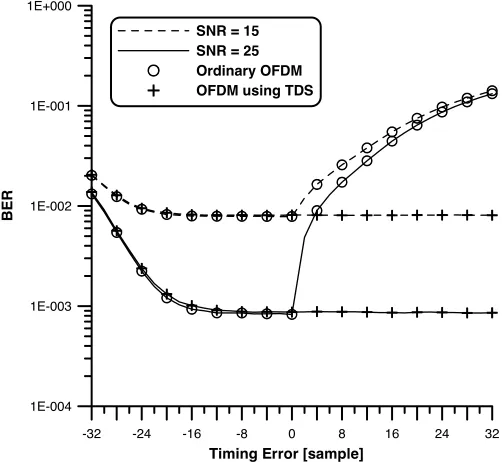
Figure 1 presents the bit error rate (BER) performance of both ordinary system and proposed systems when the values of SNR are 15 and 25 dB,respectively. In this example,we assume perfect channel equalization. When τ < 0,the proposed OFDM system with 16-QAM and the ordinary OFDM system with QPSK show a same BER performance without decreasing transmission efficiency. On the other hand,the proposed system shows a better performance rather than the ordinary OFDM system when 0 < τ ≤Ng with the aid of cyclic shifting.
-32 -24 -16 -8 0 8 16 24 32 Timing Error [sample]
1E-004 1E-003 1E-002 1E-001 1E+000
BER
SNR = 15 SNR = 25 Ordinary OFDM OFDM using TDS
Figure 1. BER performance of both ordinary and proposed OFDM systems versus timing error.
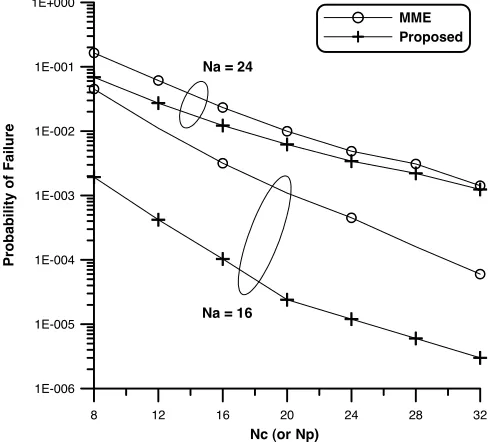
Figure 4 illustrates the probability of failure,Pr
ˆ ∆i= ∆i
of IFO estimators. In this example,the estimation range of the proposed IFO estimator is limited by M = 3 and M = 7 when Na = 16 and Na = 24,respectively,and the same range is applied to MME. As can be seen from the figure,the proposed method has smaller probability of error estimation than MME regardless of value of Na. If the allowable frequency tolerance of the system is relatively small, the proposed estimator is designed to have more improved performance whenNa= 16. Since the number of possible phases introduced by both cyclic time shift and length of CP is reduced by factor-of-two against
0 4 8 12 16 20 SNR(dB) -8 -4 0 4 8 M e a no f T im in g O ff s e t Schmidl Minn A Minn B Proposed A Proposed B
0 4 8 12 16 20
SNR(dB) 1 10 100 1000 10000 V a ri a n c e o f T im in g O ff s e t
Figure 2. Mean and MSE of timing estimators.
0 4 8 12 16 20 24
SNR(dB) 1E-007 1E-006 1E-005 0.0001 0.001 0.01 V a ri a n c e of F re qu e n c y of fs e t Schmidl Proposed
8 12 16 20 24 28 32 Nc (or Np)
1E-006 1E-005 1E-004 1E-003 1E-002 1E-001 1E+000
Probability
o
f
F
ailur
e
MME Proposed
Na = 16 Na = 24
Figure 4. Probability of failure of IFO estimators (SNR = 4 dB).
5. CONCLUSION
In order to resolve the time and frequency uncertainty in multicarrier transmission systems,a synchronization receiver which do not require the transmission of training symbols has been suggested in this paper. From the simulation results,it was observed that the proposed synchronization receiver gives very accurate estimates of the time and frequency error without additional training sequence. In addition, the proposed OFDM system provides a robustness against a positive OFDM timing error provided that it is less than the length of the CP.
ACKNOWLEDGMENT
REFERENCES
1. Doufexi,A.,S. Armour,M. Butler,A. Nix,D. Bull,J. McGeehan, and P. Karlsson,“A comparison of the HIPERLAN/2 and IEEE802.11a wireless LAN standards,” IEEE Commun. Mag., Vol. 40,No. 5,172–180,May 2002.
2. ECMA International,Standard ECMA-368,“High rate ultra wideband PHY and MAC standard,” December 2005.
3. Speth,M.,F. Classen,and H. Meyr,“Frame synchronization of OFDM systems in frequency selective fading channels,” Proc. of VTC’97,1807–1811,May 1997.
4. Pollet,T.,“The BER performamce of OFDM systems using nonsynchronized sampling,” Proc. of GLOBCOM’94,253–257, 1994.
5. Moose,P.,“A technique for orthogonal frequency division multiplexing frequency offset correcting,”IEEE Trans. Commun., Vol. 42,2908–2914,October l994.
6. Van de Beek,J.-J.,M. Sandell,and P. O. Borjesson,“ML estimation of time and frequency offset in OFDM systems,”IEEE Trans. Signal Processing,Vol. 45,1800–1805,July 1997.
7. Hsieh,M. and C. Wei,“A low-complexity frame synchronization and frequency offset compensation scheme for OFDM systems over fading channels,”IEEE Trans. vehicular Technology,Vol. 48, No. 5,September 1999.
8. Tanda,M.,“Blind symbol-timing and frequency-offset estimation in OFDM systems with real data symbols,” IEEE Trans. Commun.,Vol. 52,1609–1612,October 2004.
9. Zhang,Z.,K. Long,and Y. Liu,“Complex efficient carrier frequency offset estimation algorithm in OFDM systems,” IEEE Trans. Broadcasting,Vol. 52,No. 2,1609–1612,June 2004. 10. Schmidl,T. M. and D. C. Cox,“Robust frequency and timing
synchronization for OFDM,”IEEE Trans. Comm.,Vol. 45,1613– 1621,December 1997.
11. Minn,H.,M. Zeng,and V. K. Bhargava,“On timing offset estimation for OFDM systems,” IEEE Communication Letters, Vol. 4,242–244,July 2000.