Pecularities of Financing Higher Educational Institutions At The
Expense Of Public Funds
Mahmudov Akbar Abduhamidovich,
Independent researcher at Tashkent State University of Economics,
E-mail: [email protected]
Abstract: This article highlights the mechanism of financing of higher
educational institutions at the expense
of public funds, developing the sources,
types, distribution directions of
financial resources, and the existing
problems of funding for higher
education institutions.
Keywords: higher educational institutions, financial resources,
planning, cost, education, financial
need, salary, financial resources,
budget.
INTRODUCTION
The role and competitiveness of
any country depends not only on the
level of national development, but also
on the social development of society.
Today, societies in the world are taking
part in the process of socialization,
which is carried out through the
the educational process. The procedure
for financing the activities of higher
education institutions in the Republic
of Uzbekistan is based on the
interconnection of the budget system
with a single rule for budgets and their
use. According to the source of
financing of higher education
institutions from the state budget,
educational institutions are subdivided
into republican and local budgetary
institutions. Part of the higher
education institutions are financed from
the national budget.
Accordingly, in our country, one
of the pressing issues is "increasing the
quality and effectiveness of higher
education institutions, gradually
increasing the admission quotas for
higher education institutions based on
standards for the quality of education
and training."
Analytical Literature Review (Literature review)
The book "Organization of the
Management of Economics and of
Higher Education Institutions" which is
published by Doc .e. s Professor V.V.
Gluhov, describes the problems,
functions, principles of organization of
higher education institutions
management and methodology for
evaluating the effectiveness of their
management. However, trends in the
use of financial resources in higher
education institutions are partly studied
as a research object [2]
The main directions, methods and
means of improving the organizational
and economic basis of preparation of
highly qualified personnel in Russian
higher education institutions and the
mechanisms of state regulation were
studied in the work of Professor N.K.
Kontarayev, "Improving the
organizational and economic
mechanism of training highly qualified
personnel at Russian higher educational
institutions". In addition, the scientific
foundations of the sources of financial
resources in higher education
institutions are partly studied in terms
of the subject [3].
N.V. Laschinskaya's "Budgeting
Higher Education spheres" has studied
the scientific-methodological
foundations of higher education system
budgeting, budgeting, and budgetary
resources, and the scientific and
methodological foundations of
planning and budgeting all the costs
and expenditures for managing their
financial activities. The main directions
of improvement have been identified.
In addition, sources and types of
funding sources in higher educational
institutions are partly reflected in this
research [4].
Research Methodology
The systematic approach to the
study of higher education institutions'
was based on a systematic approach,
comprehensive assessment,
comparative and comparative analysis,
statistical and dynamic approach and
grouping, and the need to use optimal
methods to assess the effectiveness of
employment services.
The Decree of the President of the
Republic of Uzbekistan dated February
7, 2017 "On the Strategy for the
Further Development of the Republic
of Uzbekistan" is one of the most
important and priority directions of the
strategic development, which is
directly related to the development of
the education sector. At the same time,
the Law of the Republic of Uzbekistan
"On Education", the "National Program
for Personnel Training", the Strategic
Objectives of the President of the
Republic of Uzbekistan dated April 20,
2017 "On Measures for Further
Development of Higher Education
System" the basis of the methodology.
Analysis and results (Analysis and results)
At the expense of local budgets,
preschool institutions, general
education schools, extracurricular
institutions, and secondary specialized
educational institutions are funded.
Financing of higher and secondary
vocational education institutions is
carried out in accordance with the state
standards established by each type of
educational institution.
From January 1, 2000, the Cabinet
of Ministers Resolution No. 414 "On
Improvement of Budget Procedures for
Budget Organizations" of September 3,
1999, started the implementation of the
optimization of financing of budgetary
organizations. Accordingly, the
Ministry of Higher and Secondary
Special Education allocates monthly
budgetary funds to the educational
institution.
This new order, which is being
implemented, has expanded its
independence and increased its
responsibility as well. In addition, this
arrangement and created conditions for
incentives for the staff of the school. In
accordance with this regulation,
financing of budget organizations (by
type of activity) is carried out by means
of the following groups of
expenditures: [6] wages and equivalent
payments (grants to families with low
income families, financial aid to low
income families, scholarships, etc.);
adds to wages; capital expenditures (in
accordance with the specific list
considered by the state Investment
Program) and other expenses.
The introduction of the new
financing scheme on the Single List of
Standards gave the right to form
educational funds of educational
institutions at the expense of:
Savings (not used) at the expense
of budgetary financing and the amount
of budgetary funds at the end of the
reporting period;
Earnings from sales and
producing of goods (works, services)
related to educational activities;
Indifferent, charitable assistance
from legal entities and individuals.
The new funding scheme
stipulates that the educational
institutions, which earn extra income
from off-budget activities, will be
exempt from all taxes and duties on the
state budget for a certain period
determined by the state. The available
funds will be aimed at strengthening
the material-technical and social base
of the educational institution, as well as
financial incentives for the staff. The
use of budgetary funds and fiscal
discipline The Law of the Republic of
Uzbekistan "On Education" and other
legislative acts, Resolutions of the
Cabinet of Ministers of the Republic of
Uzbekistan, Ministry of Finance,
Regulations on Higher Education,
Statute of the Educational Institution
and other educational institutions, and
regulations governing certain issues
that relate to the rights of management.
Funding for higher education
accordance with the budget of the
republican budget for the expenditure
budget of the 1st and 2nd groups and the
budget expenditure lists, as well as the
changes made to them, as well as the
performance of evaluation indicators
set for the previous reporting period.
The state budget-financed higher
education institution shall submit the
expenditure estimate of the Ministry of
Higher and Secondary Special
Education of the Republic of
Uzbekistan, i.e. the monthly, quarterly
and annual reports, and shall form a
single balance on the budgetary and
extra-budgetary funds in forms and
terms established by the Ministry.
Financing of budget
organizations shall be carried out in
accordance with the approved budget
parameters for the corresponding year
and the annual apportionment of
quarterly budget expenditures in
accordance with expenditure estimates
taking into account changes to the cost
list and budget for the budget
execution.
In accordance with the existing
regulation, expenditures of the first and
second group budget organizations will
be funded primarily. It is forbidden to
execute Group I expenses without
having to pay for Group II expenses.
Financing of capital investments is
carried out according to the specific list
of construction according to the
Republican investment program for the
current fiscal year.
"Other Expenditures" will be
spent on group IV funds within the
limits set by the following order:
feeding; medicines; communal
services; other expenses.
Budget organizations may spend a
considerable amount of money from
Group IV for financing seasonal or
urgent measures, in consultation with
the Ministry of Finance of the Republic
of Uzbekistan or its territorial financial
Creditors arising in any group of
expenses are paid in proportion to their
origin in the current fiscal year, within
the limits established by
them. Budgetary funds on budgetary
funds (not included in the funds
provided for capital investments) at the
end of the last working day of the
report quarter are not deducted in the
accounts of budget
organizations. These funds are
transferred to the budget organization
development fund and used in
accordance with the established
procedure. Funding for budget
organizations in the next quarter will
not be reduced to the budgeted
(unused) budgetary funds.
Financing norms are developed
for the relevant fiscal year, approved
by the order of the Ministry of Finance
of the Republic of Uzbekistan and
delivered to the ministries and
departments, which have territorial
financial bodies, as well as social
sphere organizations.
Financing Principles Costs for the
maintenance of various types of
organizations are determined by the
total amount of costs incurred for
service units (including fixed rates and
supplements established in accordance
with current legislation), equipment
purchase and capital repairs. In higher
education institutions, funds allocated
by government grants are accounted for
separately. The allocation of funds as
budget and non-budgetary funds shall
not be permitted. This applies to the
scholarship fund, salary, development
of the educational institution, capital
investments and current expenditures.
Funds received from entrepreneurial
and production activities and other
activities of the educational institution
(except for the costs of contractual
education) are distributed
independently by the cost of the
educational institution based on mutual
agreement between the customer and
the educational institution.
production of goods (work, services) to
the educational institution in
accordance with the assigned tasks and
lease of free premises and equipment,
and benefits from the establishment of
the educational institution established
at the educational institution shall be
used at the discretion of the educational
institution.
Institutions and establishments, as
well as private individuals, can afford
to donate equipment and materials,
buildings and structures, transport and
technical equipment, and financial
resources to the educational
institution. The educational institution
independently disposes of such means
and means.
The premises use the land,
buildings, equipment and other
material resources allocated from the
state budget, as well as those bought
from enterprises and citizens or
purchased at the expense of other
sources on the terms of operational
management of the educational
institution.
The educational institution can
buy, rent and order the necessary
equipment at any enterprise or private
entity at the expense of the funds
received by them, and can pay them
without cash.
Budget accounting and off-budget
funds are controlled by the Central
Control and Audit Department of the
Ministry of Finance of the Republic of
Uzbekistan and prohibits the use of
these funds for unnecessary needs. The
Rector is a distributor of budget funds
in daily operations, and managers with
the right to distribute may allocate
costs for subdivisions or routes.
Such persons are the persons who
have the right to sign the banking
documents of the higher educational
institution, with full financial
independence of the structural
subdivisions.
The income of the higher
Public funds allocated for the preparation of
specialists according to the
quotas for the state grant
approved by the Cabinet of
Ministers of the Republic of
Uzbekistan;
financing of retraining;
financing targeted
education programs;
payment for contractual education and second
higher education;
Funds for educational services, which are
supplemented for
enterprises;
the right to provide additional education and
training to some citizens;
leasing land and
educational facilities;
intercessor means of all
enterprises and
organizations of the form of
ownership, the funds of
physical persons;
payments for scientific, counseling and other
services that are not
characterized by education; sale of intangible assets; Income from participation
in activities of other
organizations;
income from cultural and public events;
The impartial assistance of other organizations.
Additional earnings or earnings
out of plan from higher education
institutions are primarily those that are
to be financed out of additional
income, and secondly to cover current
debts, to third, to unexpected ones, and,
fourthly to repay debts.
We continue the research by
analyzing the financial performance of
the Tashkent State Economic
University for 2014-2016.
Amount1 of financial resources allocated from the national budget for Tashkent State Economic University for 2014-2017
(In million sums)
1 Prepared on the information of Tashkent state Economic University
Indicators 2014 In% of
total 2015
Compared
with the
amount
in%
2016
Compared
with the
amount
in%
2017
Compa
red
with
the
amount
in%
Group 1
expense
including:
4282,
9 84,1 4532,6 86,7 4301,3 85,3 4127 85,4
- total salary 2357,
2 55 2356,4 52 2385,4 55,4 2410,4 58,4
-
scholarships
1925,
7 45 2176,2 48 1915,9 44,6 1716,6 41,6
2nd group
expenses 640,2 12,6 546,8 10,5 592,4 11,7 599,4 12,4
4th group
expenses 168,2 3,3 147,9 2,8 148,5 3 105,3 2,2
Total
expenditures
5091,
The data from the above table
shows that in 2014, the State Budget of
the Republic of Uzbekistan totaled $
5091.3 million from the state budget.
Out of these, 84.1% was spent on 1st
group expenses, 12.6% in 2nd group
and 3.3% for 4th group expenditures.
Out of this, 55 percent of 1st
Group spending was wages and 45
percent were scholarships.
In 2017, the budget allocations
totaled 4831.7 million soums. It is
worth 210.5 million soums compared
to 2016 and 395.6 million soums,
compared to 2015 diminished 259.6
million soums relatively as of the end
of 2014.
85.4% of allocated resources
were 1st Group expenditures, 12.4% 2nd
group expenditures and 2.2% 4th group
expenditures. The main reason for the
decline in the financial resources
allocated by the state budget by 2017
can be explained by the decline in the
University membership rate to 659
students compared with 2015, and to
573 students in 2016.
From this information, we can say
that the 96-97 per cent cost of the
higher educational institution
comprises the expenses of the 1st and
2nd groups. Moreover, the financial
resources allocated to the higher
education institution have been
increasing year by year. This proves
that Uzbekistan pays special attention
to higher education institutions.
We continue our study by
analyzing the budget revenues and
expenditure estimates of the Tashkent
State Economic University by way of
budget.
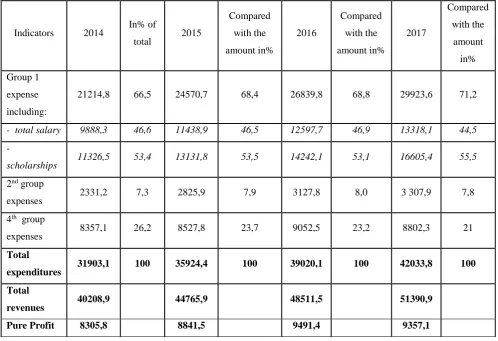
Table 2 Amount of out-of-budget financial resources of Tashkent State University
of Economics for 2014-20172 (in million soums)
Table 2 shows that the total
budget expenditure of the university in
2014 was 31,903.1 million units. of
which 66.5% were expenses of group
1st , 7.3% for 2nd group and 26.2% for
group 4th expenses. Of these, 1st Group
spending was 46.6% of wages and
53.4% of scholarships.
In 2017, the total expenditures of
the university were 42033.8 million
soums. It shows increase for 3013.7
million in 2016, for 6109,4 mln soum
in 2015 and 10130.7 mln soum in
2014. 71.2 percent of the total
expenditure were 1st Group
expenditures, 7.8 percent were 2nd
Group expenditures and 21 percent
were 4th Group expenditures.
The total revenues of the
University were amount of showing a
trend of growth with 40,208.9 million
soums in 2014, 44765.9 million soums
Indicators 2014 In% of
total 2015
Compared
with the
amount in%
2016
Compared
with the
amount in%
2017
Compared
with the
amount
in%
Group 1
expense
including:
21214,8 66,5 24570,7 68,4 26839,8 68,8 29923,6 71,2
- total salary 9888,3 46,6 11438,9 46,5 12597,7 46,9 13318,1 44,5
-
scholarships 11326,5 53,4 13131,8 53,5 14242,1 53,1 16605,4 55,5
2nd group
expenses 2331,2 7,3 2825,9 7,9 3127,8 8,0 3 307,9 7,8
4th group
expenses 8357,1 26,2 8527,8 23,7 9052,5 23,2 8802,3 21
Total
expenditures 31903,1 100 35924,4 100 39020,1 100 42033,8 100
Total
revenues 40208,9 44765,9 48511,5 51390,9
in 2015, 48511.5 million soums in
2016, and 5,1390.9 million soums in
2017.
Based on our research, the role of
off-budget payments and contractual
funds remains high in funding the
activities of higher education
institutions. Expenditures and savings
of the University (4th Group
expenditures) are at the expense of
extra-budgetary contractual funds. In
particular, TSEU allocates 2.2-3.3% of
the funds allocated from the budget to
the costs of group 4, while the share of
expenditures for off-budget payment
and contractual expenditure is
21-26.5%.
Conclusions and Recommendations
In our opinion, in our country, the
directions of increasing the efficiency
of financing the education system
should be:
increasing the amount of
investments directed to the
modernization of fixed assets in the
education sector (raising the share of
non-government funds in education
financing, increasing the cost of
education at the expense of all funding
sources, increasing the number of large
investment projects);
Upgrade the teaching and learning
base of educational institutions
(increase the number of educational
laboratories, computer rooms and
facilities with technological base);
Expanding the system of targeted
financing of education (increasing the
number of funding for training through
short and medium term targeted
programs).
References
[1]. Abalkina I.V. Budget financing
of educational institutions: structure
and sources of funds. State University
- Higher School of Economics, - M.,
2006.
[2]. Vasiliev Yu.S., Glukhov VV,
Fedorov M.P. Economics and
organization of university
V.V. Glukhova. - SPb .: publishing
house "Lan", 2001. P 544.
[3]. Kontareva N.A. Perfection of the
organizational and economic
mechanism of training highly qualified
personnel in Russian universities. -
Moscow: MELI, 2007.
[4]. Lashchinskaya N.V. Budgeting
in Higher Education // - Moscow:
Moscow State Academy of Instrument
Engineering and Informatics.
Scientific session of MEPI-2005,
volume 13.
[5]. Assessment of the benefits to
society from higher education /
Economics of Education. 2002. №З.
p.64-68.
[6]. Resolution of the Cabinet of
Ministers of the Republic of
Uzbekistan No. 414 "On the
improvement of the order of financing
of budget organizations", "Khalq
suzi", 3 September 1999.
[7]. The Decree of the President of
the Republic of Uzbekistan from
February 7, 2017 "On Strategy of
Action for Further Development of the
Republic of Uzbekistan" No. PR