Scholarship@Western
Scholarship@Western
Electronic Thesis and Dissertation Repository
4-23-2019 2:30 PM
Improving Neural Sequence Labelling Using Additional Linguistic
Improving Neural Sequence Labelling Using Additional Linguistic
Information
Information
Muhammad Rifayat Samee The University of Western Ontario
Supervisor Mercer, Robert E.
The University of Western Ontario Graduate Program in Computer Science
A thesis submitted in partial fulfillment of the requirements for the degree in Master of Science © Muhammad Rifayat Samee 2019
Follow this and additional works at: https://ir.lib.uwo.ca/etd
Part of the Artificial Intelligence and Robotics Commons
Recommended Citation Recommended Citation
Samee, Muhammad Rifayat, "Improving Neural Sequence Labelling Using Additional Linguistic Information" (2019). Electronic Thesis and Dissertation Repository. 6156.
https://ir.lib.uwo.ca/etd/6156
This Dissertation/Thesis is brought to you for free and open access by Scholarship@Western. It has been accepted for inclusion in Electronic Thesis and Dissertation Repository by an authorized administrator of
Acknowledgement
I would like to express my sincere gratitude to my thesis supervisor Dr. Robert E. Mercer.
Without his continuous guidance and significant contributions this work would not have been possible. Special thanks to my research colleague Mahtab Ahmed for his help and contributions
to this work.
I would like to thank the Department of Computer Science of The University of Western
Ontario for providing me with the Graduate Research Scholarship.
Last but not the least, I would like to thank my parents for believing in me and for providing
me with continuous support and encouragement throughout my graduate study.
Sequence Labelling is the task of mapping sequential data from one domain to another
domain. As we can interpret language as a sequence of words, sequence labelling is very
common in the field of Natural Language Processing (NLP). In NLP, some fundamental
se-quence labelling tasks are Parts-of-Speech Tagging, Named Entity Recognition, Chunking,
etc. Moreover, many NLP tasks can be modeled as sequence labelling or sequence to sequence
labelling such as machine translation, information retrieval and question answering. An exten-sive amount of research has already been performed on sequence labelling. Most of the current
high performing models are neural network models. These Deep Learning based models are
outperforming traditional machine learning techniques by using abstract high dimensional
fea-ture representations of the input data. In this thesis, we propose a new neural sequence model
which uses several additional types of linguistic information to improve the model
perfor-mance. The convergence rate of the proposed model is significantly less than similar models.
Moreover, our model obtains state of the art results on the benchmark datasets of POS, NER,
and chunking.
Keywords: Sequence Labelling, Neural Network, Deep Learning, NLP
Contents
Acknowlegements i
Abstract ii
List of Figures v
List of Tables vi
1 Introduction 1
1.1 Some Sequence Labelling Problems in NLP . . . 1
1.1.1 Parts-of-Speech (POS) Tagging . . . 1
1.1.2 Named Entity Recognition (NER) . . . 2
1.1.3 Chunking ( Shallow Parsing) . . . 3
1.2 Our Approach . . . 3
1.3 Thesis Outline . . . 4
2 Related Work 5 2.1 Previous Work . . . 5
2.1.1 Statistical Sequence Labelling Models . . . 5
2.1.2 Deep Learning models for Sequence Labelling . . . 6
2.2 Recurrent Neural Network (RNN) . . . 7
2.3 Distributional Representation of Words . . . 9
2.3.1 Word2Vec . . . 10
2.3.2 GloVe: Global Vectors for Word Representation . . . 11
2.4 Character Level Representation in Neural Network . . . 11
2.4.1 Convolutional Neural Network for Character Level Representation . . . 12
2.4.2 Long Short Term Memory Units for Character Level Representation . . 13
2.5 Word Sequence Representation in Neural Network . . . 13
2.6 Inference Layer in Neural Network . . . 14
2.6.1 Softmax Inference . . . 15
2.8 Performance Comparison Between Neural Network Models . . . 16
3 Proposed Model 19 3.1 Word Embedding Module . . . 19
3.2 Character Embedding Module . . . 20
3.3 Selective Pickup from Char-LSTM . . . 20
3.4 Word Sense Embeddings using Adaptive Skip-Gram . . . 21
3.5 Bi-gram Module using Convolutional Neural Network . . . 23
3.6 Conditional Random Field Module . . . 23
3.7 Morphology: Spelling and suffix features . . . 24
3.8 Connecting different Modules together . . . 25
4 Experimental Results 28 4.1 Experimental Setup . . . 28
4.1.1 Datasets Description . . . 28
4.1.2 Hardware and Software . . . 29
4.1.3 Performance Metrics . . . 29
4.1.4 Hyper-parameters of the Model . . . 29
4.2 Performance on Chunking . . . 30
4.3 Performance on NER Task . . . 31
4.4 Performance on POS tagging . . . 31
5 Conclusion and Future Work 35 5.1 Future Work . . . 36
Bibliography 37
Curriculum Vitae 42
List of Figures
1.1 Example of POS tagging . . . 2
1.2 Example of NER tagging . . . 3
1.3 Example of Chunking . . . 4
2.1 Recurrent Neural Network (RNN) [6] . . . 7
2.2 Long Short Term Memory Unit (LSTM) and Gated Recurrent Unit (GRU) . . . 9
2.3 Word2Vec Models [31] . . . 10
2.4 Convolutional Neural Network (CNN) for Character level representation [25] . 12 2.5 Long Short Term Memory Unit (LSTM) for Character level representation [22] 13 2.6 Word Sequence Representation [56] . . . 14
3.1 Character Embedding for the Word cats . . . 20
3.2 Pick Up Character Embedding . . . 21
3.3 CW, R, CO connection . . . 26
3.4 BLSTM-CRF model architecture . . . 27
2.1 Performance on CoNLL 2003 (NER) . . . 18
2.2 Performance on CoNLL 2000 (Chunking) . . . 18
2.3 Performance on WSJ (POS tagging) . . . 18
4.1 Dataset Description . . . 29
4.2 Ranges of different hyper-parameters. . . 30
4.3 Comparison of F1 scores of different models for chunking . . . 31
4.4 Comparison of F1 scores of different models for NER . . . 31
4.5 Comparison of Accuracy of different models for POS tagging . . . 32
4.6 Training time (hours) of our BLSTM-CRF model on the WSJ corpus compared with all models of [24] using the same hardware configuration (GPU: Nvidia GTX 1080) . . . 32
4.7 Change inwi’s for each module with epochs. . . 33
4.8 Ablation study of our BLSTM-CRF model for POS tagging. (R - Residual connection, CW - Concatenate with word embedding, CO - Concatenate with second last output layer) . . . 34
Chapter 1
Introduction
In Natural Language Processing, often we need to find a function to map sequence pairs from
different domains. An example of such sequence pairs is a sequence of words(i.e, a sentence)
and a sequence of parts-of-speech. This is the well-known parts-of-speech (POS) tagging
problem. Formally, given an input sequenceX = x1,x2, ...,xn where eachxi is from a domain
αand a corresponding tagging/state sequenceY =y1,y2, ...,ynwhere eachyi is from a domain
γ, our goal is to find a functional mapping f : X 7→ Y. For example, in the POS tagging
problem one possible input sequence might be"France won the Match". The corresponding
POS tagged sequence will be N V D N. Here N, V, and D represent tags for Noun, Verb,and
Determiner,respectively. In this example, our function f maps word sequences to their possible parts-of-speech sequences.
Sequence Labelling can be treated as a supervised machine learning task. Givenmtraining
examples (x(i),y(i)) fori = 1 . . .mwhere each x(i) is a sentencex(i) 1 . . .x
(i)
ni of lengthni, and each
y(i) is a tag sequencey(i) 1 . . .y
(i)
ni of lengthni, our task is to train a model to correctly predict the
tagged sequenceYfor an unknown input sentenceX. In this chapter we briefly introduce some
fundamental sequence labelling problems. Moreover, we give an introduction to our approach
and will give the outline of this thesis.
1.1
Some Sequence Labelling Problems in NLP
1.1.1
Parts-of-Speech (POS) Tagging
Parts-of-speech (POS) Tagging is probably the oldest and most famous sequence labelling
problem in the field of Natural Language Processing. In this problem the goal is to map each
word of a sentence to its correct POS. Extensive research has been performed on POS tagging.
Among all the sequence labelling problems, POS tagging is treated as an almost solved
lem with state of the art accuracy being between 97% and 98% [24]. In 2011, C. Manning [26]
argued that, to go from 97% to 100%, we need to explore more linguistic features. His idea is
reflected in the recent deep learning architectures where along with features which are
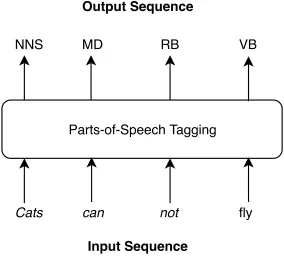
implic-itly extracted by Neural Networks, researchers are incorporating carefully designed linguistic features. Figure 1.1 shows an example of POS tagging. The input sequence is "cats can not
fly" and the corresponding POS tags are NNS (plural common noun), MD (modal auxiliary),
RB (adverb) and VB (verb).
Parts-of-Speech Tagging
Cats
can
not
Input Sequence
Output Sequence
fly
NNS
MD
RB
VB
Figure 1.1: Example of POS tagging
1.1.2
Named Entity Recognition (NER)
Named Entity Recognition is another sequence labelling problem: the input sequence is a
sentence and the output sequence is the sentence tagged with possible named entities. Some
common named entities are persons, organizations, locations and names. Named entity recog-nition is challenging because a large amount of feature and lexicon knowledge is required to
achieve high performance. Most of the high performing models for the NER task are
neu-ral network models. Current state of the art F1 score (4.1.3) for English NER task is around
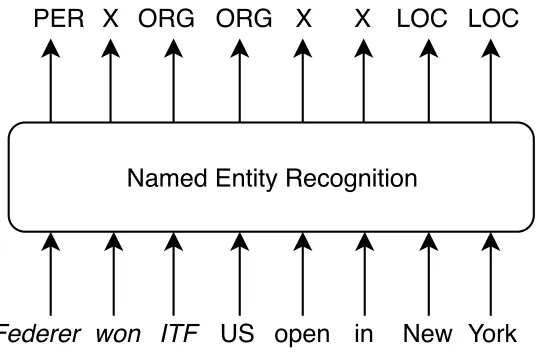
91%. Figure 1.2 shows a simple example of NER task. The input sentence is "Federer won
ITF US open in New York". And the NER model identifies Federer as a "PERSON", ITF as
1.2. OurApproach 3
Named Entity Recognition
Federer won ITF
Input Sequence Output Sequence
US open in New York
PER X ORG ORG X X LOC LOC
Figure 1.2: Example of NER tagging
1.1.3
Chunking ( Shallow Parsing)
Chunking, also known as shallow parsing, is the task of dividing texts to syntactically
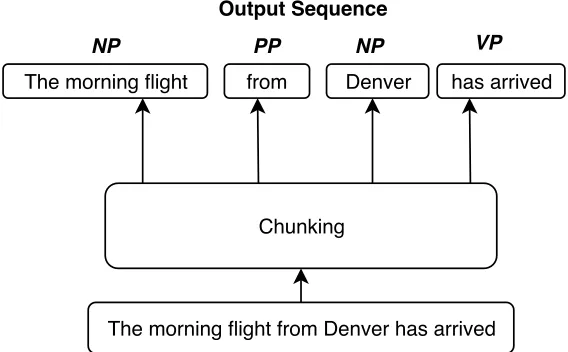
corre-lated sequence of words. For example: "The morning flight from Denver has arrived." can
be divided as"[NP The morning flight ] [PP from] [NP Denver] [VP has arrived]". Here the
syntactic constructs are noun phrase (NP), verb phrase (VP) and preposition (PP). This shallow parsing can be an intermediate step before parsing a sentence. Chunking can be designed as a
sequence labelling task where each word of the same chunk will be tagged with the same label.
Unlike POS tagging and NER, for Chunking, most of high performing models are not neural
models. The Best F1-score of 95.23% is achieved by Shen et al. [46] using a Hidden Markov
Model with a voting scheme.
1.2
Our Approach
In this thesis, our goal is to improve neural sequence labelling by using additional linguistic
features. We propose a new neural architecture for the Sequence Labelling problem which is
capable of using several linguistic features to improve tagging accuracy. In our approach we
used sense embedding along with word level knowledge to capture semantic features.
More-over, to capture morphological features we used character level embeddings for words.
Chunking
The morning flight from Denver has arrived The morning flight
NP
from Denver
NP PP
has arrived
VP
Input Sequence Output Sequence
Figure 1.3: Example of Chunking
(LSTM)[16] to capture contextual and morphological features simultaneously. We used a
Con-volutional Neural Network (CNN) to exploit bigram(two adjacent words) information. Several
hand crafted spelling features (prefix, suffix, patterns) were used with the implicit neural fea-ture extraction done by the Deep Neural Learning. To connect all the feafea-tures appropriately we used three connection methods: Residual connection, Concatenate with word embedding and
Concatenate with second last output layer. Our architecture achieved state of the art results on
benchmark datasets of POS tagging, NER and Chunking without using any additional data or
multi-task learning.
1.3
Thesis Outline
This thesis is organized in four chapters. In the second chapter we summarize previous work done in sequence labelling using Deep Neural Networks. We discuss the main components of
a typical deep sequence labelling model. Chapter 3 details our proposed model. For each of
the modules of our model, we talk about the reason behind using the module and the detail
functionality of the module. Chapter 4 is dedicated to experimental results. In this chapter, we
show our experimental setup and discuss our experimental findings. We compare our results
with several state of the art models on different benchmark data sets for POS, NER and the
Chunking task. Moreover, we do an ablation study of our model to see the impact and
useful-ness of different modules of our architecture. We also discuss feature connection methods used
Chapter 2
Related Work
In this chapter we summarize previous work done on the sequence labelling task. First we
give an overview of the previous work for Parts-of-speech (POS) tagging using traditional
ap-proaches. Then we present a summary of research work using Deep Neural Architectures for
sequence labelling tasks. Then we introduce some well-known and commonly used
architec-tures and techniques for Deep Sequence Labelling Networks. Finally, we compare several Deep learning based models on benchmark datasets for the sequence labelling task.
2.1
Previous Work
2.1.1
Statistical Sequence Labelling Models
Before the advancement of Deep Learning, most of the high performing models for sequence
labelling were Statistical in nature. Models were based on Hidden Markov Models (HMMs)
[12, 59] and Conditional Random Fields (CRFs) [21, 33]. For example, Weischedel et al. [55]
introduced a generic n-gram probabilistic model for sequence labelling. They experimented
using tri-gram version of their model on the WSJ corpus for POS tagging, achieving 96.3%
accuracy. Their experimental result showed that probabilistic models are capable of extracting
lexical features which can replace rule based systems. Even though this paper used several
features to deal with the sparsity problem, the paper did not talk about clear ways to incorpo-rate features to make the model’s feature space more robust. The Maximum-Entropy Model
[40] introduced a way to incorporate an arbitrary number of binary features into the
proba-bilistic model. As expected, the Maximum-Entropy model achieved better accuracy than the
tri-gram model on unknown words (85.6%) which leads to overall accuracy of 96.6%. The
next improvement on overall accuracy came from a Hidden Markov model using second-order
approximations. The model proposed by Scott and Harper [52] uses a 3d transition probability
matrix which not only depends on the current state but also on the previous state. Moreover,
they used a separate parameter for unknown words. The model got 96.9% accuracy on the WSJ
corpus, which is an improvement over the previous models. However, the unknown word
ac-curacy (84.9%) is significantly less than the Maximum-Entropy model. The reason behind it is
that the Second-Order Markov model did not use any hand-crafted features. It only uses
statis-tical approximations from the data. The experimental results of the three statisstatis-tical approaches
described above clearly indicate that, for supervised sequence labelling problems using only
probabilistic parameter estimation is not enough. We need to exploit specialized features to
boost model accuracy.
2.1.2
Deep Learning models for Sequence Labelling
In the past few years, Deep Neural Network architectures became very popular in the field
of Natural Language Processing (NLP). Recent advancements in distributional word
repre-sentation and Recurrent Neural Networks (RNN) made neural architectures superior to the
traditional statistical machine learning techniques in almost every NLP tasks. All of the
archi-tectires and other techniques used in this and the next paragraph will be decribed in the next
sections.
Huang et al. [17] propose a few models for the sequence tagging task. Apart from just word
embeddings, they use morphological, bigram and trigram information as their input features.
Later, they use Long Short Term Memory (LSTM) and Bidirectional LSTM (BLSTM) with Conditional Random Field (CRF) to do the final tagging. Lample et al. [22] extract character
embeddings from both the left and right directions, concatenate these with word embeddings
and use a stacked LSTM with CRF to do the tagging. Liu et al. [24] propose a model leveraging
word and character level features. It includes a language model to represent the character level
knowledge along with a highway layer to avoid the feature collision. Finally it is trained jointly
as a multitask learning. Yu et al. [57] propose a general purpose tagger using a Convolutional
Neural Network (CNN). First, they use CNNs to extract the character level features and then
concatenate it with word embeddings, position embeddings and binary features. Finally they
use another CNN to get the contextual features as well to do the tagging. Ma and Hovy [25] propose an end-to-end sequence labelling model using a combination of BLSTM, CNN and
CRF. They use a CNN to get the character level information, concatenate it with word
embed-dings and then apply BLSTM to model the contextual information. Finally they generate the
tags by using a sequential CRF layer. Rei [41] trains a language model type objective function
using BLSTM-CRF to predict the surrounding words for every word in the corpus and utilizes
2.2. RecurrentNeuralNetwork(RNN) 7
In the next portion of this chapter, we will study commonly used architectures and
tech-niques for a typical Deep Neural Sequence Labelling model. At the end of the chapter, we will
compare different neural models on three sequence labelling tasks: POS tagging, NER and
Chunking on benchmark datasets.
2.2
Recurrent Neural Network (RNN)
Traditional feedforward neural networks cannot capture dependencies in sequential data. For
this reason, feedforward neural networks are not suitable for natural language where past
con-text is important to predict the future. For example: let’s consider predicting the word “
de-feated” in the sentence"France won the World cup final 2018, so they defeated Croatia 2-1 in the final". To predict “defeated” we need to remember the inputs from earlier in the sentence. Being a bipartite graph, a feedforward neural network does not have the mechanism to address
this issue. Recurrent Neural Networks (RNN) are specially designed to have internal memory
to remember some important portion of the previous data to predict the future events. RNNs
have loops that allow information to persist. Figure 2.1 shows a typical RNN structure. There,
xt is the input at time step tand the ot is the corresponding output at time step t. W,V ,U are
the parameters of an RNN. All the parameters are shared across time steps. So the outputot+1
is influenced by all the previous inputsxt,xt−1. . .x1and the current input data xt+1.
Figure 2.1: Recurrent Neural Network (RNN) [6]
Long Short Term Memory Unit (LSTM)
Theoretically, Recurrent Neural Networks are supposed to capture long distance dependencies
of the gradient vanishing/exploding problem [5] [35]. Long Short Time Memory Units (LSTM) are designed to capture long distance dependencies without succumbing to the gradient
van-ishing/exploding problem. LSTMs were first proposed by Hochreiter and Schmidhuber [16]
in 1997. LSTMs have three multiplicative gates: input gate, forget gate and output gate. Each gate has a transformation matrixWi,Wf andWorespectively. All the gates are sigmoid gates so
the output of the gates are between 0 and 1. Using the gates, an LSTM decides what
informa-tion from the past time step should be remembered. Fig 2.2(a) shows the internal structure of
an LSTM cell.Ct−1andht−1are the cell state and hidden state at time stept−1. First the forget
gate decides what portion of theCt−1 we want to forget (eq 2.1) by using a sigmoid activation
on the linearly transformed representation of the concatenation of the previous hidden stateht−1 and the current input vector xt. In the equation, [ht−1,xt] means the concatenation operation of
two vectors: ht−1 and xt. Then the input gate decides which new values we need to update by
seeing the previous hidden state ht−1 and the current input xt (eq 2.2). A candidate cell state
¯
Ct is calculated by a tanh() layer (eq 2.3) (here ∗ is the point-wise multiplication function).
Finally the new cell state is created using the outputs from the forget gate and the input gate
(eq 2.4). Now to find the new hidden representation for the current time stept, LSTM uses the
new cell stateCtand the output of the output gateot (eq2.5) (eq2.6).
ft =σ(Wf.[ht−1,xt]+bf) (2.1)
it =σ(Wi.[ht−1,xt]+bi) (2.2)
¯
Ct = tanh(Wc.[ht−1,xt]+bc) (2.3)
Ct = ft∗Ct−1+it∗C¯t (2.4)
ot =σ(Wo.[ht−1,xt]+bo) (2.5)
2.3. DistributionalRepresentation ofWords 9
Figure 2.2: Long Short Term Memory Unit (LSTM) and Gated Recurrent Unit (GRU) [34]
Gated Recurrent Units (GRU)
A widely used and very popular variation of LSTM is Gated Recurrent Units (GRU). GRU was
proposed by Cho, et al. [9] in 2014. In GRUs the forget gate and input gate are combined into
a single update gate. So, GRUs have fewer parameters compared to LSTMs. For this reason,
unlike LSTMs, GRUs are less prone to over-fitting. Fig 2.2 (b) shows the structure of a single
GRU unit. Another major difference between LSTMs and GRUs is that the GRU structure does
not include any cell state. Updating the hidden state of a GRU unit is done as following:
zt = σ(Wz.[ht−1,xt]) (2.7)
rt = σ(Wr.[ht−1,xt]) (2.8)
¯
ht =tanh(W.[rt∗ht−1,xt]) (2.9)
ht =(1−zt)∗ht−1+zt ∗h¯t (2.10)
2.3
Distributional Representation of Words
Representing words as continuous vectors in a vector space (word embeddings) has been
ex-tensively researched. Bengio et al. [4] first proposed a neural architecture to find vector
repre-sentation of words. This model is mainly designed for estimating a neural network language
model (NNLM). The model is a feedfoward neural network with a linear projection layer and
a non-linear hidden layer. This idea of learning word representations using a neural network
2.3.1
Word2Vec
In 2013, Mikolov et al. [31] proposed a method to estimate high quality word vectors from huge
datasets. They proposed two different models: Continuous Bag of Words Model (CBOW)
and Continuous Skip-Gram model. Both models use a shallow neural network with one
hidden layer. These models use a fixed length context window for each target word. In
CBOW, the model predicts the target word from the context words. CBOW is similar to
the feedforward NNLM model where the projection layer is shared for all the words. On
the other hand, the Skip-Gram model predicts the context words from the target word.
Fig-ure 2.3 shows the model architectFig-ures. The result of the Skip-Gram model is very
surpris-ing. When the model is trained on a huge amount of data, the resulting vectors can capture
subtle semantic relationships between words. Moreover, it is possible to do meaningful
al-gebraic operations on the word vectors. For example: the resulting vector of the expression:
vector(“biggest00)−vector(“big00)+vector(“small00) is very close to the vector(“smallest00). Here, distance is measured by the cosine similarity of the vectors. Using pretrained word2vec
vectors, most of the neural NLP models get significant improvements in performance.
Nowa-days, it is common practice to use word vectors trained on extremely large amount of data for
initializing embedding layers of neural models.
2.4. CharacterLevelRepresentation inNeuralNetwork 11
2.3.2
GloVe: Global Vectors for Word Representation
Two main ideas for learning word vectors are the global matrix factorization method, such as latent semantic analysis (LSA) [11] and the fixed local context window method, such as the
Skip-Gram model [31]. The limitation of LSA and other global matrix factorization methods
is that the similarity measures of the vectors are dominated by the frequent words. On the
other hand, the Word2Vec Skip-gram model concentrate only on local context information and
fails to leverage global statistical information. In 2014 Pennington et al. [37] proposed a new
regression model which combines the advantages of the global matrix factorization method
and the local context features. Global Vectors (GloVe) first builds a co-occurrence matrixXof
a fixed window size. Xi j represents the number of times word jappears in the context of word
i. Then, GloVe tries to predict the co-occurrence ratio from the word vectors. For example, if
w∈Rdare word vectors and ¯
w∈Rd are separate context word vectors then the basic equation is
the following:
F(wi,wj,w¯k)≈
Pik
Pjk
(2.11)
Here Pik
Pjk is the ratio of co-occurrence probabilities. As one of the goals of GloVe is to find a
linear relation between the word vectors, it is possible to restrict the equation to the difference between the word vectors:
F(wi−wj,w¯k)≈
Pik
Pjk
(2.12)
The final loss function used by GloVe is the following:
J =
V
X
i,j=1
f(Xi j)(wTi wj+bi+b¯j−log(Xi j))2 (2.13)
(here V is the vocabulary size. The full mathematical simplification and optimization is not
included here.)
GloVe vectors outperform Word2Vec vectors in several NLP tasks including word analogy,
word similarity and Name Entity Recognition task. There is no significant different between
Word2Vec and GloVe in terms of performance, but with GloVe vectors it is easy to parallelize
the model. Thus GloVe can be trained a lot faster than Word2Vec.
2.4
Character Level Representation in Neural Network
In Neural Network architectures, words are represented using word embeddings. The Word
Word2Vec or Glove. To capture character level features, neural network models often
con-catenate character representations of words with their corresponding word embeddings. Other
research [10][17][49] has used feature look up tables to represent several character level
fea-tures like prefix, suffix, capitalization, etc. However, they have used predefined character level features. To extract features implicitly, a separate Neural Network model can be used.
2.4.1
Convolutional Neural Network for Character Level Representation
Convolutional Neural Networks (CNN) were first introduced by [43] for character embeddings.
They used a convolution kernel to produce local features for each character of a word and then used a max-pooling operation to produce a fixed length character embedding for that word.
Later, this idea of using CNN for character representation was used by [8][25][44]. Figure 2.4
shows the network used by [25] on the wordPlaying. First they used a convolution kernel of
size 3 over the padded character sequence of the word. Then the model used max-pooling to
create a vector representation of size 4 for the word Playing. In addition to that, a drop-out
layer[48] was used after the max-pooling layer.
2.5. WordSequenceRepresentation inNeuralNetwork 13
2.4.2
Long Short Term Memory Units for Character Level
Representa-tion
Bi-directional Long Short Term Memory Units (Bi-LSTMs) can also be used for finding
char-acter embeddings for words [22]. Figure 2.5 shows the Bi-LSTM model used by [22]. The
model uses two layers of LSTM named forward LSTM and backward LSTM. Forward LSTM captures features by going over the character sequence from left to right. The backward LSTM
captures features in the right to left direction. Then a single character representation vector is
created by concatenating the forward LSTM output and the backward LSTM output.
Figure 2.5: Long Short Term Memory Unit (LSTM) for Character level representation [22]
2.5
Word Sequence Representation in Neural Network
After extracting a feature vector for each word of a sentence from its corresponding character
sequence, each word is represented with a vector which is the result of a simple concatenation
of the word embedding vector and the character level feature vector for that word. Now using
Figure 2.6: Word Sequence Representation [56]
Like character representation, CNN and LSTM can be used to model word sequence
informa-tion. LSTM is the more popular choice for word sequence representation because we can
ex-tract features from both forward and backward direction of a sentence.[8][17][22][25][38][43]
used LSTM for word sequence representation. [10] used CNN for word sequence
representa-tion. Figure 2.6 (a) and (b) shows the Word CNN and Word LSTM architecture respectively.
The figure shows the way to represent the sentence"COLING is held in New Mexico". As the
figure indicates, the idea is similar to character level representation. The Word CNN model
uses multiple layers of convolution over the word vector representation of the sentence and
finally uses a linear layer to map the representation to the inference layer. Word LSTM model
uses one or more layers of Bi-LSTM over the word vectors to capture forward and backward
representation of the sentence. Finally the sentence vector for each time step is calculated by
concatenating the forward and backward vector of that time step. The final layer (the inference
layer) in both architectures uses either Softmax or CRF. These inference layers are discussed
in the next section.
2.6
Inference Layer in Neural Network
In sequence labelling models, after finding the word sequence representation of the sentence,
we need to assign desired labels to the word sequence. The Inference layer takes the word
sequence level representation as input and assigns labels to the word sequence. Softmax and
Conditional Random Field (CRF) are two commonly used inference layers for Neural
2.7. UsingHandCraftedFeatures inNeuralNetworks 15
2.6.1
Softmax Inference
Softmax is a normalized exponential function. The function can be written as:
σ(xi)=
exi
P
jexj
Herexiis theith component of the vectorx. We can first map the word sequence representation
to the label vocabulary by using a linear fully connected layer. After that, the softmax function can be applied on the mapping to generate a probability distribution over the label
vocabu-lary. However, softmax does not generate conditional probabilities so dependencies between
neighbouring labels cannot be considered. So for tasks with strong output label dependencies
Conditional Random Fields (CRF) is a better choice than the Softmax inference.
2.6.2
Conditional Random Fields (CRF)
In sequence Labelling problems it is often better to consider correlations between neighbour-ing labels to find the best possible taggneighbour-ing sequence. For example, for the POS task, it is
more likely that an adjective is followed by a noun rather than a verb. To capture this kind of
label dependency while finding the most probable tagging sequence, we can use Conditional
Random Fields (CRF). CRF is a Markov network over the labels, which specifies a conditional
probability distribution. Given an input sequenceZ ={z1,z2, ...,zn}and the corresponding label
sequenceY = {y1,y2, ...,yn}, CRF defines a family of conditional probabilities over all possible
label sequences y given z as follows:
p(y|z;W,b)=
Qn
i=1χi(yi−1,yi,z)
P
¯
y∈γ(z)
Qn
i=1χi( ¯yi−1,y¯i,z)
whereW,bare the parameters of the model andχi( ¯yi−1,y¯i,z)= eW
T ¯
y,yzi+b¯y,y is the potential
func-tion. We will describe χi further in Section 3.6. CRFs are trained by maximizing conditional
likelihood of p(y|z;W,b). And the Viterbi algorithm [39] is used to find the label sequencey∗ with the highest conditional probabilityy∗ =argmaxy∈γ(z)(y|z;W,b).
2.7
Using Hand Crafted Features in Neural Networks
One of the main advantages of using Deep Neural Networks is that neural models can find
fea-tures along with the implicit feafea-tures found by the Neural Networks can improve the overall
performance. Most of the best performing models [10],[17],[49] use handcrafted features in
their model. Two kinds of handcrafted features were used by [17]: spelling features and
con-textual features. There was a total of 12 spelling features for a given word. Some examples
of spelling features are: whether the word starts with capital letter, whether the word only
consist of capital letters and is the word made with letter and digits. As contextual feature
they usedUni-gram,Bi-gram and Tri-Graminformation. There are different ways to introduce
handcrafted features in a neural model. Handcrafted features can be treated as word features
and can be concatenated with the word vectors. Another way is to connect the features directly
to the output layer just before doing the inference. The experimental results of [17] showed that
handcrafted features as word features have the same tagging accuracy as the direct connection.
However, direct connection is much faster and accelerated training of the model significantly.
2.8
Performance Comparison Between Neural Network
Mod-els
In the previous sections, we introduced the main components of a neural architecture for
se-quence labelling. Now we compare different models for three sequence labelling problems:
POS tagging, NER and Chunking. Comparing Neural Networks is difficult. Neural Networks
are very sensitive to hyperparameters. Moreover, datasets used are different from model to
model. Models use different training-development-test splits of the same dataset. For example,
different development sets for Chunking were used by [24] and [15]. Also for different models
the ways to use the development set are different. For instance, the development set has been
used only for hyper parameter tuning in [22][25] while the development set has been included
into the training in [8][38]. We try to compare the models as fairly as possible. For each of the
sequence labelling tasks we present a performance table on a specific benchmark dataset. All
tables have 6 columns:
• Model: Name of the model.
• Word Seq: Technique used for word sequence representation.
• Char Seq: Technique used for Character representation.
• Inference: Inference layer used.
2.8. PerformanceComparisonBetweenNeuralNetworkModels 17
• F1-score/Accuracy: Performance metric for the task.
Table 2.1 shows the performance of several models on the CoNLL 2003 dataset [54] for the
NER task. The best performing model uses LSTM to find the word sequence representation, CNN for character embeddings and CRF for inference [25]. However the model does not
use any handcrafted features. Table 2.2 shows performance comparison for the chunking task
on CoNLL 2000 dataset [53]. For chunking, the best F1-score of 95.00% with LSTM for
word sequence representation, CNN for character representation and CRF inference layer [38].
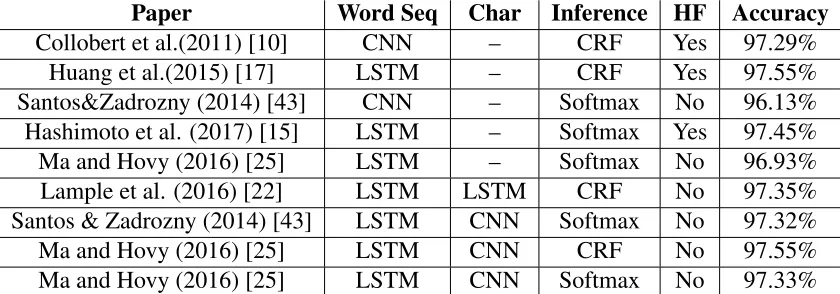
Table 2.3 shows the performance comparison among several models on POS tagging task.
The data set used for the comparison is the WSJ corpus [28]. For POS tagging two different
models get the same best accuracy of 97.55% [17][25]. Both of the models use LSTM for word
sequence and CRF for inference. CNN for character embedding was used by [25]. However,
instead of using any character level LSTM/CNN, handcrafted features to capture character
level features was used by [17]. Careful analysis of the performance tables yield insights about
neural sequence labelling models.
• For all the three tasks, models with character representation performed much better than
models which do not use any character LSTM/CNN.
• Observing POS tagging, two models attain the best performance [17][25], handcrafted
character features are used by only one of the methods [17]. This is a possible indication
that, if we can avoid possible feature collision, we can use character embedding and
handcrafted features together to boost model performance.
• For all three tasks, word-LSTM is better than word-CNN. Sometimes significantly [10][25].
• Char-CNN is superior to Char-LSTM for all the three tasks. However, in some cases the
performance difference of Char-LSTM and Char-CNN might not be significant for POS
tagging [22] and [25].
• As expected, CRF is better than Softmax for NER task. We expect CRF to be better
because CRF considers dependencies between labels and the NER task has strong label
Model Word Seq Char Inference HF F1-score
Collobert et al.(2011) [10] CNN – CRF Yes 89.59%
Huang et al.(2015) [17] LSTM – CRF Yes 90.10%
Lample et al. (2016) [22] LSTM – CRF No 90.20%
Strubell et al. (2017) [49] LSTM – CRF Yes 90.43%
Strubell et al. (2017) [49] LSTM – Softmax Yes 89.34%
Ma and Hovy (2016) [25] LSTM – Softmax No 87.00%
Chiu & Nichols (2016) [8] LSTM CNN CRF No 90.91%
Peters et al. (2017) [38] LSTM CNN CRF No 90.87%
Ma and Hovy (2016) [25] LSTM CNN CRF No 91.21%
Lample et al. (2016) [22] LSTM LSTM CRF No 90.94%
Table 2.1: Performance on CoNLL 2003 (NER)
Paper Word Seq Char Inference HF F1-score
Collobert et al.(2011) [10] CNN – CRF Yes 94.32%
Huang et al.(2015) [17] LSTM – CRF Yes 94.46%
Zhai et al. (2017) [58] LSTM – Softmax No 94.13%
Hashimoto et al. (2017) [15] LSTM – Softmax Yes 95.02%
Rei (2017) [42] CNN LSTM CRF No 93.15%
Peters et al. (2017) [38] LSTM CNN CRF No 95.00%
Table 2.2: Performance on CoNLL 2000 (Chunking)
Paper Word Seq Char Inference HF Accuracy
Collobert et al.(2011) [10] CNN – CRF Yes 97.29%
Huang et al.(2015) [17] LSTM – CRF Yes 97.55%
Santos&Zadrozny (2014) [43] CNN – Softmax No 96.13%
Hashimoto et al. (2017) [15] LSTM – Softmax Yes 97.45%
Ma and Hovy (2016) [25] LSTM – Softmax No 96.93%
Lample et al. (2016) [22] LSTM LSTM CRF No 97.35%
Santos & Zadrozny (2014) [43] LSTM CNN Softmax No 97.32%
Ma and Hovy (2016) [25] LSTM CNN CRF No 97.55%
Ma and Hovy (2016) [25] LSTM CNN Softmax No 97.33%
Chapter 3
Proposed Model
In this chapter we will talk about our proposed model for Sequence Labelling tasks. The
main contribution of the proposed model is it integrates word sense embeddings with word
level features — word embeddings, and morphological features — character embeddings. And
then our model uses novel ways to connect these embeddings with the ouput of a Convolutional
Neural Network (CNN), a Bidirectional Long Short Term Memory (BLSTM) and a Conditional
Random Field (CRF) module. We will describe each of the modules in detail. We will also
explain all the morphological and semantic features that we have used to improve our model.
Figure 3.4 in Section 3.8 shows our proposed model structure which is a reference for all the
module that we are going to describe in detail.
3.1
Word Embedding Module
For any neural network learning, we need to project the lexicons in some vector space. The
main motivation of using higher dimensional word vectors is to capture word level features.
One obvious way of extracting word level features is to randomly initialize the embeddings
and tune them with gradient optimization. However, we can also initialize the vectors with
pretrained word vectors like Word2Vec and Glove 2.3 and tune them with the model during
training phase. Pre-trained vectors are trained with huge datasets and these vectors are capable
of capturing semantic and syntactical relationships between the words. For this reason most of the time, using pre-trained vectors for initialization of the word vectors gives better results
than relaying on random vectors. We initialized our word embedding module with random
embeddings and pretrained embeddings (Glove/Word2Vec). We represent each sentence as a
column vector Imx1 where each element in the vector is a unique index of the corresponding
word. Here m is the length of the sentence. The word embeddings module transforms the
column vector Imx1 into a matrixWmxd. Each of the row of the matrix isddimensional which
represent the corresponding word vector.
3.2
Character Embedding Module
Character Embedding Module is used to capture morphological features of each word. For
example, for the wordhourly, the suffix-lygives us a good indication that,hourlyis an adverb.
To learn this kind of low level morphological features, we first represent a word as a Ck×1
column matrix wherekis the number of characters for that word. Then we used a embedding
layer to initialize random embeddings of dimentionn for each of the characters. So now the
word is represented by a matrixCk×n. After that, we run an LSTM on the matrix and used the
last hidden stateC1×n as the character embedding of the word. So if a sentence hasmwords
then the character level representation of the sentence will be a matrixCm×n where each row
C1×n is the character embedding of the corresponding word found by the LSTM. Figure 3.1
shows how the embedding for the word "cats" is calculated using 4 unfoldings of an LSTM
cell.
L S T M
L S T M
L S T M
L S T M
Character Embeddings
c a t s
Figure 3.1: Character Embedding for the Word cats
3.3
Selective Pickup from Char-LSTM
Word embeddings are used to capture contextual features. On the other hand Character
Embed-ding Module described in Section 3.2 can extract morphological features of a word. To capture
both morphological and contextual features of a sentence together, we introduce a new way of
using a BLSTM network. First each sentence is represented in character level by a vectorIk×m
wherek is the number of characters in the sentence and m is the total words. Then we used
an embedding layer to represent each of thekcharacters inddimensional vectors. So now we
have a matrix of sizek×m×d. Now we run a BLSTM over the character sequence representing
the whole sentence. While running the BLSTM we picked up the hidden state from the time
3.4. WordSenseEmbeddings usingAdaptiveSkip-Gram 21
words as well as character sequence up to that time step in both direction.
˜
Cm×d = SELECT(BLSTM(I(k×m)×d)) (3.1)
Figure 3.2 shows the Selective Pickup module in action for the sentence"cats can not fly".
L S T M L S T M L S T M L S T M L S T M L S T M L S T M L S T M L S T M L S T M L S T M L S T M L S T M
C a t s c a n n o t f l y 1st Pick Up 2nd Pick Up 3rd Pick Up
Last Pick Up Last Pick Up
Figure 3.2: Pick Up Character Embedding
3.4
Word Sense Embeddings using Adaptive Skip-Gram
Knowing the sense of a word prior to tagging makes the tagging task more straightforward.
Generally, polysemy is captured in standard word vectors, but the senses are not represented as
multiple vectors. So we have trained an adaptive skip gram model, AdaGram, [3] which gives
a vector for each sense of a word. It is a non-parametric Bayesian extension of the skip-gram
model and is based on the constructive definition of Dirichlet process (DP) [13]. It can learn
the required number of representations of a word automatically.
In our model, we denote a set of input words as X ={xi}Ni=1and their context asY ={yi}Ni=1.
Theith training pair (xi,yi) consists of wordsxi = oi with contextyi = (ot)t∈c(i), whereCis the
context window size andc(i) is the index of the context words. Then, instead of maximizing
the probability of generating a word given its contexts [32], we maximize the probability of
generating the context given its corresponding input words [3]. The skipgram (Section 2.3.1)
final objective function becomes,
p(Y|X, θ)=
N
Y
i=1
p(yi|xi, θ)= N
Y
i=1
C
Y
j=1
p(yi j|xi, θ) (3.2)
where, θ is the set of model parameters. The drawbacks of this objective function is that it
captures just one representation of a word which goes against a word having different senses
which captures the required number of senses even though the number of structure components
of the data is unknown a priori. In AdaGram, if the similarities of a word vector with all its
existing sense vectors are below a certain threshold, a new sense is assigned to that word with
a prior probability p. The prior probability of thekth meaning of wordwis
p(z=k|w, β)=βwk k−1
Y
r=1
(1−βwr),
p(βwk|α)= Beta(βwk1, α),k =1. . .
(3.3)
whereβ is a latent variable and αcontrols the number of senses. Theoretically, it is possible
to have an infinite number of senses for each word w. However, as long as we have a finite
amount of data, the number of senses can not be more than the number of occurrences of that
word. With more data, it can increase the complexity of the latent variables thereby allowing
more distinctive meanings to be captured. Taking all the facts into account, our final objective
function becomes,
p(Y,Z, β|X, α, θ)=
V
Y
w=1
∞ Y
k=1
p(βwk|α) N
Y
i=1
[p(zi|xi, β) C
Y
j=1
[p(yi j|zi,xi, θ)]
(3.4)
whereZ = {zi}iN=1is a set of senses for all the words.
To use the sense embeddings from Adagram, first we initialized an embedding layer for
all the words with the sense vectors generated from AdaGram. Then we tag each word in the
input sentence using the moduledisambiguatefrom AdaGram (the word ‘apple’ with sense
2 is tagged as ‘apple_2’). This modified input sentence is then passed to the embedding layer
initialized before and finally the resultant output is passed to a BLSTM layer. The output of
3.5. Bi-gramModule usingConvolutionalNeuralNetwork 23
3.5
Bi-gram Module using Convolutional Neural Network
Convolutional Neural Networks are often used to extract n-Gram features from a given sentence
[23]. Using kernel of different size and length of stride we can extract high level features from a given sentence. In our model, we used only bi-gram features. To extract bi-gram features,
the input sentence is padded with a start token<start>and passed to an embedding layer. This
layer represents the input sentence as a matrix of dimension (m+1)×d wheremis the
non-padded sentence length and d the dimension of the embedding. Then we run a convolution
kernel of size 2×d with stride length 1. The result is the bigram embedding matrix Bof size
m×d.
Bi,: = 2
X
j=1
Ii+j,:∗Kj,: (3.5)
where I is the input sentence matrix, K is the convolution kernel and n is the maximum
se-quence length for the current batch. Later, this bigram embedding is passed to a BLSTM layer
to extract more abstract features.
3.6
Conditional Random Field Module
Each of the tasks that we are modelling requires a tag to be assigned to each word. In addition
to using the current word to predict its tag, it is also possible to use the information about
the neighboring words’ tags. There are two main ways to do this. One way is to calculate
the distribution of tags over each time step and then use a beam search-like algorithm, such
as Maximum Entropy Markov models [29] and maximum entropy classifiers [40], to find the optimal sequence. Another way is to focus on the entire sentence rather than just the specific
positions which leads to Conditional Random Fields (CRFs) [21]. CRFs have proven to give
a higher tagging accuracy in cases where there are dependencies between the labels. Like the
bidirectionality of BLSTM networks a CRF can provide tagging information by looking at its
input features bidirectionally.
In our model we denote a generic input sequence as x = {xi}Ni=1, generic tag sequence as
y = {yi}Ni=1, and set of possible tag sequences of xas F(x). Then we use CRF to calculate the
conditional probability over all possible tag sequencesygivenxas
p(y|x;W,b)=
Qn
i=1φi(yi−1,yi;x)
P
y0∈F(x)Qni=1φi(y0
i−1,y
0 i;x)
(3.6)
whereφ(.) is the score function for the transition between the tag pair (y0,y) givenx. We train
we maximize
L(W,b)=X
i
logp(y|x;W,b) (3.7)
whereW is the weight matrix andb is the bias term. While decoding, we search for the best
tag ˆywith the highest conditional probability using the Viterbi algorithm [45]. ˆ
y=y∈F(x) p(y|x;W,b) (3.8)
3.7
Morphology: Spelling and su
ffi
x features
For the morphological features, we have focused on spelling and suffix features. We extract 14
spelling features for a given word and store it as a binary vectorS V1×14:
• Composed only of alphabetics or not
• Contains non-alphabetic characters except ‘.’ or not
• Starts with a capital letter or not
• Composed only of upper case letters or not
• Composed only of lower case letters or not
• Composed only of digits or not
• Composed of alphabetics and numbers or not
• The starting word in the sentence or not
• The last word in the sentence or not
• In the middle of the sentence or not
• Ends with an apostrophe s (’s) or not
• Has punctuation or not
• The sentence starts with a capital letter or not
3.8. Connecting differentModules together 25
Apart from extracting these features, we also replace all the numbers in the corpus with the
<number>tag.
We have assembled a list of 137 suffixes from https://www.learnthat.org/pages/
view/suffix.htmland have used the ten that occur most often in our corpus for this study.
Then for each of these suffixes, we have collected the words that end with that suffix and have
recorded their POSs as well as the frequency. Next, we made an assumption that if a wordw
with POS xends with a specific suffixsexceeds a frequency threshold in the training set, then
sis the true suffix of wordw. We record the pair as (w,s). Finally, we create a one hot (binary
vector with exactly 1 one) vectorS UV1×10for each word where a 1 at indexkmeans the word
has thekth suffix.
3.8
Connecting di
ff
erent Modules together
In this module, we combine all the features and the modules using some novel connection techniques and build our final BLSTM-CRF model as shown in Fig. 3.4. First we concatenate
the word embedding from module 3.1 with the character embedding from module 3.2 and
the suffix vector from Subsection 3.7 as [Wm×d,Cm×n,S UVm×10]. Following this, we apply a
BLSTM on this new embedding matrix, calling this output O1
m×d. The outputs of modules
3.3, 3.4 and 3.5 are calledO2
m×d, O
3
m×d, andO
4
m×d, respectively. Then we initialize four scalar
weightsw1, w2,w3 andw4with initial value 1.0 and add them as model parameters. We form
a linear combination of thewiweightedOis to form the final output.
O=
4
X
i=1
Oiwi (3.9)
The final output (Om×d) have pieces of information from all the features that we calculated
above. We choose linear addition rather than concatenation of these output features, because
concatenation will result in a very large feature matrix and the network have to tune each of
the cell of this matrix during back-propagation. Following this, we initialize an LSTM layer
where we pass the final output from Eqn. 3.9 at each time step ˜Oi1×z = LSTM(O1i×d,hi1−×1d) and store the outputs separately ˜Om×z = [ ˜O1,O˜2, . . . ,O˜m]. This LSTM layer unfolds at each time
step taking the hidden state of the previous time step to initialize the hidden state of the current
time step. The previous hidden state has the information about the previous tag and initializing
the current hidden state with the previous one explicitly gives this information. Next we pass
the output from each time step to a tanhlayer T1×d = tanh( ˜Oi), which squeezes the values
calculated in subsection 3.7 and pass this to a fully connected (FC) layer. This FC layer maps
the output to the number of tag classesY1×c = FC([T1×d,S UV1×14]), wherecrepresents number of classes. We do this for each time step and concatenate the results to make a final tensor
Ym×c. Finally, we pass this tensor to the CRF layer and calculate the possible tag sequence for
the given input sequence. While using Suffix, Spelling and Character Embeddings we tried
three different feature connection technique : Residual connection (R), Concatenate with word
embedding (CW), Concatenate with second last output layer (CO). The motivation of using
these connection techniques is to detect and overcome possible feature collision. We will talk
about this three connection ideas later in the experimental result chapter. Figure 3.3 shows the
CW, R, CO connections.
Feature vector Word Embedding Layer
BLSTM Layer Output Layer
Before Inference Feature vector
CW: Red
R: Blue
CO: Green
3.8. Connecting differentModules together 27 SU V Su ffi x Vect o r SV Sp elli n g Vect o r FC Fu lly Co n n ect ed Laye r T Tanh () Laye r Vect o r Co n cate n ati o n Si n gle u n fo ld in g o f an L STM cell Wo rd Em b edd in g Laye r Cats SU V Sen se Em b edd in g Laye r Wo rd Em b edd in g Laye r 𝑤2 𝑤1 𝑤3 𝑤4 Ad aGra m
s t a c
n a c
t o n
y l f
CRF Laye r T SV SV SV D ro p o u t D ro p o u t T T T SV FC FC FC FC D ro p o u t D ro p o u t D ro p o u t D ro p o u t D ro p o u t D ro p o u t D ro p o u t D ro p o u t Ad d itio n Co n vo lu tio n al Laye r D ro p o u t can n o t fly can n o t fly Cats Cats can n o t <s> fly
Experimental Results
In this chapter we first talk about the experimental setup for evaluating our sequence labelling
model on three different sequence labelling tasks: Parts of Speech (POS) tagging, Named
entity recognition (NER) and Chunking. Then we compare our model with other state of the
art models on benchmark datasets for all the tasks. All the model hyper-parameters are given so that our results can be easily reproduced for further study. We will also discuss the rate of
convergence of our model compared to the state of the art one. Moreover, to better understand
our model, we present an ablation study of our model on POS tagging by removing certain
modules in different combinations.
4.1
Experimental Setup
4.1.1
Datasets Description
We used three different datasets while testing our BLSTM-CRF model on three NLP tasks:
Penn TreeBank (PTB) POS tagging [27], CoNLL 2000 chunking [53], and CoNLL 2003 NER [54]. Table 4.1 shows the number of sentences in the training, validation and test sets
respec-tively for each corpus. POS allocates each word with an unique label that shows its syntactic
part. Chunking represents each word in terms of its phrase type. NER labels each word with
one of four substance: Person, Location, Organization, or Miscellaneous. For NER and
Chunk-ing there are several taggChunk-ing standards like : IO, BIO, BIO2, BIOES etc. We utilize the BIO2
tagging standard for the chunking and NER tasks.
4.1. ExperimentalSetup 29
WSJ CoNLL00 CoNLL03
Train 39831 8936 14987
Valid 1699 N/A 3466
Test 2415 2012 3684
Table 4.1: Dataset Description
4.1.2
Hardware and Software
For training our model we used GPU accelerated training. We used a machine with NVIDIA
GeForce 1080 GPU and 32GB main memory. We implemented our model and several other
baseline models using Pytorch 0.3.1 deep learning library. For getting the word sense embed-ding from Adagram, we used Julia(0.4.5) implementation of AdaGram.
4.1.3
Performance Metrics
We used two different performance metrics while evaluating our model. For NER and
Chunk-ing task, we used standard F1-score and for POS taggChunk-ing we used accuracy metric. F1-score
is simply the harmonic mean of precision and recall whereas accuracy is the ratio of total
cor-rected predictions and total number of examples. If T P,T N,FP,FN are true positive, true
negative, false positive and false negative respectively then we can define F1-score and
accu-racy as follows:
Precision= T P
T P+FP (4.1)
Recall= T P
T P+FN (4.2)
F1= 2∗Precision×Recall
Precision+Recall (4.3) Accuracy= T P+T N
T P+T N+FP+FN (4.4)
4.1.4
Hyper-parameters of the Model
Like any other neural architecture, our BLSTM-CRF model has lots of hyper-parameters. Table 4.2 shows detailed hyper-parameter settings of our model. The table also shows the parameters
used for AdaGram model for finding the sense vector for all the words in the corpus. Default
values are used for the parameters those are not mentioned in the table. We used stochastic
gradient descent(SGD) optimizer with learning rate decay and momentum for training. For
avoiding over-fitting, we used several regularization techniques like Weight and learning rate
weights of the model after seeing a batch of training examples. For CNN we used only kernel
size of 2 because we extract bi-gram features using CNN.
BLSTM-CRF
Hyper-parameter Range Selected
Learning rate 0.001/0.015/0.01
Batch size 10/50/100
No. of LSTM layers 1/2/3
Momentum 0.9
Dropout 0.5/0.2/0.1
Word embedding size 300/200/100
Character embedding
size
50/30
Initial scalar weight
value
1.0
Gradient clipping 5/20/50
Weight decay 10−5
Learning rate decay 0.05
CNN kernel size 2×(300/200/100)
AdaGram
Epoch 1000
Window size 5/7/10
No. of prototypes 5
Sense embedding size 300
Prior prob. of new sense 0.1
Initial weight on first sense
-1
Word embedding size 300/200/100
Table 4.2: Ranges of different hyper-parameters.
4.2
Performance on Chunking
Table 4.3 shows the preformance comparison between our model and other state of the art
models on Chunking task. The CoNLL 2000 chunking dataset was proposed in a competition
and the competition was won by an SVM based model [20] with an F1 score of 93.48%. Later
SVM models were outperformed by the neural architectures with Conditional Random Field
(CRF) inference. However, an Hidden Markov Model with voting scheme [46] outperformed
all the models significantly. Our sequence model which uses CRF inference as well as
addi-tional linguistic features out performs all the models with F1 score 96.76% on CoNLL 2000
4.3. Performance onNER Task 31
Model F1-score
SVM classifier [20] 93.48
SVM classifier [19] 93.91
BI-LSTM-CRF [17] 94.13
Second order CRF [30] 94.29
Second order CRF [45] 94.30
Conv. network tagger [10] 94.32
Second order CRF [51] 94.34
BLSTM-CRF (Senna) [17] 94.46
HMM+voting [46] 95.23
BLSTM-CRF (Ours) 96.76
Table 4.3: Comparison of F1 scores of different models for chunking
Model F1-score
Conv-CRF [10] 81.47
BLSTM-CRF [17] 84.26
MaxEnt classifier [7] 88.31
HMM+Maxent [14] 88.76
Semi-supervised [1] 89.31
Conv-CRF+Senna [10] 89.59
BLSTM-CRF [17] 90.10
CRF+LIE [36] 90.90
BLSTM-CRF (Ours) 91.63
Table 4.4: Comparison of F1 scores of different models for NER
4.3
Performance on NER Task
Table 4.4 is the performance comparison between models for Named Entity Recognition (NER)
task. [10] uses simple Convolutional Neural Network with CRF inference and gets 81.47%
F1 score on CoNLL 2003 NER dataset.[17] did many experiments using random and
pre-trained embeddings on their model. For random embeddings, they achieved a very low score of
84.26%. However, when they use pre-trained SENNA embeddings [10] along with a gazetteer
feature, their F1-score jumped up to 90.10%. Our BLSTM-CRF model gets 91.63%
outper-forming all the models including [17] which also uses BLSTM-CRF architecture.
4.4
Performance on POS tagging
The performance of several models on POS tagging is shown in table 4.5. As can be seen, a
to do the tagging. They achieve very good accuracies of 97.29% [10], 97.51% [22] and 97.55%
[25]. Some of the models use multitask learning, doing two or more tasks at the same time.
They also achieve very good accuracies: 97.43% [41] and 97.59% [24]. Our model achieves
an accuracy of 97.58% which is higher than all of the existing models except LM-LSTM-CRF [24] which leverages a language model for the tagging tasks. LM-LSTM-CRF, however, has
a mean accuracy of 97.53% (reported accuracy: 97.53± 0.03) which is lower than the our
model’s mean accuracy (97.57±0.01). Also, as shown in Table 4.6, our model’s training time
is one quarter that of LM-LSTM-CRF with on par performance.
Model Accuracy
Conv-CRF [10] 97.29
5wShapesDS [26] 97.32
Structure regularization [50] 97.36
Multitask learning [41] 97.43
Nearest neighbor [47] 97.50
LSTM-CRF [22] 97.51
LSTM-CNN-CRF [25] 97.55
LM-LSTM-CRF [24] 97.59
BLSTM-CRF (Ours) 97.51
BLSTM-CRF (Ours) without CNN 97.58
Table 4.5: Comparison of Accuracy of different models for POS tagging
Model Acc. Time
LSTM-CRF 97.35 37
LSTM-CNN-CRF
97.42 21
LM-LSTM-CRF
97.53 16
LSTM-CRF 97.44 8
LSTM-CNN-CRF
96.98 7
Ours BLSTM-CRF 97.51 4
BLSTM-CRF without Bigram
97.58 3.5
Table 4.6: Training time (hours) of our BLSTM-CRF model on the WSJ corpus compared with all models of [24] using the same hardware configuration (GPU: Nvidia GTX 1080)
Ablation Study for POS tagging
Table 4.8 gives the ablation study of our model where we show how we apply different
con-4.4. Performance onPOStagging 33
Module W 100th 200th 300th 400th 500th
epoch epoch epoch epoch epoch
Word emb w1 0.91 0.84 0.80 0.77 0.78
Sense w3 0.85 0.76 0.69 0.64 0.65
SP-CLSTM w2 0.81 0.66 0.48 0.35 0.34
Bigram w4 0.75 0.49 0.27 0.01 0.01
Table 4.7: Change inwi’s for each module with epochs.
figuration. With so many features and parameters, these sequence models are very much prone
to overfit. But with careful tuning as well as with proper feature connections, it is possible to
leverage those features. We extract a set of morphological as well as semantic features from
our dataset such as spelling, suffix and char-level features. We experiment on applying various
combinations of these features in different segments of our model. Our extensive
experimenta-tion shows that optimal results are achieved when these features are added in the model through
residual connection (R), concatenation with word embeddings (CW) and concatenation with
the second last output layer (CO). Focusing on which segment to connect each feature, our
experiments found that the spelling feature works best when concatenated with the second last
output layer, and the suffix feature as well as the character embeddings work well when
con-catenated with the word embeddings. This configuration is what is kept in our final model. We
further continue our experiments by turning on/offdifferent modules such as word embedding,
sense embedding, selective pickup from LSTM and bi-gram embedding. We found significant contribution of word embeddings, sense embeddings and selective pickup from LSTM
com-pared to the bigram modules as shown by the weights at the 500th epoch in Table 4.7. The
bigram module gives better performance without considering previously generated POS and
vice versa. However, linguistically, the information about the previous tag has a huge influence
in generating the current one. So we kept the first three modules along with the previously
gen-erated POS and discarded the bigram module from our final model. Our best model as shown
Chapter 5
Conclusion and Future Work
Sequence Labelling is one of the fundamental problems in Natural Language Processing. In
this thesis, a new neural architecture is proposed which can be applied to any sequence
la-belling tasks. Our model improved neural sequence lala-belling architecture by leveraging from
additional linguistic information such as polysemy, bigrams, character level knowledge and
morphological features. The model uses pre-trained word vectors and character embeddings
generated from LSTM network. We introduced a clever way of capturing morphological and
contextual features using selective pickup from a BLSTM network. We used word sense em-bedding from Adagram module for each of the word to capture polysemy. Moreover, our model
uses spelling and suffix features which are defined for every words. Total 14 carefully designed
spelling features are used. For suffixes, our model only focuses on 10 suffixes that occur most often in our training set. Our experimental finding shows that benefitting from such adequately
captured linguistic information, we can assemble a considerably more compact model, hence
yielding much better training time without loss of effectiveness. Designing a model with such
rich feature space needs careful consideration on how to connect the features appropriately.
We carefully connected the features so that feature collision can be minimized. To avoid
fea-ture collision we performed an extensive ablation study where we produced an optimal model structure along with an optimal set of features. Finally we used a linear combination of
dif-ferent feature modules while predicting the output sequence via a Conditional Random Field
inference. Our best model achieved state of the art results on the POS tagging, NER and
chunk-ing benchmark datasets and at the same time remains four times faster to train than the best
performing model currently available. Our experimental results show that multiple linguistic
features and their proper inclusion significantly boosted our model performance.
5.1
Future Work
Using a trained Language Model
We can use a separate trained Language Model like Liu et al. [24] to generalize better. A
Language Model can help us to extract features from raw texts. However, extracting knowledge
by pretraining a Language Model needs a large external corpus and a significant amount of
training time.
More Hand-crafted Features
In this thesis, we used 14 spelling features and 10 most frequent suffixes from a total of 137
available suffixes. In the future, we can introduce more carefully hand-crafted morphological
features to improve model performance.
Multitask Learning and Extra Data
We can use multitask learning, optimizing the model with separate loss functions for more than
one sequence labelling task simultaneously. Moreover, we can exploit extra training data from
![Figure 2.1: Recurrent Neural Network (RNN) [6]](https://thumb-us.123doks.com/thumbv2/123dok_us/1907164.1249873/14.612.102.531.445.609/figure-recurrent-neural-network-rnn.webp)
![Figure 2.2: Long Short Term Memory Unit (LSTM) and Gated Recurrent Unit (GRU)[34]](https://thumb-us.123doks.com/thumbv2/123dok_us/1907164.1249873/16.612.125.520.72.219/figure-long-short-term-memory-unit-gated-recurrent.webp)
![Figure 2.3: Word2Vec Models [31]](https://thumb-us.123doks.com/thumbv2/123dok_us/1907164.1249873/17.612.99.488.416.649/figure-word-vec-models.webp)
![Figure 2.4: Convolutional Neural Network (CNN) for Character level representation [25]](https://thumb-us.123doks.com/thumbv2/123dok_us/1907164.1249873/19.612.128.455.408.666/figure-convolutional-neural-network-cnn-character-level-representation.webp)
![Figure 2.5: Long Short Term Memory Unit (LSTM) for Character level representation [22]](https://thumb-us.123doks.com/thumbv2/123dok_us/1907164.1249873/20.612.170.459.241.548/figure-long-short-term-memory-unit-character-representation.webp)
![Figure 2.6: Word Sequence Representation [56]](https://thumb-us.123doks.com/thumbv2/123dok_us/1907164.1249873/21.612.74.515.69.247/figure-word-sequence-representation.webp)