Scholarship@Western
Scholarship@Western
Electronic Thesis and Dissertation Repository
9-4-2019 12:00 PM
The Impact of Expanded, Multimodal Applications during a
The Impact of Expanded, Multimodal Applications during a
German Lied Performance
German Lied Performance
Adam Domenico Iannetta
The University of Western Ontario
Supervisor Schmidt, Patrick
The University of Western Ontario Co-Supervisor Hess, John
The University of Western Ontario
Graduate Program in Music
A thesis submitted in partial fulfillment of the requirements for the degree in Doctor of Musical Arts
© Adam Domenico Iannetta 2019
Follow this and additional works at: https://ir.lib.uwo.ca/etd
Part of the Music Performance Commons
Recommended Citation Recommended Citation
Iannetta, Adam Domenico, "The Impact of Expanded, Multimodal Applications during a German Lied Performance" (2019). Electronic Thesis and Dissertation Repository. 6568.
https://ir.lib.uwo.ca/etd/6568
This Dissertation/Thesis is brought to you for free and open access by Scholarship@Western. It has been accepted for inclusion in Electronic Thesis and Dissertation Repository by an authorized administrator of
ii
Abstract and Keywords
This study explored the impact of adaptive methods and modalities in Art Song performance in
connecting with adult audiences (aged 18 and older) as explored through a live performance of
German Lieder. In addition, this study sought to contribute a qualitative experimental study of
in-situ audience perception to an emerging field of practice and research regarding the innovative
practices in Art Song performance (e.g. Art Song Theatre). The study was derived from a 2012
informal experiment by Professor Rena Sharon, a leading advocate of expanded Art Song
performance practice and pedagogy. Specifically, a single English Art Song was performed in
three different treatments: traditional, expanded traditional, and theatrical contextualization. The
data helped illustrate a difference in performer interpretation and audience comprehension,
confirming a stronger affiliation to the more expansive treatments over the more normative one.
Inspired by the anecdotal report of this experiment, the current study compared three
gestural versions of Art Song performance, similar to the previously mentioned, on a larger scale
(i.e. a German song cycle) and recorded the data through more extensive and systematic data
collection before three distinct audiences, categorized according to level of prior classical music
training and/or familiarity with Art Song. The conclusions observed provide further context on
the effectiveness of innovative performance practices within classical music, such as Art Song
Theatre, as well as suggest a set of parameters when putting forth a classical music performance
– specifically that of Art Song/German Lied – for present-day audiences.
iii
Lay Summary
This study aimed to examine the possible impact of enhanced stagecraft in Art Song performance
through a live performance of German Lieder for a diverse group of adult audiences (aged 18
and older). In addition, this study aimed to contribute to an emerging field of practice and
research regarding the innovative practices in Art Song performance (e.g. Art Song Theatre). The
study was based on a 2012 informal experiment by Professor Rena Sharon, a leading advocate of
expanded Art Song performance practice and pedagogy. The informal experiment involved a
single Art Song, sung in English, performed in three different styles, ranging from traditional to
more theatrical. The data confirmed a stronger connection to the more expansive styles over the
more traditional one from both the audience and the performer.
Inspired by this experiment, the current study compared three ways of performing Art
Song, similar to the previously mentioned, before three distinct audiences, grouped according to
familiarity with classical music and Art Song. It also focussed on a larger collection of songs, a
song cycle, performed in the original German language. The data was recorded using surveys
and interviews and provided three overarching themes. Firstly, age and post-secondary music
education were most important to determine one’s level of connection to these kinds of
performances. Secondly, the added stage elements from the lecture recital created a positive
impact on audience engagement by engaging more of one’s senses, but they could also do the
exact opposite when used improperly. Lastly, explaining the history of the piece separate from
the musical performance was also beneficial for the audience, especially for those unfamiliar
with the music. These conclusions help to establish the effectiveness of innovative performance
practices within classical music and suggest a baseline when putting together a performance of
iv
Without tradition, art is a flock of sheep without a shepherd. Without innovation, it is a corpse.
v
For Anna and Pasquale (a.k.a. Mom & Dad). Thanks to your love and support, I now see
vi
Acknowledgements
Thank you to my advisors and supervisors, Prof. Theodore Baerg, Dr. John Hess, Dr.
Patrick Schmidt, and Dr. Todd Wieczorek, for your continued support and guidance.
Thank you to my new friend, Prof. Rena Sharon, for helping me to appreciate the true
value of Art Song in the 21st century.
Thank you to my accompanist, Sarah Bowker, for being such an integral part of the
lecture recital and this collaborative undertaking.
Thank you to my friends and colleagues, Brianna DeSantis and Chad Louwerse, as well
as Jennifer Cyr, Bethany Hynes, and Carmen Specht for being part of the lecture recital.
Thank you to my former coaches, Mrs. Melanie Sloane (née Cancade), Dr. Marianna
Chibotar-Rutkevich, and Maestro Simone Luti, for helping shape the performance aspect of the
lecture recital throughout my doctoral program.
Thank you to my friend and colleague, Stéphanie Brassard, for helping choose the
graphics for the second set of the lecture recital.
Thank you to Ms. Karen Kueneman and Ms. Katelyn Harris for solidifying the
parameters of this study.
Thank you to my parents, Pasquale & Anna Iannetta, for encouraging me to pursue my
passion and for always being there for me.
Lastly, thank you to my beautiful wife, Nicole Iannetta (née Embury), for your constant
love and unwavering support over these past four years together. I could not have done any of
vii
Table of Contents
Abstract and Keywords ... ii
Lay Summary ... iii
Acknowledgements ... vi
Table of Contents ... vii
List of Tables ...x
List ofFigures ... xi
List ofAppendices ... xii
List of Abbreviations ... xiii
Preface ... xiv
I. Introduction ...1
Analyzing the Modern Art Song Recital ...2
Statement of the Problem ...5
The challenge ...11
Innovation in classical music ...13
The need for change from the Art Song recital...13
Success and sustainability within Art Song Theatre ...16
Purpose of the Study ...18
Framing the research ...21
Research Questions ...22
II. Literature Review ...24
Town: The Economy of Art ...25
Fine art-ifacts ...26
The history of art objectification ...28
Gown: How to Appreciate the Artform ...30
Knowledge versus instinct ...31
Interpretation throughout history ...32
Performer: Hands-on Application ...34
Projected translations ...35
Projected illustrations and non-traditional stagecraft ...39
Additional performers ...41
viii
III. Methodology ...47
Design ...49
Exposure and observation ...50
Sample/Participant Selection ...51
Process and Protocol ...53
Data Collection ...55
Surveys ...55
Interviews ...58
Validity and Limitations ...61
Generalization ...61
Sample-size inconsistency ...62
Researcher as performer and performance order ...63
Song selection ...63
Participant bias ...64
IV. Presentation of the Data ...66
Survey Data ...71
Section One – Sample size ...71
Section One – Age demographic ...73
Section One – Classical music affiliation ...73
Section Two – Evaluation of performance modalities ...75
Section Two – Evaluation of multimodal applications ...76
Section Three – Comprehension of text and emotional connection ...77
Section Three – Multimodal applications ...79
Section Three – Level of focus ...80
Interview Data ...81
Performance aesthetic ...82
Movement and gesture ...85
Text Translation ...87
Engagement and performance preference ...93
Summary ...99
V. Data Analysis ...101
ix
Education and understanding ...107
Age and appreciation ...110
The overarching correlation ...112
Sensory Stimulation ...113
Traditional versus innovative ...114
Sensory saturation ...116
Text projection ...117
Direct and indirect translation ...119
Contextualization ...124
“Lecture” recital ...126
Summary ...128
The past, present, and future of Art Song ...130
Considerations for the Future ...132
References ...136
Appendices ...140
x
List of Tables
1. Average and total number of attendances for performing arts activities: 2002, 2008, and 2012 (National Endowment for the Arts, 2015, p. 8) ...8
2. Genres of music attended by adults who reported attending any live music performance in the past 12 months: 2012 (National Endowment for the Arts, 2015, p. 24) ...9
3. Layout of the performance program for the lecture recital ...70
4. S1-Q1: “What is your age?” (response averages) ...73
5. S1-Q6: “How often do you attend public classical music performances within a year?” (response averages) ...74
6. S1-Q7: “How familiar are you with the genre of Art Song, specifically German Lieder?” (response averages) ...75
7. Comparison of responses between the three varying performance modalities (response averages) ...76
8. S2-Q18: “Rank the effectiveness for each of the following multimodal applications used.” (response averages) ...77
9. S3-Q1: “Explain how your comprehension of the text and emotional connection varied between the three different sections of the performance presented today.” ...79
10.S3-Q2: “How was your overall experience from today’s performances impacted by movement and gesture, props and costumes, projected illustrations, translations projected as supertitles, and additional performers?” ...80
11.S3-Q3: “Regarding the second section, did any of the aforenoted elements detract from your ability to understand or connect with the performance? Please explain why or how.” ...81
12.Comparison of responses between the three varying performance modalities (response averages) ...109
13.S1-Q1: “What is your age?” (response averages) ...111
14.Comparison of responses between the three varying performance modalities (response averages) ...115
15.S2-Q18: “Rank the effectiveness for each of the following multimodal applications used.” (response averages) ...117
16.S3-Q2: “How was your overall experience from today’s performances impacted by movement and gesture, props and costumes, projected illustrations, translations projected as supertitles, and additional performers?” ...120
17.S3: Responses associated to the narration provided by the researcher before each
xi
List of Figures
1. Illustration of the study’s exposure and observation ...50
xii
List of Appendices
A. UWO Ethics Approval Form ...140
B. Email Script – Interviews with Professor Rena Sharon ...142
C. Email Script – REMINDER Interviews with Professor Rena Sharon ...143
D. Letter of Information and Consent – Initial Interview with Professor Rena Sharon ...144
E. Semi-structured Interview Guide – Initial Interview with Professor Rena Sharon ...148
F. Semi-structured Interview-Guide – Follow-up Interview with Professor Rena Sharon ..150
G. Email Script – Lecture-recital Survey ...151
H. Email Script – REMINDER Lecture-recital Survey ...152
I. Poster...153
J. Verbal Recruitment Script ...154
K. Letter of Information and Consent – Lecture-recital Survey ...156
L. Lecture-recital Survey ...159
M. Consent Form – Contact for Future Studies ...165
N. Email Script – Interview with Lecture-recital Attendees ...166
O. Email Script – REMINDER Interview with Lecture-recital Attendees ...167
P. Letter of Information and Consent – Interview with Lecture-recital Attendees ...168
Q. Semi-structured Interview Guide – Interview with Lecture-recital Attendees ...172
R. Performance Milestone Events 1. Opera Role November 2015 ...174
2. Recital Program November 2016...175
3. Opera Role January/February 2018 ...176
4. Lecture-recital Program September 2018 ...177
xiii
List of Abbreviations
BFA ... Bachelor of Fine Arts
CASP...Canadian Art Song Project
COC ... Canadian Opera Company
DMA ... Doctorate of Musical Arts
DVI ... Digital Video Illumination
ILSR ... Institute of Learning Styles Research
MMPALT ... Multi-modal Paired Associate Learning Test
NEA ... National Endowment for the Arts
NWS ... New World Symphony
R & B ... Rhythm & Blues
SPPA ... Survey of Public Participation in the Arts
UBC ... University of British Columbia
xiv
Preface
It was not until the beginning of the second year of my doctoral program when I finally
solidified a research topic. Before then, I was convinced that I was going to focus my research on
studying opera, but this came with a caveat of problems. Firstly, opera is a very broad topic, and
I could not pinpoint exactly what I wanted to study. I knew that I enjoyed opera for its stories,
the characters, and especially the production aspect, but I could not figure out how to put that
into words – let alone an academic paper. Secondly, all the opera roles that I wanted to study
were far too advanced for a 23-year-old baritone. I was hoping to study the masterworks of
Gounod, Verdi, and Wagner; instead, my instructors suggested that I focus on Mozart, Handel,
and – of course – Art Song. First and foremost, I have no qualms with either Mozart or Handel,
nor do I dislike Art Song; rather, I disliked performing Art Song. As far as I was concerned,
performing Art Song was not performing at all: stand still, remain still, and sing. Compared to
opera, performing Art Song simply was not something I enjoyed.
Despite my reservations about performing Art Song, I could not deny all the beautiful
music within this repertoire. I love Robert Schumann, not only for his music, but for the life he
lived and the sacrifices he made that further inspired his music. Schumann’s relationship with
Clara Wieck and Johannes Brahms was so timeless, so moving that it could have easily been
adapted into a major motion picture, and it was – Song of Love (1947). I was torn. As beautiful as this music was, I did not think the traditional recital format was the way to perform it.
Ultimately, my love of Art Song and dislike for its performance parameters helped me to solidify
my research. If I was not allowed to perform the music I love the way I wanted, then I was going
to dedicate my research to figuring out how I could. A little spiteful of me, I will admit, but I at
xv
To my amazement, I was neither the first nor the only one who felt this way about Art
Song and how to perform it. As luck would have it, one of the leading advocates in expanded Art
Song performance practice and pedagogy, Professor Rena Sharon, had visited Western
University the year before I started my doctoral program. Thanks to Professor Sharon, among
other Art Song performers and enthusiasts mentioned in this study, I not only developed new
perspectives on how to approach Art Song, I learned to appreciate the value of the pre-existing
performance parameters of the Art Song recital. As such, it is my hope that the conclusions
observed in this study can provide a suggested set of adapted, expanded parameters when putting
forth an Art Song performance for present-day audiences, as well as reinforce the significance of
1
I. Introduction
By the mid-19th century, Germany had prospered and became the dynamic centre of what
is now known as the Romantic period. This era of artistic development was marked by a
synthesis of the arts; in particular, the culmination of music and poetry lead to the emergence of
the Lied. Despite its small form, the Lied was considered the quintessential medium to convey
many of the themes significant in 18th- and 19th-century Romanticism, “combining music and
poetry, art and literature, natural landscapes and the interior life of the individual seeking a place
in the world” (Elliot, 2006, p. 161). The Lied became highly popular with the general public as a
means of home entertainment, given its smaller, more accessible form. Elliot elaborates on how
composers took advantage of this demand and went on to compose songs intended for amateur
musicians:
Carl Loewe, Robert Franz, [Felix] Mendelssohn, [Robert] Schumann, and [Johannes]
Brahms all wrote songs, duets, and quartets geared to the abilities of amateur musicians.
Private music making took place in virtually every educated home. Piano and voice
teachers in the cities had no want for students from wealthy and middle-class families.
The lied was a welcome guest at private gatherings both small and large, and many
composers performed their songs in these less formal situations. (Elliot, 2006, p. 161)
This mass appeal further encouraged composers to analyze and discuss the theoretical and
philosophical aspects of music by their peers from a more critical perspective. For example,
Schumann’s Neue Zeitschrift für Musik was one of the first music journals founded out of the
development of the Lied (Elliot, 2006). Such publications were written to better inform the
general public of the music for whom it was being written and further refine their opinions as a
2
Over the course of the 19th century, the reputation of the Lied expanded from the private
parlour to the public concert hall. As the demand for professional public concerts increased, so
did the demand for variety in concert programming. This created a demand for Lieder in the
concert hall: “Songs, solo instrumental selections, melodramas, and poetry readings gradually
began to appear on the same concert programs with symphonies, concertos, and choral works”
(Elliot, 2006, pp. 161-162). Touring virtuosos, such as Franz Liszt, seized this opportunity and
attracted large audiences wanting to hear his stunning variations and fantasies on the themes and
songs of Schubert and other Lied composers, further promoting the artform. This collaboration
among performers and composers helped to develop the concept of the solo vocal recital.
Beyond the traditional performance protocol of the singer and piano, composers, such as
Brahms, Richard Strauss, and Richard Wagner, began to arrange and compose songs for voice
and orchestra. By the end of the 19th century, the Lied was an immensely popular artform and a
commercial success. Whether for the amateur musician or the professional connoisseur,
however, the Lied was “all-encompassing, [and] still nominally something for everyone”
(Johnson, 2004, p. 315). While the reputation of the Lied experienced tremendous growth, the
nature of the Lied remained consistent and still “demanded close communication between singer
and accompanist and provided an intimate experience between performers and audience” (Elliot,
2006, p. 162).The modern performance practices of Lieder continue to maintain a sense of
artistry and refinement consistent with its origins, but the modern Art Song recital, as a result,
has become marginalized, no longer reflecting the accessibility from the artform’s apogee.
Analyzing the Modern Art Song Recital
By the end of the 19th century, the song recital in North America began to accumulate a
3
the celebrity status of the musicians performing, the music that was sung (i.e. opera arias and
ensembles), and the scale of the production:
Travelling performers like Nellie Melba and Jennie Lind charmed the general public with
those operatic arias, resplendent with pyrotechnics, that their devoted public expected to
hear. Simple tunes, if included at all, were a pleasant but unimportant part of the
evening’s entertainment. On some occasions assisting artists were contracted to appear in
duets with the star singer. When feasible, orchestras were hired. In the absence of an
orchestra, the dubious duties were performed by an accompanist, who was cautioned to
appear not too conspicuous. (Emmons and Sonntag, 1979, p. 2)
As the song recital matured, however, so did the mindset of its audience. Audiences grew more
disinterested with the lesser known works, demanding only their favourites. All of this, in turn,
divided the public attending these performances, arguably, into three distinct groups:
(1) the enthusiast, whose musical appreciation and understanding is superior, who
therefore has an incentive to investigate and enjoy any new music, whether contemporary
or from the past; (2) the connoisseur of good music who hastens to admire chic music,
which is in vogue and pleases the prevailing taste; (3) the remaining individual, typical of
the majority, who accepts his [or her] standards and convictions second-hand. (Emmons
and Sonntag, 1979, p. 2)
Where the first two groups continued to support the diversity of emerging artists and
contemporary music, more so the enthusiasts, the third group, often influenced by the
connoisseurs, was less inclined to do so (Emmons and Sonntag, 1979).
By today’s standards, the Art Song recital is not a popular genre: “A soprano in a ball
4
with 21st-century mores” (Varty, 2013, paragraph 7). Helfgot and Beeman assert that singers of
classical music have become so fixated on the accuracy of their singing that they neglect the
other equally important aspects of interpretation, such as movement and gesture (Helfgot and
Beeman, 1993). As a result, the performer’s interpretation of the composer’s work is obstructed
by their obsession with pitch, rhythm, and diction accuracy (Hemsley, 1998). In some instances,
the coordination between poetry and music is made quite clear. However, the performer needs to
invest more time and energy into researching how and why the composer chose to set the text in
the manner that he or she did: “Music may illuminate, ignore or betray the text. The artist must
find his way to resolve any conflict” (Emmons and Sonntag, 1979, p. 190). Unfortunately, as
Hemsley elaborates, this step of the performance process is often treated haphazardly, if not
neglected altogether:
All too often, the text, seen as an unwelcome imposition, is treated in a slovenly manner;
and in the process the singers have denied themselves, and their audience, the expressive
possibilities of the poem which provided the initial inspiration for the composer. They
will have surrendered to the easy lure of generalization. (Hemlsey, 1998, p. 118)
As a result, the performer is unable to create a clear interpretation of the piece, let alone fully
comprehend the composer’s original inspiration, thereby leaving the audience confused and less
enthusiastic about the entire performance. This miscommunication is exacerbated with such
subsections of Art Song as German Lieder and French Mélodie, where the songs are sung in a language sometimes unfamiliar to the audience.
The inherited performance practices of the Lied have inhibited the genre from adapting
alongside its ever-changing audience. It is only until recent that these traditions have been
5
adaptations include narration, theatrical movement and gesture, props and costumes, additional
performers, as well as projected text and images, all of which have proven beneficial in
improving communicative gains between the performers and their audiences. One such
approach, Art Song Theatre, is an alternative method of performing Art Song recitals, utilizing
such expanded performance conventions.
While Art Song has existed for more than 200 years, the concept of Art Song Theatre is a
recent development – roughly 30 to 40 years. Contrary to the Art Song recital, Art Song Theatre
promotes itself as creating an all-encompassing musical experience to engage its audiences in the
synthesis of poetry and music, using expanded performance parameters and practices. Although
these applications may seem at face value excessive or daring, such attempts to adopt the artform
have been referred to as admirable while still remaining within the boundaries of good taste:
“While you won’t see dressed-down divas in blue jeans… You will see lyrics projected, opera
style, as surtitles; singers embracing a more physical style of presentation; and even a few
ventures into musical theatre” (Varty, 2013, paragraph 7). At the core of Art Song Theatre exists
a willingness to change and adapt for the sake of better communicating, better understanding,
and better appreciating Art Song. By taking a genre of music hundreds of years old and
incorporating contemporary technology and stagecraft, Art Song Theatre gives present-day
audiences the opportunity to appreciate and enjoy Art Song anew.
Statement of the Problem
While university music programs remain supportive of studying Art Song as a principal
genre of music for both voice and collaborative-piano majors, its decline outside the classroom is
cause for concern. By its very nature, all Art Song should “connect with both performer and
6
316). That is to say the artform should not simply showcase the voice alone; it should elicit a
dialogue based on the music and text between the performer and the audience. However, the Art
Song recital’s more normative format opposes the current cultural expectations for live, vocal
performance, thereby reducing its overall accessibility.
The popularity of the Art Song recital has been in decline since the early 20th century
(Emmons and Sonntag, 1979). Despite the severity of the Art Song recital’s alienation from the
modern audience, the classical music industry overall has seen a steady decline since the early
2000s. In 2012, classical album sales of physical CDs in America plummeted by 21 percent, all
of which was juxtaposed with statistically more popular genres of music, such as Rock (35%)
and R & B (18%). By the following year, only 2.8 percent of albums sold were categorized as
classical music; this includes opera, symphonic and orchestral works, chamber music, as well as
Art Song (Vanhoenacker, 2014).
Statistics have shown, however, that classical music sells better online than it does in
stores. While classical album sales now yield only 2.8 percent of sales, classical music equates to
twelve percent of sales on such popular music-downloading services as iTunes, with some
classical downloads outweighing those of CD purchases (Higgins, 2006). According to Jonathan
Gruber, Universal’s Vice President, and Chris Cracker, head of Sony BMG’s UK operation,
there are several advantages to selling classical music online which have led to some success.
‘It’s a great deal for people new to classical. It’s very easy to sample a single track at a
very low cost. It’s a low-risk purchase. On the one hand, if you are an expert classical
consumer the digital medium is also great. You can (or will be able to) access a vast
7
environment where… ‘classical has lost innumerable independent specialist stores, and
shelf space in the chains is decreasing.’ (Higgins, 2006, paragraph 4)
Furthermore, classical music’s digitalization offers other benefits for both consumers and
producers, such as never going out of stock, no cost for CD manufacturing, and – most
importantly – accessibility. Even within the digital market, however, classical music still faces its
share of problems. As a result, there is a demand for a major download network tailored
specifically for classical music. While there exist smaller operations, such as eClassical.com,
they still have a difficult time marketing themselves and competing with the more major online
services for pop music (e.g. iTunes and Google Play).
The most compelling findings, however, hail from the classical music industry’s former
breadwinners, ticket sales and audience attendance. By today’s standards, live classical music is
better funded by charitable donations, arts councils, and other foundations than dependant on
ticket sales. According to Slate magazine, “even if every seat were filled, the vast majority of symphony orchestras would still face significant performance deficits” (Vanhoenacker, 2014,
paragraph 6). Furthermore, while the classical music industry’s main source of income may not
be a direct biproduct of those attending the performances, overall attendance is facing its own
shortcomings.
According to The National Endowment for the Arts (NEA), the independent federal
agency responsible for the subsidization and funding of the arts in the United States, a gradual
decline in adult Americans attending “benchmark” activities (i.e. jazz, classical music, opera,
musical plays, non-musical plays, ballet, and art museums or galleries) has been observed via the
Survey of Public Participation in the Arts (SPPA) since 1982. The most substantial drop was
8
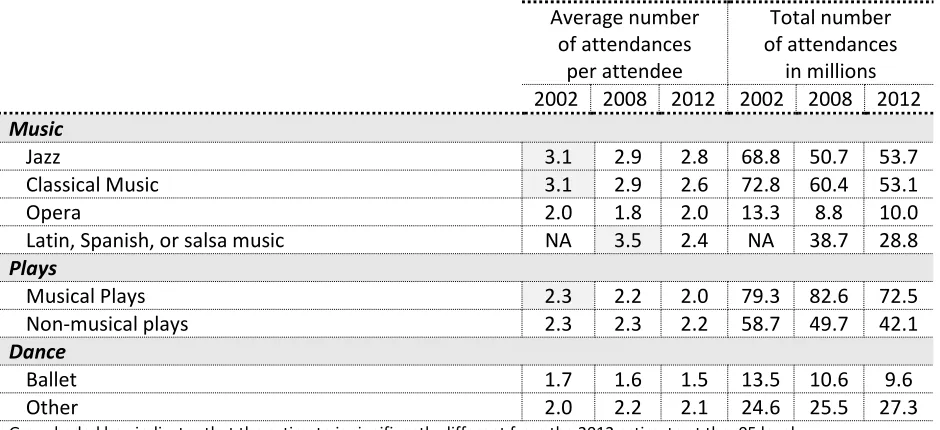
classical music events faced a decline similar to the previously stated overall attendance for
“benchmark” events, as described below (Table 1).
Attendance at classical music events declined from 2002 to 2008, but stayed the same
from 2008 to 2012… About 9 percent of adults attended a performance in each of those
years, averaging 2.6 events per attendee in 2012, and a comparable 2.9 events in 2008.
Both are lower than the 3.1 events per person reported in 2002. (National Endowment for
the Arts, 2015, p. 8)
Table 1. Average and total number of attendances for performing arts activities: 2002, 2008, and 2012 (National Endowment for the Arts, 2015, p. 8)
Average number of attendances
per attendee
Total number of attendances
in millions 2002 2008 2012 2002 2008 2012 Music
Jazz 3.1 2.9 2.8 68.8 50.7 53.7
Classical Music 3.1 2.9 2.6 72.8 60.4 53.1
Opera 2.0 1.8 2.0 13.3 8.8 10.0
Latin, Spanish, or salsa music NA 3.5 2.4 NA 38.7 28.8
Plays
Musical Plays 2.3 2.2 2.0 79.3 82.6 72.5
Non-musical plays 2.3 2.3 2.2 58.7 49.7 42.1
Dance
Ballet 1.7 1.6 1.5 13.5 10.6 9.6
Other 2.0 2.2 2.1 24.6 25.5 27.3
Gray shaded box indicates that the estimate is significantly different from the 2012 estimate at the .05 level
A correlation between arts attendance and certain demographic characteristics can be observed:
“The typical pattern is that… older adults attended ‘benchmark’ arts events more often than
younger adults, females attend more often than men, and people with higher levels of education
attend more often than the less educated” (National Endowment for the Arts, 2015, p. 22). The
only demographic subgroup to show an increase in attendance from 2002 to 2012 was older
Americans (aged 65 and over) (National Endowment for the Arts, 2015). Younger adults,
9
opera events in place of being the most likely to attend other music events (e.g. rap and
pop/rock), with pop/rock having the highest percentage of overall attendance (Table 2).
Table 2. Genres of music attended by adults who reported attending any live music performance in the past 12 months: 2012 (National Endowment for the Arts, 2015, p. 24)
Jazz Latin Classical Opera Hymns Country Rap Blues Folk Pop/rock
% attending
ALL ADULTS 15.9% 9.1% 18.2% 4.8% 14.2% 20.2% 8.7% 13.1% 9.8% 43.6%
Gender
Males 15.3% 8.5% 16.6% 4.1% 12.2% 19.3% 9.7% 12.1% 8.5% 46.4% Females 16.3% 9.6% 19.5% 5.5% 16.0% 20.9% 7.8% 14.0% 10.9% 41.1%
Race/ethnicity
Hispanic 13.2% 46.1% 12.2% 2.8% 4.8% 10.0% 15.8% 7.6% 5.8% 34.9% White 14.5% 4.9% 19.7% 4.9% 13.5% 23.7% 5.8% 11.6% 10.9% 48.6% African American 32.0% 6.7% 6.1% 1.7% 34.1% 0.4% 24.6% 31.3% 1.2% 11.4% Other 15.7% 8.4% 25.5% 12.7% 9.9% 16.4% 14.1% 16.1% 13.5% 36.0%
Age
18-24 12.0% 9.2% 11.0% 2.2% 11.0% 18.8% 24.6% 10.7% 8.3% 55.9% 25-34 12.5% 9.3% 13.5% 3.7% 9.2% 20.4% 13.8% 13.4% 10.1% 49.7% 35-44 15.8% 12.3% 15.6% 3.8% 11.5% 18.6% 5.8% 12.7% 9.5% 46.9% 45-54 16.8% 8.8% 16.7% 4.7% 13.7% 19.2% 3.1% 13.7% 8.6% 42.3% 55-64 21.8% 9.3% 23.0% 5.9% 19.2% 22.6% 2.4% 17.3% 11.3% 37.7% 65-74 19.1% 5.8% 31.3% 9.7% 22.6% 21.3% 1.2% 13.3% 13.0% 30.3% 75+ 14.1% 2.5% 36.5% 9.7% 25.6% 23.1% 0.0% 5.7% 8.5% 14.2%
Highest level of education
Grade school 19.9% 34.2% 19.5% 3.6% 8.0% 9.0% 0.0% 15.8% 10.6% 18.1% Some high school 9.6% 26.8% 4.4% 3.1% 10.0% 18.2% 11.4% 11.2% 3.0% 32.6% High school graduate 12.3% 8.4% 8.0% 1.5% 12.8% 22.2% 10.0% 10.0% 4.9% 37.8% Some college 14.1% 8.5% 13.5% 3.3% 12.9% 21.6% 13.0% 13.8% 7.9% 47.5% College graduate 17.8% 7.6% 23.9% 5.9% 14.9% 19.4% 6.0% 14.8% 12.7% 48.2% Graduate school 21.1% 9.3% 31.8% 10.1% 18.1% 17.2% 3.5% 12.8% 15.3% 38.9%
Family income
Less than $20K 17.3% 12.3% 16.0% 5.0% 20.8% 20.2% 10.7% 12.2% 11.4% 34.5% $20K to $50K 13.1% 12.0% 13.2% 3.2% 15.8% 18.9% 14.0% 14.8% 9.4% 39.2% $50K to $75K 17.1% 10.8% 15.6% 4.4% 15.1% 21.9% 6.4% 13.1% 10.0% 39.9% $75K to $100K 13.2% 6.4% 19.8% 5.7% 12.5% 22.7% 6.3% 10.6% 8.1% 50.7% $100K to $150K 17.7% 5.4% 21.8% 6.0% 10.5% 21.2% 6.9% 12.4% 10.3% 50.8% $150K and over 18.3% 7.0% 25.5% 5.5% 12.3% 15.9% 6.3% 14.2% 10.0% 45.8%
Gray shaded box indicates that the estimate is significantly different from the overall 2012 estimate at the .05 level
Additionally, the rates of attendance for younger adults at classical music and opera events
continue to drop while that of older adults increase.
Between 1982 and 2002, the portion of concertgoers under 30 fell from 27 percent to 9
percent; the share over age 60 rose from 16 percent to 30 percent. In 1982 the median age
of a classical concertgoer was 40; by 2008 it was 49. (Vanhoenacker, 2014, paragraph 4)
What this evidence suggests is that the overall audience for live classical music is decreasing not
10
any appreciation for classical music from previous generations is not easily transferrable to
younger demographics (Vanhoenacker, 2014). Where classical music may have once been
considered an artform for the old, it could be more accurately considered an artform for the dead
and dying.
There exists another contributing factor to the Art Song recital’s accessibility that is
unique to the genre – poetry. Lieder is defined by the synthesis of poetry set to music; one
artform inspires the other. Unfortunately, recent studies in poetry readership have shown equally
funereal findings as those of classical music attendance. In 2012, the Census Bureau of the
United States recorded that in the span of 20 years, from 1992 to 2012, the number of Americans
who read poetry (defined as “read a work of poetry [written in English] at least once this past
year”) had dropped by more than half, from 17 percent to 6.7 percent (Ingraham, 2015). This
nearly perfectly linear downward trend is unique among the literary arts: “Since 2002, the share
of poetry-readers contracted by 45 percent – resulting in the steepest decline in participation in
any literary genre” (Ingraham, 2015, paragraph 7). While attempts have been made to enhance
the availability of poetry (i.e. electronic databases), the share of all Google searches involving
poetry continued to drop by almost 80 percent between 2005 and 2015 (Ingraham, 2015).
Moreover, the cyclical variations of this search trend appear to be dictated by students doing
research for schoolwork as opposed to adults reading for pleasure, as any spikes within this
search only exist within an academic year (Ingraham, 2015).
Art Song exists as a unique synthesis of two distinct artforms that in turn provides a
unique experience of appreciating both the music and poetry across hundreds of years and from
11
substantial audience, it follows that Art Song is struggling to make any headway in today’s
classical performance circles.
The challenge. In order to attain as well as maintain an audience, classical musicians must achieve a delicate balance between respect for tradition and the necessity for innovation by
responding “to the needs and sophistication of contemporary audiences, keeping one eye on the
audiences of tomorrow as well” (Helfgot and Beeman, 1993, p. 225). Fortunately, innovation
within the industry has already started to occur, and the results have been documented to further
support the necessity for change in classical music.
Often referred to as the “nexus of knowledge and innovation, advocacy, and leadership
advancement” in support of American orchestras and the music they perform, the League of
American Orchestras was the first organization ever to conduct a formal study to document and
understand the organizational components responsible for and related to innovation in American
orchestras (“About the League”, n.d., paragraph 1). Initiated in 2009, the foundation of this
research was rooted in observing the dynamic economic and cultural challenges faced by modern
American orchestras and their ability to cope with such adversity; specifically, “some [modern
American orchestras] began to experiment with new approaches to delivering on their missions”
(Tepavac, 2010a, p. 1). The study was conducted as a series of case studies, documenting the
practices and innovations of five different American orchestras: Atlanta Symphony Orchestra,
Los Angeles Philharmonic, Memphis Symphony Orchestra, Pacific Symphony, and The Saint
Paul Chamber Orchestra (Tepavac, 2010a).
While the League’s findings do not present a “one size fits all” solution for modern
12
through innovative measures, rather than rely on former, obsolete systems and models, if they
hope to keep the orchestral music experience alive in America.
Perhaps the most fundamental characteristic guiding the innovative journeys of the five
orchestras in this study is their awareness of the need for constant evolution… They
question closely held and conventional assumptions and they purposefully and
intentionally blur traditional roles – which means taking risks… Above all, they focus on
the human factor. The well-being and satisfaction of the organization’s stakeholders are
critically important, and while institutional life is intense and demanding, it is also
enjoyable. (Tepavac, 2010b, p. 86)
Based on these findings, the demand for change within the classical music industry has become
more apparent; specifically, this change must happen in coordination with the industry’s
dynamic audiences and progressive stakeholders. The audiences of classical music performances
today are not the same as they once were 50 years ago. Therefore, performers of classical music
as well as the industry must be willing to adapt according to public taste (Helfgot and Beeman,
1993).
Based on the decline in popularity of classical music, it is assumed that the formats
through which classical music is presented seem less effective to establish clear communication
between both performers and audience. In this regard, what is needed should be considered an
evolution within the industry rather than a revolution for the artform (Helfgot and Beeman,
1993). Instead of trying to reform the Lied, performer’s need to readjust their focus on learning
how to better communicate this music with present-day audiences. After all, the goal of the Lied,
13
Innovation in classical music. This study aimed to understand people’s perceptions and
interaction with classical music today as it relates to German Lied. Within the broader realm of
classical music, the New World Symphony (NWS) has been readjusting its efforts to focus on
innovative means to attract larger audiences to its classical music performances. This was first
encouraged following a three-year period of study conducted by the NWS to evaluate the success
of its more non-traditional productions. Between 2010 and 2013, the NWS – in combination with
five other American professional orchestras – studied the rate of attendance and audience
response within three innovative concert formats: “30-minute ‘Mini Concerts’; Late-night,
mixed-genre, lounge-style events titled, ‘Pulse: Late Night at the New World Symphony’; [and]
Hour-long ‘Encounters’ that integrate scripted narration and video into the performance – including a
post-concert reception for the entire audience” (Burton, 2013, paragraph 4). The results of this study
found that these non-traditional, innovative concert formats “attracted more than double the number of
new patrons than traditionally formatted programs, while also increasing audience diversity” (Burton,
2013, paragraph 5). While these concerts may have only accounted for ten percent of the overall
concert funding, 31 percent of this funding was accredited to first-time ticket buyers; furthermore, 42
percent of these buyers made additional ticket purchases for upcoming productions, both innovative
and more conventional formats (Burton, 2013).
The need for change from the Art Song recital. The Art Song recital is struggling, with career opportunities being extremely rare, if practically nonexistent. Consequently, “the genre is
at imminent risk of disappearing as a performance modality” (Sharon, Fais, and
Vatikiotis-Bateson, 2013, p. 370). The genre’s potential extinction may likely result from it becoming
increasingly segregated from other forms of classical music, so much so that it is now being
14
Art Song repertoire has begun to be marginalized in many university programs to the
extent that a trained performer network may not exist within several generations, thus
putting the repertoire at risk of devolving to a primarily archival existence of recordings
and scores. (Sharon et al., 2013, p. 370)
As a result, it is surmised that the Lied will cease to exist from classical-performance circles
within 30 years time (Sharon et al., 2013).
There still exists an urgency to study the repertoire and practices of the Lied, specifically
within higher education. The majority of post-secondary and graduate music programs in North
America continue to promote the significance of the Lied and Art Song as a crucial aspect of
Western classical music within their curricula. Despite the efforts of both the students and
faculty in support of the Lied, the significance of the artform beyond this domain continues to
struggle, so much so that “the university presses remain supportive; but piano-accompanied song
needs a broader base in order to survive, and commentators almost certainly enjoy a false sense
of security about its future” (Johnson, 2004, p. 315). According to Johnson, the lifespan of the
Lied in the present time may only last as long as a two- or four-year university program in voice
or collaborative piano, with anything after this diminishing, as he goes on to explain:
As always, economics plays a crucial part in determining the future. Most universities are
a long way from concert halls where enough customers pay to hear art songs. Ardent
student recitals fade into nostalgic memories as graduates go into the outside world and
find that Lieder singing, for all its beauties, pays very few of the bills. Recital dates are
rare because audiences are scarce. (Johnson, 2004, p. 316)
In this instance, perhaps the Lied should continue to reside solely in the curricula of such
15
confines of higher education, however, does the risk of the Lied becoming further marginalized
increase?
While classical music, more specifically the Art Song recital, and other previously
mentioned genres of music, such as pop/rock music, exist within different cultural and technical
capacities, perhaps there is opportunity for one to learn from the other. For instance, if the Art
Song recital hopes to sustain itself, then perhaps the industry needs to adopt similar conventions
as those allowing such genres as pop/rock music to be more accessible. For example, whereas a
pop-/rock-music concert employs costume designers, scenic artists, and lighting directors to help
construct a multisensory production, in addition to marketing experts to further promote these
productions, the parameters of the Art Song recital can be considered minimal, even limiting at
times:
The ‘set’ usually consists of a grand piano, with perhaps a large standing vase of flowers
and a small table with a glass of water. Sometimes an ornamental rug may be added to
invoke a 19th century Salon. A singer and a pianist in formal attire are the sole occupants
of the stage. (Sharon et al., 2013, p. 370)
From this description, it follows that the Art Song recital continues to heighten the Lied’s sense
of inaccessibility.
The protocols of the Art Song recital necessitate a readjustment to ensure a broader range
of accessibility, appreciation, and relevancy for the artform. Fortunately, there already exists a
coalition of musicians and performance scholars who have committed their efforts to the
preservation and performance of Art Song. Through Art Song Theatre, this group of individuals
has assumed responsibility for the reimagining and revitalization of an endangered genre of
16
Success and sustainability within Art Song Theatre. Professor Rena Sharon’s research
on the effectiveness of Art Song performance in establishing a performer-audience connection
through non-traditional methods helped introduce Art Song Theatre as a new and innovative
medium to present Art Song (Sharon, Interview 1, 2018). Sharon’s research helped determine an
overall enhancement in solo-voice performance accredited to “natural expressive gesture,
technical capacities, and theatrical context” (Sharon et al., 2013, p. 377). From Sharon’s
findings, further research was encouraged, thus leading to the development of the Vancouver
International Song Institute (VISI) and the SONGIFRE Theatre Alliance, two organizations
developed to accommodate the study of song performance practice and performance cognition
(i.e. VISI) and the production of professional theatre and student venues for music performances,
including Art Song Theatre (i.e. SONGFIRE Theatre Alliance) (Sharon et al., 2013). In addition,
Art Song Theatre was first publicized as part of Sharon’s performance group, the Song Circle,
having performed hundreds of recitals, lectures, and theatre works across North America from
1994 to 2004 (Sharon, n.d.a).
Despite the need for change within the genre of Art Song, performers and innovators still
face the financial capability to subsidize such endeavours. As previously mentioned, the classical
music industry is already dealing with diminishing audience attendance and album sales
(Vanhoenacker, 2014). Furthermore, a dramatic change in the process of design and production
across the cultural sector has been observed within the past ten years. Specifically, “Technical
Directors across the country are now facing increasing rates of change in digital technology, but
are having difficulty adapting because of unchanging budgets, and sometimes reduced rates of
public funding in the cultural sector” (Woyno, 2011, p. 2). As a result, the present-day success
17
parameters to those of more popular genres of music, but also doing so with limited resources
and a minimal budget. As debilitating as the situation may seem, however, such restrictions have
proven beneficial in providing cost-effective alternatives for producing and performing Art Song
Theatre.
As part of his BFA thesis from the University of British Columbia (UBC) (2011), Theatre
Design and Production graduate, Wladimiro Woyno proposed “open-source initiatives, practical
testing and research in the university setting” as a solution to adapt to such changes in an
affordable manner (Woyno, 2011, p. 3). In coordination with VISI, Woyno’s team was able to
produce two Art Song Theatre performances, Try Me, Good King by Libby Larsen and Songs from Spoon River by Lita Grier, with the Digital Video Illumination (DVI) research/creation systems being developed at UBC at that time.
The significance of the proposed DVI technology was that it could enhance the musical
performances by using projected illustrations and lighting, not normally associated with the
traditional Art Song recital, while utilizing fewer resources and staying within a fixed budget
(Woyno, 2010). Woyno describes Art Song Theatre as a radical movement from the traditional
recital format, in which “the songs are dramatically staged and presented with a connecting
narrative or theme” (Woyno, 2011, p. 2). As such, Woyno’s goal was to incorporate the DVI
process, replacing traditional stage lighting with video projection, “to envelop the story in a
visually immersive ‘dreamscape’” (Woyno, 2011, p. 2). Woyno and his team were able to
achieve a professional level of production quality with an equally successful critical response.
From his findings, Art Song Theatre as a means to “reignite interest in the neglected Art Song
18
avantgarde theatre and digital media” has become more apparent, cost-effective, and, in turn,
accessible (Woyno, 2011, p. 2).
Purpose of the Study
The purpose of this study was to explore the impact of adaptive methods and modalities
in Art Song performance in connecting with adult audiences (aged 18 and older) as explored
through a live performance of German Lieder, and to investigate possible correlations.
Furthermore, it sought to examine the relationship between the performer’s ability to
communicate the music and poetry and the audience’s capacity to better understand and connect
to what the performer presented by incorporating multimodal applications not regularly
associated with the standard format of a traditional Art Song recital.
Author H. Wesley Balk asserts in his text, Performing Power: A New Approach for the Singer-Actor, that people utilize three of their five senses for interpersonal communication (i.e. sight, hearing, and touch), providing the perceptual and projective modes for communication.
While the perceptual modes (i.e. the hearing mode, the seeing mode, and the kinesthetic mode)
refer to the ways in which one processes or perceives information, the projective modes (i.e.
speech and singing, facial expression, and movement and touch) refer to the ways in which one
delivers information (Balk, 1985).
Traditionally, the performer in an Art Song recital is limited to what he or she is allowed
to do beyond the voice and face, thus largely appealing to only the hearing/vocal mode and
perhaps the facial/emotional mode.
Your [the singer’s] palette of actor’s skills is very small, more limited at some times than
others, and always dependant upon the particular musical style. Those actor’s skills
19
often suitable; and body movement, which should be used very discreetly until later in
the program, when informality increases. (Emmons and Sonntag, 1979, p. 116)
Based on Balk’s theory of perceptual and projective modes, it is expected that the incorporation
of such sensory applications beyond the normative format of the Art Song recital – as seen with
Art Song Theatre – will prove beneficial to improving communicative gains by allowing the
performer(s) to appeal to all three of the perceptual modes for an entire audience.
Balk affirms that there exist different formulas of the three means of communication –
both positive and negative. However, not all audience members will utilize the same perceptual
modes, nor will their individual perceptual modes always coordinate with the performer’s
projective modes. This is where the performer may face difficulty in trying to draw in an entire
audience.
In the performing arts we have long known that audiences tend to divide in the music
crowd (hearing mode dominants), the theatre crowd (seeing mode dominants), and the
dance crowd (kinesthetic mode dominants) … It is a relatively small audience that is able
to integrate their modes of perception, appreciating each separately or in combination and
enjoying the complexity of interplay among them. (Balk, 1985, p. 29)
In order to alleviate this sensory segregation among performing-arts audiences, Balk encourages
performers to assist their audiences in developing a higher capacity of integration by providing
more opportunities that allow them to do so (Balk, 1985). As such, performers must tailor their
performances to be as encompassing of all three perceptual modes as possible, rather than restrict
oneself to only a select group of audience members.
In addition to Balk’s findings, the Institute for Learning Styles Research (ILSR) has
20
relate to learning and teaching. Having been formally organized in 1996, the ILSR has focussed
its efforts on the assessment of perceptual learning style theory, as well as revaluating and
revising the means by which this theory is tested, the Multi-modal Paired Associate Learning
Test (MMPALT), now in its third iteration (“Welcome to the Institute for Learning Styles
Research”, n.d.).
Where Balk’s theory focusses on the three senses best associated with artistic
performance (i.e. sight, hearing, and touch) and their respective perceptual and projective modes,
the ILSR has identified seven distinct means of interpreting information based on all five senses.
Perceptual learning styles are the means by which learners extract information from their
surroundings through the use of their five senses. Individuals have different ‘pathways’
that are specific to them. When information enters that ‘pathway’ the information is
retained in short term memory. Repeated exposure and use promote retention in long
term memory. The seven perceptual modes (pathways) included in this theory are print,
aural, interactive, visual, haptic, kinesthetic, and olfactory. (“Overview of the Seven
Perceptual Styles”, n.d., paragraph 1)
While both theories present their own individual characteristics, specifically which of the five
senses are utilized more than others, Balk’s theory of perceptual and projective modes in artistic
performance and the ILSR’s theory of perceptual learning adhere to the idea that repeated
exposure to a particular projective mode – or a combination of projective modes – will
encourage participants to utilize their respective perceptual modes more easily.
In support of these theories, Professor Rena Sharon has indirectly applied the concept of
perceptual and projective modes to her own research on the application of enhanced performance
21
Conceptual Structure, Discourse, and Language Conference in Vancouver determined the
success of relational components (i.e. additional performers/actors) during an Art Song
performance, concluding that a more expanded – albeit, theatrical – interpretation of an Art Song
was more effective in establishing and maintaining a connection between performers and
audience members when compared to the normative performance parameters of an Art Song
recital (Sharon et al., 2013).
Framing the research. The current study’s conception was derived from the description of an informal experiment from 2012 by Professor Rena Sharon:
A song setting of Elizabeth Barrett-Browning’s ‘How Do I Love Thee?’ by Vancouver
composer David McIntyre was performed for delegates by soprano Robyn
Driedger-Klassen and pianist Rena Sharon in three modalities:
(1) Traditional: singer placed at the piano with minimal stage space parameters.
(2) Expanded traditional: movement and stage parameters increased.
(3) Theatrical contextualization: a volunteer spontaneously drawn from the audience of
delegates served as the relational character to whom the song was performed. The
volunteer was instructed to respond to gestural and text cues, while the singer was
instructed to imagine performing within the context of a musical theatre work.
The question posed to the audience was: Does your text comprehension and emotional
connection vary in the different gestural versions? (Sharon et al., p. 379)
The event was reported anecdotally by Sharon, who noted with regret that had she and her
research partners thought to devise a methodology for a survey process at the time, the data
would have been invaluable – given the particular areas of expertise of the audience
22
study and data capture during an era when the Art Song professional network was urgently
seeking new strategies for audience development (Sharon, Interview 1, 2018).
For those reasons (with Sharon’s enthusiastic consent and support), the researcher
undertook to build a formal model drawn from the initial ad hoc exploration. The original
parameters were greatly altered at a larger scale in which the three distinct performance
modalities, as well as their impact on performer-audience communication, were compared and
evaluated. Contrary to Sharon’s experiment, this study sought to record the data collected
through more extensive testing and systematic data collection before three distinct audiences.
Additionally, whereas Sharon’s study focused on the performance of a single Art Song
performed in English, this study focussed on a larger collection of songs, a song cycle, in which
the pieces were performed in the original German language. It is crucial to note that this
experimental model did not reflect nor explore the scope of fully realized Art Song Theatre.
Specifically, Art Song Theatre comprises a broad range of multimedia elements and may include
multiple singing characters, full-scale theatrical production capacities (e.g. lighting, sets,
multiple projection options, etc.), and extensive spoken narrative presented along the lines of
opera and/or musical theatre. Nevertheless, it was assumed that the incorporation of expanded,
multimodal applications found in Art Song Theatre would help resolve issues of
miscommunication for the performer and misinterpretation for the audience.
Research Questions
The following questions were used to guide and frame this study:
I. When incorporated in a live performance of 18th- and 19th-centruy German Lieder, can
23
– support an effective means of providing communicative gains to present-day
performances of German Lieder for adult audiences?
II. To what extent can the use of expanded, multimodal applications help mitigate the
obstruction of communicative gains between a performer and his or her audience during a
24
II. Literature Review
The goal of this study was to explore the impact of adaptive methods and modalities in
Art Song performance in connecting with adult audiences (aged 18 and older) as explored
through a live performance of German Lieder, and to investigate possible correlations.
Concurrently, the present-day stagnation of this style of music based on more traditional
performance practices – the Art Song recital – must be effectively addressed to support the
requisite change within the way the music is performed and perceived. Given the objective of
this study, the corresponding literature review has been structured according to author Graham
Johnson’s three-point theory of the classical music industry from his article, “The Lied in
performance”. According to Johnson, there are three distinct elements that interact with one
another to ultimately determine the success of a genre of classical music, German Lieder in this
instance:
The triangle made up of town, gown, and performer – between the money to buy (and
thus support) the Lied, the knowledge to explicate its subtleties, and the hands-on ability
to sing and play it – seems to me [Johnson] to mark out the battle lines for survival in the
modern world. (Johnson, 2004, p. 317)
A career in Lieder performance today cannot succeed without any one of the three previously
mentioned elements – town, gown, and performer. Though individual, each element within the
industry must be acknowledged by and cooperate with the remaining two. As the aim of this
study was to fully contextualize its focus and establish a clear background upon which the
methodology would be designed, a variety of texts, articles, and performance reviews were
considered to represent the individual components of Johnson’s three-point theory and in turn
25
Town: The Economy of Art
As previously stated, the Lied found its success from the ability to easily communicate
the significant themes of 18th- and 19th-century Romanticism with the general public in the form
of easily accessible home entertainment. Since that time, however, the Lied is no longer as
accessible – certainly not to the general public, at least. Johnson asserts a connection between the
Lied’s current level of inaccessibility to the general public with the removal of its everyday,
more human qualities, thus deeming it only worthy to those who have dedicated their lives to
further studying the theoretical composition and historical background of the artform, as
explained below.
There are countless artistic disciplines, after all, which are unconnected with the realities
of everyday life, and the university publications devoted to these are increasingly arcane
manifestos of power-politics within academia more concerned with internal point-scoring
and scholarly one-upmanship than with communicating with the outside world. (Johnson,
2004, p. 316)
Even so, Johnson emphasizes that, while the Lied may still exist within the confinement of
university music programs, its success outside the realm of academia is not as strong.
Furthermore, he argues that any attempt to pursue a career in Lieder performance outside
post-secondary education is often futile, as the current economic state of the Lied in recital has not
been in demand for quite some time: “Recital dates are rare because audiences are scarce; there
is little sign that the abundance of commentary about German song is reflected by a growth
industry in actual performance” (Johnson, 2004, p. 316).
By its very nature, all music – regardless of genre or style – should encourage
26
Lied as a monument of fine art within the vast history of Western classical music has in turn
replaced the everyday, human qualities of the artform, the very qualities that helped the Lied to
achieve a level of universal popularity from its conception. The simplicity and accessibility of
these once simple songs has now been superseded by “the fact that its [the Lied’s] seeming
inaccessibility to the common listener has given it the glamour of a minority cult” (Johnson,
2004, pp. 315-316).
Fine art-ifacts. While such appreciation for the genre has granted the Lied a place within the canon of Western classical music, the complexity surrounding it has further removed the
Lied from the human experiences from which it was created, that is to establish an intimate
connection between the performers and their audience through the synthesis of poetry and music.
As a result, the Lied is no longer a genre of music for the general public. In his text, Art as Experience, author John Dewey expands on Johnson’s argument, explaining that all art – not just music – is inevitably constrained to forfeit the human experiences from which it was created
after having achieved the status of fine art: “When an art product once attains classic status, it
somehow becomes isolated from the human conditions under which it was brought into being
and from the human consequences it engenders in actual life experience” (Dewey, 1934, p. 3).
Contrasted with its current denomination, Dewey goes on to argue that these artifacts and
compositions, now glorified as fine art, were not originally conceived for the purpose of being
placed atop a pedestal of isolation; rather, they were crafted for the specific needs of human
existence from that time.
Domestic utensils, furnishings of tent and house, rugs, mats, jars, pots, bows, spears,
were wrought with such delighted care that today we hunt them out and give them places
27
enhancements of the processes of everyday life. Instead of being elevated to a niche
apart, they belong to display of prowess, the manifestation of group and clan
membership, worship of gods, feasting and fasting, fighting, hunting, and all the rhythmic
crises that punctuate the stream of living. (Dewey, 1934, pp. 6-7)
Even today, almost all the items previously mentioned have their specific place within human
existence. The utensils and dishes one uses today are not so different from the ones used
hundreds of years ago; yet, such items from hundreds of years ago are now seen as unequal when
compared to their modern-day equivalences. Where such items should be observed as a
reflection of what human convenience once was, they are instead marveled as obelisks of fine
art, severed from any human connection. It would seem, however, that the only difference
between them is whether they were manufactured to accommodate the current demands of
human existence or excavated from an anthropological site once home to a group of beings – still
of the same species and functions for daily life as are today – hundreds of years in the past. Does
this mean that present-day life will one day find its way atop a pedestal or hung on the walls of
future historical museums and art galleries, and if so, when? At what point do these objects deem
themselves worthy to the title of fine art?
While Dewey’s research focuses more on the philosophy and interpretation of visual art
(e.g. paintings, sculptures, pottery, etc.), music and the performing arts have also fallen victim to
the debate of art versus fine art and suffer the same communicative obstructions as a result.
Dewey affirms the association of music and other performing arts with religious rites and
celebrations of daily life (Dewey, 1934). Where such works are now segregated within the
unnatural confinement of upscale performance halls and theatre houses, their very existence was