E
RRATOR: a Tool to Help Detect Annotation Errors in the Universal
Dependencies Project
Guillaume Wisniewski
LIMSI, CNRS, Univ. Paris-Sud, Universit´e Paris Saclay, 91 403 Orsay, France [email protected]
Abstract
Enforcing guidelines compliance is today one of the main challenge faced by the Universal Dependencies project. This work introduces ERRATOR, a set of tools implementing theannotation variation principlethat can be used to help annotators find and correct errors in the different layers of annotations of UD treebanks. The results of a first annotation campaign that used ERRATORto correct and harmonize the annotations of the different French corpora are also described.
Keywords:Universal Dependencies, Annotation Coherence, Evaluation
1.
Introduction
The Universal Dependencies project (Nivre et al., 2017) aims at developing cross-linguistically consistent treebank annotations for a wide array of languages. Each treebank contains raw text, sentence and word segmentation, PoS tags, dependency relations and in many cases lemmas and morphological features.
In its latest release, the UD project gathers 70 treebanks covering 50 languages. Many of these corpora result from a manual or semi-automatic transformation from existing de-pendency or constituent treebanks into the UD formalism (see, for instance, (Bosco et al., 2013) or (Lipenkova and Souˇcek, 2014) for a description of such transformations). Because many treebanks have been annotated and/or con-verted independently by different groups, the risk of inco-herence and errors in the application of annotation guide-lines is increased. There may indeed be several sources of errors in the produced annotations: in addition to the di-vergences in the theoretical linguistic principles that gov-erned the design of the original annotation guidelines, er-rors may also result from automatic (pre-)processes, human post-editing, or human annotation.
As a matter of fact, several works have recently pointed out that different treebanks for the same language are not consistently annotated even though they should follow the same guidelines (Aufrant et al., 2017; Vilares and G´omez-Rodr´ıguez, 2017). More generally, (Wisniewski et al., 2014) has shown that, in spite of common annotation guide-lines, the main bottleneck in cross-lingual transfer is the difference in the annotation conventions across corpora and languages.
Enforcing guidelines compliance to improve annotation quality is therefore one of the main challenge faced by the UD project today: as it is, performance achieved on UD corpora, especially in a cross-lingual or cross-corpus setting may be underestimated and this drop may results mainly from divergences in annotations. This work de-scribes ERRATOR, a set of tools implementing the anno-tation variation principlethat has been proposed to detect errors in PoS annotations (van Halteren, 2000; Dickinson and Meurers, 2003) and syntactic annotations (Dickinson and Meurers, 2005; Boyd et al., 2008). We propose an
ex-tension of this principle to word segmentation making ER
-RATORable to help annotators find and correct errors in the different layers of annotations of the UD corpora.
The rest of this paper is organized as follows: we will first explain how the annotation variation principle can be used to identify potential annotation errors (§ 2.). We will then describe our implementation (§ 3.) and the results of a first annotation campaign that used ERRATOR to correct and harmonize the annotations of the different French corpora. ERRATOR is open-source and can be freely downloaded fromhttps://perso.limsi.fr/wisniews/errator/.
2.
Identifying Potential Annotation Errors
Principle ERRATOR implements the annotation varia-tion principle (Boyd et al., 2008) to detect potential an-notation errors. This principle states that if two identical sequences of words are annotated in different ways, there is a high chance that one of the annotation is erroneous. More precisely, we consider that a corpus annotated with PoS, tokenization or dependencies information defines an alignmentbetween source sentences and their annotations (in the usual Machine Translation meaning). Following these alignment links, formally defined in the next para-graph, it is possible, given a substring of a source sentence to extract the ‘corresponding’ part of the annotation. The annotation variation principle can then be implemented as follows:1. Given one or several corpora of annotated sentences, find allmaximal repeats, that is to say a substring that occurs at least in two different sentences and cannot be extended to the left or to right to a longer substring. Themaximal repeat problemcan be solved efficiently1
using Generalized Suffix Tree (Gusfield, 1997).
2. For all repeats, extract their corresponding annotation following alignment links;
3. if not all the annotations corresponding to a single re-peat are identical, flag them as a potential annotation error.
1If the corpus containnwords, extracting all the maximal
These potential errors have then to be reviewed by a human annotator that can eventually correct them.
Aligning source text with their annotation As ex-plained in the previous paragraph, alignment aims at al-lowing us to ‘extract’ the part of the annotation that cor-responds to a sub-part of a sentence. Aligning tokenized words with PoS or morphological information is straight-forward as each word is associated to exactly one label. For dependencies we represent the dependency tree with a list of pairs (head index, label),2that, again, can be mapped
directly with the words of the sentence. To test if the depen-dency annotation of two identical (sub-)sequences of words are the same, we consider that heads outside the sequence are replaced by a special symbol and head indices are re-placed by their relative position. Figure 1 shows an exam-ple of this representation.3
For word segmentation, things are more complicated as, as illustrated in Table 1, the tokenization is not necessarily concatenative: for instance, according to UD guidelines, concatenation and clitics are expanded. It is therefore nec-essary to define an alignment between the characters of the raw and segmented texts in which some of characters of the raw string can be aligned to more than one characters of the tokenized string.
The alignment is built as follows: we start by looking for the longest common substring (at the character level) be-tween the raw and the tokenized strings and align all their characters. We then remove this substring from both strings and, recursively, re-apply this procedure to the resulting strings as long as there is a common substring. Parts of the annotation that have not been matched are then arbitrarily aligned with the first character of the following match.
À Souvent, celui-ci l’assume seul. Souvent , celui - ci l’ assume seul .
Á je vais au jardin je vais ˋa le jardin
 la galerie des batailles, dans la galerie de les batailles , dans
Table 1: Example of the alignments for word segmenta-tion: groups represented in the same color define 1:1 or 1:n alignments between characters. In examplesÁandÂ, the segmentation is not concatenative.
3.
E
RRATORIn this Section, we describe ERRATOR a set of tools we have developed to automatically detect potential annotation errors and help users to filter out false positive and correct true annotation errors. ERRATORis freely available from https://perso.limsi.fr/wisniews/errator/. ERRATORis made of two parts:
2
Formally, for a sentence ofnwords, the parse tree can be rep-resented by a listlofnpairs so thatl[i]is the index of the head of thei-th word of the sentence and the label of the dependence
3Considering alternative representations (e.g. by dropping
la-bels or considering PoS rather than words) is left for future work.
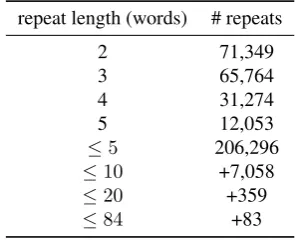
repeat length (words) # repeats
2 71,349
3 65,764
4 31,274
5 12,053
≤5 206,296
≤10 +7,058
≤20 +359
[image:2.595.347.495.69.189.2]≤84 +83
Table 2: Distribution of the match length in the French tree-banks of the UD project.
• a Python script that implements the method described in Section 2. to extract potential errors from one or several corpora in the CoNLL-U format. This imple-mentation relies on our in-house Generalized Suffix Tree library that can represent an annotated corpus of sentences and efficiently handle all the required oper-ations on strings.
[image:2.595.53.289.469.554.2]• a web server that can be used to visualize and interacts with these potential errors. This server is developed using the micro web frameworkFlask4and relies on both Python and Javascript to generate the web pages and manage interactions with the user.
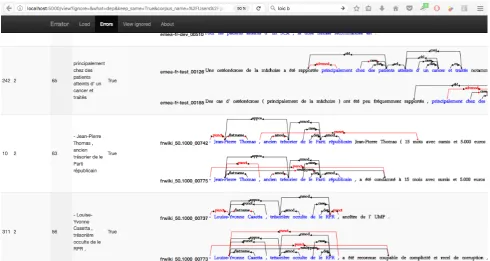
Figure 2 shows an example of the web interface. This in-terface allows the user to browse, sort, query potential an-notation errors, highlighting the differences in anan-notations and link them to corresponding sentences in the UD cor-pora. It is also possible to filter out annotation variations that correspond to truly ambiguous sequence of words ei-ther by selecting a particular entry or by writing rules (reg-ular expression that can match either the raw text, the an-notations or the two). Anan-notations can not be corrected di-rectly within ERRATORso that users can use their favorite ‘external’ tools for annotating treebanks.
4.
Analyzing Annotation Errors in the
French Corpora
In this section, we will present the results of our first exper-iments with ERRATORto correct the errors on the different French treebanks of the Universal Dependencies project. There are 5 treebanks for French in the UD project, repre-senting a total of 40,101 sentences and 1,099,571 tokens. Considering all corpora, 213,796 sequence of two words or more that appear in more than one sentence, the longest re-peat containing 84 words, and 7,000 rere-peats being made of more than 10 words. Table 2 gives some statistics on match length.
Table 3 shows the number of matches for which the annota-tion is not the same and are therefore considered as a poten-tial error. Examples of the output produced by ERRATOR
for the PoS annotation of the FrenchSequoiatreebank are given in Figure 4.
To evaluate the impact of annotation incoherences on pre-diction performance, we have manually checked all the
There is a ghost in the room
2/expl 0/root 4/det 2/nsub 7/case 7/det 2/obj +2/case +1/det None root
expl
obl
nsubj
det case
[image:3.595.157.427.79.179.2]det
[image:3.595.51.542.229.490.2]Figure 1: Representation of a dependency tree as a list of heads (first line) and representation of its substring ‘on the issue’ with local indices used when comparing to tree fragments (second line).
Figure 2: ERRATORUser Interface that allows users to browse, query and filter potential annotation errors.
annotation number of potential errors
word segmentation 2,617
PoS 25,527
Dependencies 48,986
Table 3: Number of potential errors in the French treebanks of the UD project.
matches between the French UD and the French FTB cor-recting incoherences and errors.
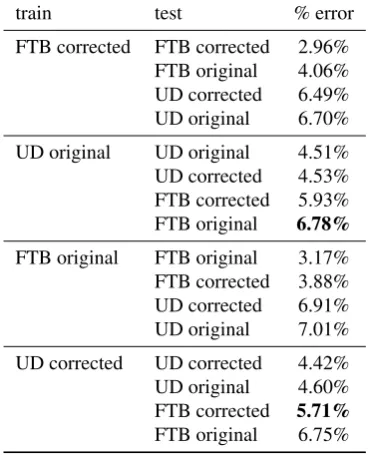
The impact of these modifications on the performance of a PoS tagger are reported in Table 5. These result show, in particular, that, for PoS tagging, part of the drop in perfor-mance observed when testing on out-domain data is due to divergences in annotations, as shown by the comparison on the results in bold.
5.
Conclusion
We have introduced ERRATOR, a set of tools implementing theannotation variation principlethat can be used to help
annotators find and correct errors in the different layers of annotations of UD treebanks. Our experience with ERRA
-TORto correct and harmonize the annotations of the differ-ent French corpora show that has proved the usefulness of this tool. ERRATORcould, however, be more efficient if it is tightly integrated with annotation tools to detect potential errors as soon as possible during the annotation campagn. This will be the goal of our future developments.
Acknowledgments
This work has been partly funded by theAgence Nationale de la Recherche(ParSiTi project, ANR-16-CE33-0021).
6.
Bibliographical References
[image:3.595.68.273.539.596.2]emea-fr-dev 00104 Pour les patients atteints d’ un SCA , la dose initiale recommand´ee est un bolus intraveineux de 0,1 mg / kg suivi d’ une perfusion de 0,25 mg / kg / h .
ADP DET NOUN VERB ADP DET NOUN PUNCT DET NOUN ADJ VERB AUX DET NOUN ADJ ADP NUM NOUN ADP NOUN VERB ADP DET NOUN ADP NUM NOUN ADP NOUN ADP NOUN PUNCT emea-fr-dev 00510 Pour les patients atteints d’ un SCA , la dose initiale recommand´ee est :
ADP DET NOUN VERB ADP DET NOUN PUNCT DET NOUN ADJ VERB VERB PUNCT
frwiki 50.1000 00767 - Michel Roussin , reconnu coupable de complicit´e et recel de corruption ,
a ´et´e condamn´e ˋa 4 ans de prison avec sursis et une amende de 50 000 euros .
PUNCT PROPN PROPN PUNCT AUX NOUN ADP NOUN CCONJ NOUN ADP NOUN PUNCT AUX AUX VERB ADP NUM NOUN ADP NOUN ADP NOUN CCONJ DET NOUN ADP DET NOUN PUNCT frwiki 50.1000 00773 - Louise-Yvonne Casetta , tr´esoriˋere occulte de le RPR , a ´et´e reconnue
coupable de complicit´e et recel de corruption , et a ´et´e condamn´ee ˋa 20 mois de prison avec sursis et 10 000 euros d’ amende .
PUNCT PROPN PROPN PUNCT NOUN ADJ ADP DET PROPN PUNCT AUX AUX AUX ADJ ADP NOUN CCONJ NOUN ADP NOUN PUNCT CCONJ AUX AUX VERB ADP NUM NOUN ADP NOUN ADP NOUN CCONJ DET NOUN ADP NOUN PUNCT
emea-fr-dev 00228 Les saignements majeurs se sont produits le plus fr´equemment ˋa le site de ponction ( voir Tableau 3 ) .
DET NOUN ADJ PRON AUX VERB DET ADV ADV ADP DET NOUN ADP NOUN PUNCT VERB
PROPN NUM PUNCT PUNCT
emea-fr-dev 00258 Les saignements majeurs se sont produits le plus fr´equemment ˋa le site de ponction ( voir Tableau 5 ) .
DET NOUN ADJ PRON AUX VERB DET ADV ADV ADP DET NOUN ADP NOUN PUNCT VERB
NOUN NUM PUNCT PUNCT
Table 4: Example of errors in PoS annotation found by ERRATORon the French Sequoia corpus of the UD project. Words in blue and red appears in two different sentence, but the red part has not the same annotation.
Bosco, C., Montemagni, S., and Simi, M. (2013). Convert-ing italian treebanks: Towards an italian stanford depen-dency treebank. InProceedings of the 7th Linguistic An-notation Workshop and Interoperability with Discourse, pages 61–69, Sofia, Bulgaria, August. Association for Computational Linguistics.
Boyd, A., Dickinson, M., and Meurers, W. D. (2008). On detecting errors in dependency treebanks. Research on Language and Computation, 6(2):113–137, Oct. Dickinson, M. and Meurers, W. D. (2003). Detecting
er-rors in part-of-speech annotation. InProceedings of the Tenth Conference on European Chapter of the Associ-ation for ComputAssoci-ational Linguistics - Volume 1, EACL ’03, pages 107–114, Stroudsburg, PA, USA. Association for Computational Linguistics.
Dickinson, M. and Meurers, W. D. (2005). Detecting errors in discontinuous structural annotation. In Pro-ceedings of the 43rd Annual Meeting of the Association for Computational Linguistics (ACL’05), pages 322–329, Ann Arbor, Michigan, June. Association for Computa-tional Linguistics.
Gusfield, D. (1997). Algorithms on Strings, Trees, and Se-quences: Computer Science and Computational Biology. Cambridge University Press, New York, NY, USA. Lipenkova, J. and Souˇcek, M. (2014). Converting russian
dependency treebank to stanford typed dependencies representation. In Proceedings of the 14th Conference of the European Chapter of the Association for
Compu-tational Linguistics, volume 2: Short Papers, pages 143– 147, Gothenburg, Sweden, April. Association for Com-putational Linguistics.
van Halteren, H. (2000). The detection of inconsistency in manually tagged text. InProceedings of the COLING-2000 Workshop on Linguistically Interpreted Corpora, pages 48–55, Centre Universitaire, Luxembourg, Au-gust. International Committee on Computational Lin-guistics.
Vilares, D. and G´omez-Rodr´ıguez, C. (2017). A non-projective greedy dependency parser with bidirectional lstms. InProceedings of the CoNLL 2017 Shared Task: Multilingual Parsing from Raw Text to Universal De-pendencies, pages 152–162, Vancouver, Canada, August. Association for Computational Linguistics.
Wisniewski, G., P´echeux, N., Gahbiche-Braham, S., and Yvon, F. (2014). Cross-lingual part-of-speech tagging through ambiguous learning. InProceedings of the 2014 Conference on Empirical Methods in Natural Language Processing (EMNLP), pages 1779–1785, Doha, Qatar, October. Association for Computational Linguistics.
7.
Language Resource References
Nivre, J., Agi´c, ˇZ., Ahrenberg, L., et al. (2017). Universaltrain test % error
FTB corrected FTB corrected 2.96% FTB original 4.06% UD corrected 6.49% UD original 6.70%
UD original UD original 4.51% UD corrected 4.53% FTB corrected 5.93% FTB original 6.78%
FTB original FTB original 3.17% FTB corrected 3.88% UD corrected 6.91% UD original 7.01%
[image:5.595.77.262.290.518.2]UD corrected UD corrected 4.42% UD original 4.60% FTB corrected 5.71% FTB original 6.75%