Utterance Segmentation Using Combined Approach
Based on Bi-directional N-gram and Maximum Entropy
Ding Liu
National Laboratory of Pattern Recognition Institute of Automation
Chinese Academy of Sciences Beijing 100080, China.
Chengqing Zong
National Laboratory of Pattern Recognition Institute of Automation
Chinese Academy of Sciences Beijing 100080, China.
Abstract
This paper proposes a new approach to segmentation of utterances into sentences using a new linguistic model based upon Maximum-entropy-weighted Bi-directional N-grams. The usual N-gram algorithm searches for sentence bounda-ries in a text from left to right only. Thus a candidate sentence boundary in the text is evaluated mainly with respect to its left context, without fully considering its right context. Using this approach, utterances are often divided into incomplete sen-tences or fragments. In order to make use of both the right and left contexts of can-didate sentence boundaries, we propose a new linguistic modeling approach based on Maximum-entropy-weighted Bi-directional N-grams. Experimental results indicate that the new approach signifi-cantly outperforms the usual N-gram al-gorithm for segmenting both Chinese and English utterances.
1 Introduction
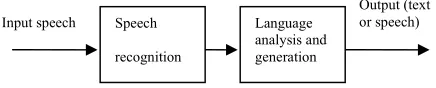
[image:1.595.299.517.283.327.2]Due to the improvement of speech recognition technology, spoken language user interfaces, spo-ken dialogue systems, and speech translation sys-tems are no longer only laboratory dreams. Roughly speaking, such systems have the structure shown in Figure 1.
Figure 1. System with speech input.
In these systems, the language analysis module takes the output of speech recognition as its input, representing the current utterance exactly as pro-nounced, without any punctuation symbols mark-ing the boundaries of sentences. Here is an
example: 这边请您坐电梯到 9 楼服务生将在那
里等您并将您带到913号房间 . (this way please
please take this elevator to the ninth floor the floor attendant will meet you at your elevator entrance there and show you to room 913.) As the example shows, it will be difficult for a text analysis module to parse the input if the utterance is not segmented. Further, the output utterance from the speech rec-ognizer usually contains wrongly recognized words or noise words. Thus it is crucial to segment the utterance before further language processing. We believe that accurate segmentation can greatly improve the performance of language analysis modules.
Stevenson et al. have demonstrated the difficul-ties of text segmentation through an experiment in which six people, educated to at least the Bache-lor’s degree level, were required to segment into sentences broadcast transcripts from which all punctuation symbols had been removed. The ex-perimental results show that humans do not always agree on the insertion of punctuation symbols, and that their segmentation performance is not very good (Stevenson and Gaizauskas, 2000). Thus it is a great challenge for computers to perform the task
Output (text or speech) Language
analysis and generation Speech
automatically. To solve this problem, many meth-ods have been proposed, which can be roughly classified into two categories. One approach is based on simple acoustic criteria, such as non-speech intervals (e.g. pauses), pitch and energy. We can call this approach acoustic segmentation. The other approach, which can be called linguistic segmentation, is based on linguistic clues, includ-ing lexical knowledge, syntactic structure, seman-tic information etc. Acousseman-tic segmentation can not always work well, because utterance boundaries do not always correspond to acoustic criteria. For ex-ample: 您好<pause>请问<pause>明天的单人间 还有吗<pause>或者<pause>标准间也行. Since the simple acoustic criteria are inadequate, linguis-tic clues play an indispensable role in utterance segmentation, and many methods relying on them have been proposed.
This paper proposes a new approach to linguis-tic segmentation using a Maximum-entropy-weighted Bi-directional N-gram-based algorithm (MEBN). To evaluate the performance of MEBN, we conducted experiments in both Chinese and English. All the results show that MEBN outper-forms the normal N-gram algorithm. The remain-der of this paper will focus on description of our new approach for linguistic segmentation. In Sec-tion 2, some related work on utterance segmenta-tion is briefly reviewed, and our motivasegmenta-tions are described. Section 3 describes MEBN in detail. The experimental results are presented in Section 4. Finally, Section 5 gives our conclusion.
2 Related Work and Our Motivations
2.1 Related Work
Stolcke et al. (1998, 1996) proposed an approach to detection of sentence boundaries and disfluency locations in speech transcribed by an automatic recognizer, based on a combination of prosodic cues modeled by decision trees and N-gram lan-guage models. Their N-gram lanlan-guage model is mainly based on part of speech, and retains some words which are particularly relevant to segmenta-tion. Of course, most part-of-speech taggers re-quire sentence boundaries to be pre-determined; so to require the use of part-of-speech information in utterance segmentation would risk circularity. Cet-tolo et al.’s (1998) approach to sentence boundary detection is somewhat similar to Stolcke et al.’s.
They applied word-based N-gram language models to utterance segmentation, and then combined them with prosodic models. Compared with N-gram language models, their combined models achieved an improvement of 0.5% and 2.3% in precision and recall respectively.
Beeferman et al. (1998) used the CYBERPUNC system to add intra-sentence punctuation (espe-cially commas) to the output of an automatic speech recognition (ASR) system. They claim that, since commas are the most frequently used punc-tuation symbols, their correct insertion is by far the most helpful addition for making texts legible. CYBERPUNC augmented a standard trigram speech recognition model with lexical information concerning commas, and achieved a precision of 75.6% and a recall of 65.6% when testing on 2,317 sentences from the Wall Street Journal.
Gotoh et al. (1998) applied a simple non-speech interval model to detect sentence boundaries in English broadcast speech transcripts. They com-pared their results with those of N-gram language models and found theirs far superior. However, broadcast speech transcripts are not really spoken language, but something more like spoken written language. Further, radio broadcasters speak for-mally, so that their reading pauses match sentence boundaries quite well. It is thus understandable that the simple non-speech interval model outperforms the N-gram language model under these conditions; but segmentation of natural utterances is quite dif-ferent.
Zong et al. (2003) proposed an approach to ut-terance segmentation aiming at improving the per-formance of spoken language translation (SLT) systems. Their method is based on rules which are oriented toward key word detection, template matching, and syntactic analysis. Since this ap-proach is intended to facilitate translation of Chi-nese-to-English SLT systems, it rewrites long sentences as several simple units. Once again, these results cannot be regarded as general-purpose utterance segmentation. Furuse et al. (1998) simi-larly propose an input-splitting method for translat-ing spoken language which includes many long or ill-formed expressions. The method splits an input into well-balanced translation units, using a seman-tic dictionary.
user interface. They considered as their features words and their distances to potential boundaries. They posited 400 feature functions, and trained their weights using 3000 commands. The system then achieved a precision of 98.2% in a test set of 1900 commands. However, command sentences for conversational natural language user interfaces contain much smaller vocabularies and simpler structures than the sentences of natural spoken lan-guage. In any case, this method has been very helpful to us in designing our own approach to ut-terance segmentation.
There are several additional approaches which are not designed for utterance segmentation but which can nevertheless provide useful ideas. For example, Reynar et al. (1997) proposed an approach to the disambiguation of punctuation marks. They con-sidered only the first word to the left and right of any potential sentence boundary, and claimed that examining wider context was not beneficial. The features they considered included the candidate’s prefix and suffix; the presence of particular charac-ters in the prefix or suffix; whether the candidate was honorific (e.g. Mr., Dr.); and whether the can-didate was a corporate designator (e.g. Corp.). The system was tested on the Brown Corpus, and achieved a precision of 98.8%. Elsewhere, Nakano et al. (1999) proposed a method for incrementally understanding user utterances whose semantic boundaries were unknown. The method operated by incrementally finding plausible sequences of utterances that play crucial roles in the task execu-tion of dialogues, and by utilizing beam search to deal with the ambiguity of boundaries and with syntactic and semantic ambiguities. Though the method does not require utterance segmentation before discourse processing, it employs special rule tables for discontinuation of significant utter-ance boundaries. Such rule tables are not easy to maintain, and experimental results have demon-strated only that the method outperformed the method assuming pauses to be semantic boundaries.
2.2 Our motivations
Though numerous methods for utterance segmen-tation have been proposed, many problems remain unsolved.
One remaining problem relates to the language model. The N-gram model evaluates candidate sentence boundaries mainly according to their left context, and has achieved reasonably good results,
but it can’t take into account the distant right con-text to the candidate. This is the reason that N-gram methods often wrongly divide some long sentences into halves or multiple segments. For example:小王病了一个星期. The N-gram method is likely to insert a boundary mark between “了” and “一”, which corresponds to our everyday im-pression that, if reading from the left and not considering several more words to the right of the current word, we will probably consider “小王病 了” as a whole sentence. However, we find that, if we search the sentence boundaries from right to left, such errors can be effectively avoided. In the present example, we won’t consider “一个星期” as a whole sentence, and the search will be contin-ued until the word “小” is encountered. Accord-ingly, in order to avoid segmentation errors made by the normal N-gram method, we propose a re-verse N-gram segmentation method (RN) which does seek sentence boundaries from right to left. Further, we simply integrate the two N-gram methods and propose a bi-directional N-gram method (BN), which takes into account both the left and the right context of a candidate segmenta-tion site. Since the relative usefulness or signifi-cance of the two N-gram methods varies depending on the context, we propose a method of weighting them appropriately, using parameters generated by a maximum entropy method which takes as its features information about words in the context. This is our Maximum-Entropy-Weighted Bi-directional N-gram-based segmentation method. We hope MEBN can retain the correct segments discovered by the usual N-gram algorithm, yet ef-fectively skip the wrong segments.
3 Maximum-Entropy-Weighted
Bi-directional N-gram-based Segmentation Method
3.1 Normal N-gram Algorithm (NN) for Ut-terance Segmentation
Assuming that W1W2...Wm (where m is a natural
number) is a word sequence, we consider it as an n
order Markov chain, in which the word
) 1
( i m
) ... | ( ) ... |
(Wi W1W2 Wi−1 =PWi Wi−n+1 Wi−1
P
From this conditional probability formula for a word, we can derive the probability of a word se-quenceW1W2...Wi:
) ... | ( ) ... ( ) ...
(W1W2 Wi =PW1W2 Wi−1 ×PWi W1W2 Wi−1 P
Integrating the two formulas above, we get:
) ... | ( ) ... ( ) ...
(W1W2 Wi =PW1W2 Wi−1 ×PWi Wi−n+1 Wi−1
P
Let us use SB to indicate a sentence boundary and add it to the word sequence. The value of
) ...
(W1W2 WiSBWi+1
P and P(W1W2...WiWi+1)will
determine whether a specific word
) 1
( i m
Wi ≤ ≤ is the final word of a sentence. We say Wi is the final word of a sentence if and only
if P(W1W2...WiSBWi+1)>P(W1W2...WiWi+1). Taking the trigram as our example and consid-ering the two cases where Wi-1 is and is not the final word of a sentence, P(W1W2...WiSBWi+1)
and P(W1W2...WiWi+1) is computed respectively by the following two formulas:
) | ( ) ... ( ) | ( ) ... ( ) ... ( ) | ( ) | ( ) ... ( ) | ( ) | ( ) ... ( ) ... ( 1 1 1 2 1 1 2 1 1 2 1 1 1 1 2 1 1 2 1 1 2 1 i i i i i i i i i i i i i i i i i i i i i i W W W P W W W W P SBW W P SBW W W P W W W W P SB W W P W W SB P W W W W P SB W W P SBW SB P SBW W W P SBW W W W P − + − + + + − − + + × + × = × × + × × =
In the normal N-gram method, the above iterative formulas are computed to search the sentence boundaries from W1 to Wm.
3.2 Reverse N-gram Algorithm (RN) for Ut-terance Segmentation
In the reverse N-gram segmentation method, we take the word sequence W1W2...Wm as a reverse
Markov chain in which Wi(1≤i≤m) is predicted by the n-1 words to its right. That is:
) ... | ( ) ... |
(Wi WmWm−1 Wi+1 =PWi Wi+n−1 Wi+1 P
As in the N-gram algorithm, we compute the occurring probability of word sequence
m
W W
W1 2... using the formula:
) ... | ( ) ... ( ) ...
(WmWm−1 Wi =PWmWm−1 Wi+1 ×PWi WmWm−1 Wi+1
P
Then the iterative computation formula is:
) ... | ( ) ... ( ) ...
(WmWm−1 Wi =PWmWm−1 Wi+1 ×PWi Wi+n−1 Wi+1 P
By adding SB to the word sequence, we say Wi
is the final word of a sentence if and only if
) ...
(WmWm 1 Wi 1SBWi
P − + > P(WmWm−1...Wi+1Wi) .
Similar to NN, P(WmWm−1...Wi+1SBWi) and
) ...
(WmWm 1 Wi 1Wi
P − + are computed as follows in the trigram: ) | ( ) ... ( ) | ( ) ... ( ) ... ( ) | ( ) | ( ) ... ( ) | ( ) | ( ) ... ( ) ... ( 1 2 1 2 1 1 1 1 1 1 1 1 2 1 2 1 1 1 1 1 1 1 + + + + − + + − + − + + + + + − + + + − + − × + × = × × + × × = i i i i i m m i i i m m i i m m i i i i i i m m i i i i m m i i m m W W W P W W W W P SBW W P SBW W W P W W W W P SB W W P W W SB P W W W W P SB W W P SBW SB P SBW W W P SBW W W W P
In contrast to the normal N-gram segmentation method, we compute the above iterative formulas to seek sentence boundaries from Wm to W1.
3.3 Bi-directional N-gram Algorithm for Ut-terance Segmentation
From the iterative formulas of the normal N-gram algorithm and the reverse N-gram algorithm, we can see that the normal N-gram method recognizes a candidate sentence boundary location mainly according to its left context, while the reverse N-gram method mainly depends on its right context. Theoretically at least, it is reasonable to suppose that, if we synthetically consider both the left and the right context by integrating the NN and the RN, the overall segmentation accuracy will be im-proved.
Considering the word sequence W1W2...Wm , the candidate sites for sentence boundaries may be found between W1 and W2 , between W2 and
3
W , …, or between Wm−1andWm. The number of
candidate sites is thus m-1. We number those m-1
candidate sites 1, 2 … m-1 in succession, and we use Pis(i) (1≤i≤m−1) and
) (i
Pno (1≤i≤m−1) respectively to indicate the probability that the current site i really is, or is not, a sentence boundary. Thus, to compute the word sequence segmentation, we must compute Pis(i)
and Pno(i) for each of the m-1 candidate sites. In the bi-directional BN, we compute Pis(i) and
) (i
where Pis_NN(i), Pno_NN(i) denote the
probabili-ties calculated by NN which correspond to
) ...
(W1W2 WiSBWi+1
P and P(W1W2...WiWi+1) in
section 3.1 respectively and Pis_RN(i), Pno_RN(i)
denote the probabilities calculated by RN which correspond to P(WmWm−1...Wi+1SBWi) and
) ... (WmWm1 Wi 1Wi
P − + in section 3.2 respectively. We say there exits a sentence boundary at site i
) 1 1
( ≤i≤m− if and only if Pis_BN(i)>Pno_BN(i).
3.4 Maximum Entropy Approach for Utter-ance Segmentation
In this section, we explain our maximum-entropy-based model for utterance segmentation. That is, we estimate the joint probability distribution of the candidate sites and their surrounding words. Since we consider information concerning the lexical context to be useful, we define the feature func-tions for our maximum method as follows:
== = else b S c efix include if c b f j j 0 ) 0 & & ) ), ( (Pr ( 1 ) , ( 10 == = else b S c efix include if c b f j j 0 ) 1 & & ) ), ( (Pr ( 1 ) , ( 11 == = else b S c Suffix include if c b f j j 0 ) 0 & & ) ), ( ( ( 1 ) , ( 20 == = else b S c Suffix include if c b f j j 0 ) 1 & & ) ), ( ( ( 1 ) , ( 21
Sj denotes a sequence of one or more words
which we can call the Matching String. (Note that
Sj may contain the sentence boundary mark ‘SB’.)
The candidate c’s state is denoted by b, where b=1
indicates that c is a sentence boundary and b=0
indicates that it is not a boundary. Prefix(c) de-notes all the word sequences ending with c (that is,
c's left context plus c) and Suffix(c) denotes all the word sequences beginning with c (in other words,
c plus its right context). For example: in the utter-ance: 去<c1>机<c2>场<c3>怎<c4>么<c5>走,
‘场’, ‘机场’, and ‘去机场’ are c3’s Prefix, while ‘怎’ , ‘怎么’and ‘怎么走’ are c3’s Suffix. The value of function include(Prefix(c),Sj) is true
when word sequence Sj is one of c’s Prefixes, and
the value of function include(Suffix(c),Sj) is
true when Sj is one of c’s Suffixes.
Corresponding to the four feature functions
) , ( 10 b c
fj , fj11(b,c), fj20(b,c), fj21(b,c) are the
four parameters
α
j10,α
j11,α
j20,α
j21. Thus the joint probability distribution of the candidate sites and their surrounding contexts is given by:) (
) ,
( 1 21(,)
) , ( 20 ) , ( 11 ) , ( 10 21 20 11 10
∏
= × × × = k j c b f j c b f j c b f j c b f j j j j j b cP π α α α α
where k is the total number of the Matching Strings and
π
is a parameter set to make P(c,1) and P(c,0)sum to 1. The unknown parameters
10
j
α
,α
j11,α
j20,α
j21 are chosen to maximize the likelihood of the training data using the General-ized Iterative Scaling (Darroch and Ratcliff, 1972) algorithm. In the maximum entropy approach, we say that a candidate site is a sentence boundary if and only if P(c, 1) > P(c, 0). (At this point, we can anticipate a technical problem with the maximum approach to utterance segmentation. When a Matching String contains SB, we cannot know whether it belongs to the Prefixes or Suffixes of the candidate site until the left and right contexts of the candidate site have been segmented. Thus if the segmentation proceeds from left to right, the lexi-cal information in the right context of the current candidate site will always remain uncertain. Like-wise, if it proceeds from right to left, the informa-tion in the left context of the current candidate site remains uncertain. The next subsection will de-scribe a pragmatic solution to this problem.)3.5 Maximum-Entropy-Weighted Bi-directional N-gram Algorithm for Utter-ance Segmentation
In the bi-directional N-gram based algorithm, we have considered the left-to-right N-gram algorithm and the right-to-left algorithm as having the same significance. Actually, however, they should be assigned differing weights, depending on the lexi-cal contexts. The combination formulas are as fol-lows: ) ( ) ( ) ( ) ( ) ( ) ( ) ( ) ( ) ( ) ( _ _ _ _ _ _ _ _ i P C W i P C W i P i P C W i P C W i P RN no i no r NN no i no n no RN is i is r NN is i is n is × × × = × × × = ) ( _is i
n C
W ,Wn_no(Ci) ,Wr_is(Ci),Wr_no(Ci)
are the functions of the context surrounding candi-date site i which denotes the weights of
) ( _ i
Pis NN ,Pno_NN(i),Pis_RN(i) and Pno_RN(i)
re-spectively. Assuming that the weights of Pis_NN(i)
) ( _ i
Pis RN and Pno_RN(i) depend on the context to
the right of the candidate site, the weight functions
can be rewritten as:
) (
_is i n LeftC
W ,Wn_no(LeftCi),Wr_is(RightCi) ,
) (
_no i
r RightC
W . It is reasonable to assume that as the joint probability P(LeftCi,i=SB) rises,
) ( _ i
Pis NN will increase in significance. (The joint probability in question is the probability of the cur-rent candidate’s left context, taken together with the probability that the candidate is a sentence boundary.) Therefore the value of Wn_is(LeftCi)
is given by Wn_is(LeftCi)=P(LeftCi,i=SB) . Similarly we can give the formulas for comput-ing Wn_no(LeftCi) , Wr_is(RightCi) , and
) (
_no i
r RightC
W as follows:
) ! , ( ) (
_ LeftC P LeftC i SB Wn no i = i =
) ,
( ) (
_ RightC P RightC i SB
Wr is i = i =
) ! , (
) (
_ RightC P RightC i SB
Wr no i = i =
We can easily get the values of
) ,
(LeftC i SB
P i = , P(LeftCi,i!=SB) ,
) ,
(RightC i SB
P i = , and P(RightCi,i!=SB)
using the method described in the maximum en-tropy approach section. For example:
∏
==
= k
j i f j i
j
SB i LeftC
P 1 11(1,)
11 )
,
( π α
∏
==
= k
j i f j i
j
SB i LeftC
P 1 10(0,)
10 )
! ,
( π α
As mentioned in last subsection, we need seg-mented contexts for maximum entropy approach. Since the maximum entropy parameters for MEBN algorithm are used as modifying NN and RN, we just estimate the joint probability of the candidate and its surrounding contexts based upon the seg-ments by NN and RN. Using NLeftCi indicate the left context to the candidate i which has been seg-mented by NN algorithm and RRightCi indicate the right context to i which has been segmented by RN, the combination probability computing formulas for MEBN are as follows:
) ( )
! , (
) ( )
! , (
) (
) ( )
, (
) ( )
, (
) (
_ _ _
_ _ _
i P SB i RRightC P
i P SB i NLeftC P i P
i P SB i RRightC P
i P SB i NLeftC P i P
RN no i
NN no i
MEBN no
RN is i
NN is i
MEBN is
× = ×
× = =
× = ×
× = =
We evaluate site i as a sentence boundary if and only if Pis_MEBN(i)>Pno_MEBN(i).
4 Experiment
4.1 Model Training
Our models are trained on both Chinese and Eng-lish corpora, which cover the domains of hotel res-ervation, flight booking, traffic information, sightseeing, daily life and so on. We replaced the full stops with “SB” and removed all other punc-tuation marks in the training corpora. Since in most actual systems part of speech information cannot be accessed before determining the sentence boundaries, we use Chinese characters and English words without POS tags as the units of our N-gram models. Trigram and reverse trigram probabilities are estimated based on the processed training cor-pus by using Modified Kneser-Ney Smoothing
(Chen and Goodman, 1998). As to the maximum entropy model, the Matching Strings are chosen as all the word sequences occurring in the training corpus whose length is no more than 3 words. The unknown parameters corresponding to the feature functions are generated based on the training cor-pus using the Generalized Iterative Scaling algo-rithm. Table 1 gives an overview of the training corpus.
Corpus SIZE SB
Num-ber Average Length of Sentence Chinese 4.02MB 148967 8 Chinese
charac-ters
English 4.49MB 149311 6 words
Table 1. Overview of the Training Corpus.
4.2 Testing Results
We test our methods using open corpora which are also limited to the domains mentioned above. All punctuation marks are removed from the test cor-pora. An overview of the test corpus appears in table 2.
Corpus SIZE SB Number
Average Length of Sentence Chinese 412KB 12032 10 Chinese
char-acters English 391KB 10518 7 words
If we use “RightNum” to denote the number of right segmentations, “WrongNum” denote the number of wrong segmentations, and “TotalNum” to denote the number of segmentations in the original testing corpus, the precision (P) can be computed using the formula
P=RightNum/(RightNum+WrongNum), the recall (R) is computed as R=RightNum/TotalNum, and
the F-Score is computed as F-Score =
R P
R P
+ × ×
2
.
The testing results are described in Table 3 and Table 4.
Methods Total Num Right Num Wrong Num Preci-sion Recall F-Score
NN 12032 10167 2638 79.4% 84.5% 81.9%
RN 12032 10396 2615 79.9% 86.4% 83.0%
BN 12032 10528 2249 82.4% 87.5% 84.9%
MEBN 12032 10348 1587 86.7% 86.0% 86.3% Table 3. Experimental Results for Chinese Utter-ance Segmentation.
Methods Total Num Right Num WrongNum Preci-sion Recall F-Score
NN 10518 8730 3164 73.4% 83.0% 77.9%
RN 10518 9014 3351 72.9% 85.7% 78.8%
BN 10518 9056 3019 75.0% 86.1% 80.2%
MEBN 10518 8929 2403 78.8% 84.9% 81.7% Table 4. Experimental Results for English Utter-ance Segmentation.
From the result tables it is clear that RN, BN, and MEBN all outperforms the normal N-gram algo-rithm in the F-score for both Chinese and English utterance segmentation. MEBN achieved the best performance which improves the precision by 7.3% and the recall by 1.5% in the Chinese ex-periment, and improves the precision by 5.4% and the recall by 1.9% in the English experiment.
4.3 Result analysis
MEBN was proposed in order to maintain the cor-rect segments of the normal N-gram algorithm while skipping the wrong segments. In order to see whether our original intention has been realized, we compared the segments as determined by RN with those determined by NN, compare the seg-ments found by BN with those of NN and then compare the segments found by MEBN with those of NN. For RN, BN and MEBN, suppose TN notes the number of total segmentations, CON de-notes the number of correct segmentations overlapping with those found by NN; SWN
de-notes the number of wrong NN segmentations which were skipped; WNON denotes the number of wrong segmentations not overlapping with those of NN; and CNON denotes the number of segmen-tations which were correct but did not overlap with those of NN. The statistical results are listed in Table 5 and Table 6.
Methods TN CON SWN WNON CNON
RN 13011 9525 1098 1077 870
BN 12777 9906 753 355 622
MEBN 11935 9646 1274 223 678 Table 5. Chinese Utterance Segmentation Results Comparison.
Methods TN CON SWN WNON CNON RN 12365 8223 1077 1271 792 BN 12075 8565 640 488 491 MEBN 11332 8370 1247 486 559 Table 6. English Utterance Segmentation Results Comparison.
5 Conclusion
This paper proposes a reverse N-gram algorithm, a bi-directional N-gram algorithm and a Maximum-entropy-weighted Bi-directional N-gram algorithm for utterance segmentation. The experimental re-sults for both Chinese and English utterance seg-mentation show that MEBN significantly outperforms the usual N-gram algorithm. This is because MEBN takes into account both the left and right contexts of candidate sites: it integrates the left-to-right N-gram algorithm and the right-to-left N-gram algorithm with appropriate weights, using clues on the sites’ lexical context, as modeled by maximum entropy.
Acknowledgements
This work is sponsored by the Natural Sciences Foundation of China under grant No.60175012, as well as supported by the National Key Fundamen-tal Research Program (the 973 Program) of China under the grant G1998030504.
The authors are very grateful to Dr. Mark Selig-man for his very useful suggestions and his very careful proofreading.
References
Beeferman D., A. Berger, and J. Lafferty. 1998. CYBERPUNC: A lightweight punctuation annotation system for speech. In Proceedings of the IEEE Inter-national Conference on Acoustics, Speech and Signal
Processing, Seattle, WA. pp. 689-692.
Beeferman D., A. Berger, and J. Lafferty. 1999. Statisti-cal models for text segmentation. Machine Learning
34, pp 177-210.
Berger A., S. Della Pietra, and V. Della Pietra. 1996. A Maximum Entropy Approach to Natural Language Processing. Computational Linguistics, 22(1), pp. 39-71.
Cettolo M. and D. Falavigna. 1998. Automatic Detection of Semantic Boundaries Based on Acoustic and Lexical Knowledge. ICSLP 1998, pp. 1551-1554. Chen S. F. and J. Goodman. 1998. An empirical study
of smoothing techniques for language modeling.
Tech-nical Report TR-10-98, Center for Research in
Com-puting Technology, Harvard University. pp.243-255. Darroch J. N. and D. Ratcliff. 1972. Generalized
Itera-tive Scaling for Log-Linear Models. The Annals of
Mathematical Statistics, 43(5), pp. 1470-1480.
Furuse O., S. Yamada, and K. Yamamoto. 1998. Split-ting Long or Ill-formed Input for Robust
Spoken-language Translation. COLING-ACL 1998, pp. 421-427.
Gotoh Y. and S. Renals. 2000. Sentence Boundary De-tection in Broadcast Speech Transcripts. In Proc. In-ternational Workshop on Automatic Speech
Recognition, pp. 228-235.
Nakano M., N. Miyazaki, J. Hirasawa, K. Dohsaka, and T. Kawabata. 1999. Understanding Unsegmented User Utterances in Real-Time Spoken Dialogue Systems.
Proceedings of the 37th Annual Meeting of the
Asso-ciation for Computational Linguistics (ACL-99),
Col-lege Park, MD, USA, pp. 200-207.
Ramaswamy N. G. and J. Kleindienst. 1998. Automatic Identification of Command Boundaries in a Conversa-tional Natural Language User Interface. ICSLP 1998. pp. 401-404.
Reynar J. and A. Ratnaparkhi. 1997. A maximum en-tropy approach to identifying sentence boundaries. In
Proceedings of the 5th Conference on Applications of
Natural Language Processing (ANLP), Washington
DC, pp. 16-19.
Seligman M. 2000. Nine Issues in Speech Translation.
In Machine Translation, 15, pp. 149-185.
Stevenson M. and R. Gaizauskas. 2000. Experiments on sentence boundary detection. In Proceedings of the Sixth Conference on Applied Natural Language Proc-essing and the First Conference of the North American Chapter of the Association for Computational Linguis-tics, pp. 24-30.
Stolcke A. and E. Shriberg. 1996. Automatic linguistic segmentation of conversational speech. Proc. Intl.
Conf. on Spoken Language Processing, Philadelphia,
PA, vol. 2, pp. 1005-1008.
Stolcke A., E. Shriberg, R. Bates, M. Ostendorf, D. Hakkani, M. Plauche, G. Tur, and Y. Lu. 1998. Auto-matic Detection of Sentence Boundaries and Disfluen-cies based on Recognized Words. Proc. Intl. Conf. on
Spoken Language Processing, Sydney, Australia, vol.
5, pp. 2247-2250.
Zong, C. and F. Ren. 2003. Chinese Utterance Segmen-tation in Spoken Language translation. In Proceedings
of the 4th international conference on intelligent text
processing and Computational Linguistics (CICLing),
Mexico, Feb 16-22. pp. 516-525.
Zhou Y. 2001. Utterance Segmentation Based on Deci-sion Tree. Proceedings of the 6th National joint
Con-ference on Computational Linguistics, Taiyuan, China,