Convolution-Enhanced Bilingual Recursive Neural Network
for Bilingual Semantic Modeling
Jinsong Su1, Biao Zhang1, Deyi Xiong2∗, Ruochen Li1, Jianmin Yin3 Xiamen University, Xiamen, China 3610051
Soochow University, Suzhou, China 2150062
Weifang Beida Jade Bird Huaguang Information Technology Co., Ltd, Weifang, China 2612053
[email protected], [email protected]
[email protected], lrc [email protected], [email protected]
Abstract
Estimating similarities at different levels of linguistic units, such as words, sub-phrases and phrases, is helpful for measuring semantic similarity of an entire bilingual phrase. In this paper, we propose a convolution-enhanced bilingual recursive neural network (ConvBRNN), which not only exploits word alignments to guide the generation of phrase structures but also integrates multiple-level information of the generated phrase structures into bilingual semantic modeling. In order to accurately learn the semantic hierarchy of a bilingual phrase, we develop a recursive neural network to constrain the learned bilingual phrase structures to be consistent with word alignments. Upon the generated source and target phrase structures, we stack a convolutional neural network to integrate vector representations of linguistic units on the structures into bilin-gual phrase embeddings. After that, we fully incorporate information of different linguistic units into a bilinear semantic similarity model. We introduce two max-margin losses to train the Con-vBRNN model: one for the phrase structure inference and the other for the semantic similarity model. Experiments on NIST Chinese-English translation tasks demonstrate the high quality of the generated bilingual phrase structures with respect to word alignments and the effectiveness of learned semantic similarities on machine translation.
1 Introduction
Recently, adapting deep neural networks to statistical machine translation (SMT) is of growing interest due to their superior capacity against conventional lexical models in feature learning and representation (Yang et al., 2013; Liu et al., 2013; Li et al., 2013; Devlin et al., 2014; Liu et al., 2014; Setiawan et al., 2015). As phrases are the basic translation units in many SMT systems, one line of research among these studies is to learn the semantic similarity of bilingual phrases for translation selection in SMT (Zhang et al., 2014a; Gao et al., 2014; Cho et al., 2014; Su et al., 2015; Hu et al., 2015).
Typically, these bilingual semantic similarity models learn source and target phrase representations with some bilingual constraints (Gao et al., 2014; Hu et al., 2015; Zhang et al., 2014a). In spite of their success, they often suffer from two problems. Firstly, it is difficult for them to recover the semantic hierarchy (binary tree structure) of a bilingual phrase. In this respect, Su et al. (2015) improve tree con-struction by incorporating word alignments into their objective function. Unfortunately, they still employ the recursive autoencoder (RAE) as the underlying model to build tree structures of phrases according to the minimum reconstruction error. As a result, word alignments are not fully exploited for phrase structure generation. Secondly, the previous bilingual semantic similarity models are incapable of lever-aging representations at different levels of linguistic units, such as words, sub-phrases and phrases. They usually represent a phrase (a sequence of words) with a single, fixed vector. However, as demonstrat-ed in attention-basdemonstrat-ed neural machine translation (Bahdanau et al., 2014), one vector is not semantically sufficient to encode a sequence of words preserving representations at different levels of linguistic units may be beneficial.
∗Corresponding author.
This work is licensed under a Creative Commons Attribution 4.0 International License. License details: http:// creativecommons.org/licenses/by/4.0/
To solve these problems, we propose a convolution enhanced bilingual recursive neural network (Con-vBRNN), which exploits word alignments to guide the generation of phrase structures and then inte-grates embeddings of different linguistic units on the phrase structures into bilingual semantic modeling. Specifically, we develop a new recursive neural network, in which the composition criterion for tree construction is the degree of consistency to word alignments rather than the reconstruction error. Fur-thermore, we propose a variant of the tree-based convolutional neural network (Mou et al., 2015) to fully access all embeddings on the phrase structures, which can be used to produce better phrase rep-resentations (see Section 3.2). All these make ConvBRNN more suitable for the subsequent bilingual semantic modeling, where a bilinear model is introduced to interact and compare the source and target phrase representations in terms of the degree of semantic equivalence. To train our model, we introduce two max-margin losses: one for the bilingual semantic structure inference and the other for the semantic similarity model, both of which are derivable.
We conduct experiments on large-scale corpus to examine the effectiveness of ConvBRNN on bilin-gual phrase structure learning and semantic similarity estimation. Experiment results on NIST MT06 and MT08 datasets show that our system achieves significant improvements over baseline methods. We further analyze the generated bilingual phrase structures and semantic scores, both of which indicate that ConvBRNN indeed learns information from word alignments that is beneficial for bilingual semantic representations.
Our major contributions lie in the following three aspects:
• We develop a new recursive neural network with an alignment-based semantic composition metric to generate word-alignment-consistent bilingual phrase structures.
• we develop a variant of tree-based convolutional neural model, which utilizes all embeddings on a phrase structure rather than the embedding of the entire phrase to model bilingual semantics. • We carry out a series of experiments and demonstrate that our model is superior to baselines in
terms of both the learned phrase structures and semantic similarities.
2 Related Work
A straightforward approach to learning bilingual phrase representations is to adapt monolingual phrase models with bilingual supervisions. For example, Li et al. (2013) encode reordering orientations into RAE-generated embeddings. To utilize the semantic equivalence constraint between source and target phrases, Gao et al. (2014) use a feedforward neural network to model phrase embeddings and try to maximize their semantic similarity, while Zhang et al. (2014a) introduce a bilingually-constrained RAE. Furthermore, Hu et al. (2015) incorporate context information to disambiguate translation selection. Very recently, neural machine translation trains a unified encoder-decoder (Sutskever et al., 2014; Bahdanau et al., 2014) neural network for translation, where an encoder maps the input sentence into a fixed-length vector, and a decoder generates a translation from the encoded vector.
Unlike the work mentioned above, our model mainly explore word alignments to guide the generation of bilingual phrase structures. The most relevant work to ours is the model proposed by Su et al. (2015), where they treat word alignments as a constraint to the RAE model. However, as discussed in Section 1, the composition criterion in RAE (i.e. reconstruction errors) does not allow us to fully benefit from word alignments. Therefore, we introduce a new composition criterion based on word alignment consistency. The proposed recursive neural network works in a way similar to that in (Socher et al., 2011b) except for our specific bilingual supervision. Zhang et al. (2014b) also propose a recursive neural network. However, their model mainly focuses on the composition in machine translation process (namely,swap
ormonotone), which is different from ours.
RecNN TreeCNN
[image:3.595.165.434.62.195.2]Bilingual Semantic Supervision
Figure 1: An illustration of the convolution-enhanced bilingual recursive neural network.
𝑥1 𝑥2 𝑥3
𝑊𝑟𝑒𝑐 𝑦1
𝑊𝑟𝑒𝑐 𝑦2
𝑊𝑐𝑜𝑛𝑠𝑎𝑐
𝑊𝑖𝑛𝑐 𝑠𝑎𝑐
𝑊𝑖𝑛𝑐 𝑠𝑎𝑐
𝑊𝑐𝑜𝑛 𝑠𝑎𝑐
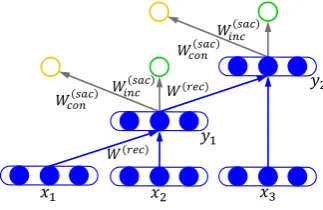
Figure 2: An illustration of the proposed RecNN. We use a yellow/green circle to represent the prefer-ence score of a node to be an SAC/non-SAC node.
(Socher et al., 2011a), where they compute an interaction matrix from which discriminative features are dynamically extracted for paraphrase identification. He et al. (2015) and Yin et al. (2015b) further extend this idea to convolutional neural network. Although our method is partially inspired by them, we implement it in a completely different manner.
3 Convolution-Enhanced Bilingual Recursive Neural Network
This section elaborates the proposed ConvBRNN model, of which network structure is shown in Figure 1. We begin with the generation of phrase structures via a recursive neural network. We then elaborate how to perform convolution upon the generated phrase structures. After that, we describe our bilingual semantic similarity model. Finally, we provide a detailed illustration on the training of ConvBRNN.
3.1 Recursive Neural Network for Generating Phrase Structures
To generate phrase structures, the conventional RAE usually composes neighboring nodes based on their reconstruction errors, which we argue are insufficient to model bilingual semantics. In SMT, one important auxiliary for a bilingual phrase is its word alignments, which contain some useful guidance signals for the bilingual structure construction, as discussed in Section 1. To make better use of these signals, we introduce the following recursive neural network (RecNN).
As shown in Figure 2, the input to our RecNN is a list of orderedd-dimensional vectorsx=(x1, x2, x3), each of which can be retrieved from a word embedding matrixL ∈ Rd×|V|via its corresponding word index. Here|V|is the size of the vocabulary. Given two neighboring childrenc1 andc2, we compose them into a parent noden(For example, in Figure 2, if we setc1=x1andc2=x2, thenn=y1) and produce its semantic vectorpnthrough a non-linear transformation:
pn=f(W(rec)[c1;c2] +b(rec)) (1)
[image:3.595.217.379.226.331.2]et al., 2014a; Su et al., 2015) adopt reconstruction error to measure how wellpn represents its children c1 andc2, which, however, is not a good solution to directly fully exploit word alignments for bilingual semantic modeling. To fully exploit different levels of bilingual semantic constraints within phrase pairs, we design a new semantic composition metric based on word alignments. As word alignments are shared across the source and target language, they are suitable to act as a desirable bridge for modeling bilingual semantics.
To achieve this goal, we first use thestructural alignment consistency(SAC) (Su et al., 2015) that is the basis of our model to classify resultant nodes of semantic compositions into two categories. Specifically, if the nodencovers a sub-phrase, and there exists a sub-phrase in the other language such that these two sub-phrases are consistent with word alignments (Och and Ney, 2003), we saynsatisfies the structural alignment consistency, and it is referred to as an SAC node, otherwise, it is a non-SAC node.
Then, we introduce two functions Scorecon(n)andScoreinc(n)to measure the preference strength
of nodento be an SAC or a non-SAC node, respectively
Scorecon(n) =Wcon(sac)pn, Scoreinc(n) =Winc(sac)pn (2)
where Wcon(sac)∈R1×d and Winc(sac)∈R1×d are parameter matrices. Furthermore, we calculate the final
semantic composition score of nodenas follows
Scoresc(n) = exp(Scoreexp(Scorecon(n))
inc(n)) (3)
Obviously, the largerScorecon(n)is thanScoreinc(n), the largerScoresc(n)should be.
We traverse each possible semantic composition of neighboring children and calculate its semantic composition score, and finally select the composition with the largest score. This combination process on neighboring children repeats at each node until the structure and embedding of the entire bilingual phrase are generated. To obtain the optimal binary tree and phrase representation forx, we minimize the following objective function formulated as follows:
Ealign(x) =
X
n∈Tcon(x)
max{0,1−Scorecon(n) +Scoreinc(n)}
+ X
n∈Tinc(x)
max{0,1−Scoreinc(n) +Scorecon(n)}
(4)
whereTcon(x)andTinc(x)denote the SAC and non-SAC node sets in the binary tree ofx, respectively.
It should be noted especially that we use different max-margin loss functions for different types of nodes. On the one hand, we simultaneously maximize theScorecon(∗)and minimize theScoreinc(∗)of SAC
nodes. On the other hand, we take an opposite approach to deal with non-SAC nodes. In this way, the node type (SAC/non-SAC) with word alignment information performs as a guidance signal to encourage the generation of word-alignment-consistent phrase structures.
3.2 Convolutional Neural Network for Learning Phrase Representations
Given a generated phrase structure, a straightforward way to obtain phrase representation is to extract the embedding of the root node of the phrase structure, as implemented in the conventional RAE. However, a major limitation of this method is the neglect of lower-level linguistic units, e.g. words and sub-phrases. To alleviate this problem, we stack a variant of tree-based convolutional neural network (TreeCNN) to incorporate all the embeddings inside the phrase structure.
Input Convolution Folding K-max pooling
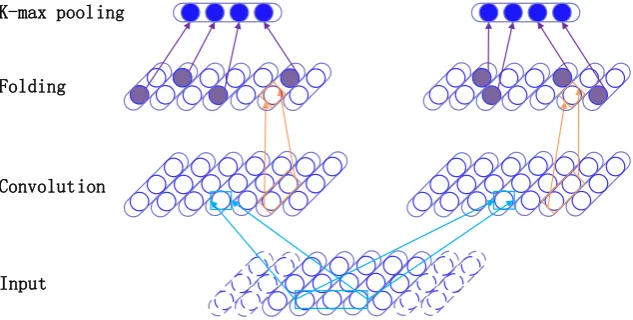
Figure 3: Illustration of the proposed TreeCNN with window size3, pooling size2and filter number2. We use a light blue, orange and purple color to indicate the convolution, folding and pooling operation, respectively. The nodes with dashed circles represent zero-padded embeddings for wide convolution.
3 shows the architecture of our TreeCNN, which consists of three different layers: convolution,folding
andk-max pooling.
Convolution Layer This layer iteratively convolves an h-sized sliding window on M, and uses a filterF to summarize the information inside the window. Since the length of phrases in the translation model is usually not long, we pad the matrixM withh-1zero embeddings on both sides and adopt the wide convolution (Kalchbrenner et al., 2014) (see the dashed circles in Figure 3). To discover semantic information at a finer granularity, we further constructper-dimension filtersF[r](1≤r≤d) (He et al., 2015) to convolve the embeddings in ther-th row ofM.
Formally, applying the per-dimension filterF[r]onMproduces an output vectorC[r]∈R|n|+h−1where thei-th entry (1≤i≤ |n|+h−1) is computed as follows:
Ci[r]= (WF[r])TMi[:ri]+h−1 (5)
whereWF[r] ∈ Rh is the parameter vector ofF[r]. This procedure is illustrated in Figure 3 with a light
blue color. By applying all per-dimension filters to traverse all windows of matrixM, we can obtain a feature mapC ∈ Rd×(|n|+h−1). It encodes complex dependencies across different levels of linguistic units and contains linguistic properties implied in each dimension, which, nevertheless, makes different dimensions independent of each other. Next we will introduce a folding layer to exploit these dimensions simultaneously.
Folding LayerThis layer bridges the gap across different dimensions through averaging each nonover-lapping neighboring rows in the convoluted feature mapC. Specifically, for each row indexr(1≤r ≤ bd
2c), the output can be computed as follows (shown in the orange color in Figure 3):
A[r]= (C[2r−1]+C[2r])/2 (6)
whereA[r] ∈R|n|+h−1 is ther-th row ofA∈Rdd
2e×(|n|+h−1). Different from previous work, we allow
dimension sizedto be odd. In this case, we simply append the last row ofContoA.
After the above operation, each element of Acaptures complex dependencies across both rows and columns ofM. To mingle these dependencies, we further perform a non-linear transformation following Yin et al. (2015a):
U =f(A+b[:]) (7)
whereb ∈Rdd
2eis the bias term that is shared across different columns, and the subscript[:]indicates a
U into a fixed-length vector. In order to deal with this problem, we further stack a K-max Pooling layer (Kalchbrenner et al., 2014).
K-max Pooling LayerThis layer extracts the top-kvalues over each row ofU so as to: 1) preserve rich semantic information of a sentence; and 2) eliminate the variance in the column dimension ofU (shown in the purple color in Figure 3). In doing so, we obtain a phrase vector representation with the dimension sizedd2e ·k. Notice thatkin this layer is predefined. Although we can use the dynamic version ofk-max pooling to stack more convolution, folding and pooling layers (Kalchbrenner et al., 2014), we do not take this strategy due to the trade-off between performance and cost. Theoretically, more layers should capture much deeper semantic information. We leave this for our future research.
So far we have described how we apply the wide convolution, folding layer and k-max pooling layer onto an input phrase matrix to obtain a fixed-length phrase representation. Inspired by studies on convo-lutional networks for object recognition, we introduceLfilters to produce multiple feature maps, which are used to capture semantics of input phrases. Finally, we concatenate the vector representations derived fromLfilters to obtain the final phrase representationp∈Rdd2e·k·L.
3.3 Bilingual Semantic Supervision
Through the above procedures, we obtain the semantic representations of bilingual phrase(f, e), denoted bypf andpe. To measure the semantic similarity off ande, we introduce two transformation matrixes Wf(sem)∈Rdsem×(dds2e·k·L)andWe(sem)∈Rdsem×(ddt2e·k·L)to project their semantic representationspf and peinto a common semantic space:
p0
f =f(Wf(sem)pf +b(sem)), pe0 =f(We(sem)pe+b(sem)) (8)
wherep0
f andp0eare transformed representations off ande,ds/dtis the dimension size of phrase
repre-sentation in the source/target semantic space,dsemis the that of the common semantic space. Although
we distinguish the transformation matrices for the source and target language, we share the same bias termb(sem) for both languages. The advantage of this is that our model will learn to encode bilingual semantics into these transformation matrices, rather than biases.
Then, we further stack a bilinear model over the transformed representations to compute the semantic similarity scoreSim(f, e):
Sim(f, e) =p0fTWbi(sem)p0e (9)
whereWbi(sem)∈Rdsem×dsem is a squared matrix of parameters to be learned. Intuitively, each element in Wbi(sem)represents an interaction betweenp0
f andp0e, which is used to capture the semantic
correspon-dence withinf ande.
To make the semantic scores of translation equivalents as large as possible while scores of non-translation pairs as small as possible, we introduce the following max-margin loss for(f, e):
Esem(f, e) =max{0,1−Sim(f, e) +Sim(f, e−)}
+max{0,1−Sim(f, e) +Sim(f−, e)} (10)
where f−/e− is a bad translation that replaces the words in f/ewith randomly chosen source/target language words.
3.4 Model Training
As described above, there are two types of errors involved for the phrase pair(f, e): (1) structural align-ment errorEalign(f, e)that estimates how well the generated structures of f andecomply with word
alignments, and (2) semantic errorEsem(f, e)that measures how well the learned phrase embeddings of f andeare semantically equivalent.
Given a training corpusD={(f, e)}, the final objective of ConvBRNN is formulated as follows:
JConvBRNN(θ) = |D1|
X
(f,e)∈D
whereEalign(f, e)is the sum ofEalign(f)andEalign(e), the hyper-parameterαis used to balance the
effects ofEalign(f, e)andEsem(f, e), andR(θ)is a regularization term.
Parameters θare divided into four sets1: (1)θ
L: the word embedding matrix (Section 3.1); (2) θRT:
the structure parameters of RecNN (Section 3.1) and TreeCNN (Section 3.2); (3)θwa: the parameters for
structural alignment consistency (Section 3.1); (4)θsem: the parameters for semantic similarity (Section
3.3). Following previous work (Zhang et al., 2014a; Su et al., 2015), we assign each parameter set a unique weight for regularization:
R(θ) = λ2LkθLk2+λRT2 kθRTk2+λwa2 kθwak2+λsem2 kθsemk2 (12)
We apply L-BFGS to tune parameters based on gradients over the joint error, as implemented in (Socher et al., 2011c). Word vector embeddingsθLare initialized with the toolkit Word2Vec2on a large
scale unlabeled data. Other parameters are randomly initialized according to a normal distribution (µ
= 0,σ = 0.01). With the trained model parameters, we can easily obtain the dense semantic vectors for bilingual phrases. During translation, we incorporate the derived phrasal similarity feature into the standard log-linear framework (Och and Ney, 2002) of SMT for translation selection.
4 Experiment
We conducted experiments on NIST Chinese-English translation task to validate the effectiveness of ConvBRNN.
System OverviewOur baseline decoder is a state-of-the-art phrase-based translation system equipped with a maximum entropy based reordering model, which adopts three bracketing transduction grammar rules (Wu, 1997; Xiong et al., 2006). We compared the proposed model with two models: (1) the bilingual correspondence model (BCorrRAE) proposed by Su et al. (2015); (2) the proposed model without the convolutional neural network (ConvBRNN-CNN), which simply treats the embedding of root node of the phrase structure as the semantic representation of the whole phrase, instead of the convoluted one. Other components of ConvBRNN-CNN are the same as those in the ConvBRNN model.
All translation systems used the log-linear framework. The adopted sub-models include: (1) rule translation probabilities in two directions, (2) lexical weights in two directions, (3) targets-side word number, (4) phrase number, (5) language model score, (6) the score of maximal entropy based reordering model, (7) the semantic similarities of phrase pairs. We performed minimum error rate training to tune the optimal feature weights on the development set (Och and Ney, 2003).
Experiment SetupOur training corpus contains 1.0M sentence pairs (25.2M Chinese words and 29M English words) that are from the FBIS corpus and Handsards part of LDC2004T07 corpus. We ran GIZA++3on the training data in two directions and applied the “grow-diag-final-and” heuristic rule to
obtain word alignments. We trained a 5-gram language model on the Xinhua portion of the GIGAWORD corpus using SRILM Toolkit4 with modified Kneser-Ney Smoothing. We chose the 2005 NIST MT
evaluation test data as the development set, and the 2006, 2008 NIST MT evaluation test data as the test sets. We used case-insensitive BLEU-4 metric (Papineni et al., 2002) to evaluate translation quality, and conducted paired bootstrap sampling (Koehn, 2004) for significance test.
Network Training To train ConvBRNN, we applied forced decoding (Wuebker et al., 2010) on the training corpus to extract high-quality bilingual phrases for model training. We tuned the optimal hyper-parameters viarandom searchmethod (Bergstra and Bengio, 2012) to minimize the joint error on a small portion of our training data. Finally, we setds=dt=dsem=50,h=5,L=10,k=3,α=0.116,λL= 2.14e−7,λ
RT =2.43e−5,λwa=7.33e−5andλsem=4.03e−6, the L-BFGS iteration numberNiter=100.
To train BCorrRAE, we used the same training data and method for hyper-parameter optimization.
1Note that the source and target languages have different four sets of parameters. 2https://code.google.com/p/word2vec/
Method MT06 MT08 AVG
Baseline 29.66 21.52 25.59
BCorrRAE 30.94 23.33 27.14
ConvBRNN-CNN 31.16+ 23.39+ 27.28
[image:8.595.188.410.62.136.2]ConvBRNN 31.48+∗ 23.89+∗ 27.69
Table 1: Experiment results on the MT 06/08 test sets, where we highlight the best result in bold. AVG
= average BLEU scores on test sets; “+”: significantly better thanBaseline(p <0.01); “∗”: significantly better thanBCorrRAE(p <0.05);
60 65 70 75 80 85 90 95 100
2 3 4 5 6
The rat
io
of
SA
C
no
de
(%)
BCorrRAE
ConvBRNN
Length
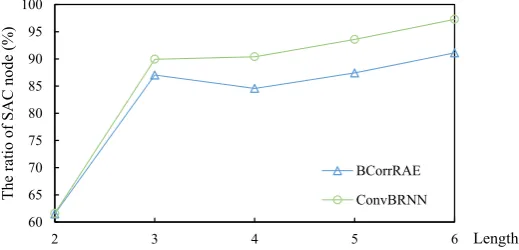
Figure 4: The ratio ofSACnode specific to the length of covered source phrase. We limit the maximal length of source and target phrase to be 7, and the results when length is 1 and 7 are not shown because they are the same for both models.
4.1 Translation Results
The first experiment checks whether the learned bilingual semantic similarity is able to improve the translation quality. Table 1 summarizes the detailed results. We can observe that our ConvBRNN model significantly improves translation quality in terms of BLEU score on all test sets. Overall, ConvBRNN obtains a gain of up to2.1 BLEU points on average over the Baseline. Particularly, on the MT08 data set, the improvements over the Baseline can be up to2.37BLEU points.
The integration of bilingual correspondence helps BCorrRAE gain1.55BLEU points on average over the Baseline. With the recursive neural network for phrase structure generation, ConvBRNN-CNN per-forms slightly better than BCorrRAE. By integrating the tree-based convolution network for phrase repre-sentation learning, our ConvBRNN achieves further improvements over BCorrRAE, which is significant atp<0.05. For this result, the reasons may be the following two points: 1) bilingual phrase structures generated by ConvBRNN are more close to the actual semantic structures of phrases; 2) the ConvBRNN model encodes different levels of linguistic units inside phrase structures into final phrase representation-s. These two points are not adequately considered in BCorrRAE.
4.2 Result Analyses
In order to know how the ConvBRNN model improves the performance of the SMT system, we study the bilingual phrases of our model from the following two respects:
First, we investigate the ability of our model in generating word-alignment-consistent bilingual phrase structures. For this, we extracted phrase pairs from our translation model filtered by NIST test sets and computed the percentage of SAC nodes (Section 3.1) specific to the length of covered source phrase. Following the previous work (Su et al., 2015), we define this percentage as the ratio of the number of SAC nodes to that of all nodes.
[image:8.595.169.429.207.332.2]Source Phrase BCorrRAE ConvBRNN
wˇo r`enw´ei zh`e zhˇong (((((((i thinki think))thatthis))wasis)a)) ((((i thinki think) (() ((this kindthis type))ofof)))) ((i regard)this) ((i find) ((that kind)of))
biˇaosh`ı qi´angli`e b`umˇan (((((expressed strongstrong((opposition against)opposition))theto)))the) (((voice(((stronglymy(strong opposition(dissatisfied with)))))againstthe) )the) (voice(my(strong(opposition against)))) ((express(strong dissatisfaction))at) ji¯anju´e zh¯ich´ı zh`engfˇu ((((firmresolutely(supporter(support the(of our)))))governmentgovernment)) ((staunchly support((resolutely support) ((the Chinese) (the government)government)) ))
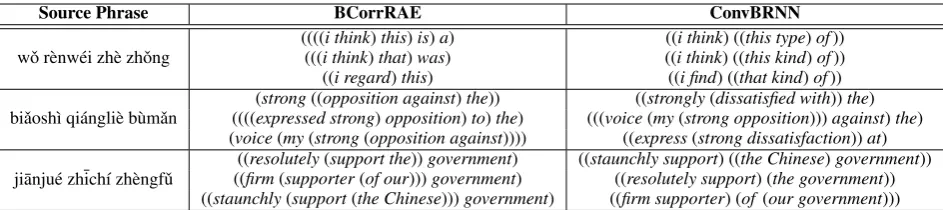
[image:9.595.73.545.62.167.2]((staunchly(support(the Chinese)))government) ((firm supporter) (of (our government))) Table 2: Semantically similar target phrases in the training set for example source phrases. The brackets indicate the learned binary tree structure.
ConvBRNN model to generate word-alignment-consistent bilingual phrase structures.
Second, we study whether ConvBRNN can extract meaningful information for semantic similarity from the learned phrase structures. We show some source phrases in Table 2 with their most semantically similar translations learned by BCorrRAE and ConvBRNN in the training corpus. We find that both models are able to distinguish semantic equivalents from non-translation pairs. However, in contrast to BCorrRAE, ConvBRNN prefers diverse expressions. For example, “zhˇong” can be translated into “type” or “kind”, and “b`umˇan” also has two candidate translations “opposition” and “dissatisfaction”. Therefore, during translation, the decoder has many candidate translations for the same source phrase, which we argue is one of the reasons for our success.
We also provide phrase structures in Table 2. We observe that the semantic compositions in BCor-rRAE are relatively meaningless because they often do not respect the linguistic phenomena. For ex-ample, BCorrRAE prefers branching structures in the same composition direction, such as “(voice(my
(strong(opposition against))))”. Besides, BCorrRAE is more likely to produce undesirable nodes cover-ing high-frequency sub-phrases. For instance, the target phrase “firm supporter of our government” has different structures learned by BCorrRAE and ConvBRNN: “((firm (supporter (of our))) governmen-t))” (BCorrRAE) and “((firm supporter) (of (our government)))” (ConvBRNN). Obviously, the phrase structure learned by ConvBRNN is more syntactically meaningful. This again demonstrates the advan-tage of ConvBRAE over BCorrRAE in exploiting word alignments for learning better bilingual phrase structures.
5 Conclusion and Future Work
In this paper, we have presented a convolution-enhanced bilingual recursive neural network to learn bilingual semantic similarity. We first introduce a recursive neural network which directly exploits word alignments to generate word-alignment-consistent bilingual phrase structures. Based on these structures, we further employ a variant of tree-based convolutional neural network to produce bilingual phrase embeddings by summarizing embeddings at different levels of lingual units. Experiment results and analyses on machine translation demonstrate the effectiveness of our model.
In the future, we would like to explore more different selection functions in Eq. (3) for our model due to its importance for the generation of bilingual phrase structures. Besides, as discussed in Section 3.2, we will further enhance the proposed model by trying more effective components, such as dynamic version ofk-max pooling, multi-layer convolutions.
Acknowledgements
References
Dzmitry Bahdanau, Kyunghyun Cho, and Yoshua Bengio. 2014. Neural machine translation by jointly learning to align and translate. InProc. of ICLR.
James Bergstra and Yoshua Bengio. 2012. Random search for hyper-parameter optimization.Journal of Machine Learning Research, pages 281–305.
Kyunghyun Cho, Bart van Merrienboer, Caglar Gulcehre, Dzmitry Bahdanau, Fethi Bougares, Holger Schwenk, and Yoshua Bengio. 2014. Learning phrase representations using rnn encoder–decoder for statistical machine translation. InProc. of EMNLP, pages 1724–1734.
Jacob Devlin, Rabih Zbib, Zhongqiang Huang, Thomas Lamar, Richard Schwartz, and John Makhoul. 2014. Fast and robust neural network joint models for statistical machine translation. InProc. of ACL, pages 1370–1380. Jianfeng Gao, Xiaodong He, Wen-tau Yih, and Li Deng. 2014. Learning continuous phrase representations for
translation modeling. InProc. of ACL, pages 699–709.
Hua He, Kevin Gimpel, and Jimmy Lin. 2015. Multi-perspective sentence similarity modeling with convolutional neural networks. InProc. of EMNLP, pages 1576–1586.
Baotian Hu, Zhaopeng Tu, Zhengdong Lu, Hang Li, and Qingcai Chen. 2015. Context-dependent translation selection using convolutional neural network. InProc. of ACL, pages 536–541.
Nal Kalchbrenner, Edward Grefenstette, and Phil Blunsom. 2014. A convolutional neural network for modelling sentences. InProc. of ACL, pages 655–665.
Yoon Kim. 2014. Convolutional neural networks for sentence classification. InProc. of EMNLP, pages 1746– 1751.
Philipp Koehn. 2004. Statistical significance tests for machine translation evaluation. InProc. of EMNLP, pages 388–395.
Peng Li, Yang Liu, and Maosong Sun. 2013. Recursive autoencoders for ITG-based translation. InProc. of EMNLP, pages 567–577.
Lemao Liu, Taro Watanabe, Eiichiro Sumita, and Tiejun Zhao. 2013. Additive neural networks for statistical machine translation. InProc. of ACL, pages 791–801.
Shujie Liu, Nan Yang, Mu Li, and Ming Zhou. 2014. A recursive recurrent neural network for statistical machine translation. InProc. of ACL, pages 1491–1500.
Lili Mou, Hao Peng, Ge Li, Yan Xu, Lu Zhang, and Zhi Jin. 2015. Discriminative neural sentence modeling by tree-based convolution. InProc. of EMNLP, pages 2315–2325.
Franz Josef Och and Hermann Ney. 2002. Discriminative training and maximum entropy models for statistical machine translation. InProc. of ACL, pages 295–302.
Franz Josef Och and Hermann Ney. 2003. A systematic comparison of various statistical alignment models.
Computational Linguistics, pages 19–51.
Kishore Papineni, Salim Roukos, Todd Ward, and Wei-Jing Zhu. 2002. Bleu: a method for automatic evaluation of machine translation. InProc. of ACL, pages 311–318.
Hendra Setiawan, Zhongqiang Huang, Jacob Devlin, Thomas Lamar, Rabih Zbib, Richard Schwartz, and John Makhoul. 2015. Statistical machine translation features with multitask tensor networks. In Proc. of ACL-IJCNLP, pages 31–41.
Richard Socher, Eric H. Huang, Jeffrey Pennin, Christopher D Manning, and Andrew Y. Ng. 2011a. Dynamic pooling and unfolding recursive autoencoders for paraphrase detection. InProc. of NIPS, pages 801–809. Richard Socher, Cliff C. Lin, Andrew Y. Ng, and Christopher D. Manning. 2011b. Parsing Natural Scenes and
Natural Language with Recursive Neural Networks. InProc. of ICML.
Richard Socher, Jeffrey Pennington, Eric H. Huang, Andrew Y. Ng, and Christopher D. Manning. 2011c. Semi-supervised recursive autoencoders for predicting sentiment distributions. InProc. of EMNLP, pages 151–161. Jinsong Su, Deyi Xiong, Biao Zhang, Yang Liu, Junfeng Yao, and Min Zhang. 2015. Bilingual correspondence
Ilya Sutskever, Oriol Vinyals, and Quoc V. Le. 2014. Sequence to sequence learning with neural networks. CoRR. Dekai Wu. 1997. Stochastic inversion transduction grammars and bilingual parsing of parallel corpora.
Computa-tional Linguistics, Volume 23, Number 3, September 1997.
Joern Wuebker, Arne Mauser, and Hermann Ney. 2010. Training phrase translation models with leaving-one-out. InProc. of ACL, pages 475–484.
Deyi Xiong, Qun Liu, and Shouxun Lin. 2006. Maximum entropy based phrase reordering model for statistical machine translation. InProc. of ACL, pages 521–528.
Nan Yang, Shujie Liu, Mu Li, Ming Zhou, and Nenghai Yu. 2013. Word alignment modeling with context dependent deep neural network. InProc. of ACL, pages 166–175.
Wenpeng Yin and Hinrich Sch¨utze. 2015a. Convolutional neural network for paraphrase identification. InProc. of NAACL-HLT, pages 901–911.
Wenpeng Yin and Hinrich Sch¨utze. 2015b. Multigrancnn: An architecture for general matching of text chunks on multiple levels of granularity. InProc. of ACL-IJCNLP, pages 63–73.
Jiajun Zhang, Shujie Liu, Mu Li, Ming Zhou, and Chengqing Zong. 2014a. Bilingually-constrained phrase embeddings for machine translation. InProc. of ACL, pages 111–121.