Building Effective Question Answering Characters
Anton Leuski and Ronakkumar Patel and David Traum Institute for Creative Technologies
University of Southern California Marina del Rey, CA, 90292, USA
leuski,ronakkup,[email protected]
Brandon Kennedy
Abstract
In this paper, we describe methods for building and evaluation of limited do-main question-answering characters. Sev-eral classification techniques are tested, in-cluding text classification using support vector machines, language-model based retrieval, and cross-language information retrieval techniques, with the latter having the highest success rate. We also evalu-ated the effect of speech recognition errors on performance with users, finding that re-trieval is robust until recognition reaches over 50% WER.
1 Introduction
In the recent Hollywood movie “iRobot” set in 2035 the main character played by Will Smith is running an investigation into the death of an old friend. The detective finds a small device that projects a holographic image of the deceased. The device delivers a recorded message and responds to questions by playing back prerecorded answers. We are developing virtual characters with similar capabilities.
Our target applications for these virtual charac-ters are training, education, and entertainment. For use in education, such a character should be able to deliver a message to the student on a specific topic. It also should be able to support a basic spo-ken dialog on the subject of the message, e.g., an-swer questions about the message topic and give additional explanations. For example, consider a student learning about an event in a virtual world. Lets say there is a small circus in a small town and someone has released all the animals from circus. A young student plays a role of a reporter to find
out who caused this local havoc. She is out to in-terrogate a number of witnesses represented by the virtual characters. It is reasonable to expect that each conversation is going to be focused solely on the event of interest and the characters may refuse to talk about anything else. Each witness may have a particular and very narrow view into an aspect of the event, and the student’s success would depend on what sort of questions she asks and to which character she addresses them.
Automatic question answering (QA) has been studied extensively in recent years. For example, there is a significant body of research done in the context of the QA track at the Text REtrieval Con-ference (TREC) (Voorhees, 2003). In contrast to the TREC scenario where both questions and an-swers are based on facts and the goal is to provide the most relevant answer, we focus the answer’s appropriateness. In our example about an inves-tigation, an evasive, misleading, or an “honestly” wrong answer from a witness character would be appropriate but might not be relevant. We try to highlight that distinction by talking about QA characters as opposed to QA systems or agents.
We expect that a typical simulation would con-tain quite a few QA characters. We also expect those characters to have a natural spoken language interaction with the student. Our technical require-ments for such a QA character is that it should be able to understand spoken language. It should be robust to disfluencies in conversational English. It should be relatively fast, easy, and inexpensive to construct without the need for extensive domain knowledge and dialog management design exper-tise.
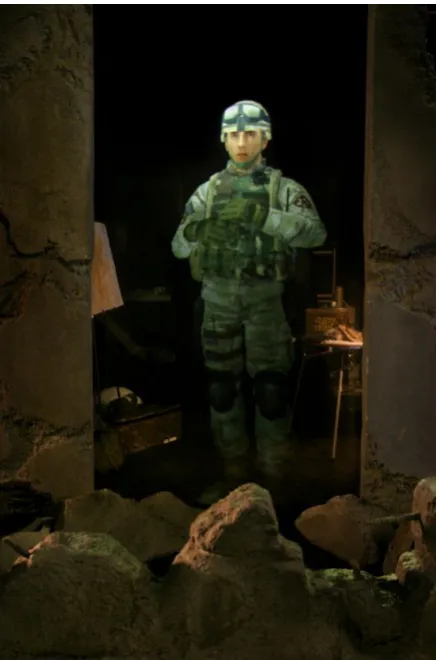
In this paper we describe a QA character by the name of SGT Blackwell who was originally de-signed to serve as an information kiosk at an army
conference (see Appendix C for a photograph of the system) (?). We have used SGT Blackwell to develop our technology for automatic answer se-lection, conversation management, and system in-tegration. We are presently using this technology to create other QA characters.
In the next section we outline the SGT Black-well system setup. In Section 3 we discuss the answer selection problem and consider three dif-ferent algorithms: Support Vector Machines clas-sifier (SVM), Language Model retrieval (LM), and Cross-lingual Language Model (CLM) retrieval. We present the results of off-line experiments showing that the CLM method performs signifi-cantly better than the other two techniques in Sec-tion 4. SecSec-tion 5 describes a user study of the sys-tem that uses the CLM approach for answer selec-tion. Our results show that the approach is very robust to deviations in wording from expected an-swers, and speech recognition errors. Finally, we summarize our results and outline some directions for future work in Section 6.
2 SGT Blackwell
A user talks to SGT Blackwell using a head-mounted close capture USB microphone. The user’s speech is converted into text using an au-tomatic speech recognition (ASR) system. We used the Sonic statistical speech recognition en-gine from the University of Colorado (Pellom, 2001) with acoustic and language models pro-vided to us by our colleagues at the University of Southern California (Sethy et al., 2005). The an-swer selection module analyzes the speech recog-nition output and selects the appropriate response. The character can deliver 83 spoken lines rang-ing from one word to a couple paragraphs long monologues. There are three kinds of lines SGT Blackwell can deliver: content, off-topic, and prompts. The 57 content-focused lines cover the identity of the character, its origin, its language and animation technology, its design goals, our university, the conference setup, and some mis-cellaneous topics, such as “what time is it?” and “where can I get my coffee?”
When SGT Blackwell detects a question that cannot be answered with one of the content-focused lines, it selects one out of 13 off-topic re-sponses, (e.g., “I am not authorized to comment on that,”) indicating that the user has ventured out of the allowed conversation domain. In the event
that the user persists in asking the questions for which the character has no informative response, the system tries to nudge the user back into the conversation domain by suggesting a question for the user to ask: “You should ask me instead about my technology.” There are 7 different prompts in the system.
One topic can be covered by multiple answers, so asking the same question again often results in a different response, introducing variety into the conversation. The user can specifically request alternative answers by asking something along the lines of “do you have anything to add?” or “anything else?” This is the first of two types command-like expressions SGT Blackwell under-stands. The second type is a direct request to re-peat the previous response, e.g., “come again?” or “what was that?”
If the user persists on asking the same question over and over, the character might be forced to re-peat its answer. It indicates that by preceding the answer with one of the four “pre-repeat” lines in-dicating that incoming response has been heard re-cently, e.g., “Let me say this again...”
3 Answer Selection
The main problem with answer selection is uncer-tainty. There are two sources of uncertainty in a spoken dialog system: the first is the complex nature of natural language (including ambigu-ity, vagueness, underspecification, indirect speech acts, etc.), making it difficult to compactly char-acterize the mapping from the text surface form to the meaning; and the second is the error-prone out-put from the speech recognition module. One pos-sible approach to creating a language understand-ing system is to design a set of rules that select a response given an input text string (Weizenbaum, 1966). Because of uncertainty this approach can quickly become intractable for anything more than the most trivial tasks. An alternative is to cre-ate an automatic system that uses a set of train-ing question-answer pairs to learn the appropriate question-answer matching algorithm (Chu-Carroll and Carpenter, 1999). We have tried three differ-ent methods for the latter approach, described in the rest of this section.
3.1 Text Classification
as input and a finite set of answers, – classes, – we build a system that selects the most appropriate class or set of classes for the question. Text classi-fication has been studied in Information Retrieval (IR) for several decades (Lewis et al., 1996). The distinct properties of our setup are (1) a very small size of the text, – the questions are very short, and (2) the large number of classes, e.g, 60 responses for SGT Blackwell.
An answer defines a class. The questions corre-sponding to the answer are represented as vectors of term features. We tokenized the questions and stemmed using the KStem algorithm (Krovetz, 1993). We used a tf ×idf weighting scheme to assign values to the individual term features (Al-lan et al., 1998). Finally, we trained a multi-class Support Vector Machines (SV Mstruct) classifier with an exponential kernel (Tsochantaridis et al., 2004). We have also experimented with linear kernel function, various parameter values for the exponential kernel, and different term weighting schemes. The reported combination of the ker-nel and weighting scheme showed the best clas-sification performance. Such an approach is well-known in the community and has been shown to work very well in numerous applications (Leuski, 2004). In fact, SVM is generally considered to be one of the best performing methods for text clas-sification. We believe it provides us with a very strong baseline.
3.2 Answer Retrieval
The answer selection problem can also be viewed as an information retrieval problem. We have a set of answers which we can call documents in ac-cordance with the information retrieval terminol-ogy. Let the question be the query, we compare the query to each document in the collection and return the most appropriate set of documents.
Presently the best performing IR techniques are based on the concept of Language Model-ing (Ponte and Croft, 1997). The main strategy is to view both a query and a document as samples from some probability distributions over the words in the vocabulary (i.e., language models) and com-pare those distributions. These probability distri-butions rarely can be computed directly. The “art” of the field is to estimate the language models as accurately as possible given observed queries and documents.
Let Q = q1...qm be the question that is
re-ceived by the system, RQ is the set of all the an-swers appropriate to that question, andP(w|RQ) is the probability that a word randomly sampled from an appropriate answer would be the wordw. The language model ofQ is the set of probabili-tiesP(w|RQ)for every word in the vocabulary. If we knew the answer set for that question, we can easily estimate the model. Unfortunately, we only know the question and not the answer setRQ. We approximate the language model with the condi-tional distribution:
P(w|RQ)≈P(w|Q) =
P(w, q1, ..., qm)
P(q1, ..., qm) (1)
The next step is to calculate the joint probabil-ity of observing a string:P(W) =P(w1, ..., wn). Different methods for estimatingP(W)have been suggested starting with simple unigram approach where the occurrences of individual words are as-sumed independent from each other: P(W) = Qn
i=1P(wi). Other approaches include Proba-bilistic Latent Semantic Indexing (PLSI) (Hoff-man, 1999) and Latent Dirichlet Allocation (LDA) (Blei et al., 2003). The main goal of these different estimations is to model the interdepen-dencies that exist in the text and make the esti-mation feasible given the finite amount of training data.
In this paper we adapt an approach suggested by Lavrenko (Lavrenko, 2004). He assumed that all the word dependencies are defined by a vector of possibly unknown parameters on the language model. Using the de Finetti’s representation the-orem and kernel-based probability estimations, he derived the following estimate for the query lan-guage model:
P(w|Q) = P
s∈Sπs(w)Qmi=1πs(qi)
P
s
Qm
i=1πs(qi)
(2)
Here we sum over all training strings s ∈ S, whereSis the set of training strings. πs(w)is the probability of observing word w in the string s, which can be estimated directly from the training data. Generally the unigram maximum likelihood estimator is used with some smoothing factor:
πs(w) =λπ·
#(w, s)
|s| + (1−λπ)· P
s#(w, s)
P
where#(w, s)is the number of times wordw ap-pears in string s, |s|is the length of the string s, we sum over all training strings s ∈ S, and the constantλπ is the tunable parameter that can be determined from training data.
We know all the possible answers, so the answer language model P(w|A) can be estimated from the data:
P(w|A) =πA(w) (4)
3.3 Ranking criteria
To compare two language models we use the Kullback-Leibler divergenceD(pq||pa)defined as
D(pq||pa) =
X
w∈V
P(w|Q) logP(w|Q)
P(w|A) (5)
which can be interpreted as the relative entropy be-tween two distributions. Note that the Kullback-Leibler divergence is a dissimilarity measure, we use−D(pq||pa)to rank the answers.
So far we have assumed that both questions and answers use the same vocabulary and have the same a priori language models. Clearly, it is not the case. For example, consider the follow-ing exchange: “what happened here?” – “well, maam, someone released the animals this morn-ing.” While the answer is likely to be very appro-priate to the question, there is no word overlap be-tween these sentences. This is an example of what is known in information retrieval as vocabulary mismatch between the query and the documents. In a typical retrieval scenario a query is assumed to look like a part of a document. We cannot make the same assumption about the questions because of the language rules: e.g., “what”, “where”, and “why” are likely to appear much more often in questions than in answers. Additionally, a typi-cal document is much larger than any of our an-swers and has a higher probability to have words in common with the query. Finally, a typical re-trieval scenario is totally context-free and a user is encouraged to specify her information need as ac-curately as possible. In a dialog, a portion of the information is assumed to be well-known to the participants and remains un-verbalized leading to sometimes brief questions and answers.
We believe this vocabulary mismatch to be so significant that we view the participants as speak-ing two different “languages”: a language of ques-tions and a language of answers. We will model
the problem as a cross-lingual information task, where one has a query in one language and wishes to retrieve documents in another language. There are two ways we can solve it: we can translate the answers into the question language by building a representation for each answer using the question vocabulary or we can build question representa-tions in the answer language.
3.4 Question domain
We create an answer representation in the ques-tion vocabulary by merging together all the train-ing questions that are associated with the answer into one string: a pseudo-answer. We use equa-tions 5, 2, 3, and 4 to compare and rank the pseudo-answers. Note that in equation 2siterates over the set of all pseudo-answers.
3.5 Answer domain
Let us look at the question language model
P(w|Q)again, but now we will take into account thatwandQare from different vocabularies and have potentially different distributions:
P(w|Q) = P
sαAs(w)
Qm
i=1πQs(qi)
P
s
Qm
i=1πQs(qi)
(6)
Heresiterates over the training set of question-answer pairs {Qs, As} and αx(w) is the experi-mental probability distribution on the answer vo-cabulary given by the expression similar to equa-tion 3:
αx(w) =λα
#(w, x)
|x| + (1−λα) P
s#(w, x)
P
s|x|
and the answer language model P(w|A) can be estimated from the data as
P(w|A) =αA(w)
4 Algorithm comparison
study we considered all our off-topic responses equally appropriate to an off-topic question and we collapsed all the corresponding responses into one class. Thus we have 60 response classes.
We divided our collection of questions into training and testing subsets following the 10-fold cross-validation schema. The SVM system was trained to classify test questions into one of the 60 classes.
Both retrieval techniques produce a ranked list of candidate answers ordered by the−D(pq||pa) score. We only select the answers with scores that exceed a given threshold−D(pq||pa) > τ. If the resulting answer set is empty we classify the ques-tion as off-topic, i.e., set the candidate answer set contains to an off-topic response. We determine the language model smoothing parametersλsand the thresholdτ on the training data.
We consider two statistics when measuring the performance of the classification. First, we mea-sure its accuracy. For each test question the first response returned by the system, – the class from the SVM system or the top ranked candidate an-swer returned by either LM or CLM methods, – is considered to be correct if there is link between the question and the response. The accuracy is the proportion of correctly answered questions among all test questions.
The second statistic is precision. Both LM and CLM methods may return several candidate an-swers ranked by their scores. That way a user will get a different response if she repeats the question. For example, consider a scenario where the first response is incorrect. The user repeats her ques-tion and the system returns a correct response cre-ating the impression that the QA character simply did not hear the user correctly the first time. We want to measure the quality of the ranked list of candidate answers or the proportion of appropri-ate answers among all the candidappropri-ate answers, but we should also prefer the candidate sets that list all the correct answers before all the incorrect ones. A well-known IR technique is to compute aver-age precision – for each position in the ranked list compute the proportion of correct answers among all preceding answers and average those values.
Table 1 shows the accuracy and average preci-sion numbers for three answer selection methods on the SGT Blackwell data set. We observe a sig-nificant improvement in accuracy in the retrieval methods over the SVM technique. The differences
shown are statistical significant by t-test with the cutoff set to 5% (p <0.05).
We repeated out experiments on QA charac-ters we are developing for another project. There we have 7 different characters with various num-ber of responses. The primary difference with the SGT Blackwell data is that in the new sce-nario each question is assigned to one and only one answer. Table 2 shows the accuracy numbers for the answer selection techniques on those data sets. These performance numbers are generally lower than the corresponding numbers on the SGT Blackwell collection. We have not yet collected as many training questions as for SGT Blackwell. We observe that the retrieval approaches are more successful for problems with more answer classes and more training data. The table shows the per-cent improvement in classification accuracy for each LM-based approach over the SVM baseline. The asterisks indicate statistical significance using a t-test with the cutoff set to 5% (p <0.05).
5 Effect of ASR
In the second set of experiments for this paper we studied the question of how robust the CLM answer selection technique in the SGT Blackwell system is to the disfluencies of normal conversa-tional speech and errors of the speech recogni-tion. We conducted a user study with people in-terviewing SGT Blackwell and analyzed the re-sults. Because the original system was meant for one of three demo “reporters” to ask SGT Black-well questions, specialized acoustic models were used to ensure the highest accuracy for these three (male) speakers. Consequently, for other speak-ers (especially female speakspeak-ers), the error rate was much higher than for a standard recognizer. This allowed us to calculate the role of a variety of speech error rates on classifier performance.
For this experiment, we recruited 20 partici-pants (14 male, 6 female, ages from 20 to 62) from our organization who were not members of this project. All participants spoke English flu-ently, however the range of their birth languages included English, Hindi, and Chinese.
SVM LM CLM
accuracy accuracy impr. SVM avg. prec. accuracy impr. SVM avg. prec.
[image:6.595.106.495.62.106.2]53.13 57.80 8.78 63.88 61.99 16.67 65.24
Table 1: Comparison of three different algorithms for answer selection on SGT Blackwell data. Each performance number is given in percentages.
number of number of SVM LM CLM
questions answers accuracy accuracy impr. SVM accuracy impr. SVM
1 238 22 44.12 47.06 6.67* 47.90 8.57*
2 120 15 63.33 62.50 -1.32 64.17 1.32
3 150 23 42.67 44.00 3.12* 50.00 17.19*
4 108 18 42.59 44.44 4.35* 50.00 17.39*
5 149 33 32.21 41.35 28.37* 42.86 33.04*
6 39 8 69.23 58.97 -14.81* 66.67 -3.70
7 135 31 42.96 44.19 2.85 50.39 17.28*
average 134 21 48.16 48.93 1.60* 53.14 10.34*
Table 2: Comparison of three different algorithms for answer selection on 7 additional QA characters. The table shows the number of answers and the number of questions collected for each character. The accuracy and the improvement over the baseline numbers are given in percentages.
wherein the participant would act as a reporter about to interview SGT Blackwell. The partici-pants were then given a list of 10 pre-designated questions to ask of SGT Blackwell. These ques-tions were selected from the training data. They were then instructed to take a few minutes to write down an additional five questions to ask SGT Blackwell. Finally they were informed that af-ter asking the fifteen written down questions, they would have to spontaneously generate and ask five additional questions for a total of 20 questions asked all together. Once the participants had writ-ten down their fifteen questions, they began the interview with SGT Blackwell. Upon the com-pletion of the interview the participants were then asked a short series of survey questions by the experimenter about SGT Blackwell and the inter-view. Finally, participants were given an explana-tion of the study and then released. Voice record-ings were made for each interview, as well as the raw data collected from the answer selection mod-ule and ASR. This is our first set of question an-swer pairs, we call it the ASR-QA set.
The voice recordings were later transcribed. We ran the transcriptions through the CLM answer se-lection module to generate answers for each ques-tion. This generated question and answer pairs based on how the system would have responded to the participant questions if the speech recogni-tion was perfect. This is our second set of
ques-tion answer pairs – the TRS-QA set. Appendix B shows a sample dialog between a participant and SGT Blackwell.
Next we used three human raters to judge the appropriateness of both sets. Using a scale of 1-6 (see Appendix A) each rater judged the ap-propriateness of SGT Blackwell’s answers to the questions posed by the participants. We evaluated the agreement between raters by computing Cron-bach’s alpha score, which measures consistency in the data. The alpha score is 0.929 for TRS-QA and 0.916 for ASR-QA, which indicate high con-sistency among the raters.
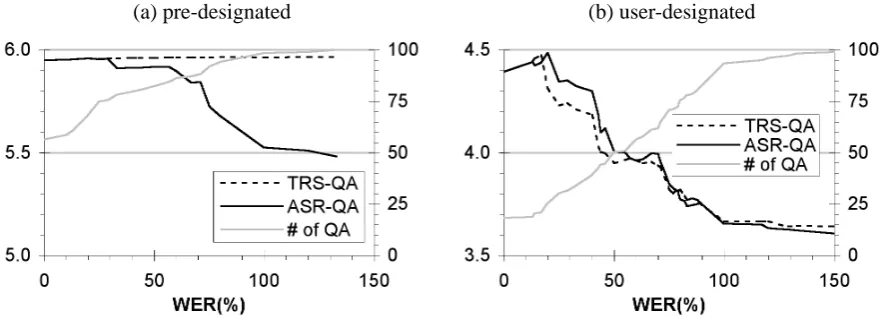
The average appropriateness score for TRS-QA is 4.83 and 4.56 for ASR-QA. The difference in the scores is statistically significant according to t-test with the cutoff set to 5%. It may indicate that ASR quality has a significant impact on answer selection.
[image:6.595.88.516.149.289.2](a) pre-designated (b) user-designated
Figure 1: Shows the cumulative average appropriateness score (CAA) of (a) pre-designated and (b) user-designated question-answer pairs as function of the ASR’s output word error rate. We show the scores for TRS-QA (dotted black line) and ASR-QA (solid black line). We also show the percentage of the question-answer pairs with the WER score below a given value (“# ofQA”) as a gray line with the corresponding values on the right Y axis.
or equal tot.
CAA(t) = 1
|S| X
p∈S
A(p), S ={p|W ER(p)≤t}
where p is a question-answer pair, A(p) is the appropriateness score forp, andW ER(p) is the WER score forp. It is the expected value of the ap-propriateness score if the ASR WER was at most
t.
Both figures show the CAA values for TRS-QA (dotted black line) and ASR-TRS-QA (solid black line). Both figures also show the percentage of the question-answer pairs with the WER score be-low a given value, i.e., the cumulative distribution function (CDF) for the WER as a gray line with the corresponding values depicted on the right Y axis.
Figure 1a shows these plots for the pre-designated questions. The values of CAA for TRS-QA and ASR-QA are approximately the same between 0 and 60% WER. CAA for ASR-QA decreases for WER above 60% – as the input becomes more and more garbled, it becomes more difficult for the CLM module to select an appropri-ate answer. We confirmed this observation by cal-culating t-test scores at each WER value: the dif-ferences between CAA(t) scores are statistically significant for t > 60%. It indicates that until WER exceeds 60% there is no noticeable effect on the quality of answer selection, which means that our answer selection technique is robust relative to the quality of the input.
Figure 1b shows the same plots for the user-designated questions. Here the system has to deal with questions it has never seen before.CAA val-ues decrease for both TRS-QA and ASR-QA as WER increases. Both ASR and CLM were trained on the same data set and out of vocabulary words that affect ASR performance, affect CLM perfor-mance as well.
6 Conclusions and future work
In this paper we presented a method for efficient construction of conversational virtual characters. These characters accept spoken input from a user, convert it to text, and select the appropriate re-sponse using statistical language modeling tech-niques from cross-lingual information retrieval. We showed that in this domain the performance of our answer selection approach significantly ex-ceeds the performance of a state of the art text clas-sification method. We also showed that our tech-nique is very robust to the quality of the input and can be effectively used with existing speech recog-nition technology.
Preliminary failure analysis indicates a few di-rections for improving the system’s quality. First, we should continue collecting more training data and extending the question sets.
use the original and the rephrased version to repeat the answer selection process.
Finally, we observed that a notable percent of misclassifications results from the user asking a question that has a strong context dependency on the previous answer or question. We are presently looking into incorporating this context informa-tion into the answer selecinforma-tion process.
Acknowledgments
The project or effort described here has been spon-sored by the U.S. Army Research, Development, and Engineering Command (RDECOM). State-ments and opinions expressed do not necessarily reflect the position or the policy of the United States Government, and no official endorsement should be inferred.
References
James Allan, Jamie Callan, W. Bruce Croft, Lisa Ballesteros, Donald Byrd, Russell Swan, and Jinxi Xu. 1998. Inquery does battle with TREC-6. In
Sixth Text REtrieval Conference (TREC-6), pages
169–206, Gaithersburg, Maryland, USA.
D. M. Blei, A. Y. Ng, and M. I. Jordan. 2003. Latent dirichlet allocation. Journal of Machine Learning
Research, 3:993–1022.
Jennifer Chu-Carroll and Bob Carpenter. 1999. Vector-based natural language call routing. Journal
of Computational Linguistics, 25(30):361–388.
Sudeep Gandhe, Andrew S. Gordon, and David Traum. 2006. Improving question-answering with linking dialogues. In Proceedings of the 11th international
conference on Intelligent user interfaces (IUI’06),
pages 369–371, New York, NY, USA. ACM Press.
T. Hoffman. 1999. Probabilistic latent semantic index-ing. In Proceedings of the 22nd International ACM
SIGIR Conference, pages 50–57.
Robert Krovetz. 1993. Viewing morphology as an in-ference process. In Proceedings of the 16th
Inter-national ACM SIGIR Conference on Research and Development in Information Retrieval, pages 191–
202.
Victor Lavrenko. 2004. A Generative Theory of
Rele-vance. Ph.D. thesis, University of Massachusetts at
Amherst.
Anton Leuski. 2004. Email is a stage: discover-ing people roles from email archives. In
Proceed-ings of 27th annual international ACM SIGIR Con-ference on Research and Development in Informa-tion Retrieval (SIGIR’04), pages 502–503, Sheffield,
United Kingdom. ACM Press. NY, USA.
David D. Lewis, Robert E. Schapire, James P. Callan, and Ron Papka. 1996. Training algorithms for lin-ear text classifiers. In Proceedings of the 19th
Inter-national ACM SIGIR Conference on Research and Development in Information Retrieval, pages 298–
306, Zurich, Switzerland.
Bryan Pellom. 2001. Sonic: The university of col-orado continuous speech recognizer. Technical Re-port TR-CSLR-2001-01, University of Colorado, Boulder, CO.
Jay M. Ponte and W. Bruce Croft. 1997. Text segmen-tation by topic. In Proceedings of the First European
Conference on Research and Advanced Technology for Digital Libraries, pages 120–129.
Abhinav Sethy, Panayiotis Georgiou, and Shrikanth Narayanan. 2005. Building topic specific language models from webdata using competitive models. In
Proceedings of EUROSPEECH, Lisbon, Portugal.
Ioannis Tsochantaridis, Thomas Hofmann, Thorsten Joachims, and Yasemin Altun. 2004. Support vector machine learning for interdependent and structured output spaces. In Proceedings of the Twenty-first
in-ternational conference on Machine learning, Banff,
Alberta, Canada.
Ellen M. Voorhees. 2003. Overview of the trec 2003 question answering track. In Proceedings of The
Twelfth Text Retrieval Conference, pages 54–69.
Joseph Weizenbaum. 1966. Eliza–a computer program for the study of natural language communication be-tween man and machine. Communications of the
A Appropriateness grading
Gandhe and his colleagues (Gandhe et al., 2006) suggested the following grading scheme that we used in our user evaluation.
Grade Description
1 Response is not related in any way the question
2 Response contains some discussion of people or objects mentioned in the question, but does not really address the question itself.
3 Response partially addresses the question, but little or no coherence between the question and response. 4 Response does mostly address the
question, but with major problems in the coherence between question and response; seems like the response is really addressing a different question than the one asked.
5 Response does address the question, but the transition is somewhat awk-ward.
[image:9.595.73.290.133.423.2]6 Response answers the question in a perfectly fluent manner.
Table 3: The question-answer appropriateness scale.
B Sample dialog
This section presents an example of a participant’s dialog with SGT Blackwell. We only show spon-taneous questions asked by the participant. Each of the participant’s questions (called “Reporter” in this transcript) is followed by the ASR output of that line in brackets. That is what the answer se-lection module “heard.” Note that ASR does make an occasional mistake and the answer selection is able to recover gracefully until the next to the last question, where the input was so garbled that only one correct word got through.
Reporter: Who created you (Who created you)
Blackwell: Tell you the truth, I have spent a lot
of time with the smart folks at ICT, testing and tweaking. I am about ready to get out there and train with real soldiers. I am think-ing first stop is gothink-ing to be Fort Sill. But my ultimate goal is to get forward deployed...
Reporter: Why should we spend money on you
(What should we spend money on you)
Blackwell: Why do you need me?! What you
should be saying is ”How did you get along without me?” I will show you how to be a leader, how to make critical decisions under stress... And I am glad to be here, because I can help. I know I can. Look... I have one mission: to make better soldiers, make bet-ter warfighbet-ters. And if I can ... can save one life... bring one loved one back to his fam-ily... Well, then, I am definitely worth it. You be the judge.
Reporter: What’s your value (What’s the value
in)
Blackwell: I can do ”Virtually” anything. I do
mission rehearsals, Urban Combat training, language training - I speak Farsi, Pashtun and Arabic. ”Mar Haba shabab! That means how are you in Arabic.
Reporter: Do you really work or is this just a
demo (G. really worker is this just a demo)
Blackwell: Sorry. That’s outside my AO.
Reporter: How could you be better (How could
you be better)
Blackwell: Stop mumbling. Just kidding. I didn’t get that.
Reporter: What do you wish you could do
(When you wish you could do)
Blackwell: Career Army. That is what I am thinking. Just call me a lifer.
Reporter: What kind of people have you trained
(What other people in the turn in)
Blackwell: I teach cultural awareness, function
as a training mentor and can call in the full range of Joint fires and effects.
Reporter: What’s the hardest part of your job
(He was the hardest are you job)
Blackwell: I am not authorized to comment on
that
Reporter: You have any virtual friends (The
Blackwell: Sorry, I can’t hear you
Reporter: Are you hard of hearing (Are you had
a hearing)
Blackwell: I can’t understand you.
[image:10.595.72.292.174.505.2]C SGT Blackwell