919
Study on Compressive Strength of Ternary Blended
Cement Mortars
Dommeti Renuka Devi1, Prof. V Siva Rama Raju2 1
M. Tech Scholar, 2Professor, 1,2Department of Civil Engineering 1,2
S R K R Engineering College (Autonomous), Chinna Amiram, Bhimavaram, Andhra Pradesh, India.
Abstract—Mortar is the material utilized in the construction of masonry to replete the space between the blocks and bricks. It’s a miscellany of water, fine aggregate and cement which is applied as a paste and then becomes hard. Among the materials utilized for mortar, cement is very expensive whereas the other two will come for lower cost. Hence there is a necessity to replace the cement with any other material availed locally i.e., agricultural or industrial wastage. Due to the increase in industrialization, wastage production in the Industries is also increasing. To dispose this waste generated from the industries a large amount of land is needed. To minimize this problem certain effective methods are to be adopted to reduce this problem. The worldwide production of cement has greatly increased since 1990. Production of cement results in environmental pollution as it involves the emission of C02 gas. Supplementary Cementation Materials (SCM) are finely ground solid materials that are used to partially replacement a portion of the cement in a mortar mixture. These supplementary materials may be naturally occurring or manufactured, (manmade) waste. Numerous pozzolanic material types that enhance the properties of cement industry for a long period. The main aim is to study the compressive strength of cement mortars by partial replacing of cement with GGBS and PALM OIL FUEL ASH with different percentage replacements. The variable factors considered in this study are mortar water cement ratio 1:3 and curing periods for 3days, 7days, 28days, 60days and 90days of the specimens. GGBS has been chemically and physically characterized and partially replaced in the ratio of 2%, 5%, 10%, 15%, 20% and 25% by weight of cement for mix and PALM OIL FUEL ASH is replaced in the ratio of 5%, 10%, 15%, 20%, 25% and 28% by the weight of cement. The parameters investigated is, how the strength characteristics of GGBS, and PALM OIL FUEL ASH replaced, cubes strength changes with respect to time in days. Ternary cement mortar tests like compressive strengths at the age of 3days, 7days, 28 days, 60days and 90 days are obtained.
1. INTRODUCTION
1.1.Cement
Cement is one of the oldest manufactured construction materials and it has been used extensively in the construction of various structures since ancient days. Each of the cement possesses their own unique characteristic to meet and suit the demand of industry. Sustainability is vital to the well-being planet, society’s constant growth and development of human. However, the portland cement generation is an indispensable concrete element which leads to the production of substantial amounts of carbon dioxide (CO2) which is known as a greenhouse gas. In addition to the issues of natural resources, these greenhouse gases associated with the issues of environment will play a vital role in the sustainable growth of industry of concrete and cement. Higher energy, raw materials development, quarrying and higher production cost are the requirements of the cement industry. Therefore, to mitigate the demand of cement, an efficient way should be arisen. To mitigate the required amount of cement for supplementary cementitious materials (SCMs) that have properties likely to cement can be utilized to replace it partially. Few of SCMs which are known commonly are Metakaolin (MK), Fly Ash (FA),
Ground Granulated Blast-furnace Slag (GGBS) and Silica Fume (SF) etc. A proper disposal of waste materials that are produced from various industries is a serious problem in many countries. Generation of industrial waste material and by products is increasing as a result of industrialization as is the need for higher amounts of raw materials and fuel to accommodate the rapid increase in the world population. One, two or three SCMs can be utilized to replace the cement thereby developing binary, tertiary and quaternary mixed concretes, respectively.
1.2.Ground granulated blast furnace slag (GGBS)
920 This glassy granulate is dried and grounded to the
required size, which is known as ground granulated blast furnace slag (GGBS). The slag is a mixture of lime, silica and alumina. These are the same oxides that compose Portland cement but not in the same proportion. GGBS is therefore an environmentally friendly construction material. GGBS is also termed as an additional cementitious material which can be used in concrete production. It acts as pozzolanic and is therefore combined with Portland cement resulting in hardened cement. This also improves the performance characteristics of the concrete such as strength, workability, permeability, durability and corrosion resistance.
1.3.palm oil fuel ash (POFA)
The oil palm is a tall-stemmed tree which belongs to palm family Palmea. Palm oil fuel ash (POFA) is a by-product of palm oil industry. It is resulting from the combustion of palm oil plant residues. Malaysia is the largest producer of palm oil and palm oil products. It has been reckoned that the entire wastage solid produced by this industry is approximately 200 mills of palm oil in the country has amounted to about ten million tons in a year, which can be utilized as a boiler’s fuel in the palm oil mills and then becomes ash. This material is generally known as fuel ash of palm oil or POFA. This is a material of wastage which presents tremendous pollutions in environmental. Simply it can be throwing out without any commercial returns. Properties of pozzolanic which can be utilized as a supplement for cement has been recognized in this POFA material and can be utilized in mortar and the mixes of concrete. Over past decades, there has been an attractive attention towards the supplementary cementing materials utilization. Agriculture origin ashes also identified as supplement materials for cement in many regions of world. These ashes include corn cub, rice husk, peanut shell and coconut husk etc., This can enhance the durability and mitigation in the cost due to the less cement usage. This will also be good sign for the nature with respect to mitigating the amount of waste disposal of landfills. POFA is an agro-waste ash from which palm oil residue, such as palm fiber and shells, are burnt at temperatures of about 80000C–100000C to produce steam for electricity generation in biomass thermal power plants. The POFA material utilization which is used as a cement supplement in the concrete can resolve the disposal and problems of health caused by the produced ash in the industry of palm oil, diminish the pollution of environment caused by the factories of cement and mitigate the concrete cost.
2. MATERIALS
2.1.Cement (IS: 455-1989)
Ordinary Portland cement (53 grade) available in the local market of standard brand is used in the investigation. Portland cement is most commonly used type of cement in the world today. Care have been taken that it has to be stored in airtight containers to check it from being affected by the atmospheric and monsoon moisture and humidity. The secure of cement is tested for physical requirements in concurrence of opinion with IS: 12269-1987 and for the needs of chemical in grant with IS: 4032-1977. The cement conforms to 53 susceptible to shrinkage and cracking. A correction factor is to be applied for fineness of cement as all sieves are not exactly alike.
Fig. 1. Fineness of cement
3.2.Standard consistency test
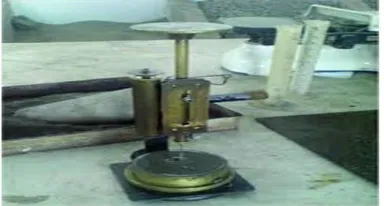
The standard consistency of a cement paste is defined as the one which permits the VICAT plunger to penetration to a point 5 to 7mm from the bottom of the mould when the given cement paste is tested.
921
3.3.Specific gravity
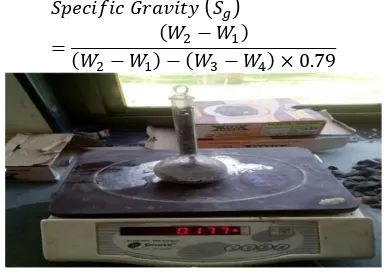
The ratio of weight of material mass to the weight of water volume is known as specific gravity.
( ) ( )
( ) ( )
Fig. 3. Specific gravity bottle
4. PROPERTIES OF MATERIALS USED
4.1.Properties of ordinary portland cement
The physical properties of OPC used in the present investigations are conforming to the IS specifications. The 28days cube compressive strength of cement is 53 MPa.
Table 1. Physical properties of portland cement (53grade)
Table 2. Chemical properties of OPC 53 Grade
S. No. Constituents Value (%)
4.2.Physical and chemical properties of GGBS
4.2.1. Physical properties
GGBS consists of fine powdered particles that are predominantly sub-rounded to angular in shape and mostly glassy in nature. The powder is almost white in color in dry state and Fresh GGBS concrete may show mottled green or bluish-green areas on the surface mainly due to the occurrence of a small amount of sulphate. The grain size distribution of GGBS consists of silt, clay, and fine sand, medium sand and coarse sand. The uniformity coefficient has a value of 3.85 and coefficient of curvature as 1.43. The specific gravity of GGBS ranges from 2.61 to 2.85. The fineness modulus of GGBS using Blaine’s fineness is 320m2/kg. The color is off- white and is non-plastic.
4.2.1. Chemical properties
The performance of slag largely depends on its chemical composition. The main components of blast furnace slag are CaO (30 to 50%), SiO2 (28 to 38%), Al2O3 (8 to 24%) and MgO (1 to 18%). The MgO and Al2O3 content show the same trend up to respectively 10 to 12% and 14% beyond which no further improvement can be obtained. In general, increasing the CaO content of slag results in raised slag basicity and an increase in its compressive strength.
4.3. GGBS specifications
922 required is known to be ground granulated blast
furnace slag (GGBS). The GGBS generation needs a tiny extra energy equated with the required energy for the portland cement production. This substitution of GGBS in place of port land cement will results in the mitigation of CO2 emission. Hence this is a material that is friendly in nature. It can be utilized as a supplement material about to 80% of portland cement in concrete. High volume eco-friendly replacement of slag results in the production of concrete which not only utilizes the wastages from industries but also save substantial energy and natural resources. This in turn mitigates the cement consumption.
Fig. 5. GGBS
4.4. Palm oil fuel ash properties
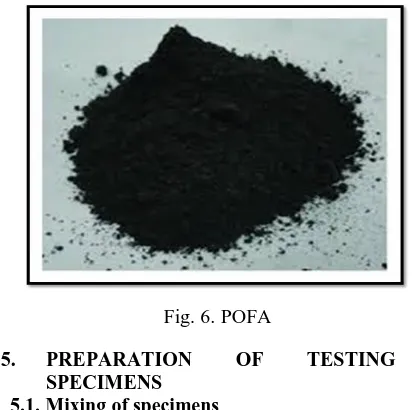
Palm oil fuel ash (POFA) is freely available material. The chemical properties of palm oil fuel ash are obtained by testing the samples as per Indian standards.
Fig. 6. POFA
5. PREPARATION OF TESTING
SPECIMENS 5.1. Mixing of specimens
The 53 OPC grade is replaced with GGBS has been partially replaced in the ratio 25%, 20%, 15%, 10%, 5% and 2% by weight of cement for mix and PALM OIL FUEL ASH is replaced in the ratio of 28%, 25%, 20%, 15%, 10% and 5% by the weight of cement and ennore of Grade I, Grade II, Grade
III will be added in 3 equal weights. The cementations materials were thoroughly mixed followed by gradual water. Mixing is prepared for each cube and put on the vibrating machine, after vibrating 3 minutes then ready the casting cube.
Fig. 7. Vibrating Machine
5.2. Casting of specimens
The test moulds is kept ready before preparing the mix. The cast iron moulds are cleaned of dust particles and applied with mineral oil on all side before concrete is poured into the moulds. The moulds are placed on the level platform. The specimen sizes are 70.7×70.7×70.7mm. The specimen is kept in the vibrating machine and filled with mix and then vibrated. Excess concrete is removed with a trowel and top surface is finished level and smooth as per IS 516-1959.
Fig. 8. Casted specimens
5.3. Curing of specimens
923 Fig. 9. Demoulded specimens
Fig. 10. Curing of specimens
6. TESTING OF SPECIMENS
The mortar properties such as Compressive strength Test. A time schedule for testing of specimens is maintained to make sure their proper testing on the due date and time. As per IS 516-1959 immediately after they are removed from the curing tubs and wiped off the surface water. The casted specimens are tested as per standard procedures.
6.1. Compressive strength test on mortar specimens
Out of many tests applied to the concrete, this is the important which gives an idea about all the characteristics of the concrete. By this single test one evaluator that whether Concreting has been done properly or not. Concrete mixtures can be designed to provide the wide range of mechanical & durability properties to meet the design requirements of the structure. The compressive strength of concrete is a most common performance measure is used by the engineer in designing buildings & other structures. The compressive strength is measured by breaking cube concrete specimen in a compression testing machine and the tests are carried out 3 days, 7
days, and 28 days, 60 days and 90 days at regular intervals.
Fig. 11. Testing of specimens
7. RESULTS AND DISCUSSION
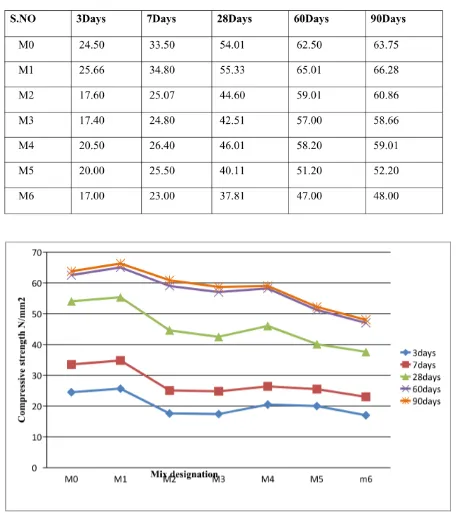
Compressive strength test results were tested for 7 days, 14 days 28 days 60 days and 90 days in MPa. The test results for different mixes are shown in the below tables 5.
Table 3. Test results for different mixes
Fig. 12. Compression strength results of cement mortar cubes at the ages of 3days, 7days, 28days,
60days and 90days
8. CONCLUSION
924 slightly higher strength than normal mix (M0)
and increase in strength by 4.73%.
At the age of 7 days with maximum replacement of cement 40% with different cementations materials.M1 mix given slightly higher strength than normal mix (M0) and increase in strength by 3.88%.
At the age of 28 days with maximum replacement of cement 40% with different cementations materials. M1 mix given slightly higher strength than normal mix (M0) and increase in strength by 2.44%.
At the age of 60 days with maximum replacement of cement 40% with different cementations materials. M1 mix given slightly higher strength than normal mix (M0) and increase in strength by 4.016%.
At the age of 90 days with maximum replacement of cement 40% with different cementations materials. M1 mix given slightly higher strength than normal mix (M0) and increase in strength by 3.96%.
Finally, it concluded 40% of cement can be replaced with 5% POFA+25% GGBS without losing strength compared to normal cement mortar.
The increase in strength may be due to the presence of SiO2 content is higher In POFA than GGBS.
The decrease in strength may be due to excess of Al2O3 content is higher in GGBS than POFA.
REFERENCES
[1] IS 456-2000: Plain and Reinforced Concrete. [2] IS 650-1991(Reaffirmed 2008): Standard sand
for testing of cement-Specification.
[3] IS 5513-1996(Reaffirmed 2005): Vicat Apparatus- Specification.
[4] ASTM C989-94a, Standard specification for ground granulated blast furnace slag for use in concrete and mortars.
[5] Jamilu usman, Abdulrahman Mohammed Sam, and Salihuddin Radin Sumadi, “Strength and Porosity of Cement Mortar Blended with Metakaolin” Advanced Materials Research ISSN: 1662-8985, Vols. 838-841.
[6] Etaveni.Madhavi, Praveen Mailaram, Nalla Sharath Kumar,Kadapa Vinod Kumar4 , Korra Ram Babu & Bomma Praveen Kumar, “Strength properties of cement mortar when Cement partially replaced with Silica fume and GGBS”, Imperial Journal of Interdisciplinary Research (IJIR), Vol. 3, No. 4, 2017.
[7] M C Nataraja, P G Dileep Kumar, A S Manu and M C Sanjay, “Use of granulated blast
furnace slag as fine aggregate in cement mortar”, International Journal of Structural and Civil Engineering Research, Vol. 2, No. 2, 2013.
[8] Wan Yuslinda Wan Yusof, Suraya Hani Adnan, Zalipah Jamellodin and Noor Shuhada Mohammad, “Strength Development of Fine Grained Mortar Containing Palm Oil Fuel Ash as a Partial Cement Replacement”, Applied Mechanics and Materials, Vols. 773-774, pp. 964-968, 2015.
[9] Harjinder Singh, Shikha Bansal, “Effect of silica fume on the strength of cement mortar” International Journal of Research in Engineering and Technology, Vol. 4, No. 2, 2015.
[10]Maitri Mapa, Hemalatha, T and Rama Chandra Murthy A., “Investigation on mechanical properties of silica and GGBS incorporated cement mortar”, International Journal of Research in Engineering and Technology, Vol. 4 special Issue 13, 2015.
[11]Deepak T.J., Albarra Elsayed., Noor Hassan, Chakravarthy. N, Siow Yun Tong, Mithun B.M, “Investigation on Properties of Concrete with Palm Oil Fuel Ash as Cement Replacement”, International journal of scientific and technology research, Vol. 3, 2014.