Modality Specific Meta Features for Authorship Attribution
in Web Forum Posts
Thamar Solorio and Sangita Pillay
The University of Alabama at Birmingham 1300 University Boulevard
Birmingham, AL 35294, USA
{solorio,rsangita}@cis.uab.edu
Sindhu Raghavan
The University of Texas at Austin 1 University Station C0500
Austin, TX 78712, USA
Manuel Montes y G´omez
The University of Alabama at Birmingham 1300 University Boulevard
Birmingham, AL 35294, USA
National Institute of Astrophysics, Optics, and Electronics Luis Enrique Erro No. 1
Tonantzintla, Puebla, Mexico
Abstract
This paper presents a new method for Au-thorship Attribution (AA) on online fo-rum posts. The idea behind the method is to generate meta features that cap-ture modality specific similarity relations among texts from different authors. Each modality represents a particular linguistic dimension (syntactic, lexical, stylistic). To evaluate this approach we measure predic-tion accuracy on data from an online fo-rum with up to 100 candidate authors. We also compare our results with a state of the art approach that has shown to per-form well across different genres. We have found the meta features to be especially helpful in the online forum domain, where the documents are very short, showing this to be a very promising direction for AA on a realistic web forum scenario.
1 Introduction
Authorship attribution (AA) refers to the task of analyzing a document to identify the potential au-thor who wrote the text. Earlier work on this problem involved gathering statistics about the fre-quency of words with specific length, together with other stylistic characteristics extracted from written samples that were in most cases an en-tire book or volume (Mendenhall, 1887; Mosteller and Wallace, 1964). Current approaches to AA relay on casting this problem as a text classifica-tion task, where instead of aiming to do a thematic classification of documents the goal is to have the
models learn the distinguishable characteristics in the written work of authors. The focus of analysis on more recent work has also shifted from book-length pieces to documents with book-length ranging from a couple of blocks (Hirst and Feiguina, 2007) to samples with at most 140 characters (Layton et al., 2010).
AA can help settle disputes over the original creators of a given piece of text. But other prac-tical applications include using AA for building a prosecution case against an online abuser. This is an important application, especially when we con-sider the raising trends in cyber-bullying and other electronic forms of teen violence1.
Achieving good accuracy in AA on spontaneous online data is, however, far more challenging than the typical scenario for AA. One of the major com-plicating factors involves the limited amount of training data. In the typical scenario, we may have an entire document (several pages long), or even an entire book, while in the case of online data from social media we will have very short texts that are a couple of sentences long. Another challenge related to online data from social media is the number of potential authors that the model will need to learn. Consider aiming to do AA for data of online web forums, which is the goal in our work. In this case the potential author of a given post is one out of the thousands of regis-tered users in that forum. In contrast, the major-ity of the text classification problems have a small number of classes. Lastly, we have to consider the problems with processing spontaneous written
1
http://cyberbullying.us/index.php
language, and in particular, from informal interac-tions of web forum posts. The fact that the written fragments are informal is not by itself a complicat-ing factor. We can argue that because they are in-formal they allow the writer to express more freely and thus they may contain more revealing infor-mation. But if we are to use syntactic analyzers to extract features for our learning model, as pre-vious work in AA has done, then these informal and spontaneous samples can cause the analyzers to break, or output very noisy information.
This paper presents a new approach for AA on web forum data that generates informative meta features that can help discriminate the posts from different authors. The meta features in our work are derived from clustering of the feature vectors. However, different from distributional clustering and related approaches such as (Baker and McCal-lum, 1998; Slonim and Tishby, 2001; Dhillon et al., 2003), we do not cluster the features, but the instances in an unsupervised fashion. The goal of the meta features is to encode high level relations of similarities among posts from different authors, and not to reduce the feature set or find semanti-cally related features as in the work listed above. Moreover, another difference and contribution of our work is the idea of generating modality spe-cific meta features. This modality spespe-cific frame-work allows to reach higher AA accuracy on short texts than that achieved by the standard approach using only first level features and competitive state of the art approaches.
The question we aim to answer here is whether generating these metafeatures, which contribute to the computational cost, are indeed helpful in the scenario of AA on web forum posts. Our experi-ments are done on a much smaller scale than that of the real scenario, with data sets of up to 100 au-thors and in a closed-class setting. However, they represent the best results reported so far under sim-ilar conditions and thus they show promise to scale up. The results we present show that the modality specific meta features are indeed helpful for short online data, and outperform accuracy of previous work.
The next section reviews related work on AA. Then in Section 3 we discuss our approach to gen-erating meta features from clustering the instances using different “views” of the posts. A discussion of the first level features is presented in Section 4. Section 5 presents the data sets used in our
experi-ments. The evaluation of our approach is outlined in Section 6, where we also discuss our baseline system and results. The last section summarizes our findings and outlines our research goals for the immediate future.
2 Related Work
Authorship Attribution (AA) and related author analysis tasks, such as plagiarism detection and author profiling, have received a lot of attention recently, but most of the evaluation sets have a small number of authors. Here we highlight previ-ous work that involves a large number of authors (at least 50) and refer the reader to the survey by (Stamatatos, 2009).
Luyckx and Daelemans studied the impact on accuracy of the number of potential authors and the size of the training data per author (Luyckx and Daelemans, 2010). They measured classi-fication accuracy of a memory-based learner on three datasets with up to 145 candidate authors for one of them. The features used in their experi-ments include lexical features, such as word and lemman-grams, type/token ratio, and readability measures; the syntactic features include Parts-of-Speech (POS), grammatical relations, chunk n-grams, and tokens with POS attached. They also used character n-grams, features that have been found to work well for AA (Peng et al., 2004; Plakias and Stamatatos, 2008). As expected, ac-curacy reported for 145 authors (˜12%) was consid-erably lower than that achieved when the number of authors was smaller. An important characteris-tic of Luyckx and Daelemans work is that the 145 author set has only one document per author. In the experimental setup they partitioned each doc-ument into 10 fragments and used 9 of these frag-ments for training their model while testing on the remaining one. We believe that training a model on pieces of the same document used for testing is not exactly the task of AA, at least not in a realistic scenario. However, we recognize that the limited training data is an important constraint.
au-thor. On a set with 50 authors, the SCAP method reached an accuracy of 55%, although when the @usernamewas included in the text their accu-racy increased to little over 70%. As the authors suggest, expecting to have this@username infor-mation from an author that wants to remain anony-mous is not realistic.
Koppelet al. (2011) present a study of AA us-ing blog data crawled fromblogger.com. The approach used by them is based on computing co-sine similarity from vectors of character 4-grams, and the number of candidate authors is by far the largest reported in the literature: for some exper-iments they trained on 10,000 authors and tested on 1,000. Precision and Recall in this setting were reported at 87.9% and 28.2%, respectively. How-ever, we should also note that in these experiments text was also fragmented into snippets, and similar to what Luyckx and Daelemans did, the similar-ity model uses fragments of the same source text to predict authorship. In our opinion, the task re-sembles more a data provenance problem than an AA one. Moreover, because the blog data used in this work was not controlled for topic, and given that they used character 4-grams as features in a similarity based approach, we speculate that in the Koppelet al. setting there is more risk to bias the task from AA to a semantic or topic categoriza-tion and the only way to disentangle the two is by controlling for topic variation.
In another interesting recent work on AA, Prob-abilistic Context-Free Grammars (PCFGs) were proposed for AA (Raghavan et al., 2010). The number of authors in the evaluation data sets was rather small (3 to 6) but it included different do-mains, such as poetry, football, business, travel, and cricket, and all the data was harvested from the Internet. Raghavan et al. trained a PCFG for each author independently and authorship on the test data was assigned by taking the highest likeli-hood score from these grammars. To overcome the data sparseness problem, they mixed treebanked data from the Wall Street Journal (WSJ). They also enriched this mostly syntactic models with lexical information by combining the output with a bag-of-words Maximum Entropy classifier and a word-based n-gram language model. In their case, the combined model performed better than the base-line and the other machine learning approaches for most of the datasets. What is very interesting from this previous work is the fact that the same
inex-pensive PCFG-based approach worked reasonably well on all the data sets tested. In our experi-ments we evaluate this approach on the web forum data and the results show this to be a competitive method, even though the number of potential au-thors increased by a large margin and the docu-ments are shorter than those used in (Raghavan et al., 2010).
3 Modality Specific Meta Features for Authorship Attribution
The standard formulation of text classification considers having a set of labeled examples, l, where each document is represented by a feature vector x ∈ Rn and their corresponding labels y, whereyi ∈ {0,1}in a binary classification. The feature vectors and their true class values are then input to a learning algorithm that will then build a model to predict the class of new instances. In contrast, we extract a set of smaller feature vectors that are then the basis for generating meta features, or more concretely, meta feature vectors.
Our approach starts with the extraction of first-level features to generate a feature vector rep-resentation for each instance. However, in our framework instead of having a single feature vec-tor forx, we generatemsmaller vectors that con-tain complementary types of features, or views, describing the instances. We call these different views multimodal because they represent differ-ent characteristics of the text. More formally, an instance x is now represented as {x1,x2, ...,xm} where each xi is a vector with |xi| features in modality i. Note thatunion(x1,x2, ...,xm) = x andintersection(x1,x2, ...,xm) =∅since we are only generating sub vectors (or complementary views) from the original feature set.
The generation of meta features uses these m different vectors to producemclustering solutions for the training data with k clusters each. That means that we end up with different arrangements of the training instances into clusters, one arrange-ment per modality. Note that since clustering is performed per modality,kmay be different in each clustering solution. From each cluster ck in each of themclustering solutions, we compute a cen-troid by averaging all the feature vectors in that cluster.
centroidmi =
1
|cmi |
X
xj∈cmi
whereiabove ranges from 1 tok, the number of clusters. We then measure the similarity of each instance to these centroids using the cosine func-tion. Thesem×ksimilarity values are then used as the meta features,x′, and we compute them for training and testing instances. Thus, as a result of this step each instancexis now represented by m tuples of vectors, the first level feature vectors hxi1, ...,xi
|xi|i and the newly generated meta
fea-ture vectorshx′i1, ...,x′ikifor each modalityi.
In our problem of AA, we consider four types of first level features: stylistic features, lexical features, syntactic features, and perplexity values from character 3-gram language models. That is, in these experiments m = 4. Therefore, in our problem we havex ={xsty,xlex,xppl,xsyn}, wherexsty refers to the feature vector containing only stylistic features,xlexis the vector for lexical features, xppl is the feature vector for perplexity values, and lastly, xsyn is the vector of syntactic features. Section 4 describes the features we are using in more detail.
To summarize, our MSMF approach is different from previous machine learning approaches to AA in that it has an intermediate step where we gen-erate meta features from clustering the training in-stances per modality. Thus, all the vectorsxsty in the training data are input to a k-means clustering algorithm. Similarly, the set of vectors xlex,xppl, andxsynare clustered separately.
We are proposing to generate new meta features from clustering the data that can better represent posts from each author, but more important, the relation, i.e. closeness, to posts from other au-thors. It should be noted that no class informa-tion is used during clustering as the idea is to un-cover regularities across the posts from authors on individual modalities as a result of the clustering. New in this work as well is the idea of a multi-modal clustering, where each feature multi-modality is clustered separately. Our assumption is that gener-ating clusters by looking at feature sets separately will allow contrasting authors’ characteristics in a subdimensional space without the risk of blurring differences, or similarities, across authors that can occur when clustering the entire feature vector at once. For instance, one author may have a similar style on the use of emoticons to a subset of authors while sharing similar syntactic characteristics to a very different subset of authors. This information, we hope, will be captured by the metafeatures, and
will yield higher classification accuracy than the first level features by themselves.
4 First Level Features
The previous section motivated and described the use of the meta features. This section describes the first level features, where by first level features we refer to features computed directly from the docu-ments.
Table 1 shows a list of the features used ar-ranged by modality. For thestylisticmodality we crafted a list of features tuned for written interac-tions in social networks. Thus, we use percent-ages of non-alphanumeric characters that are com-monly used in emoticons. We also include per-centages of capitalized words, use of quotations, and use of signature, that we believe allow writ-ers more freedom to express their unique writing style. The lexical modality is the standard bag of words representation used in text classification that has also been commonly used in previous AA work (Argamon and Levitan, 2005; Zhao and Zo-bel, 2005). In the modality noted as perplexity
in Table 1 we use perplexity values as computed by character 3-gram language models. We use the training data to train one language model per author and each model generates a perplexity, or cross entropy, value per instance. For training the language models and computing perplexity values we used the SRI-LM toolkit (Stolcke, 2002). Fre-quencies of charactern-grams have also been suc-cessfully used to build author profiles (Keselj et al., 2003). However, to the best of our knowl-edge, this is the first work exploiting character-based language models for AA, although, Ragha-van et al.’s work on PCFGs is closely related to this. Lastly, in thesyntacticmodality we have un-igrams, bun-igrams, and trigrams of POS tags, and typed dependency relations extracted using the Stanford parser (Marneffe et al., 2006), that have been used before in AA.
5 Data Sets
Modality Features
Stylistic Total number of words
Average number of words per sentence Binary feature indicating use of quotations Binary feature indicating use of signature Percentage of all caps words
Percentage of non-alphanumeric characters
Percentage of sentence initial words with first letter capitalized Percentage of digits
Number of new lines in the text
Average number of punctuations (!?.;:,) per sentence Percentage of contractions (won’t, can’t)
Percentage of two or more consecutive non-alphanumeric characters Lexical Bag of words (freq. of unigrams)
Perplexity Perplexity values from character 3-grams Syntactic Part-of-Speech (POS) tags
Dependency relations Chunks (unigram freq.)
Table 1: Feature breakdown by modality
of authors each. Table 2 shows some statistics on these data sets.
Because the forum is related to higher educa-tion it is expected that users of this forum will be more conscious about their writing and grammar. This is one of the reasons why we decided to start working on this data as a first cut on the problem of AA on online forums. However, it is still a spon-taneous and informal setting. Table 3 shows some excerpts from the forum that show this to be a mid-dle ground between carefully edited and written text and typical social media samples.
“OH MY GOD. ARE YOU THE STUPIDEST MAN... WAIT STUPIDEST PERSON ON THE FACE OF THIS EARTH?
“We’ve been married for xx years and you STILL can’t figure it out? Look, here’s a quarter. Why don’t you call someone and see if they will help you PULL YOUR HEAD OUT OF YOUR A$$.”
Table 3: Excerpts from the CHE forums
Our datasets are available to the research com-munity by contacting the authors2.
6 Empirical Evaluation
For all our experiments we chose a fixed parti-tion of training and testing for all collecparti-tions. We randomly divided each data set into 80% training and 20% testing. We are presenting results of us-ing Support Vector Machines (SVMs) (Sch¨olkopf and Smola, 2002) as the underlying learner as
im-2
Because the CHE data set exceeds the 10MB limit we were unable to upload it as supplementary material.
plemented in WEKA (Witten and Frank, 2005). We report classification accuracy as the evaluation metric.
6.1 Baseline Experiments for AA
The first set of experiments we present are aimed at establishing a good baseline for our approach. Following the baselines presented in previous work, we measure prediction performance for AA on the CHE collection using a bag-of-words ap-proach.
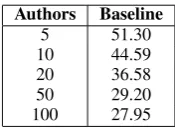
Authors Baseline
5 51.30 10 44.59 20 36.58 50 29.20 100 27.95
Table 4: Baseline accuracy using SVMs and bag of words for the CHE data set
The results are shown in Table 4. The baselines chosen are strong. Especially for the data set with 100 authors, where SVMs reached an accuracy of close to 30%, much higher than a simple major-ity predictor (1/100), but also considerably higher than that reported for datasets with a similar num-ber of authors (Luyckx and Daelemans, 2010). As expected, accuracy drops as the number of poten-tial authors increases, with the 100 authors data set posing the greatest challenge for the classifier.
6.2 First Level Features (FLF) for AA
Total Number Avg Number of Avg Number of Dataset Authors of Posts Posts per Author Words per Author
1 5 2,889 577.8 39,664
2 10 5,579 557.9 40,953
3 20 9,779 488.95 35,838
4 50 15,543 310.86 21,502
5 100 16,171 161.71 11,322
Table 2: Summary of the CHE data set
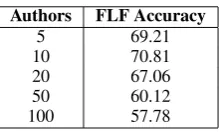
4 were tailored to the web forum domain, there-fore we expect them to be valuable for learning to discriminate the writeprint of each author. We used SVMs as the underlying algorithm. The re-sults are shown in Table 5. In all cases the FLF outperformed the baseline results.
Authors FLF Accuracy
5 69.21 10 70.81 20 67.06 50 60.12 100 57.78
Table 5: Results using First Level Features (FLF) and SVMs for the CHE data set
These results are higher than what has been re-ported on AA for a similar number of authors. The FLF have shown to be competitive and in some cases the improvement in accuracy over the base-line reaches 100%. In most cases accuracy de-creased with a larger number of potential authors, although, for the data set with 10 authors accuracy was a little bit higher than with 5 authors. More-over, the drop in accuracy is not as pronounced as in the baseline system, suggesting that BOWs are not sufficient to solve this task and that a combina-tion of features, such as those included in our FLF are more appropriate for this problem.
6.3 Using Modality Specific Meta Features (MSMF)
After establishing the baseline performance in our data set, and the performance of using only FLF, we want to evaluate the idea of generating meta features that are modality specific. As described in Section 3, we cluster each of the four types of feature vectors in the training data set sepa-rately. Because we use a k-means clustering al-gorithm, implemented in CLUTO, the first step is to choose the number of clusters. Determin-ing the optimal number of clusters is challengDetermin-ing and beyond the scope of this exploratory work. But it is still an important parameter in our
solu-tion since the value ofkdetermines the number of meta features generated per modality. The role of these meta features is to extract relations among the posts of different authors on a given modal-ity. A reasonable assumption is then to set k as a function of the number of authors. We exper-imented setting k =number of authors ×n, with values ofn= 1,3,5,10,15. For example, for the data set with 5 authors we experimented with val-ues ofk= 5,15,25,50,75.
Authors K MSMF FLF MSMF+FLF
5
1×5 45.04
69.21
73.39
3×5 50.95 74.6
5×5 53.91 74.08
10×5 62.60 75.47
15×5 65.04 76.17
10
1×10 37.47
70.81
77.38
3×10 47.29 75.85
5×10 50.09 76.3
10×10 61.16 77.38
15×10 59.54 76.84 20
1×20 35.35
67.06
70.81
3×20 40.03 71.22
5×20 43.78 71.37
10×20 48.40 71.42
15×20 49.58 70.96 50
1×50 32.77
60.12
63.20
3×50 37.66 62.75
5×50 39.83 63.72
10×50 43.50 63.79
15×50 44.53 63.33
100
1×100 33.15
57.78
60.41
3×100 40.11 60.95
5×100 42.02 61.17
10×100 42.52 62.10
15×100 43.34 59.54
Table 6: Accuracy results for AA on the CHE col-lection when using modality specific metafeatures (MSMF), first level features (FLF) and the combi-nation of both (MSMF+FLF)
fea-tures by themselves are always outperformed by the first level features. This is not surprising since the meta features aggregate posts from different authors depending on similarity and thus predict-ing authorship only on these features does not work as well as the standard approach of using first level features. However, these meta features do outperform the bag of words baseline results (compare column MSMF in Table 6 with results shown in Table 4), underscoring the fact that the CHE data set is harder than the typical text clas-sification task where the lexical features by them-selves can solve the problem with very high ac-curacy. Moreover, the combination of first level features and meta features (MSMF+FLF) consis-tently achieves higher accuracy than any of the other two alternatives, this is the second trend and the most relevant to our work. These results show that the modality specific meta features are impor-tant and yield improvements of up to 10% in ac-curacy over the standard approach of using only FLF, and of more than 100% in accuracy over a strong bag of words baseline. Third, with respect to the value ofk, the results show that for all val-ues chosen, the MSMF outperforms the baseline results, and that using the combined set of features (MSMF+FLF) will yield a higher accuracy than that of using only the first level features. How-ever, it does seem that higher values of k result in higher accuracy, suggesting that trying to find more clusters, and therefore finer-grained clusters in the data is resulting in the extraction of more meaningful relations among the posts of different authors. The results also show that the bestk over-all wask = 10×number of authors. For larger k values only the data set with 5 authors reached bet-ter results. Overall, it is inbet-teresting to see as well that both types of features yield classifiers that are less affected by the larger number of authors, as the drop in accuracy seems to be less pronounced than in the baseline system (see Table 4).
Our previous results show that the meta features contribute to a better prediction of authorship. But what about the multi modal framework? In or-der to assess if generating modality specific meta features is helpful we performed additional experi-ments where all instances are represented by a sin-gle vector that concatenates all modality feature vectors. The rest of the meta features approach remains unchanged, the vectors are clustered us-ing k-means clusterus-ing and we generate
metafea-tures for each instance. The results are shown in Table 7 and for all cases we chose k = num-ber of authors×10. The results under AMMF are the meta features generated without separate pro-cessing per modality, AMMF+FLF shows results of combining first level features with “all modal-ities together” meta features. As we speculated, there is a considerable gain in accuracy from the independent processing per modality. The gain in accuracy of MSMF over AMMF ranges from 73% to ∼250%. This gain possibly comes from the ability to aggregate feature vectors that se-mantically represent the same type of information, which can be difficult to maintain when all modal-ities are grouped together. Both approaches im-prove accuracy when they are combined with FLF, but again the combination using modality specific meta features (MSMF+FLF) yields the best re-sults. However, the gain in accuracy observed when going from AMMF+FLF (Column 4 in Ta-ble 7) to MSMF+FLF (Column 5 in TaTa-ble 7) is not as large as that observed when going from us-ing only AMMF (Column 2 in Table 7) to MSMF (Column 3 in Table 7). This is expected since both approaches share the same set of FLF, which we know are by themselves very powerful. Fur-ther experiments and analysis are needed to bet-ter characbet-terize the advantages of the MSMF ap-proach. We plan to leave this for future work.
6.4 Benchmark Comparisons
Authors AMMF MSMF(% gain) AMMF+FLF MSMF+FLF(% gain) 5 36.00 62.60 (73%) 71.47 75.47(5%) 10 19.63 61.16 (211%) 70.99 77.38(9%) 20 19.63 48.40 (146%) 69.06 71.42(3%) 50 12.44 43.50 (249%) 61.65 63.79(3%) 100 15.07 42.52 (182%) 59.16 62.10(4%)
Table 7: Accuracy comparison on CHE data set between generating modality specific meta features (MSMF) and meta features with all modalities together (AMMF), and the combination of each with first level features (FLF).
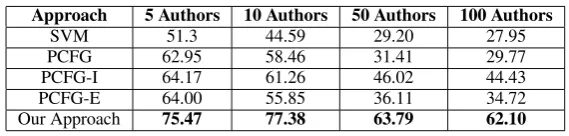
Approach 5 Authors 10 Authors 50 Authors 100 Authors
SVM 51.3 44.59 29.20 27.95 PCFG 62.95 58.46 31.41 29.77 PCFG-I 64.17 61.26 46.02 44.43 PCFG-E 64.00 55.85 36.11 34.72 Our Approach 75.47 77.38 63.79 62.10
Table 8: Benchmark comparison of AA accuracy on the CHE collection
shown in Table 4. The baseline results are consis-tently outperformed by all of the PCFG-based ap-proaches, showing yet again PCFGs to be robust to different genres but more important, to scale up well to a larger number of authors. However, the results were considerably lower than those of our method. These results support our hypothesis that the modality specific meta features are appro-priate for online forum data where the documents are short, the number of potential authors is larger, the stylistic features are more discriminative, and there are less restrictions with respect to standards of writing. Another interesting finding from these experiments is the fact that the PCFG-I method al-ways reached higher accuracies than the ensem-ble in the CHE collection. In Raghavan et al.’s collection, the ensemble (PCFG-E) was the most accurate model. We believe this difference is be-cause of the fact that the CHE collection is single topic, having a more semantically uniform collec-tion prevented the lexical-based components, such as bag of words and n-gram language models, used in the ensemble to boost accuracy.
7 Concluding Remarks
Following recommendations from previous work in AA, we have gathered a single topic evalua-tion data set of web forum posts with up to 100 candidate authors. The main contribution of this work is the use of modality specific meta features generated by an unsupervised approach. Previous work has used distributional clustering to aggre-gate features that share the same relation with the class (Baker and McCallum, 1998; Slonim and
Tishby, 2001; Dhillon et al., 2003). Our proposed framework is different, we generate meta features from similarity metrics between centroids from an unsupervised clustering of instances and the in-stances themselves. The additional cost in cluster-ing instances shows to be valuable for AA as we can gain up to 100% improvements in accuracy over strong baselines. Further analysis of results also showed that treating each modality separately to generate the meta features is also important and can yield gains of close to 10% in accuracy over the standard approach of using only first level fea-tures. To the best of our knowledge, this is by far the best result reported for AA in a task having up to 100 authors. The framework is general enough that it can be extended to other classification prob-lems where instances can be represented using dif-ferent modalities.
The experimental evaluation presented here shows that a relatively inexpensive approach based on PCFGs can scale up to a larger number of au-thors, even if the documents are only a couple of sentences long. However, this syntactically driven approach is outperformed by our proposed modal-ity specific meta features framework.
Acknowledgements
This work was partially supported by a UAB fac-ulty development grant to the first author. It was also supported in part by the CONACYT-Mexico (project no. 134186) and by the European Com-mission as part of the WIQ-EI project (project no. 269180) within the FP7 People Programme.
References
S. Argamon and S. Levitan. 2005. Measuring the use-fulness of function words for authorship attribution. InProceedings of the Conference of the Association for Computers and the Humanities and the Associa-tion for Literary and Linguistic Computing.
L. Douglas Baker and Andrew McCallum. 1998. Dis-tributional clustering of words for text classification. InSIGIR 98: Proceedings of the 21st Annual In-ternational ACM SIGIR, pages 96–103, Melbourne, Australia, August. ACM.
Inderjit S. Dhillon, Subramanyam Mallela, and Rahul
Kumar. 2003. A divisive information-theoretic
feature clsutering algorithm for text classification.
Journal of Machine Learning Research, 3:1265– 1287.
G. Frantzeskou, E. Stamatatos, S. Gritzalis, and C. E. Chaski. 2007. Identifying authorship by byte-level n-grams: The source code author profile (SCAP).
Journal of Digital Evidence, 6(1).
Graeme Hirst and Ol’ga Feiguina. 2007. Bigrams of syntactic labels for authorship discrimination. Liter-ary and Linguistic Computing, 22(4):405–417, Oc-tober.
V. Keselj, F. Peng, N. Cercone, and C. Thomas. 2003. N-gram based author profiles for authorship attribu-tion. InProceedings of the Pacific Association for Computational Linguistics, pages 255–264.
Moshe Koppel, Jonathan Schler, and Shlomo Arga-mon. 2011. Authorship attribution in the wild. Lan-guage Resources and Evaluation, 45:83–94.
Robert Layton, Paul Watters, and Richard Dazeley. 2010. Authorship attribution for twitter in 140
char-acters or less. In Second Cybercrime and
Trust-worthy Computing Workshop, CTC 2010, pages 1–8, Ballart, VIC, Australia, July.
Kim Luyckx and Walter Daelemans. 2010. The effect of author set size and data size in authorship
attri-bution. Literary and Linguistic Computing, pages
1–21, August.
M.C. De Marneffe, Bill Maccartney, and Christo-pher D. Manning. 2006. Generating typed
depen-dency parses from phrase structure parses. InLREC
2006.
T.C. Mendenhall. 1887. The characterstic curves of
composition.Science, IX:237–249.
F. Mosteller and D. L. Wallace. 1964. Inference
and Disputed Authorship: The Federalist. Addison-Wesley.
F. Peng, D. Shuurmans, and S. Wang. 2004. Augment-ing naive Bayes classifiers with statistical language
models. Information Retrieval Journal, 7(1):317–
345.
S. Plakias and E. Stamatatos. 2008. Tensor space mod-els for authorship attribution. InProceedings of the 5th Hellenic Conference on Artificial Intelligence: Theories, Models and Applications, volume 5138 of
LNCS, pages 239–249, Syros, Greece.
Sindhu Raghavan, Adriana Kovashka, and Raymond Mooney. 2010. Authorship attribution using
prob-abilistic context-free grammars. InProceedings of
the ACL 2010 Conference Short Papers, pages 38– 42, Uppsala, Sweden, July. Association for Compu-tational Linguistics.
Andrew I. Schein, Johnnie F. Caver, Randale J. Honaker, and Craig H. Martell. 2010. Author attri-bution evaluation with novel topic cross-validation. In The 2010 International Conference on Knowl-edge Discovery and Information Retrieval, Valencia, Spain, October.
Bernhard Sch¨olkopf and Alexander J. Smola. 2002.
Learning with Kernels: Support Vector Machines, Regularization, Optimization and Beyond. MIT Press.
Noam Slonim and Naftali Tishby. 2001. The power of word clusters for text classification. In23rd Euro-pean Colloquium on Information Retrieval Research (ECIR).
Efstathios Stamatatos. 2009. A survey on modern au-thorship attribution methods. Journal of the Ameri-can Society for Information Science and Technology, 60(3):538–556.
Andreas Stolcke. 2002. SRILM - an extensible lan-guage modeling toolkit. pages 901–904.
Ian H. Witten and Eibe Frank. 2005. Data Mining:
Practical Machine Learning Tools and Techniques. Morgan Kauffmann, 2nd edition.
Y. Zhao and J. Zobel. 2005. Effective and scalable authorship attribution using function words. In Pro-ceedings of 2nd Asian Information Retrieval
Sympo-sium, volume 3689 ofLNCS, pages 174–189, Jeju