Dimensionality Reduction with Multilingual Resource
YingJu Xia Hao Yu Gang Zou
Fujitsu Research & Development Center Co.,LTD.
13F Tower A, Ocean International Center, No.56 Dong Si Huan Zhong Rd, Chaoyang District,
Beijing, China, 100025
{yjxia,yu,zougang}@cn.fujitsu.com
Abstract
Query and document representation is a key problem for information retrieval and filtering. The vector space model (VSM) has been widely used in this domain. But the VSM suffers from high dimensionality. The vectors built from documents always have high dimensionality and contain too much noise. In this paper, we present a novel method that reduces the dimensional-ity using multilingual resource. We intro-duce a new metric called TC to measure the term consistency constraints. We deduce a TC matrix from the multilingual corpus and then use this matrix together with the term-by-document matrix to do the Latent Se-mantic Indexing (LSI). By adopting differ-ent TC threshold, we can truncate the TC matrix into small size and thus lower the computational cost of LSI. The experimen-tal results show that this dimensionality re-duction method improves the retrieval per-formance significantly.
1
Introduction
1.1 Basic concepts
The vast amount of electronic information that is available today requires effective techniques for accessing relevant information from it. The meth-odologies developed in information retrieval aim at devising effective means to extract relevant docu-ments in a collection when a user query is given. In information retrieval and filtering, Query and document representation is a key problem and many techniques have been developed. Among these techniques, the vector space model (VSM)
proposed by Salton (1971; 1983) has been widely used. In the VSM, a document is represented by a vector of terms. The cosine of the angle between two document vectors indicates the similarity be-tween the corresponding documents. A smaller angle corresponds to a larger cosine value and in-dicates higher document similarity. A query, which describes the information need, is encoded as a vector as well. Retrieval of documents that satisfy the information need is achieved by finding the documents most similar to the query, or equiva-lently, the document vectors closest to the query vector. There are several advantages to this ap-proach beyond its mathematical simplicity. Above all, it is efficient to compute and store the word counts. This is one reason that why VSM is widely used for query and document representation. But this method has problem that the vectors built from documents always have high dimensionality and contain too much noise. The high dimensionality causes high computational and memory require-ments while noise in the vectors degrades the sys-tem performance.
1.2 Related works
and Saad, 2004; Sun et al., 2004; Husbands et al., 2005). Among them, IRR (Ando and Lee, 2001) is a subspace-projection method that counteracts ten-dency to ignore minority-class documents. This is done by repeatedly rescaling vectors to amplify the presence of documents poorly represented in pre-vious iterations.
In concept indexing (CI) (Karypis and Han, 2000) method, the original set of documents is first clustered into k similar groups, and then for each group, the centroid vector (i.e., the vector obtained by averaging the documents in the group) is used as one of the k axes of the lower dimensional space. The key motivation behind this dimensionality re-duction approach is the view that each centroid vector represents a concept present in the collec-tion, and the lower dimensional representation ex-presses each document as a function of these con-cepts. George and Han (2000) extend concept in-dexing in the context of supervised dimensionality reduction. To capture the concept, phrase also has been used as indexing entries (Mao and Chu, 2002).
The LPI method (Isbell and Viola, 1999) tries to discover the local structure and obtains a compact document representation subspace that best detects the essential semantic structure. The LPI uses Lo-cality Preserving Projections (LPP) (Xiaofei He and Partha, 2003) to learn a semantic space for document representation. Xiaofei He et al., (2004) try to get sets of highly-related words, queries and documents are represented by their distance to these sets. These algorithms have successfully re-duced the dimensionality and improve the retrieval performance but at the mean time they led to a high computational complexity.
1.3 Our method
In this study, we propose a novel method that duces the dimensionality using multilingual re-source. We first introduce a new metric called TC to measure the term consistency constraints. We use this metric to deduce a TC matrix from the multilingual corpus. Then we combine this matrix to the term-by-document matrix and do the Latent Semantic Indexing. By adopting different TC threshold, we can truncate the TC matrix into small size and thus lower the computational cost of LSI.
The remainder of this paper is organized as fol-lows. Section 2 describes the dimensionality reduc-tion method using multilingual resource. Secreduc-tion 3 shows the experimental results to evaluate the
di-mensionality reduction method. Finally, we pro-vide conclusions and remarks of future work in Section 4.
2
Dimensionality reduction using
multi-lingual resource
2.1 Motivation
As mentioned above, the queries and documents are represented by vectors of terms. The weight of each term indicates its contribution to the vectors. Many weighting schemes have been proposed. The simplest form is to use the term-frequency (TF) as the term weight. In this condition, a document can be represented as a vectord=(tf1,tf2,...,tfn)
r
, where
is the frequency of the ith term in the document. A widely used refinement to this model is to weight each term based on its inverse document frequency (IDF) in the documents collection. This is commonly done by multiplying the frequency of each term i by , where N is the total
number of documents in the collection, and is the number of documents that contain the ith term. This leads to the TF-IDF representation of the documents. Although the TF-IDF weighting scheme has many variants (Buckley, 1985; Berry et al., 1999; Robertson et al., 1999), the idea is the same one that uses the statistical information such as TF and IDF to calculate the term weight of vectors.
i tf
) / log(N dfi
i df
This kind of statistical information is independ-ence with languages. For example, in one language, say La, we have a vocabulary Va = {w1a, w2a, …,
wna} and a documents collection Da = {d1a, d2a,…,
dma }. If this documents collection has a parallel
corpus in language Lb, say, Db = {d1b, d2b,…, dmb}
and a vocabulary Vb = {w1b, w2b, …, wnb}. When
we put a query Qka = {qk1a, qk2a ,…, qkla} (qkia∈Va)
into an information retrieval system. The informa-tion retrieval system will converts the query Qka
and the documents in the collection Da into vectors. By calculating the similarity between query Qka
and each document dia, the system selects the
documents whose similarity is higher than a threshold as the results Rka. If we translate the
query Qka into language Lb and get query Qkb, when
putting the Qkb into the same information retrieval
system, we get the retrieval results Rkb. Since the
Qka and Qkbcontain the same content and only
and Rkb will contain the same content. If this
as-sumption holds, the vocabulary which is used to build queries and documents vectors should have high representative ability. Since the weight of each term in the vector is calculated by the statisti-cal information such as TF and IDF. If the vocabu-lary Va and Vb have high representative ability, their statistical information will be consistent as well. This is the main motivation of our dimen-sionality reduction method.
2.2 Dimensionality reduction method
The most straightforward way to measure the word’s representability in multilingual resource is to calculate the TF and IDF of each word in differ-ent languages. But this method has one problem that the TF-IDF scheme is dedicated for each sin-gle document, the same word will have different weight in different documents. It is impractical to impose the consistency constraint to every docu-ment. Even we can do that, this method still has the drawback that it is very difficult to port to another documents collection. To address this problem, we consider the whole documents collection as one single document. In this condition, the IDF will be a fixed number.
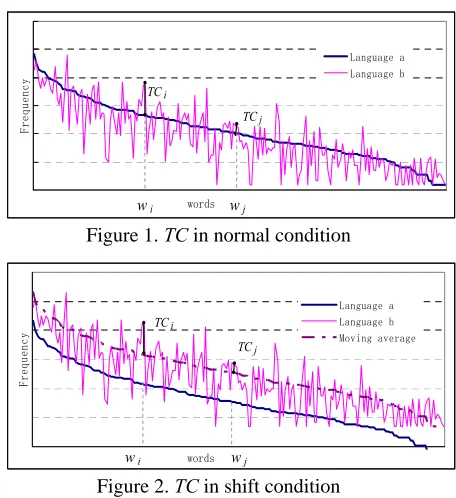
We introduce a new metric to measure the term consistency called TC. Figure 1 and Figure 2 illus-trate the basic idea. In these figures, the curve La
shows the word logarithmic frequency in the documents collection of language La, the curve Lb
shows the corresponding translation’s logarithmic frequency in the documents collection of language Lb. TCi and TCj are the term consistency of wi and
wj respectively.
Figure 1 shows the TC in normal condition that the average word frequency in language a is proxi-mate to that of language b. In this case, the TC is defined as below:
))
is the frequency of the wia’s translation in language
b. In multilingual case, the TC(wi) will be defined
the average word frequency in lan
to calculate the TC of wi as below:
(3) Here H is distance between the moving average
guage a is different with that of language b, we will first calculate the moving average as shown in the Figure 2. After that, we use the moving average
))
and the original one.
words
Figure 1. TC in normal condition
words tion retrieval, we combine T into the t
t proximation derived from its truncated Singular Value Decomposition (SVD a high computational complexity sinc he matrix
matri
-105 dimensional space. To lower the computational cost, we truncate the TC
computational cost on the matrix wil
. Note that
b). To this one-to-many
phe-no
stem to evaluate eduction method presented in Section 2. The term weight in the term-by-do
comes from Chinese Linguistic eseldc.org/
d r
Bˆ × l lower
thanBt× the matrix Bˆr×d is deduced from the TC matrix Tt×t which is sorted by word representative ability. It will contain less noise and outperform the original matrixAt×d. The experi-mental results have shown the effective of this method.
For one word w d
ia in languag , there are
al-ways several translations in language L e La
b, say (w i1b,
wi2b,…, wik handle
menon, we calculate the co-occurrence of wia
and each translation and select the highest one as the translation of wia.
3
Experiments
We adopt a VSM based IR sy the dimensionality r
cument matrix is calculated by the TF-IDF weighting scheme.
3.1 Training and test corpora
The training corpus
Data Consortium (http://www.chin , ab-
(“2003-863-006”). It is a C
breviate as CLDC). Its code number is
009”. This parallel corpus contains parallel texts in Chinese, English and Japanese. It is aligned to sen-tence level. The sensen-tence alignment is manually verified and the sampling examination shows the accuracy reaches 99.9%.
The experiments are conducted on two test cor-pora. The first one is the information retrieval test corpus gotten from CLDC
hinese IR corpus and contains 20 topics for test. Each topic has key words and description and nar-rative. The second one is the Reuters 2001 data (http://about.reuters.com/researchandstandards/cor pus/ ). This corpus is a collection of about 810,000 Reuters English news stories from August 20, 1996 to August 19, 1997. It was used by the TREC-10 Filtering Tracks (Robertson and Soboroff, 2002). In TREC-10, 84 Reuters categories were used to simulate user profiles.
The evaluate measure is a version of van Rijsbergen(1979)’s F measure with β=1(we de-note it as F1).
3.2 Experimental results
The table1 and table2 show the experimental re-sults conducted on Chinese and English test Cor-pus respectively. In these tables, we compare our method with basic LSI and LPI (Xiaofei et.al, 2004). In the table1, the ‘C-E’ means the TC ma-trix gotten from Chinese-English training collec-tion (deduced from the trilingual training corpus). The ‘C-J’ means that the TC matrix gotten from Chinese-Japanese training collection, and so force the ‘C-E-J’. All the TC matrices have been normal-ized to range from 0 to 1. The threshold θ is used to truncate the TC matrix into small size. Bigger θ corresponds to smaller truncated TC matrix. Note that here θ is discrete since for some θ, the size of truncated matrix is very similar. For example, when θ = 0.85 and θ = 0.9, the size of truncated TC matrices are the same one.
LSI: 0.3785, LPI: 0.405
θ C-E C-J C-E-J
0.3 0.404 0.4014 0.4124
0.4 0.4098 0.406 0.4185
0.45 0.4159 0.4185 0.4226
0.5 0.4204 0.4124 0.4105
0.55 0.4061 0.4027 0.3997
0.6 0.3913 0.3992 0.396
0.8 0.3856 0.3867 0.3842
0.85 0.3744 0.3754 0.3768
Table1.F1 measure of Chinese test corpus
LSI: 0.3416, LPI: 0.3556
θ E-C E-J E-C-J
0.3 0.356 0.3478 0.3578
0.4 0.3578 0.3596 0.3702
0.45 0.3698 0.3651 0.3734
0.5 0.3636 0.3575 0.363
0.55 0.3523 0.3564 0.3477
0.6 0.3422 0.3448 0.3458
0.8 0.3406 0.3397 0.3378
0.85 0.3304 0.3261 0.3278
Table2. F1 measure of English test corpus
at θ=0.5 and the C-J test collection get 0.4185 at
θ=0.45. For the English test corpus, the trilingual training collection also gets the best performance. But the difference between bilingual and trilingual training collection is also subtle (E-C-J: F1=0.3734, E-C: F1=0.3698, E-J: F1=0.3651). In the English test corpus, all the training collection get the best performance at θ=0.45.
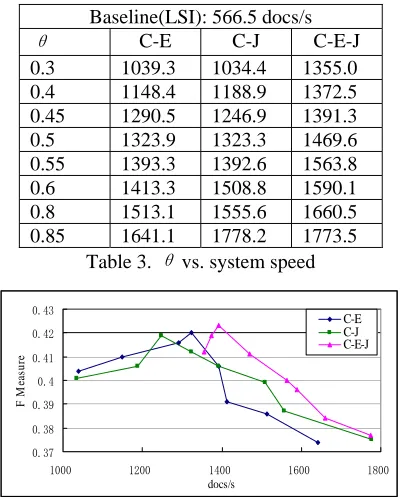
As mentioned before, the bigger θ means the smaller size of the truncated TC matrix. While small size of the truncated TC matrix means low computational cost and high system speed. This is one of the advantages of our method over the tradi-tional LSI method. We conducted some experi-ments to test the system speed on different thresh-old θ. We use the number of documents per sec-ond (docs/s) to denote this kind of system speed. The experiment is conducted on the personal com-puter with a Pentium (R) 4 processor @2.8GHz, 256 KB cache and 512 MB memory. Table 3 shows the experimental results that the θ vs. sys-tem speed and Figure 3 illustrates the F1 measure vs. the system speed.
Baseline(LSI): 566.5 docs/s
θ C-E C-J C-E-J
0.3 1039.3 1034.4 1355.0
0.4 1148.4 1188.9 1372.5
0.45 1290.5 1246.9 1391.3
0.5 1323.9 1323.3 1469.6
0.55 1393.3 1392.6 1563.8
0.6 1413.3 1508.8 1590.1
0.8 1513.1 1555.6 1660.5
0.85 1641.1 1778.2 1773.5
Table 3. θ vs. system speed
0.37 0.38 0.39 0.4 0.41 0.42 0.43
1000 1200 1400 1600 1800
docs/s
F M
ea
su
re
C-E C-J C-E-J
Figure 3. F1 measure vs. system speed
4
Conclusions
In this paper, we present a novel method that duces the dimensionality using multilingual re-source. We deduce a TC matrix from the multilin-gual corpus and then truncate it to small size
ac-cording to different TC threshold. Then we use the truncated matrix together with the term-by-document matrix to do the LSI analysis. Since the truncated TC matrix is sorted by word representa-tive ability. It will contain less noise than the origi-nal term-by-document matrix. The experimental results have shown the effectiveness of this method. In the future, we will try to find the optimal truncate threshold θ automatically. And since it is more difficult to get the parallel corpora than comparable corpora, we will explore using com-parable corpora to do the dimensionality reduc-tion.
Acknowledgement
This research was carried out through financial support provided under the NEDO International Joint Research Grant Program (NEDO Grant).
References
Ando R. K., “Latent Semantic Space: Iterative Scaling improves precision of inter-document similarity measurement”, in Proc. of the 23th International ACM SIGIR, Athens, Greece, 2000.
Ando R. K., and Lee L., “Iterative Residual Rescaling: An Analysis and Generalization of LSI”, in Proc. of the 24th International ACM SIGIR, New Orleans, LA, 2001.
Arampatzis A., Beney J., Koster C.H.A., and T.P. van der Weide. KUN on the TREC9 Filtering Track: In-crementality, decay, and theshold optimization for adaptive filtering systems. The ninth Text Retrieval Conference, November 9-12, 2000 Gaithersburg, MD,
Avi Arampatzis and Andre van Hameren The Score-Distributional Threshold Optimization for Adaptive Binary Classification Tasks , SIGIR’01, September 9-12,2001, New Orleans, Louisiana,USA. 285-293
Berry M., Drmac Z., and Jessup E.. Matrices, vector spaces, and information retrieval. SIAM Review, 41(2):pp335-362, 1999.
Bingham E. and Mannila H., “Random Projection in dimensionality reduction: applications to image and text data”, Proc. Of the seventh ACM SIGKDD In-ternational Conference on Knowledge Discovery and Data Mining, p. 245-250,2001.
Ithaca, NY 14853, May 1985. Source code available at ftp://ftp.cs.cornell.edu/pub/smart.
C.H. Lee, H.C. Yang, and S.M. Ma, “A Novel Multi-Language Text Categorization System Using Latent Semantic Indexing”, The First International Confer-ence on Innovative Computing, Information and Control (ICICIC-06), Beijing, China, 2006.
C.J. van Rijsbergen. Information Retrieval, chapter 7. Butterworths, 2 edition, 1979.
Deerwester S. C., Dumais S. T., Landauer T. K., Furnas G. W., and harshman R. A., “Indexing by Latent Se-mantic Analysis”, Journal of the American Society of Information Science, 41(6):391-407, 1990.
Ding C. H.. A probabilistic model for dimensionality reduction in information retrieval and filtering. In Proc. of 1st SIAM Computational Information Re-trieval Workshop, October 2000.
George Karypis, Eui-Hong (Sam) Han, Fast supervise d dimensionality reduction algorithm with applications to document categorization & retrieval ,Proceedings of the ninth international conference on Information and knowledge management, November 2000
Hofmann T., “Probabilistic Latent Semantic Indexing”, in Proc. of the 22th International ACM SIGIR, Berkeley, California, 1999.
Husbands, P., Simon, H., and Ding, C. Term norm dis-tribution and its effects on latent semantic indexing, Information Processing and Management: an Interna-tional Journal, v.41 n.4, p.777-787, July 2005
Isbell C. L. and Viola P., “Restructuring Sparse High Dimensional Data for Effective Retrieval”, Advances in Neural Information Systems, 1999.
Jiang F. and Littman M.L., Approximate dimension equalization in vector-based information retrieval. Proc. 17th Int'l Conf. Machine Learning, 2000.
Karypis G. and Han E.H.. Concept indexing: A fast di-mensionality reduction algorithm with applications to document retrieval & categorization. Technical Re-port TR-00-016, Department of Computer Science, University of USA
Kokiopoulou E., Saad Y., Polynomial filtering in latent semantic indexing for information re-trieval ,Proceedings of the 27th annual international ACM SIGIR conference on Research and develop-ment in information retrieval SIGIR '04,July 2004
Mao W. and Chu W.W.. Free-text medical document retrieval via phrase-based vector space model. In Proceedings of AMIA Annual Symp 2002.
Minnesota, Minneapolis, 2000. Available on the WWW at URL http://www.cs.umn.edu/~karypis.
Robertson SE, Walker S, Beaulieu M,Okapi at TREC-7: automatic ad hoc, filtering, VLC and interactive track- Proceedings of the seventh Text Retrieval Conference, TREC-7, pp. 253-264 ,1999
Robertson, S., & Soboroff, I., The TREC-10 Filtering track final report. Proceeding of the Tenth Text RE-trieval Conference (TREC-10) pp. 26-37. National Institute of Standards and Technology, special publi-cation 500-250., 2002
Salton, G, the SMART Retrieval System – Experiments in Automatic Document Processing. Prentice-Hall, Englewood. Cliffs, New Jersey,1971.
Salton, G., Dynamic Information and Library process-ing. Prentice-Hall, Englewood Cliffs, New Jer-sey,1983.
Salton, G and McGill. M.J., Introduction to Modern Information retrieval. McGraw Hill, New York,1983.
Sun, J.T. , Chen , Z. , Zeng , H.J. , Lu, Y.C. , Shi, C.Y. and Ma, W.Y. ,“Supervised Latent Semantic Index-ing for Document Categorization” , In ProceedIndex-ings of the Fourth IEEE International Conference on Data Mining 2004
Xiaofei He and Partha Niyogi, “Locality Preserving Projections”,in Advances in Neural Information Processing Systems 16, Vancouver, Canada, 2003.
Xiaofei He, Deng Cai, Haifeng Liu, Wei-Ying Ma, Lo-cality preserving indexing for document representa-tion, Proceedings of the 27th annual international ACM SIGIR conference on Research and develop-ment in information retrieval SIGIR '04, July 2004
Zhai C., Jansen P., Roma N., Stoica E., and Evans D.A.. Optimization in CLARIT adaptive filtering. In pro-ceeding of the Eight Text Retrieval Conference 1999, 253-258.