Beyond Normalization: Pragmatics of Word Form in Text Messages
Tyler Baldwin
Department of Computer Science and Engineering Michigan State University
East Lansing, MI 48824 [email protected]
Joyce Y. Chai
Department of Computer Science and Engineering Michigan State University
East Lansing, MI 48824 [email protected]
Abstract
Non-standard spellings in text messages often convey extra pragmatic information not found in the standard word form. However, text message normalization sys-tems that transform non-standard text mes-sage spellings to standard form tend to ignore this information. To address this problem, this paper examines the types of extra pragmatic information that are con-veyed by non-standard word forms. Em-pirical analysis of our data shows that 40% of non-standard word forms contain emo-tional information not found in the stan-dard form, and 38% contain additional emphasis. This extra information can be important to downstream applications such as text-to-speech synthesis. We fur-ther investigated the automatic detection of non-standard forms that display addi-tional information. Our empirical results show that character level features can pro-vide important cues for such detection.
1 Introduction
Text message conversations are often filled with non-standard word spellings. While some of these are unintentional misspellings, many of them are purposely produced. One commonly acknowl-edged reason that text message authors intention-ally use non-standard word forms is to reduce the amount of time it takes to type the message, or the amount of space the message occupies.
This phenomenon has motivated the text mes-sage normalization task (Aw et al., 2006), which attempts to replace non-standard spelling and symbols by their standard forms. The normaliza-tion task is potentially critical for applicanormaliza-tions in-volving text messages, such as text-to-speech syn-thesis.
However, one important aspect that is over-looked when performing normalization is the use of non-standard word forms to express additional information such as emotion or emphasis. For in-stance, consider the following text message con-versation:
A: They won the game! B: Yesssss
The intent of the utterance by person B seems clear: he wishes to show that he is happy about the event described by person A. If the non-standard formYessssswas normalized to the standard form yes, the intent conveyed by the utterance would be ambiguous; it could suggest that person B is happy about this turn of events, or he is indifferent, or he could simply be acknowledging that he already knows this fact. By using the non-standard form instead of the standard one, Person B communi-cated his excitement to A.
As shown in the above example, text message users often employ these non-standard forms to display extra pragmatic information that is not easily displayed otherwise. However, because normalization is only concerned about converting non-standard spellings to standard forms, it has the potential to remove this important pragmatic infor-mation.
To address this problem and to better under-stand some of the pragmatics of non-under-standard spellings in text messages, we conducted an ini-tial investigation. In this study, we investigate the prevalence of non-standard spelling for the pur-pose of displaying information not captured in the standard word form. We also investigate the non-standard word form style associated with extra information and make a first attempt at identify-ing whether a non-standard form holds extra prag-matic information.
2 Related Work
There are two main areas of related work: text nor-malization and affective text classification. Be-cause it may be unclear how non-standard forms should be read aloud, the field of text-to-speech synthesis has long been interested in text normal-ization. Sproat et. al. (2001) study several dif-ferent corpora and identify several types of non-standard word, including several seen frequently in text message data, such as misspelling, abbre-viation, and “funny spellings”. More recent work (Zhu et al., 2007) has employed conditional ran-dom fields in an attempt to handle word normaliza-tion simultaneously with several related problems such as detecting sentence and paragraph bound-aries.
Several different approaches have been pro-posed for normalization of text messages specif-ically, including those motivated by machine translation (Aw et al., 2006) and spell-checking (Choudhury et al., 2007). Most recently, Pennell and Liu (2010) use handcrafted rules as classifi-cation features to normalize SMS terms that con-tain character deletion, with a focus on normal-ization for text-to-speech systems. A few hybrid approaches (Kobus et al., 2008; Beaufort et al., 2010) and an unsupervised approach (Cook and Stevenson, 2009) have also been investigated. All of these methods assume that the normalized form is functionally equivalent to the non-standard form found in the text; none address the potential ex-istence of extra information in the non-standard form.
Affective text classification attempts to identify the type or polarity of emotion that is expressed by the text, without the aid of extra linguistic cues such as gesture or prosody. Kao et. al. (2009) survey the field and divide approaches into 3 cate-gories: 1) keyword based approaches (Bracewell, 2008), 2) learning-based approaches (Alm et al., 2005; Yang et al., 2007; Binali et al., 2010), and 3) hybrid approaches (Wu et al., 2006; Agarwal et al., 2009). Although there has been some recog-nition of the effect that non-standard word forms play in emotion detection (Zhang et al., 2006), the primary feature sources for emotion detection systems has been at the word and sentence level (Quan and Ren, 2010). To our knowledge, no pre-vious work has focused on the role non-standard word form plays in conveying emotional and other pragmatic information in text messages.
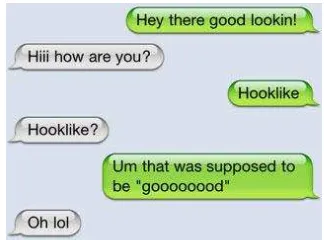
Figure 1: Example dialogue from our corpus
3 Empirical Analysis 3.1 Data Set
In order to access whether non-standard word forms have additional pragmatic information, it is necessary to study these forms in their original dialogue context. Because no currently available text message dataset contains messages in context, we collected our own. The website “Damn You Autocorrect”1posts screenshots of short text
mes-sage conversations that contain mistakes produced by automatic spelling correction systems. To cre-ate an initial dataset, 1190 text message conver-sations were transcribed. A sample dialogue is shown in Figure 1.
The speech bubbles originating from the left of the image in Figure 1 are produced by one par-ticipant, while those originating from the right are produced by the other. The dialogue shown con-tains several examples of non-standard spelling. The non-standard form lookin drops the letter g from the end of the morpheme ing, a technique commonly used in informal writing. Two other non-standard spellings,hiiiandgoooooood exem-plify the use of letter repetition. This dialogue also includes the common texting slang termlol.
Since we are interested in studying the presence of extra information in non-standard word forms, we must first identify word forms that contain non-standard spelling. To create a set of non-non-standard word forms, we used the CMU pronouncing dic-tionary2as a vocabulary set and selected all tokens
that were out of our vocabulary. Those tokens that were simply legitimate words in the lexicon, such as proper names or obscure terms not in our dic-tionary, were manually removed. This left us with a data set of 764 non-standard word tokens.
1www.damnyouautocorrect.com
3.2 Survey
To assess which word forms displayed extra prag-matic information, we created a short survey that asked users of Amazon Mechanical Turk3 to
de-termine whether this form contained information not present in the standard form. Survey partici-pants were given the word in context and asked to answer the following four questions:
1. “What is the standard form of this word?”
2. “What type of emotion, if any, is provided by the spelling used that is not provided by the standard form?” (Choose from the following: none, fear, suprise, happiness, disgust, sad-ness, anger, other)
3. “What other information, if any, is provided by the spelling used that is not provided by the standard form?” (Choose from the following: friendliness/closeness, emphasis, other, none)
4. “Why do you think the writer chose to use the modified spelling instead of the standard form?” (Choose from the following: wanted to display extra information, wanted to save time or space, made an unintentional mistake, other)
Three separate annotators were asked to exam-ine each word form. The observed agreement be-tween any two annotators was around 80% for a given question. For our analysis, we consider a case in which 2 or more annotators agreed as the gold standard. Cases in which no annota-tors agreed were thrown out, judged separately for each question4.
3.3 Analysis Results
Figure 2 shows the results of question 2. The emo-tions used include the six basic emoemo-tions (Ekman, 1993) often used in affective text literature. If several emotions were displayed, annotators were asked to pick the emotion that was displayed most strongly. As shown, 5 of the 6 emotions were present in our corpus, with only fear being ab-sent. Although many forms did not contain ex-tra emotion, a full 40% of them did. When addi-tional emoaddi-tional information was present, it was
3mturk.amazon.com
4This accounts for the difference in total instances be-tween Figures 2, 3, and 4
Figure 2: Distribution of forms containing emo-tion not present in normalized form
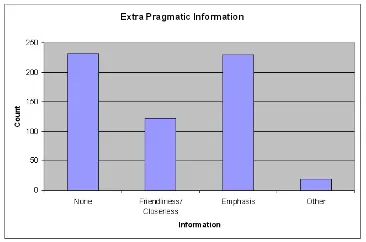
Figure 3: Distribution of forms containing addi-tional information not present in normalized form
most commonly positive; happiness was by far the most common emotion displayed.
Figure 3 shows the results of question 3. Al-though it was again common for no extra infor-mation to be present, cases in which non-standard forms were used to emphasize a word were nearly as common, appearing in 38% of our instances. The use of non-standard forms to express empha-sis appears to be widespread in text messaging data. This is an important finding, especially rele-vant to text-to-speech research. Additionally, Fig-ure 3 suggests that another common usage of non-standard forms, found in 20% of our data, is to display a sense of kinship with the reader through subtle expressions of friendliness or closeness.
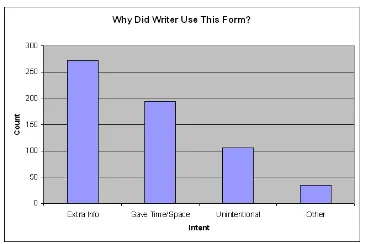
Results for question 4 are shown in Figure 4. Wanting to display extra information was per-ceived as a primary reason why text message au-thors chose a non-standard spelling. This seems to suggest that, in choosing non-standard word forms, expressiveness is a primary concern for text message writers.
non-Figure 4: Perceived intent of text message author
standard spellings. It is thus relevant for text mes-sage normalization systems to consider the intent of the writer in producing a non-standard form, to ensure that the intended meaning is not lost. This leads to the question of whether an automated sys-tem can accurately recognize words that carry ex-tra pragmatic information. In the next section, we take an initial look at this problem.
4 Automatic Identification of Words with Extra Information
We model the task of identifying whether a non-standard word form is intended to display extra information as a binary classification task. All in-stances that were marked by annotators as having some form of emotion or extra information were considered to be positive instances.
We drew features from three sources for our classification: character level features, punctua-tion features, and posipunctua-tional features. Because we are focused on classifying the emotional or prag-matic content of the word and not the utterance, we restrict our feature set to only features that per-tain the to the word itself.
Character level features. Our feature set fo-cused primarily on character level features. Sev-eral features focused on identifying the type of ab-breviation used. Features indicating whether the word contained the same letter repeated more than twice, the maximum number of times a letter was repeated in the word, and whether deletion of re-peated characters produced an in-vocabulary word were used to detect cases of word elongation. Edit distance from the closest word using only inser-tions was used as an indicator of word shortening and truncation. One additional feature recorded whether the non-standard form was longer than the normalized form. Features were also included to detect whether the non-standard form contained
Accuracy
Baseline 59.5%
Character Level Features Only 72.4% Character Level + Punctuation 72.3%
All Features 72.4%
Table 1: Classification of word forms by the pres-ence of added information
concatenated words or contained numbers or non-alphanumeric characters. Whether or not a word was written in all capital letters was also observed.
Punctuation features. Punctuation features cap-ture some information beyond that of the word form. The punctuation features detected whether the word was followed by a comma, period, ques-tion mark, exclamaques-tion point, or emoticon.
Positional features. Positional features were the most discourse dependent features examined. These features indicated whether the word was the first, last, or only word in the current message.
Classification was performed using an SVM classifier. Ten-fold cross validation was per-formed. The results are shown in Table 1. A majority class baseline suggests that classification is not trivial; although many instances carry extra information, many do not. As shown, the use of character level feature alone achieves above base-line performance of 72.4% (p < 0.01). Adding additional features on top of this does not result in an increase in performance.
5 Conclusion
The analysis presented in this paper shows that non-standard word forms contain additional prag-matic information not present in the standard form. Some of the main functions of this extra information include the expression of emphasis, happiness, and friendliness. It is important that text message normalization systems recognize and address this fact, as it is relevant for downstream applications such as text-to-speech synthesis.
References
Apoorv Agarwal, Fadi Biadsy, and Kathleen Mckeown. 2009. Contextual phrase-level polarity analysis us-ing lexical affect scorus-ing and syntactic N-grams. In
Proceedings of the 12th Conference of the Euro-pean Chapter of the ACL (EACL 2009), pages 24– 32, Athens, Greece, March. Association for Compu-tational Linguistics.
Cecilia Ovesdotter Alm, Dan Roth, and Richard Sproat. 2005. Emotions from text: machine learn-ing for text-based emotion prediction. In Proceed-ings of the conference on Human Language Tech-nology and Empirical Methods in Natural Language Processing, HLT ’05, pages 579–586, Stroudsburg, PA, USA. Association for Computational Linguis-tics.
AiTi Aw, Min Zhang, Juan Xiao, and Jian Su. 2006. A phrase-based statistical model for sms text nor-malization. InProceedings of the COLING/ACL on Main conference poster sessions, pages 33–40, Mor-ristown, NJ, USA. Association for Computational Linguistics.
Richard Beaufort, Sophie Roekhaut, Louise-Am´elie Cougnon, and C´edrick Fairon. 2010. A hybrid rule/model-based finite-state framework for normal-izing sms messages. InProceedings of the 48th An-nual Meeting of the Association for Computational Linguistics, pages 770–779, Uppsala, Sweden, July. Association for Computational Linguistics.
H. Binali, Chen Wu, and V. Potdar. 2010. Computa-tional approaches for emotion detection in text. In
Digital Ecosystems and Technologies (DEST), 2010 4th IEEE International Conference on, pages 172 – 177.
D.B. Bracewell. 2008. Semi-automatic creation of an emotion dictionary using wordnet and its evaluation. InCybernetics and Intelligent Systems, 2008 IEEE Conference on, pages 1385 –1389.
Monojit Choudhury, Rahul Saraf, Vijit Jain, Animesh Mukherjee, Sudeshna Sarkar, and Anupam Basu. 2007. Investigation and modeling of the structure of texting language. Int. J. Doc. Anal. Recognit., 10(3):157–174.
Paul Cook and Suzanne Stevenson. 2009. An un-supervised model for text message normalization. InProceedings of the Workshop on Computational Approaches to Linguistic Creativity, pages 71–78, Boulder, Colorado, June. Association for Computa-tional Linguistics.
Paul Ekman. 1993. Facial expression and emotion.
American Psychologist, 48:384–392.
E.C.-C. Kao, Chun-Chieh Liu, Ting-Hao Yang, Chang-Tai Hsieh, and Von-Wun Soo. 2009. Towards text-based emotion detection a survey and possible im-provements. InInformation Management and Engi-neering, 2009. ICIME ’09. International Conference on, pages 70 –74.
Catherine Kobus, Franc¸ois Yvon, and G´eraldine Damnati. 2008. Normalizing SMS: are two metaphors better than one ? InProceedings of the 22nd International Conference on Computational Linguistics (Coling 2008), pages 441–448, Manch-ester, UK, August. Coling 2008 Organizing Com-mittee.
D.L. Pennell and Yang Liu. 2010. Normalization of text messages for text-to-speech. In Acoustics Speech and Signal Processing (ICASSP), 2010 IEEE International Conference on, pages 4842 –4845.
Changqin Quan and Fuji Ren. 2010. An exploration of features for recognizing word emotion. In Proceed-ings of the 23rd International Conference on Com-putational Linguistics (Coling 2010), pages 922– 930, Beijing, China, August. Coling 2010 Organiz-ing Committee.
Richard Sproat, Alan W. Black, Stanley F. Chen, Shankar Kumar, Mari Ostendorf, and Christopher Richards. 2001. Normalization of non-standard words. Computer Speech and Language, pages 287–333.
Chung-Hsien Wu, Ze-Jing Chuang, and Yu-Chung Lin. 2006. Emotion recognition from text using seman-tic labels and separable mixture models. 5:165–183, June.
Changhua Yang, Kevin Hsin-Yih Lin, and Hsin-Hsi Chen. 2007. Emotion classification using web blog corpora. InProceedings of the IEEE/WIC/ACM In-ternational Conference on Web Intelligence, WI ’07, pages 275–278, Washington, DC, USA. IEEE Com-puter Society.
Li Zhang, John A. Barnden, Robert J. Hendley, and Alan M. Wallington. 2006. Developments in af-fect detection in e-drama. In Proceedings of the Eleventh Conference of the European Chapter of the Association for Computational Linguistics: Posters & Demonstrations, EACL ’06, pages 203–206, Stroudsburg, PA, USA. Association for Computa-tional Linguistics.