Models Cascade for Tree-Structured Named Entity Detection
Marco Dinarelli
LIMSI-CNRS / Orsay Cedex, France
Sophie Rosset
LIMSI-CNRS / Orsay Cedex, France
Abstract
Named Entity Recognition (NER) is a well-known Natural Language Processing (NLP) task, used as a preliminary process-ing to provide a semantic level to more complex tasks. In this paper we describe a new set of named entities having a multi-level tree structure, where base entities are combined to define more complex ones. This definition makes the NER task more complex than previous tasks, even more due to the use of noisy data for the anno-tation: transcriptions of French broadcast data. We propose an original and effec-tive system to tackle this new task, putting together the strengths of solutions for se-quence labeling approaches and syntactic parsing via cascading of different mod-els. Our system was evaluated in the 2011 Quaero named entity detection evaluation campaign and ranked first, with results far better than those of the other participating systems.
1 Introduction
Named Entity Detection is a well-known NLP task used to extract semantic information in other more complex tasks such as Relation Extrac-tion (Doddington et al., 2004) or QuesExtrac-tion An-swering (Voorhees, 2001). After its definition in MUC-6 (Grishman and Sundheim, 1996), the NER task evolved increasing its complexity. Cur-rent definitions provide a fine-grained semantic in-formation level with a broad coverage (Sekine, 2004). This has increased the interests in devel-oping named entity detection systems.
In this paper we describe a new set of named en-tities defined recently(Grouin et al., 2011). These named entities have a multilevel tree structure where components are combined to define more
complex and general entity structures. This defi-nition increases significantly the complexity of the NER task, even more due to the type of data used for the annotation: manual and automatic tran-scriptions of French broadcast data.
Given such a definition, it is not possible to tackle the task with traditional sequence labeling approaches. At the same time, solutions able to re-construct tree structures from flat sequences, like syntactic parsing solutions, may have serious lim-itations, due to the noisy data used. In order to solve these problems, we studied and implemented a two-stage system that put together the strengths of the two approaches: i) a complex linear-chain Conditional Random Field (CRF) model, integrat-ing a huge number of features, takes the noisy data as input and generates the corresponding sequence of components; ii) a syntactic parsing model based on Probabilistic Context Free Grammar (PCFG) reconstructs the tree-structured named entities.
We describe our solution showing that it is equivalent, in the processing steps, to a syntac-tic parsing analysis solution, and that it can better handle noisy data. Additionally, given the amount of data used and the relatively slow training time of CRF models when using large amount of data and features, we describe a procedure for incre-mental CRF model training that solves this partic-ular efficiency problem. The system we propose ranked first at the 2011 Quaero NER evaluation campaign (Galibert et al., 2011), with results far better than those of the other participating sys-tems, though results on automatic transcriptions are largely affected by ASR system errors.
The remainder of the paper is organized as fol-lows: in the next section we describe the new set of named entities defined and the data used for an-notation. In section 3 we describe the system we propose, and implemented for the 2011 Quaero Named Entity Recognition evaluation campaign. In section 4 we detail the experimental setup, and
Zahra name.first
Abouch name.last pers.ind
Conseil de Gouvernement kind
irakien demonym org.adm
Figure 1: Examples of structured named entities defined within the Quaero project. Left: Iraqi Governing Council
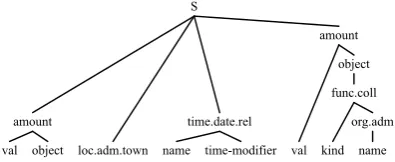
val object amount
loc.adm.town name time-modifier time.date.rel
val kind name org.adm func.coll
object amount S
Figure 2: An example of named entity tree corresponding to entities of a whole sentence. Tree leaves, corresponding to sentence words have been removed to keep readability.
describe and comment the results. Finally in sec-tion 5 we draw our conclusions and propose some perspectives for future work.
2 Towards Tree Structured Named Entities
Named Entity Recognition was first defined as rec-ognizing proper names (Coates-Stephens, 1992). Since MUC-6 (Grishman and Sundheim, 1996) named entities are proper names falling into three major classes: persons, locations and organiza-tions. There are some propositions to sub-divide these entities into fine-grained classes. For exam-ple, politicians for the person class (Fleischman and Hovy, 2002) or cities for the location class (Fleischman, 2001). Some are sometimes added like product (Bick, 2004; Galliano et al., 2009).
Recently some extensions of named entity have been proposed. For example, (Sekine, 2004) de-fined a complete hierarchy of named entities con-taining about 200 types.
A well-known task of named entity detection is the one proposed for the CoNLL shared task 2003, described in (Tjong Kim Sang and De Meul-der, 2003), where only four named entities were involved: Person, Organization, Location and
Other. The latter was used for proper names be-longing to any other entity different from the first three types.
After this task, named entity detection has been refined to include other entities, e.g. describ-ing time expressions, events, quantity, currency etc. Current named entity detection tasks pro-vide a fine-grained semantic representation level of the lexical surface form, sometimes comparable
to other semantic representations like those used in Semantic Role Labeling (Carreras and Mar-quez, 2005) or Spoken Language Understanding (De Mori et al., 2008). The increasing complexity of named entities definition reflects the change of needs in computer science activities, that in turn is the consequence of the tremendous growth of the amount of information to deal with nowadays.
The set of named entities used in this work has been recently defined in (Grouin et al., 2011) and presents an important difference with respect to previous sets. Beyond the presence of subtypes, named entities have a tree structure. For example, theOrganizationtype can be characterized by the subtypes administrative or enterprise giving the named entitiesorg.adm andorg.entstarting from the entityorg. Each entity is composed of at least one component, which trigger in any case an entity type. The component allows to characterize more precisely the semantic content of the entity. For example the entitypers, used to describe persons, has, among others, the componentsname.first, for first name, andname.last, for last name. The pres-ence of either name.first or name.last (or both) triggers the entity pers. The results of the com-position is a tree-structured named entity. Two ex-amples of structured named entities are shown in figure 1. In addition we report a named entity tree in figure 2, where words, corresponding to tree leaves, have been removed to keep readability, and it was generated starting from the sentence:
90 personnes toujours pr´esentes `a Atambua c’est l`a qu’hier matin ont ´et´e tu´es 3 employ´es du haut commis-sariat des Nations uniesaux r´efugi´es, leHCR1
Here words realizing entities have been high-lighted in bold. More details on the definition of this new set of named entities can be found in (Grouin et al., 2011), where also statistics on inter-annotators agreements are reported.
Given this structured named entities definition, the corresponding NER task is significantly more complex than previous equivalent tasks, where the entity structure was flat. Moreover, the complex-ity of the task is increased also by the type of data used for the annotation, that is manual and auto-matic transcriptions of French broadcast data. In
190 people still present in Atambua is where yesterday
Quaero training dev
# sentences 43,251 112
words entities words entities # tokens 1,251,432 245,880 2,659 570 # vocabulary 39,631 134 891 30
# components – 133662 – 971
# components dict. – 28 – 18
# OOV rate [%] – – 17.15 0
Table 1: Statistics on the training and development sets of the Quaero corpus.
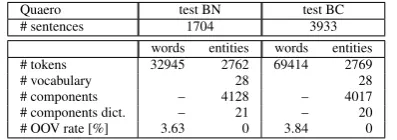
Quaero test BN test BC
# sentences 1704 3933
words entities words entities # tokens 32945 2762 69414 2769
# vocabulary 28 28
# components – 4128 – 4017
# components dict. – 21 – 20 # OOV rate [%] 3.63 0 3.84 0
Table 2: Statistics on the test set of the Quaero corpus, divided in Broad-cast News (BN) and BroadBroad-cast Conversations (BC)
particular the data have been collected not only from French radio channels, but also from a North-African French-speaking radio channel. This as-pect introduces complexity due to different ex-pressions used from French non-native speakers as well as to their particular accents and sometimes vocabulary.
The training data are the same used for the ES-TER2 evaluation campaign (Galliano et al., 2009). The transcriptions have been re-annotated with the named entities described above.
The corpus will be referred in this work as Quaero. Description of training, development and test data are reported in table 1 and 2. In particular the test set is constituted by different kind of data: transcriptions of broadcast news, and broadcast conversations. the merge of the first two types. An interesting point in table 1 and 2 is the Out-of-Vocabulary (OOV) rate of dev and test sets.
3 Tree-Structured Named Entity Detection System
Given the definition of named entities described in previous section, we consider that, even if possi-ble, the best solution cannot be a sequence label-ing approach as largely used in standard named en-tity detection task (Tjong Kim Sang and De Meul-der, 2003). In contrast, an approach coming from syntactic parsing would be possible. In that case syntactic parse trees could be replaced by named entity trees like the one shown in figure 22.
A first problem with this choice is constituted by the noisy data involved in our task. Indeed, our preliminary evaluations of a classic algorithm used successfully for syntactic parsing, resulted in
2where words are not shown for readability reason
quite poor results. Note also that most syntactic parsing solutions, are designed to perform parsing using Part-of-Speech (POS) tags, annotated upon words, as tree leaves, instead of words. This solu-tion introduces a good generalizasolu-tion over surface forms, allowing algorithms to deal with relatively noisy data, although the same solutions proved to be much less effective on automatic transcriptions. Moreover, this solution is effective for syntactic parsing, since syntactic constituents are directly related to POS tags, but it would not be reason-able for named entity detection, since the gener-alization introduced by POS tags over lexical sur-face forms would make it impossible to discrim-inate between different entities. Indeed, most of the named entities syntactic heads are known to be nouns. Additionally, since our named entity de-tection task must be performed also on automatic transcriptions containing ASR mistakes, a solution designed for syntactic parsing and adapted to be applied directly on lexical surface forms would be not robust enough, due to OOV words and ASR mistakes that alter significantly the syntactic struc-ture of the input sentence. Our idea is thus to split the annotation process in two phases:
1. In the first step we use a model robust to noisy input and Out-of-Vocabulary words in order to annotate entity components, i.e. compo-nents of named entities that can be annotated directly on words (tree leaves in figure 2). 2. In the second step we use a model for
syntac-tic parsing in order to reconstruct the entire entity trees.
The first step is a sequence segmentation and la-beling task, thus any model suitable for this kind of problems can be adopted. Given its character-istics and its success in sequence labeling tasks, we adopt CRF (Lafferty et al., 2001) for the first step. For the second step we adopt a Probabilis-tic Context-Free Grammar (Booth and Thomson, 1973; Krenn and Samuelsson, 1997). The next two subsections describe these two models.
3.1 Linear-Chain Conditional Random Fields
model, but computing global conditional probabil-ities normalized at sentence level, instead of posi-tion level. In particular this last point results very effective since it solves the label bias problem, as pointed out in (Lafferty et al., 2001).
Given a sequence of N words W1N =
w1, ..., wN and its corresponding sequence of
named entitiesEN1 = e1, ..., eN, CRF trains the
where λm are the training parameters.
hm(en−1, en, wnn−+22) are the feature functions
capturing conditional dependencies of entities and words. Z is a probability normalization factor in order to model well defined probability distribution:
esized for the previous and current words, H(˜en−1,e˜n, wnn+2−2) is an abbreviation for
PM
m=1 λm·hm(en−1, en, wnn−+22).
Two particular effective implementations of CRFs have been recently proposed. One is de-scribed in (Hahn et al., 2009) and uses a margin based training criteria for probabilities estimation. The other is described in (Lavergne et al., 2010) and has been implemented in the softwarewapiti3.
The latter solution in particular trains the model using two different regularization parameters at the same time: Gaussian prior, also known as l2
regularization and used in many software to avoid over fitting; and Laplacian prior, also known as
l1 regularization (Riezler and Vasserman, 2010), which has the effect to filter out features with very low scores. These two regularization param-eters are used together in the model implementing the so-called elastic net regularization (Zou and Hastie, 2005):
λ is the set of parameters of the model intro-duced in equation 1,l(λ)is the minus-logarithm of
equation 1, used as loss function for training CRF. kλk1andkλk2 are thel1andl2regularization,
re-spectively, whileρ1andρ2are two parameters that
can be optimized as usual on development data or with cross validation.
3available athttp://wapiti.limsi.fr
As explained in (Lavergne et al., 2010), using
l1regularization is an effective way for feature se-lection in CRF at training time. Note that other ap-proaches have been proposed for feature selection, e.g. in (McCallum, 2003). In this work we refer to the CRF implementation described in (Lavergne et al., 2010).
3.1.1 Incremental CRF Training
Despite the improvements on CRF implementa-tions, this model remains hard to train on large amount of data when using a reasonable amount of features. Using the data described in section 2 and using features as word prefixes and suffixes, capitalization, punctuation and morpho-syntactic features, our CRF model creates more than 2 bil-lions feature functions. Training such a model is infeasible on current machines.
Exploiting the characteristics of the CRF soft-ware wapiti and the definition of feature func-tions, we implemented a procedure for incremen-tal training of CRF models that can be used with an arbitrary number of features. Feature functions hm(en−1, en, wnn+2−2)used in our CRF models have
particular function fires when the current wordwi0 in the sequence matcheswiand the corresponding
entitye0imatchesei. When using such simple
fea-tures, there is usually no limitation on the amount of data that can be used for training. Indeed, more accurate models can be trained using complex fea-tures, using also words and entities at previous or next positions, i.e. adjacent tokens. For example:
hw,e(ei, wi) = δ(w
This feature function fires if both words and en-tities at current and previous positions match. The higher accuracy reached with this type of features is paid at training time with the number of feature function generated in situations like the one re-ported above, and makes direct CRF model train-ing unfeasible. The solution to this limitation is given observing that:
2. Feature functions like 5 fire if and only if both words and both entities at previous and cur-rent position matches.
The second point means that if a simple feature matching only the word (and/or entity) at current position is filtered away from l1 regularization, it doesn’t make sense to include in the training any complex feature function involving that word (and/or entity). In order to train our model using all the features, we proceed in three different steps: 1. we train a model with simple feature
func-tions like 4
2. we search the model for simple feature functions corresponding to adjacent words (and/or entities), that in turn corresponds to complex features
3. we retrain the model where we added the complex features found at previous step In the second step, the features kept in the model are some order of magnitude fewer in num-ber than those generated including directly com-plex features in step 1, like it can be done with less data. As a consequence, the number of com-plex features is limited. Moreover, the fact that simple feature functions must correspond to adja-cent words (and/or entities) is a further constraint for the number of added features. As we will see in section 4.1, training CRF model with this pro-cedure provides the same prediction accuracy than what we could have training the model directly with all features.
3.2 Structured Named Entities Reconstruction
Models described in this section are well-known solutions for syntactic parsing. We report them to provide a self-contained and complet work, our main contribution in this respect is to have imple-mented and adapted algorithms to our task.
The model we use for entity tree reconstruc-tion is PCFG (Booth and Thomson, 1973; Krenn and Samuelsson, 1997). There are more accurate models for the same purpose, e.g. the one used in (Charniak and Johnson, 2005). In practice, the first annotation step being carried out with CRF, which provide a high robustness on noisy data, there is no need for complex and expensive mod-els. Moreover PCFG are quite accurate and very fast for parsing (Collins and Koo, 2005).
The input of the CRF model described in the previous section is a sentence like the one reported
in section 24. The output is the sequence of
enti-ties corresponding to the leaves of the tree in Fig-ure 2, i.e. entity tree components. For example the chunkNations unies(United Nations) is an-notated by CRF as
org.adm-B{Nations}org.adm-I{unies} where suffixes-Band-I(for Begin and Inside) are used to have a one-to-one correspondence be-tween words and entities. This makes the NER task a sequence segmentation and labeling prob-lem, without having to deal with alignment issues. From the annotation above it is immediate to re-construct the annotation
org.adm{Nations unies}
Afterwards words are removed and only com-ponents are used as input of the PCFG model to reconstruct the entity tree. In our example, the in-put would then be:
val object name time-modifier val kind name. PCFG production rules are extracted directly from the trees. For example from the tree in Figure 2 the following set of rules is extracted:
S⇒amount loc.adm.town ... org.adm
amount⇒val object
time.date.rel⇒name time-modifier object⇒func.coll
func.coll⇒kind org.adm org.adm⇒name
where the first production as been cut to keep readability and corresponds to the children of the tree root S. Once the rules have been generated from all trees in the training set, probabilities are estimated with simple maximum likelihood esti-mation as the probability of a production given the right-hand side (RHS) of the rule. The pars-ing algorithm uspars-ing the PCFG generated from en-tity trees is theCocke-Younger-Kasami(CYK) de-scribed in (Johnson, 1998). In order to use this algorithm production rules must be in Chomsky Normal Form (CNF), i.e. rules must have one of the two forms: i)Xi ⇒XjXk; ii)Xi ⇒w, where
X are non-terminal symbols and w are terminal symbols. The corresponding probabilities are
pi→j,k=
P(Xi⇒Xj, Xk)
P(Xi) (6)
pi→w=
P(Xi⇒w)
P(Xi) (7)
There are well-known algorithms to convert a grammar into CNF, e.g. (Krenn and Samuelsson, 1997). Probabilities are then re-estimated using the Expectation Maximization algorithm called
Inside-Outside (Krenn and Samuelsson, 1997). The latter is equivalent to the forward-backword
algorithm for HMM (Rabiner, 1989), whereInside
andOutsidevariables are used instead ofForward
andBackwardvariables.
Inside variables Iiw(s, t) store the probability
P(Xi⇒∗ws,t|Xi), that is the probability of
pro-ducing the sub-sequencews,t = ws, ..., wt of the
string w1,T = w1, ..., wT from the non-terminal
symbolXi, given the non-terminal symbolXi, in
any number of steps (⇒∗is the closure of the pro-duction symbol ⇒). Outside variables Oiw(s, t)
store the probability P(S ⇒∗ w
0,s, Xi,wt,T |
S), that is the probability of producing the
sub-sequence w0, ..., ws, Xi, wt, ..., wT from the root
symbolS, given the root symbolS.
Probability re-estimation consists in computing the quantitiesP(Xi ⇒Xj, Xk),P(Xi⇒w)and
P(Xi) in terms of Inside and Outside variables.
This give a new estimation of rules probabilities that is used to re-computeInsideandOutside vari-ables. This procedure is repeated until a conver-gence criterion is met, e.g. the likelihood doesn’t increase significantly.
Given the two annotation steps implemented with CRF and PCFG, our system is in principle equivalent to a single system for syntactic parsing performing a “one-shot” annotation. In particu-lar, solutions like (Charniak and Johnson, 2005) and (Collins and Koo, 2005) use POS tags as tree leaves. This has a two-fold benefit: i) introduces a generalization level over surface forms; ii) provide to the parsing algorithm only the essential infor-mation, since POS tags are directly related to syn-tactic constituents and are sufficient to induce the syntactic structure of a sentence. In our system, the role played by POS tags in syntactic parsing is played by entity components, annotated by CRF.In contrast, for named entity annotation it is not true that components are sufficient to induce the entity tree. Nevertheless, as we will see in next section, this solution does not prevent having good results.
4 Experiments and Results
In this section we first describe the experimental setup, and then we discuss the results. As men-tioned in section 3.1, the software used for CRF
models iswapiti.5 The procedure for incremental
training of CRF models is realized with our own software. We didn’t optimize parametersρ1 and
ρ2 of the elastic net (see section 3.1), default
val-ues lead in most cases to very accurate models. We used a wide set of features in CRF models, in a window of [-2,+2] around the target word:
• A set of standard features like word prefixes and suffixes of length from 1 to 5, plus some
Yes/No features like “Does the word start with capital letter ?” “Does the word con-tain non alphanumeric characters ?”, etc. • Morpho-syntactic features extracted from the
output of the tool tagger (Allauzen and Bonneau-Maynard, 2008)
• Features extracted from the output of the tool
WMatch(Galibert, 2009; Rosset et al., 2008).
The output provided by WMatch contains de-tailed motpho-syntactic information as well as se-mantic information at the same level of named en-tities. Concerning the PCFG model, for prelimi-nary studies we used our own implementation, but for this work we used the much faster implemen-tation described in (Johnson, 1998).6
Concerning data, for preliminary studies carried out to validate our incremental training procedure, we used the same data used in the ESTER2 named entity detection evaluation campaign, Thus our re-sults can be directly compared with those reported in (Galliano et al., 2009).
The final results of the 2011 Quaero evaluation campaign are obtained on the data described in section 2. The test data contains transcriptions of both broadcast news and broadcast conversation data. Results are provided on both manual and au-tomatic transcriptions. In the last case, three dif-ferent ASR systems were used in order to study robustness of the named entity detection systems with respect to different ASR errors and accu-racies. These systems are referred to as ASR1,
ASR2andASR3and have word error rates of:
• 16.32%, 18.77%, 24.06% on broadcast news
• 23.34%, 22.99%, 29.18% on broadcast con-versations
• 20.96%, 21.56%, 27.44% on the whole test data
5available athttp://wapiti.limsi.fr
6available athttp://web.science.mq.edu.au/
˜
CRF model training Incremental procedure Model features SER Model features SER Words 27.4% Words+MS+WM unigrams 24.6%
+ MS 26.3% – –
+ WM 22.8% + Observation bigrams 20.6% + MS + WM 20.0% + Label bigrams 20.0%
Table 3: Results of CRF models on ESTER2 task obtained with a “normal” training procedure and our incremental procedure.MSare morpho-syntactic features,WMare features extracted fromWMatchoutput
Model DEV TEST
CRF(SER) 24.8% 26.7% CY Kref.(NER) 6.8% 7.4%
CYK(SER) 30.9% 33.3%
Table 4: Results of preliminary experiments obtained with the CRF model and with PCFG separately
Additionally, since manual transcriptions were provided with punctuation, theASR1 output has been automatically annotated with punctuation to try to fit manual transcription conditions.
All results are reported in terms of Slot Error Rate (SER) (Makhoul et al., 1999), which has a similar definition of word error rate for ASR sys-tems, with the difference that correct entity with wrong boundaries and wrong entity with correct boundaries are given half points.
4.1 Results
4.1.1 Evaluation of the incremental procedure
Our incremental procedure was evaluated and re-sults are reported in table 3. We compare two models trained and tested on the ESTER2 data used for the evaluation described in (Galliano et al., 2009). The two models are based on the same features, described in previous section, but use them in two different ways: In the first model, trained with “traditional procedure”, the three dif-ferent type of features (words, features from tag-ger and features from WMatch) were integrated in three different steps, using each time unigrams and bigrams on observations and labels. The three steps are mandatory since the total amount of fea-tures would not fit into memory.
In the second model, we used directly all type of features, but generating at first only simple fea-tures. 3.1.1. In the two other training steps, we added compound features, i.e. bigrams of obser-vations and labels, and we retrained at each step. As we can see from results in table 3, the two models reach the same final accuracy (a SER of 20.0%), which proves that our incremental train-ing procedure doesn’t leave out meantrain-ingful fea-tures. Additionally, although we don’t report ing time, we can comment that CRF model train-ing was roughly 10 times faster with our
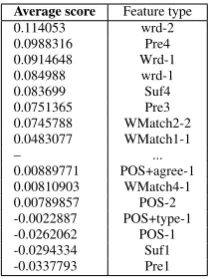
incre-Average score Feature type 0.114053 wrd-2 0.0988316 Pre4 0.0914648 Wrd-1 0.084988 wrd-1 0.083699 Suf4 0.0751365 Pre3 0.0745788 WMatch2-2 0.0483077 WMatch1-1
– ...
0.00889771 POS+agree-1 0.00810903 WMatch4-1 0.00789857 POS-2 -0.0022887 POS+type-1 -0.0262062 POS-1 -0.0294334 Suf1 -0.0337793 Pre1
Table 5: Ranks of average score given by the CRF model to feature types
mental procedure. This is normal since in the sec-ond and third steps only compound features corre-sponding to simple features kept by the first model are added, with the additional constraint that sim-ple features must correspond to adjacent positions. As explained in sub-section 3.1.1, the simple fea-tures kept at the end of the training are some orders of magnitude fewer in number than the original features. This limits tremendously the number of compound features added in the other steps. Note also that the results shown in Table 3 are much better than those shown in (Galliano et al., 2009), compared with other solutions.
4.1.2 Features relevance
In order to understand features relevance, we re-port in table 5 feature types ranked by the average score given by the CRF model. Each type cor-respond to features at any position with respect to the target word, with label unigrams and bi-grams. Unigrams are distinguished from bigrams using suffixes-1and-2respectively. Feature types
wrd are words converted to lower case, Wrd are words kept with original capitalization. Feature typesPrenare word prefixes of lengthn,Sufnare word suffixes of lengthn. Features extracted from
WMatch output are indexed starting from 1. As
4.1.3 Models for tree-structured named entities
In table 4 we report an evaluation of the two models composing our system. In the first row we report the SER of the CRF model used in the system, taking into account only components, i.e. base entities annotated directly on words. They can be compared for the test set (TEST) with the 20% SER of table 3. We go from a SER of 20% to 26.7%, but it is important to note that
the ESTER2 evaluation campaign was performed using only 17 labels, while 26.7% is obtained
using 196 entity components. We can thus be
satisfied by that result. In order to evaluate the robustness of the CYK algorithm on our task, we computed the Node Error Rate (NER in table 4) on reference components (CY Kref.). The CYK
module is applied on the reference components instead of those output by the CRF model. The rate of wrong tree nodes with respect to the reference trees is then computed. The NER being under10%, we can assume that the PCFG model is robust on unseen data. This also confirms the effectiveness of using components directly, instead of the lexical surface forms. Finally we report the results obtained combining the two approaches (CRF+CYK). Errors of the CYK algorithm are summed to errors of CRF, thus we go from a SER of24.8% and26.7% on DEV and
TEST (row 1, table 4), to30.9% and33.3%.
4.1.4 Official results
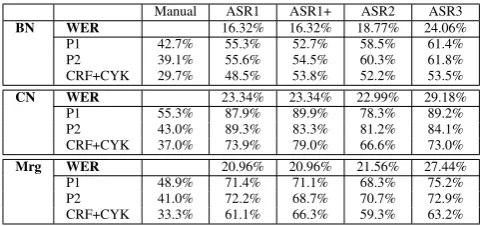
We report results of the 2011 Quaero named en-tity detection evaluation campaign (Galibert et al., 2011) in table 6, whereBNcorrespond to broad-cast news,BNto broadcast conversations andMrg
to the merge of these two types. Our system is in-dicated asCRF+CYK. The other two participants,
P1andP2, used a system based on CRF and deep syntactic analysis, respectively.7
Looking at results we can see that our sys-tem outperforms the others in all cases by sev-eral points. Nevertheless error rates are quite high, over 50% on ASR output. The complexity of the task must without a doubt be taken into account. It is indeed the first time that structured named enti-ties are handled with an automatic detection. Also the type of data used for the task, i.e.
transcrip-7There are not more details on the other participant’s
sys-tems, since they have not been published yet
Manual ASR1 ASR1+ ASR2 ASR3
BN WER 16.32% 16.32% 18.77% 24.06%
P1 42.7% 55.3% 52.7% 58.5% 61.4% P2 39.1% 55.6% 54.5% 60.3% 61.8% CRF+CYK 29.7% 48.5% 53.8% 52.2% 53.5%
CN WER 23.34% 23.34% 22.99% 29.18%
P1 55.3% 87.9% 89.9% 78.3% 89.2% P2 43.0% 89.3% 83.3% 81.2% 84.1% CRF+CYK 37.0% 73.9% 79.0% 66.6% 73.0%
Mrg WER 20.96% 20.96% 21.56% 27.44%
P1 48.9% 71.4% 71.1% 68.3% 75.2% P2 41.0% 72.2% 68.7% 70.7% 72.9% CRF+CYK 33.3% 61.1% 66.3% 59.3% 63.2%
Table 6: SER results for the 2011 evaluation campaign on broadcast news (BN), broadcast conversation (BC) and their merge (Mrg) on both manual and automatic transcriptions
Oracles VS Evaluations DEV TEST CRF+CYK(SER) 30.9% 33.3% CRF+CYK(OER) 18.6% 21.1%
Table 7: Comparison of Oracle Error Rate (OER) and SER obtained in the evaluation for DEV and TEST sets
tions of French broadcast data, contributes to in-crease the task complexity. Despite these results, our approach seems promising since it worked far better than the others in all cases.
We report a comparison of results on manual transcriptions with Oracle Error Rates (OER), i.e. results of our system using the best annotation of CRF among the10-best hypotheses. This
compar-ison is reported in table 7, and shows that we have a large margin for improvements on our system.
5 Conclusions
In this paper we proposed a system for structured named entity detection. We describe the defini-tion of these structured named entities. The pro-posed system is based on CRF and syntactic pars-ing approaches, which combines the effectiveness and robustness of the former with the capability of easily and quickly parsing trees of the latter. Addi-tionally, we proposed an incremental training pro-cedure for CRF model, which showed to be cor-rect and effective and allows to train CRF mod-els with huge number of features. The proposed system participated in the Quaero evaluation cam-paign and obtained the best results. Although re-sults on ASR output are not satisfactory, taking all results into account the proposed approach seems promising and encourages further studies.
Acknowledgments
References
Erik F. Tjong Kim Sang and Fien De Meulder. 2003. Introduction to the conll-2003 shared task: language-independent named entity recognition. In
Proceedings of NLL at HLT-NAACL 2003 - Volume 4, pages 142–147, Morristown, USA.
Ellen M. Voorhees. 2001. The trec question answering track.Nat. Lang. Eng., 7:361–378, December.
X. Carreras and Lluis Marquez. 2005. Introduction to the conll-2005 shared task: Semantic role labeling.
R. De Mori, F. Bechet, D. Hakkani-Tur, M. McTear, G. Riccardi, and G. Tur. 2008. Spoken language understanding: A survey. IEEE Signal Processing Magazine, 25:50–58.
Sylvain Galliano, Guillaume Gravier, and Maura Chaubard. 2009. The ester 2 evaluation campaign for the rich transcription of french radio broadcasts. InProceedings of Interspeech, Brighton, U.K.
Olivier Galibert, Sophie Rosset, Cyril Grouin, Pierre Zweigenbaum, Ludovic Quintard 2011. Structured and Extended Named Entity Evaluation in Auto-matic Speech Transcriptions InProceedings of IJC-NLP, Chang Mai, Thailand.
E. Charniak and M. Johnson. 2005. Coarse-to-fine n-best parsing and maxent discriminative reranking. In Proceedings of ACL, page 363370, Ann Arbor, MI.
Michael Collins and Terry Koo. 2005. Discriminative re-ranking for natural language parsing. Computa-tional Linguistic (CL), 31(1):25–70.
J. Lafferty, A. McCallum, and F. Pereira. 2001. Con-ditional random fields: Probabilistic models for seg-menting and labeling sequence data. InProceedings of ICML, pages 282–289, Williamstown, USA.
T.L. Booth and R.A. Thompson. 1973. Applying Prob-ability Measures to Abstract Languages. In IEEE Transactions on Computers, 22:442–450.
Brigitte Krenn and Christer Samuelsson. 1997. The linguist’s guide to statistics - don’t panic.
Thomas Lavergne, Olivier Capp´e, and Franc¸ois Yvon. 2010. Practical very large scale CRFs. In Proceed-ings ACL, pages 504–513.
Stefan Hahn, Patrick Lehnen, Georg Heigold, and Her-mann Ney. 2009. Optimizing crfs for slu tasks in various languages using modified training criteria. InProceedings of Interspeech, Brighton, U.K. Stefan Riezler and Alexander Vasserman. 2010.
In-cremental feature selection and l1 regularization for relaxed maximum-entropy modeling.
Hui Zou and Trevor Hastie. 2005. Regularization and variable selection via the Elastic Net. Journal of the Royal Statistical Society B, 67:301–320.
Andrew McCallum. 2003. Efficiently inducing fea-tures of conditional random fields. In19th Confer-ence on Uncertainty in Artificial IntelligConfer-ence.
Lawrence R. Rabiner. 1989. A tutorial on hidden markov models and selected applications in speech recognition. Proceedings of the IEEE, 77(2):257– 286.
Mark Johnson. 1998. Pcfg models of linguistic tree representations. Computational Linguistics, 24:613–632.
Olivier Galibert, Ludovic Quintard, Sophie Rosset, Pierre Zweigenbaum, Claire Ndellec, Sophie Aubin, Laurent Gillard, Jean-Pierre Raysz, Delphine Pois, Xavier Tannier, Louise Delger, and Dominique Lau-rent. 2010. Named and specific entity detection in varied data: The quro named entity baseline evalua-tion. InProceedings of LREC, La Valletta, Malta.
Olivier Galibert. 2009. Approches et m´ethodologies pour la r´eponse automatique `a des questions adapt´ees un cadre interactif en domaine ouvert. Ph.D. thesis, Universit Paris Sud, Orsay.
Sophie Rosset, Olivier Galibert, Fuillaume Bernard, Eric Bilinski, and Gilles Adda. 2008. The LIMSI participation to the QAst track. In Working Notes of CLEF 2008 Workshop.
G. Doddington, A. Mitchell, M. Przybocki, L. Ramshaw, S. Strassel, and R. Weischedel. 2004. The Automatic Content Extraction (ACE) Program–Tasks, Data, and Evaluation. Proceedings of LREC 2004, pages 837–840.
Sam Coates-Stephens. 1992. The analysis and acqui-sition of proper names for the understanding of free text. Computers and the Humanities, 26:441–456.
Ralph Grishman and Beth Sundheim. 1996. Message Understanding Conference - 6: A brief history. In
Proceedings of COLING, pages 466–471, Copen-hagen, Denmark.
Michael Fleischman and Eduard Hovy. 2002. Fine grained classification of named entities. In Proceed-ings of COLING, pages 1–7.
Michael Fleischman. 2001. Automated subcategoriza-tion of named entities. InProceedings of the ACL 2001 Student Research Workshop, pages 25–30.
Eckhard Bick. 2004. A named entity recognizer for danish. InLREC’04, Lisbon, Portugal.
Satoshi Sekine. 2004. Definition, dictionaries and tagger of extended named entity hierarchy. In
LREC’04, Lisbon, Portugal.
John Makhoul, Francis Kubala, Richard Schwartz, and Ralph Weischedel. 1999. Performance measures for information extraction. In Proceedings of DARPA Broadcast News Workshop, pages 249–252.