Monolingual Distributional Profiles for Word Substitution in Machine
Translation
Rashmi Gangadharaiah
Ralf D. Brown
Language Technologies Institute, Carnegie Mellon University
Jaime Carbonell
Abstract
Out-of-vocabulary (OOV) words present a significant challenge for Machine Trans-lation. For low-resource languages, lim-ited training data increases the frequency of OOV words and this degrades the qual-ity of the translations. Past approaches have suggested using stems or synonyms
for OOV words. Unlike the previous
methods, we show how to handle not just
the OOV words but rare words as well
in an Example-based Machine Transla-tion (EBMT) paradigm. Presence of OOV words and rare words in the input sentence prevents the system from finding longer phrasal matches and produces low qual-ity translations due to less reliable lan-guage model estimates. The proposed method requires only a monolingual cor-pus of the source language to find can-didate replacements. A new framework is introduced to score and rank the re-placements by efficiently combining fea-tures extracted for the candidate replace-ments. A lattice representation scheme al-lows the decoder to select from a beam of possible replacement candidates. The new framework gives statistically signif-icant improvements in English-Chinese and English-Haitian translation systems.
1 Introduction
An EBMT system makes use of a parallel corpus to translate new sentences. Each input sentence is matched against the source side of a training
corpus. When matches are found, the correspond-ing translations in the target language are obtained through sub-sentential alignment. In our EBMT system, the final translation is obtained by com-bining the partial target translations using a sta-tistical target Language Model. EBMT systems, like other data-driven approaches, require large amounts of data to function well (Brown, 2000).
Having more training data is beneficial re-sulting in log-linear improvement in translation quality for corpus-based methods (EBMT, SMT). Koehn (2002) shows translation scores for a num-ber of language pairs with different training sizes translated using the Pharaoh SMT toolkit (Koehn et al., 2003). However, obtaining sizable paral-lel corpora for many languages is time-consuming and expensive. For rare languages, finding bilin-gual speakers becomes especially difficult.
One of the main reasons for low quality transla-tions is the presence of large number of OOV and rare words (low frequency words in the training corpus). Variation in domain and errors in spelling increase the number of OOV words. Many of the present translation systems either ignore these un-known words or leave them untranslated in the fi-nal target translation. When data is limited, the number of OOV words increases, leading to the poor performance of the translation models and the language models due to the absence of longer sequences of source word matches and less reli-able language model estimates.
morpho-logically rich languages, the OOV word is mor-phologically analyzed and the stem is used as its replacement (Popovi´c and Ney, 2004).
This paper presents a simpler method inspired by the Context-based MT approach (Carbonell et al., 2006) to improve translation quality. The method requires a large source language mono-lingual corpus and does not require any other language dependent resources to obtain replace-ments. Approaches suggested in the past only concentrated on finding replacements for the OOV words and not the rare words. This paper pro-poses a unified method to find possible replace-ments for OOV words as well as rare words based on the context in which these words appear. In the case of rare words, the translated sentence is traced back to find the origin of the translations and the target translations of the replacements are replaced with the translations of the rare words. In the case of OOV words, the target translations are replaced by the OOV word itself. The main idea for adopting this approach is the belief that the EBMT system will be able to find longer phrasal matches and that the language model will be able to give better probability estimates while decod-ing if it is not forced to fragment text at OOV and rare-word boundaries. This method is highly ben-eficial for low-resource languages that do not have morphological analysers or Part-of-Speech (POS) taggers and in cases where the similarity measures proposed in the past do not find closely related words for certain OOV words.
The rest of the paper is organized as follows. The next section (Section 2) discusses related work in handling OOV words. Section 3 describes the method adopted in this paper. Section 4 de-scribes the experimental setup. Section 5 reports the results obtained with the new framework for English-Chinese and English-Haitian translation systems. Section 6 concludes and suggests pos-sible future work.
2 Related Work
Orthographic and morpho-syntactic techniques for preprocessing training and test data have been
shown to reduce OOV word rates. Popovi´c
and Ney (2004) demonstrated this on rich mor-phological languages in an SMT system. They
introduced different types of transformations to the verbs to reduce the number of unseen word forms. Habash (2008) addresses spelling, name-transliteration OOVs and morphological OOVs in an Arabic-English Machine Translation system. Phrases with the OOV replacements in the phrase table of a phrase-based SMT system were “recy-cled” to create new phrases in which the replace-ments were replaced by the OOV words.
Yang and Kirchhoff (2006) proposed a back-off model for phrase-based SMT that translated word forms in the source language by hierarchi-cal morphologihierarchi-cal phrase level abstractions. If an unknown word was found, the word was first stemmed and the phrase table entries for words sharing the same stem were modified by replacing the words with their stems. If a phrase entry or a single word phrase was found, the corresponding translation was used, otherwise the model backed off to the next level and applied compound split-ting to the unknown word. The phrase table in-cluded phrasal entries based on full word forms as well as stemmed and split counterparts.
Vilar et al. (2007) performed the translation process treating both the source and target sen-tences as a string of letters. Hence, there are no unknown words when carrying out the actual translation of a test corpus. The word-based sys-tem did most of the translation work and the letter-based system translated the OOV words.
The method proposed in this work to han-dle OOV and rare words is very similar to the method adopted by Carbonell et al. (2006) to gen-erate word and phrasal synonyms in their Context-based MT system. Context-Context-based MT does not require parallel text but requires a large monolin-gual target language corpus and a fullform bilin-gual dictionary. The main principle is to find those
n-gram candidate translations from a large target corpus that contain as many potential word and phrase translations of the source text from the dic-tionary and fewer spurious content words. The overlap decoder combines the targetn-gram
trans-lation candidates by finding maximal left and right overlaps with the translation candidates of the
pre-vious and followingn-grams. When the overlap
transla-tions are obtained by substituting words or phrases in the targetn-grams by their synonyms.
Barzilay and McKeown (2001) and Callison-Burch et al. (2006) extracted paraphrases from monolingual parallel corpus where multiple trans-lations were present for the same source. The syn-onym generation in Carbonell et al. (2006) differs from the above in that it does not require paral-lel resources containing multiple translations for the same source language. In Carbonell et al. (2006), a list of paired left and right contexts that contain the desired word or phrase are extracted from the monolingual corpus. The same corpus is used to find other words and phrases that fit the paired contexts in the list. The idea is based on the distributional hypothesis which states that words with similar meanings tend to appear in similar contexts (Harris, 1954). Hence, their approach performed synonym generation on the target lan-guage to find translation candidates that would provide maximal overlap during decoding.
Marton et al. (2009) proposed an approach sim-ilar to Carbonell et al. (2006) to obtain replace-ments for OOV words, where monolingual dis-tributional profiles for OOV words were con-structed. Hence, the approach was applied on the source language side as opposed to Carbonell et al. (2006) which worked on the target language. Only similarity scores and no other features were used to rank the paraphrases (or replacements) that occured in similar contexts. The high rank-ing paraphrases were used to augment the phrase table of phrase-based SMT.
All of the previously suggested methods only handle OOV words (except Carbonell et al. (2006) which handles low frequency target phrases) and no attempt is made to handle rare words. Many of the methods explained above directly modify the training corpus (or phrase table in phrase-based SMT) increasing the size of the corpus. Our method clusters words and phrases based on their context as described by Carbonell et al. (2006) but uses the clustered words as replacements for not just the OOV words but also for the rare words on the source language side. Our method does not make use of any morphological analysers, POS taggers or manually created dictionaries as they may not be available for many rare or
low-resource languages. The translation of the replacements in the final decoded target sentence is replaced by the translation of the original word (or the source word itself in the OOV case), hence, we do not specifically look for synonyms. The only condition for a word to be a candidate replacement is that its left and right context need to match with that of the OOV/rare-word. Hence, the clustered words could have different semantic relations. For example,
(cluster1):“laugh, giggle, chuckle, cry, weep” where “laugh, giggle, chuckle” are synonyms and “cry, weep” are antonyms of “laugh”.
Clusters can also contain hypernyms (or hy-ponyms), meronyms (or holonyms), troponyms and coordinate terms along with synonyms and antonyms. For example,
(cluster2):“country, region, place, area,
dis-trict, state, zone, United States, Canada, Korea, Malaysia”.
where “country” is a hypernym of “United States/Canada/Korea/Malaysia”. “district” is a meronym of “state”. “United States, Canada, Korea, Malaysia” are coordinate terms sharing “country” as their hypernym.
The contributions made by the paper are three-fold: first, replacements are found for not just the
OOV words but for therare words as well.
Sec-ond, the framework used allows scoring replace-ments based on multiple features to permit op-timization. Third, instead of directly modifying the training corpus by replacing the candidate re-placements by the OOV words, a new representa-tion scheme is used for the test sentences to effi-ciently handle a beam of possible replacements.
3 Proposed Method
3.1 OOV and Rare words
Words in the test sentence (new source sentence to be translated) that do not appear in the training corpus are called OOV words. Words in the test sentence that appear less thanKtimes in the train-ing corpus are considered as rare words (in this
paperK = 3). The method presented in the
fol-lowing sections holds for both OOV as well as rare words. In the case of rare words, the final transla-tion is postprocessed (Sectransla-tion 3.7) to include the translation of the rare word.
The procedure adopted will be explained with
a real example T (the rest of the sentence is
removed for the sake of clarity) encountered in the test data with “hawks” as the OOV word,
T:a mobile base , hitting three hawks with
one arrowover the past few years ...
3.2 Context
As the goal is to obtain longer target phrasal
trans-lations for the test sentence before decoding,
only words that fit the left and right context of the OOV/rare-word in the test sentence are extracted. Unlike Marton et al. (2009) where a context list for each OOV is generated from the contexts of their replacements, this paper uses only the left and right context of the OOV/rare-word. The default window size for the context is five words (two words to the left and two words to the right of the OOV/rare-word). If the windowed words contain only function words, the window is incremented until at least one content word is present in the resulting context. This enables one to find sensible replacements that fit the context well. The contexts forTare:
Left-context (L): hitting three
Right-context (R): with one arrow
The above contexts are further processed to
generalize the numbers by a N U M BER tag
to produce more candidate replacements. The resulting contexts are now:
Left-context (L): hittingN U M BER
Right-context (R): withN U M BERarrow
As a single L − R context is used, a far
smaller number of replacements are extracted.
3.3 Finding Candidate replacements
The monolingual corpus (M L) of the source
lan-guage is used to find words and phrases (Xk) that
fitLXkRi.e., withLas its left context and/orRas
its right context. The maximum length forXk is
set to 3 currently. The replacements are further fil-tered to obtain only those replacements that con-tain at least one content word. As illustrated ear-lier, the resulting replacement candidates are not necessarily synonyms.
3.4 Features
A local context of two to three words to the left of an OOV/rare-word (wordi) and two to three
words to the right of wordi contain sufficient
clues for the word,wordi. Hence, local contextual
features are used to score each of the replacement candidates (Xi,k) ofwordi. EachXi,k extracted
in the previous step is converted to a feature vector containing 11 contextual features. Certainly more features can be extracted with additional knowl-edge sources. The framework allows adding more features, but for the present results, only these 11 features were used.
As our aim is to assist the translation system in finding longer target phrasal matches, the features are constructed from the occurrence statistics of
Xi,k from the bilingual training corpus (BL). If a
candidate replacement does not occur in theBL,
then it is removed from the list of possible replace-ment candidates.
Frequency counts for the features of a partic-ular replacement, Xi,k, extracted in the context
of Li,−2Li,−1 (two preceding words of wordi)
andRi,+1Ri,+2 (two following words of wordi)
(the remaining words in the left and right context ofwordi are not used for feature extraction) are
obtained as follows:
f1: frequency ofXi,kRi,+1
f2: frequency ofLi,−1Xi,k f3: frequency ofLi,−1Xi,kRi,+1
f4: frequency ofLi,−2Li,−1Xi,k f5: frequency ofXi,kRi,+1Ri,+2
f7: frequency ofLi,−1Xi,kRi,+1Ri,+2
f8: frequency ofLi,−2Li,−1Xi,kRi,+1Ri,+2
f9: frequency ofXi,k in ML f10: frequency ofXi,kinBL
f11: number of feature values (f1, ..f10)>0
f11 is a vote feature which counts the
num-ber of features (f1 ... f10) that have a value
greater than zero. The features are normalized to fall within [0,1]. The sentences in ML, BL
and test data are padded with two begin markers and two end markers for obtaining counts for OOV/rare-words that appear at the beginning or end of a test sentence.
3.5 Representation
Before we go on to explaining the lattice repre-sentation, we would like to make a small clarifica-tion in the terminalogy used. In the MT commu-nity, a lattice usually refers to the list of possible partially-overlapping target translations for each possible sourcen−gram phrase in the input
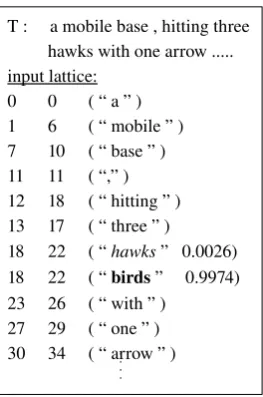
sen-tence. Since we are using the term lattice to also refer to the possible paths through the input sen-tence, we will call the lattice used by the decoder, the “decoding lattice”. The lattice obtained from the input sentence representing possible replace-ment candidates will be called the “input lattice”. An input lattice (Figure 1) is constructed with a beam of replacements for the OOV and rare words. Each replacement candidate is given a score (Eqn 1) indicating the confidence that a suit-able replacement is found. The numbers in Fig-ure 1 indicate the start and end indices (based on character counts) of the words in the test sen-tence. InT, two replacements were found for the word“hawks”:“homers”and“birds”. However,
“homers” was not found in the BLand hence, it
was removed from the replacement list.
The input lattice also includes the OOV word with a low score (Eqn 2). This allows the EBMT system to also include the OOV/rare-word dur-ing decoddur-ing. In the Translation Model of the EBMT system, this test lattice is matched against the source sentences in the bilingual training cor-pus. The matching process would now also look for phrases with “birds” and not just “hawks”. When a match is found, the corresponding
trans-T : a mobile base , hitting three hawks with one arrow ... input lattice:
0 0 ( “ a ” ) 1 6 ( “ mobile ” ) 7 10 ( “ base ” ) 11 11 ( “,” ) 12 18 ( “ hitting ” ) 13 17 ( “ three ” )
18 22 ( “ hawks ” 0.0026) 18 22 ( “ birds ” 0.9974) 23 26 ( “ with ” )
27 29 ( “ one ” ) 30 34 ( “ arrow ” )
[image:5.595.346.478.70.269.2]
Figure 1: Lattice of the input sentenceT
contain-ing replacements for OOV words.
OOV/Rare word Candidate Replacements
Spelling errors
krygyzstan kyrgyzstan,...
yusukuni yasukuni,..
kilomaters kilometers, miles, km, ...
Coordinate terms
somoa india, turkey, germany, russia, japan,...
ear body, arms, hands, feet, mind, car, ...
buyers dealer, inspector, the experts, smuggler,.
Synonyms
plummet drop, dropped, fell, ....
Synonyms and Antonyms
optimal worse, better, minimal,....
Figure 2: Sample English candidate replacements obtained.
lation in the target language is obtained through sub-sentential alignment (Section 3.7). The scores on the input lattice are later used by the decoder
(Section 3.7). Each replacement Xi,k for the
OOV/rare-word (wordi) is scored with a logistic
function (Bishop, 2006) to convert the dot product of the features and weights(~λ˙f~i,k)to a score
be-tween 0 and 1 (Eqn 1 and Eqn 2).
pλ(Xi,k|wordi) =
exp(~λ˙f~i,k) 1+Pj=1...Sexp(~λ˙f~i,j)
[image:5.595.306.519.327.509.2]pλ(wordi) =
1
1 +Pj=1...Sexp(~λ ˙f~i,j)
(2)
where,f~
i,jis the feature vector for thejth
replace-ment candidate of wordi, S is the number of
re-placements,~λis the weight vector indicating the importance of the corresponding features.
3.6 Tuning feature weights
We would like to select those feature weights (~λ) which would lead to the least expected loss in translation quality (Eqn 3). −log(BLEU)
(Pap-ineni et al., 2002) is used to calculate the expected loss over a development set. As this objective function has many local minima and is piecewise constant, the surface is smoothed using the L2-norm regularization. Powell’s algorithm (Powell, 1964) with grid-based line optimization is used to find the best weights. 7 different random guesses are used to initialize the algorithm.
min
λ Eλ[L(ttune)] +τ ∗ ||λ||
2 (3)
The algorithm assumes that partial derivates of the function are not available. Approximations of the weights (λ1, ..λN) are generated successively
along each of the N standard base vectors. The
procedure is iterated with a stopping criteria based on the amount of change in the weights and the change in the loss. A cross-validation set (in ad-dition to the regularization term) is used to pre-vent overfitting at the end of each iteration of the Powell’s algorithm. This process is repeated with different values ofτ, as in Deterministic
Anneal-ing (Rose, 1998).τis initialized with a high value and is halved after each process.
3.7 System Description
The EBMT system finds phrasal matches for the test (or input) sentence from the source side of
the bilingual corpus. The corresponding
tar-get phrasal translations are obtained through
sub-sentential alignment. When an input lattice is
given instead of an input sentence, the system per-forms the same matching process for all possible phrases obtained from the input lattice. Hence, the system also finds matches for source phrases that contain the replacements for the OOV/rare-word. Only the topCranking replacement
candi-
a mobile base , hitting three hawks with one arrow .... birds
流动 基地 三 雕 一 箭
一 箭
雕 三 ,
基地
同 击球
一
hawks
“ three birds ”
移动
Decoding Lattice
一 箭三雕
[image:6.595.307.517.71.188.2]“ three birds with one arrow ”
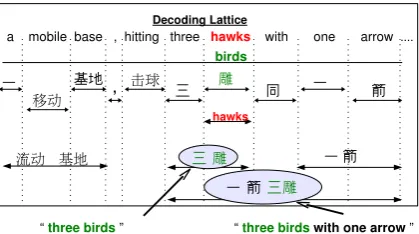
Figure 3: Lattice containing possible phrasal tar-get translations for the test sentenceT.
dates for every OOV/rare word are used in build-ing the input lattice. The optimal value ofC was
empirically found to be 2. On examining the ob-tained input lattices, the proposed method found replacements for at the most 3 OOV/rare words in each test sentence (Section 4). Hence, the number of possible paths through the input lattice is not substantially large.
The target translations of all the source phrases are placed on a common decoding lattice. An
example of a decoding lattice for example T is
given in Figure 3. The system is now able to find longer matches (“ three birds with one arrow ” and“ three birds ”) which was not possible earlier
with the OOV word, “hawks”. The local
order-ing information between the translations of “three birds” and “with one arrow” is well captured due to the retrieval of the longer source phrasal match, “three birds with one arrow”. Our ultimate goal is to obtain translations for such longern−gram
source phrases boosting the confidence of both the translation model and the language model.
The decoder used in this paper (Brown, 2003)
works on this decoding lattice of possible
phrasal target translations (or fragments) for source phrases present in theinput latticeto
gen-erate the target translation. Similar to Pharaoh (Koehn et al., 2003), the decoder uses multi-level beam search with a priority queue formed based on the number of source words translated. Bonuses are given for paths that have overlapping fragments. The total score (T S) for a path (Eqn
path. The EBMT engine assigns each candidate phrasal translation a quality score computed as a log-linear combination of alignment score and translation probability. The alignment score indi-cates the engine’s confidence that the right target translation has been chosen for a source phrase. The translation probability is the proportion of times each distinct alternative translation was en-countered out of all the translations. If the path includes a candidate replacement, the log of the score,pλ(wi), given for a candidate replacement
is incorporated intoT Sas an additional term with a weightwt5.
T S= 1 t
t
X
i=1
[wt1log(bi) +wt2log(peni) +wt3log(qi) +wt4log(P(wi|wi−2, wi−1))
+1I(wi=replacement)wt5log(pλ(wi)) ] (4)
where,tis the number of target words in the path, wtj indicates the importance of each score, bi is
the bonus factor given for long phrasal matches,
peni is the penalty factor for source and target
phrasal-length mismatches,qi is the quality score
andP(wi|wi−2, wi−1) is the LM score. The
pa-rameters of the EBMT system (wtj) are tuned on
a development set.
The target translation is postprocessed to in-clude the translation of the OOV/rare-word with the help of the best path information from the decoder. In the case of OOV words, since the translation is not available, the OOV word is put back into the final output translation in place of the translation of its replacement. In the output translation of the test example T, the translation of“birds”is replaced by the word,“hawks”. For rare words, knowing that the translation of the rare word may not be correct (due to poor alignment statistics), the target translation of the replacement is replaced by the translation of the rare word obtained from the dictionary. If the rare word has multiple translations, the translation with the highest score is chosen.
4 Experimental Setup
As we are interested in improving the per-formance of low-resource EBMT, the English-Haitian (Eng-Hai) newswire data (English-Haitian
Cre-ole, CMU, 2010) containing 15,136 sentence-pairs was used. To test the performance in other languages, we simulated sparsity by choosing less training data for English-Chinese (Eng-Chi). For the Eng-Chi experiments, we extracted 30k train-ing sentence pairs from the FBIS (NIST, 2003) corpus. The data was segmented using the Stan-ford segmenter (Tseng et al., 2005). Although we are only interested in small data sets, we also performed experiments with a larger data set of 200k. 5-gram Language Models were built from the target half of the training data with Kneser-Ney smoothing. For the monolingual English cor-pus, 9 million sentences were collected from the Hansard Corpus (LDC, 1997) and FBIS data.
EBMT system without OOV/rare-word han-dling is chosen as the Baseline system. The pa-rameters of the EBMT system are tuned with 200 sentence pairs for both Eng-Chi and Eng-Hai. The tuned EBMT parameters are used for the Base-line system and the system with OOV/rare-word handling. The feature weights for the proposed method are then tuned on a seperate development set of 200 sentence-pairs with source sentences containing at least 1 OOV/rare-word. The cross-validation set for this purpose is made up of 100 sentence-pairs. In the OOV case, 500 sentence pairs containing at least 1 OOV word are used for testing. For the rare word handling experiments, 500 sentence pairs containing at least 1 rare word are used for testing.
To assess the translation quality,4-gram
word-based BLEU is used for Eng-Hai and 3-gram
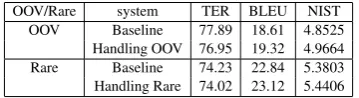
OOV/Rare system TER BLEU NIST OOV Baseline 77.89 18.61 4.8525
[image:8.595.91.271.70.119.2]Handling OOV 76.95 19.32 4.9664 Rare Baseline 74.23 22.84 5.3803 Handling Rare 74.02 23.12 5.4406
Table 1: Comparison of translation scores of the Baseline system and system handling OOV and Rare words for Eng-Hai.
handling OOV words and by only handling rare words over their corresponding Baselines. As fu-ture work, it would be interesting to create one test data set to handle both OOV and rare words to see the overall gain.
The test set is further split into 5 files and the Wilcoxon (Wilcoxon, 1945) Signed-Rank test is used to find the statistical significance.
5 Results
Sample replacements found are given in Figure 2. For both Eng-Chi and Eng-Hai experiments, only
the top C ranking replacement candidates were
used. The value ofC was tuned on the
develop-ment set and the optimal value was found to be 2. Translation quality scores obtained on the test data with 30k and 200k Eng-Chi training data sets are given in Table 2. Table 1 shows the results obtained on Eng-Hai. Statistically significant im-provements (p < 0.0001) were seen by handling
OOV words as well as rare words over their cor-responding baselines.
As the goal of the approach was to obtain longer target phrasal matches, we counted the number of
n-grams for each value of n present on the
de-coding lattice in the 30k Eng-Chi case. The sub-plots: A and B in Figure 4, shows the frequency of n-grams for higher values of n (for n > 5)
when handling OOV and rare words. The plots clearly show the increase in number of longer tar-get phrases when compared to the phrases ob-tained by the baseline systems.
Since the BLEU and NIST scores were com-puted only up to 3-grams, we further found the number of n-gram matches (for n > 3) in the
final translation of the test data with respect to the reference translations (subplots: C and D).
As expected, a larger number of longern−gram
matches were found. For the OOV case, matches
6 7 8 9 10 11 12 13 14 15 0
2000 4000 6000 8000 10000 12000
n−gram
#n
−
grams on the decoding lattice
Baseline Handling OOV words
6 7 8 9 10 11 12 13 14 15 0
5000 10000 15000
n−gram Baseline Handling Rare words
4 5 6 7 8 9 10 11
0 50 100 150
n−gram Baseline Handling OOV words
4 5 6 7 8 9 10 11
0 10 20 30 40
n−gram
#correctly translated n
−
grams
Baseline Handling Rare words
A C
[image:8.595.305.517.70.234.2]B D
Figure 4: A, B: number ofn-grams found for
in-creasing values ofnon the decoding lattice. C, D:
number of targetn-gram matches for increasing
values ofnwith respect to the reference
transla-tions.
OOV/Rare Training system TER BLEU NIST data size
OOV 30k Baseline 82.03 14.12 4.1186 30k Handling OOV 80.97 14.78 4.1798 200k Baseline 79.41 19.90 4.6822 200k Handling OOV 77.66 20.50 4.7654 Rare 30k Baseline 82.09 15.36 4.3626 30k Handling Rare 80.02 16.03 4.4314 200k Baseline 78.04 20.96 4.9647 200k Handling Rare 77.35 21.17 5.0122
Table 2: Comparison of translation scores of the Baseline system and system handling OOV and Rare words for Eng-Chi.
up to 9-grams were found where the baseline only found matches up to 8-grams.
6 Conclusion and Future Work
A simple approach to improve translation quality by handling both OOV and rare words was pro-posed. The framework allowed scoring and rank-ing each replacement candidate efficiently.
The method was tested on two language pairs and statistically significant improvements were seen in both cases. The results showed that rare words also need to be handled to see improve-ments in translation quality.
[image:8.595.306.519.330.425.2]References
R. Barzilay and K. McKeown 2001. Extracting
para-phrases from a parallel corpus. In Proceedings
of the 39th Annual Meeting of the Association for
Computaional Linguistics,pp. 50-57.
C. M. Bishop 2006. Pattern Recognition and Machine Learning, Springer.
R. D. Brown, R. Hutchinson, P. N. Bennett, J. G. Car-bonell, P. Jansen. 2003. Reducing Boundary
Fric-tion Using TranslaFric-tion-Fragment Overlap. In
Pro-ceedings of The Ninth Machine Translation Summit, pp. 24-31.
R. D. Brown. 2000. Automated Generalization of
Translation Examples. In Proceedings of The
Inter-national Conference on Computational Linguistics, pp. 125-131.
C. Callison-Burch, P. Koehn and M. Osborne. 2006. Improved Statistical Machine Translation Using
Paraphrases. In Proceedings of The North
Ameri-can Chapter of the Association for Computational Linguistics, pp. 17-24.
J. Carbonell, S. Klien, D. Miller, M. Steinbaum, T. Grassiany and J. Frey. 2006. Context-Based
Ma-chine Translation Using Paraphrases. In
Proceed-ings of The Association for Machine Translation in the Americas, pp. 8-12.
N. Habash. 2008. Four Techniques for
On-line Handling of Out-of-Vocabulary Words in Arabic-English Statistical Machine Translation. In Proceedings of Association for Computational
Linguistics-08: HLT, pp. 57-60.
Public release of Haitian Creole
lan-guage data by Carnegie Mellon, 2010.
http://www.speech.cs.cmu.edu/haitian/
Z. Harris. 1954. Distributional structure. Word,
10(23): 146-162.
P. Koehn. 2004. Pharaoh: a Beam Search Decoder for Phrase-Based Statistical Machine Translation Mod-els. The Association for Machine Translation.
P. Koehn, F. J. Och and D. Marcu. 2003.
Statis-tical Phrase-Based Translation. In Proceedings of
HLT:The North American Chapter of the Associa-tion for ComputaAssocia-tional Linguistics.
P. Koehn 2002 Europarl: A multilingual corpus for evaluation of machine translation. Unpublished, http://www.isi.edu/koehn/publications/europarl/
Linguistic Data Consortium. 1997 Hansard Corpus of Parallel English and French. Linguistic Data
Con-sortium, December. http://www.ldc.upenn.edu/
Y. Marton, C. Callison-Burch and P. Resnik. 2009. Improved Statistical Machine Translation Using
Monolingually-derived Paraphrases. In
Proceed-ing of The Empirical Methods in Natural Language
Processing, pp. 381-390.
NIST. 2003. Machine translation evaluation.
http://nist.gov/speech/tests/mt/
K. Papineni, S. Roukos, T. Ward, and W. Zhu. 2002. BLEU: A Method for Automatic Evaluation of
Ma-chine Translation. In Proceedings of The
Associa-tion for ComputaAssocia-tional Linguistics. pp. 311-318. M. Popovi´c and H. Ney. 2004. Towards the use of
Word Stems and Suffixes for Statistical Machine
Translation. In Proceedings of The International
Conference on Language Resources and Evalua-tion.
M. J. D. Powell. 1964. An efficient method for find-ing the minimum of a function of several variables
without calculating derivatives Computer Journal.
Volume 7, pp. 152-162.
K. Rose. 1998. Deterministic annealing for clustering, compression, classification, regression, and related
optimization problems. In Proceedings of The
In-stitute of Electrical and Electronics Engineers, pp. 2210-2239.
H. Tseng, P. Chang, G. Andrew, D. Jurafsky and C. Manning. 2005. A Conditional Random Field
Word Segmenter. Fourth SIGHAN Workshop on
Chinese Language Processing.
D. Vilar, J. Peter, and H. Ney. 2007. Can we translate
letters? In Proceedings of Association
Computa-tional Linguistics Workshop on SMT, pp. 33-39.
M. Yang and K. Kirchhoff. 2006. Phrase-based back-off models for machine translation of highly
inflected languages. In Proceedings of European
Chapter of the ACL,41-48.
F. Wilcoxon. 1945. Individual comparisons by
ranking methods. Biometrics, 1, 80-83. tool: