Japanese Dependency Parsing Using a Tournament Model
Masakazu Iwatate and Masayuki Asahara and Yuji Matsumoto Nara Institute of Science and Technology, Japan
8916-5, Takayama, Ikoma, Nara, Japan, 630-0192
{masakazu-i, masayu-a, matsu}@is.naist.jp
Abstract
In Japanese dependency parsing, Kudo’s relative preference-based method (Kudo and Matsumoto, 2005) outperforms both deterministic and probabilistic CKY-based parsing methods. In Kudo’s method, for each dependent word (or chunk) a log-linear model estimates relative preference of all other candidate words (or chunks) for being as its head. This cannot be consid-ered in the deterministic parsing methods. We propose an algorithm based on a tour-nament model, in which the relative pref-erences are directly modeled by one-on-one games in a step-ladder tournament. In an evaluation experiment with Kyoto Text
Corpus Version 4.0, the proposed method
outperforms previous approaches, includ-ing the relative preference-based method.
1 Introduction
The shared tasks of multi-lingual dependency pars-ing took place at CoNLL-2006 (Buchholz and Marsi, 2006) and CoNLL-2007 (Nivre et al., 2007). Many language-independent parsing al-gorithms were proposed there. The algorithms need to adapt to various dependency structure constraints according to target languages: projec-tive vs. non-projecprojec-tive, head-initial vs. head-final, and single-rooted vs. multi-rooted. Eisner (1996) proposed a CKY-like O(n3) algorithm. Yamada and Matsumoto (2003) proposed a shift-reduce-like O(n2) deterministic algorithm. Nivre et al. (2003; 2004) also proposed a shift-reduce-like
c
⃝2008. Licensed under the Creative Commons
Attribution-Noncommercial-Share Alike 3.0 Unported
li-cense (http://creativecommons.org/licenses/by-nc-sa/3.0/). Some rights reserved.
人だ。
hito-da.
(man .)
読まない
yomanai
(doesn’t read)
本を
hon-wo
(books)
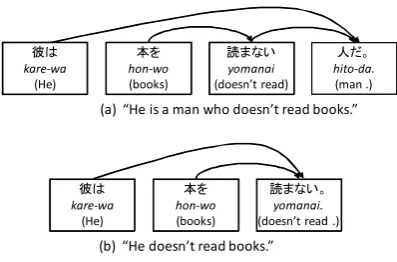
(a) “He is a man who doesn’t read books.”
読まない。
yomanai.
(doesn’t read .)
本を
hon-wo
(books)
彼は
kare-wa
(He)
(b) “He doesn’t read books.”
彼は
kare-wa
[image:1.595.316.515.253.384.2](He)
Figure 1: Examples of Japanese sentences.
O(n) deterministic algorithm for projective lan-guages. The model is enhanced for non-projective languages by Nivre and Nilsson (2005). McDon-ald et al. (2005) proposed a method based on search of maximum spanning trees employing the Chu-Liu-Edmonds algorithm (hereafter “CLE
al-gorithm”) (Chu and Liu, 1965; Edmonds, 1967).
Most Japanese dependency parsers are based on
bunsetsu units, which are similar concept to
En-glish base phrases. The constraints in Japanese dependency structure are stronger than those in other languages. Japanese dependency structures have the following constraints: head-final, single-head, single-rooted, connected, acyclic and projec-tive. Figure 1 shows examples of Japanese sen-tences and their dependency structures. Each box represents a bunsetsu. A dependency relation is represented by an edge from a dependent to its head. Though sentence (a) is similar to sentence (b), the syntactic structures of these two are differ-ent, especially because “kare-wa” directly depends on “yomanai” in (b) but not in (a).
In dependency parsing of Japanese, determin-istic algorithms outperform probabildetermin-istic CKY methods. Kudo and Matsumoto (2002) applied the
cascaded chunking algorithm (hereafter “CC
al-gorithm”) to Japanese dependency parsing.
Ya-mada’s method (Yamada and Matsumoto, 2003) employed a similar algorithm. Sassano (2004) proposed a linear-order shift-reduce-like algorithm (hereafter “SR algorithm”), which is similar to Nivre’s algorithm (Nivre, 2003). These determin-istic algorithms are biased to select nearer candi-date heads since they examine the candicandi-dates se-quentially, and once they find a plausible one they never consider further candidates.
We experimented the CLE algorithm with Japanese dependency parsing, and found that the CLE algorithm is comparable to or in some cases poorer than the deterministic algorithms in our ex-periments. Actually, the CLE algorithm is not suit-able for some of the constraints in Japanese depen-dency structures: head-final and projective. First, head-final means that dependency relation always goes from left to right. Second, since the CLE al-gorithm may produce non-projective dependency trees, we need to conduct projectivity check in the algorithm.
Kudo and Matsumoto (2005) proposed a rela-tive preference-based method (hereafter “relarela-tive
preference method”). They defined the parsing
algorithm as series of selection steps of the most likely head for each bunsetsu out of all candidates. The method has so far achieved the highest ac-curacy in the experiments with Kyoto Text
Cor-pus Version 3.0 data 1, since other deterministic methods do not consider relative preference among candidate heads but solely consider whether the focused-on pair of bunsetsu’s is in a dependency relation or not.
We propose a model that takes a bunsetsu and two candidate heads into consideration and se-lects the better candidate head out of those two. This step is repeated in a step ladder tournament to get the best candidate head (hereafter we call this model as a “tournament model”). The tour-nament model was first introduced by Iida et al. (2003) for coreference resolution. We applied this model to selecting the most plausible candidate head for each bunsetsu except for the sentence final one.
Section 2 describes the tournament model com-paring with previous research. Section 3 describes
1
Note: Sassano’s SR algorithm is the highest by exper-iment with the smaller data Kyoto Text Corpus Version 2.0 Relative preference method and SR algorithm are not com-pared directly with the same data.
人だ。 hito-da. (man .) 本を
hon-wo (books) 彼は
kare-wa (He)
Focused-on
dependent Its candidate heads The most likely candidate head
[image:2.595.316.517.71.195.2]読まない yomanai (doesn’t read)
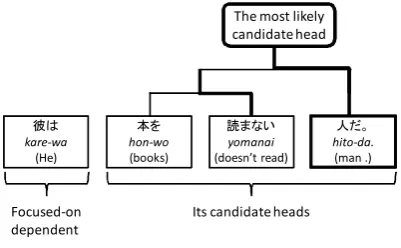
Figure 2: Example of a tournament.
how the tournament model is applied to Japanese dependency parsing. Section 4 shows the results of evaluation experiments. Section 5 shows our current and future work, and Section 6 gives con-clusions of this research.
2 Tournament Model
The tournament model was first introduced by Iida et al. (2003) for coreference resolution. The model chooses the most likely candidate in a step-ladder tournament, that is a sequence of one-on-one games between candidate referents for a given anaphoric expression. In each game, the winner is chosen by a binary classifier such as SVMs.
We applied the tournament model to Japanese dependency parsing taking into consideration Japanese constraints. The projective constraint is easily met. When selecting candidate heads for the focused-on dependent, we only consider those can-didates that introduce no crossing dependency.
Figure 2 illustrates a tournament. The focused-on dependent bunsetsu is “kare-wa”, and the can-didate heads are the three bunsetsu’s on the right-hand side: “hon-wo”, “yomanai” and “hito-da”. The first game is “hon-wo” vs. “yomanai”. Then the next game is the winner of the first game vs. “hito-da”. The winner of the second game (i.e., “hito-da”) is chosen as the most likely candidate of the dependent, “kare-wa”.
In the tournament model, the most likely head of a given bunsetsu is determined by a series of one-on-one games in a tournament. Below, we present the advantages of the tournament model by com-parison with the previous methods.
2.1 Scope of Feature Views
head – in the parsing action determination (here-after “2-tuple model”). The same 2-tuple may or may not have a dependency relation when they ap-pear in different context. For example, both (a) and (b) in Figure 1 include the two bunsetsu’s, “kare-wa” and “yomanai”; in (b) they have a de-pendency relation, but not in (a). The 2-tuple mod-els and relative preference method cannot discrim-inate between these two patterns without consider-ing contextual features2. The tournament model can be regarded as a “3-tuple model,” which con-siders three bunsetsu’s – a dependent and two can-didate heads. The discriminative performance of the 3-tuple model is greater than the 2-tuple mod-els, since it directly compares two candidate heads and selects the one that is more plausible than the other candidate. Consider Figure 1 again. In (a), “kare-wa” does not depend on “yomanai” because there is another bunsetsu “hito-da” which is a more plausible head. 2-tuple models may use this infor-mation as a contextual feature, but the effect is in-direct. On the other hand, the tournament model directly compares these candidates and always se-lects the better one. The situation becomes crucial when the true head appears outside of the context window of the current candidate. 2-tuple models have to select the head without consulting such in-formation. The advantage of the tournament model is its capability of deferring the decision by al-ways keeping the current best candidate head. On the other hand, a disadvantage of the tournament model is its space and time complexity. The size of features is larger since they come from three
bun-setsu’s. The size of training instances is also larger.
2.2 Relative Position in a Sentence
We name the two candidate heads in the 3-tuple model as “the nearer candidate head” and “the far-ther candidate head.” The dependent, the nearer candidate head and the farther candidate head ap-pear in this order in Japanese sentences. The order defines the relative position of the contextual fea-tures. The distance between the dependent and a candidate head is another feature to represent the relative position. In previous research, the distance has been represented by feature buckets, such as 1, 2-5, or 6+. While for some dependents and their heads whether the distance is 1 or not is impor-tant, absolute distance is not so important since
2
Contextual features are features neither in the dependent nor in the candidate head(s).
Japanese is a free-order language. Relative posi-tions are more informative since some dependents tend to appear closer to other dependents, such as objects that tend to appear closer to predicates compared with other complements. The tourna-ment model represents both the distance and rela-tive position as features.
The deterministic algorithms are biased to select nearer candidate heads. As most dependent and head pairs appear within a close window, this ten-dency does not cause many errors; deterministic algorithms are weak at finding correct heads that appear in a long distance as pointed out in Kudo and Matsumoto (2005).
2.3 Relative Preferences
// N: # of bunsetsu’s in input sentence // true_head[j]: bunsetsu j’s head at
// training data
// gen(j,i1,i2,LEFT): generate // an example where bunsetsu j is // dependent of i1
// gen(j,i1,i2,RIGHT): generate // an example where bunsetsu j is // dependent of i2
for j = 1 to N-1 do h = true_head[j]; for i = j+1 to h-1 do
gen(j,i,h,RIGHT); for i = h+1 to N do
[image:4.595.302.512.72.273.2]gen(j,h,i,LEFT); end-for;
Figure 3: Pseudo code of training example gener-ation procedure.
3 Proposed Algorithm
3.1 Training Example Generation Algorithm
As shown in Figure 3, for each dependent, we gen-erate pairs of the correct head and all other candi-date heads. On the example generation, the proce-dure does not take into account the projective con-straint; all bunsetsu’s on the right-hand side of the focused-on dependent are candidate heads.
Table 1 shows all examples generated from two sentences shown in Figure 1. 2-tuple models gen-erate training examples formed as (dependent, can-didate). So, from the sentences of Figure 1, it gen-erates opposite classes to the pair (kare-wa,
hito-da). On the other hand, the examples generated by
the tournament model do not contain such incon-sistency.
3.2 Parsing Algorithm
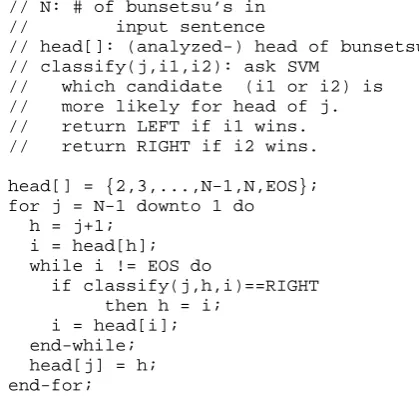
The tournament model has quite wide freeness in the parsing steps. We introduce one of the tour-nament algorithms, in which the dependents are picked from right to left; and the games of the tour-nament are performed from left to right. This pars-ing algorithm takes into account the projective and head-final constraints.
This algorithm is shown in Figure 4. The over-all parsing process moves from right to left. On selecting the head for a dependent all of the
bun-setsu’s to the right of the dependent have already
been decided. In Figure 4, the array “head” stores the parsed results and ensures that only non-crossing candidate heads are taken into considera-tion.
// N: # of bunsetsu’s in // input sentence
// head[]: (analyzed-) head of bunsetsu // classify(j,i1,i2): ask SVM
// which candidate (i1 or i2) is // more likely for head of j. // return LEFT if i1 wins. // return RIGHT if i2 wins.
head[] = {2,3,...,N-1,N,EOS}; for j = N-1 downto 1 do
h = j+1; i = head[h]; while i != EOS do
if classify(j,h,i)==RIGHT then h = i;
[image:4.595.71.276.73.239.2]i = head[i]; end-while; head[j] = h; end-for;
Figure 4: Pseudo code of parsing algorithm.
Note that the structure of the tournament has lit-tle effect on the results (< 0.1) in our preliminary experiments. We tried2×2 options: the depen-dents are picked from right to left or from left to right; and the games of the tournament are per-formed from right to left or from left to right. We choose the most natural combination for Japanese dependency parsing, which is easy to implement.
4 Experiment
4.1 Settings
We implemented the tournament model, the CC al-gorithm (Kudo and Matsumoto, 2002), SR algo-rithm (Sassano, 2004) and CLE algoalgo-rithm (Mc-Donald et al., 2005) with SVM classifiers. We evaluated dependency accuracy and sentence accu-racy using Kyoto Text Corpus Version 4.0, which is composed by newspaper articles. Dependency ac-curacy is the percentage of correct dependencies out of all dependency relations. Sentence accuracy is the percentage of sentences in which all depen-dencies are determined correctly. Dependency ac-curacy is calculated excluding the rightmost
bun-setsu of each sentence.3 Sentences that consist of one bunsetsu are not used in our experiments.
We use January 1st to 8th (7,587 sentences) for the training data. We use January 9th (1,213 sen-tences), 10th (1,479 sentences) and 15th (1,179 sentences) for the test data. We use TinySVM 4 as a binary classifier. Cubic polynomial kernel is
3
Most research such as Kudo’s (2005) uses this criteria.
4
Sentence Focused-on dependent Left(Nearer) candidate Right(Farther) candidate Class label
(a) kare-wa hon-wo hito-da. RIGHT
(a) kare-wa yomanai hito-da. RIGHT
(a) hon-wo yomanai hito-da. LEFT
(b) kare-wa hon-wo yomanai. RIGHT
Table 1: Generated examples from sentences in Figure 1.
used for the kernel function. Cost of constraint vi-olation is 1.0. These SVM settings are the same as previous research (Kudo and Matsumoto, 2002; Sassano, 2004). All experiments were performed on Dual Core Xeon 3GHz x 2 Linux machines.
4.2 Features
Here we describe features used in our experiments. Note that for the tournament model, features cor-responding to candidates are created for each of the nearer and farther candidates. We define the
information of a word as the following features:
lexical forms, coarse-grained POS tags, full POS tags and inflected forms. We also define the
infor-mation of a bunsetsu as word inforinfor-mation for each
of syuji and gokei. Syuji is the head content word of the bunsetsu, defined as the rightmost content word. Gokei is the representative function word of the bunsetsu, defined as the rightmost functional word.
Existence of punctuations or brackets, whether the bunsetsu is the first bunsetsu in the sentence, and whether it is the final bunsetsu in the sentence are also members of information of a bunsetsu.
Standard features are the following: Informa-tion of the dependent and the candidate heads,
dis-tance between the dependent and the candidate heads (1, 2-5 or 6+ bunsetsu’s), all punctuations, brackets and all particles between the dependent and the candidate heads.
Additional features are the following: All case
particles in the dependent and the candidate heads,
information of the leftmost word in the candidate
heads, and the lexical form of the neighboring
bun-setsu to the right of the candidate heads.
Case particle features are the following: All
case particles appearing in the candidates’ depen-dent. These features are intended to take into con-sideration the correlation between the case parti-cles in the dependent of a head. When the head is a verb, it has a similar effect of learning case frame information.
Standard and additional features are introduced
by Sassano (2004). The case particle feature is newly introduced in this paper. Features corre-sponding to the already-determined dependency relation are called dynamic features, and the other contextual features are called static features. Stan-dard and additional features are static features, and case particle features are dynamic features. Whether a dynamic feature is available for a pars-ing algorithm depends on the parspars-ing order of the algorithm.
4.3 Parsing Accuracy
The parsing accuracies of our model and previ-ous models are summarized in Table 2. Note that, since the CLE algorithm is non-deterministic and dynamic features are not available for this algo-rithm, we use only a standard and additional fea-ture set instead of an all feafea-ture set. By McNemar test (p < 0.01) on the dependency accuracy, the tournament model significantly outperforms most of other methods except for the SR algorithm on January 10th data with all features (p = 0.083) and the CC algorithm on January 10th data with all features (p = 0.099). The difference between the tournament models with all features and with the standard feature only is significant except for on January 9th data (p= 0.25).
The highest dependency accuracy reported for January 9th of Kyoto Text Corpus Version 2.0 is 89.56% by Sassano(2004)’s SR algorithm.5
Since we don’t have the outputs of Sassano’s ex-periments, we cannot do a McNemar test between the tournament model and Sassano’s results. Our model outperforms Sassano’s results by the depen-dency accuracy, but the difference between these two is not significant by prop test (p= 0.097).
When we add the additional and case particle features, the improvement of our model is less than that of other algorithms. This is interpreted that our model can consider richer contextual
informa-5
This accuracy in Sassano (2004) is not for Kyoto Text
Corpus Version 4.0 but Version 2.0 The feature set of
Method Features Jan. 9th Jan.10th Jan. 15th Tournament Standard feature only 89.89/49.63 89.63/48.34 89.40/49.70
All features 90.09/49.71 90.11/49.02 90.35/52.59
SR algorithm Standard feature only 88.18/45.92 88.80/44.76 88.03/47.24 (Sassano, 2004) All features 89.22/47.90 89.79/47.87 89.55/49.79 CC algorithm Standard feature only 88.17/45.92 88.80/44.76 88.00/47.24 (Kudo and Matsumoto, 2002) All features 89.22/47.90 89.80/47.94 89.53/49.79 CLE algorithm Standard feature only 88.64/45.34 88.16/43.14 88.07/45.21 (McDonald et al., 2005) Standard and Additional 89.21/46.83 89.05/45.03 88.90/48.43
Table 2: Dependency and sentence accuracy [%] using 7,587 sentences as training data.
tion within the algorithm itself than other models. This result also shows that the accuracies of the SR algorithm and CC algorithm are comparable when using the same features. However, this does not mean that their substantial power is compara-ble because the parsing order limits the availacompara-ble dynamic features.
4.4 Parsing Speed
Parsing time and the size of the training exam-ples are shown in Table 3. All features were used. The column “# Step” represents the number of SVM classification steps in parsing all the test data. Time complexity of the tournament model and CC algorithm areO(n2)and that of the SR al-gorithm isO(n). The tournament model needs 1.7 times more SVM classification steps and is 4 times slower than the SR algorithm. The reason for this difference in steps (x1.7) and time (x4) is the num-ber of training examples and features in the SVM classification.
4.5 Comparison to Relative Preference Method
We performed another experiment under the same settings as Kudo’s (2005) to compare the tourna-ment model and relative preference method. The corpus is Kyoto Text Corpus Version 3.0 since Kudo and Matsumoto (2005) used this corpus. Training data is articles from January 1st to 11th and editorials from January to August (24,263 sen-tences). Test data is articles from January 14th to 17th and editorials from October to December (9,287 sentences). We did not perform parameter engineering by development data, although Kudo and Matsumoto (2005) performed it. The criteria for dependency accuracy are the same as the exper-iments above. However, the criteria for sentence accuracy in this section include all sentences, even
if the length is one as Kudo and Matsumoto (2005) did.
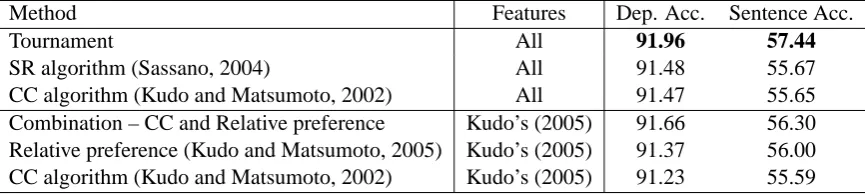
The results are shown in Table 4. Note that Kudo and Matsumoto (2005) and our feature sets are different. Only the CC Algorithm is tested with both feature sets. Our feature set looks better than Kudo’s. By McNemar test (p < 0.01) on the de-pendency accuracy, the tournament model outper-forms both the SR and CC algorithms significantly. Since we don’t have the outputs of relative prefer-ence methods, we cannot do a McNemar test be-tween the tournament model and the relative pref-erence methods. By prop test (p < 0.01) on the dependency accuracy, our model significantly out-performs the relative preference method of Kudo and Matsumoto (2005). Though our model outper-forms the “combination” model of Kudo and Mat-sumoto (2005) by the dependency accuracy, the difference between these two is not significant by prop test (p= 0.014).6
Note that, a log-linear model is used in Kudo’s experiment. The log-linear model has shorter training time than SVM. The log-linear model re-quires feature combination engineering by hand, while SVMs automatically consider the feature combination by the use of polynomial kernels.
5 Discussion and Future Work
In our error analysis, many errors are observed in coordination structures. Sassano (2004) reported that introduction of features of coordinated
bun-6The “combination” model is the combination of the CC
Method # Step Time[s] # Example # Feature
Tournament 26396 371 374579 56165
[image:7.595.99.504.72.127.2]SR algorithm (Sassano, 2004) 15641 80 94669 37183 CC algorithm (Kudo and Matsumoto, 2002) 18922 99 112759 37183
Table 3: Parsing time and the size of the training examples.
Method Features Dep. Acc. Sentence Acc.
Tournament All 91.96 57.44
SR algorithm (Sassano, 2004) All 91.48 55.67
CC algorithm (Kudo and Matsumoto, 2002) All 91.47 55.65 Combination – CC and Relative preference Kudo’s (2005) 91.66 56.30 Relative preference (Kudo and Matsumoto, 2005) Kudo’s (2005) 91.37 56.00 CC algorithm (Kudo and Matsumoto, 2002) Kudo’s (2005) 91.23 55.59
Table 4: Dependency and sentence accuracy [%] using 24,263 sentences as training data with all features: comparison with Kudo(2005)’s experiments.
setsu improves accuracy. In Kyoto Text Corpus Version 4.0, coordination and apposition are
anno-tated with different types of dependency relation. We did not use this information in parsing. A sim-ple extension is to include those dependency types. Another extension is to employ a coordination ana-lyzer as a separate process as proposed by Shimbo and Hara (2007).
Incorporating co-occurrence information will also improve the parsing accuracy. One usage of such information is verb-noun co-occurrence in-formation that would represent selectional prefer-ence for case-frame information. Abekawa and Okumura (2006) proposed a reranking method of k-best dependency analyzer outputs using co-occurrence information. We have already devel-oped a method to output k-best dependency trees. One of our future works is to test the reranking method using co-occurrence information on the k-best dependency trees.
Multilingual parsing is another goal. Japanese is a strict head-final language. However, most lan-guages do not have such constraint. A different parsing algorithm should be employed for other less constrained languages so as to relax this con-straint. A simple solution is to introduce a discrim-ination model according to whether the head is on the left-hand-side or on the right-hand-side of a de-pendent. Existence of projective constraint does not matter for the tournament model. The tourna-ment model can be extended to relax the projec-tive constraint. The preliminary results for English are shown in our CoNLL Shared Task 2008 report
(Watanabe et al., 2008). The unlabeled syntac-tic dependency accuracy of 90.73% for WSJ data shows that the model is also effective in other (not strictly head final, non-projective) languages. In parsing word sequences, O(n2) time complexity becomes a serious problem compared to parsing
bunsetsu sequences. Since a bunsetsu is a base
phrase in Japanese, the number of bunsetsu’s is much less than the number of words. One solution is to perform base phrase chunking in advance and to apply dependency parsing on the base phrase se-quences.
A reviewer pointed out similarities between our model and RankSVM. RankSVM compares pairs of elements to find out relative ordering between elements. Our tournament model is a special case where two elements are compared, but with a spe-cific viewpoint of a focused dependent.
6 Conclusions
[image:7.595.83.516.165.262.2]accu-racy of our model significantly outperforms that of the previous methods in most experiment set-tings. Even though the problem of parsing speed remains, our research showed that considering two or more candidate heads simultaneously can achieve more accurate parsing.
References
Abekawa, Takeshi and Manabu Okumura. 2006. Japanese Dependency Parsing Using Co-occurrence Information and a Combination of Case Elements. In Proceedings of the 21st International
Confer-ence on Computational Linguistics and 44th Annual Meeting of the Association for Computational Lin-guistics (COLING-ACL 2006), pages 833–840.
Buchholz, Sabine and Erwin Marsi. 2006. CoNLL-X Shared Task on Multilingual Dependency Parsing. In CoNLL-2006: Proceedings of the Tenth
Confer-ence on Computational Natural Language Learning,
pages 149–164.
Chu, Yoeng-Jin and Tseng-Hong Liu. 1965. On the shortest arborescence of a directed graph. Science
Sinica, 14:1396–1400.
Crammer, Koby and Yoram Singer. 2003. Ultraconser-vative Online Algorithms for Multiclass Problems.
Journal of Machine Learning Research, 3:951–991.
Edmonds, Jack. 1967. Optimum branchings.
Jour-nal of Research of the Natural Bureau of Standards,
71B:233–240.
Eisner, Jason M. 1996. Three New Probabilistic Mod-els for Dependency Parsing: An Exploration. In
COLING-96: Proceedings of the 16th Conference on Computational Linguistics - Volume 1, pages 340–
345.
Iida, Ryu, Kentaro Inui, Hiroya Takamura, and Yuji Matsumoto. 2003. Incorporating Contextual Cues in Trainable Models for Coreference Resolution. In
EACL Workshop ‘The Computational Treatment of Anaphora’.
Kudo, Taku and Yuji Matsumoto. 2002. Japanese De-pendency Analysis Using Cascaded Chunking. In
CoNLL-2002: Proceedings of the Sixth Conference on Computational Language Learning, pages 1–7.
Kudo, Taku and Yuji Matsumoto. 2005. Japanese pendency Parsing Using Relative Preference of De-pendency (in Japanese). Information Processing
So-ciety of Japan, Journal, 46(4):1082–1092.
McDonald, Ryan, Koby Crammer, and Fernando Pereira. 2005. Online Large-Margin Training of Dependency Parsers. In ACL-2005: Proceedings of
43rd Annual Meeting of the Association for Compu-tational Linguistics, pages 523–530.
Nivre, Joakim and Jens Nilsson. 2005. Psuedo-Projective Dependency Parsing. In ACL-2005:
Pro-ceedings of 43rd Annual Meeting of the Association for Computational Linguistics, pages 99–106.
Nivre, Joakim and Mario Scholz. 2004. Deterministic Dependency Parsing of English Text. In
COLING-2004: Proceedings of the 20th International Confer-ence on Computational Linguistics, pages 64–70.
Nivre, Joakim, Johan Hall, Sandra K¨ubler, Ryan Mc-Donald, Jens Nilsson, Sebastian Riedel, and Deniz Yuret. 2007. The CoNLL 2007 Shared Task on De-pendency Parsing. In CoNLL-2007: Proceedings of
the CoNLL Shared Task Session of EMNLP-CoNLL-2007, pages 915–932.
Nivre, Joakim. 2003. An Efficient Algorithm for Pro-jective Dependency Parsing. In IWPT-2003: 8th
In-ternational Workshop on Parsing Technology, pages
149–160.
Sassano, Manabu. 2004. Linear-Time Dependency Analysis for Japanese. In COLING-2004:
Proceed-ings of the 20th International Conference on Com-putational Linguistics, pages 8–14.
Shimbo, Masashi and Kazuo Hara. 2007. A Discrimi-native Learning Model for Coordinate Conjunctions. In Proceedings of the 2007 Joint Conference on
Empirical Methods in Natural Language Process-ing and Computational Natural Language LearnProcess-ing (EMNLP-CoNLL), pages 610–619.
Watanabe, Yotaro, Masakazu Iwatate, Masayuki Asa-hara, and Yuji Matsumoto. 2008. A Pipeline Ap-proach for Syntactic and Semantic Dependency Pars-ing. In Proceedings of the Twelfth Conference on
Computational Natural Language Learning (To Ap-pear).
Yamada, Hiroyasu and Yuji Matsumoto. 2003. Statis-tical Dependency Analysis with Support Vector Ma-chines. In IWPT-2003: 8th International Workshop