J´erˆome Besombes, Jean-Yves Marion
Loria, INRIA LorraineAbstract
We investigate learning dependency grammar from positive data, in Gold’s identification in the limit model. Examples are dependency trees. For this, we introduce reversible lexical dependency grammars which generate a significant class of languages. We have demonstrated that reversible dependency languages are learnable. We provide a
-time, in the example size, algorithm. Our objective is to contribute to design and the understanding of formal process of language acquisition. For this, dependency trees play an important role because they naturally appear in every tree phrase structure.
1. An identification paradigm
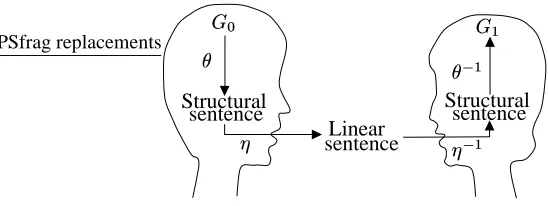
From Tesni´ere (Tesni`ere, 1959) seminal study, and from ideas of Mel’˘cuk (Mel’˘cuk, 1988), we propose a two tier communication process between two speakers, see Figure 1. Jean transmits a sentence to Marie. At the first stage, Jean generates a structural sentence, like the following dependency tree
the rabbit runs fast
Then, Jean transforms it into a linear phrase, the rabbit runs fast, and send it to Marie. Now, Marie has to inverse the two tier process of Jean. For this, she has (i) to recover the structural sentence from the linear sentence ( ), (ii) to build/update/improve her grammar in order to understand the message, and to generate other messages ( ). In the setting of natural language learning, parsers perform the first task of Marie. Roughly speaking,
parsing corresponds to inverse , that is to compute .
We are investigating identification, that is exact learning, of dependency tree languages. The leading idea is that data used to learn are dependency trees. Dependencies are semantic annotation by additional informations which facilitates the learning process. Such data are widely available and come from a lot of computational linguistic formal grammars such as LFG, TAG, categorial grammar and interaction grammar. The relations between those formalism are explained in the special issue of TAL (Kahane, 2000) on dependency grammars.
The data available are positive examples of a language, that is a sequence of dependency trees. Our hypothesis is that the computation of is reversible, that is the inputs can always be deduced from the outputs. So,
identifi-cation corresponds to inverse . For this, we give a sufficient condition of reversibility on the grammars ( ). We
show that the class of reversible dependency tree languages is efficiently identifiable in Gold’s model (Gold, 1967). That is, given a finite sequence of examples of a reversible language, we determine a reversible grammar that gen-erates it. We refer to (Jain et al., 1999) for further explanations. Our study leans on the work of Angluin (Angluin, 1982) on learning languages produced by deterministic and reversibles finite automaton. It is also closely related to Sakakibara (Sakakibara, 1992) work on reversible context free grammars and to Kanazawa (Kanazawa, 1998) work on rigid categorial grammars.
Linear
sentence
Structural
sentence
sentence
Structural
PSfrag replacements
[image:1.595.120.394.608.711.2]
Figure 1: A two tier communication process
c
Following Dikovsky and Modina (Dikovsky and Modina, 2000), we present a class of projective dependency grammars which was introduced by Hays (Hays, 1961) and Gaifman (Gaifman, 1965).
A lexical dependency grammar (LDG) is a quadruplet , where is the set of terminal symbols, is the set of non-terminal symbols, is the start symbol, and is the set of productions. Each production
is of the form
. . .
. . ., where , each! and#" are in %$& . The terminal symbol
is called the head of the production. In other words, the head is the root of the flat tree formed by the production right handside. Actually, if we forget dependencies, we just deal with context free grammars.
Example 1. The grammar '(*)+,.-0/12)+3/4 . where consists
56-78-Partial dependency trees are recursively defined as follows.
1. is a partial dependency tree generated by .
2. If . . . b . . . is a partial dependency tree generated by , and if
9(
. . .:;
. . . is a production of , then
. . .
. . .:<
. . .# . . . b . . .
is a partial dependency tree generated by .
A dependency tree generated by a LDG is a partial dependency tree of in which all nodes are terminal symbols. The language=?>
@
is the set of all dependency trees generated by .
Example 2. The language generated by of Example 1 is
=?>
@
'A)0- <<-8- <<<-!-- 2B2BCBD/
Without dependencies, we recognize the context free language)0FEG-HEFI+J&KML#/ .
3. Reversible LDG
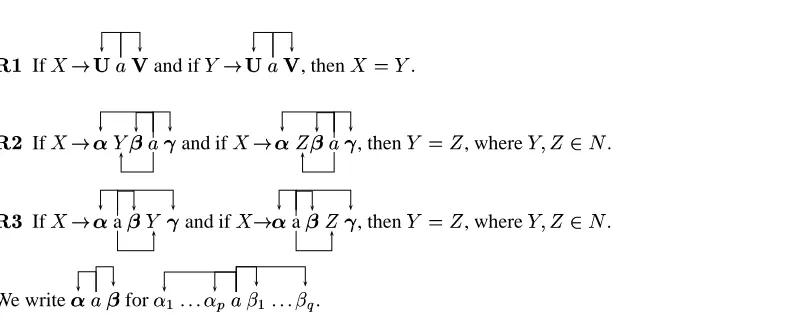
A LDG grammar is reversible if the conditionsN&O ,NQP andNQR of Figure 2 are satisfied. The class of
reversible dependency tree languages is the class of languages generated by reversible LDG.
4. The learning algorithm
The learning algorithm works as follows. The input is a finite set S of positive examples which are
de-pendency trees. DefineTG>TS
@
as the grammar constructed from all productions outputed byTG>TU
@
, for each
UAS . The functionTGis described in Figure 3.
Stage 0
' TG>VS
@
.
N&O If and if , then' .
NP If and if9 , then ' , where8 .
NQR If a and ifQ a , then ' , where8 .
We writeM for
. . .
. . . .
Figure 2: Reversibility conditions and reduction rules.
FunctionTG>U
@
Inputs :U is a dependency tree, is a non-terminal symbol.
ifU 6
then Output U
ifU '
. . . a
. . .
then Take new
2BCB2BH and
CB2B2BC
Output
. . . a
. . .
for ' to doTG> .
@
for ' to doTG>
[image:3.595.74.474.87.248.2]@
Figure 3:TG>TU
@
recognizes exactlyU , i.e.=?>TG>U @ @
'A)CU</
The process terminates at some stage because the number of grammar productions decreases at each stage.
So, put >TS
@
' ! .
Theorem 3. learns the class of reversible dependency tree languages.
The learning algorithm is incremental and runs in quadratic time in the size of the examples. Our algorithm is implemented as a Java prototype which is accessible fromhttp://www.loria.fr/" besombes.
Example 4. S' ) the rabbit is very fast, the rabbit is fast, the rabbit is very very fast/ ,
The productions of ' TG>VS
@
TG>the rabbit is very fast. @ ' is rabbit fast ; the very
TG>the rabbit is fast
@ ' is rabbit ; fast theB
TG>the rabbit is very very fast/1.
@ ' is ; rabbit ; fast the very ; very
Second, we applyN6O to identify
'M , ' ' . is
; the rabbit
rabbit
rabbit very fast
fast
fast is is
very
We applyN6O to identify
'M and ;'M
.
is very 5
is rabbit
is ;
fast
; fast ; fast
very
Now, we merge ' ' by applyingN?R on rules.
is
fast very
rabbit
; fast
very
fast the
Lastly, we applyNQP on rules by merging 'M
. We obtain the final grammar:
is ; fast very
rabbit the very
; fast
5. Related works
Sakakibara (Sakakibara, 1992) gives a learning algorithm to infer reversible context free languages from skeleton parse trees. The definition of reversible grammar is very similar to ours. However, we distinguish between both
productions <- and 9- , unlike (Sakakibara, 1992) in which they are considered identical.
Kanazawa (Kanazawa, 1998) studies inference of several classes of categorial grammars from functor structures, based on counting the number of categories associated to a terminal symbol. It is not difficult to faithfully translate rigid grammar in reversible dependency grammars.
The defect of learning from structures is that examples usually depend on the implicit grammar that we have to guess. It appears that it is not the case in our approach because we deal with tree languages, and so is seemingly more natural.
References
Angluin, Dana. 1982. Inference of reversible languages. Journal of the ACM, 29:741–765.
Dikovsky, A. and L. Modina. 2000. Dependencies on the other side of the curtain. Traitement automatique des langues, 41(1):67–96.
Gaifman, H. 1965. Dependency systems and phrase structure systems. Information and Control, 8(3):304–337. Gold, M.E. 1967. Language identification in the limit. Information and Control, 10:447–474.
Hays, D.G. 1961. Grouping and dependency theories. In National symp. on machine translation. Jain, J., D. Osherson, J. Royer and A. Sharma. 1999. Systems that learn. MIT press.
Kahane, S. 2000. Les grammaires de d´ependance, volume 41. Hermes. Kanazawa, M. 1998. Learnable classes of Categorial Grammars. CSLI. Mel’˘cuk, I. 1988. Dependency Syntax: Theory and Practice. The SUNY Press.
Sakakibara, Y. 1992. Efficient learning of context free grammars from positive structural examples. Information and Compu-tation, 97:23–60.