L e a r n i n g D e p e n d e n c i e s b e t w e e n C a s e F r a m e S l o t s
H a n g
L i a n dN a o k i A b e
T h e o r y N E C L a b o r a t o r y , R W C P * c / o ('.&C. R e s e a r c h L a b o r a . t o r i e s , NEC. 4 - 1 - 1 M i y a z a k i M i y a m a . e - l ~ u , K a w a s a k i , 2116 J a p a n{lih a n g , a b e } ( ~ . s b l . c l . n e c . c o . j p
A b s t r a c t
We address the problem of automati- cally acquiring case frame patterns (se- lectional patterns) from large corpus data. In particular, we l)ropose a method of learning dependencies between case frame slots. We view the problem of learning case frame patterns as that of learning a multi-dimensional discrete joint distribution, where r a n d o m vari- ables represent case slots. We then for- mMize the dependencies between case slots as the
probabilislic
dependencies between these r a n d o m variables. Since the number of p a r a m e t e r s in a multi- dimensional joint distribution is expo- nential in general, it is infeasible to ac- curately estimate them in practice. To overcome this difficulty, we settle with approximating the target joint distribu- tion by the product oflow
order com- ponent distributions, based on corpus data. In particular we propose to employ an efficient learning algorithm based on the MDL principle to realize this task. Our experimental results indicate that for certain classes of verbs, the accuracy achieved in a disambiguation experiment is improved by using the acquired knowl- edge of dependencies.1
I n t r o d u c t i o n
We address the problem of automatically acquir- ing case frame patterns (selectional patterns) from large corpus data. The acquisition of case frame patterns normally involves the following three subproblems: 1) Extracting case fl'ames from cor- pus data, 2) Generalizing case frame slots wMfin these case frames, 3) Learning dependencies that exist between these generalized case frame slots.
In this paper, we propose a method of learn- ing dependencies between case frame slots. By
*Real World Computing Partnership
'dependency' is m e a n t the relation t h a t exists be- tween case frame slots which constrains the pos- sible values assumed by each of those slots. As illustrative examples, consider tile following sen- tences.
T h e girl will fly a jet.
This aMine company flies m a n y jets. T h e gM will fly J a p a n AMines.
*The airline conlpany will fly ,Japan Airlines.
(1)
We see that an 'airline c o m p a n y ' can be the sub- ject of verb 'fly' (the value of case slot ' a r g l ' ) , when the direct object (the value of ease slot 'arg2') is an 'airplane' but n o t when it is an 'air- line c o m p a n y '1. These, examples indicate t h a t the possible values of case slots depend in general on those of the other case slots: that is, there exist 'dependencies' between different case slots. The knowledge of such dependencies is useflfl in var- ious tasks in natural language processing, espe- cially in analysis of sentences involving multiple prepositional phrases, such asThe girl will fly a jet fl'om Tokyo to Beijing.
(2)
Note in the above example that the case slot of 'from' and that of ' t o ' should be considered depen- dent and the a t t a c h m e n t sit(." of one of the prepo- sitional phrases (case slots) can be determined by that of the other with high accuracy and confi- dence.There has been no method proposed to date, however, t h a t learns dependencies between case frame slots in the natural language processing lit- erature. In the past research, the distributional p a t t e r n of each case slot is learned independently,
1 One may argue that 'fly' has different word senses in these sentences and for each of these word senses there is no dependency between the case frames. Word senses are in general difficult to define precisely, how- ever, and in language processing, they would have to be disambiguated Dora the context ~nyway, which is essentially equivalent to assuming that the depen- dencies between case slots exist. Thus, our proposed method can in effect 'discover' implicit word senses
fi'om
corpus data.and methods of resolving ambiguity are also based on the assuml:ition th.at case slots are independent (llindle and Rooth, 1991), or dependencies lm- tween at most two case slots are considered (Brill and Resnik, 1994). Thus, provision of an efl'ec- tive method of learning de, pendencies between (;as(; slots, as well as investigation of the usefulness of the acquired dependencies in disambiguation and other natural language processing tasks would be an inll)ortant contributiota to the fie.ld.
In this paper, wc view the problem of learning (;as(? frame patterns as that of learning a lnulti- dimensional discrete joint distribution, where r a w doni variables represent case slots. We then for- malize the dependencies between case slots as the
probabilistic dependencies betweeit these ralldoiil variables. Since the illllllber Of dependencies that exist, in a nmlti-dimensiona.l joint disl.ribution is exponential if we allow n-ary dependencies in gen- eral, it is int>asible to accurately esi.itllate them with high accuracy with a data size available in practice. It is also clear that relatiw;ly few of these ra.ndom variahles (case slots) are actually depeit- dent on each other with any signiticance. Thus it is likely that the target joint distribution can be a p p r o x i m a t e d reasonably well by the product of component distributions of low order, drastically reducing the nuniber (:if paralneters /.hat need to be considered. 'Fhis is indeed the apl>roach we take in this lmper.
Now the probleni is how to approxilnal,e a ,joint distribution by the product of lower or<ler com- pOlletit distributions, llecently, (Suzuki, 1993) l)roposed a.ii algorithnl to approxhnal.cly learii a lnulti-dimensional joint distribution exlwessible as a 'dendroid distribution', which is both efticient and tlworet, ica.ily so/lnd. ~,.Ve employ Suzuki's al- gorithm 1,o learn case fralim patterns ;is dendroid distributions. We conducted sollle experinlelits to automatically acquire case fi'alne patterns from the Penn 'Free Bank bra.cketed corpus. Our ex- perimental results indicate that for seine class of verbs the accuracy achiew?d ill a disa.nlbiguni.ion experinlent can be inlproved by using the acquired knowledge of dependencies between case slots.
2 P r o b a b i l i t y M o d e l s f o r C a s e F r a m e P a t t e r n s
Suppose that we haw? d a t a given by ills(antes of the case frame of a verb automatically extracted from a corpus, using conventional techniques. As explained in Introduction, the l:irol~lelu of learning case fraille l)atteriis ca.it be viewed as that of es- tilnating the unde~rlying mulli-dimemsioltal joilll distribulioT~ which giw~s rise to such data. 111 this research, we assume that <'as(.' t}ame instances with the same head are generated by a joint dis- tribution of type,
I'~, ( & , X ~ , . . . , X , , ) , (:3)
where index Y stands for the head, and each of the randonl variables X i , / = 1 , 2 , . . . , n, represents a case slot. In this paper, we use 'case slots' to mean re,face case slots, and we uniformly treat obliga- tory cases and optional cases. ' r h u s the muN)er n of the r a n d o m variables is roughly equal to the nunfl)er of prepositions in English (and less than 100). These models can be further classified into three types of probability models according to the type of values each random variable. Xi assumes 2. When Xi assumes a word or a special symbol '0' as its value, we refl:r to the corresponding model Pv ( X i , . •., X , ) as a 'word-based model.' Here '0' indicates the absence of the case slot in question. When Xi assumes a. word-class or '0' as its value, the corresponding model is called a 'class-based model.' When Xi takes on 1 or 0 as its value, we call the model a 'slot-based model.' Here the value of ' l ' indicates the presence of the case slot in question, and '0' al>sence. Suppose for sim- plicity t h a t there are only 4 possible case slots (random variables) corresponding respectively to the subject, direct object, 'front' phrase, and ' t o ' phrase. Then,
l'flv(X.,.,at = girl, X.,.g2 = jet, Xf,. .... = 0, X~o = O)
(4)
is given a specific l)robability value by a word- based model. In contrast,
Ig,u(X<,,.ai = <person), S.,.:,~ = (airplane), Xf,.o,, = O, Xto = O)
(a)
is given a specilic l)robability by a class-based ,nodel, where (l,e,'son) alid (airplane) denote~ word classes. Finally,l)tzy(X,,.,a~ = 1 , X ~ , . a u = 1, X.r,.o,,, = O, X t o = O)
(o)
is assigned a specific probability by a slot-based model.
We then forlmllale the dependencies between case slots as the probabilislic dependencies be- tween the randonl variabh~s in each of these three trtodcls. In the absence of any constraints, how- ever, the number of parameters in each of the above three lnodels is exponential (even the slot- based model has 0 ( 2 " ) parameters ), and thus it is infeasible to accurately estimate t h e m in prac- tice. A simplifying assumption t h a t is often made to deal with this difficulty is that r a n d o m variables (case slots) are mutually independent.
Sul)pose for examl:ile that in the analysis of the setltellCe
l saw a girl with a t.elescope, (7) two interpretatiolls are obtained. We wish to se- lect. the nlore appropriate of the two in(eft:itera- tions. A heuristic word-based m e t h o d for disam- biguation, in which the slots arc a s s u m e d to be
dependent, is to calculate tile following values of word-based likelihood and to select tile interpreta- tion corresponding to the higher likelihood value.
Psee(Xa,',.1t =" [, X a r 9 2 = girl, )l'~uit h ~- telescope)
(s)
P.~.~(Xa,.al = I, Xa,.oe = girl)
(9)
x l~li,.l( X~,,io,. = telescope )If on the other hand we a.ssume that the ran- dom variables are independe'~l, we only need to calculate and compare t~,:(X~,iH, = telescope)
and Pgi,'t(.\'with = telescope) (c.f.(Li and Abe.,
1995)). The independence assumption can also be made in the case of a class-based model or a slot-based model. For slot-based m o d e l s , with tile independence assumption, P.~(X,~,ith = 1) and
P s , . l ( X w i t f l = 1) are to be compared (c.f.(Hindle
and Rool:.h, 1991)).
Assuming t h a t r a n d o m variables (case slots) are mutually independent would drastically re- duce tile number of parameters. (Note that. un- der
the
independence assuml)tion tile nmnber of parameters in a slot-based model becomes 0 ( ~ ) . ) As illustrated in Section 1, t.his assumption is not necessarily valid in practice. W h a t seems to be true in practice is that some case slots are ill fact dependent but overwhelming m a j o r i t y of t.hem a.re independent, due partly to the fa.cl that usually only a few slots are obligatory and most others are optional. :~ Thus the target, joint distribution is likely to be a.pproximabie by the product of several component distributions of low order, and thus have in fact a reasonably small number of parameters. We are thus lead to the approach of approximating tile tal:get joint distribution by such a simplified model, based on corpus data.3 A p p r o x i m a t i o n b y D e n d r o i d D i s t r i b u t i o n
Without loss of generality, any n-dinlensiorlal joint distribution can be writl.en as
P ( x i , x._, . . .
x,,)
=H
P ( x , , , I X ... . . . . x % , _ , ) i=1(1o)
for some pernnttation (mq, m._, .... nb~ ) of 1, 2 .... n, here we letP(X,~,I x
...)
denote FIX,,,,).A pta.usib[e assumption on I.he dependencies be- tween r a n d o m variables is intuitively that each variable direetbj depends oil at most one other variable. (Note that this assumption is tile sim- plest among those that relax the independence a.s- sumption.) For example, if a joint distribution P ( X 1 , X,,, X:3) over 3 r a n d o m variables X1, X2, Xa
aOptiona.1 slots ~tre not necessarily i n d e p e n d e n t , but if two optional slots are r a n d o m l y selected, it is likely t h a t they are indet)endent of one a.nother.
can be written (approximated) as follows, it (al> proximately) satisfies such an assumption.
P(.z¥1,-"k2, X 3 ) : (~,"~)P(-\'1 ) ' / ) ( X 2
IX1 ). P(X:,
IX[ )(11)
Such distributions are referred to as 'dendroid dis- tributions' in tile literature. A dendroid distribu- tion can be represenled by a dependency forest (i.e. a set of dependency trees), whose nodes rep- resent the r a n d o m variaMes, and whose directed arcs represent the dependenciesthat
exist between these r a n d o m w/riahles, each labeled with a num- ber of parameters specil}'ing the probabilistic de- pendency. (A dendroid distribution can also be considered as a re.stricted form of the Bayesian Network (Pearl, 1988).) It is not difficult t.o see tha.t there are 7 and only 7 such representations for the joint distribution P(X1, X,2, X3) disregard- ing the actual nmnerical values of t.he probability parameters.Now we turn to the problem of how to select the best dendroid distribution fi:om among all possi- ble ones to a p p r o x i m a t e a target joint distribution based on input d a t a generated by it. This prob- lem has been inw?stiga.ted in the area of machine learning and related fields. A classical method is Chow & Liu's algorMnn for estimating a nmlti- dimensional .joint distribution as a dependency tree, ill a way which is both el-~cient and theo- retically sound (C.how and I,iu, 1968). More re- cent.ly (Suzuki, 1993) extended their algorithm so that it estimates the target ,joint. distribution as a dependency Forest. or 'dendroid distrihution', al- lowing for the possibility of learning one group of r a n d o m variables to be completely independent of another. Since nlany of the r a n d o m variables (case slots) in case flame patterns are esseutially independent, this feature is crucial in our context, and we thus employ Suzuki's algorithm for learn- ing our case frame patterns. Figure 1 shows the detail of this Mgorithm, where ki denotes the nun> her of possible values assumed by node (random variable) Xi, N the input d a t a size, and qog' de- notes the logarithm to the base 2. It is easy to see that the nulnber of p a r a m e t e r s in a dendroid distribution is of the order O(k2ne), where k is the m a x i n m n i of all ki, and n is the. number of r a n d o m variables, and the time complexity of the algorithm is of the same order, as it is linear in the number of parameters.
Suzuki's algorithm is derived from the Mini- m u m Description Length (MDL) principle (liis- sanen, 1989) which is a principle for statistical es- timation in information theory. It is known that as a. method of estimat.ion, MI)L is guaranteed to be near optinm.l 4. [n applying MDL, we usu- ally assume that the given data are generated by a probability model t.hat belongs to a certain class of models and selects a model within tile class which
4We reDr the interested reorder 1o (Li and Abe,
1995) for an introduction to MDL.
I,et 7' : = (/); ('.alculat.e 1,he m u t t m | in[ol:~nat.ion I( Xi, X5 ) for all uo(:t(~ p a i r s (,Y/, X j ); Sort. 1]w n o d e p a i r s in d(~scen(liug o]'(h+r of l, a n d stor(~ l.hent int.o q m ' u e Q; l,(;t V 1)c /.he s e t of { X i } ,
i =: 1,2, ...,~]:
whih'+ T h e llla.xittltlltl v a h w o f l in Q s a r i s [ i t s
](&., '
:v~)
>o(x~
' & ) = ( < : - t)(a,~ 1)>~" 2 Nd o t ) ( ; g i n
I~muov(" tlw nod(> l)air (,\7i. ,\+j) h;/vil~g th(, ni;/xi]~mil+ v;t.ltw <)I' / ['ro~t Q;
If" ,\7+ a m l A j I>(,lot~g to diIl'('r(mt, s c l s It+, ll':+, in 1 ;
T h e m I{el)lac(> IVI a.n(l II +., in l w i l h
H'I U I1":,, a n d a d d e d g e ( , \ i . A'j ) 10 "[':
e n d
O u t p u t . 7' as 1.ho set. of (xlgcs o1' t h e ('stitnal('(t m o d e l .
l"ig.trc l: T h e hm.rtfing a l g o r i l . h u l
b e s t ( ' x p l a i i > l.he dal.a. I1. i.(m(ls Io I~(' l l w ('asc usua.Hy t;hal, a s i m l l h ' r m o d e l has a l)oor(,r Ill t.o 1,he dal.a, a.H(/ a nlore c o m p l e x mo(hq h+ts a l+(,i,l,(q:
fil I lIO I'll() (la.t.a. T h u s t,h('l:e is n t.rad('-ofI' I>ctw(>cn t,t> s i m p l i c i t y of a m o d ( q gum l.h(' go(>dn('ss of lit. to d a t a . M1)I, r e s o l v e s I.his I.ra(h~-<)[l' in a (lis('il>ti[>d way: 11. s(eh,cl.s a Illod('l w h i c h is i'(msonably silu- I/l(> a.nd fits l.he d a t a sal.isl"acl.orily as w('[l. In our
('lil'I;('l/l prol)l(ml, a :-;iltlI)](? IHod('l iil(:;tl/S ;t IIIC)([('I
wil.h less d(q)('l~(l(mcies, a n d t h u s N i l ) l , l)rovi(l(,.-, a (h(?or(q.ic;dly s o u n d way 1.o learn ()Ill N I h o s c &, pcq]dcncies thai, arc sl.al.isticMly s i g n i l i c a n t in Ill(: g i v e n ([al;a. Air esp(~c[;dly iJll('t'(,s(iug [}~alur(~ o f M I l l , is l]lal it. incorl)orat.es l:he il]l)tll, d a l a size in it.s m o d e l soh>ct.ion crit.crion. ' l ' h i s is rcfl~'('led,
in our (u~,s(>, in t.hc <terival.i(>n ()l' 1,h(' thr('sh(,hl O. Nol.e l, haI, wh(m wc (lo not, ]l;iv(~ e n o u g h d a t a (i.e. [or s m f l l N ) , the thr(>shohls will b(' large and
Ibw n o d e s Icn(I 1.o 1)c Iinlccd, r c s u l i i l l g ill a sil]l- pie m o d ( ' l ill w h i c h most. o[ t,l> ('as(> tTr+m> s l o t s arc ,jtt(lgc'd in(h':l)(m,,hml.. T h i s is r(uts(>na.lA(, since w i t h a s m a l l data. size m o s t cas,, slot> cam]oi I)(, degermin(xl i.o I)c dep(m(h-]tt w i t h a.uy s i g n i f i c a n c e .
4 E x p e r i m e n t a l R e s u l t ; s
\~"o COl]([/l(%.'."(I soltt(" l)r(,lindluu'y ('xp('ritn(qtts to lest. t h e i;(,rl'otul|atlc(, o[ t.hc l;l',.)lt()s(+(l tt+('th()(/ as ;] m(,I.ho(I o1' +requiring ('aso l'r+uu(' i);tt~cru~, lit i);n +- 1.icular, wc t.cs(('(l t.o see hoxx cl[(?('tiv( ~ th(> p;tl t(q'us a.cquired by o u r nJ('lhod ar<' i]~ s l r u c t ural d i s a m - b i g u a t i o n . \V(' will dcs(:rib(' the resull.s o17 this ex- p o r i n ] c n t a t i o n in this sccl;ion.
4.1. E x p e r i n t t ; i ~ t t , 1: S l o l ; - b a s c , d M o d e l
lu otn' tirsl, cxp(erim(,nt, w(, Iri('d io a('(luir(' slot
});~s(~(I case f'ra.tt]e patt.(u:us. Fil'sl., W(' ('xl.r;t('l.('([
18 t ,250 case fra.ules f r o m l,hc Wall S1 r('(>t .l()u rnal ( W S J ) I ) r a c k c t e d COl'IreS o/' l,]tc I ' e n u 'lrve I~ank as t;t:a.iniug data.. Thor(> w('t'(~ 357 vcrl)s [or which
'['al)le 1: V e r b s a n d l:hoir l ) e r p t e x i t y
V e r b I n d e l ) ( m d e n t l ) ( m d r o i d
ndd 5.g2 5.36
b u y 5.0,11 4.98
find 2.07 1.92
ol)(m 20.5(3 16.53
l)rot.c('t. :L3!) 3.13
l/rovid(> ,l.46 4.13 r(?t)r(,s(m t 1.2G 1.26
s(qld 3.20 3.29
s u(:cc(+d '23)7 2.57
tell 1.3(5 1.36
m o r e (,hmi 50 cas(~ f r a m e examph~s a p p e a r e d in lira
l r a i n i n g d a t a .
lqrsl, wo a c q u i t > d l,hc s l o i - b a s c d case f l a m e p a l - iOI'|IS for ;Ill of t.he 357 verbs. \,'V(~ [lll(~ ii (~()t~ (l ~ [(: to(l ~ I , c w f o h l cross va]idai, ion to cva[uai,e t l w %esI, d a t a
p(u:ph~xii,y' of t,/w a c q u i r e d case f r a m e pat, t e r n s , t h a t is, w¢~ used nine l,(ml, h o[ the case f l a m e s %r e a c h v e r b as t r a i n i n g dat,a ( s a v i n g what, rema.ins as t, es(, data), t,o a c q u i r e case f l a m e pai, l, e r n s , a n d
t h e n c a l c u l a l c d pCrl)lexil. ¥ using t h e lesl, d a t a . VV(> rel>Catc'd this p r o c o s s t.cn lim(~s a.nd c a l c u l a t e d tlm ;tvcragc l)Crl)lexity. '['able I s h o w s the a v e r a g e p e r - plexit.y ( ) b t m m ' d for s o m e r a n d o m l y s ( ' h ' c t c d v e r b s . \Ve also calculat.cd tim av(u:age p e r p l e x i l . y of the qndcpcndettt, slof n l o d c l s ' a c q u i r e d bas(~d on 1.h(' assumpt, ion t, hal. (~ach slof is h M e p c m h m l , . O u r ex l ) c r i m e n l , a l rcsull, s s h o w n in 'l'able 1 i n d i c a t e ( h a l
1.he use o[ t.he +'ndroid models can a c h i e v e up t.o 2()~. pcrpl(~xil:y r e d u c l ion as COmlmt'ed ~o t h e i m b - [)Ol|d(Hll, slot ll](,)([OIS. It scorns sail" lo s a y lhere['ore
t h a i the d e n d r o i d u t o d c l is more s t t i t a b l c I'or rcp- rcscnl:ing t h e Ira+ m o d e l o[' case f l a m e s t h a n l.[w h M q ) e m l c n l s]ol. lttOdO[.
\Vc also used l h e acquir(>d d e p e n d ( r a c y k n o w l - c+,{gc ill a pl>at, l, a c h m e n l , d i s a m b i g u a i . i o n e x p e r i - i]lol]l., kV(' used the case h'an]~s of' all 357 v e r b s as o]tr t.raining dat.a. Wc used Chc cttl:irc + b r a c k -
etc<l c o r p u s as Iil'a.illillg dat.a it] part: b e c a u s e wc wanl.ed t.o u t i l i z e as m a n y t.raining d a t a as possi- ble. W e ext.ract.(<l (c~ rb, , o u ? q , prep, ?,)tt?~2) or
( v(,A,, t . ' c p t , ~ o t m l , p r r p.2, ~ou~]2) p a t . t e r n s ['rotlt the \VSJ t a g g e d ('orplts ;ts i,est. (lata, ItSillg pa.t- tc]'n m a t c h i n g tccl!t]iqucs. \Vc t.ook care to e n s u r e i h a l otlly t, hc part. o[' l[w (agg('d (non-l)rackt,t.cll) c o r l m s w h i c h do(,s not o v ( ' r l a p xxit.h t h e I)rack('l,('(I corptlS is tlSC(I a,'< test. dai.a. ( T h e bracl,:(,ted c o r l m s
l o t s o v e r l a p wii.h i)arl, o[ t h e t,ttgg~x:[ ( o r p u s . ) \Vc a c q u i r e d ('aso [ratne pal t.crns u s i n g t, hc | . r a i n i n g da, ta. \V~ f o u n d l:hai t h e r e were 266 v<wl>s, w h o s e ' a r g 2 ' slot is (tel'~(qtdc'lll Ol1 SOl]tO. of i, hc ot,lwr p r e p o s i t i o n slots. 'l'hm'v w e r e 37 (Se~' e x m r @ e s in 'l'al)lc 2) v e r b s w h o s e d e p e n - (h>l]cy I)cl,w(>en ;u:g2 a n d ol, hcr s l o t s is positAv(, atl(l (~x(:o,,d.'-; a COl;t.ailt t h r e s h o l d , i.e. P l a y 9 2 -
by our method seem to agree with human intu- ition in most cases. There were 93 examples in
Table 2: Verbs and their dependent slots
Verb Dependent slots
add blame buy climb compare convert defend explain file focus
arg2 to arg2 for arg2 for arg2 from arg2 with a.rg2 to arg2 against arg2 to arg2 against arg2 on
Table 3: Disambiguation results 1
Dendroid Independent
Accuracy(%) 90/93(96.8) 79/93(84.9)
the test data ((verb, n o u n l , p r c p , no'an2) pattern) in which tile two slots 'a.rg2' and prep of verb
are determined to be positively dependent and their dependencies are stronger than tile thresh- old of 0.25. We forcibly attached prep nou~t2 to
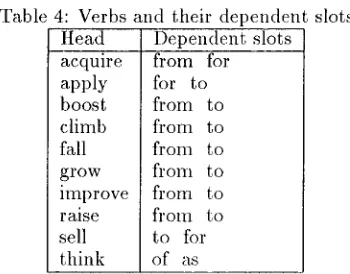
verb for these 93 examples. For comparison, we also tested the disambiguation method based on the independence assumption proposed by (Li and Abe, 1995) on these examples. Table 3 shows the results of these experiments, where 'Dendroid' stands for the former method and ' I n d e p e n d e n t ' the latter. We see t h a t using tile information on dependency we can significantly improve the dis- ambiguation accuracy on this part of the data Since we can use existing m e t h o d s to per- form disambiguation for the rest of the data, we can improve the disambiguation accuracy for the entire test d a t a using this knowledge. Further- more, we found t h a t there were 140 verbs hav- ing inter-dependent preposition slots. There were 22 (See examples in Table 4 ) out of these 140 verbs such that their ease slots hawe positive de- pendency t h a t exceeds a certain threshold, i.e.
P ( p r e p l = 1,prep2 = 1) > 0.25. Again the de- pendencies found by our method seem to agree with h u m a n intuition. In the test d a t a (which are of v e r b , p r e p : t , n o u n t , p r e p ~ , n o u ~ pattern), there were 21 examples that involw? one of the above 22 verbs whose preposition slots show de- pendency exceeding 0.25. We forcibly attached bot.h p r e p , no'unl and prep2 noun2 to verb on these 21 examples, since the two slots prept and
prep~ are judged to be dependent. Table 5 shows the results of this experimentation, where 'Den- droid' and ' I n d e p e n d e n t ' respectively represent
Table 4: Verbs and their dependent slots
Head Dependent slots
acquire apply boost climb fall grow improve raise sell think
froII1 for
for to from to from to from to fi'om to from to fl'om to to for
Of as
the method of using and not using the knowl- edge of dependencies. Again, we found that for the part of the test data in which dependency is present, the use of the dei)endency knowledge can be used to improve the accuracy of a disambigua- tion method, Mthough our experimental results are inconclusive at this stage.
Table 5: Disambiguation results 2 Accuracy(%)
Dendroid 21./21(100)
Independent 20/21(95.2)
4.2 E x p e r i m e n t 2: C l a s s - b a s e d M o d e l We also used the 357 verbs and their case frames used in Experiment 1 to acquire class-based case frame patterns using the proposed method. We randomly selected 100 verbs among these 35r verbs and a t t e m p t e d to acquire their case frame patterns. We generalized the case slots within each of these case frames using the method pro- posed by (Li and Abe, 1995) to obtain class-based case slots, and then replaced the word-based case slots in the data with the obtained class-based case slots. W h a t resulted are class-based case frame examples. We used these d a t a as input to the learning algorithm and acquired case frame p a t t e r n s for each of' the 100 verbs. We found iJmt no two case slots are determined as dependent in any of the case frame patterns. This is because the number of p a r a m e t e r s in a class based model is very large compared to the size of the d a t a we had available.
Our experimental result verifies the validity in practice of the assumption widely made in statis- tical natural language processing that class-based case slots (and also word-based case slots) are mu- tually independent, at least when the d a t a size available is t h a t provided by the current version of the Penn Tree Bank. This is an empirical find- ing that is worth noting, since up to now the in- dependence assumption was based soMy on hu-
[image:5.596.325.500.67.204.2] [image:5.596.90.268.101.327.2] [image:5.596.340.487.333.382.2]/ / / /
...? ... ///~'"" j:/
.. /
2.5 "
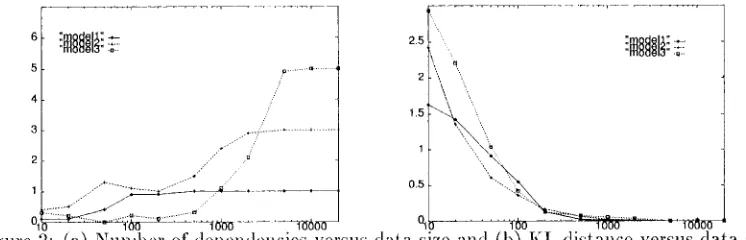
Figure 2: (a) Number of dependencies versus d a t a size and (b) KL distance versus d a t a size
man intuit, ion, to the best of our knowledge. T o test h o w large a data size is required to eslimate a class-based model, w e conducted the following experiment. W e defined an artifMal class-based
model and genera.ted some data. according to its distribution. We then used the d a t a to estimate a class-based model (dendroid distribution), and evaluated the estimated model by measuring the mlmber of dependencies (dependency arcs) it has and the KL distance between the estimated model and the true model. We repeatedly generated data and obserwed the learning 'curve', nan,ely the re- lationship between the number of dependencies in the estimated model and the data. size used in esti- mation, and the relationship betweett the KI, dis- tance between the estimated and true modols and the d a t a size. We defined two other models and conducted the same experiments. Figure 2 shows the results of these experiments for these three ar- tificial models averaged ower tO trials. (The num- ber of p a r a m e t e r s in Modell, Model2, and Model3 are 18, 30, and 44 respectiv(_'ly, while the number of dependencies are 1, 3, aud 5 respectively.) We see that to accurately estimate a model the data size required is as large as 100 times the nmnber of parameters. Since a class-based mode[ tends to have more than 100 parameters usually, the cur- rent d a t a size available in the Penn Tree Bank is not enough for accurate estimation of the depen- dencies wilhin case fi'antes of most verbs.
5
C o n c l u s i o n s
We conclude this paper with the following re- marks.
1. The p r i m a r y contribution of research re- ported in this paper is t h a t we ha.ve proposed a method of learning dependencies between case fi'ame slots, which is theoretically somld and elficient, thus 1)roviding au effective tool for acquiriug (;as(' depend(racy information. 2. For the sk)t-based too(M, sometimes case
slots are found to I)e del)endent. Experimeu- t.al results demonstrate that using the depen- dency information, when dependency does exist, structural disambignation results can be improved.
3. For the word-based or class-based models, case slots are judged independent, with the data size
cm'renl,Iy
available in the Penn Tree Bank. This empirical finding verifies the in- dependence assumption widely made in prac- tice in statistical natural language processing. We proposed to use dependency forests to repre- sent case frame pa~terns. It is possible t h a t more complicated probabilistic dependency graphs like Bayesian networks would be more appropriate for representing case frame patterns. This would re- quire even more d a t a and thus the I)roblenl of how to collect sufficient d a t a would b e . a crucial issue, in addition to the methodology (ff learning case frame patterns as probabilistic dependency graphs. Finally the problem of how to determine obligatory/optional cases based on dependencies (acquired fi'om data.) should also be addressed.References
Eric Bril] and Philip Resnik. 1994. A rule-based approach to prepositional phrase attaclunent disantbignation, lb'occediT~gs of the 15lh COl,-
[N(;, pages 1198 -1204.
C,.K. Chow and C',.N. Liu. 1968. Approximat- ing discrete probability distributions with de- pendence trees. [NEE Transaclions on [nfor-
marion Theory, t4(3):,t62 467.
Donald Hindle and Mats Rooth. 1991. Structural ambiguity and lexical relations. Proceedings of
the 29th ACL, pages 229- 236.
Hang Li and Naoki Abe. 1995. Generalizing case frames using a thesaurus attd the MDL princi- ple. Proceedings of Recent Advances in Nalural
Language Processing, pages 239--248.
J u d e a Pearl. 1988. Probabilistic Reasoning in In-
telligent Eyslems: Networks of Plausible Infer-
euce. Morgan Kauflnann Publishers Inc.
J o r m a Rissanen. 1989. Slochastic Complexily in
5'talistical Inquiry. World Scientific Publis}ting
Co.
[image:6.596.92.465.49.169.2]