A Best-Match Algorithm for Broad-Coverage
Example-Based Disambiguation
Naohiko
URAM()TO
IBM Research, Tokyo Research Laboratory
1623-1.4 S i m o t s u r u l n ~ L Y a l n a t o - s h i , K a n a g a w a - k e n 2 4 2 J a p a n u r t m l o t o ( ( ~ t r l . v n c l ; . i b m . c o m
A b s t r a c t
To improve tit(.' coverage of examl)le-bases , two nlethods are i n t r o d u c e d into the 1)est-match algo- rithm. T h e first is for acquiring conjunctive rela- tionships fl'om corpora, as measures of word simi- larity t h a t can be used in addition to thesauruses. T h e Second, used when a word does not a p p e a r in an examltled)asc or a thesaurus, is for inferring links to words in the examph>base by ('mnparing the us- age of the word in the t e x t ~md t h a t of words in the example- base.
1
I n t r o d u c t i o n
I m p r o v e m e n t of cow, rage in practical domains is one of the most i m p o r t a n t issues in the area of example- based systems. T h e examl)le-based apI)roach [6] has become a (:amman technique for m~turM language processing apI)lications such as machine t r a n s l a t i o n *rod d i s a m b i g u a t k m (e.g. [5, 10]). However, few existing systems can cover a practical d o m a i n or h a n d l e a l)road range of p h e n o m e n a .
T h e most serious obstacle to r o b u s t example- based systems is the coverage of examt)le-bases. It is an oi)en question how m a n y e~xaml)les are required for d i s a m b i g u a t i n g sentences in a specific domain.
T h e Sentence AnMyzer (SENA) wax developed in order to resolve a t t a c h m e n t , word-sense, a n d conjunctive anlbiguitics t)y using c o n s t r a i n t s and example-based preferences [11]. It lists at)out 57,000 d i s a m b i g u a t e d head-modifier relationships a n d al)out 300,000 synonyms and is-a 1)inary~ relationships. Even so, lack of examl)les (no rele- vant examlfles ) accounted for 46.1% of failures in a experiment with S E N A [12].
Previously, it was believed to be easier to collect examples t h a n to develop rules for resolving ambi- guities. However, the coverage of each examltie is nmch nlore local t h a n a rule, and therefore a huge m u n b e r of examt)les is required in order to resolve realistic 1)rot)lems. T h e r e has been some carl)uS- based research (m how to acquire large-scah~ knowl- edge automati(-ally in order to cover the domain to be disambiguatcd, lint there are still m a j o r 1)rot)-
l c n l s t o ])e o v e r e o n l e .
First, smmmtic kvowledge such as word-sense c a n n o t be e x t r a c t e d by a u t o m a t i c cort)u~-base(l knowledge, acquisition. The example-base in SENA is deveh)l)ed by using a bootstr~q)ping method. However, the results of word-sense d i s a m b i g u a t i o n n m s t be (:he(:ked by a hutnan, a,nd word-senses are tagged to only a b o u t ;t half of all the examt)les , since the task is very time-consmning.
A second ditliculty in the exalnple-t)ased att- proach ix the a l g o r i t h m itself, namely, the be.st- match algorithm, which was used in earlier systems built a r o u n d a t h e s a u r u s t h a t consisted of a hierttr- chy of is-a or synonym relationships between words
(word-senses).
This p a p e r proposes two m e t h o d s for ilnprov- ing the coverage of exantple-bases. T h e selected domain is th~tt of sentences in comt)uter manmds. First, knowledge thtd; represents a type of similar- ity other t h a n synonym or is-a relationships is a(> quired. As one m e a s u r e m e n t of the similarity, inter- changeability between words (:~m be used. In this paper, two types of the relationship reflect such in- terchangeability. First, the elements of coordinated s t r u c t u r e s are good clues to the interchangeat)ility of words. Words can be e x t r a c t e d easily from a dolnain-specitic carl)us , and therefore the example- base can I)e a d a p t e d to the sl)ecific domain by using the domain-specific relationships.
If there are no examples a n d relations in the the- saurus, the example-base gives no information for disambiguation. However, the text to be disam- 1)iguate.d provides useful knowledge for this pur- pose [7, 3]. '['he relationshit)s between words in the example-base a n d ;ut unknown word can be guessed by comi)aring t h a t word's usage in e x t r a c t e d cxant- ples and in the text.
2
A B e s t - M a t c h
A l g o r i t h m
In this section, conventional algorithms for exami)le-b~tsed disalnl)iguation~ art(1 their associat- e(i prol)lems, a.re briefly introduced. T h e algorithms of lnost examph>l)ased systems consist of the fol- lowing three steps~:
till s o m e systenls, t h e e x a c t - m a h : h ttl|(I Lhe b e s t - m a t c h
"store+V" *storel "in" "disk" *disk 1)
"store+V" *store1 "in" "storage-device" *device 2) "store+V" *storel "in" "cell" *cell 1)
"store+V" *store1 "in" "computer" *computer1 4) "store+V" *storel "in" "storage" *storage2 3) "store+V" *storel "in" "format" *formatl 1) "store+V" *storel "in" "data-network" *network3 t)
Fig. 1: Examples for R1
("progrmn+N" *progl "in" "profile+N" *profile 5) ("program+N" *progl "in" "data-storage+N" *stor- age3 1)
("program+N" *progl "in" "publieation+N" *publica- tion1 2)
("program+N" *progl "in" "form+N" *form1 2) ("program+N" *prog2 "in" "group+N" *group1 1)
Fig. 2: Examples for R2
1. Searching for examples 2. Exact matching
3. Best matching with a thesaurus
Suppose the prepositional phase attachment ambi- guity in $1 is resolved by using these steps.
(S1) A managed AS/400 s y s t e m can s t o r e a new program i n t h e r e p o s i t o r y .
There are two candidates for the attachnmnt of the prepositional phrase "in the repository." They are represented by the following head-modifier rela- tionships:
(R1) ("store+V" (PP "in") "repository-FN") (R2) ("program+N" (PP "in") "repository+N")
In R1 the m)un "repository" modifies the verb "store" with "in," while in R2, it modifies the noun "program."
First,, SENA searches for examples whose heads match the candidate. Figures 1 and 2 show the relevant examples for R1 and I/.2. They represent the head-modifier relationships, including word- senses, a relation label between the word-senses, (e.g. 'in"), and a frequency.
If a relationship identical to either of the can- didates R1 and R2 is found, a high similarity is attached to the candidate and the example (exact matching).
Word-sense ambiguities are resolved by using the same framework [12]. In this case, each candi- date represent each word sense. For example, the word-sense *store1 is preferred among the examples shown in Fig. I.
If no examples are obtained by the exact- matching process, the system executes the best- matching process, which is the most important mechanism in the example-based approach. For the comparison, synonym or is-a relationships described
in a thesaurus are used. For example, if synonym relations are h)und between "repository" and "disk" in the first example for the R1, a similarity whose value is smaller than that for exact matching is giv- en to the examples. The most preferable candi- date is selected by comparing all examples in Fig. 1 and computing the total similarity value for each candidate. If multiple candidates have tile same similarity values, the frequency of the example and some heuristics (for example, innermost attachment is preferred) are used to weight the similarities.
Experience with S E N A reveals two problems that prevent an improvement in the performance of the best-matching algorithm. First, the approach is strongly dependent on the thesaurus. Many sys- tems calculate the similarity or preference mainly or entirely by using the hierarchy of the thesaurus. However, these relationships indicate only a cer- tain kind of similarity between words. To improve the coverage of the example-base, other additional types of knowledge are required, as will be discussed in the following sections.
Another problem is the existence of
unknown
words;
that is, words that are described in the sys- tem dictionary but do not appear in the example- base or the thesaurus. In SENA, the New Collins Thesaurus [1] is used to disambiguate sentences in computer manuals. Many unknown words appear, especially nouns, since the thesaurus is for the gen- eral domain. Therefore, a inechanism for handling the unknown words is required. This is covered in Chapter 4.3
K n o w l e d g e
A c q u i s i t i o n for
R o b u s t B e s t - M a t c h i n g
As described in the previous section, the best- matching algorithm is a basic element of example- based disambiguation, but is strongly dependent on the thesaurus. Nirenburg [8] discusses the type of knowledge needed for the matching; in his method, morphological information and antonyms are used in addition to synonym and is-a relationships. This section discusses the acquisition of knowledge front other aspects for a broad-coverage best-match algo- rithm.
3.1
Acquisition of Conjunctive Rela-
tionships from Corpora
The New Collins Thesaurus, which is used in SENA as a source of synonym or is-a relationships, gives the following synonyms of "store":
s t o r e :
the usage of words also (:hange. Even a general- d o m m n t h e s a u r u s some, tinms does not suit a. spe- (:ific domain. Moreover, develolmmnk of a domain- spccitie t h e s a u r u s is it time-consuming task.
T h e use of synonym or is-a relationships suggests the hypothesis t h a t from the viewpoint of the exalni)le-l)~tsed itI)pl'oadl ~ a, word in iL sentell(;e citn be replaced by its synonyms or t~xonyms. T h a t is, it s u p p o r t s the existe, nce of the (virtual) exam- pie $1' when "store" a n d "keep" h~tve a synonynl relationshil).
(SI') A m a n a g e d A S / 4 0 0 systenl can keep a new p r o g r a m in tile repository.
l}~terchangeability is :m i m p o r t a n t condition for cM('ulating similarity or preferences t)etween words. Our claim is t h a t if words are inter(:hangeat)h~ in senten(:es, t h e y should have strong similarity.
In this l)al)er, (:onjmtetive relationships, whMt are COllllDon ill te(:hnictd (lOClllDetlts~ 3,re l)roposed as relationships t h a t satisfy the conditiml of inter ehlmgeability. Seutenee, s in which the word "store" ix used as a n element of coordinated s t r u c t u r e can be e x t r a c t e d from c o m p u t e r manuMs, as following examples show:
(1) The service retrieves, fornlats, all(/ stores a message for the user,
(2) Delete the identifier being stored or rood|tied froin the tM)le.
(3) This EXEC verifies mM StOlIt!S the language defaults
in your tile.
(4) You use the fltnetion to add, store, retrieve, ~tll(l update inforlna, tion Mmut doculnents.
From tile sentences, the R)tlowing words t h a t are inter(:hangeable with "store" are acquired:
store,: retrieve, fo'r'm, at, modiJy, "oeTiiflj, add, "ltpda, te
Often the words share easeq)atterns, which is ;t useNl characteristic fi)r d e t e r m i n i n g interchanl,/e-- ability. A n o t h e r reason we use (:onjunctive re- lationships is t h a t they can 1)e e x t r a c t e d scmi- automatieMly from untagged or tagged corpora 1)y using a simph', patkeri>matehing nmtho(l. We ex- tract, ed a b o u t 700 conjunctive relationships from nntagged c o m p u t e r mamlMs by i)attern matching. T h e relationships include various types of knowl- edge, such as 10t ) a n t o n y m s (e.g. "private" itnd "publiC'), ( t > ) s e q u e n c e s of ~ctions (e.g. "toad" itnd "edit"), (c) (weak) synonyms (e.g. " p r o g r a m " and "service"), a n d ((l) part-of relationships (e.g. "tape" ~tn(l "device"). A n o t h e r merit of conjunctive relationships is t h a t they reflect dommn-specili(: re- lations.
3.2
A c q u i s i t i o n f r o m Text to
Be Dis-
a m b i g u a t e dIf there are no exami)les of i~ word to I)e dismn.- biguated, and the word does not a p p e a r in the the- saurus, no relationships ~Lre acquired.
The existence of words theft m'e mlknown to khe examl)le-base antl the t h e s a u r u s ix inevitat)le wtmn one is deMing with tile d i s a m b i g u a t i o n <>f senten<:es in f>ri~(:ti(:al dmmdns. C o m p u t e r manuals, for e×- ~nni)le , coIiLain lnally special llOUns such as llantes
of colDlllands and products, but, there are no the- sauruses for such highly domMn-speeilic words.
One w~ty of resolving the prol)h'nt ix to use the text to be processed as the most domainospecilic example-base. This idea ix s u p p o r t e d by the fact t h a t most word-It;O-word dependencies il,<:luding the
UllklloWll words aq)pear lltalty kimes il~ the sAIue text. Nasukawa [7] deveh)pe(l the Dis(:ourse An- alyzer (DIANA), which resolves ambiguities in a t e x t by dynamically referring to contextual infor- mation. K i n o s h i t a et ;-I.1. [3] Mso prolmsed *t nletho<l for machine I;ra.nslatiml by lm.rsing ;t eoml)lete text in advance aud using it as an ex~mlple-1)ase, tlowev- er, neither system works for llllkllown wt)rds~ since b o t h use only dependencies t h a t al)l)eltr explicitly in the texl.
4
A n A l g o r i t h m t o S e a r c h tbr
U n k n o w n
W o r d s
We first give ~ut enilaneed best-matci~ a l g o r i t h m for disamlfiguation. '['he steps given ill C h a p t e r 2 axe moditied as follows:
[. Searching for examph!s 2. ]~xlt(q, m a t c h i n g
3. Best matching with a thesmtrus and conjunc- tive relationshil)s
4. Unknowll-word-makx:hil~g using a. context-base ']'he outline of the the a l g o r i t h m is as follows: Sen- tences in the text; to he processed are parsed ill ad-
V I L l l C ( ! 1 aud 1;11(! parse trees axe stored as a, context- base. '['tie com;ext-h~tse caAI inchlde alIll)igllOllS
word-to-word dependencies, since no disambigua- kion l)rot:ess is executed. Using tm exanq)le-base slid the contextd)ase, the sentences ill the text are disantbiguated sequentially. If an ambiguous word does not ~q~pear in an exanlple-base or in the the- saltrus, 3.11 IlIIklIOWII word search is executed (other- wise, the COltve(lliOllil,[ best~lllaA;ch process is e X ( ! C t l l ; -
ed.) T h e mlknow:u-word-matching i)l'oeess includes the following ske, ps:
1. '['he dependencies t h a t include the unknown word are e x t r a c t e d froIil the context-base.
2. A c a n d i d a t e set of words t h a t is interchange- abh; with tile unknown word ix searched for in kite (!xamph>base by using the context depen- dency.
Let us see how the algorithm resolves the attach- ment ambiguity in sentence S1 from Chapter 2, which is taken from a text (manual) for the AS/400 system.
(Sl) A managed AS/400 system can store a
new program in the repository.
The text that contains S1 is parsed in advance, and stored in the context-base. The results of the example search arc shown in Fig. 1. There are two candidate relationships for the attachment of the prepositional phrase "in the repository".
(R1) ("store+V" (PP "in")
"repository+N")
(R2) (
"program+N" (PP "in")
"repository+N")
Tile noun "repository" does not appear in the example-base or thesaurus, and therefore no infor- mation for the attachment is acquired.
Consequently, the word-to-word dependencies that contain "repository" are searched for in the context-base. The following sentences appear be- fore or after S1 in the text:
(CBI) The repository can hold objects that are
ready to be sent or that have been received
from another user library.
(CB2) A distribution catalog entry exists ~or
each object in the distribution repository.
(CB3) A data object can be loaded into the
distribution repository from an AS/400 library.
(CB4) The object type of the object specified
must match the information in the distribution
repository.
From the sentences, the head-nn)difier relation- ships that contain the unknown word "repository" are listed. These relationships are called the context dependency for the word. The context dependency of "repository" is us follows:
(D1) ("hold+V" (sub j) "repository+N"): 1 (D2) ("exist+V" (PP "in") "repository+N') : 0.5 (D3) ("object+N" (PP "in") "repository+N'): 0,5 (D4) ("load+V" (PP "into") "relmsitory+N"): 1 (D5) ("information+N" (PP "in") "repository+N') : 0.5
(D6) ("match+V" (PP "into") "repository+N"): 0.5
The last number in each relation is the certainty factor (CF) of the relationship. The value is 1/(the number of candidates for the resolving ambiguity). For example, the attachment of "repository" in CB2 has two candidates, D2 and D3. Therefore, the cer- tainty factors for D2 and D3 are 1/2.
For each dependency, candidate words (CB) in the context-base are searched for in the example- base. The words in the set can be considered as substitutable synonyms of the unknown word. For example, the W O R D s that satisfy the relationship ( " h o l d + V " (subj) W O R D + N ) i n the case of D1 a r e
searched for. The Mlowing are candidate words in
the context-base for the word"repository." CB1 = {I, user, cradle, rock} (for D1) CB2 = {storage, transient data} (for D2)
CB3 = {condition, format, path, 1916, technique, control area} (for DO)
CB4 = {systema8, facility} (for D4)
CB5 ={reeord} (for DS)
CB6 = {} (for D6)
The total set of candidate words (CB) of the "repository" is an union of CB1 through CB6. The set is compared with the extracted examples for each attachntent candidate (Fig. 1). The words in the examples are candidate words in the example- base. By intersecting the candidate words in the context-base and the example-base, word that are interchangeable with the unknown word can be ex- tracted. The intersections of ea(:h set are as follows: For 111, CBr3C1 -- {storage, format}
For R2, CBNC2 = {}
This result means that "storage" and "format" have the same usage (or are interchangeal)le) in the text. The preference value P(R) for the candidate R with the interchangeable word w is calculated by the formula:
P(R) = E~,(CF) × (frequency)
In this (:use, P(R1) = 0.5 x 1 + 0 . 5 x 1 = 1.0, and P(R2) = 0 (sui)posing that the frequency of the words is 1). As a result, R1 is preferred to R2.
if both sets of candidates are empty, the num- bers of extracted examples are coml)ared (this is called Heuristic-I). If there are no related words in this ease, R1 is preferred to i"12 (see Fig. 1). This heuristic indicates that "in" is preferred after "s- tore," irrespective of the head word of the preposi- tional phrase.
5
E x p e r i m e n t a l R e s u l t s
5.1
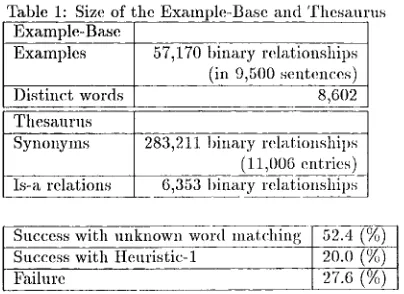
E x a m p l e - B a s e a n d T h e s a u r u s All example-base for disambigu~tion of sentences in computer manuMs is now being developed. Table 1 shows its currem; size. The sentences are extracted from examples in the L(mgman Dictionary of Con- temporary English[9]
and definitions in the IBM Dictionary of Computing [2]. Synonym and is-a re- lati(mships arc extracted from the New Collins The- saurus [1] and Webster's Seventh New Collegiate Dictionary [4].Table 1: Size of the Example-Base a n d ' r l m s a u r u s
Example-Base
Examples 57,170 binary relationshit)s (in 9,500 sentences)
Distinct words 8,602
T h e s a u r u s
Synonylns 283,21 i binary relationshil)s (11,1)06 entries) Is-a relations
6,353
binary relationslfips52.4 (%) I Success with u n k n o w n word matctfing
Success with Heuristic-1 L'tilure
20.o (%)
27.6 (%)
Fig. 3: Result of d i s a m b i g u a t i o n
To resolve semantic ambiguities, the examl)les should be d i s a m b i g u a t e d semantically. On the oth- er band, s t r u c t u r a l def)endencies can be e x t r a c t e d from raw or tagged corpora t)y using simple rules or p a t t e r n s , in our approach, multile, vel descriptions of examples are allowed: one example may provide b o t h s t r u c t u r a l and word-sense information, while a n o t h e r m a y provide only s t r u c t u r a l dependem:ies. Word-senses are added to a half of the sentences in example-base.
5 . 2 E x p e r i m e n t
We did a small experiment on d i s a m b i g u a t i o n of prepositional I)hrase a t t a c h m e n t . First, we pre- pared 105 ambiguous test dater randomly from 3,000 sentences in a (:olni)ute.r manual. T h e f o r m a t of the d a t a was as follows:
verb noun prep unknown-noun
None of these d a t a (:an be d i s a m b i g u a t e d by us- ing the conventional b e s t - m a t e l d n g algorithm, s- ince noun2 does not a p p e a r in the example-base or thesaurus. Conjunctive, relationslfips, described in C h a p t e r 3, are used with the exmnple-base and the thesaurus.
T h e results of the d i s a m b i g u a t i o n are shown in Fig. 3. We were able to d i s a m b i g u a t e 52.4% of the, test d a t a by using mlknown-word-matching. By us- ing Heuristic-1 in addition, we obt~ine(l a 72.4% success rate for u n k n o w n words.
ODe cause of failure is imbalai,ce a m o n g exam- pies. The n u m b e r of exanq)les for frequent verbs is larger t h a n the n u m b e r of exanq)les tk)r frequent nouns. As a result, verb a t t a c t u n e n t tends to be preferred. 2 A n o t h e r cause of failure is the mmfl)er of context dependen(:ies. In tim experim(mt, at most the nearest eight sentences were used; the o p t i n m m n u m b e r is still a n open question.
2We did not use other heuristics such as prefl?r(mce lop inner attachment.
6
C o n c l u s i o n
M e t h o d s h)r improving the coverage of example- bases were 1)reposed in order to allow the realization of broad-coverage examph>l)ased systems. ~vV(, are evMuating our approacl) with larger a m o u n t s of da- ta. For future progress, the following issues must be discussed:
I. In this paper, conjunctive relationships were used as knowledge with the b e s t - m a t c h algo- r i t h m , in addition to a thesaurus. However, various types of knowledge will be required on a large scale for a more r o b u s t system. Au- t o m a t i c or semi-mttomatic acquisition, using corpus-based m e t h o d s , is also needed. 2. If there are many u n k n o w n words ill an all]-
biguity, unknown-word m a t c h i n g will not work well. In additio,t to scaling up the example- base and the tlwsaurus, we should deve, top a nmre r o b u s t algorithm.
R e f e r e n c e s
[1] Collins. The New Collin,~ The,~aurus. Collins Pub- lishers, Glasgow, 1984.
[2] IBM Corpor~ttion. 1BM Dictionary of Comp'~din.q, volume SC20q699o(17. IBM Corporation, 1988. [3] S. Kinoslfita, M. Shimazu, and H. Hirakawa. "Bet-
ter Translation with Knowledge Extracted from Souree Text". In Proceedings of TM1-93, pages 240 252, 1993.
[4] Merriam. Webster'a Seventh Nc'w Collegiate Dictionary. G.& C. Merriam, Spring- tield,Massttehuset t s, 1963.
[5] K. Nagao. "Delmmleney Analyzer: A Knowledge- Based A1)proaeh to Structural Disambiguation". In Procceding,~ of COLING-90, pages 282 287, 1990. [6] M. Nagao. "A Frmnework of a Mechanical Trans-
lation between a~pmtese ~md English by Analogy Principle". In A. Elithorn and 12. Banerji, editors, Artificial and Human Intelligence. NAT(), 1984. [7] T. Nasukawa. "Discourse Constraint ill Computer
Mammls". In Proceedinga of TMI-93, pages 183 194, 1993.
[8] S. Niren|mrg, (2. Domashnev, and D. I. Grannes. "Two Approaclms to Matching iu Exmnple-Based Machine ~lYmLslation". In PTvcec, ding.~ of TMI-93, pages 4"[ 57, 1993.
[9] P. Proeter. Longman Dictionary of Contemporary Engli,~h. Longman Group Limited, Harlow told London, England, 1978.
[10] S. Sate and M. Nagao. "Towards Memory-Based Trmtslation". in Proeeeding,~ of CO LING-90, pages 1.46 152, 1990.
[11] N. Urmnoto. "LexieM and Structural Dismnbigua- lion Using an Exmnl)le-Base". In The 2rid Japan- Australia ,loint 5'ympo,~i,um on Natural Language Procc,~,sing, 1);tges 150 160, 1991.
[image:5.612.81.283.85.232.2] [image:5.612.305.497.323.704.2]