Universal Dependencies for Japanese
Takaaki Tanaka
∗, Yusuke Miyao
†, Masayuki Asahara
♢,
Sumire Uematsu
†, Hiroshi Kanayama
♠, Shinsuke Mori
♣, Yuji Matsumoto
‡∗NTT Communication Science Labolatories,†National Institute of Informatics, ♢National Institute for Japanese Language and Linguistics,
♠IBM Research - Tokyo,♣Kyoto University,‡Nara Institute of Science and Technology [email protected], [email protected], [email protected], [email protected], [email protected], [email protected], [email protected]
Abstract
We present an attempt to port the international syntactic annotation scheme, Universal Dependencies, to the Japanese language in this paper. Since the Japanese syntactic structure is usually annotated on the basis of unique chunk-based dependencies, we first introduce word-based dependencies by using a word unit called the Short Unit Word, which usually corresponds to an entry in the lexicon UniDic. Porting is done by mapping the part-of-speech tagset in UniDic to the universal part-of-speech tagset, and converting a constituent-based treebank to a typed dependency tree. The conversion is not straightforward, and we discuss the problems that arose in the conversion and the current solutions. A treebank consisting of 10,000 sentences was built by converting the existent resources and currently released to the public.
Keywords: typed dependencies, Short Unit Word, multiword expression, UniDic
1.
Introduction
The Universal Dependencies (UD) project has been de-veloping cross-linguistically consistent treebank annota-tion for various languages in recent years. The goal of the project is to facilitate multilingual parser development, cross-lingual learning, and parsing research from a lan-guage typology perspective (Nivre, 2015). The annotation scheme is based on (universal) Stanford dependencies (de Marneffe and Manning, 2008; de Marneffe et al., 2014) and Google universal part-of-speech (POS) tags (UPOS) (Petrov et al., 2012).
In our research, we attempt to port the UD annotation scheme to the Japanese language. The traditional annota-tion schemes for the Japanese language have been uniquely developed and are markedly different from other schemes, such as Penn Treebank-style annotation. Japanese syntac-tic parsing trees are usually represented as unlabeled de-pendency structures between bunsetsu chunks (base phrase units), as found in the Kyoto University Text Corpus (Kuro-hashi and Nagao, 2003) and the outputs of syntactic parsers (Kudo and Matsumoto, 2002; Kawahara and Kuro-hashi, 2006). Therefore, we must devise a method to con-struct word-based dependency con-structures that match the characteristics of the Japanese language (Uchimoto and Den, 2008; Mori et al., 2014; Tanaka and Nagata, 2015) and are able to derive the syntactic information required to assign relation types to dependencies.
We describe the conversion from the Japanese POS tagset to the UPOS tagset, the adaptation of the UD annotation for Japanese syntax, and the attempt to build a UD corpus by converting the existing resources. We also address the remaining issues that may emerge when applying the UD scheme to other languages.
2.
Word unit
The definition of a word unit is indispensable in UD an-notation, which is not a trivial question for Japanese, since a sentence is not segmented into words or morphemes by white space in its orthography. Thus, we have several word unit standards that can be found in corpus annota-tion schemata or in the outputs of morphological analyz-ers (Kudo et al., 2004; Neubig et al., 2011).
NINJAL1 proposed several word unit standards for
Japanese corpus linguistics, such as the minimum word unit (Maekawa et al., 2000). Since 2002, the Institute has maintained a morphological information annotated lexicon, UniDic (Den et al., 2008), and has proposed three types of word unit standards:
Short Unit Word (SUW): SUW is a minimal language unit that has a morphological function. SUW almost always corresponds to an entry in traditional Japanese dictionaries.
Middle Unit Word (MUW): MUW is based on the right-branching compound word construction and on phonological constructions, such as an accent phrase and/or sequential voicing.
Long Unit Word (LUW): LUW refers to the composition of bunsetsu units. An LUW has nearly the same con-tent as functional words bounded by bunsetsu bound-aries.
We adopted SUW from the two types of word units, SUW and LUW, used for building the Balanced Corpus of Con-temporary Written Japanese (BCCWJ) (Maekawa et al., 2014). SUWs correspond to an entry conveying morpho-logical information in the UniDic. In this way, the UD
1
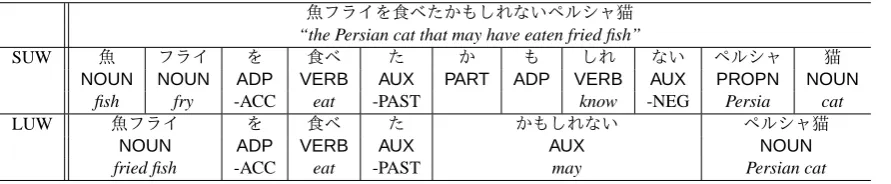
魚フライを食べたかもしれないペルシャ猫
“the Persian cat that may have eaten fried fish”
SUW 魚 フライ を 食べ た か も しれ ない ペルシャ 猫
NOUN NOUN ADP VERB AUX PART ADP VERB AUX PROPN NOUN
fish fry -ACC eat -PAST know -NEG Persia cat
LUW 魚フライ を 食べ た かもしれない ペルシャ猫
NOUN ADP VERB AUX AUX NOUN
[image:2.595.78.524.68.160.2]fried fish -ACC eat -PAST may Persian cat
Figure 1: Japanese word unit: Short unit word (SUW) and Long unit word (LUW).
... ..
魚 フライ.. を .. 食べ.. た .. か.. も.. しれ.. ない.. ペルシア.. 猫 ..
..
NOUN NOUN.. ADP.. VERB.. AUX.. ADP.. ADP.. VERB.. AUX.. NOUN.. NOUN.. ..
fish fry.. -ACC.. eat.. -PAST.. .. .. know.. -NEG.. Persia.. cat.. .
compound
. case
. dobj
. aux
. aux
.
mwe
.
mwe
.
mwe
.
compound
.
[image:2.595.98.493.201.335.2]acl
Figure 2: Dependencies for compounding SUWs into LUWs.
scheme for the Japanese language was based on the lex-emes and the POS tagset defined in the UniDic. This was done because the UniDic guidelines are fully established and widely used in Japanese NLP. The UniDic has been maintained diachronically, and NINJAL has published ver-sions of UniDic for several eras.
SUWs are sometimes too short for assigning the syntactic relation types for a pair of SUWs, while LUWs are more suitable for representing syntactic structure and function. Figure 1 is an example of Japanese unit word segmenta-tion with SUWs and LUWs. The sentence contains some multiword expressions (multi SUWs) composing a single LUW, such as a compound noun and function phrase. For a compound noun LUW, e.g., 魚/フライ“fried fish”, the internal relation is tagged withcompound. An LUW that behaves like a single function word is annotated by a flat and head-initial structure. LUW internal dependencies are tagged withmwein conformity to the UD scheme. In the example,the phraseか/も/しれ/ないkamosirenai,
function-ing like a sfunction-ingle auxiliary verb, is annotated by a flat struc-ture usingmwerelations.
3.
Part-of-speech annotation
UD employs UPOS tags, based on the Google univer-sal tagset. The Japanese POSs are defined as a map-ping from UniDic POS tags to UPOS tags. The POSs in Japanese corpora can be understood in two ways: based and usage-based approaches. The lexicon-based approach involves extracting all possible categories for one word as labels. For example, the UniDic POS tagnoun(common.verbal.adjectival)2means that a word can be a common noun, verbal noun, or adjective.
2
Typewriter font is used for UniDic POS tags in this paper.
Usage-based labeling is determined by the contextual in-formation in sentence.
We assume that the UPOS tagset is usage-based, though this is not clearly defined, and map the UniDic POS tagset to the UPOS tagset by disambiguating the lexicon-based UniDic POS using available context. For example, we must determine whether nominal verbs are tagged withVERBor
NOUNdepending on the context, as described in the rest of this section.
Table 1 shows a mapping from UniDic POS tags to Uni-versal POS tags. The mapping between two tagsets is not a one-to-one correspondence, and thus, conversion is not straightforward. Issues that arise during the actual mapping for individual POS tags are described below.
Particle In traditional Japanese grammar, particles are classified into several subcategories; UniDic has six particle subcategories. Some particles can be mapped to UPOS tags using the subcategories, while some are split and assigned different UPOS tags. Case particles (particle(case)) and binding particles (particle(binding)) correspond toADPwhen they are attached to a noun phrase as case markers. Note that the case particleと(particle(case))
3is tagged withCONJwhen it marks a conjunct in a
coor-dinating conjunction. Phrase final postpositional particles (particle(phrase final)) are classified into PART. Conjunctive particles (particle(conjunctive)), which introduce subordinate clauses, and nominal particles (particle(nominal)), which introduce noun phrases as complementizers, are mapped toSCONJ.
3
Adnominal There is a small group of adnominal words tagged withadnominalin UniDic, which are similar to at-tributive adjectives but not conjugative words. Some words in the class correspond to demonstrative and possessive pronouns, e.g.,あのano “that” andどのdono “which,” and
are classified as determinersDET, while others are tagged
ADJ, e.g., 同じ onaji “same” and大きな ookina “big.”
This is because, in other language, the former functions as a determiner. However, the Japanese language does not have articles and the traditional Japanese grammar does not have the determiner word class.
Auxiliary verb In some cases it is difficult to distinguish between main and auxiliary verbs.
• 走っ たhashit ta “ran”
• 走っ て いるhashit te iru “running”
• 走っ て ほしいhashit te hoshii “want (you) to run”
• 走り 始めるhashiri hajimeru “begin to run”
In our first example, we clearly have an auxiliary verb, be-causeたdoes not appear independently. The other cases, however, are unclear, because verbs likeいる,ほしいand
始めるcan also be used as main verbs. In the above exam-ples, the usual meanings of these verbs are replaced (simi-lar to a light verb) and auxiliary meanings are added to the preceding verbs.
These verbs are defined as非自立verb(bound)in Uni-Dic, and we define this type of verb preceded by another verb as an auxiliary verb. If these verbs appear indepen-dently, they are regarded as the main verb.
Nominal verb and nominal adjective Words in this cat-egorynoun(common.verbal suru) are basically nouns and function as verbs when followed by an auxiliary verb, e.g.,するsuru “do.” The stems of nominal verbs, e.g.,報 告houkoku “report,” are tagged withVERBas heads when they are used as verb (1). They are still tagged withNOUN
when used as nouns (2).
The noun(common.adjectival) words are similarly tagged withNOUNorADJdepending on context. That is, the stems of the nominal adjectives, e.g.,自由jiyuu “free,”
are tagged ADJ as heads when used as adjectives, and tagged NOUNwhen used as nouns, as shown in (3) and (4).
ADJas
(1)
.. ..
結果 を.. 報告 .. する..
..
NOUN ADP.. VERB.. AUX.. ..
results -ACC.. report.. do.. .
case
. dobj
.
aux
‘(Someone) reports the results. ’
(2)
.. ..
報告 が.. あり .. ませ.. ん..
..
NOUN ADP.. VERB.. AUX.. AUX.. ..
reports -NOM.. exist.. .. -NOT.. .
case
. nsubj
. aux
.
neg
‘There is no report. ’
(3)
.. ..
思想 は.. 自由 .. だ..
..
NOUN ADP.. ADJ.. AUX.. ..
thought -TOPIC.. free.. be.. .
case
. nsubj
.
aux
‘Thought is free.’
(4)
.. ..
自由 を.. 得る ..
..
NOUN ADP.. VERB.. ..
freedom -ACC.. gain.. .
case
. dobj
‘(Someone) gains freedom.’
Suffix UniDic has thesuffix (andprefix) categories as independent word classes. A typical suffix adds meaning to the preceding noun and forms a new noun phrase. For instance, the suffix達 tachi is a type of plural suffix and
makes a plural form as in 学生/達 “students”. These are tagged withNOUN.
Another type of suffix alters the POS of the preceding word. For example, the suffixさ sa changes an adjective into a
noun as in (5), andっぽいppoi changes a noun into an
ad-jective as in (6). These words are tagged withPARTand are dependent on the preceding words. Unlike nominal verbs and nominal adjectives, the POS of the preceding word re-mains the same as the original one in the annotation. This is because the preceding words do not have the syntactic prop-erties of the altered POS without suffixes, while nominal verbs and nominal adjectives have the properties of verbs and adjectives by themselves. This kind of construction is very generative, and it is considered to be morphological (a word formation), rather than a syntactic relation.
(5)
.. ..
かわい さ..
..
ADJ PART.. ..
cute -ness.. . mark
‘Cuteness’
(6)
.. ..
子ども っぽい..
..
NOUN PART.. ..
child -like.. . mark
‘Child-like’
4.
Syntax annotation
Universal POS UniDic POS
ADJ adjective i 赤い“red” adnominal いろんな“various” noun(adjectival) 自由/だ‘“free”
ADP particle(case) が(nominative case),を(accusative case) particle(binding) は(binding)
ADV adverb とても“very”,必ず“always” noun(adverbial) 完全/に“absolutely” AUX auxiliary verb 食べ/た“ate” (past tense)
verb(bound) 食べ/て/いる“be eating” (progressive) verb(bound) 勉強/する“study” (verbification) adjective i 食べ/ない“not study” (negation) CONJ particle(case) コーヒー/と/牛乳“coffee and milk”
particle(adverbial) コーヒー/か/牛乳“coffee or milk” conjunction しかし“but”
DET adnominal この“this”,その“that” (demonstrative) INTJ interjection ああ“oh”,えっと“well”
NOUN noun 猫“cat”,質問“question” prefix 副/社長“vice president”
suffix 学生/達“students” (plural),付属/品“accessories (lit.) supplementary parts” NUM noun(numeral) 十“ten”
PART particle(phrase final) 良い/ね“good, isn’t it”
suffix(adjectival noun) 衝撃/的/だ“(something) is shocking” PRON pronoun 私“I”,彼女“she”,いつ“when”
PROPN noun(proper.*.*) 京都“Kyoto”,鈴木“Suzuki”
PUNCT supplementary symbol .(period),「」(parentheses) SCONJ particle(conjunctive) 食べ/て/寝る“eat, then sleep”
particle(nominal) 食べる/の/が/好き“(I) like to eat” (nominal particle) SYM supplementary symbol +.−,<,>
[image:4.595.312.465.472.594.2]VERB verb 遊ぶ“play” noun(common.verbal suru) 勉強/する“study” X whitespace white space
Table 1: Mapping from UniDic POS to Universal POS. The symbols ‘/’ denote the borders of SUWs.
In the following paragraphs, we show the annotation scheme for some basic constructions.
Core dependent of the predicate Core dependents of the predicate can be either subject, direct object or indirect ob-ject in the context of UD. It is difficult to strictly define verb valency in Japanese; generally, a postpositional phrase that is a dependent of the predicate is assigned with subject, di-rect object or indidi-rect object depending on its case particle,
がga,をo orにni. Even if the case particle is hidden by a
topical markerはwa in a topicalized phrase and the
adver-bial particleもmo, the relation is assigned on the basis of
the original particle.
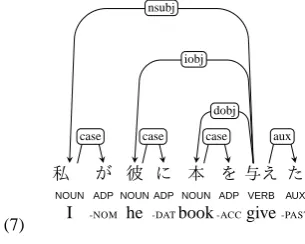
In sentence (7), the relationship between the predicate与え
る“give” ataeru and the postpositional phrases私/が “I”-NOM,彼/に“he”-DAT, and本/を“book”-ACC are tagged
nsubj,dobj, andiobj, respectively. Even if the phrase本/
を“book”-ACC is topicalized, i.e.,私が彼に本 は 与えた. “As for the book, I gave it to him. (I may not give anything else.),” the dependency between the argument 本and the verb与えるis still taggeddobj.
(7)
.. ..
私 が.. 彼.. に.. 本.. を.. 与え.. た.. ..
NOUN ADP.. NOUN.. ADP.. NOUN.. ADP.. VERB.. AUX.. ..I -NOM.. he.. -DAT.. book .... -ACCgive.. -PAST..
. case
. case
. case
. nsubj
. iobj
. dobj
.
aux
‘I gave him a book’
Nominal subject and clausal subject Concerning the distinction between nominal subjectnsubjand clausal sub-jectcsubj, we have the following gradation.
• 食べる の が 大切 だ“Eating is important” • 食べる こと が 大切 だ“Eating is important” • 食べる ところ が 大切 だ“The place where (we) eat
is important”
The first one is the csubj case because の no is a
relation definition typical construction in Japanese
nsubj nominal subject predicate→a postpositional phrase with the case markerが dobj direct object predicate→a postpositional phrase with the case markerを
iobj indirect object predicate→a postpositional phrase with the case markerに csubj clausal subject predicate→a postpositional phrase with the case markerが
dislocated dislocated elements predicate→a postpositional phrase with the topic markerは
nmod nominal modifier noun phrase with the genitive markerの→noun phrase amod adjective modifier noun phrase→ADJ
advmod adverbial modifier predicate→ADV case case marking noun phrase→ADP
mark marker subordinating clause→complementizerと
aux auxiliary predicate→AUX
cop copula noun phrase→the copular auxiliaryだ
neg negation predicate→the negative auxiliaryない
auxpass passive auxiliary predicate→ the passive auxiliariesれる/られる acl clausal modifier of noun head noun→relative clause
advcl adverbial clause modifier head verb→adverbial clause
ccomp clausal complement predicate of main clause→complement clause xcomp open clausal complement not used
[image:5.595.309.496.569.677.2]expl expletive not used
Table 2: Mapping to syntactic annotation in UD
Formal nounsことkoto “fact” andところtokoro “place”
(NOUN) can have clausal complements and form noun phrases denoting the action expressed by the clause. This occurs when the expressions are used as nouns having con-tent, but in these examples these words have light mean-ings.
In the current definition, we define only the first case, i.e., a phrase introduced byの, as a clausal subject, while the other cases are regarded as noun phrases. Here, the second example has almost the same meaning as the first.
Adnominal clause and adjective There are two types of noun modifying clauses: the clausal complement of a noun and a relative clause. In the UD scheme, these two types are not distinguished and are taggedacl4.
The dependency between formal nounことkoto “fact” and
the clausal complement is termed the clausal modification of a noun. 食べるtaberu “eat”ことmeans eating (or the fact that someone eats) in the example above, and the rela-tion between them is also taggedacl.
For a relative clause, the head of the dependency is the noun modified by the clause; the dependent is the main predicate of the clause as shown in (8). However, it is difficult to dis-tinguish between a clause and a non-clause because there is no difference between a simple adjective-noun construction as in (9) and a relative clause construction. This is because relative clauses are not accompanied by a relativizer. Our current solution is to define an adjective without any ar-guments, e.g.,nsubj, and auxiliary verbs, e.g.,たta, as a
non-clauseamodor otherwise as a clauseacl.
(8)
.. ..
服 が.. かわいい.. 人形..
..
NOUN ADP.. ADJ.. NOUN.. ..
cloth -NOM.. cute.. doll.. .
case
. nsubj
.
acl
4
In UD for English, the relative clause is currently classified into a subclassacl:relcl.
‘a doll whose clothes are cute’
(9)
.. ..
かわいい 人形..
..
ADJ NOUN.. ..
cute doll.. . amod
‘a cute doll’
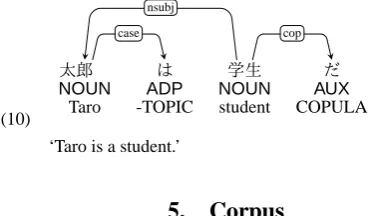
Copula The dependency typecopis reserved for the cop-ular auxiliaryだda. This auxiliary typically follows a noun
phrase to form a copular clause. A postpositional phrase with a nominative case is commonly needed to complete sentence as in (10). Note that we treat the auxiliaryだ af-ter nominal adjectivesnoun(common.adjectival)as an auxiliary instead of a copula as shown in (3).
(10)
.. ..
太郎 は.. 学生.. だ..
..
NOUN ADP.. NOUN.. AUX.. ..
Taro -TOPIC.. student.. COPULA.. .
case
. nsubj
.
cop
‘Taro is a student.’
5.
Corpus
for the Mainichi Shimbun Newspaper. The treebank was initially built by converting the Kyoto University Text Cor-pus and was manually annotated. The treebank has clause level annotations with syntactic function labels, e.g., syn-tactic role and clause type, and coordination construction, which are required for UD annotation. The treebank is composed of complete binary trees, and can be easily con-verted to dependency tree by adapting the head percolation rules and dependency type rules for each partial tree. The UD corpus is composed of 10,000 sentences, and it contains 267,631 tokens. The data is available on the UD website 5. Moreover, we attempted to construct conversion rules for BCCWJ with third-party annotations in order to build UD resources covering a wide variety of genres including books, magazines, blogs, etc.
6.
Discussion
Several issues remain before the Japanese syntactic struc-ture can be fully covered in the UD scheme.
Voice In UD, the passive voice is marked with special de-pendency types, such as nsubjpass andauxpass. This is useful in recognizing semantic dependencies. Sentence (12) is the passivized sentence of sentence (11). The subject of (11), which is an agent of食べる“eat,” is distinguished from the subject of (12).
(11)
.. ..
太郎 が.. りんご.. を.. 食べ .. た.. ..
NOUN ADP.. NOUN.. ADP.. NOUN.. AUX.. ..
Taro-NOM.. apple.. -ACC.. eat.. -PAST.. .
case
. case
. nsubj
. dobj
.
aux
‘Taro ate an apple. (active)’
(12)
.. ..
りんご が.. 太郎.. に.. 食べ.. られ.. た.. ..
NOUN ADP.. NOUN.. ADP.. NOUN.. AUX.. AUX.. ..
apple -NOM.. Taro .... -DAT eat.. -PASS.. -PAST.. .
case
. case
. nsubjpass
. iobj
.
auxpass
.
aux
‘An apple was eaten by Taro. (passive)’
Japanese syntax involves another voice that involves case alternations done by adding specific auxiliary verbs to pred-icates similar to passive voice construction, as shown in (13) and (14). The problem here is that the relationship between the verb and its subject in this voice is not dis-tinguished from the relationship indicated by the original active voice 6. The subject of the verb phrases 食べ/さ/
5
http://universaldependencies.org/. Note that the orig-inal Mainichi Shimbun Corpus CD-ROM 1995, available at http://www.nichigai.co.jp/sales/mainichi/
mainichi-data.html, is needed to restore the treebank.
6
Voice information can be included as a morphological fea-ture; however it is not clearly represented as a syntactic structure.
せる“eat +CAUS” or食べ/て/もらう“eat +BENEF”,花 子“Hanako”, is an additional argument, which is a causer in sentence (13) and a benefactor in sentence (14). It is normally annotated withnsubj, following the current UD scheme, while the subject in sentence (12),りんご“apple”, which is the patient of the verb, is annotated with the spe-cial relationnsubjpass. In addition, the proto-agent of the verb食べ“eat”,太郎“Taro”, is tagged withiobjbecause it is marked with the case markerに“ni” in these construc-tions.
We do not have a method to indicate these case alternations in the current UD. Currently, we give dependency types on the basis of surface expressions, without any markings of case alternations.
(13)
.. ..
花子 が.. 太郎.. に.. りんご.. を.. 食べ .. させる.. ..
NOUN ADP.. NOUN.. ADP.. NOUN.. ADP.. VERB.. AUX.. ..
Hanako-NOM.. Taro .... -DAT apple.. -ACC.. eat.. -CAUS.. .
case
. case
. case
. nsubj
. iobj
. dobj
.
aux
‘Hanako makes Taro eat an apple. (causative)’
(14)
.. ..
花子 が.. 太郎.. に.. りんご.. を.. 食べ.. て .. もらう.. ..
NOUN ADP.. NOUN.. ADP.. NOUN.. ADP.. VERB.. SCONJ.. AUX.. ..
Hanako-NOM.. Taro .... -DAT apple.. -ACC.. eat.. .. -BENEF.. .
case
. case
. case
. nsubj
. iobj
. dobj
.
aux
.
aux
‘Hanako asks Taro to eat an apple. (benefactive)’
Coordination We take the first conjunct as the head in the coordinating construction in the fashion of the UD scheme. However, because Japanese is a head final language, the last conjunct tends to be the head. Using first conjunct head construction for a head final language creates issues be-cause different constructions share the one annotation. For example, the annotation (15) has two possible interpreta-tions.かわいい犬と猫“cute dogs and cats” could be inter-preted as having the adjective modifying the first conjunct
犬“dog” or the adjective modifying the whole construction
(15)
.. ..
かわいい 犬 .. と.. 猫..
..
ADJ NOUN.. CONJ.. NOUN.. ..
cute dog.. and.. cat.. .
cc
. conj
. amod
‘cute dogs and cats’
Topic phrase The dependency type dislocated is as-signed for topic phrases. A topic phrase introduces the topic of a sentence, and is typically a prepositional phrase with a topic markerはwa. One of the most famous examples is
象 は 鼻 が 長い 。zou wa hana ga nagai “For elephants,
trunks are long.”7
However, this type is also used for fronted or postposed elements that do not fulfill the usual core grammatical rela-tions; for example, the relation between “office” and “me” in the sentence “This is our office, me and Sam.” It is possi-ble to argue that these constructions share the same depen-dency type.
(16)
.. ..
象 は.. 鼻.. が.. 長い..
..
NOUN ADP.. NOUN.. ADP.. ADJ.. ..
elephant -TOPIC.. trunk.. -NOM.. long.. .
case
. case
. dislocated
.
nsubj
‘For elephants, trunks are long. ’
7.
Conclusion
We have presented an attempt to apply the UD annotation scheme on Japanese language annotation and build a UD corpus. Porting the UD scheme to Japanese is not straight-forward. We have enumerated the issues related to mor-phological and syntactic phenomena in Japanese and shown our current solutions. We believe that the remaining issues, including voice and coordination provide hints towards a better UD scheme in terms of the commonization of phe-nomena in various languages.
The first draft of the guidelines for UD Japanese was re-leased on June 1st, 2015, and the first treebank is available through the UD website.
8.
Bibliographical References
de Marneffe, M.-C. and Manning, C. D. (2008). The stan-ford typed dependencies representation. In Proceedings
of COLING 2008 Workshop on Cross-framework and Cross-domain Parser Evaluation.
de Marneffe, M.-C., Silveira, N., Dozat, T., Haverinen, K., Ginter, F., Nivre, J., and Manning, C. D. (2014). Univer-sal stanford dependencies: A cross-linguistic typology. In Proceedings of the Ninth International Conference on
7
Note that the relationdislocatedis not used as a topicalized phrase and also a core argument of a predicate, as described in Section 4.
Language Resources and Evaluation, LREC 2014, pages
4584–4592.
Den, Y., Nakamura, J., Ogiso, T., and Ogura, H. (2008). A proper approach to Japanese morphological analysis: Dictionary, model and evaluation. In Proceedings of the
Sixth International Conference on Language Resources and Evaluation, LREC 2008, pages 1019–1024.
Kawahara, D. and Kurohashi, S. (2006). A fully-lexicalized probabilistic model for Japanese syntactic and case structure analysis. In Proceedings of the Human
Language Technology Conference of the North American Chapter of the Association of Computational Linguistics,
HLT-NAACL 2006, pages 176–183.
Kudo, T. and Matsumoto, Y. (2002). Japanese dependency analysis using cascaded chunking. In Proceedings of
the 6th Conference on Natural Language Learning,
vol-ume 20 of CoNLL 2002, pages 1–7.
Kudo, T., Yamamoto, K., and Matsumoto, Y. (2004). Applying conditional random fields to Japanese mor-phological analysis. In Proceedings of the Conference
on Empirical Methods in Natural Language Processing,
EMNLP 2004, pages 230–237.
Kurohashi, S. and Nagao, M., (2003). Building a Japanese
Parsed Corpus – while Improving the Parsing System,
chapter 14, pages 249–260. Kluwer Academic Publish-ers.
Maekawa, K., Koiso, H., Fukui, S., and Isahara, H. (2000). Spontaneous speech corpus of Japanese. In Proceedings
of the Second International Conference on Language Re-sources and Evaluation, LREC 2000, pages 947–952.
Maekawa, K., Yamazaki, M., Ogiso, T., Maruyama, T., Ogura, H., Kashino, W., Koiso, H., Yamaguchi, M., Tanaka, M., and Den, Y. (2014). Balanced corpus of contemporary written Japanese. Language Resources
and Evaluation, 48(2):345–371.
Mori, S., Ogura, H., and Sasada, T. (2014). A Japanese word dependency corpus. In Proceedings of the Ninth
International Conference on Language Resources and Evaluation, LREC 2014, pages 753–758.
Neubig, G., Nakata, Y., and Mori, S. (2011). Pointwise prediction for robust, adaptable Japanese morphological analysis. In Proceedings of the 49th Annual Meeting of
the Association for Computational Linguistics: Human Language Technologies, ACL HLT 2011, pages 529–
533.
Nivre, J. (2015). Towards a universal grammar for natural language processing. In Proceedings of the 16th
Interna-tional Conference of ComputaInterna-tional Linguistics and In-telligent Text Processing, CICLing 2015, pages 3–16.
Petrov, S., Das, D., and McDonald, R. (2012). A univer-sal part-of-speech tagset. In Proceedings of the
Interna-tional Conference on Language Resources and Evalua-tion, LREC 2012, pages 2089–2096.
Tanaka, T. and Nagata, M. (2013). Constructing a practical constituent parser from a Japanese treebank with func-tion labels. In Proceedings of the Fourth Workshop on
Statistical Parsing of Morphologically-Rich Languages,
SPMRL 2013, pages 108–118.
typed dependency parsing with grammatical function analysis. In Proceedings of the 53rd Annual Meeting of
the Association for Computational Linguistics, volume 2
of ACL 2015, pages 237–242.
Uchimoto, K. and Den, Y. (2008). Word-level dependency-structure annotation to corpus of sponta-neous Japanese and its application. In Proceedings of the