Chinese Relation Classification using Long Short Term Memory Networks
Linrui Zhang, Dan Moldovan
The University of Texas at Dallas800 West Campbell Road ; MS EC31, Richardson, TX 75080 U.S.A [email protected], [email protected]
Abstract
Relation classification is the task to predict semantic relations between pairs of entities in a given text. In this paper, a novel Long Short Term Memory Network (LSTM)-based approach is proposed to extract relations between entities in Chinese text. The shortest dependency path (SDP) between two entities, together with the various selected features in the path, are first extracted, and then used as input of an LSTM model to predict the relation between them. The performance of the system was evaluated on the ACE 2005 Multilingual Training Corpus (Walker et al., 2006), and achieved a state-of-the-art F-measure of 87.87% on six general type relations and 83.40% on eighteen subtype relations in this corpus.
Keywords: Long Short Term Memory Networks, Shortest Dependency Path, Chinese Relation Classification
1.
Introduction
The task of relation classification is to predict semantic re-lations between pairs of entities. Formally, the goal is to predict the semantic relations between a head entityehand
a tail entityetfrom a given sentence. For example, in the
phrase “ÄW¯;ßRussian President”, the relations be-tween “Russia (ORG)” and “President (PER)” are ORG -AFFwhich indicate that the “President” is affiliated to an or-ganization “Russia” , in ACE annotationORG-AFF(Russia, President), and to be more specific, “President” is the em-ployee of “Russia”, EMPLOYMENT(Russia, President). In ACE corpus 2005, six general relations such asORG-AFF andPART-WHOLE, and eighteen subtype relations such as OWNERSHIP,LOCATED, andEMPLOYMENTare defined. The feature-based, kernel-based and deep learning-based methods are the most popular models for relation extrac-tion in the literature. The basic idea of the feature-based approach is to treat relation extraction as a classification problem. Different kinds of features are extracted from text and then fed into a classifier. Such work includes (Kamb-hatla, 2004), (GuoDong et al., 2005) and (Moldovan and Blanco, 2012). However, these approaches suffer from er-ror propagation problems. If the features are not well se-lected, the errors will be added up until the end. (Jiang and Zhai, 2007) systematically analyzed the effectiveness of different features for relation extraction on a large feature space and concluded that just using the basic unit features from each feature space (sequence, syntactic and depen-dency relation) can achieve reasonably good performance, and adding more complex features may not benefit the re-sult. The kernel-based approach is to compute a kernel function to measure the similarity between two data ob-jects. Such work includes (Zelenko et al., 2003), (Culotta and Sorensen, 2004), (Bunescu and Mooney, 2005), (Zhang et al., 2006), (Zhou et al., 2007), (Wang, 2008) and (Plank and Moschitti, 2013). The key issue of the kernel-based approach is the slow training and prediction time, so it is not good enough to process big data. With the development of deep learning, a series of neural network-based models are proposed, such as recursive neural network-based ap-proaches (Socher et al., 2012),(Ebrahimi and Dou, 2015),
and convolutional neural network-based approaches (Zeng et al., 2014), (Santos et al., 2015), and (Nguyen and Grish-man, 2015).
Long short-term memory (Hochreiter and Schmidhuber, 1997) can capture long-term dependencies in sequences, so they could be used to model sequential data naturally. Re-cently they have been used frequently in many NLP tasks (Cho et al., 2014). Shortest dependency paths (SDP) have proven to be highly useful to relation extraction (Ebrahimi and Dou, 2015). They can to the utmost avoid involving irrelevant words in the path from one entity to another. (Xu et al., 2015) combined LSTMs and SDPs together and pro-posed a SDP-LSTM model for an English relation classifi-cation task on the SemEval-2012 dataset. Intrigued by this idea, we built a simplified SDP-LSTM model for Chinese relation classification on the ACE 2005 corpus and obtained state-of-the-art results. To the best of our knowledge, we are the first to implement an LSTM network for Chinese relation classification. This paper is organized as follows: We first present related work, then describe the system in detail, including the SDP and features for Chinese, and ex-plain how to apply them to the LSTM Model. After that we present the details of our experiment, such as the corpus, the training details and the tools used. Finally, we compare our work with previous work in the literature, and show the effectiveness of different features on the final results.
2.
Related Work
enti-ties and focused on the effectiveness of the positional fea-ture on Chinese relation extraction. (Chen et al., 2014) pro-posed a novel Omni-word feature which takes advantage of Chinese sub-phrases, together with soft constraints for Chinese relation extraction, and got a 90.35% F1 score on Type relation, and a 75.44% F1 score on subType relation. Other interesting work such as (Chen et al., 2012) intro-duces a Deep Belief Network model that can handle high-dimensional feature space (Lin et al., 2010) worked on a mixed model that combined feature-based and kernel-based models together.
Word vector representation is the foundation of deep learn-ing techniques for NLP. There are two popular models for word embedding: the word2vec model, which is promoted by Google (Mikolov et al., 2013), and the GloVe model, which is promoted by Stanford University (Pennington et al., 2014). Low-dimensional, dense word embeddings can effectively alleviate sparsity by sharing statistical strength between similar words, and can provide a good starting point to construct features of words and their interactions (Chen and Manning, 2014).
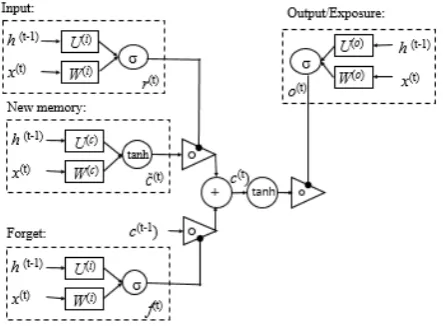
Long short term memory (LSTM) networks were first pro-posed by Hochreiter in 1997 (Hochreiter and Schmidhuber, 1997). An LSTM could be viewed as a complex activation unit that has an input gate, a forget gate, an output gate, a new memory cell and a final memory cell. Figure 1 shows the complete representation of a long short term memory unit.1
Figure 1: The complete representation of a long short term memory unit.
The mathematical formulation of LSTM units is as follows: The input gateis to decide if the inputxtis worth being
preserved based on the input wordxtand the past hidden
stateht−1.
it=σ(W(i)xt+U(i)ht−1)
The forget gate ftmakes an assessment on whether the
past memory cell is useful to compute the current memory cell.
ft=σ(W(f)xt+U(f)ht−1)
The output gate is to separate the final memoryctfrom
1http://web.stanford.edu/class/cs224n/lecture notes/cs224n-2017-notes5.pdf
the hidden state.
ot=σ(W(o)xt+U(o)ht−1)
The new memory generation cell is used to generate a new memory˜ctby input workxtand the past hidden state
ht−1.
˜
ct=tanh(W(c)xt+U(c)ht−1)
The final memory cell produces the final memoryct by
summing the advice of the forget gateftand input gateit
ct=ft◦ct−1+it◦c˜t
ht=ot◦tanh(ct)
3.
Approach
The pipeline of the system is as follows: we first find the shortest dependency path (SDP) between two given enti-ties in a sentence. Second, we extract the selected features along the words in the SDP. Finally, we concatenate the dis-tributated representation of the words and their features into dense vectors, and feed them as input of LSTM models.
3.1.
The Shortest Dependency Path
Dependency parsing captures the dependence relations be-tween words, and when compared with constituency paths, dependency paths have a better ability to encode informa-tion. In dependency parsing, the dependency relations and words will form a dependency graph. The edges are the dependency relations and the vertices are the words. Find-ing the shortest dependency path between words may be mapped into finding the shortest path between two ver-tices in the dependency graph. We used Stanford CoreNLP (Manning et al., 2014) for dependency parsing, and Net-workX (Hagberg et al., 2008) to get the shortest path in the dependency graph. Figure 2 and 3 show an example to map from the dependency graph to shortest dependency path of sentence “We went home after comforting her sister (ì
(p¹¹_Þ¶).”.
3.2.
Feature selection
We extracted four kinds of features: word embedding, Part-of-Speech tags, entity type, and entity subtype.
We use Google’s word2vec model and trained our word vectors on Chinese Wikipedia data. Part-of-Speech tags are extracted by Stanford CoreNLP. The type and subtype of the entities are already annotated by the corpus. The ACE corpus defines seven general types of entities, and each gen-eral type could be subcategorized into subtypes. There are 44 total subtypes of entities.
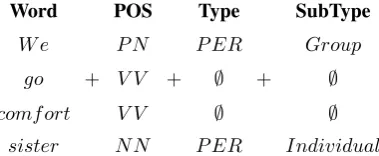
All the features use distributed representations and are only applied to the words that are on the shortest dependency path. For each word, we concatenated it with all its fea-tures into a dense vector and fed it as the input of the LSTM model. Figure 4 shows the feature representation of the sen-tence.
3.3.
Model Structure
In general, the model has three layers: one LSTM layer, one dropout layer and one softmax layer. An overview of the model is shown in Figure 5.
3.3.1. The LSTM layer
P N Puu V V casercomp ..V V **N N
dobj
LC
)
)
case
AD V V
nsubj
u
u
prep
u
u rr advmod
SP
,
,
asp
P U
)
)
punct
ì ( p ¹¹ _ Þ
we comf ort sister went back .
Figure 2: The dependency graph of the sentence “We went back after comforting her sister.”
weoo nsubjwent back prep //comf ort dobj //sister
Figure 3: The shortest dependency path between “we ”and “sister ”.
Word POS Type SubType
W e P N P ER Group
go + V V + ∅ + ∅
comf ort V V ∅ ∅
sister N N P ER Individual
Figure 4: feature representation of the sentence.
Figure 5: The strcture of our model.
The first dimension is the batch size, which is set during the experiment. The second dimension is the size of the input, which is the size of the dense vector that concatenates the word and its features. The third dimension is the time step dimension of the LSTM, which in our case is the sequence length of the Shortest Dependency Path (SDP). However, different instances have the different lengths of SDPs, so we use padding techniques that unify the SDP length of all the training examples.
3.3.2. The Dropout layer
A dropout layer is built on top of LSTM layer. It is used to reduce overfitting by randomly delete features from net-work during the training in order to prevent the features from excessively co-adaptation (Hinton et al., 2012)
(Sri-vastava et al., 2014). To be more formal, a kept prob rate of probability P is initialized. During the training process, 1- P of the features will be randomly deleted, however dur-ing the test process we do not delete any features, as a re-sult, the testing process will have the same magnitude as the training process, and the overfitting will be prevented.
3.3.3. The softmax layer
A softmax layer is usually used as the output layer for clas-sification problems in Deep Learning. It takes the output of the dropout layer and outputs the probability distribution of the candidate classes. In our case, the outputs are the six general type relations and the eighteen subtype relations be-tween the entities.
3.3.4. Learning
The training goal is to minimize the cross-entropy error be-tween the softmax layer outputs (the probabilistic distribu-tion of the predicated reladistribu-tions) and the one-hot representa-tion of the gold annotated relarepresenta-tions. The mathematic repre-sentation of the training process is as follows:
E(θ) =−X
n X
k
tknlogykn+λ 2||θ||
2
t is the gold annotated relations. y is the predicated relations from the softmax layer.λis the regularization rate.θis the model parameters we are trying to learn.
4.
Experiments and Results
The model is implemented using Google’s Tensor-flow(Abadi et al., 2016). All the layers and the training object used the default packages included in Tensorflow. We did not make any changes to these packages.
4.1.
Corpus and experiment details
The performance of the system was tested on the ACE 2005 training corpus Chinese data set. There are in total positive 7985 instances, and we split the corpus into 80% training and 20% testing.
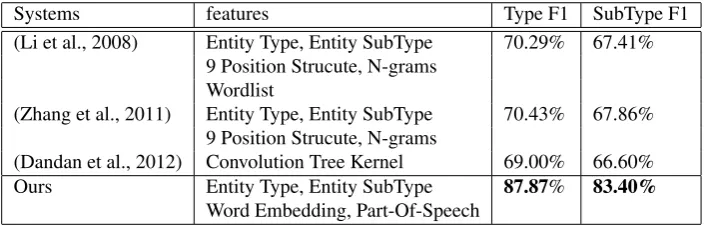
Systems features Type F1 SubType F1 (Li et al., 2008) Entity Type, Entity SubType 70.29% 67.41%
9 Position Strucute, N-grams Wordlist
(Zhang et al., 2011) Entity Type, Entity SubType 70.43% 67.86% 9 Position Strucute, N-grams
(Dandan et al., 2012) Convolution Tree Kernel 69.00% 66.60%
Ours Entity Type, Entity SubType 87.87% 83.40%
Word Embedding, Part-Of-Speech
Table 1: Performance of Relation Extraction Systems
we randomly initialized them and set the vector length to 20 for each of them, so the input size of the LSTM model is 120 dimensions. Because most relations in the ACE corpus are short-range relations, and some of them even within single noun phrases, we set the time step size to 5, and used padding to unify the sequence length. We also set the number of hidden units in the LSTM layer to 64 and kept the prob rate on the dropout layer at 0.5.
4.2.
Results
Table 2 shows the final results and effectiveness of different features to the result. From Table 2, we can conclude that all the selected features are effective and will benefit the re-sults, and among those, word embedding is the most impor-tant feature. There is another popular feature, “positional structure” that is frequently used in previous research, and we believe our results will be further improved if we in-clude it. This feature has been used particularly with the ACE corpus. However, modern corpus is no longer anno-tated with this feature, which is why we do not include it.
Systems features Type F1 SubType F1
Word Embeddings 78.55% 72.92%
+ POS +1.63% +1.67%
LSTM + Entity Type +6.38% +9.23%
+ Entity SubType +5.22% +7.82%
Overall 87.87% 83.40%
Table 2: The experiment results
4.3.
Compare with state-of-the-art System
We compared our results with those of three previous ap-proaches that were evaluated on the same corpus. Table 1 shows the comparison of the features/kernel use and the F1 scores of type and subtype relations between our ap-proach and that of others. Previous works on this corpus focused on relation extraction problem. The different be-tween relation extraction and relation classification is that relation extraction needs to detect if a relation utters corre-sponding to some entity pairs before predicting the relation between them. In practise, we could reduce the relation extraction problem into relation classification problem by removing negative instances (that do not have relations be-tween entities). (Nguyen and Grishman, 2015) discoveredthat the system performace will improve about 20% from relation extraction to relation classification in ACE corpus. Considering this discovery, our system is still superior to the others. More importantly, our model does not combine tremendous feature engineering work, and this re-confirms its advantages.
4.4.
Error analysis
Errors most frequently happen at the feature selection step. Stanford CoreNLP may make mistakes analyzing Chinese sentences. As with the entire pipeline model, it has error propagation issues.
Optimizing the feature embedding is another way to im-prove the results. For example, when we face a complex noun phrase that is not in the pretrained word vector, we may split it into several small elements, and then take the average of each element embedding. It is a simple strat-egy, but not the best. Besides, we randomly initialized the embeddings for the rest of features, however, as stated in (Chen and Manning, 2014), similar POS such as “NNS” and “NN”, “VB” and “VBZ” should be clustered together and have similar embeddings, and it is also the same for entity type and subtype features.
5.
Conclusion and Future Work
In this paper, we present an LSTM network with shortest dependency path model to extract relations between enti-ties in Chinese. The results show that the model is ef-fective on the ACE 2005 training corpus. Compared with traditional feature-based and kernel-based methods, deep learning models (neural network based methods) can easily achieve better results with fewer features.
6.
Bibliographical References
Abadi, M., Agarwal, A., Barham, P., Brevdo, E., Chen, Z., Citro, C., Corrado, G. S., Davis, A., Dean, J., Devin, M., et al. (2016). Tensorflow: Large-scale machine learn-ing on heterogeneous distributed systems. arXiv preprint arXiv:1603.04467.
Bunescu, R. C. and Mooney, R. J. (2005). A shortest path dependency kernel for relation extraction. In Proceed-ings of the conference on human language technology and empirical methods in natural language processing, pages 724–731. Association for Computational Linguis-tics.
Che, W., Jiang, J., Su, Z., Pan, Y., and Liu, T. (2005). Improved-edit-distance kernel for chinese relation ex-traction. InProceedings of IJCNLP, pages 132–137. Chen, D. and Manning, C. D. (2014). A fast and
accu-rate dependency parser using neural networks. InEmnlp, pages 740–750.
Chen, Y., Zheng, D.-Q., and Zhao, T.-J. (2012). Chinese relation extraction based on deep belief nets. Ruanjian Xuebao/Journal of Software, 23(10):2572–2585. Chen, Y., Zheng, Q., and Zhang, W. (2014). Omni-word
feature and soft constraint for chinese relation extraction. InACL (1), pages 572–581.
Cho, K., Van Merri¨enboer, B., Gulcehre, C., Bah-danau, D., Bougares, F., Schwenk, H., and Ben-gio, Y. (2014). Learning phrase representations using rnn encoder-decoder for statistical machine translation.
arXiv preprint arXiv:1406.1078.
Culotta, A. and Sorensen, J. (2004). Dependency tree ker-nels for relation extraction. InProceedings of the 42nd annual meeting on association for computational lin-guistics, page 423. Association for Computational Lin-guistics.
Dandan, L., Yanan, H., and Longhua, Q. (2012). Exploit-ing lexical semantic resource for tree kernel-based chi-nese relation extraction. Natural Language Processing and Chinese Computing, pages 213–224.
Ebrahimi, J. and Dou, D. (2015). Chain based rnn for rela-tion classificarela-tion. InHLT-NAACL, pages 1244–1249. GuoDong, Z., Jian, S., Jie, Z., and Min, Z. (2005).
Ex-ploring various knowledge in relation extraction. In Pro-ceedings of the 43rd annual meeting on association for computational linguistics, pages 427–434. Association for Computational Linguistics.
Hagberg, A., Swart, P., and S Chult, D. (2008). Explor-ing network structure, dynamics, and function usExplor-ing net-workx. Technical report, Los Alamos National Labora-tory (LANL).
Hinton, G. E., Srivastava, N., Krizhevsky, A., Sutskever, I., and Salakhutdinov, R. R. (2012). Improving neural net-works by preventing co-adaptation of feature detectors.
arXiv preprint arXiv:1207.0580.
Hochreiter, S. and Schmidhuber, J. (1997). Long short-term memory.Neural computation, 9(8):1735–1780. Huang, R., Sun, L., and Feng, Y. (2008). Study of
kernel-based methods for chinese relation extraction. Informa-tion Retrieval Technology, pages 598–604.
Jiang, J. and Zhai, C. (2007). A systematic exploration of
the feature space for relation extraction. InHLT-NAACL, pages 113–120.
Kambhatla, N. (2004). Combining lexical, syntactic, and semantic features with maximum entropy models for ex-tracting relations. In Proceedings of the ACL 2004 on Interactive poster and demonstration sessions, page 22. Association for Computational Linguistics.
Kebin, L., Fang, L., Lei, L., and Ying, H. (2007). Imple-mentation of a kernel-based chinese relation extraction system [j]. Journal of Computer Research and Develop-ment, 44(8):1406–1411.
Levy, R. and Manning, C. (2003). Is it harder to parse chinese, or the chinese treebank? In Proceedings of the 41st Annual Meeting on Association for Computa-tional Linguistics-Volume 1, pages 439–446. Association for Computational Linguistics.
Li, W., Zhang, P., Wei, F., Hou, Y., and Lu, Q. (2008). A novel feature-based approach to chinese entity relation extraction. InProceedings of the 46th Annual Meeting of the Association for Computational Linguistics on Hu-man Language Technologies: Short Papers, pages 89– 92. Association for Computational Linguistics.
Lin, R., Chen, J., Yang, X., and Xu, H. (2010). Research on mixed model-based chinese relation extraction. In
Computer Science and Information Technology (ICC-SIT), 2010 3rd IEEE International Conference on, vol-ume 1, pages 687–691. IEEE.
Manning, C. D., Surdeanu, M., Bauer, J., Finkel, J. R., Bethard, S., and McClosky, D. (2014). The stanford corenlp natural language processing toolkit. In ACL (System Demonstrations), pages 55–60.
Mikolov, T., Sutskever, I., Chen, K., Corrado, G. S., and Dean, J. (2013). Distributed representations of words and phrases and their compositionality. In Advances in neural information processing systems, pages 3111– 3119.
Moldovan, D. I. and Blanco, E. (2012). Polaris: Lymba’s semantic parser. InLREC, pages 66–72.
Nguyen, T. H. and Grishman, R. (2015). Relation extrac-tion: Perspective from convolutional neural networks. In
VS@ HLT-NAACL, pages 39–48.
Pennington, J., Socher, R., and Manning, C. D. (2014). Glove: Global vectors for word representation. In
EMNLP, volume 14, pages 1532–1543.
Plank, B. and Moschitti, A. (2013). Embedding semantic similarity in tree kernels for domain adaptation of rela-tion extracrela-tion. InACL (1), pages 1498–1507.
Santos, C. N. d., Xiang, B., and Zhou, B. (2015). Classi-fying relations by ranking with convolutional neural net-works. arXiv preprint arXiv:1504.06580.
Socher, R., Huval, B., Manning, C. D., and Ng, A. Y. (2012). Semantic compositionality through recursive matrix-vector spaces. InProceedings of the 2012 joint conference on empirical methods in natural language processing and computational natural language learn-ing, pages 1201–1211. Association for Computational Linguistics.
to prevent neural networks from overfitting. Journal of Machine Learning Research, 15(1):1929–1958.
Walker, C., Strassel, S., Medero, J., and Maeda, K. (2006). Ace 2005 multilingual training corpus. Linguistic Data Consortium, Philadelphia, 57.
Wang, M. (2008). A re-examination of dependency path kernels for relation extraction. In IJCNLP, pages 841– 846.
Xu, Y., Mou, L., Li, G., Chen, Y., Peng, H., and Jin, Z. (2015). Classifying relations via long short term memory networks along shortest dependency paths. In
EMNLP, pages 1785–1794.
Yu, H., Qian, L., Zhou, G., and Zhu, Q. (2010). Chinese semantic relation extraction based on unified syntactic and entity semantic tree.Journal of Chinese Information Processing, 24(5):17–23.
Zelenko, D., Aone, C., and Richardella, A. (2003). Ker-nel methods for relation extraction. Journal of machine learning research, 3(Feb):1083–1106.
Zeng, D., Liu, K., Lai, S., Zhou, G., Zhao, J., et al. (2014). Relation classification via convolutional deep neural net-work. InCOLING, pages 2335–2344.
Zhang, M., Zhang, J., Su, J., and Zhou, G. (2006). A com-posite kernel to extract relations between entities with both flat and structured features. InProceedings of the 21st International Conference on Computational Lin-guistics and the 44th annual meeting of the Association for Computational Linguistics, pages 825–832. Associa-tion for ComputaAssocia-tional Linguistics.
Zhang, P., Li, W., Wei, F., Lu, Q., and Hou, Y. (2008). Exploiting the role of position feature in chinese relation extraction. InLREC.
Zhang, P., Li, W., Hou, Y., and Song, D. (2011). Develop-ing position structure-based framework for chinese en-tity relation extraction.ACM Transactions on Asian Lan-guage Information Processing (TALIP), 10(3):14. Zhou, G., Zhang, M., Ji, D.-H., and Zhu, Q. (2007). Tree