A D I R E C T E D RANDOM P A R A G R A P H G E N E R A T O R S t a n l e y Y . W . Su & K e n n e t h E . H a r p e r ( T h e RAND C o r p o r a t i o n , S a n t a M o n i c a , C a l i f o r n i a )
I. INTRODUCTION
The work described in the present paper represents a combination of two widely different approaches to the study of language. The first of these, the automatic gen- eration of sentences by computer, is recent and highly specialized: Yngve (1962), Sakai and Nagao (1965), Arsent'eva (1965), Lomkovskaja (1965), Friedman (1967), and Harper (1967) have applied a sentence generator to the study of syntactic and semantic problems of the level of the (isolated) sentence. The second, the study of units of discourse larger than the sentence, is as old as rhetor- ic, and extremely broad in scope; it includes, in one way or another, such diverse fields as beyond--the sentence analysis (cf. Hendricks, 1967) and the linguistic study of literary texts (Bailey, 1968, 53--76). The present study is an application of the technique of sentence generation to an analysis of the paragraph; the latter is seen as a unit of discourse composed of lower-level units (sentences), and characterized by some kind of structure. To repeat: the object of our investigation is the paragraph; the technique is analysis by synthesis, i.e. via the automatic generation of strings of sentences that possess the
--2--
Harper's earlier sentence generation program differed from other versions in its use of data on lexical co- occurrence and word behavior, both obtained from machine analysis of written text. These data are incorporated with some modifications in a new program designed to pro- duce strings of sentences that possess the properties of coherence and development found in "real" discourse. (The actual goal is the production of isolated paragraphs, not an extended discourse.) In essence the program is designed
(i) to generate an initial sentence; (ii) t o "inspect" the result in order to determine strategies for producing the following sentence; (iii) to build a second sentence, .making use of one of these strategies,
and
employing, inaddition, such criteria of cohesion as lexical class recurrence, substitution,
anaphora, an4
synonymy; (iv) to continue the process for a prescribed number of sentences, observing both the generalstrategic
principles and the lexical context. Analysis of the output ~ill lead to modification of the input materials, and the cycle will be repeated.This paper describes the implementations of these ideas, and discusses the theoretical implications of the paragraph generator. First we give a description of the language materials on which the generator operates. The next section deals with a program which converts the
--3-
--5--
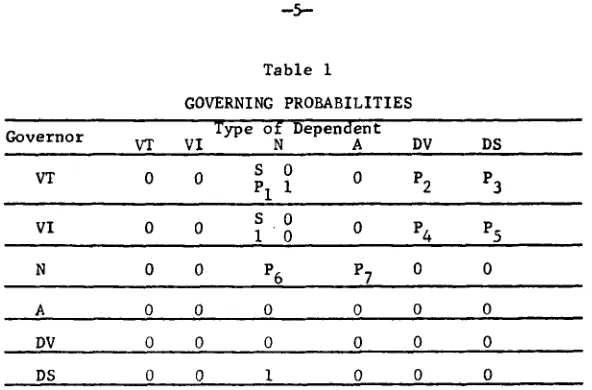
Table i
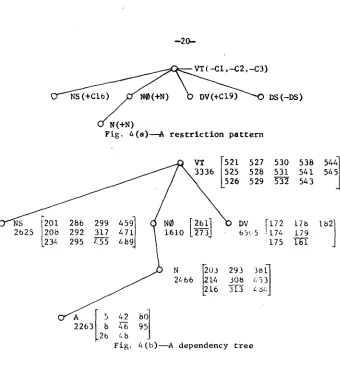
G O V E R N I N G P R O B A B I L I T I E S Type" of
Dependent
G o v e r n o r VT VI N A DV DS
S I 0 0 P2 P3
VT
0
0
P1
S 0
VI 0 0 1 0 0 P4 P5
N 0 0
P6
P7
0
0
A 0 0 0 0 0 0
DV 0 0 0 0 0 0
DS 0 0 I 0 0 0
The g o v e r n i n g p r o b a b i l i t i e s for a word are i n d e p e n d e n t of each other. In p a r a g r a p h g e n e r a t i o n the d e c i s i o n to select a dependent type will be made w i t h o u t regard to the
selection of other dependent types. For example, a noun
can have p r o b a b i l i t i e s P6 and P7 of being the g o v e r n o r of a noun and an a d j e c t i v e respectively. The s e l e c t i o n of a noun as a d e p e n d e n t based on P6 will not affect, and will not be a f f e c t e d by, the selection of an a d j e c t i v e as a
dependent.
There are two types of co--occurrence data a c c o m p a n y i n g every word in the glossary: a set of g o v e r n i n g p r o b a b i l -
ities and a list of dependents. The p r o b a b i l i t y values
[image:4.612.155.451.153.348.2]--6--
adjective in I00 occurrences in a text, the probability of havipg an adjective as a dependent is 0.75. The zeroes and ones in Table I are constant for all words in the glossary. These values are not listed in the sets of probability values for the entrles of the glossary; however, they are known to the system. For instance, the set of probability values for a transitive verb will contain PI' P2' and P3" The probability I of governing a noun as object will not be listed in the data.
The second type of co--occurrence data accompanying every word in the glossary is a list of possible dependents. The list is specified in terms of word numbers and semantic classes (to be described later). It contains the words that actually appear in the processed physics text as dependents of the word with which the list is associated. Since the lists of dependents are compiled on the basis of word co- occurrence in the text, legitimate word combinations are guaranteed. In the list of dependents for a verb~ those words which can only be the subject are marked "S" and those which can only be the direct object are marked "0".
--7--
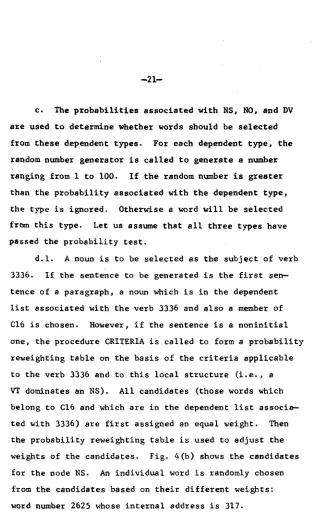
basis of their tendency to co-occur syntactically with the same words in text---cf. Harper, 1965); other classes contain words of the same root, synonyms, hypernyms, and words arbitrarily classified as "concrete." The semantic classi- fications are highly tentative, and are subject to modifi- cation. Their extent is shown in Table 2.
Table 2 SEMANTIC DATA
Number of Number of
Classification Classes Words in Class
Distributional Classes 22 150
Hypernym Classes i0 160
Word Families 25 52
Synonym--antonym Classes 16 48
"Concrete" Words I 5 4
TOTAL 74 464
[image:6.612.157.448.290.462.2]--8-
3. DATA CO~VERSION PROGRAM
The paragraph generator is written in PI/I and run on
the IBM 360 Model 65. It consists of two main programs:
a data conversion program and a generation program. These
two programs run as separate jobs. The data conversion
program converts the language materials described above
into compact data tables with associative links. The
converted d a t a a r e stored on a magnetic tape which is used
as input to the generation program.
During the process of paragraph generation it is desirable that the language data described in the preced-
ing section remain in core storage. However, since the
data base is rather l~rge, its conversion into a more compact and flexible form is desirable so that storage requirements and access time can be reduced.
In view o£ the characteristics of the language data and the generation algorithm (to be described latex), we
structure the data base in the following way.
s. Words belonging to the same parts of speech or
semantic classes are stored in consecutive locations. In
--9--
b. The data storage for each entry of the glossary is of variable length, since the lists of dependents, governing probabilities, hypernyms and semantic classes associated with the entries are of variable length.
c. Word numbers in the lists of dependents and semantic classes are replaced by pointers, which identify the locations where the word numbers are actually stored. Thus, data tables containing different types of informa- tion are linked to one another, and access to this informa- tion can be carried out by straight table lookup.
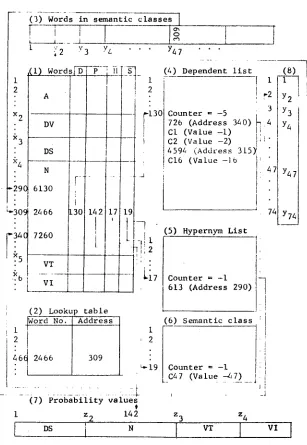
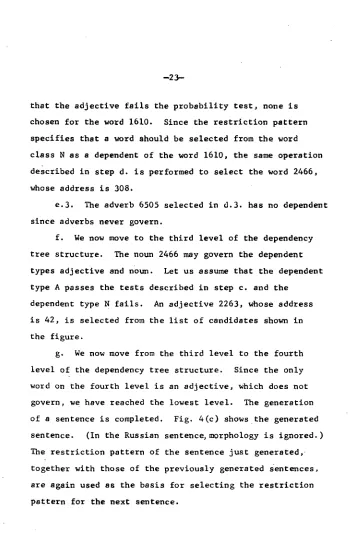
In keeping with these prlnciples, data tables of the form shown in Fig. i have been constructed. An example will illustrate the organization of the data base and the procedure of setting up these data tables. As a noun, represented by word number 2466, and its associated language data are read from the input unit, the word number is stored in the block in table (i) reserved for nouns. The last three digits of the word number are used as an index to a location in the lookup table (2), where the word number 2466 and its address in table (i), i.e. 309, are stored. If the location in table (2) has been occupied (when m o r e than one word has the same last three digits), the word number and its address are stored at the
- 1 0 -
.... i3) Words in semantic classes 1
~'2
Y3
YL
Y47
i
2
x 2
x? i
~4
29~ I ~ 3 0 ~
[
' . 3 ~ c1~5
I
(2) Lookup table
W
o r d No. A d d r e s s 1• i
(4) Dependent list
1 ! i
2 i
!
r2
: 3
-130 Counter = -5
726 (Address 340) ~ 4 CI (Value -i) ,li C2 ( V a l u e - 2 ) iii" 4594 (Address 315)! C16 ( V a l u e - ] b Ii
J 4~
(5) Hypernym List i
2
~17 Counter = -i 613 (Address 290)
(6) Semantic class
~ 2
~ 1 9 C o u n t e r = - 1
_C4 7 (Vs lu e 7z~ 7 2 __
74
t J,
(8)
! Y2 ~ Y3 Y4
Y471
(7) Probability values
I z 2 142
I
DS
i
N
z 3 z 4
!
vT
I
vl I
[image:9.612.166.473.164.609.2]--U--
T h e r e a r e f o u r p o i n t e r s a s s o c i a t e d w i t h e a c h w o r d stored in table ( I ) . Pointer D specifies the location in table (4) where the list of dependents associated with the word is stored. A countez is used to specify the number of words and semantic classes in the list. A semantic class in the original data is prefixed by a C
(CI identifies senmntic class I). In table (4) all the counters and semantic classes (the numerical values) are stored as negative values so that the positive values
(i.e. word numbers) can be conveniently changed to pointers at a later stage. In our example the pointer D is 130 and the words 726 and 4594, and also the semantic classes CI, C2 and C16, are in the dependent list associated with word 2466. The value which identifies a semantic class in table (4) is actually a pointer to a table which contains the starting locations of the lists of words in all senmr~- tic classes. This is illustrated in Fig. I by the links from table (4) through table (8) to table (3).
The set of governing probabilities associated with word 2466 is stored in table ( 7 ) . Pointer P specifies the starting location where the probability values are stored. In the example, P is set to 142. Notice that no spaces are reserved for adjectives and adverbs bocauae
they
do not have governing probabilities.i
--12--
the hypernyms of the word are stored. Word 613 is a hypernym of the word 2466. Thus, H is set to 17 which is the location in table (5) where a counter and the word 613
a r e stored. Since the word 2466 is a member of the seman-
tic class C47, the pointer S associated with the word 2466 is set to the location in table (6) where a counter and C47 is stored.
Table (3) contains 74 blocks, which are reserved for the 74 semantic classes established in the system. Each block contains a counter and the addresses of the words in a semantic class. For example, the address 309 is stored in the 47th block in tBble ( 3 ) . Table (3) is thus linked to table (I).
After all data have been entered in the tables, the word numbers (positive values) in tsbles (4) and (5) are replaced by their addresses in table ( i ) . This operation is done by using the lookup table (2).
The data a r e organized in tables with a s s o c i a t i v e
links. All word numbers in tables ( 3 ) , (4), and (5) are replaced by their addresses in table ( i ) . From an entry in table (I) (where the generation of a sentence usually begins), we can trace its possible dependents; since these dependents are specified as pointers to their addresses in
i
--13--
down to any desired leve~. Table (i) is linked to tables (4), ( 5 ) , (6), and (7), and tables (4), (5), and (6) are linked either directly back to table (I) or indirectly through table (8) and then table (3) back to table (i). Thus, access to any piece of information in these data tables is gained by simple table lookup.
In view of the variability in the number of words in each part-of--speech and semantic class, and in the number of governing probabilities, hypernyms, ser~ntic classes and dependents associated with each word, we have packed these data in large arrays as illustrated in tables (i),
[image:12.612.157.475.84.609.2]--15--
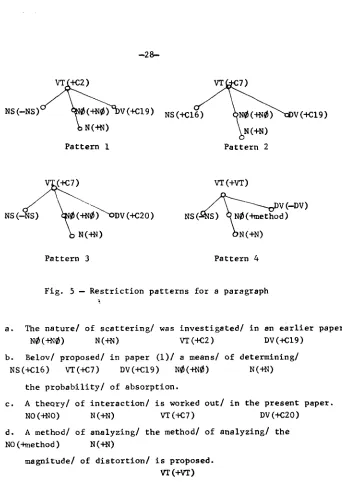
The r e s t r i c t i o n pattern in Fig. 2 specifies that the sen-- tence to be g e n e r a t e d should contain a t r a n s i t i v e verb
which belongs to either semantic class C1 or C2. The verb
should govern (I) a noun as the subject of the sentence, (2) an object w h i c h is to be selected from the words in
semantic class C15 or the specified words W 1 and W2, and (3) an a d v e r b which does not b e l o n g to semantic class C19. The subject of the sentence should not govern an adjective.
As i l l u s t r a t e d in the pattern, each node in a p a t t e r n
contains a word class and selection r e s t r i c t i o n s which are p o s i t i v e l y or n e g a t i v e l y specified in terms of semantic
class(es), specific word(s) or a word class. R e s t r i c t i o n
p a t t e r n s are stored in the f o l l o w i n g form: Q-PIP2..oPn. Q is a single pattern, o r a c o m b i n a t i o n of p a t t e r n s , and P I P 2 . . . P n are single r e s t r i c t i o n patterns. E s s e n t i a l l y ,
Q - P I P 2 . . . P n is e rule which specifies that if a s e n t e n c e (or string of sentences) whose s e n t e n c e skeleton(s) m a t c h e s
Q, then it can be followed by a s e n t e n c e w h o s e sentence
skeleton is one of these Ps. Thus, o n e of these Ps is
r a n d o m l y selected to be used as a r e s t r i c t i o n p a t t e r n for a s u c c e e d i n g sentence. The p a t t e r n selection p r o c e d u r e is not yet coded. At present, strings of r e s t r i c t i o n p a t t e r n s
are given d i r e c t l y to the pattern selection routine. The
g e n e r a t i o n p r o g r a m generates strings of sentences under the control oz d i r e c t i o n of the r e s t r i c t i o n s s p e c i f i e d in
--16--
the general "development" of paragraphs will be described in a later section.
4.1~3. Discourse Relator (RELATOR~ Input to this procedure are (i) a dependent type, (2) a probability value, and (3) a restriction pattern. This procedure determines whether the given dependent type conflicts with the restrictions specified in the pattern. If no conflict is found, this procedure determines whether a word should be selected from the given dependent type based on the input probability value. If the selection of the dependent type conflicts with the restriction pattern, or if the dependent type fails the probability test, no word will be selected from the dependent type.
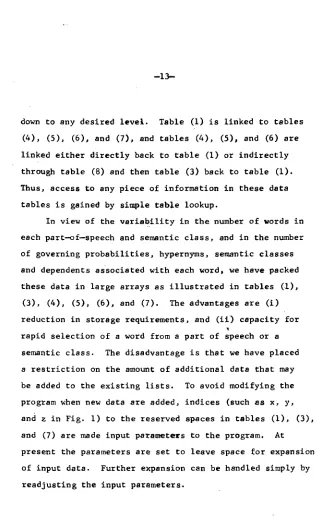
4.1.4. ~CRITERIA~. Whenever, during any stage of sentence generation, the selection of one word from a list of candidates is required, this procedure determines which criteria should be applied to control the selection. All criteria (implemented principles of cohesion to be described in a later section) are presented to the genera- tion program in the form of a table that reweights the probabilities. The generation program increases or de- creases the probability of selecting words on the basis of the values in this table. It has the following format
I
--17--
I d e n t i f i e r Weight
C2 W I
½
C12
+5 --7 +3 - 4
Fig. 3 -- Format of a r e w e i g h t i n g table
To i l l u s t r a t e the Use of this table, let us suppose
that in a certain stage of g e n e r a t i n g a s e n t e n c e there are
five words, each of which can be the subject of the verb
p r e v i o u s l y selected for the sentence. The selection of
any word from these five will satisfy the r e s t r i c t i o n pattern for the sentence. Instead of r a n d o m l y s e l e c t i n g
one word out of these five candidates, we may w a n t to
increase the p r o b a b i l i t y of s e l e c t i n g a word w h i c h will have semantic c o n n e c t i o n s with the word(s) in the p r e c e d i n g
or current sentence. When there are choices in word s e l e c -
[image:15.612.154.451.90.598.2]--18-
added, and a random number in the range from I to the total sum is generated to determine which candidate should be selected.
4.1.5. Word Generator ~WOR-GEN). This procedure finds all possible candidates which satisfy the restrictions specified in s restriction pattern, and assigns different weights to them on the basis of the contents of a proba- bility reweighting table. It selects a word st random from the candidates according to their weights.
4.1.6. .Random Number Generator ~RA .NDOM). Input to this procedure is an integer No This procedure generates a random integer in the range from i to N.
4°2. The Generation Al~orithm
The general strategy for generating a paragraph is, first, to generate the initial sentence based on a selected restriction pattern, and then to generate each noninitial sentence base not only on a selected restriction pattern but also on the semantic properties of the words in all the previously generated sentences of the paragraph. The algorithm and the sentence generation procedure can best be illustrated by an example. Let us suppose that the restric- tion pattern shown in Fig. 4(a) is chosen for a sentence. For ease of reference we will letter, the steps involved in this procedure.
--19-
sitive verb (VT) or an intransitive verb (VI)), a VT or VI will be randomly chosen from the specified semantic class(as) or word(s). Otherwise a VT or VI will be randomly chosen. In our example the restriction pattern in Fig. 4(a) specifies that a word should be selected from the word class VT which is not a member of the semantic e[eeBes
C I , C2, and C3, but is a governor of a word in C16, a word in word class N. and a word in C19. (Note also that the sentence should not contain a sentence adverb.) There are 16 candidates which satisfy the restrictions. They are shown in Fig. 4(b) by their addresses, at which word numbers are stored. A random number is generated in the range i to 16, for example, 8. Thus the eighth VT is chosen: word number 3336 whose address is 531.
--20--
~
)DS(--DS)N(+N)
Fig. 4(a)---A restriction pattern
VT
p 5 2 1 527 530
( ~ N S
1201 286 299 4591 ~ N~
12611
DV
[172
2
6
2
~
~
~_711
1 1610 L273J
b5c~5 ,174
L234 295 z:55 4~9j
1
175
\
/ ~
N
[203
293 3~q
J
2466 1214 30B
z. 53 I
L216 ~[5~.q
22631 8 46 951
Fig. A(b)--A dependency tree
538 54~
541 54
~
543
lTb ib 1
/79
English:
Russian:
Word No.:
Address:
Muxin published a study of linear method in a previous paper.
Mu~in opublikoval izu~enie linejnyj metod v predydu~ej rabote,
2625
3336
1610
2263
2466
6505
317
531
261
42
308
179
[image:18.612.120.460.118.484.2]--21--
c. The probabilities associated with NS, NO, and DV are used to determine whether words should be
selected
from these dependent types. For each dependent type, therandom number generator is called to generate a number ranging from 1 to i00. If the random number is greater than the probability associated with the dependent type, the type is ignored. Otherwise a word will be selected from this type. Let us assume that all three types have passed the probability test.
[image:19.612.154.482.76.604.2]--22--
d.2. A noun is to be selected as the object of the
verb 3336. As in d.l, the restriction pattern is consulted
end, if the sentence is a noninitial one, the procedure
CRITERIA is called. Fig. 4(b) shows the candidates for the
node NO. The same probability reweighting scheme is
applied to adjust the weights of the candidates. A word is
selected at random: word number 1610 whose address is 261.
d.3~ An adverb is to be selected for the verb 3336.
Similar to the previous procedure, the restriction pattern restricts the selection of candidates; CRITERIA is called for a noninitial sentence to construct the probability
reweighting table, and an adverb is randomly selected. In
the figure we see the candidates for the node DV, and the adverb 6505, whose address is 179, is chosen.
e. The dependents of the words 2625, 1610, and 6505
are now considered with respect to their possible dependents
and associated probabilities. We are working from the top
to the second level of the dependency tree structure.
e.l. The noun 2625 may govern the dependent types
adjective and noun. Each of these is considered in turn
by the same operations described in steps b. and c. For
brevity, let us assume that none of these dependent types
pass the probability test. Thus, no word is selected from
these dependent types.
e.2. The noun 1610 may govern the dependent types
adjective and noun with different probability. Assuming
[image:20.612.125.471.95.638.2]--23--
that the adjective fails the probability test, none is chosen for the word 1610. Since the restriction pattern specifies that a word should be selected from the word class N as a dependent of the word 1610, the same operation described in step d. is performed to select the word 2466, whose address is 308.
e.3. The adverb 6505 selected in d.3. has no dependent since adverbs never govern.
f. We now move to the third level of the dependency tree structure. The noun 2466 may govern the dependent types adjective and noun. Let us assume that the dependent type A passes the tests described in step c. and the
dependent type N fails. An adjective 2263, whose address is 42, is selected from the list of candidates shown in the figure.
[image:21.612.134.484.80.627.2]--24--
At the present stage of development no criterion is used to determine the end of a paragraph. The number of restriction patterns input to the pattern selection procedure determines the number of sentences in a paragraph. When the
sentences of a paragraph have been generated, glossary look-
- 2 5 -
5. IMPLEMEntATION OF LINGUISTIC ASSUMPTIONS
The structure of paragraphs is poorly understood, and is in any event subject to enormous variety. Nevertheless, we have adopted a simplified model, which postulates that the units (sentences) of a paragraph should be arranged in a recognizable pattern. Specifically, it is assumed that each pair of sentences should be characterized by the
--26--
designed t o e f f e c t an overall p a t t e r n , whereas t h e reweight- ing tables are more local in effect, dealing with purely lexical materials.
5.1. Development
An examination of hundreds of sentence pairs, and scores of paragraphs, of Russian scientific texts, suggests that the following principles of development are commonly employed in intersentence connection: (I) progress from the general to the specific (more rarely, the reverse); (2) from whole to part, or from multiplicity to singularity (presumably a variation of the first--cited principle);
(3) past action to present; (4) "other" to "present" agent;
(5) "other" to "present" place; (6) cause to effect (more rarely, the reverse); (7) action to purpose of the action;
(8) action to means of performing the action; (9) simple rephrasing. Lack of space prevents illustration of these principles; it should be obvious that even this small stock of strategies will suffice for the production of innumerable
paragraphs. It should also be noted that a random ordering
of sentences built on the above pair--wise strategies will produce less than satisfactory results; certain sequences of sentence pairs are more likely than others to fit into an acceptable pattern for the paragrgph.
It was stated in Sec. 1 that the computer program would provide a means of inspecting the initial sentence of a
--28--
Pattern i
Ns
(--Ns) ~
N
(
~))~'oDv
(+c20)
Pattern 3
NS(+CI6) ~N~(+N~) "~DV(+CI9)
~N(+N)
Pattern 2
NS
VT(+VT)
~~-~--~V(--DV)
(~NS)
~O(-~ethod)
ON(+N)
Pattern 4
Fig. 5 -- Restriction patterns for
a paragraph
%
a .
N@ (+N@) N(+N) VT (+C2) DV(+CI9)
b. Belov/ proposed/ in paper (i)/ a means/ of determining/
NS(+CI6) VT(+C7) DV (+C19) N@(+N~) N(+N)
the
probability/
of absorption.c. A theory/ of interaction/ is worked
out/
in the present paper.NO (+NO) N(+N) VT (+C7) DV (+C20)
d. A method/ of analyzing/ the method/ of analyzing/ the
NO (+method) N (+N)
magnitude/ of distortion/ is proposed.
VT(+VT)
[image:25.612.163.505.105.602.2]--29-
The u s e o f p a t t e r n s t o c o n t r o l d e v e l o p m e n t i s summar-
i z e d i n T a b l e 3. S i n c e t h e v e r b i n v e s t i g a t e i n s e n t e n c e ( a )
b e l o n g s t o s e m a n t i c c l a s s C2, and C2 c o n t a i n s such v e r b s
as " s t u d y " and " i n v e s t i g a t e " w h i c h s p e c i f y v e r y g e n e r a l
a c t i o n s , t h e node VT(+C7) i n p a t t e r n 2 c o n t r o l s t h e s e l e c - -
t i o n o f a v e r b o f g r e a t e r s p e c i f i c i t y ; t h e v e r b s i n C7 a r e
a p p r o p r i a t e . The node VT(+C7) i n p a t t e r n 3 s e r v e s t h i s
purpose, i . e . , to c o n t r o l t h e development o f a c t i o n s
from ~ e n e r a l i t y t o s p e c i f i c i t y . The node NS(+C16) i n
p a t t e r n 2 s p e c i f i e s t h a t an agent f o r t h e second sentence
is not the present author implicitly specified in the third sentence. This restriction introduces another type of text development, i.e. from other wKiter to present author. The node DV(+CI9) in pattern I and pattern 2, and node DV(+C20) in pattern 3 introduce the time progression and location chan~e to the
paragraph.
Class C19 contains such adverbs as "in an earlier paper," "in paper I," "in an earlier study," etc., which specify that the time is past. Class C20 contains such adverbs as "in the present work,"c ~ U , r_l 0 , " 0 W ,,-I q-I -,.4
• ~
,-~
t'~ °° 0 0 1.1 1-~ ° - .1~
- 3 0 -
4,; .,-4
U 0
• ,-4 ,1.4 u)
(~ " 0 " 0 $.1 .,-I . H
0 0
0 m ' ~ m O
- ~ ~ 0
~ u 0 &0
..~ (n
~ 0
• r4 0~ ,,,4
.U~ v .I~ ..,-.¢ .~-~ ~
m l . t m
~4-~ 42 0 4-~
M
c,4
0
0 -~ m o
. ~ ~ 0
x ~
• ,-¢ ¢g
U ~ 0
'4.-I
• 1-1 I J .r,t
~ 0 " , ~
, . C O 0
~.~ 0
0
O ~ c0
u l:L
0 ' ~ 0 ,,~ [ . - 4 , . . . 1
0
0
. ~ . 0 ~
~ 0 ~
0 U -,.4
~ 2
• ,~ 0
0
4.J
c~ ~.
,'~ Iw
° ° 4.1
--31--
Table 3 also suggests partial introduction of coherence into the sentence-sequence. For example, the verbs in all sentences are in s o m e degree related, and a general parallel- ism is maintained in the selection of agents and adverbs of time and location. Nonetheless it is clear that sentences a. through d. do not form n good paragraph. One deficiency is the excessively general character of the noun phrase, "the nature of scattering," in a.; a more obvious shortcom- ing is the lack of continuity in the noun object. Such deficiencies suggest the need for greater cohesion.
5°2. Cohesion
As a first approximation we have chosen to implement the following principles of cohesion: (i) selection of a "concrete" word in noun phrases; (2) word repetition; (3) use of hypernyms a n d synonyms; (4) use of anaphoric words; (5) increased repetition of members of the same
semantic classes; (6) avoidance of word repetition within a single noun phrase. The implementation of these tactics
--32--
When the principles of cohesion have been applied, sentences a. through d. above might have the following form: a'. The nature of nuclear scattering was investigated in
an earlier paper.
b'. BelDv proposed in paper (i) a means of determining the probability of such pheonomena.
c'. A theory of proton scattering is worked out in the present paper.
d'. A method of analyzing the interaction of these particles is proposed.
The following are some of the improvements in this sentence-sequence over a. through d.:
(i) The addition of the "concrete" adjectives ~ and ~roton gives the noun phrases in a'. and c'. a specificity that is lacking in s. and c. This effect is forced upon the generation routine by requiring the selec- tion of dependents in a noun phrase to continue until a word coded as "concrete n has been chosen. (Since the
effect may also be one of very long noun phrases, a counter-- effect is achieved by constant up-weighting of the semantic class of concrete words in the reweighting table.)
(2) The recurrence of scatterln~ in a'. and c'. increases continuity in the sentence sequence. The gener--
i
--33--
choice between noun--subject or noun--object is made by reference to the restriction pattern for the sentence being generated) into the reweighting table, together with a high positive reweighting value. Moreover, the possible governors of these nouns are also entered into the table with the same reweighting value. The value controls the probability of repeating one of the nouns in a previously generated sentence or of selecting a noun which is the governor of a word in a previously generated sentence. In the latter case word repetition will occur on the next level of dependency structure, i.e., when the program selects a dependent for the selected governor.
(3) The selection in b'. and d'. of phenomenon end particle, hypernyms of scat terin~ and proton respectively, introduces semantic continuity and, in addition, reduces the redundancy and monotony of word repetition. The use of hypernyms and synonyms is implemented by entering any hypernym and synonym of the words in previous sentences into the reweighting table with a positive reweighting value, thus increasing the probability of their selection.
--34--
automatically terminates the selection of other dependents for the hypernym.
(5) The selection of pro tOo and interaction in e'~ and d'o is a result of increasing the repetition of members of the same semantic class: the semantic classes repre- sented by nuclear in a'o and scatterin~ in c'. are up-- weighted during the generation of e'. and d'
(6) The undesirable repetition in d. is eliminated: words generated in a noun phrase are entered with negative value in the reweighting table, so that their repetition in the same phrase is inhibited.
--35--
6. CONCLUSION
The paragraph generator is currently operational, and produces output in reasonable times. Using the strategies
for achieving development and cohesion so far developed, it is capable of generating ten--sentence strings in
approximately fifteen seconds. Some of the main difficul- ties connected with the omtput are the following:
(i) Deficiencies in the co-occurremce data affect the quality of individual sentences. For example, some nouns have very few dependents, a characteristic deriving from their behavior in the text on which the data is based; the selection of one of these nouns in a sentence may nullify the effect of applying strategies for development or cohesion. In general a generated paragraph is only as strong as the weakest link; defective single sentences can disturb the implementation of structural principles.
(2) The grammar permits the generation of simple sentences only. Complex or compound sentences can, of course, be created by the device of juxtaposing these
simple sentences with the help of conjunctions or relatives; the conditions under which this can be done remain to be specified.
(3) The creation of "lexical fields" (containing, e.g~ such words as "to photograph," "camera," "film,")
--36--
the result will be inconsistent with our present system of classification.