Labeled Alignment for Recognizing Textual Entailment
∗Xiao-Lin Wang Hai Zhao Bao-Liang Lu Center for Brain-Like Computing and Machine Intelligence
MOE-Microsoft Key Laboratory for Intelligent Computing and Intelligent Systems Department of Computer Science and Engineering, Shanghai Jiao Tong University
800 Dongchuan Road, Shanghai 200240, China
[email protected] {zhaohai,blu}@cs.sjtu.edu.cn
Abstract
Recognizing Textual Entailment (RTE) is to predict whether one text fragment can semantically infer another, which is re-quired across multiple applications of nat-ural language processing. The conven-tional alignment scheme, which is devel-oped for machine translation, only marks the paraphrases and hyponyms to justify the entailment pairs, while provides less support for the non-entailment ones. This paper proposes a novel alignment scheme, named labeled alignment, to address this problem, which introduces negative links to explicitly mark the contradictory ex-pressions to justify the non-entailment pairs. Thus the alignment-based RTE method employing the proposed scheme, compared with those employing the con-ventional one, can gain accuracy improve-ment through actively detecting the signals of non-entailment. The experimental re-sults on the data sets of two shared RTE tasks indicate the implemented system sig-nificantly outperforms both the baseline system and all the other submitted sys-tems.
1 Introduction
Textual Entailment (TE) is a directional relation between two text fragments. One natural-language premise, noted asP, entails one natural-language hypothesis, noted asH, if typically a human
read-∗ B. L. Lu and X. L. Wang are supported by the National Natural Science Foundation of China (Grant No. 61272248), the National Basic Research Program of China (Grant No.2013CB329401), and the Science and Tech-nology Commission of Shanghai Municipality (Grant No. 13511500200). H. Zhao is supported by the National Nat-ural Science Foundation of China (Grant No. 60903119 and Grant No. 61170114).
ingP would infer thatH is most likely true (Da-gan et al., 2006).
Recognizing Textual Entailment (RTE) is pro-posed as a generic task that captures the seman-tic inference need across a wide range of natural language processing applications. For example, a question answering system should identify the texts that entail a hypothesized answer, e.g., given the question “What does Peugeot manufacture?”, the text “Chr´etien visited Peugeot’s newly reno-vated car factory” entails the hypothesized answer form “Peugeot manufactures cars” (Dagan et al., 2006). Similarly, in Machine Translation (MT) evaluation, a correct translation should be seman-tically equivalent to the gold translation, that is, both translations should entail each other (Pad´o et al., 2009).
RTE has attracted extensive attention ever since it was proposed. A wide range of methods have been proposed, and quite a few success-ful approaches treat RTE as an alignment prob-lem. Alignment is originally developed for MT to bridge two languages (Brown et al., 1993). Alignment is to establish links between the seman-tically equivalent atom expressions in two sen-tences. (Marsi and Krahmer, 2005) first advocates pipelined system architectures that contain dis-tinct alignment components. This latter becomes a strategy crucial to the top-performing systems of (Hickl et al., 2006). In addition, human-generated alignment annotations for the second PASCAL 1 RTE challenge is released by Microsoft Research to facilitate related research (Brockett, 2007).
The principle of the existing alignment-based RTE methods is that a sufficiently good alignment betweenP andHmeans a close lexical and struc-tural correspondence, thusP probably entailsH. For example, Fig. (1a) shows that the entailment
1PASCAL is the European Commission’s ICT-funded
Network of Excellence for Cognitive Systems, Interaction & Robotics.
relation can be correctly predicted through recog-nizing “read into”→“interpreted”2and “what he wanted”→“in his own way”.
However, the alignment developed in MT does not solve the non-alignment samples well. It usu-ally links the words inH, which have no counter-parts in P, to NULL regardless their impacts on the entailment relation. For example, in Fig. (1b), “ferry sinking”, “cause” and “that” are all linked toNULL3, while only “ferry sinking” is the cause for non-entailment. Thus such an alignment is im-proper for RTE.
This paper extends the normal alignment scheme to meet the challenge of RTE. The pro-posed scheme, named labeled alignment, intro-duce another type of links, named negative links, to mark those critical RTE-related linguistic phe-nomena that cannot be captured by the normal alignment. For example, Fig. (1c) shows that the previous vital expressions “ferry sinking” is linked to “flood” through a negative link, noted as “ferry sinking”̸→“flood”.
The proposed labeled alignment, which explic-itly marks the causes of non-entailment, can facil-itate the design of RTE method. This paper pro-poses an RTE method based on the labeled align-ments that actively looks for the signal of negative links in order to correctly recall non-entailment samples.
The main contributions of this paper are as fol-lows,
• A labeled alignment scheme is proposed for RTE;
• An RTE data set annotated with the proposed scheme is released;
• High prediction accuracies are achieved on two RTE data sets.
2 Related Work
RTE has attracted extensive attention in the past decade, and a wide range of approaches have been proposed besides the alignment-based meth-ods (Androutsopoulos and Malakasiotis, 2009). The logic-based methods interpret sentences to first-order-logic expressions and then invoke theo-rem provers (Bos and Markert, 2005). Similarity-based methods employ classifiers to learn from
2
The notation means that the expression “read into” inP is connected to the expression “interpreted” inH.
3NULLmeans an empty expression.
multiple similarity measures including lexical similarities (Watanabe et al., 2012),edit dis-tance (Rios and Gelbukh, 2012), measurements from MT (Volokh and Neumann, 2011), syntactic tree similarity (Mehdad, 2009) and dependency similarity (Wang and Zhang, 2009). Transform-based methods take entailment as finding a cred-ible transform from the premise to the hypothe-sis (Kouylekov et al., 2011).
(MacCartney et al., 2008) argues the align-ment techniques and tools for MT such as GIZA++ (Och and Ney, 2003) do not readily trans-fer to RTE. They compare the alignment for RTE with that for MT, and state the following differ-ences:
• The alignment for RTE is monolingual rather than cross-lingual, opening the door to uti-lizing abundant monolingual resources on se-mantic relatedness.
• The alignment for RTE is asymmetric, since
P is often much longer thanH.
• One cannot assume approximate semantic equivalence, sinceP might be contradictory or independent withH.
• Little training data is available.
They propose a new alignment tool named MANLI for RTE, but still adopts a alignment scheme similar with the one in MT (Brockett, 2007). This paper, however, revises the alignment scheme to support RTE, especially to address the third difference.
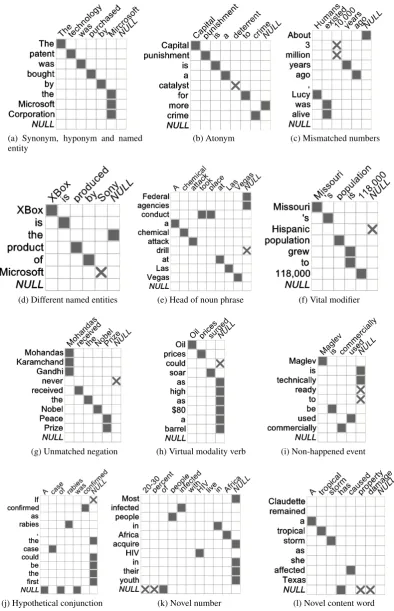
(MacCartney et al., 2006) argues that some critical RTE-related linguistic phenomena such as negations and modalities cannot be captured by alignment. They propose a wide range of fea-tures to represent them, and employ a classifier to learn from these specialized features as well as the alignment features to predict the entailment relation. The proposed labeled alignment in this paper, however, can natively process these phe-nomena, e.g., Fig. (2g) solves negations and (2h) solves modalities.
(a) Alignment on entailment pair (b) Weakness on non-entailment pair (c) Labeled alignment on non-entailment pair
Figure 1: Illustration of Alignment for RTE. Each subfigure presents an RTE sample. The vertical text is the premise, and the horizontal text is the hypothesis. The solid squares represent positive links, and the crosses represent negative links. (a) is of entailment relation, while (b) and (c) are of non-entailment relations.
non-entailment phenomena such as missing ar-guments, named entities mismatches and missing modifiers. This paper greatly favors their work, and the proposed labeled alignment scheme can annotate most of the non-entailment phenomena mentioned in their paper, which is beneficial to re-searchers.
3 Labeled Alignment
Labeled alignment consists of two types of links, named positive link and negative link, respec-tively. The positive link is inherited from the nor-mal alignment, while the negative link is newly in-troduced.
3.1 Positive Link
The positive link is inherited from the normal alignment to handle the variability of natural lan-guage expressions, that is, the same meaning can be expressed by different texts. The positive link connects the atom expressions ep inP and eh in H, if ep andeh are paraphrases or ep infers eh, noted asep → eh. As the occurrence of this type of links suggests the entailment relation between
P andH, they are named positive links.
This paper partially follows the alignment scheme in (Brockett, 2007; MacCartney et al., 2008) where the links are token-based but many-to-many is allowed, thus multi-word phrases can be explicitly aligned.
The positive links are mainly applied to the fol-lowing cases:
• identical words;
• synonyms or near synonyms, e.g., “bought”
→“purchased” in Fig. (2a);
• hyponyms, e.g., “patent”→“technology” in Fig. (2a);
• same named entities, e.g., “the Microsoft Corporation”→“Microsoft” in Fig. (2a);
• paraphrases or semantically inferable expres-sions which cannot be further decomposed into smaller links, e.g., “read into”→“ inter-preted” and “what he wanted”→“in his own way” in Fig. (1a);
• trivial words inH versusNULL, e.g.,NULL →“just” in Fig. (1a).
3.2 Negative Link
The negative link is introduced to annotate why a RTE sample does not possess an entailment rela-tion. The negative link is noted asep̸→enwhere epandenare the expressions inP andH, respec-tively. As the occurrence of this type of links sug-gests the non-entailment relation, they are named negative links.
The usage of negative links can be divided to three categories – contradictory expressions, un-matched sentence-level modifier and hypothesis novelty.
conflic-tion betweenP andH. The contradictory expres-sions include, but are not limited to, the following cases:
• antonyms, e.g., “catalyst” ̸→ “deterrent” in Fig. (2b);
• mismatches between numbers, dates and times, e.g., “3 millions” ̸→ “10,000” in Fig. (2c);
• different named entities, e.g., “Mircrosoft”̸→ “Sony” in Fig. (2d);
• heads of noun phrases, e.g., “drill”̸→NULL
in Fig. (2e);
• vital modifiers of noun phrases, e.g., “ His-panic”̸→NULLin Fig. (2f);
• contradictory content words4, e.g., “flood”̸→ “ferry sinking” in Fig. (1c).
The unmatched sentence-level modifier refers to the modifier in eitherPorHwhich impacts the meaning of the whole sentence but has no counter-part in the other sentence. Such phenomena usu-ally flip the entailment relation. The unmatched sentence-level modifier is marked through con-necting it to NULLthrough a negative link. The usage includes the following cases:
• negations including simple negation (not), negative quantifiers (no, few), prepositions (without, except), adverbs (never, seldom, nearly), e.g., “never”̸→NULLin Fig. (2g);
• Virtual modalities, e.g., “could”̸→NULLin Fig. (2h);
• phrases that suggest the sentence is not stat-ing a happened event, e.g., “ready to” ̸→
NULLin Fig. (2i);
• hypothetical conjunctions, e.g., “if”̸→NULL
in Fig. (2j).
The hypothesis novelty refers to the expression in H that conveys novel information against P. It is also marked through connecting it toNULL
through a negative link. Such an expression is usu-ally among the following cases:
4This phenomenon is actually hard to recognize in a
prac-tical system. Multiple relevant weak features for classifica-tion are employed.
• numbers, e.g., NULL ̸→ “20-30 percent” in Fig. (2k);
• novel content words, e.g., NULL ̸→ “ prop-erty damage” in Fig. (2l).
4 Alignment-based RTE Methods
In this section, the conventional alignment-based RTE method is introduced first. This method is then augmented to leverage the proposed labeled alignment to improve the prediction accuracy.
4.1 RTE Method Based on Normal Alignment
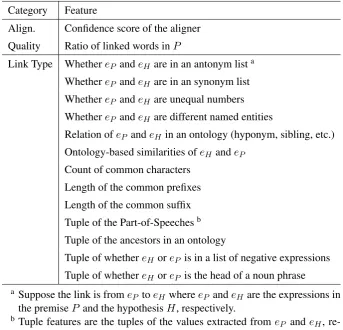
The conventional alignment-based RTE method measures the quality of the alignment between the premise P and the hypothesis H to predict their entailment relation (Fig. 3a). An automated aligner is first learned from the annotation of itive links, the normal alignment consists of pos-itive links (see Sec. 3.1). Then this aligner pro-duces an alignment for each input (P, H). After that, a feature extractor measures the quality of the alignment. Finally a classifier utilizes these mea-sures as features to predict the entailment relation. Commonly used quality measurements for align-ment include the confidence score of the aligner and the ratio of linked words inP (Tab. 1).
4.2 RTE Method Based on Labeled Alignment
The augmented RTE method based on the labeled alignment not only measures the quality of the alignment, but also detects the signals of negative links to improve the prediction accuracy (Fig. 3b). The augmentation is conducted in two aspects. First, the aligner is trained with both positive and negative links, thus the produced alignment for each input (P,H) contains both positive and po-tentially negative links (but two types of links are not distinguished). Second, the feature extractor not only measures the quality of the alignment, but also analyzes the type of each link. A wide range of type-related features can be extracted from each link of the alignment (Tab. 1). These type-related features together with the quality-related features are added into a feature vector for classification.
(a) Synonym, hyponym and named entity
(b) Atonym (c) Mismatched numbers
(d) Different named entities (e) Head of noun phrase (f) Vital modifier
(g) Unmatched negation (h) Virtual modality verb (i) Non-happened event
[image:5.595.103.498.86.698.2](j) Hypothetical conjunction (k) Novel number (l) Novel content word
Aligner Feature Extractor
alignment
align. quality (features)
Classifier yes/no
machine learning (P, H)
Positive Link Annotation
(a) Baseline Method Based on Normal Alignment
Extended Aligner
(P, H) Extended
Feature Extractor alignment
align. quality link type (features)
Classifier yes/no
machine learning
Positive Link Negative Link
Annotation
Knowledge Base
[image:6.595.130.470.68.329.2](b) Proposed Method Based on Labeled Alignment Method Figure 3: Baseline and Proposed Alignment-based RTE methods
Category Feature
Align. Confidence score of the aligner
Quality Ratio of linked words inP
Link Type WhethereP andeH are in an antonym lista
WhethereP andeH are in an synonym list
WhethereP andeH are unequal numbers
WhethereP andeH are different named entities
Relation ofeP andeH in an ontology (hyponym, sibling, etc.)
Ontology-based similarities ofeH andeP
Count of common characters
Length of the common prefixes
Length of the common suffix
Tuple of the Part-of-Speechesb
Tuple of the ancestors in an ontology
Tuple of whethereH oreP is in a list of negative expressions
Tuple of whethereH oreP is the head of a noun phrase
a Suppose the link is frome
P toeH whereeP andeH are the expressions in the premiseP and the hypothesisH, respectively.
bTuple features are the tuples of the values extracted frome
P andeH, re-spectively.
[image:6.595.127.471.390.720.2]# Train. # Test. Ratio Posi.
RITE1 407 407 0.649
[image:7.595.99.262.63.93.2]RITE2 814 781 0.596
Table 2: Experimental Data Sets
pipeline method first employs a classifier to pre-dict whether each link is positive or negative, and then employs another classifier to predict the en-tailment relation based on the confidence scores of the first classifier.
5 Experiment
The data sets of the NTCIR-95 RITE16 and NTCIR-10 RITE2 shared tasks (simplified Chi-nese binary-class track) are taken as the experi-mental data sets(Shima et al., 2011; Watanabe et al., 2013). This section first describes the annotat-ing process of the labeled alignment, then presents the experimental settings and finally reports the experimental results.
5.1 Data Set Annotation
The data sets from the simplified Chinese binary-class tracks of 9 RITE1 and NTCIR-10 RITE2 contains 1,595 sentence pairs in all (Tab. 2). Note that all the training and test sam-ples of RITE1 are reused as the training samsam-ples of RITE2, while newly collected 781 sentence pairs are taken as the test samples.
The annotating process follows the methodol-ogy employed by (Brockett, 2007). The training set of NTCIR-9 RITE1 is used for training anno-tators, and three Chinese native-speaking under-graduates are actively encouraged to discuss the arising cases, resolve questions and reconcile re-sults with the authors. In annotating the test set of NTCIR-9 RITE1, however, they are first instructed not to discuss the annotations either with the au-thors or among themselves in order to measure an-notator agreement. After that, they reconcile the results on the test set with the authors.
The measure of annotator agreement indicates the alignment annotations are reliably consistent. All three annotators concurred on about 72% of proposed links on the test set, two out of three
5
NTCIR is the abbreviation of NII Test Collection for IR Systems where NII abbreviates the National Institute of In-formatics in Japan.
6RITE is the abbreviation of Recognizing Inference in
TExt.
agreed on about 24% of cases, and three-way dis-agreements were as rare as about 4%.
5.2 Experimental Settings
The supervised learning aligner described in (Chambers et al., 2007) and (MacCartney et al., 2008) is adopted in this paper. This aligner is a structured learning algorithm that employs a linear weighted scoring function to evaluate each candi-date alignment. We adapt the original algorithm from two aspects. First, the candidate alignment links are generated from a wide range of NLP analysis results, as follows,
• each segmented word in P → each seg-mented word inH;
• each syntactic node in P → each syntactic node inH;
• each NE inP →each NE inH;
• each expressioneP inP → each expression eH inHas long as (eP,eH) appears in a syn-onym list,a antsyn-onym list,or an ontology.
Second, the alignment-learning features contains all the link type features in Tab. 1. These two en-hancements, abstractly, convert aligning to a com-prehensive NLP process.
The BaseSeg toolkit based on the conditional random field is employed to segment the Chinese texts (Zhao et al., 2006). The Stanford factored parser, which is reported to be more accurate than the PCFG parsers (Klein and Manning, 2002), is employed to analyze the segmented Chinese text. The BaseNER toolkit is employed to recognize named entities (Zhao and Kit, 2008).
We take two Chinese ontologies – CiLin7 (Mei et al., 1983) and HowNet (Dong and Dong, 2003) – as the knowledge-base for extracting features. Three methods of computing the semantic simi-larity proposed in (Liu and Li, 2002; Xia, 2007) are employed.
We take the RBF-kernelled SVM as the entail-ment classifier. The impleentail-mentation of LibSVM is employed. The parameters are tuned through 5-fold cross-validation on the training set.
The conventional RTE method based on the nor-mal alignment, which is presented in Sec. 4.1, is taken as the baseline method.
Method Acc. on RITE1 Acc. on RITE2 Top entries 0.7764 (ICRC HITSZaRun03b) 0.6850 (MIG Run02)c
0.7617 (FudanNLP Run02) 0.6812 (CYUT Run03) 0.7568 (ICRC HITSZ Run02) 0.6658 (WHUTE Run02) 0.7469 (FudanNLP Run01) 0.6581 (MIG Run01) 0.7371 (WHUTE Run03) 0.6479 (WHUTE Run01) normal align. (baseline) 0.7715 0.6991
labeled align. (proposed) 0.8129 0.7465
aTeam ID;
[image:8.595.133.466.60.193.2]bRun ID. Each team can submit the results of five runs at most. cThe top entry is the proposed method, thus not listed.
Table 3: Entailment Prediction Accuracy on NTCIR-9 RITE and NTCIR-10 RITE2 Data Sets
5.3 Experimental Results
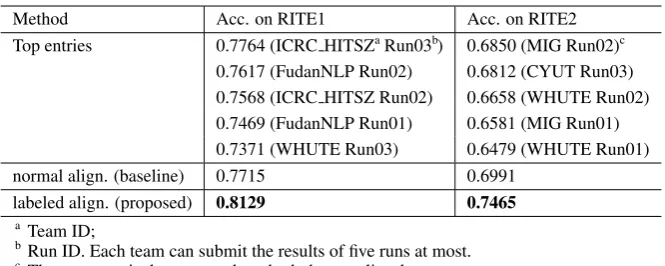
The experimental results of the prediction accu-racy on NTCIR-9 RITE1 and NTCIR-10 RITE2 data sets are presented at Tab. 3. The participants mainly employ committees of classifiers to learn from a wide range of features including multi-level similarities, occurrences of negative words, mismatches of named entities and numbers, syn-tactic correspondences, and so on (Zhang et al., 2011; Ren et al., 2011). The results show that the proposed RTE method outperforms not only the baseline method, but also the official entries of the shared tasks.
6 Conclusion and Future Work
In this paper, a labeled alignment scheme is pro-posed to address the shortage of the normal align-ment scheme for non-entailalign-ment RTE samples. To verify the proposed scheme, an augmented alignment-based RTE method that employs the la-beled alignment is compared with a conventional one that employs the normal alignment. The data sets of two shared RTE tasks are taken as the ex-perimental data sets and manually annotated with the proposed scheme. Experimental results indi-cate that the augmented RTE method outperforms not only the baseline method, but also all the sub-mitted systems of the shared tasks. Therefore, the proposed labeled alignment scheme proves to be effective.
The future work of this paper is two-fold. First, during the research, though two Chinese ontology resources – CiLin and HowNet – are employed to detect negative links, it is found that quite a few critical semantic relations are not covered. There-fore we plan to merge and scale existing Chi-nese ontologies through data mining techniques
such as (Liu and Singh, 2004). Second, the pro-posed method is actually applicable to multiple languages, though it is only tested on Chinese in this paper. We plan to apply it to other languages such as the Microsoft English RTE corpus in the future.
References
Ion Androutsopoulos and Prodromos Malakasiotis. 2009. A survey of paraphrasing and textual en-tailment methods. http://arxiv.org/abs/ 0912.3747. [accessed 10-Jan-2013].
Johan Bos and Katja Markert. 2005. Recognising tex-tual entailment with logical inference. In Proceed-ings of HLT-EMNLP, pages 628–635.
Chris Brockett. 2007. Aligning the RTE 2006 cor-pus. Microsoft Research Technical Report MSR-TR-2007-77.
Peter F Brown, Vincent J Della Pietra, Stephen A Della Pietra, and Robert L Mercer. 1993. The mathemat-ics of statistical machine translation: Parameter esti-mation. Computational Linguistics, 19(2):263–311.
Nathanael Chambers, Daniel Cer, Trond Grenager, David Hall, Chloe Kiddon, Bill MacCartney, Marie-Catherine de Marneffe, Daniel Ramage, Eric Yeh, and Christopher D Manning. 2007. Learning align-ments and leveraging natural logic. InProceedings of the ACL-PASCAL Workshop on Textual Entail-ment and Paraphrasing, pages 165–170.
Ido Dagan, Oren Glickman, and Bernardo Magnini. 2006. The PASCAL recognising textual entailment challenge. Machine Learning Challenges. Evaluat-ing Predictive Uncertainty, Visual Object Classifi-cation, and Recognising Tectual Entailment, pages 177–190.
Language Processing and Knowledge Engineering, pages 820–824. IEEE.
Andrew Hickl, John Williams, Jeremy Bensley, Kirk Roberts, Bryan Rink, and Ying Shi. 2006. Rec-ognizing textual entailment with LCC’s GROUND-HOG system. In Proceedings of the Workshop on the Second PASCAL Recognising Textual Entailment Challenge.
Dan Klein and Christopher D Manning. 2002. Fast ex-act inference with a fex-actored model for natural lan-guage parsing. Advances in neural information pro-cessing systems, 15(2003):3–10.
Milen Kouylekov, Alessio Bosca, and Luca Dini. 2011. EDITS 3.0 at RTE-7. Proceedings of the Seventh PASCAL Recognizing Textual Entailment Challenge.
Qun Liu and Su Jian Li. 2002. Computation of seman-tical similarity for phrases based on HowNet (in Chi-nese). Chinese Computational Linguistics, 7(2):59– 76.
Hugo Liu and Push Singh. 2004. Conceptnet – a prac-tical commonsense reasoning tool-kit. BT technol-ogy journal, 22(4):211–226.
Bill MacCartney, Trond Grenager, Marie-Catherine de Marneffe, Daniel Cer, and Christopher D. Man-ning. 2006. Learning to recognize features of valid textual entailments. InProceedings of HLT-NAACL, pages 41–48.
Bill MacCartney, Michel Galley, and Christopher D Manning. 2008. A phrase-based alignment model for natural language inference. In Proceedings of EMNLP’08, pages 802–811.
Erwin Marsi and Emiel Krahmer. 2005. Classifica-tion of semantic relaClassifica-tions by humans and machines. In Proceedings of the ACL workshop on Empirical Modeling of Semantic Equivalence and Entailment, pages 1–6.
Yashar Mehdad. 2009. Automatic cost estimation for tree edit distance using particle swarm optimization. InProceedings of ACL-IJCNLP, pages 289–292.
Jia Ju Mei, Yi Ming Zhu, and Yun Qi Gao. 1983.
TongYiCi CiLin. Shanghai Dictionary Publisher.
Franz Josef Och and Hermann Ney. 2003. A sys-tematic comparison of various statistical alignment models. Computational Linguistics, 29(1):19–51.
Sebastia Pad´o, Michel Galley, Dan Jurafsky, and Chris Manning. 2009. Robust machine translation eval-uation with entailment features. In Proceedings of ACL-IJCNLP, pages 297–305.
Han Ren, Chen Lv, and Donghong Ji. 2011. The WHUTE system in NTCIR-9 RITE task. In Pro-ceedings of NTCIR-9 Workshop Meeting, Tokyo, Japan.
Miguel Rios and Alexander Gelbukh. 2012. Recogniz-ing textual entailment with a semantic edit distance metric. In11th Mexican International Conference on Artificial Intelligence,, pages 15–20. IEEE.
Mark Sammons, VG Vydiswaran, and Dan Roth. 2010. Ask not what textual entailment can do for you... InProceedings of ACL’10, pages 1199–1208.
Hideki Shima, Hiroshi Kanayama, Cheng-Wei Lee, Chuan-Jie Lin, Teruko Mitamura, Yusuke Miyao, Shuming Shi, and Koichi Takeda. 2011. Overview of NTCIR-9 RITE: Recognizing inference in text. In
Proceedings of NTCIR-9 Workshop Meeting, Tokyo, Japan.
Alexander Volokh and G¨unter Neumann. 2011. Us-ing MT-based metrics for RTE. In Proceedings of the Seventh PASCAL Recognizing Textual Entail-ment Challenge.
Rui Wang and Yi Zhang. 2009. Recognizing textual relatedness with predicate-argument structures. In
Proceedings of the 2009 Conference on Empirical Methods in Natural Language Processing: Volume 2, pages 784–792. ACL.
Yotaro Watanabe, Junta Mizuno, Eric Nichols, Kat-suma Narisawa, Keita Nabeshima, Naoaki Okazaki, and Kentaro Inui. 2012. Leveraging diverse lexical resources for textual entailment recognition. ACM Transactions on Asian Language Information Pro-cessing, 11(4):18.
Yotaro Watanabe, Yusuke Miyao, Junta Mizuno, To-mohide Shibata, Hiroshi Kanayama, CHeng-Wei Lee, Chuan-Jie Lin, Shuming Shi, Teruko Mita-mura, Noriko Kando, Hideki Shima, and Kohichi Takeda. 2013. Overview of the Recognizing Infer-ence in Text (RITE-2) at the NTCIR-10 Workshop. InProceedings of NTCIR-10.
Tian Xia. 2007. Research on the computation of se-mantical similarity for Chinese phrases (in Chinese).
Computer Engineering, 33(6):191–194.
Yaoyun Zhang, Jun Xu, Chenlong Liu, Xiaolong Wang, Ruifeng Xu, Qingcai Chen, Xuan Wang, Yong-shuai Hou, and Buzhou Tang. 2011. ICRC HITSZ at RITE: Leveraging multiple classifiers voting for textual entailment recognition. In Proceedings of NTCIR-9 Workshop Meeting, Tokyo, Japan.
Hai Zhao and Chunyu Kit. 2008. Unsupervised segmentation helps supervised learning of charac-ter tagging for word segmentation and named entity recognition. In Proceedings of the Sixth SIGHAN Workshop on Chinese Language Processing, pages 106–111.